TagSea-Tac Communities Plan(215)
-
 1982-01-07
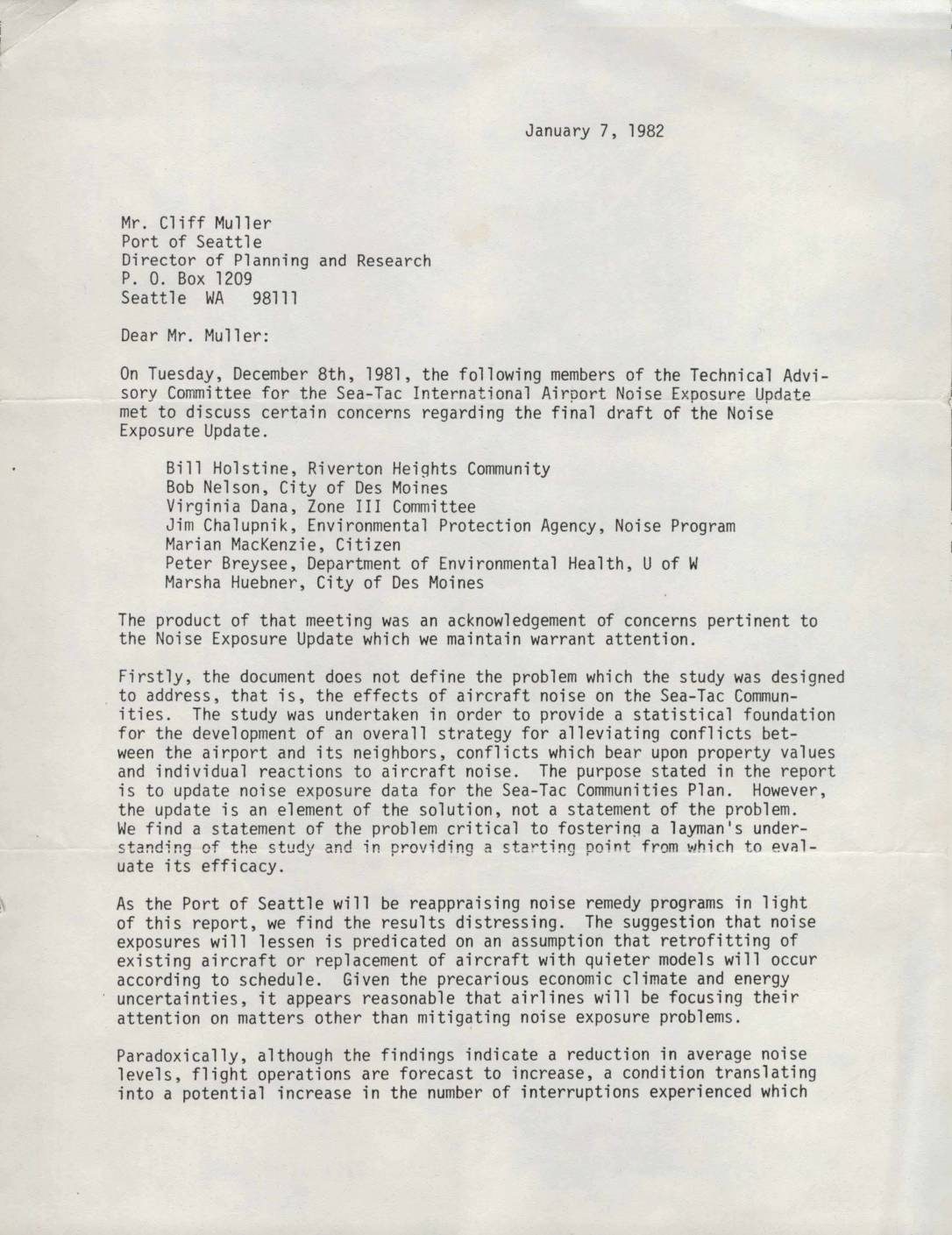
Letter to Cliff Muller, Port Of Seattle, from Technical Advisory Committee Re: Sea-Tac Noise Exposure Update Concerns
In January 1982, members of the Technical Advisory Committee for the Sea-Tac International Airport Noise Exposure Update wrote to the Port of Seattle's Director of Planning and Research to raise concerns about the final draft of the noise study. The letter argues that the report fails to clearly define the problem of aircraft noise impacts on surrounding communities, relies on optimistic assumptions about airlines adopting quieter aircraft, and uses an average noise level methodology that does not capture how residents actually experience flight disruptions. The committee also expressed frustration that their technical input and unanswered questions were largely ignored, despite their role being cited in the report as evidence of public participation. -
 1981-12-16
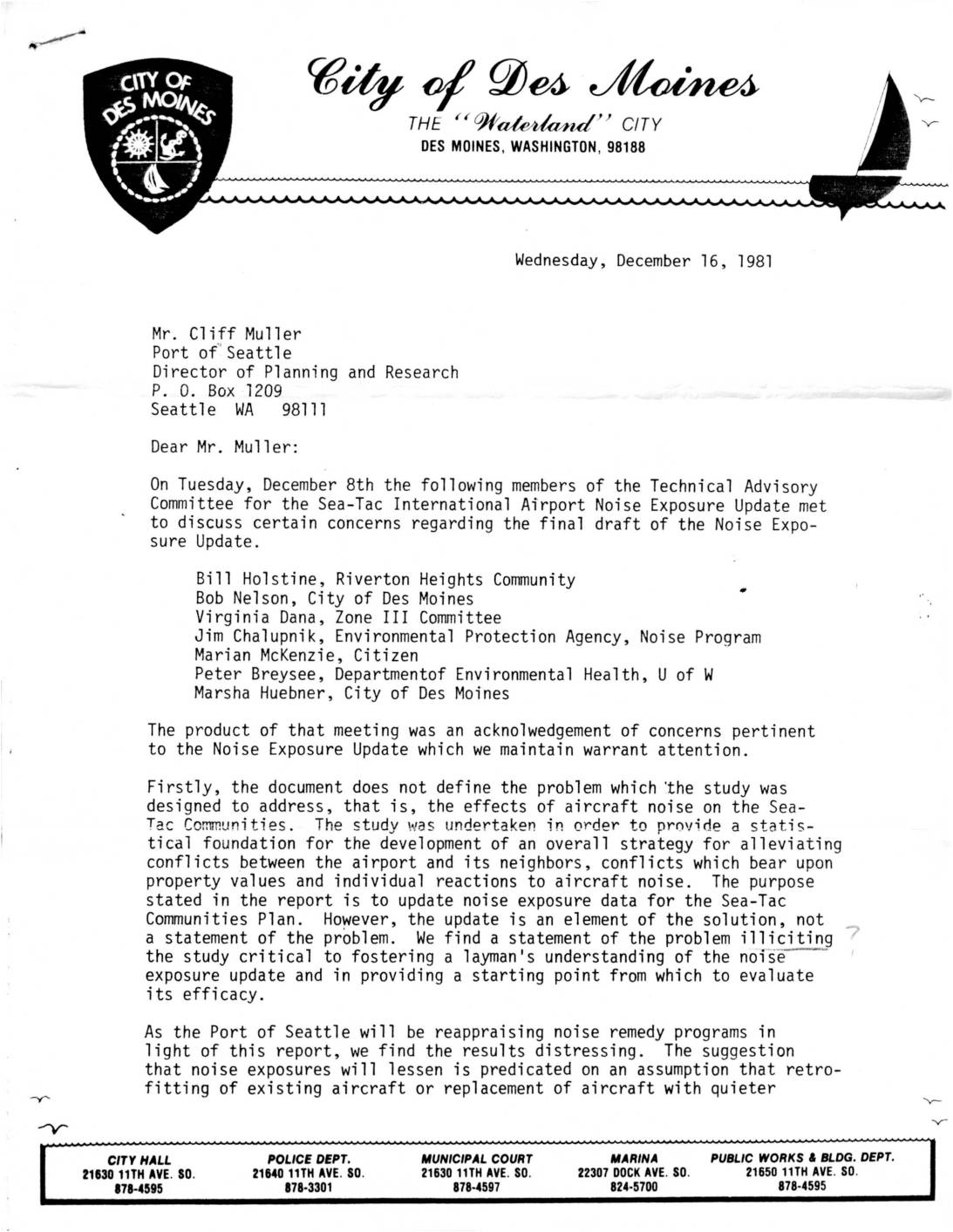
Letter from City of Des Moines to Port Of Seattle Regarding Noise Exposure Update Concerns
In this December 1981 letter, members of the Technical Advisory Committee for the Sea-Tac International Airport Noise Exposure Update write to the Port of Seattle's Director of Planning and Research to raise concerns about the final draft of the noise study. They argue that the report fails to define the core problem of aircraft noise impacts on surrounding communities, relies on optimistic assumptions about quieter aircraft that may not materialize, and uses an average noise level methodology that does not reflect how residents actually experience noise. The committee also expresses frustration that their technical input was largely ignored, and that their participation appeared to serve mainly as a formality to meet public participation requirements. -
 1980-11-04
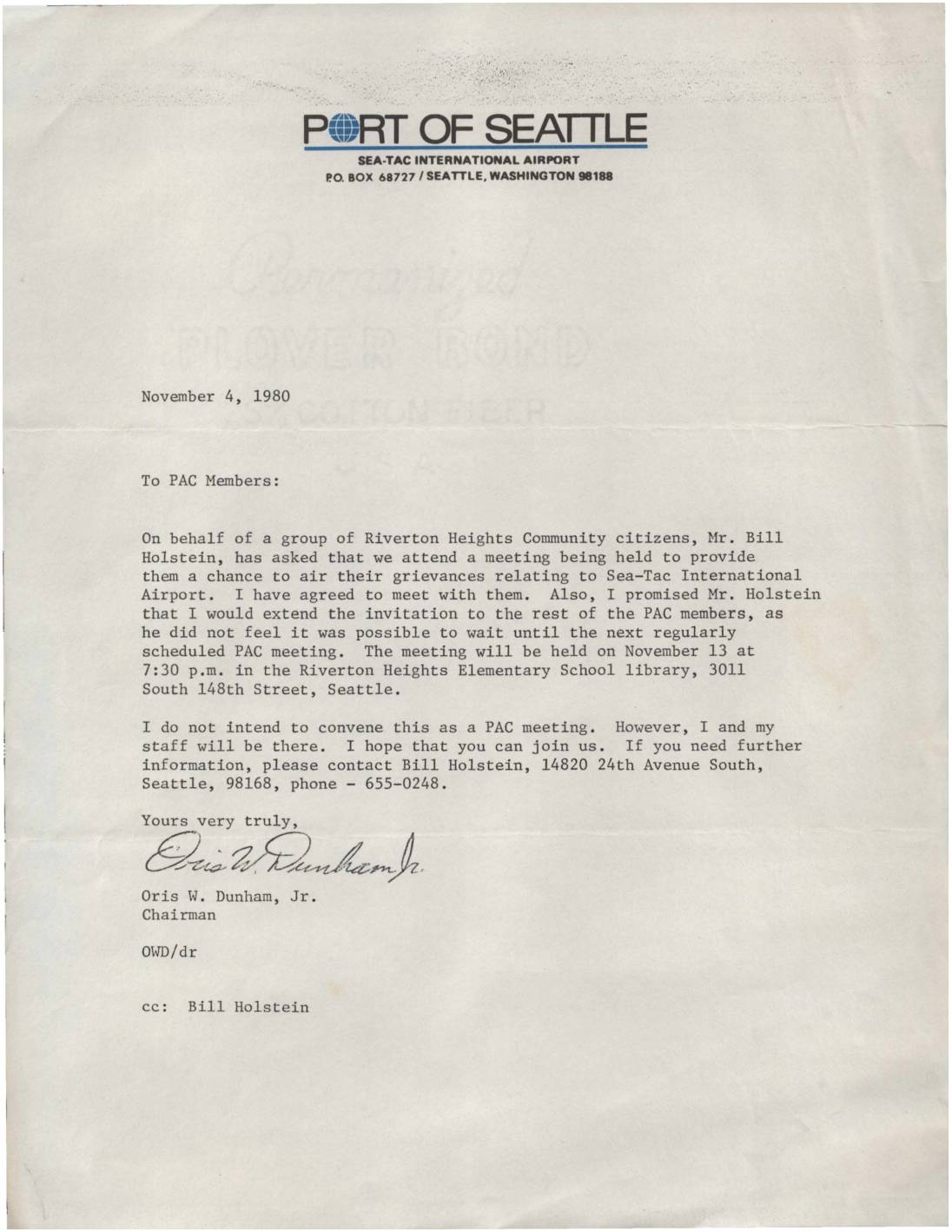
Letter from Oris Dunham to PAC Members: Riverton Heights Community Meeting on Sea-Tac Airport Grievances
In this November 4, 1980 letter, Port of Seattle PAC Chairman Oris W. Dunham, Jr. invites PAC members to a community meeting requested by Riverton Heights residents to air their grievances about Sea-Tac International Airport. The meeting was scheduled for November 13, 1980, at 7:30 p.m. at Riverton Heights Elementary School library in Seattle. Dunham clarified the gathering would not be an official PAC meeting, but that he and his staff would attend. -
 1980-09-17
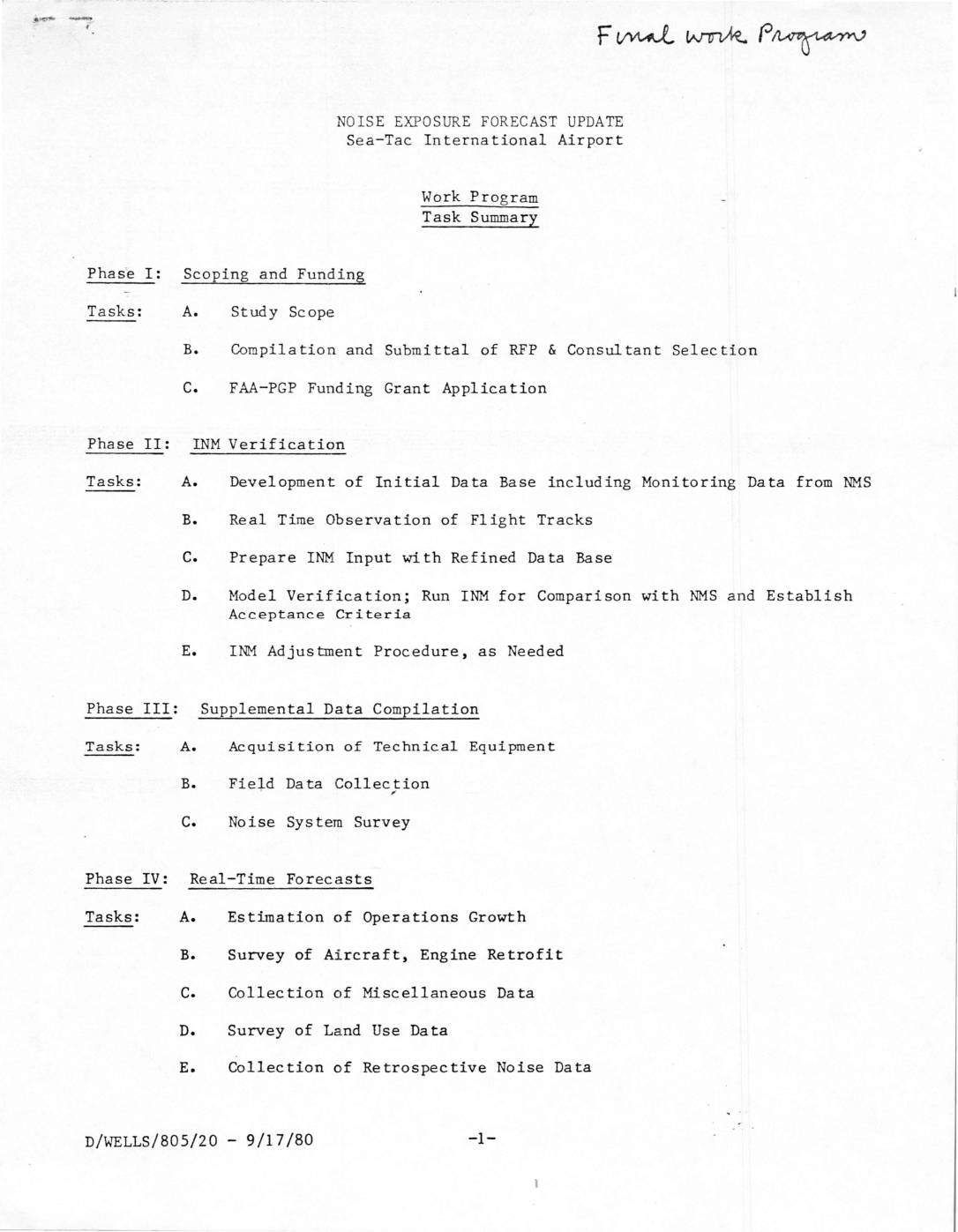
Noise Exposure Forecast Update Work Program Task Summary: Sea-Tac International Airport
This document outlines the work program for a Noise Exposure Forecast Update at Sea-Tac International Airport, dated September 17, 1980. The program is divided into six phases covering study scoping and funding, INM (Integrated Noise Model) verification, supplemental data collection, real-time forecasting, report generation, and public/administrative involvement. It details specific tasks, staff assignments, and procedures aimed at validating or revising noise impact programs developed under the Sea-Tac/Communities Plan, in compliance with the Aviation Safety and Noise Abatement Act of 1979. -
 1980-05-28
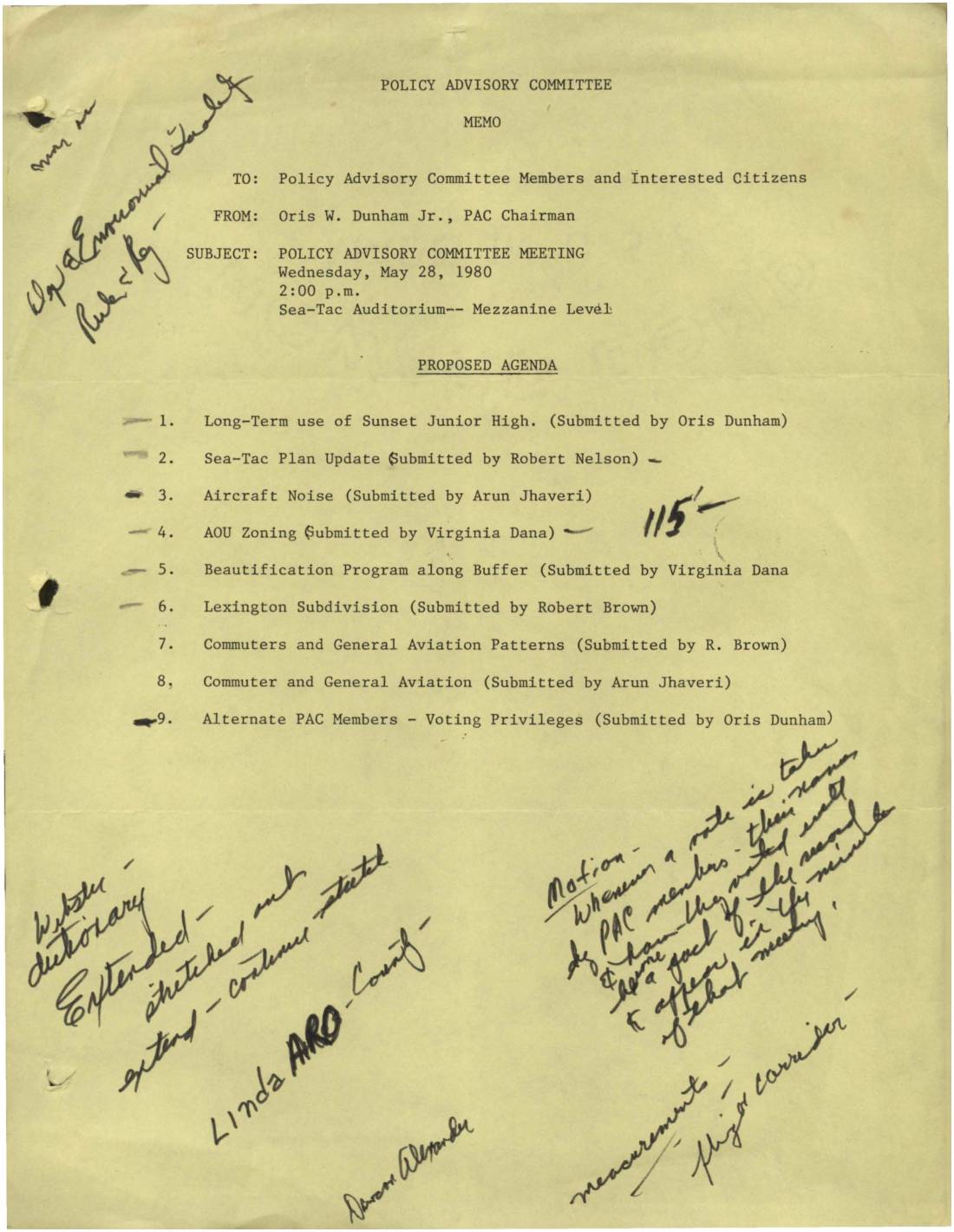
Policy Advisory Committee Meeting Agenda, May 28, 1980
This is a Policy Advisory Committee (PAC) meeting agenda memo from May 28, 1980, chaired by Oris W. Dunham Jr. and addressed to PAC members and interested citizens. The meeting, held at the Sea-Tac Airport Mezzanine, covered topics including aircraft noise, commuter and general aviation patterns, AOU zoning, and a beautification program along the airport buffer zone. Handwritten notes on the document suggest motions and discussions took place regarding PAC member voting privileges and flight path measurements. -
 1979-07-20
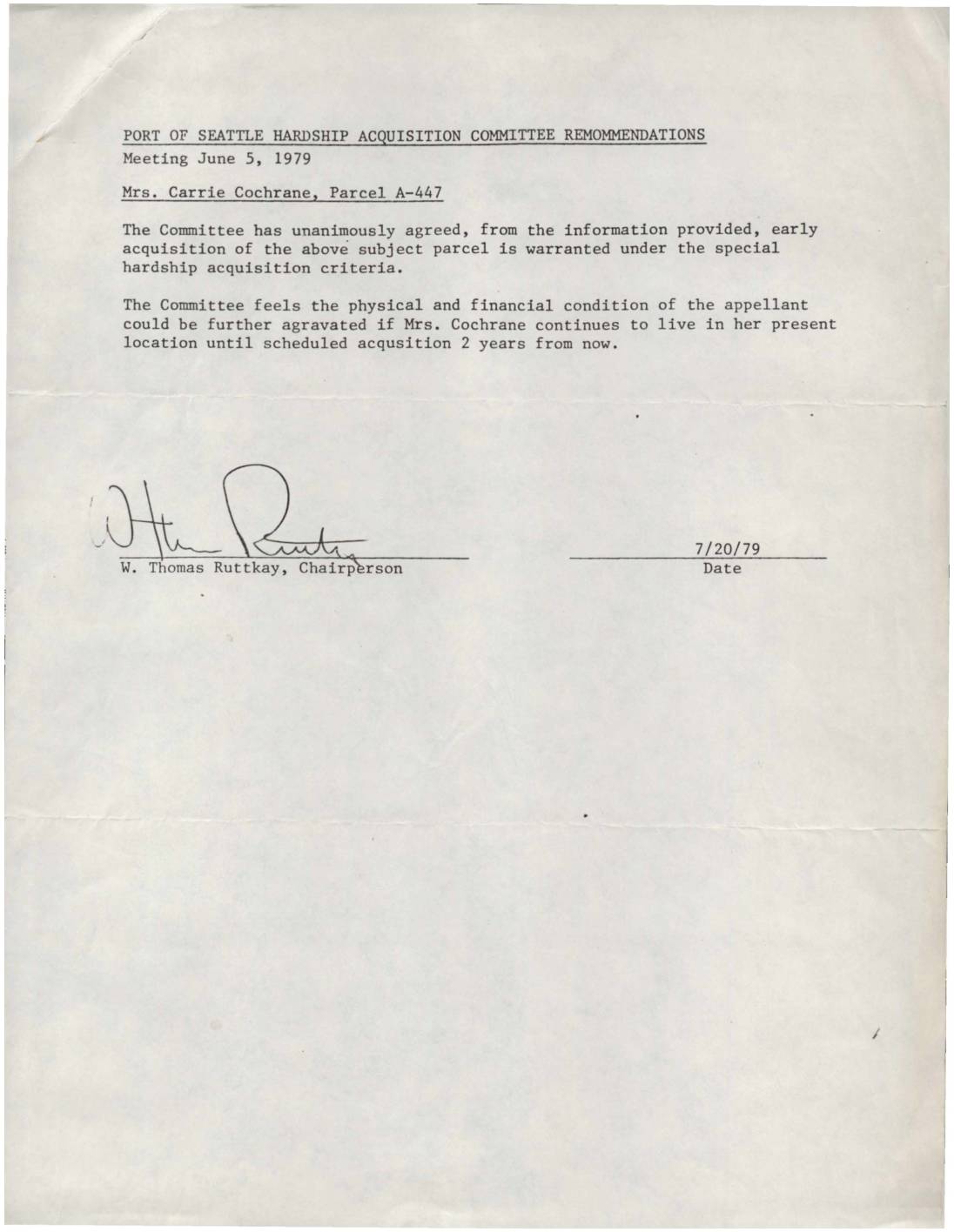
Port Of Seattle Hardship Acquisition Committee recommendations: Mrs. Carrie Cochrane, Parcel A-447
At a June 5, 1979 meeting, the Port of Seattle Hardship Acquisition Committee unanimously recommended the early purchase of Parcel A-447, owned by Mrs. Carrie Cochrane, under special hardship acquisition criteria. The Committee determined that Mrs. Cochrane's physical and financial condition could worsen if she remained in her current home until the regularly scheduled acquisition, approximately two years away. The recommendation was signed by Committee Chairperson W. Thomas Ruttkay on July 20, 1979. -
 1979-07-03
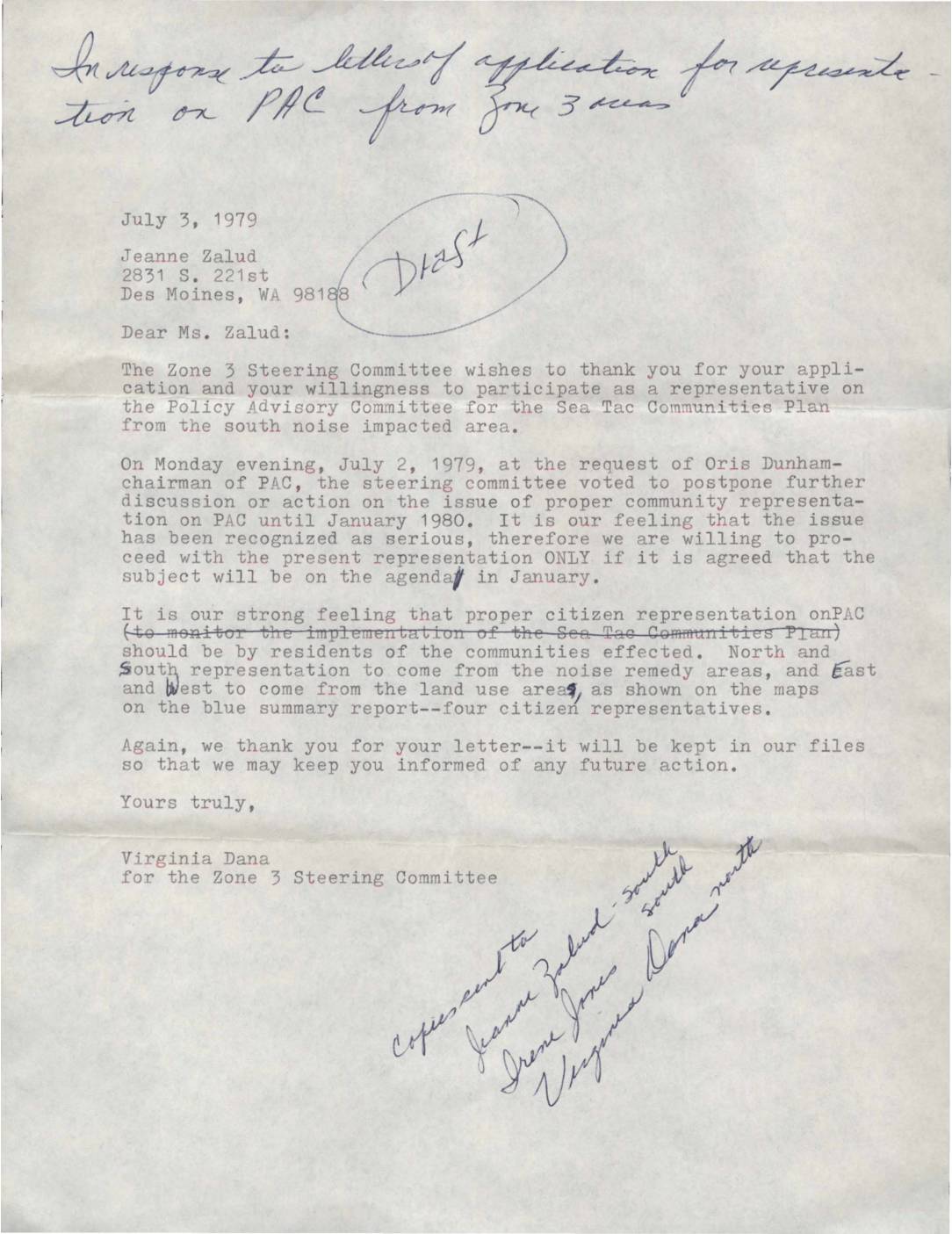
Zone 3 Steering Committee Letter to Jeanne Zalud Regarding PAC Application and Community Representation
In May 1979, Jeanne Zalud of Des Moines, WA applied to serve as a citizen representative on the Policy Advisory Committee (PAC) for the Sea-Tac Communities Plan, citing her community involvement and knowledge of the S.T.C.P. The Zone 3 Steering Committee responded in July 1979, acknowledging her application but informing her that further action on PAC representation had been postponed until January 1980. The committee expressed its position that proper citizen representation on the PAC should come from residents of the affected communities, with north and south representatives drawn from noise remedy areas and east and west from land use areas. -
 1979-04-10
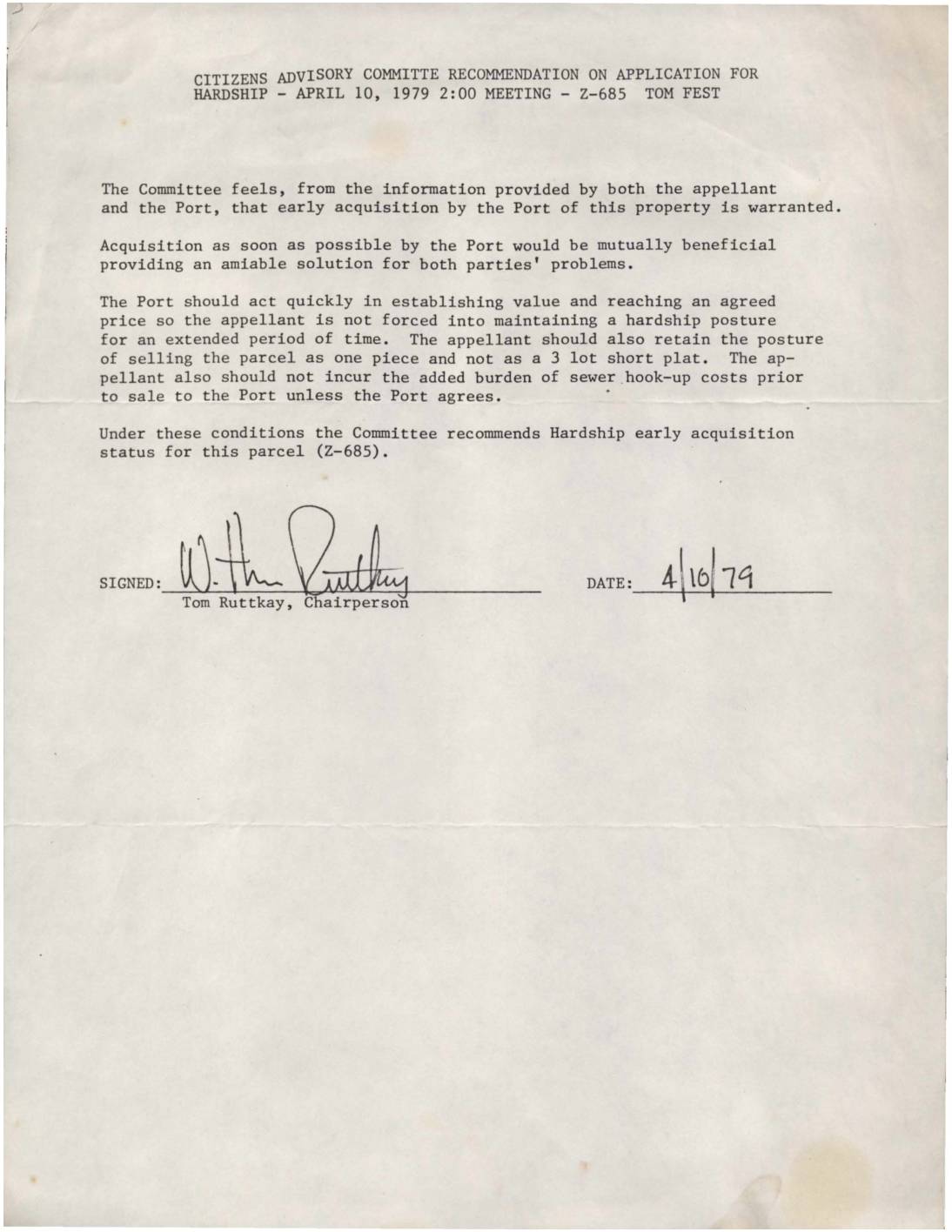
Citizens Advisory Committee Recommendation on Application for Hardship – Z-685 Tom Fest
In April 1979, the Citizens Advisory Committee recommended that the Port of Seattle pursue early acquisition of a property owned by Tom Fest (parcel Z-685) under hardship status. The Committee determined that a quick purchase would benefit both parties, urging the Port to promptly establish a fair price and the owner to sell the property as a single parcel rather than subdividing it into three lots. The recommendation also specified that the owner should not be required to pay sewer hook-up costs before the sale unless the Port agreed to them. -
 1979-03-05
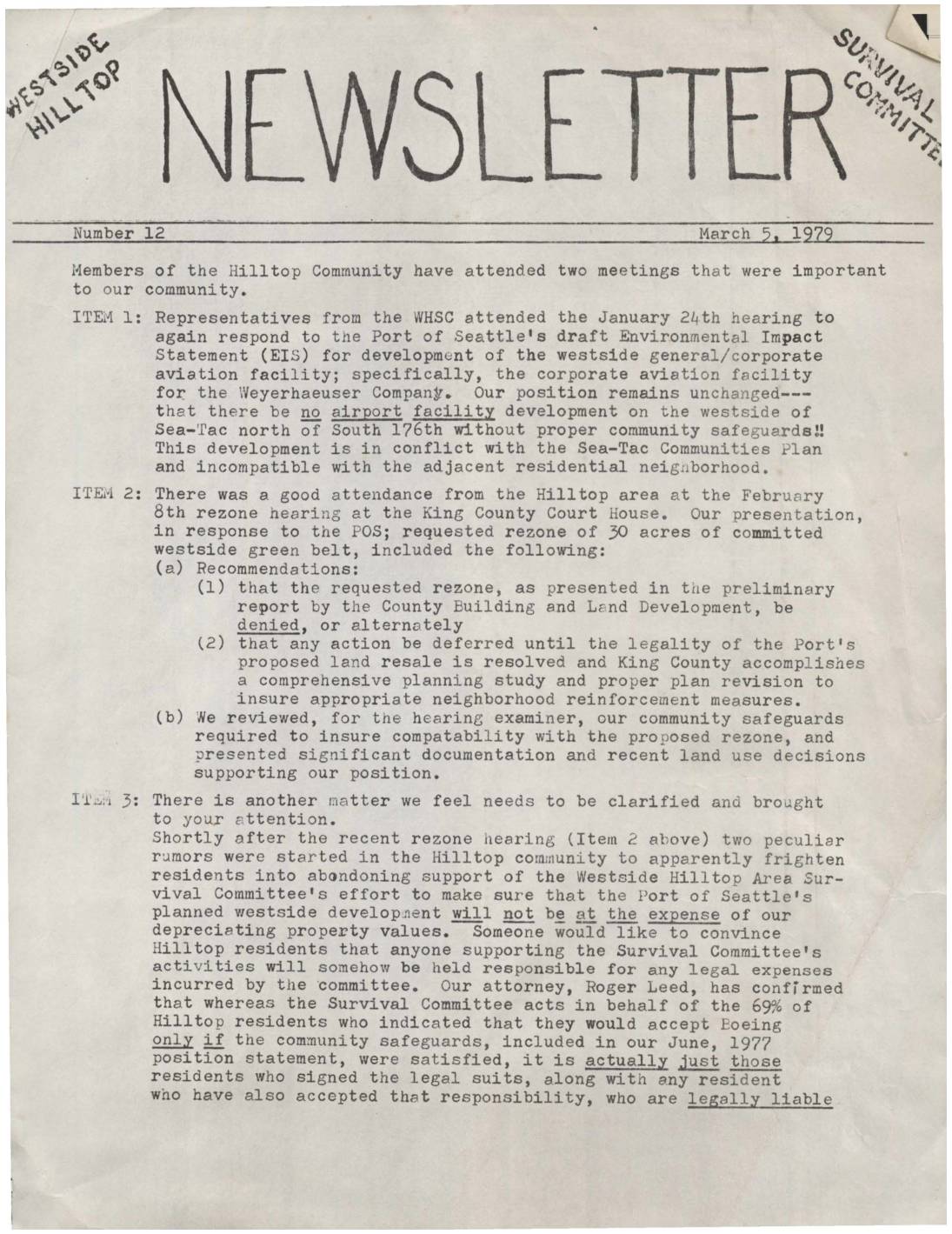
Westside Hilltop Survival Committee Newsletter, Number 12
This March 1979 newsletter from the Westside Hilltop Area Survival Committee (WHSC) updates Hilltop Community residents on two key hearings: one opposing the Port of Seattle's proposed corporate aviation facility north of South 176th Street, and another challenging a requested rezone of 30 acres of westside greenbelt land near Sea-Tac Airport. The committee reaffirms its position that no airport development should proceed without proper community safeguards, and addresses rumors about residents' legal liability for the committee's activities. The newsletter also notes that the State Legislature approved legislation allowing the Port of Seattle to extend the airport impact zone to include the Hilltop area. -
 1979-01-25
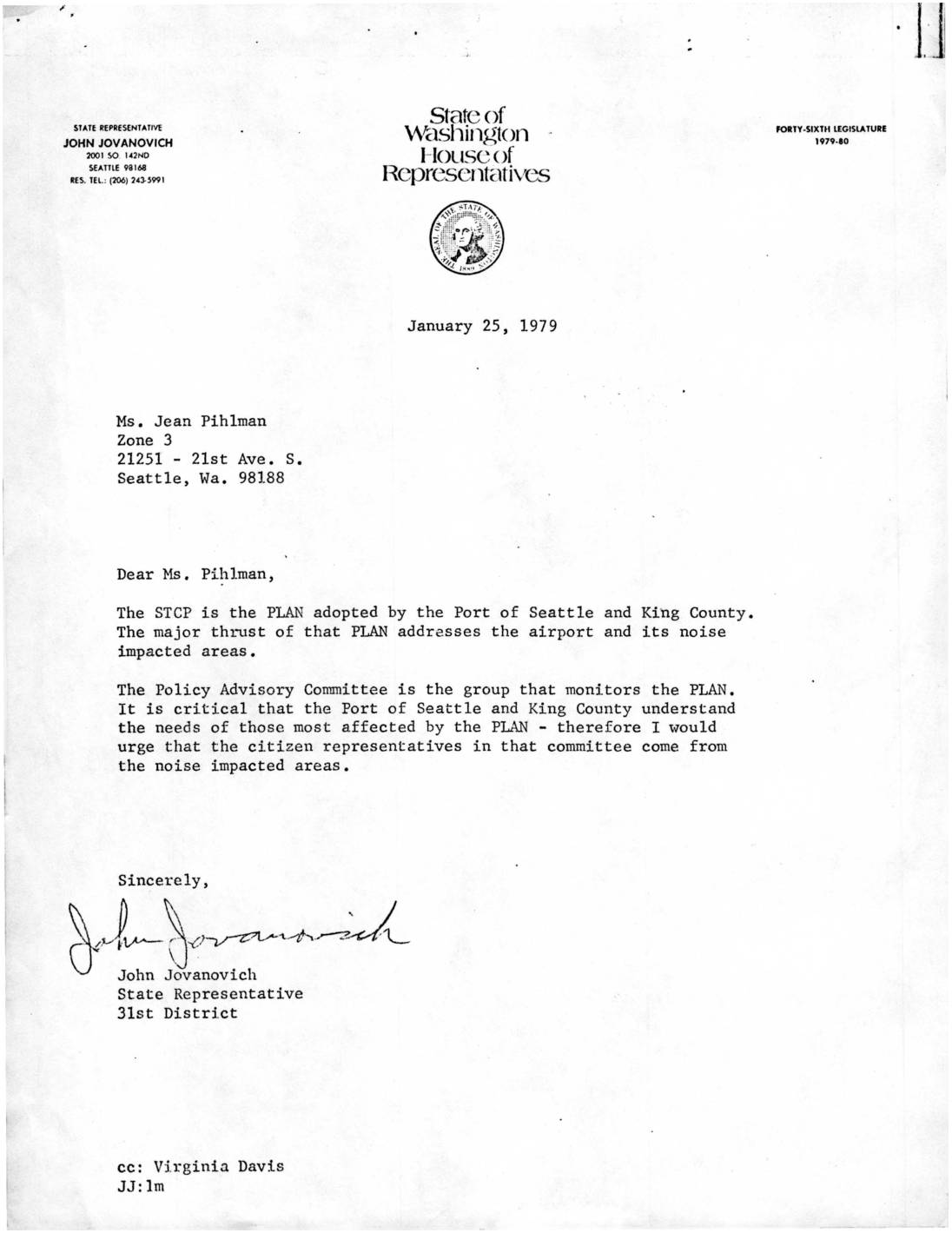
Letter from State Representative John Jovanovich to Jean Pihlman regarding STCP Policy Advisory Committee
In this January 25, 1979 letter, Washington State Representative John Jovanovich (31st District) writes to Ms. Jean Pihlman explaining that the Sea-Tac Comprehensive Plan (STCP), adopted by the Port of Seattle and King County, primarily addresses the airport and its noise-impacted areas. He urges that citizen representatives on the Policy Advisory Committee — the body responsible for monitoring the plan — should come directly from the noise-impacted communities, so that their needs are properly understood by decision-makers.