TagSea-Tac Airport(1835)
-
 2018-08-01
Sea-Tac International Airport Economic Impacts
This report, produced by Community Attributes Inc. for the Port of Seattle and revised in August 2018, analyzes the economic impacts of Seattle-Tacoma International Airport (Sea-Tac). It is included as Appendix K in a broader study covering socioeconomics and children's health topics related to airport operations. The findings are intended to inform decision makers about the airport's role in the regional economy and its effects on surrounding communities. -
 2018-07-19
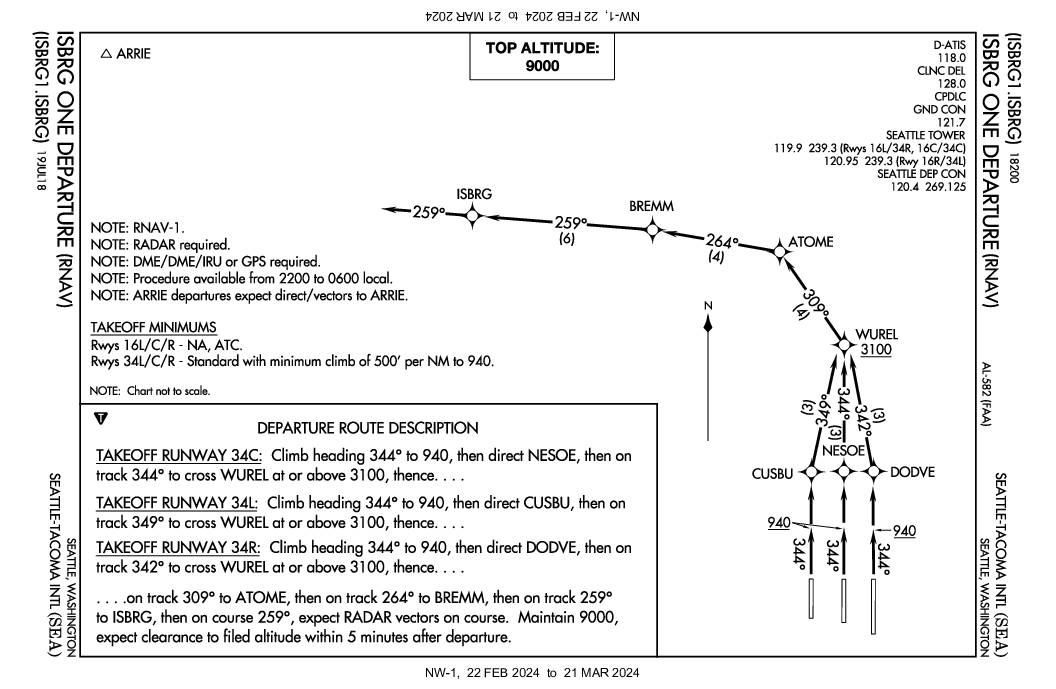
ISBRG One Departure (RNAV) Standard Instrument Departure Chart, Seattle-Tacoma International Airport
The ISBRG One Departure is an RNAV instrument departure procedure at Seattle-Tacoma International Airport (SEA) available only between 10 PM and 6 AM local time, designed to route departing aircraft on specific northwestward flight paths. Aircraft departing runways 34L, 34C, and 34R follow assigned headings and waypoints—climbing to 940 feet, then proceeding through fixes such as WUREL, ATOME, BREMM, and ISBRG—while maintaining a top altitude of 9,000 feet. The procedure's nighttime-only restriction and structured routing reflect noise-abatement considerations for communities surrounding the airport. -
 2018-07-11
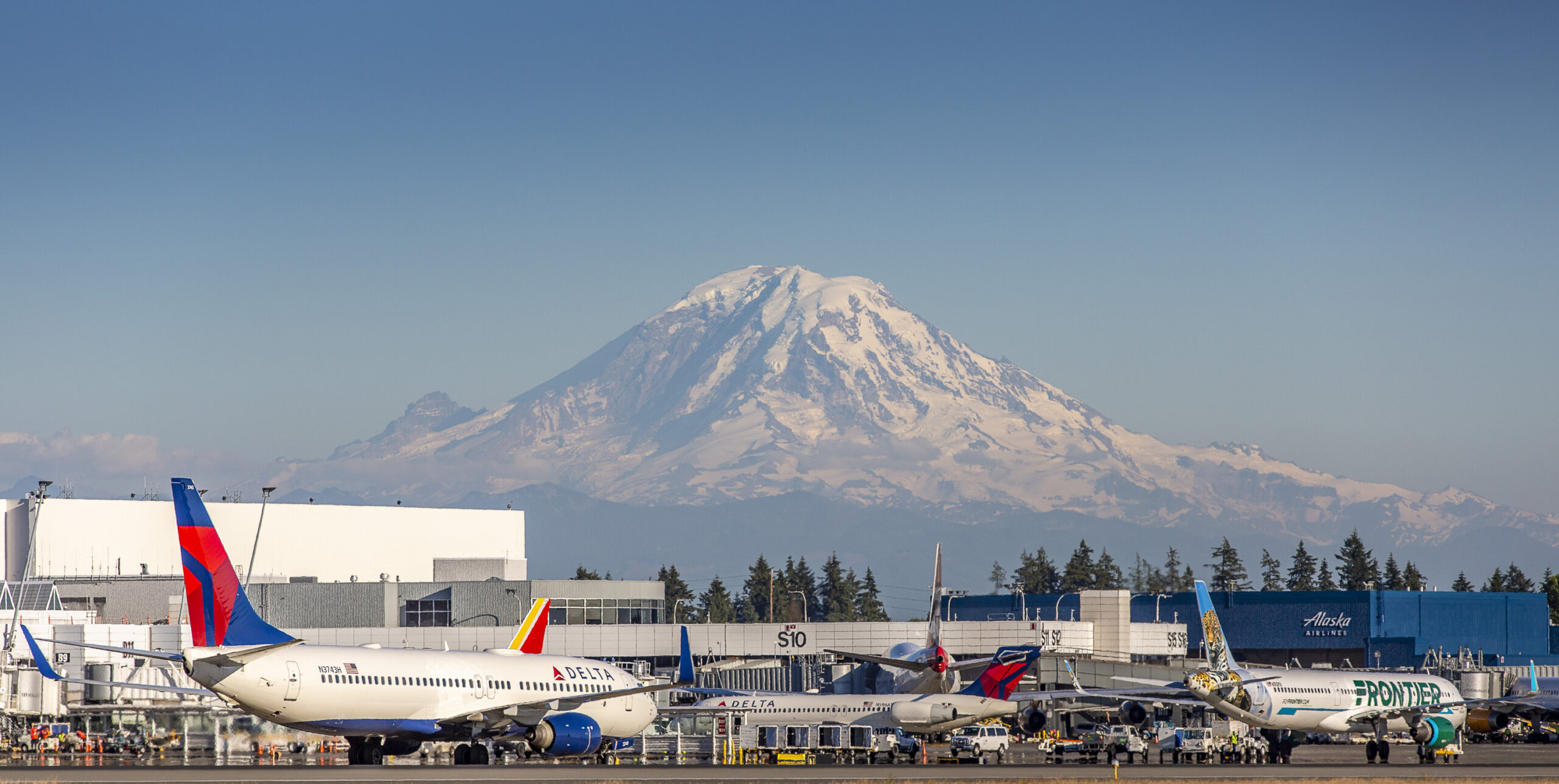
Delta aircraft operations at Sea-Tac, 11 July 2018 with Mount Rainier in background
Delta Air Lines and Frontier Airlines aircraft are parked at gates in the South Satellite (S10) concourse area of Seattle-Tacoma International Airport, with an Alaska Airlines facility visible at right. Mount Rainier dominates the background skyline, a characteristic view from Sea-Tac's airfield. -
 2018-07-01
Seattle-Tacoma International Airport Sustainable Airport Master Plan Near Term Projects: Environmental Review Process Scoping Information Packet
This scoping information packet, prepared by Landrum & Brown, Inc. for the Port of Seattle in July 2018, outlines the environmental review process for near-term projects under the Seattle-Tacoma International Airport Sustainable Airport Master Plan. It initiates the scoping phase, during which public and agency input is gathered to identify key environmental issues to be studied. The document serves as a foundational reference for understanding the scope and potential impacts of planned airport development projects. -
 2018-06-24
Declaration of Mary L. Vigilante in Opposition to Plaintiffs’ Amended Motion for Class Certification
Bearse v. Port Of Seattle -
 2018-05-30
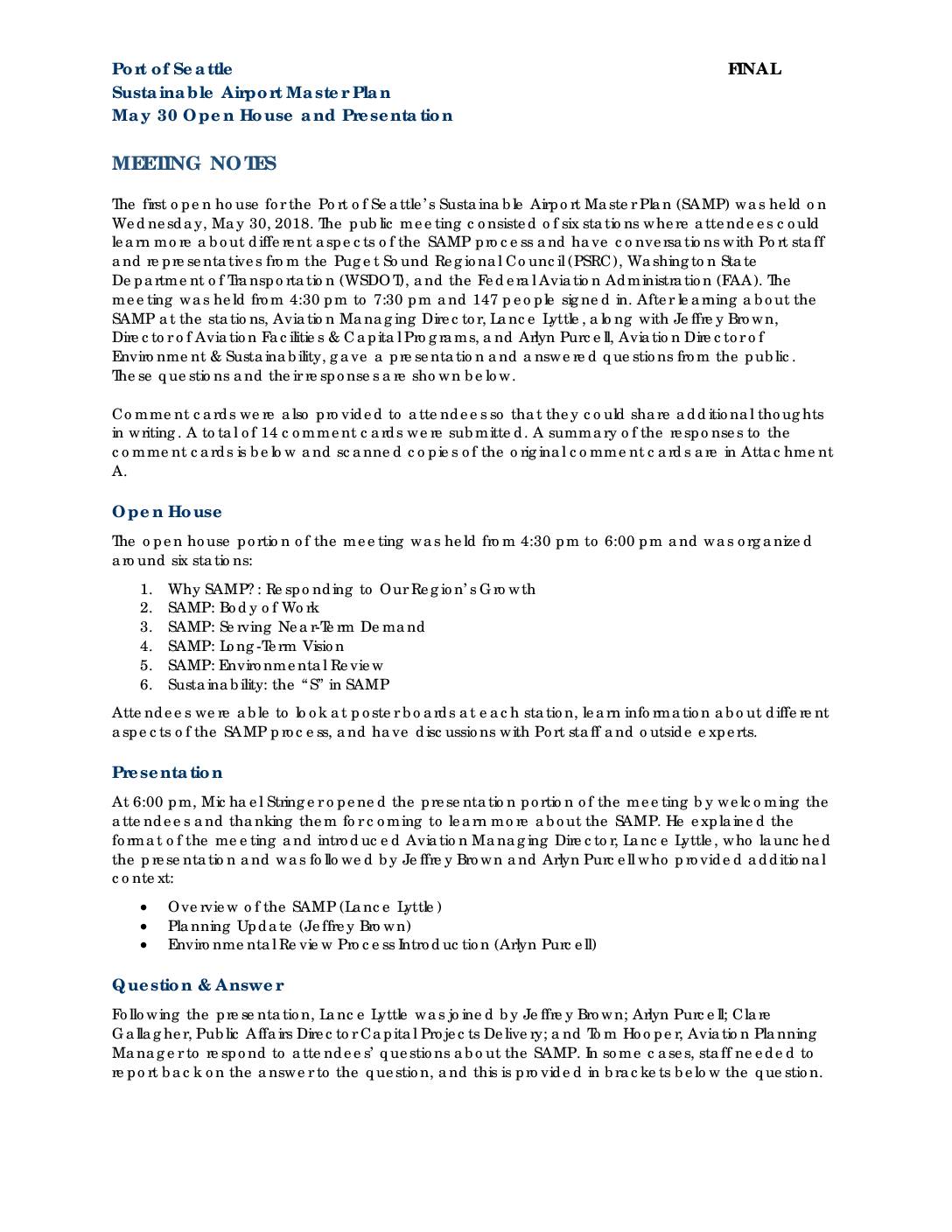
Sustainable Airport Master Plan May 30 open house and presentation meeting notes
On May 30, 2018, the Port of Seattle held its first public open house for the Sustainable Airport Master Plan (SAMP), drawing 147 attendees who discussed Sea-Tac Airport's projected growth to 56 million annual passengers and 480,000 aircraft operations by 2027. Community members raised concerns about noise, pollution, and the disproportionate impact on nearby low-income and minority communities, while Port officials explained limitations on controlling flight schedules and discussed noise mitigation efforts. The meeting notes document questions and answers covering topics such as cargo forecasts, flight pattern changes, the airport's physical footprint, and the possibility of distributing air traffic among other regional airports. -
 2018-05-23
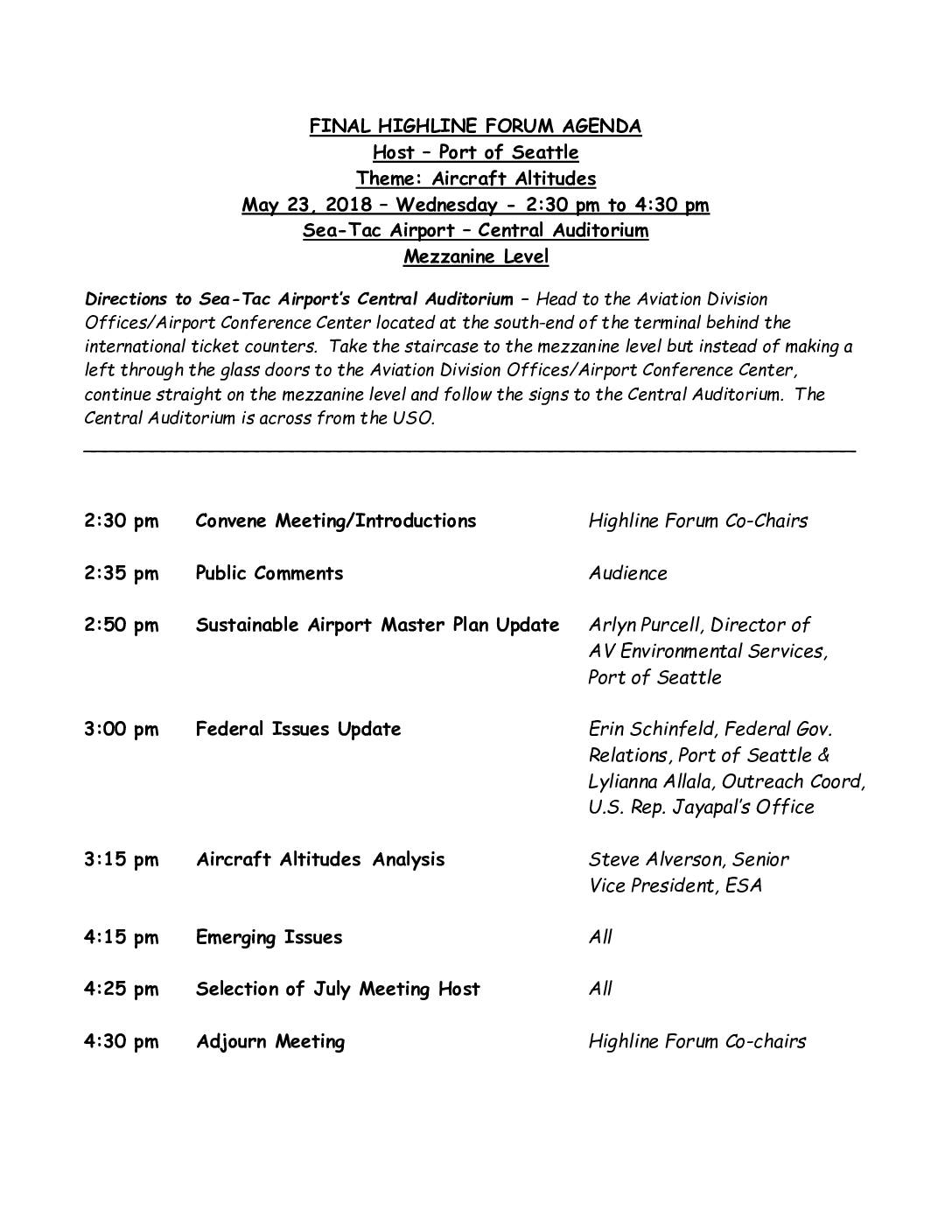
Final Highline Forum agenda: Aircraft altitudes
The Highline Forum held a public meeting on May 23, 2018, hosted by the Port of Seattle at Sea-Tac Airport's Central Auditorium, focusing on the theme of Aircraft Altitudes. The two-hour agenda included updates on the Sustainable Airport Master Plan and Federal Issues, as well as a one-hour Aircraft Altitudes Analysis presented by Steve Alverson, Senior Vice President of ESA. The meeting also allowed time for public comments and discussion of emerging issues related to airport noise and flight operations. -
 2018-05-23
Sea-Tac Airport Aircraft Arrival Altitude Analysis
This May 2018 draft report by ESA analyzes changes in aircraft arrival altitudes at Seattle-Tacoma International Airport across 2013, 2015, and 2017, examining how those changes relate to noise exposure for surrounding communities. Key findings from earlier meetings indicate that while overall arrival numbers increased and traffic flow direction remained stable, there was a notable shift in runway use from center runways to right and left runways, along with changes in the mix of narrow-body and wide-body aircraft types serving the airport. -
 2018-05-15
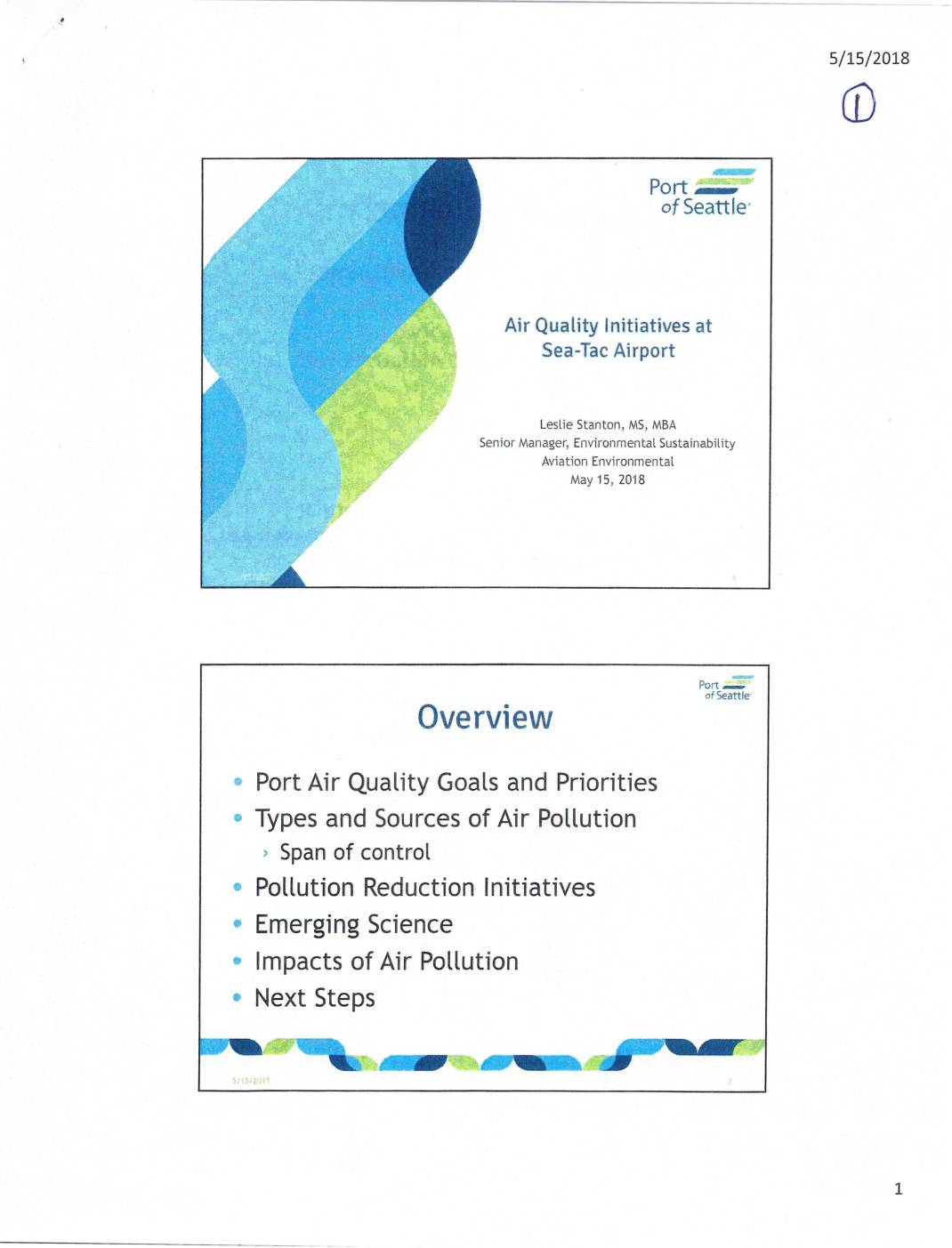
Air quality initiatives at Sea-Tac Airport
This 2018 presentation by Port of Seattle Senior Manager Leslie Stanton outlines air quality initiatives at Sea-Tac Airport, covering the types and sources of air pollution including greenhouse gases and regulated pollutants such as NOx, SOx, and particulate matter. It highlights efforts to reduce emissions through clean vehicle programs, including Sea-Tac's distinction as the first US airport to require green taxis and green TNCs, conversion of CNG buses to electric, and expanded EV charging infrastructure. The presentation also addresses passenger ground transportation planning aimed at improving public transit access and reducing the airport's overall environmental footprint. -
 2018-05-14
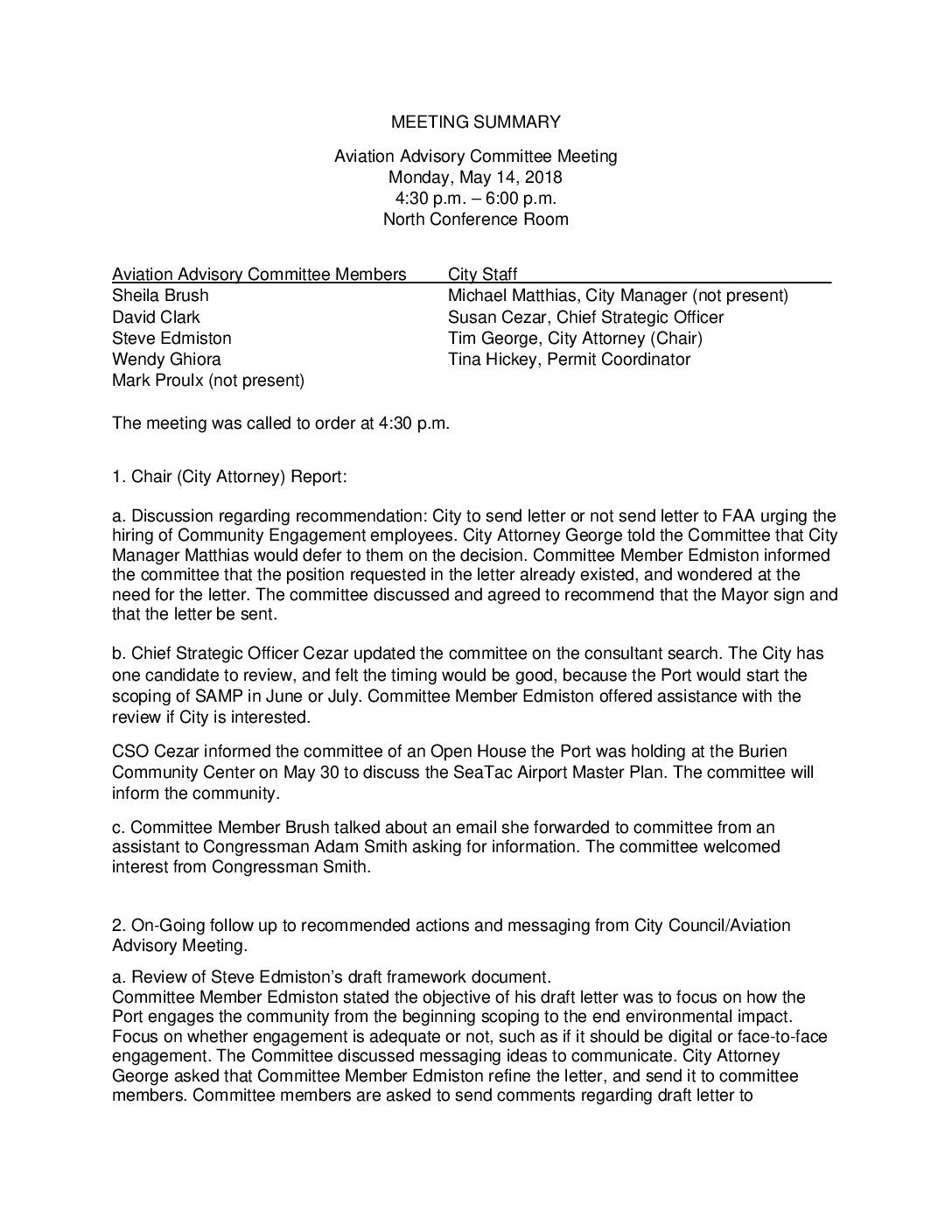
Aviation Advisory Committee Meeting Minutes — May 14, 2018
The Des Moines Aviation Advisory Committee met on May 14, 2018 to discuss several Sea-Tac Airport-related issues, including a recommendation to send a letter to the FAA urging the hiring of Community Engagement employees, an update on the city's consultant search ahead of the Port's Strategic Airport Master Plan (SAMP) scoping process, and a review of a draft framework letter focused on improving community engagement throughout the environmental impact process. The committee also discussed Hush House noise-reduction technology potentially coming to Sea-Tac Airport and noted upcoming events including a Port-hosted Open House on the Airport Master Plan and a Noise 101 workshop for START members.