Skip to content
  • STNI
  • Statistics
    • Ops and Passengers
      • King County International Airport (Boeing Field) Annual Operations
    • Financials
    • Aviation fuel uplift in the State of Washington 2018 – 2025
      • Aviation Fuel Tax Revenue in the State of Washington 1983-2025
      • Aviation Fuel Uplift at Sea-Tac Airport
    • Air Quality Monitoring
    • Flight Tracking
      • Flow and Flight Tracks
      • Five Year Comparison
      • Busiest Hours and Days
    • SEL Noise Reports & Graphs
      • About The Permanent Noise Monitors
      • Minutes of Quiet by Noise Monitor
      • Noise Events mapped
      • Noise Events (SEL)
    • Runways
    • Employees
    • Real Estate
      • Port Properties and Trees mapped
    • Parking
  • Events
  • Protest
    • Regular Events
    • Policy
      • Legislative Agenda 2027
      • Airport mitigation for the twenty first century
      • Port Dracula
    • Complain about a particular flight
    • Advocacy Organizations
    • Media Outlets
    • People
    • The Port of Seattle
      • Commission Meetings
      • Public Records Requests
      • StART
      • Highline Forum
    • Contact Your Electeds
  • Resources
    • FAQs
      • FAA Occurrences/Accidents/Indents
    • The SAMP
      • SAMP Public Comment Template
        • Two versions of Appendix K: NEPA/SEPA 2018 vs 2023
      • SAMP NTP: 31 projects by the numbers
      • SEPA Draft EIS (2026)
      • SAMP Record of Decision/FONSI (2025)
      • SAMP Draft EA (October 2024)
      • 2018 Scoping
    • Port Packages
      • Port Package Property Costs
      • Port Packages mapped
      • The Port Package Explainer
      • So you want a (first-time) Port Package? Start here
      • Port Package Looker Upper
      • How do I determine if I have a Port Package or Avigation Easement?
      • Progress on Port Package Update legislation
      • Having a Port Package Problem?
      • Port Package Site Visit Follow-Up
    • Document Library
    • Explainers
      • The Airport Law Cheat Sheet
      • The Grant Explainer
    • External Articles
    • History
      • Timeline
      • The Sea-Tac Communities Plan
        • Sea-Tac Communities Plan – Planning Maps
      • PSRC Third Runway Decision Process
    • Studies
    • Videos
  • Stories
  • Mission
  • Subscribe
  • Contact
Scroll down to content

Get InformedStay Informedx

I understand that you will never share my information with anyone, you will only use it to keep me updated on relevant events and that I may unsubscribe at any time.

STNI

STNISea-Tac Noise.Info

  • Solve for Sea-Tac. Solve for every airport.
  • Since 2016, working to obtain justice for everyone living under the flight path.
  • Less Noise. Cleaner Air. Better Public Health. Compensation.
  • Everything you think you know about the airport is wrong.

TagRCAA(206)

Advanced Search Options

  • Dates
  • Media
    • External Articles
    • Images
    • PDFs
    • Video
    • Audio
  • Order By
  • 2003-05-16

    Fly Quiet Committee Report: Port Introduces Fly Quiet Committee at Seattle-Tacoma International Airport, Third Quarter 2002

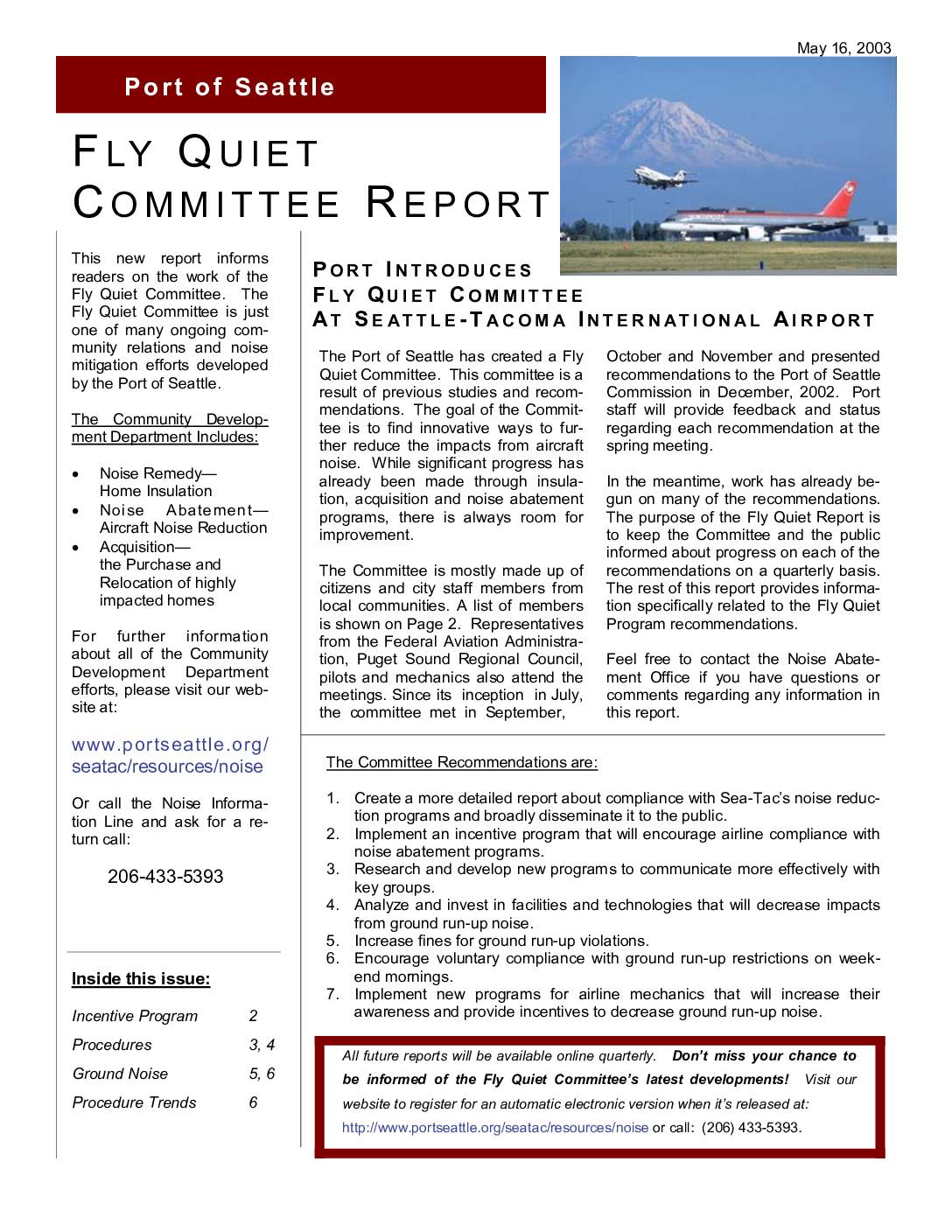
    The Port of Seattle introduced the Fly Quiet Committee at Seattle-Tacoma International Airport to find innovative ways to reduce aircraft noise impacts on surrounding communities. The committee, made up of local citizens, city staff, and aviation representatives, developed seven key recommendations including creating detailed compliance reports, launching an airline incentive program modeled after Chicago O'Hare's point-based system, and addressing ground run-up noise through increased fines and new technologies. The report also outlines existing noise abatement flight procedures governing how aircraft depart and arrive at Sea-Tac to minimize noise over residential areas.
    TagsFly Quiet, Fly Quiet Committee, Noise Abatement Procedures, Port Of Seattle, RCAA, Sea-Tac AirportFolderFlyers
  • 2003-04-21

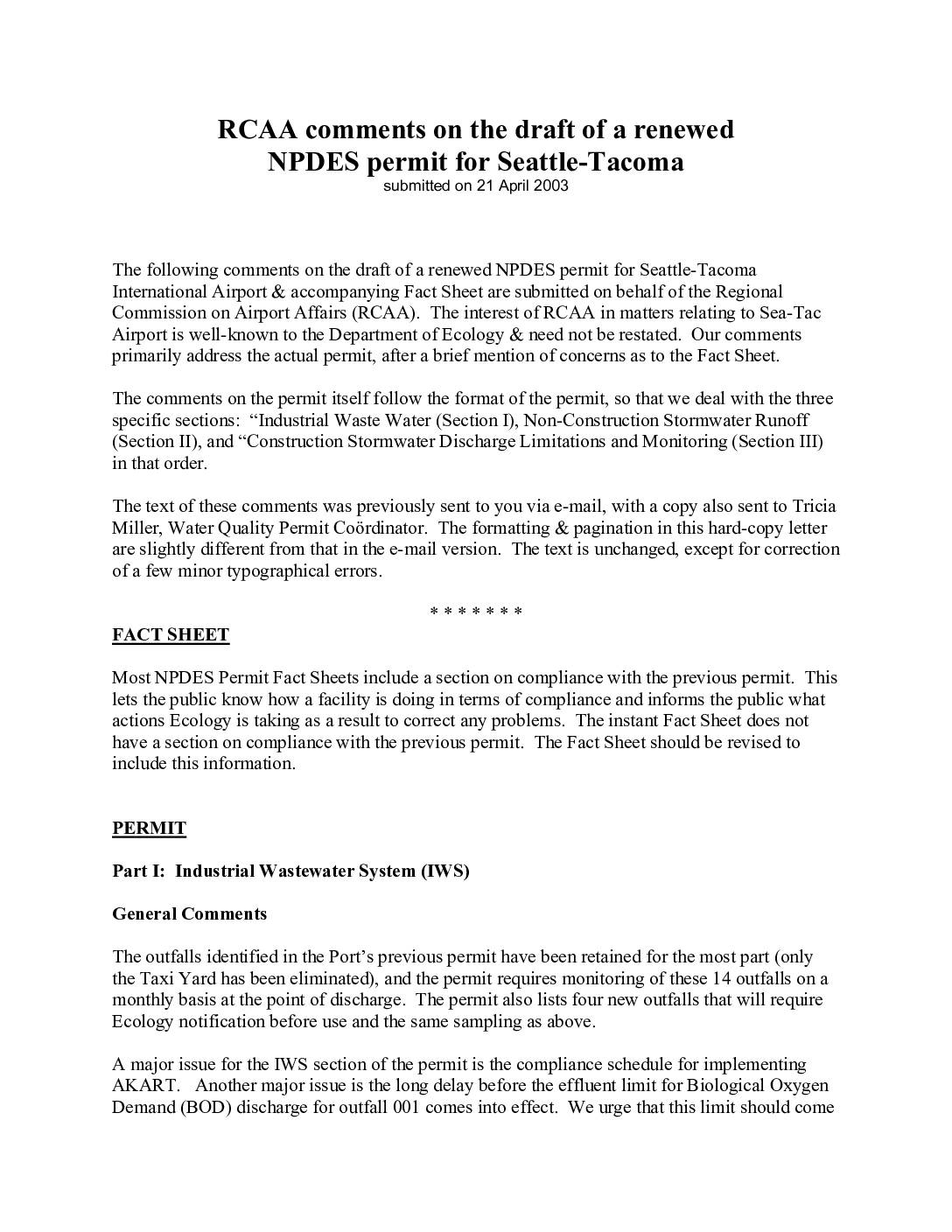
    RCAA comments on the draft of a renewed NPDES permit for Seattle-Tacoma

    In April 2003, the Regional Commission on Airport Affairs (RCAA) submitted formal comments criticizing a proposed water pollution permit renewal for Seattle-Tacoma International Airport, arguing that it failed to adequately protect local waterways from airport runoff and industrial wastewater. Key concerns included excessive delays in enforcing limits on harmful chemicals from aircraft de-icing operations, insufficient monitoring of stormwater containing copper and zinc harmful to fish, and a compliance schedule for wastewater treatment that stretched years beyond what regulators considered acceptable. The RCAA urged the Washington Department of Ecology to strengthen the permit's requirements and accelerate deadlines for bringing the airport into compliance with water quality standards.
    TagsRCAA, Regional Commission On Airport AffairsFolderRCAA
  • 2003-03-31

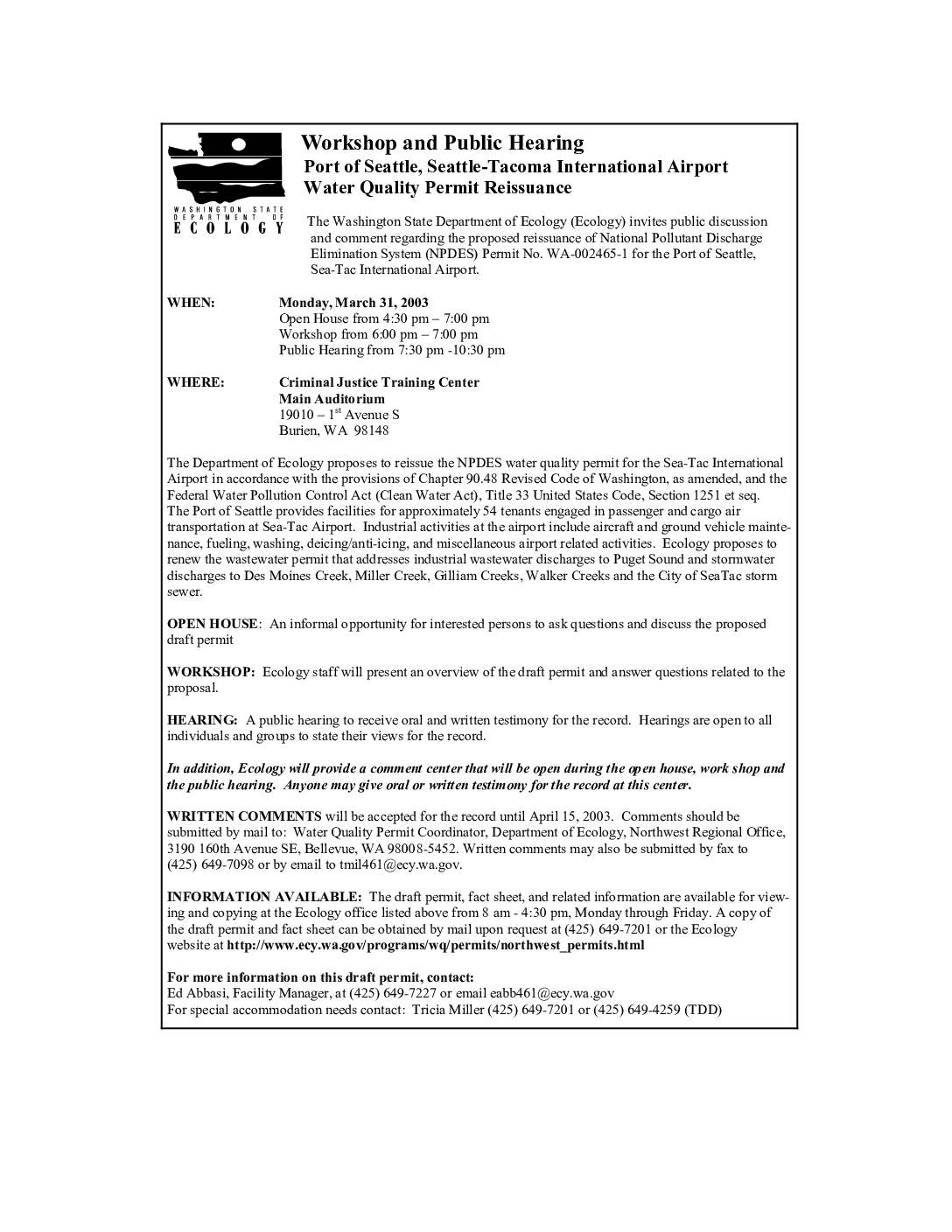
    Workshop and public hearing: Port Of Seattle, Seattle-Tacoma International Airport water quality permit reissuance

    The Washington State Department of Ecology held a public workshop and hearing on March 31, 2003, to discuss the proposed reissuance of a water quality permit for Seattle-Tacoma International Airport. The permit covers industrial wastewater discharges to Puget Sound and stormwater runoff to nearby creeks from airport activities such as aircraft maintenance, fueling, washing, and deicing. Written public comments were accepted through April 15, 2003.
    TagsEcology, NPDES, RCAA, Sea-Tac Airport, Stormwater, Water QualityFolderRCAA
  • 2003-03-31

    Response to comments: NPDES proposed waste discharge permit no. WA-002465-1, Port Of Seattle, Seattle-Tacoma International Airport

    This document is a public responsiveness summary from Washington State's Department of Ecology regarding an NPDES wastewater discharge permit issued to the Port of Seattle for Seattle-Tacoma International Airport. It compiles and responds to comments received during a March 2003 public meeting and hearing, covering concerns about the airport's treated industrial wastewater, stormwater runoff, and construction runoff discharges. The summary addresses feedback from a range of stakeholders, including the Port of Seattle, local legislators, advocacy groups, and individual residents.
    TagsNPDES, Port Of Seattle, RCAA, Sea-Tac Airport, Stormwater, Water QualityFolderRCAA
  • 2003-02-17

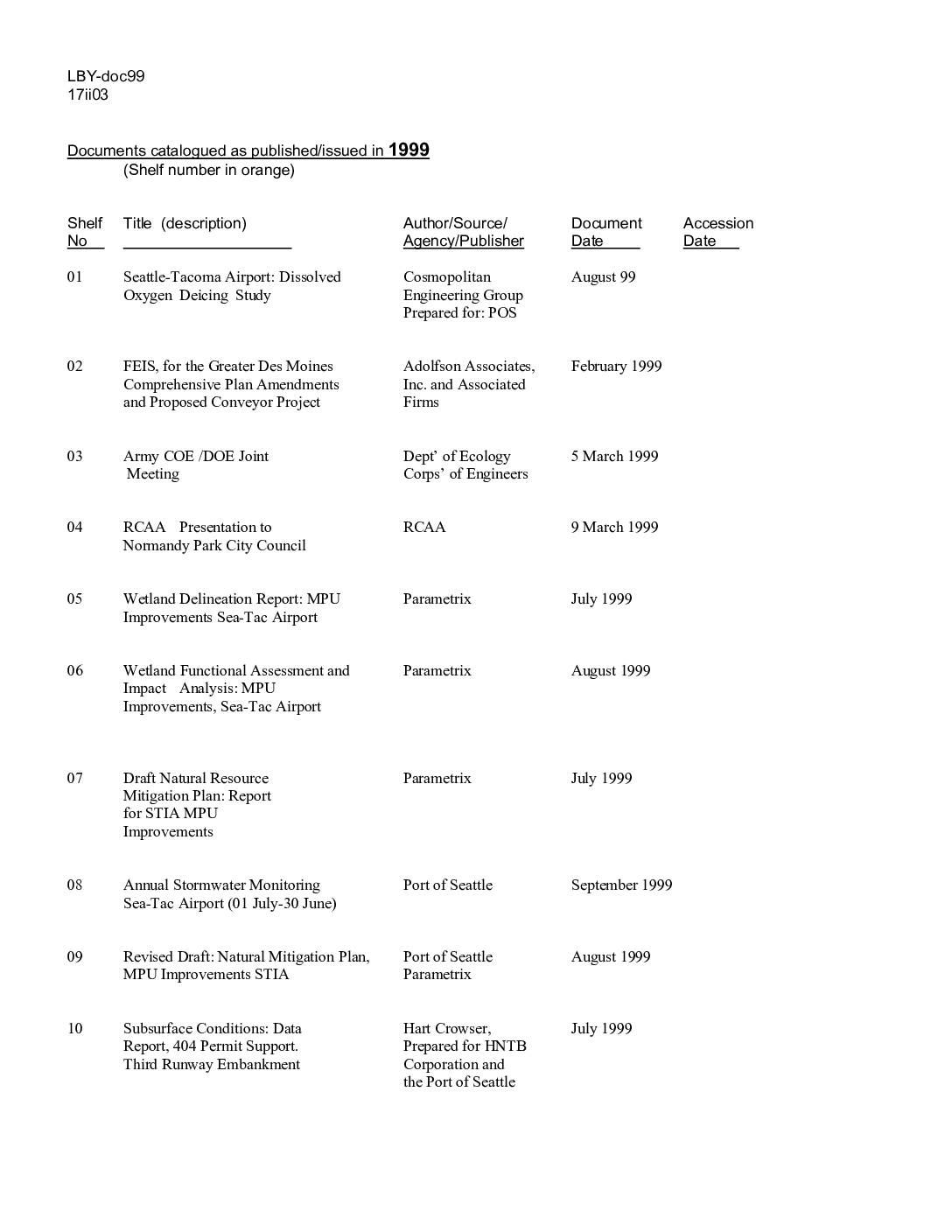
    Documents catalogued as published/issued in 1999

    This document is a catalog of 31 reports and studies published in 1999 related to Sea-Tac Airport expansion and environmental review, including wetland assessments, stormwater monitoring, subsurface conditions reports, and community health studies. Sources range from the Port of Seattle and U.S. Army Corps of Engineers to environmental consultants such as Parametrix and Hart Crowser. The materials primarily concern the proposed third runway project and its impacts on local ecosystems, waterways, and surrounding communities.
    TagsArmy Corp of Engineers, Environmental Impact Statement, Port Of Seattle, RCAA, Sea-Tac Airport, Third RunwayFolderRCAA
  • 2003-02-06

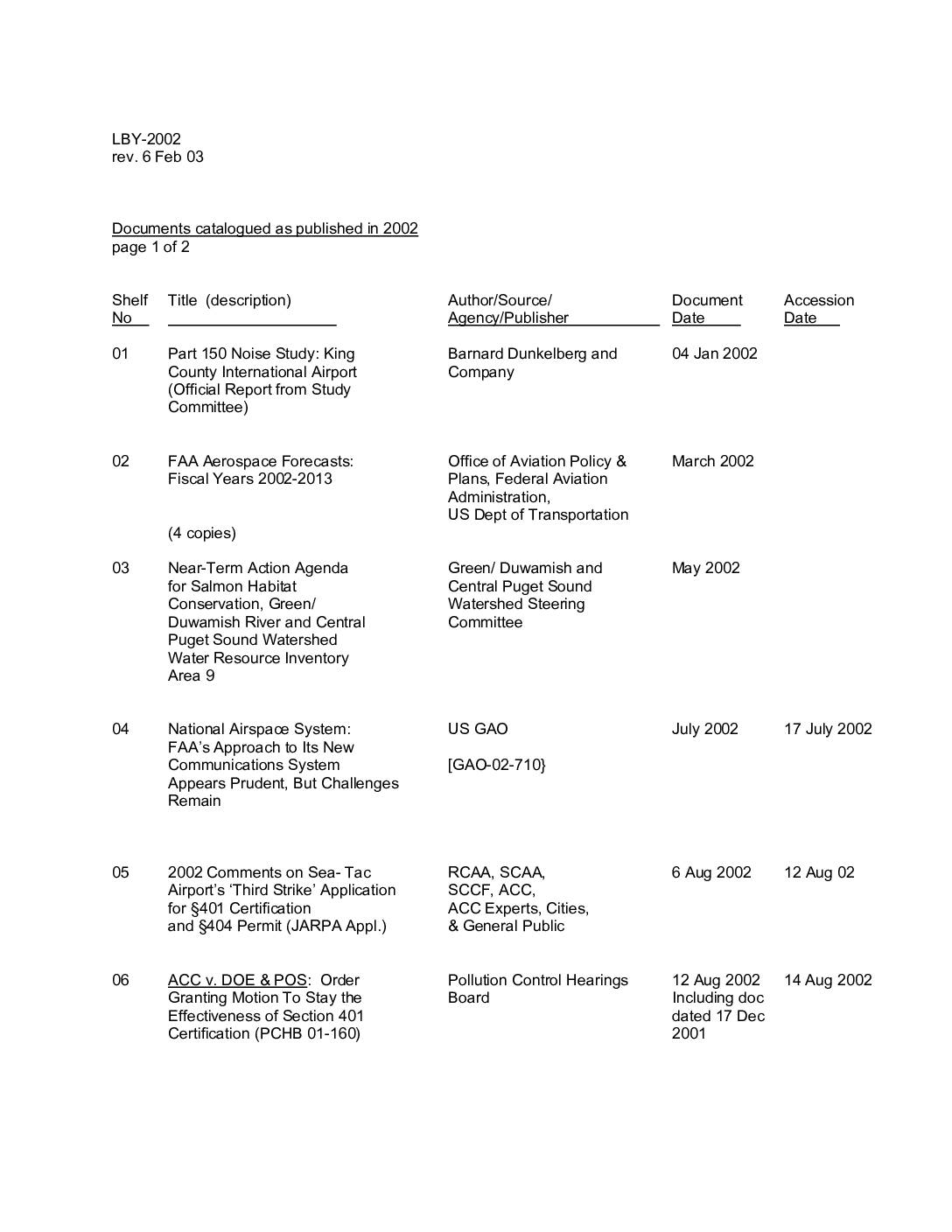
    LBY-2002: Documents catalogued as published in 2002

    This is a library catalog (LBY-2002) listing 16 documents published in 2002 and held in an archive related to Sea-Tac Airport and regional aviation policy. The collection covers topics including airport noise studies, FAA forecasts, wetland mitigation, water quality permits, and legal proceedings involving Section 401 and 404 environmental certifications for the airport. Each entry provides the document title, author or agency, publication date, and the date it was added to the archive.
    TagsFAA, NPDES, Part 150, Pollution Control Hearings Board, RCAA, Sea-Tac AirportFolderRCAA
  • 2002-12-13

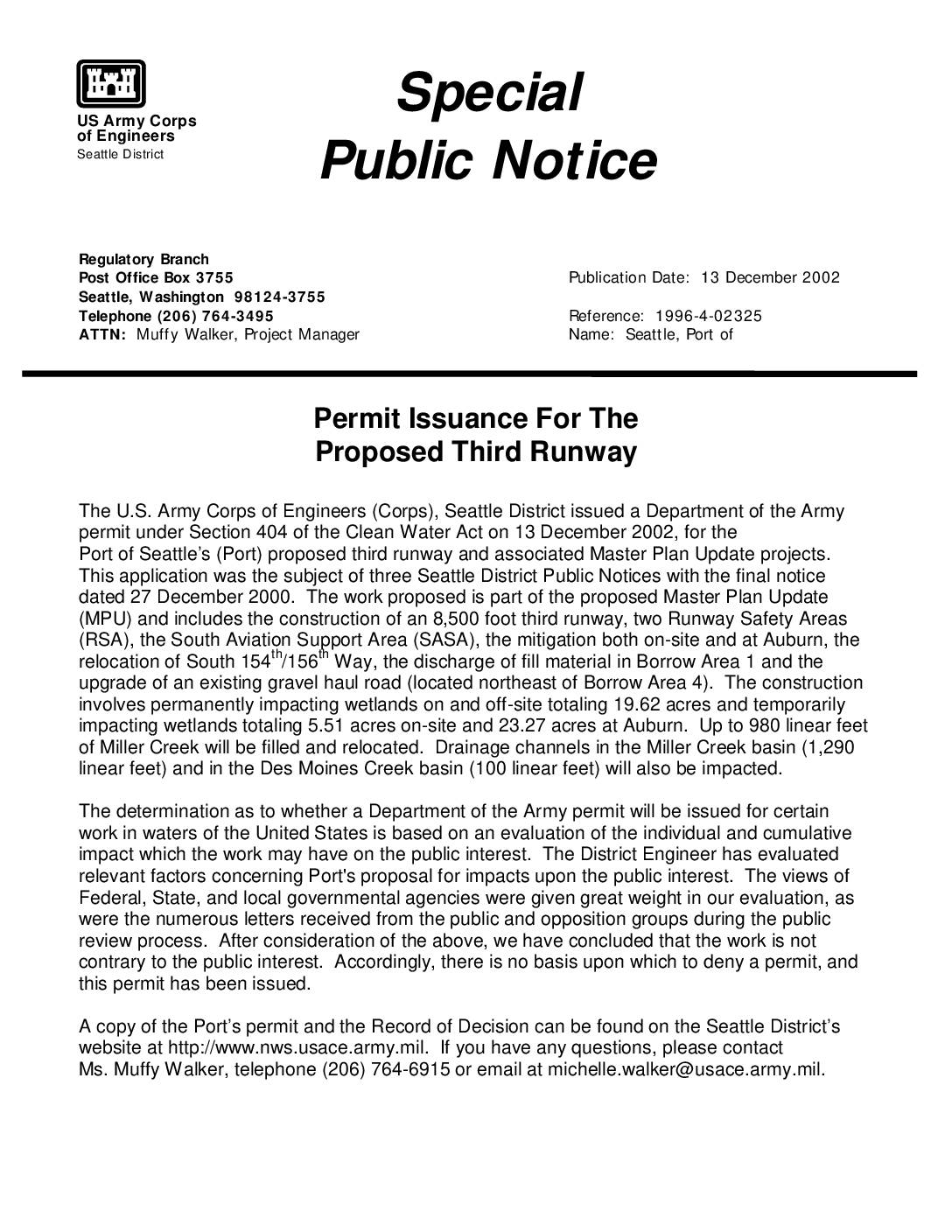
    Permit issuance for the proposed third runway

    On December 13, 2002, the U.S. Army Corps of Engineers issued a federal permit allowing the Port of Seattle to build a third runway at Sea-Tac Airport as part of its Master Plan Update. The project includes an 8,500-foot runway, two Runway Safety Areas, and related construction that will permanently impact nearly 20 acres of wetlands and up to 980 linear feet of Miller Creek. After weighing input from government agencies and the public, the Corps determined the project was not contrary to the public interest and approved the permit.
    TagsArmy Corp of Engineers, Clean Water Act, Miller Creek, Port Of Seattle, RCAA, Third RunwayFolderRCAA
  • 2002-11-04

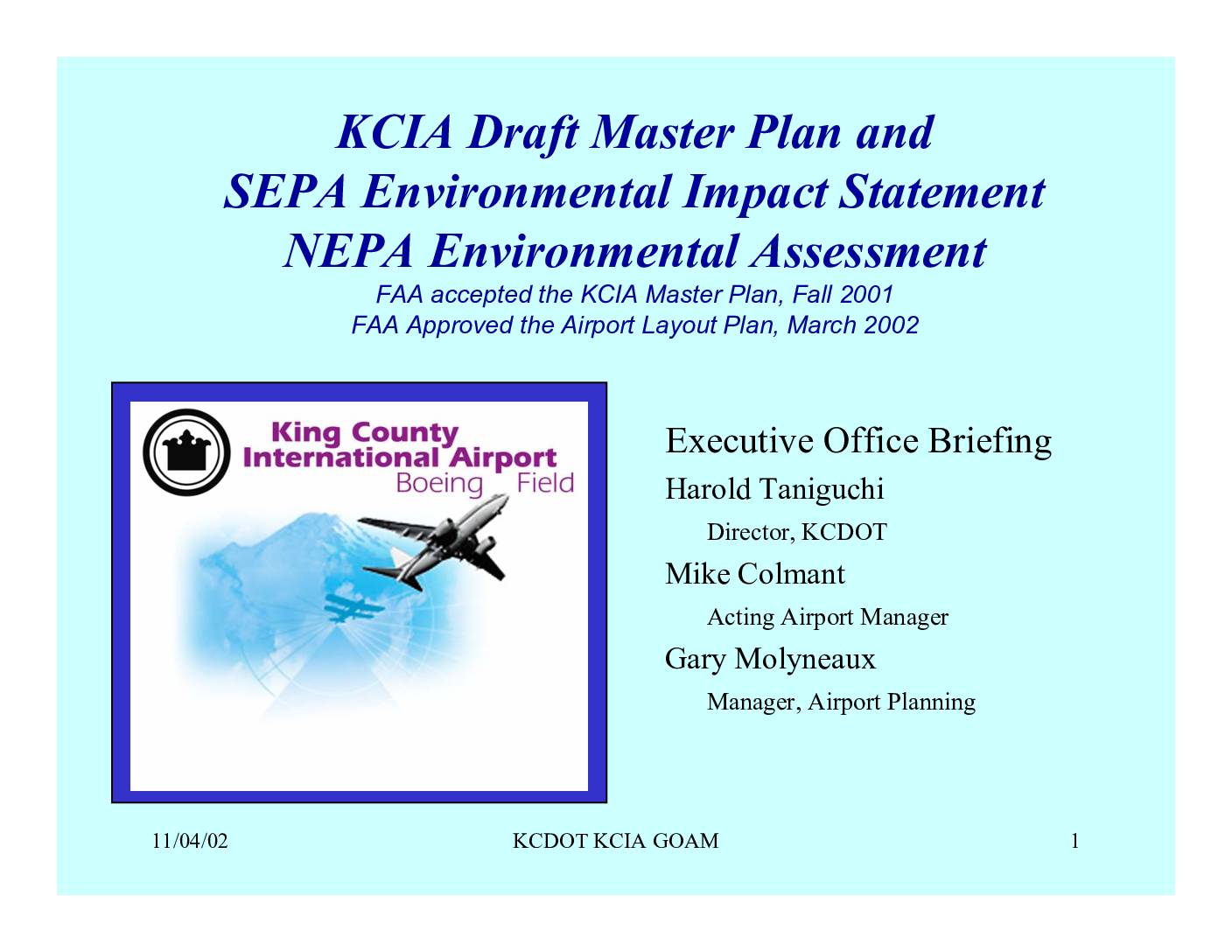
    KCIA draft master plan and SEPA/EIS and NEPA/EA executive office briefing

    This 2002 executive briefing presents the draft Master Plan and environmental review documents (SEPA/EIS and NEPA/EA) for King County International Airport (Boeing Field), located five miles south of downtown Seattle. The airport, which covers 594 acres and hosts 150 tenant businesses and 479 based aircraft, recorded approximately 290,000 flight operations in 2001. The FAA accepted the Master Plan in Fall 2001 and approved the Airport Layout Plan in March 2002, setting the stage for future development and noise impact assessments.
    TagsEnvironmental Impact Statement, KCIA, Master Plan, NEPA, RCAA, SEPAFolderRCAA
  • 2002-09-06

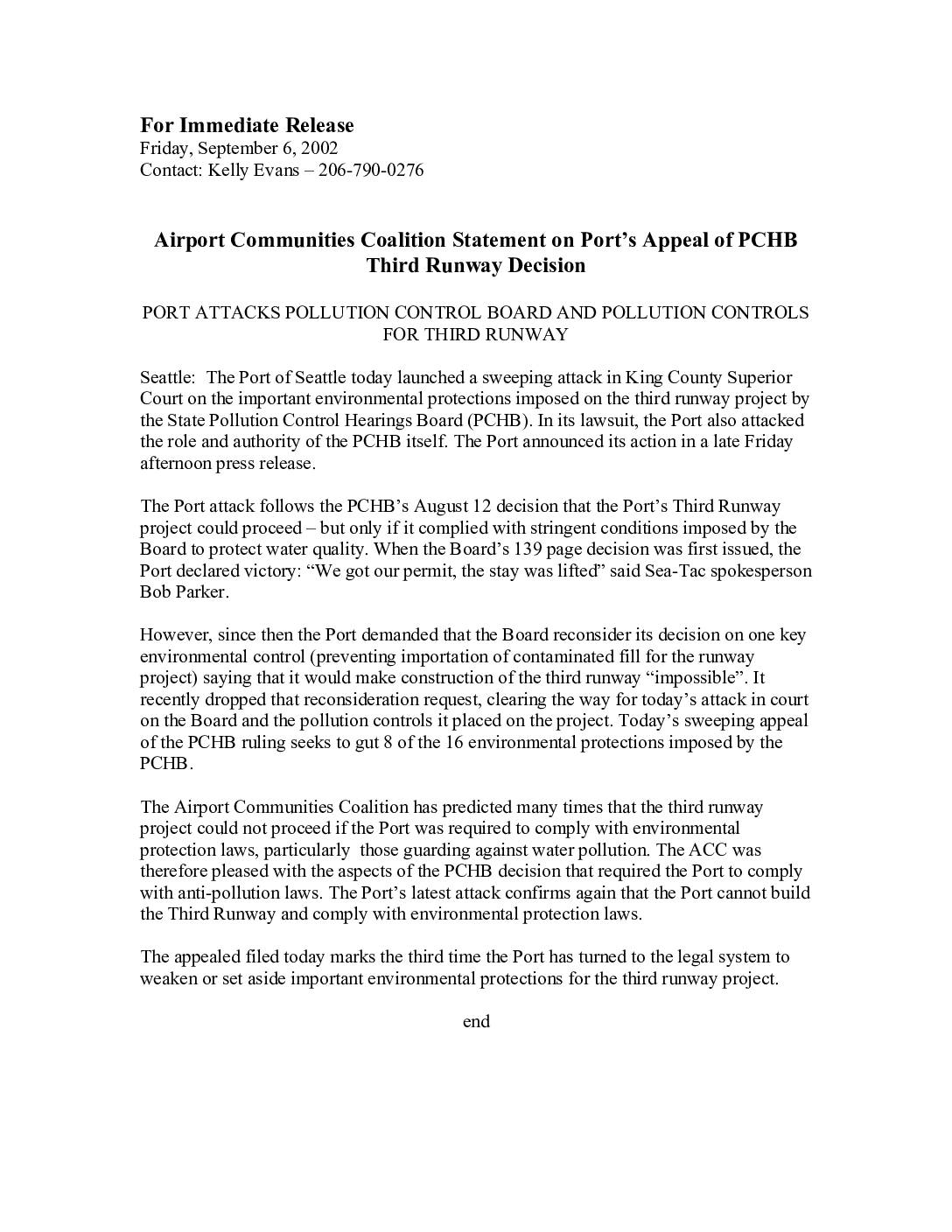
    Airport Communities Coalition statement on Port’s appeal of PCHB third runway decision

    In September 2002, the Port of Seattle filed a lawsuit in King County Superior Court challenging eight of sixteen environmental protections imposed on its Third Runway project by the State Pollution Control Hearings Board (PCHB). The Airport Communities Coalition, which opposed the runway expansion, argued that this legal action proved the Port could not build the Third Runway while complying with environmental and water-quality laws. This appeal marked the third time the Port had used the courts to attempt to weaken environmental safeguards tied to the project.
    TagsAirport Communities Coalition, PCHB, Pollution Control Hearings Board, Port Of Seattle, RCAA, Third RunwayFolderRCAA
  • 2002-09-06

    Order setting administrative appeal case schedule

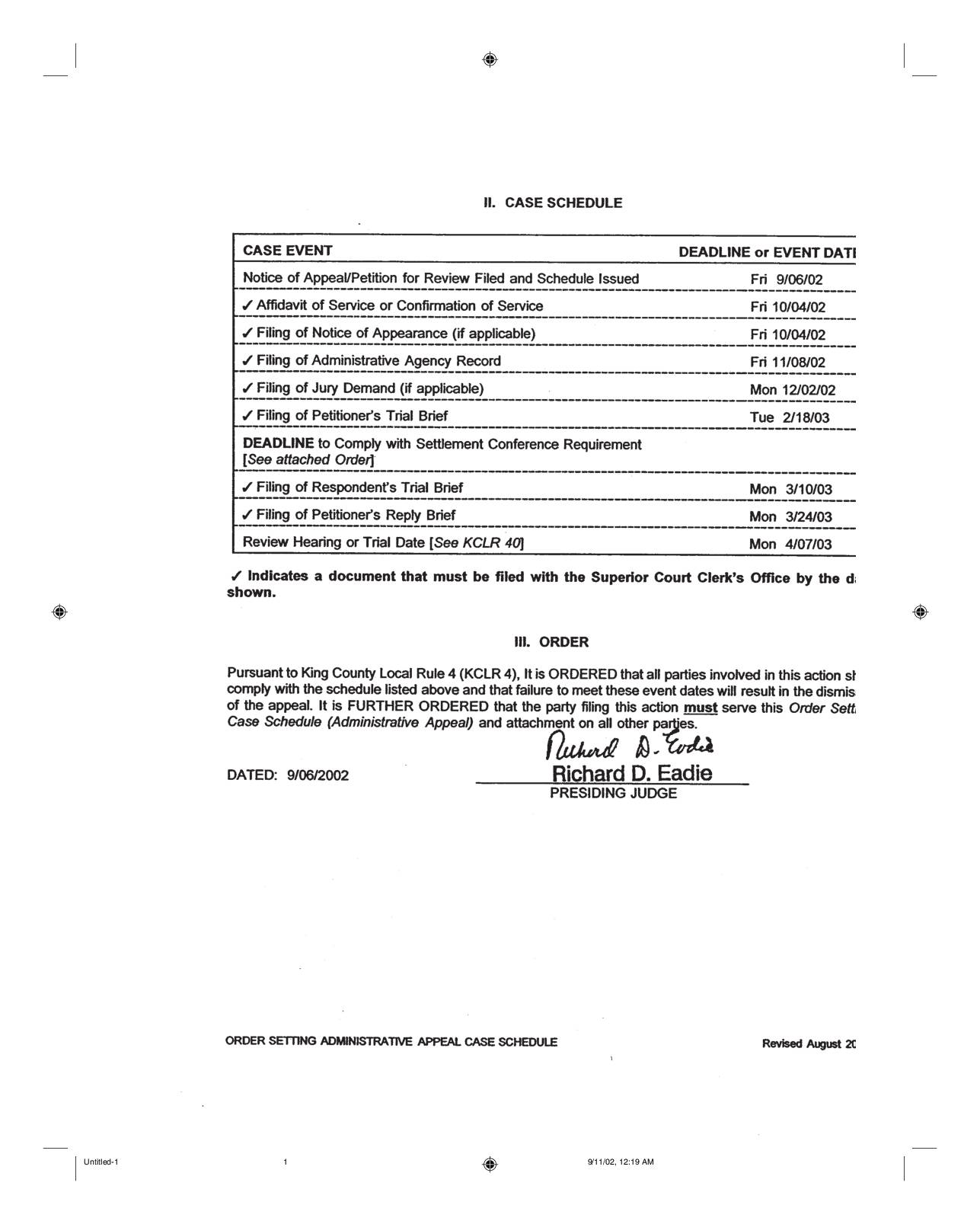
    This is a King County Superior Court case schedule order for an administrative appeal, signed by Presiding Judge Richard D. Eadie on September 6, 2002. The order sets key deadlines for the case, including filing of briefs, administrative agency records, and a review hearing date of April 7, 2003. All parties are required to comply with the schedule, as failure to meet deadlines could result in dismissal of the appeal.
    TagsCaselaw, King County, Legal, RCAA, State of WashingtonFolderRCAA

Posts pagination

Page 1 … Page 11 Page 12 Page 13 Page 14 Page 15 … Page 21
Sidebar On/Off

Upcoming Events

  • Part 150 NCP Workshop — Burien
    Add to CalendarMSaturday Oct 17: 10:00am

    Attend a Port of Seattle open house on the Part 150 Study Noise Compatibility Program (NCP). The Part 150 program determines the noise boundary around the airport and opportunities for noise mitigation such as sound insulation.

    [...]
  • Part 150 NCP Workshop — SeaTac
    Add to CalendarMMonday Oct 19: 6:00pm

    Attend a Port of Seattle open house on the Part 150 Study Noise Compatibility Program (NCP). The Part 150 program determines the noise boundary around the airport and opportunities for noise mitigation such as sound insulation.

    [...]
  • Part 150 NCP Workshop — Des Moines
    Add to CalendarMTuesday Oct 20: 6:00pm

    Attend a Port of Seattle open house on the Part 150 Study Noise Compatibility Program (NCP). The Part 150 program determines the noise boundary around the airport and opportunities for noise mitigation such as sound insulation.

    [...]

[See all...]


Issues

Sea-Tac Airport is currently undergoing the largest and longest expansion in its history, collectively known as the Sustainable Airport Master Plan (SAMP). Some of it you can already hear, but you’re probably not aware of what it all means. Here’s what you need to know.
read more...

Read This!

As the source for federal transportation grants, the Puget Sound Regional Council was charged with developing a system to meet the growing need for commercial aviation. When the search for a second airport failed, they authorized the Port of Seattle to build the Third Runway, with a mandate to develop a noise abatement and mitigation program. In their effort to stop the Third Runway, the ACC argued over every detail of the Port's efforts--including property buyouts and sound insulation. The dispute was meant to be settled by a three member Expert Arbitration Panel. This is their final report. It finds 2-1, that the Port's program was insufficient in several respects. Despite that, funding for the Third Runway was approved by the PSRC, and the 'Port Package' program, proceeded largely unchanged. Expert Arbitration Panel's final decision finding that the Port of Seattle had not shown sufficient reduction in real on-the-ground noise impacts to satisfy noise reduction conditions required for approval of a third runway at Sea-Tac International Airport. The majority decision concluded the Port's noise abatement programs were insufficient despite being impressive in scope.
continue...

  • Sea-Tac Noise.Info
  • Connect with STNI

    • Subscribe
    • Port Package Problem?
    • Donate
    • Podcast
    • Socials
      • Facebook
      • X (Twitter)
      • Bluesky
      • Instagram
  • Learn

    • Frequently Asked Questions
    • Explainers
    • Youtube
    • Research Requests
    • Complain about one flight
  • Goals

    Fulfill the promises of 1976:
    • Compensation
    • Reduced noise
    • Improved air quality
    • Environmental remediation
Login/Register
©2026•Data Privacy

Message

We use cookies to provide basic functionality. We also provide access to search engines in order to provide site analytics. We do not sell or share your data.
V V