TagPort Of Seattle(2349)
-
 2018-01-01
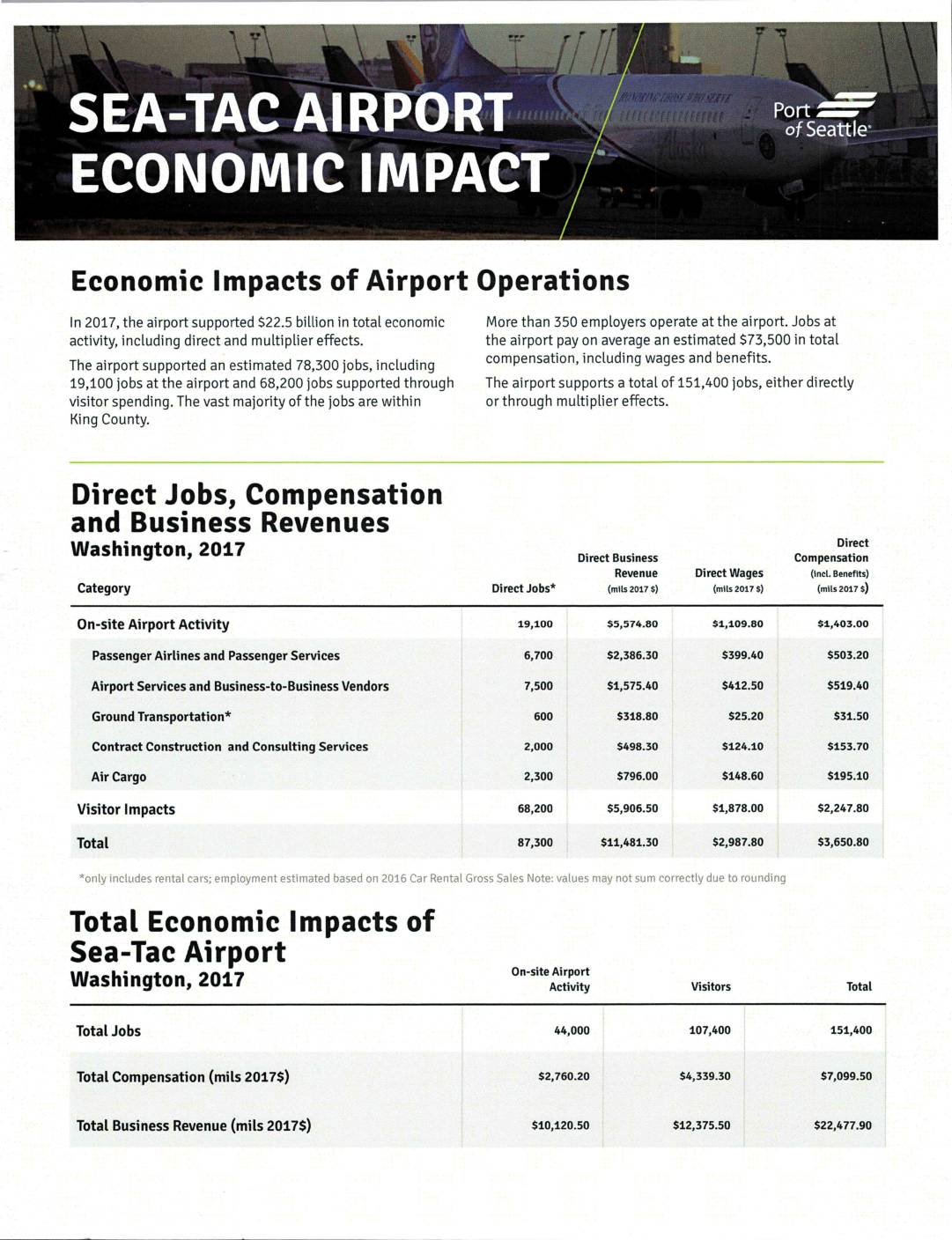
Sea-Tac Airport economic impact
A 2017 economic impact report from the Port of Seattle shows that Seattle-Tacoma International Airport supported $22.5 billion in total economic activity and approximately 151,400 jobs across the region, including direct employment and multiplier effects. More than 350 employers operate at the airport, with on-site jobs averaging $73,500 in total compensation, and the surrounding communities of King and Pierce counties benefiting significantly from visitor spending and airport-related business revenues. -
 2017-12-31
Comprehensive annual financial report
This is the Port of Seattle's Comprehensive Annual Financial Report covering financial data as of December 31, 2017 and 2016, and for the fiscal years ended December 31, 2017, 2016, and 2015. Prepared by the Port's Accounting and Financial Reporting Department, the report provides a detailed overview of the Port's financial position and results of operations across its facilities, including Seattle-Tacoma International Airport. It serves as an official public financial disclosure document for the Port of Seattle, a Washington State government entity. -
 2017-11-28
Proposed 2018 City/Port Interlocal Agreement
This November 2017 City Council study session presentation outlines a proposed 2018 Interlocal Agreement (ILA) between the City of SeaTac and the Port of Seattle, which operates Seattle-Tacoma International Airport. Because Port properties make up 42% of SeaTac's total land area and the airport creates unique demands on city services, the two governments have used ILAs since 1997 to manage operational and authority issues. The proposed agreement, intended to replace the expiring February 2018 ILA, aims to improve efficiency, reduce costs, and avoid litigation through a mutually beneficial, comprehensive package of terms. -
 2017-11-15
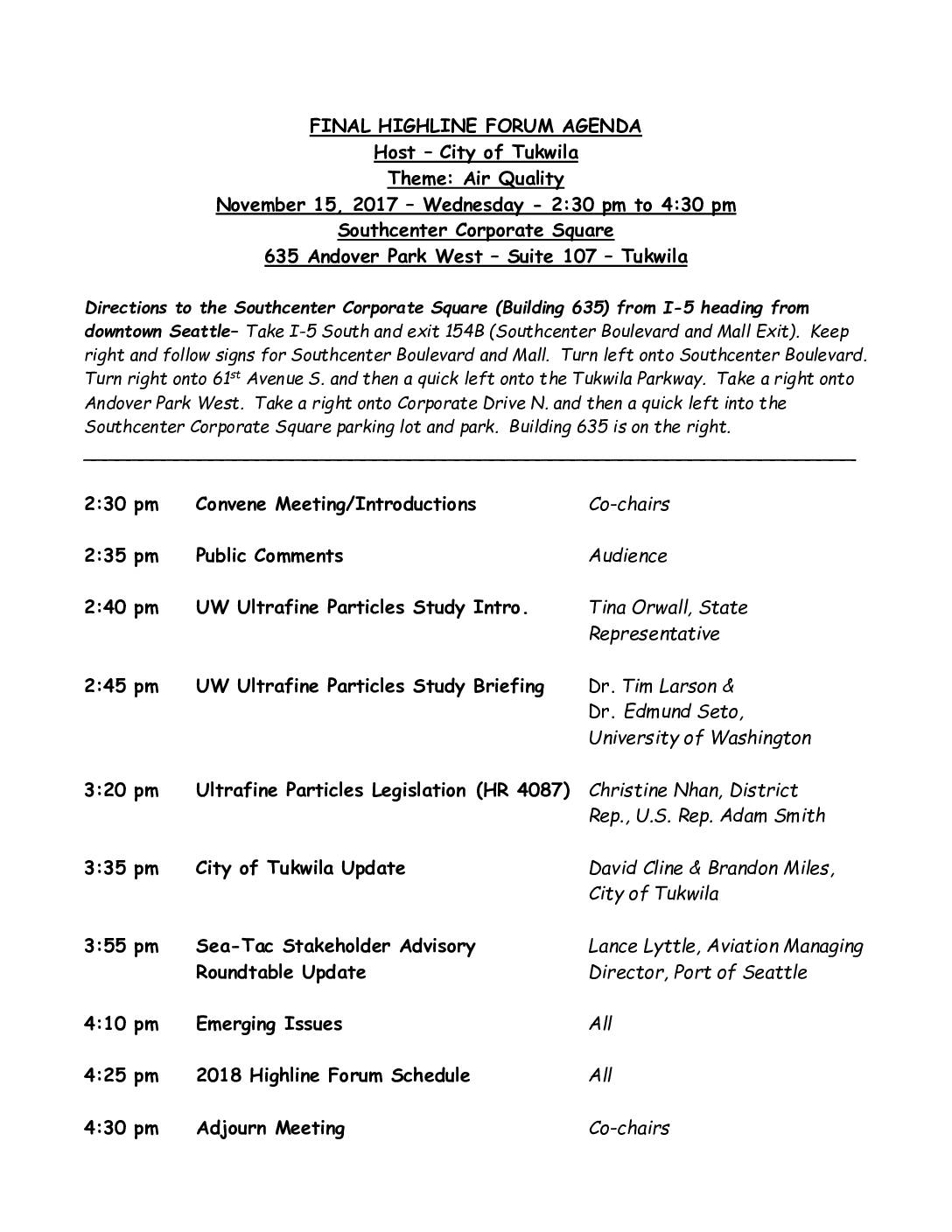
Final Highline Forum agenda: Air quality
The Highline Forum meeting, hosted by the City of Tukwila on November 15, 2017, focused on air quality concerns related to Sea-Tac Airport, featuring a briefing from University of Washington researchers on an ultrafine particles study and a discussion of related federal legislation (HR 4087). The agenda also included updates from the City of Tukwila and the Sea-Tac Stakeholder Advisory Roundtable, presented by Port of Seattle Aviation Managing Director Lance Lyttle. The two-hour session concluded with a discussion of emerging issues and planning for the 2018 Highline Forum schedule. -
 2017-11-07
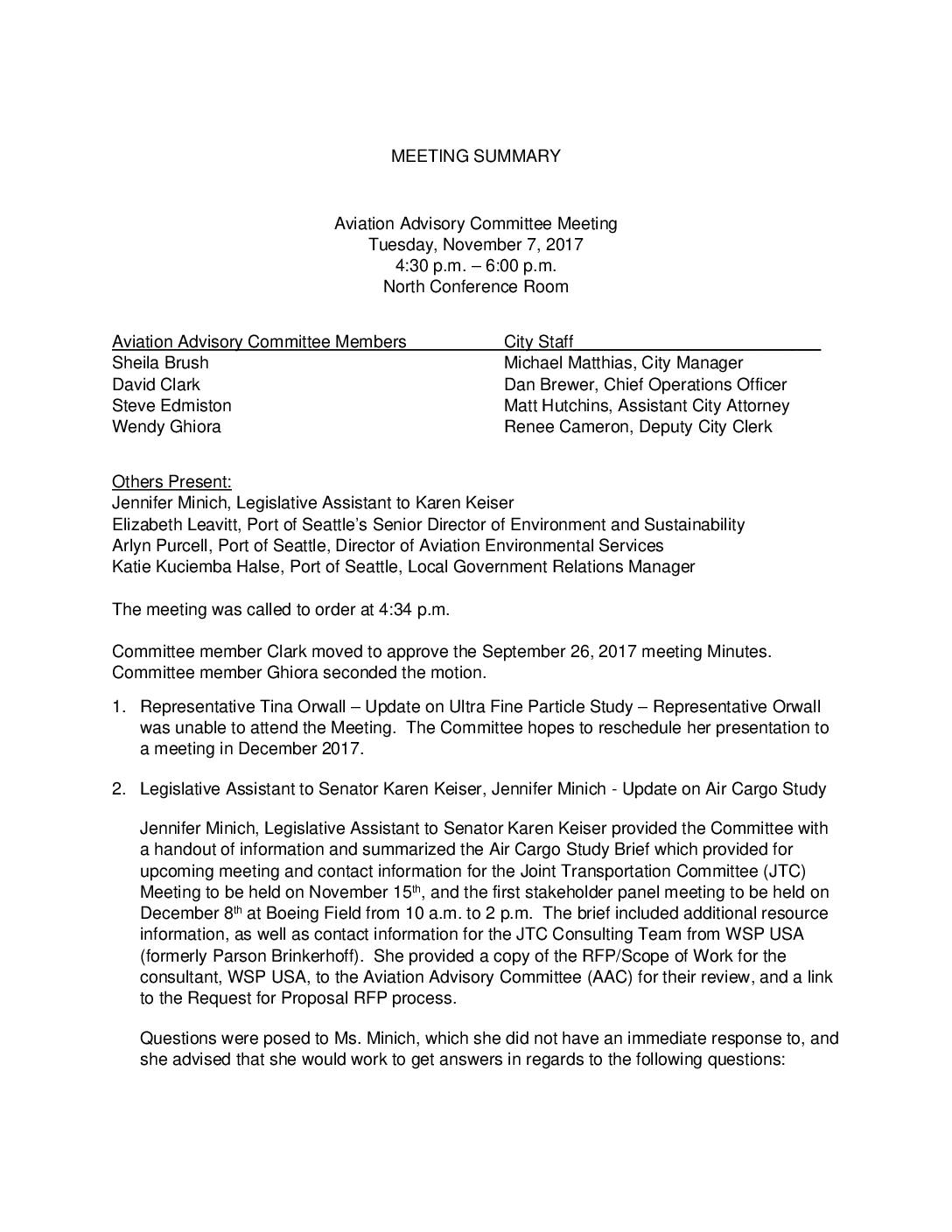
Aviation Advisory Committee Meeting Minutes: November 7, 2017
The Des Moines Aviation Advisory Committee met on November 7, 2017, to discuss several airport-related topics, including an Air Cargo Study being conducted by the Joint Transportation Committee and updates on the Sustainable Airport Master Plan (SAMP) Environmental Impact Statement process presented by Port of Seattle representatives. Key community concerns raised included nighttime flights, aircraft noise frequency, and whether airport-impacted communities would have a voice in upcoming stakeholder meetings. The committee also nominated member Sheila Brush to represent the City of Des Moines on a new Public Forum Panel headed by the Port's Director of Aviation, expected to launch in early 2018. -
 2017-10-24
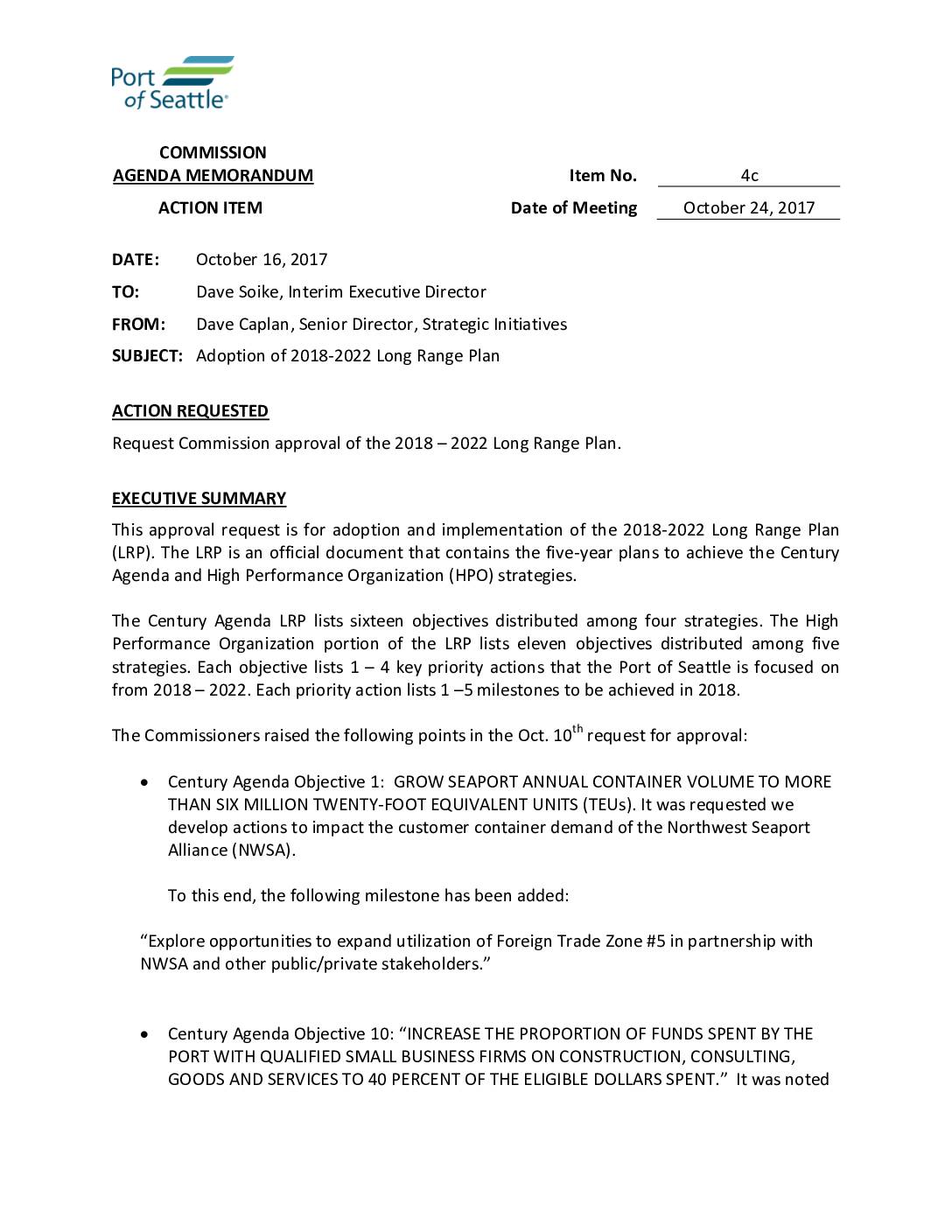
Adoption of 2018-2022 Long Range Plan
The Port of Seattle Commission considered approval of its 2018-2022 Long Range Plan (LRP) at its October 24, 2017 meeting, outlining a five-year strategy to achieve the Port's Century Agenda goals, including growing seaport container volume and increasing spending with small, women-owned, and minority-owned businesses. The plan incorporates cross-departmental efforts across aviation, maritime, environmental, and workforce development areas, and is designed to support the creation of 100,000 new jobs in the Puget Sound region. Note: this document addresses broad Port strategic planning and does not specifically cover Sea-Tac Airport noise policy. -
 2017-10-24
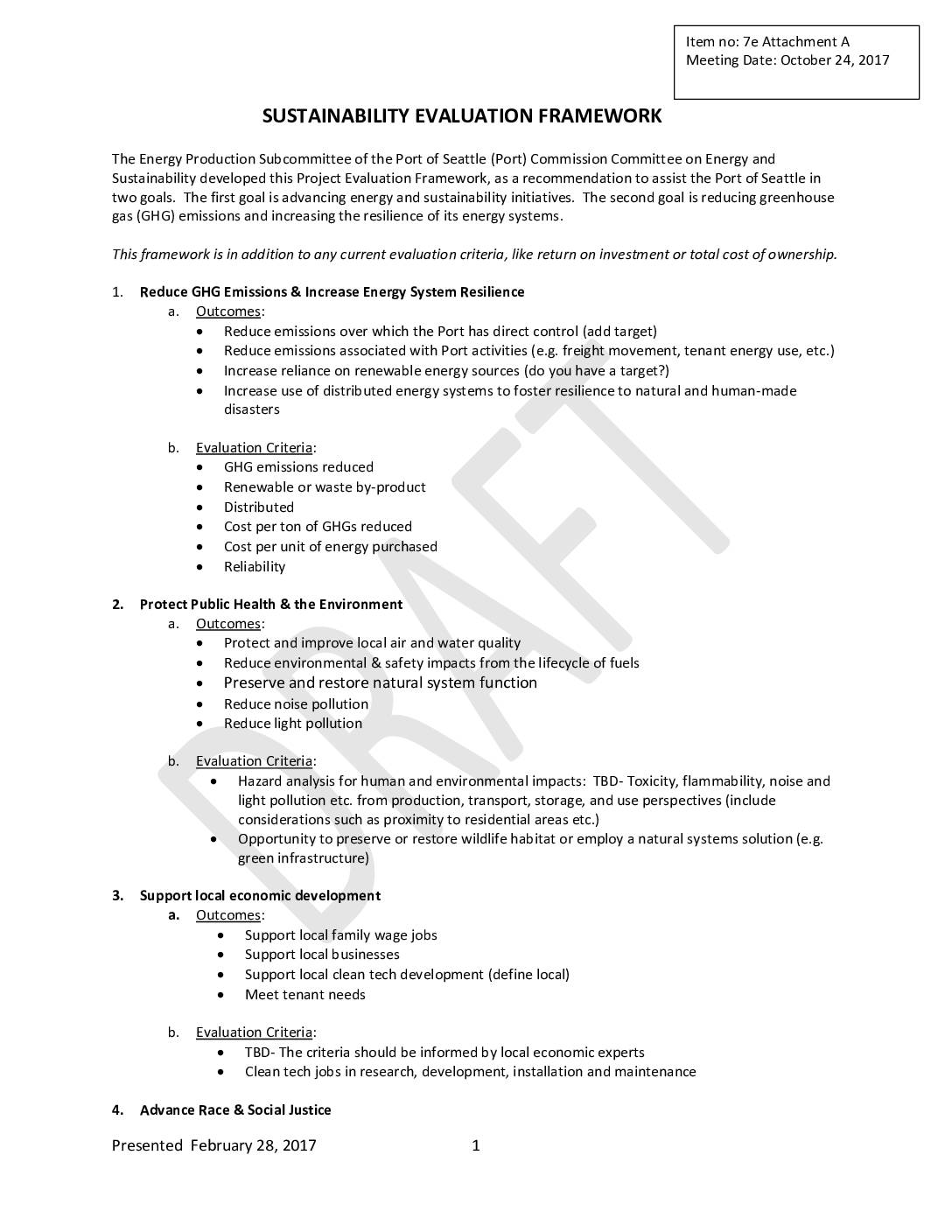
Sustainability evaluation framework
The Port of Seattle's Sustainability Evaluation Framework outlines six key goals for guiding energy and sustainability decisions: reducing greenhouse gas emissions, protecting public health and the environment, supporting local economic development, advancing race and social justice, leveraging partnerships, and encouraging innovation. Developed by the Energy Production Subcommittee, the framework provides outcomes and evaluation criteria for each goal, supplementing existing financial measures like return on investment. The subcommittee recommends the Port incorporate these considerations into its decision-making when evaluating energy sources and projects. -
 2017-10-24
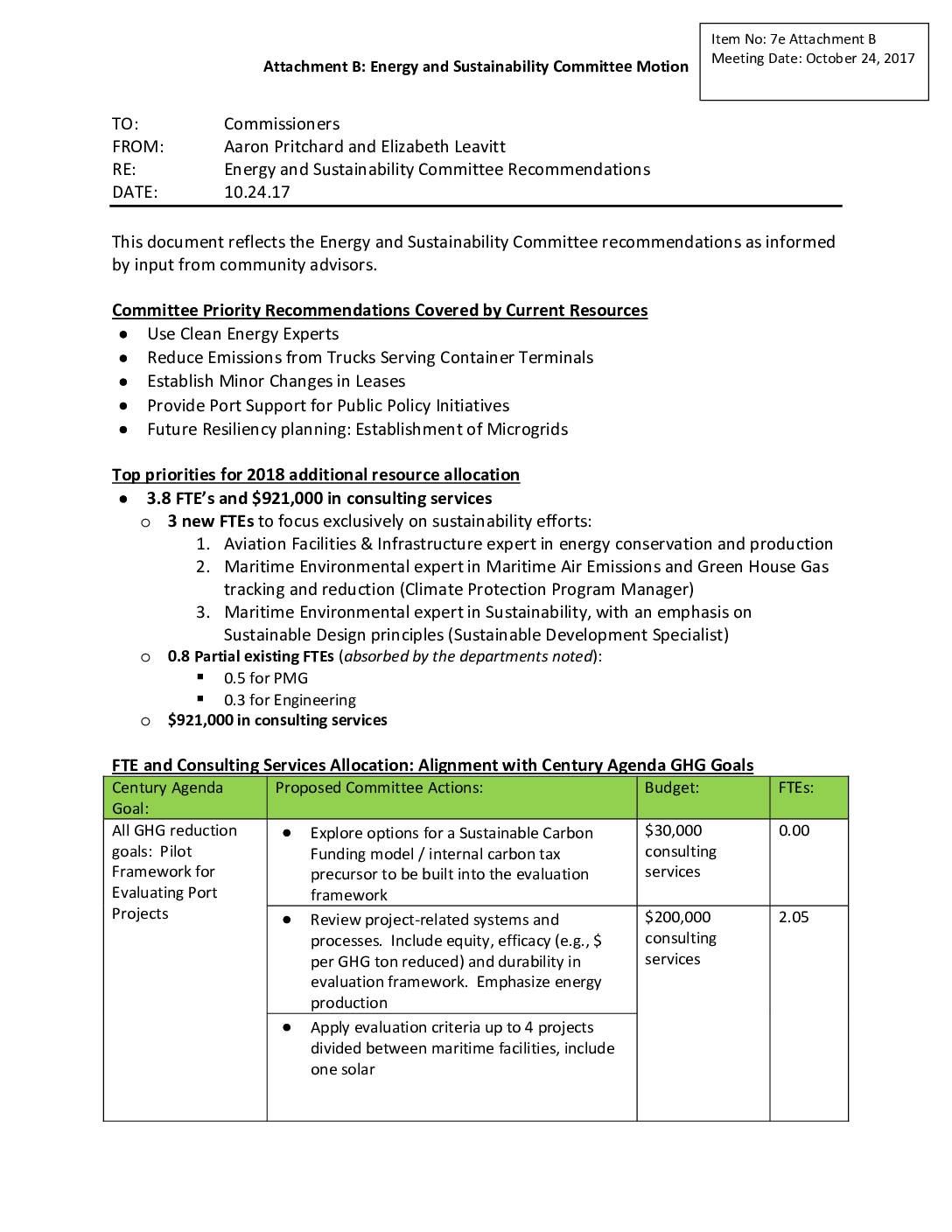
Energy and Sustainability Committee motion: recommendations for 2018 resource allocation
In October 2017, the Port of Seattle's Energy and Sustainability Committee recommended allocating 3.8 new staff positions and $921,000 in consulting services to advance greenhouse gas reduction goals for both aviation and maritime operations. Key initiatives included reducing natural gas use at airport terminals, improving energy efficiency at maritime facilities, and developing programs to cut ground transportation emissions. These efforts were designed to meet Century Agenda targets of 15% Scope 1 and 2 GHG reductions by 2020 and 50–80% Scope 3 reductions by 2030–2050. -
 2017-10-24
Draft 2018 state legislative agenda presentation to Port Of Seattle Commission
This October 2017 presentation outlines the Port of Seattle's draft state legislative priorities for 2018, including support for a study of State Route 518 to address transportation congestion and safety challenges caused by the growth of Seattle-Tacoma International Airport. The agenda also includes workforce development initiatives focused on the maritime, manufacturing, and industrial sectors. The Commission was asked to formally adopt the agenda at the October 24, 2017 meeting. -
 2017-10-24
Transfer of airport property to EDD
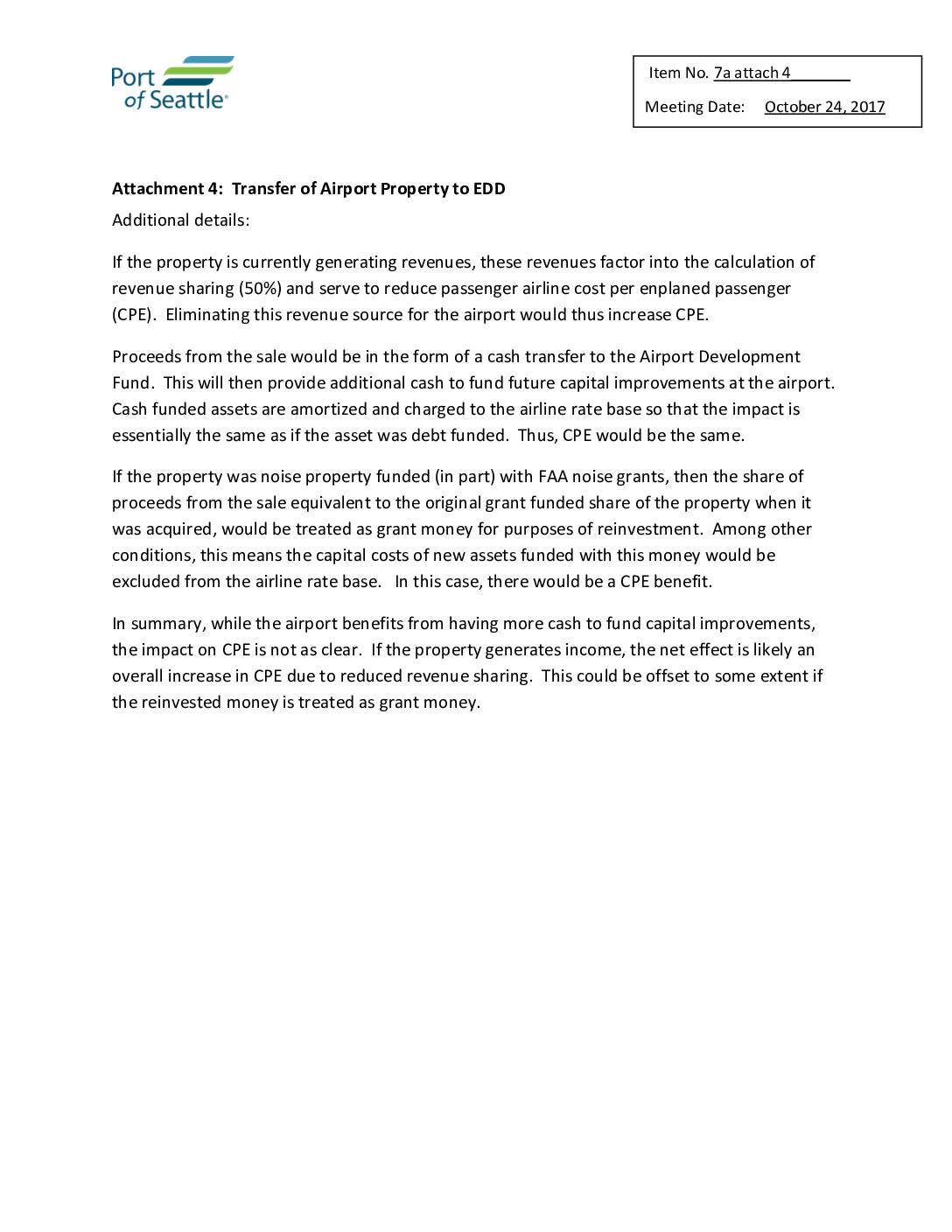
This Port of Seattle document examines the financial implications of transferring airport property to the Economic Development Division (EDD). It explains that if the transferred property currently generates revenue, losing that income would likely raise the cost per passenger (CPE) for airlines, since those revenues normally offset airline fees. However, if the property was originally purchased using FAA noise grants, a portion of the sale proceeds could be reinvested as grant money, potentially reducing costs and partially offsetting the CPE increase.