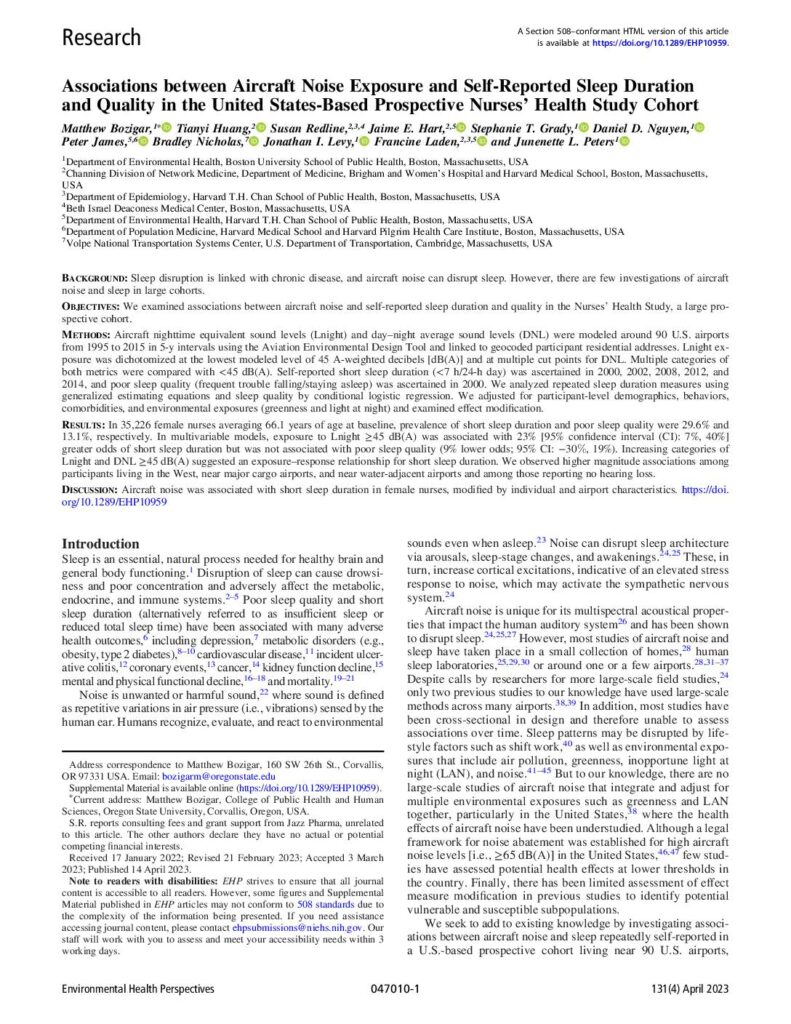
A large study of over 35,000 female nurses across the United States found that exposure to aircraft nighttime noise levels at or above 45 decibels was associated with 23% greater odds of sleeping less than 7 hours per night. The research, which tracked participants living near 90 U.S. airports between 2000 and 2014, suggests that aircraft noise — including at levels below the federally regulated threshold of 65 decibels — may meaningfully disrupt sleep duration. Stronger effects were observed among residents in the Western United States and those living near major cargo airports, findings with direct relevance to communities around airports like Sea-Tac.Open full document
Notes
This study investigates associations between aircraft nighttime noise levels and self-reported sleep duration and quality among 35,226 female nurses in the Nurses’ Health Study cohort living near 90 U.S. airports from 1995 to 2015. Results found that exposure to nighttime aircraft noise at or above 45 dB(A) was associated with 23% greater odds of short sleep duration, with evidence of an exposure-response relationship, though no significant association with poor sleep quality was found. Effect modification was observed by geographic region, airport type, and hearing loss status.