Tagletter(154)
-
 2000-09-26
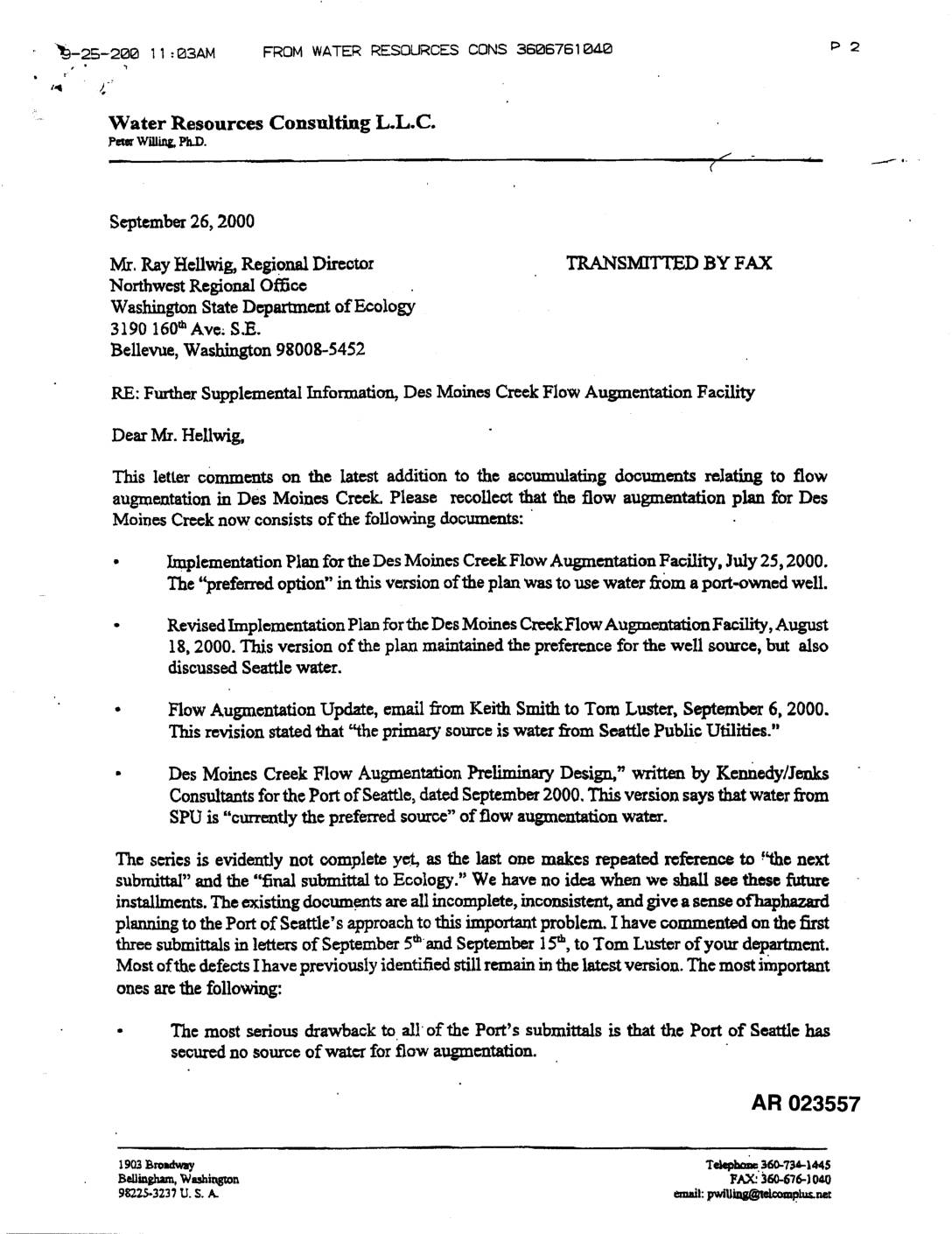
EXH AR023557: Water Resources Consulting to Ecology — Des Moines Creek Flow Augmentation Facility
A September 26, 2000 letter from Water Resources Consulting L.L.C. to the Washington State Department of Ecology critiques the Port of Seattle's plans to augment water flow in Des Moines Creek, a project related to Sea-Tac Airport operations. The letter identifies several serious flaws in the proposal, including the lack of a secured water source, concerns about water temperature and fluoride toxicity to fish, and a maintenance-intensive design prone to failure. The author concludes that the Port's 'preliminary design' does not provide reasonable assurance that water quality standards will be met. -
 2000-04-27
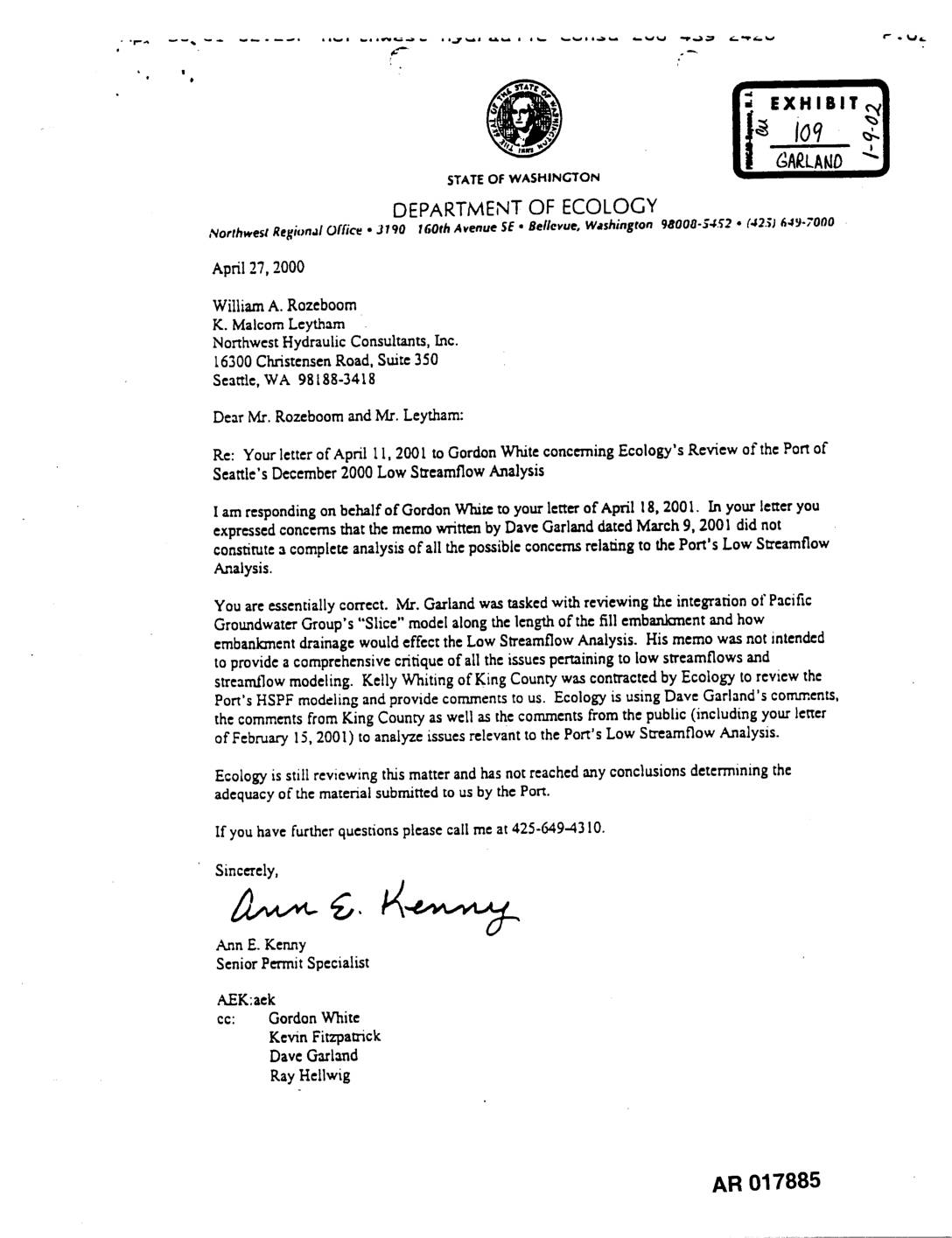
Exhibit 109: Ecology Letter to Northwest Hydraulic Consultants Re: Port Of Seattle Low Streamflow Analysis Review
Letter dated April 27, 2000 from Ann E. Kenny, Senior Permit Specialist, Washington State Department of Ecology (Northwest Regional Office), to William A. Rozeboom and K. Malcom Leytham of Northwest Hydraulic Consultants, Inc. Responds to their April 11, 2001 letter to Gordon White concerning Ecology’s review of Port Of Seattle’s December 2000 Low Streamflow Analysis. -
 1999-10-28
EXH AR026497: Aquatic Research Inc Lab Analysis — Water Samples (PAR025-18)
A October 1999 laboratory analysis report from Aquatic Research Incorporated details water sample testing conducted for Parametrix/Port of Seattle. One water sample collected on October 8-11, 1999 was tested for total suspended solids, petroleum hydrocarbons (diesel and motor oil), and total metals including cadmium, copper, lead, and zinc. Results showed low levels of contaminants, with zinc detected at 0.102 mg/l and copper at 0.0070 mg/l, while diesel and motor oil levels fell below detection limits. -
 1996-10-21
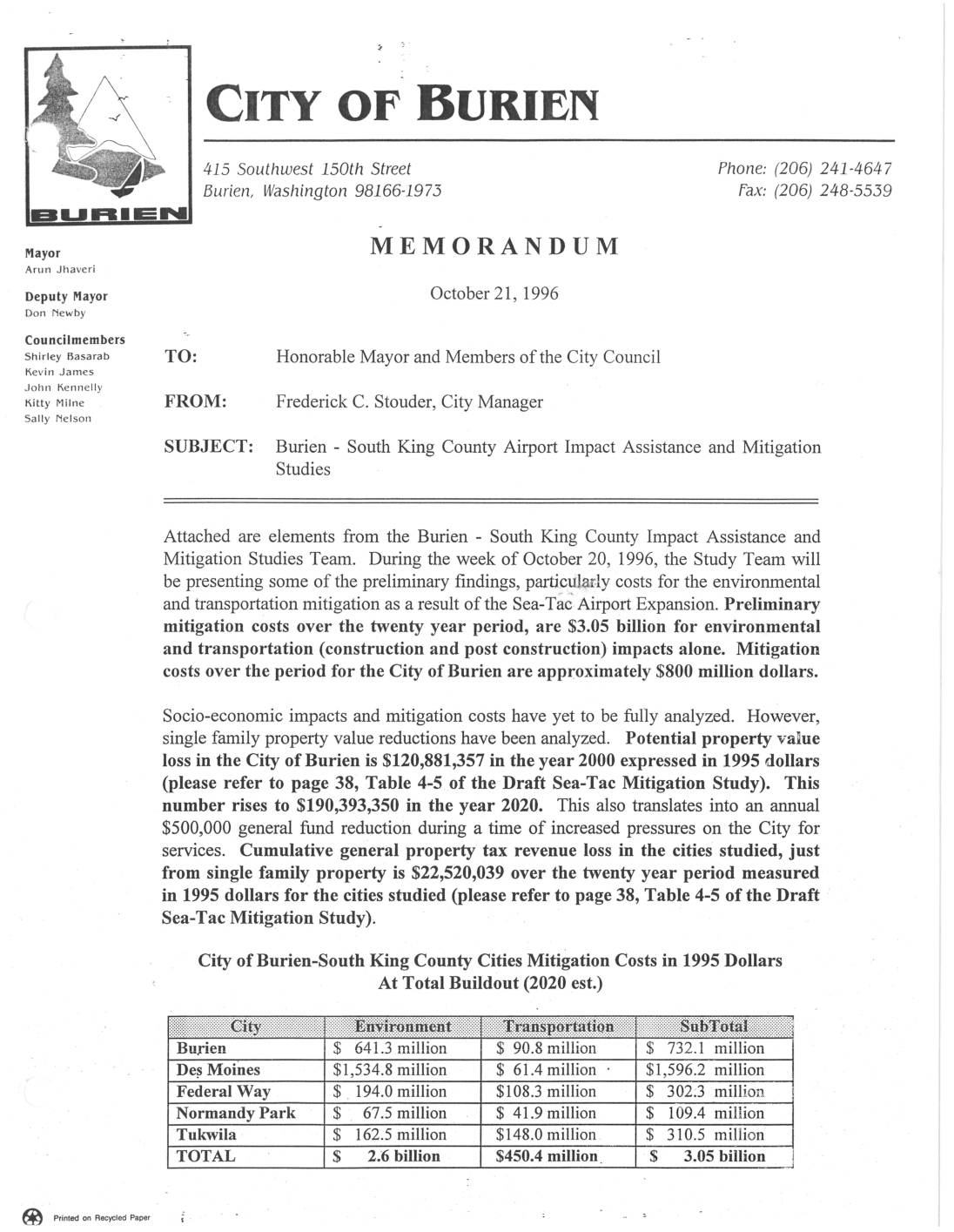
City of Burien Memorandum: South King County Airport Impact Assistance and Mitigation Studies
A 1996 City of Burien memorandum outlines preliminary findings from a regional study on the socio-economic and environmental impacts of Sea-Tac Airport's proposed expansion and third runway. Estimated mitigation costs for five South King County cities totaled $3.05 billion over twenty years, with Burien alone facing roughly $800 million in costs and over $190 million in single-family property value losses by 2020. The study argues that because the airport's benefits are spread across the broader Puget Sound region while its costs—including noise, traffic, and a reduced tax base—fall disproportionately on a handful of nearby communities, targeted mitigation funding is both an equity issue and a necessity. -
 1996-08-23
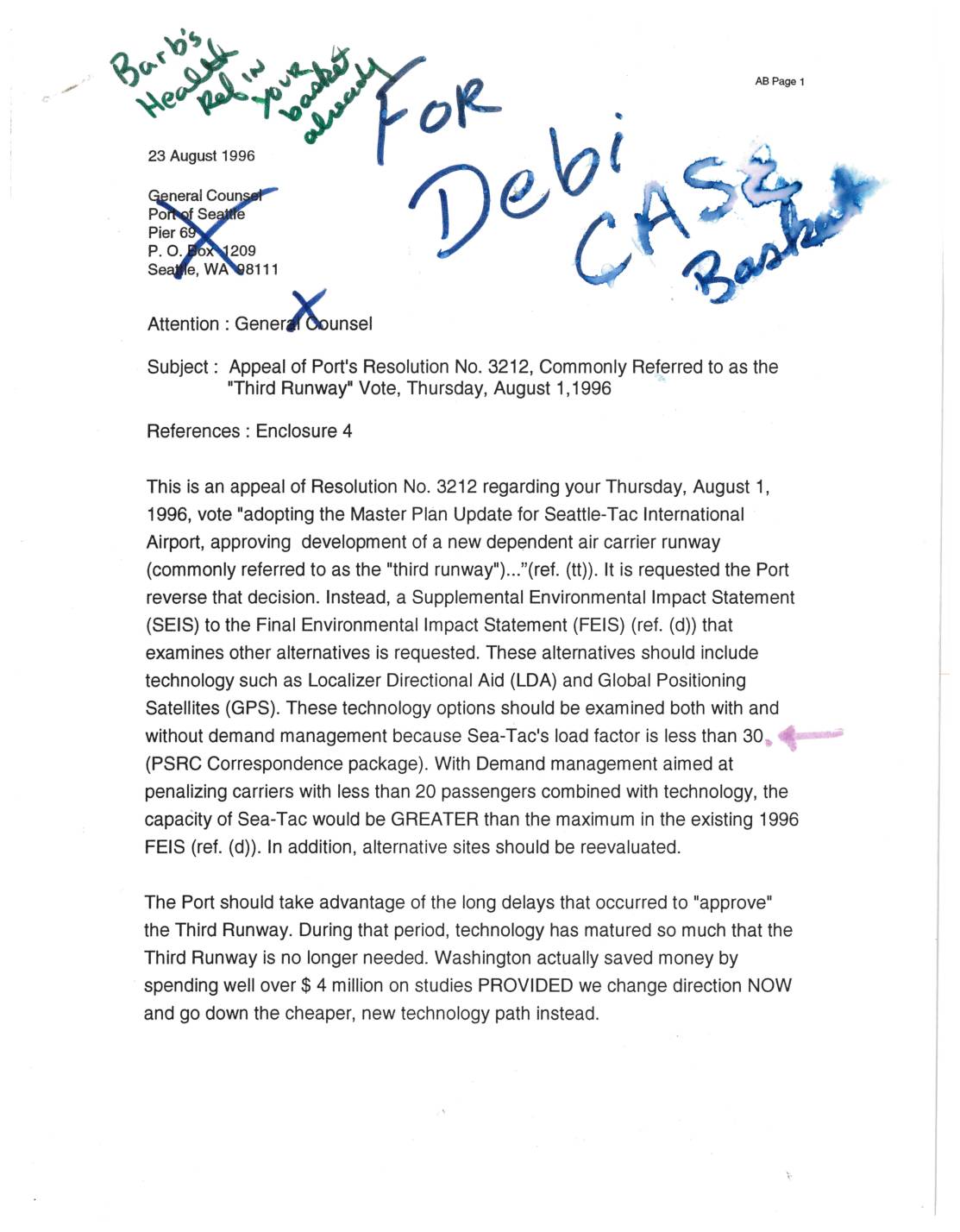
CASE & RCAA Appeal of Port Of Seattle Resolution No. 3212 (Third Runway Vote)
In August 1996, community groups CASE and RCAA formally appealed the Port of Seattle's Resolution No. 3212, which approved construction of a third runway at Seattle-Tacoma International Airport. The appeal argued that newer navigation technologies such as Localizer Directional Aid (LDA) and GPS, combined with demand management strategies, could provide equivalent airport capacity at far lower cost and with less environmental harm. The groups requested a Supplemental Environmental Impact Statement to evaluate these technology-based alternatives and reconsider the third runway decision. -
 1996-03-18
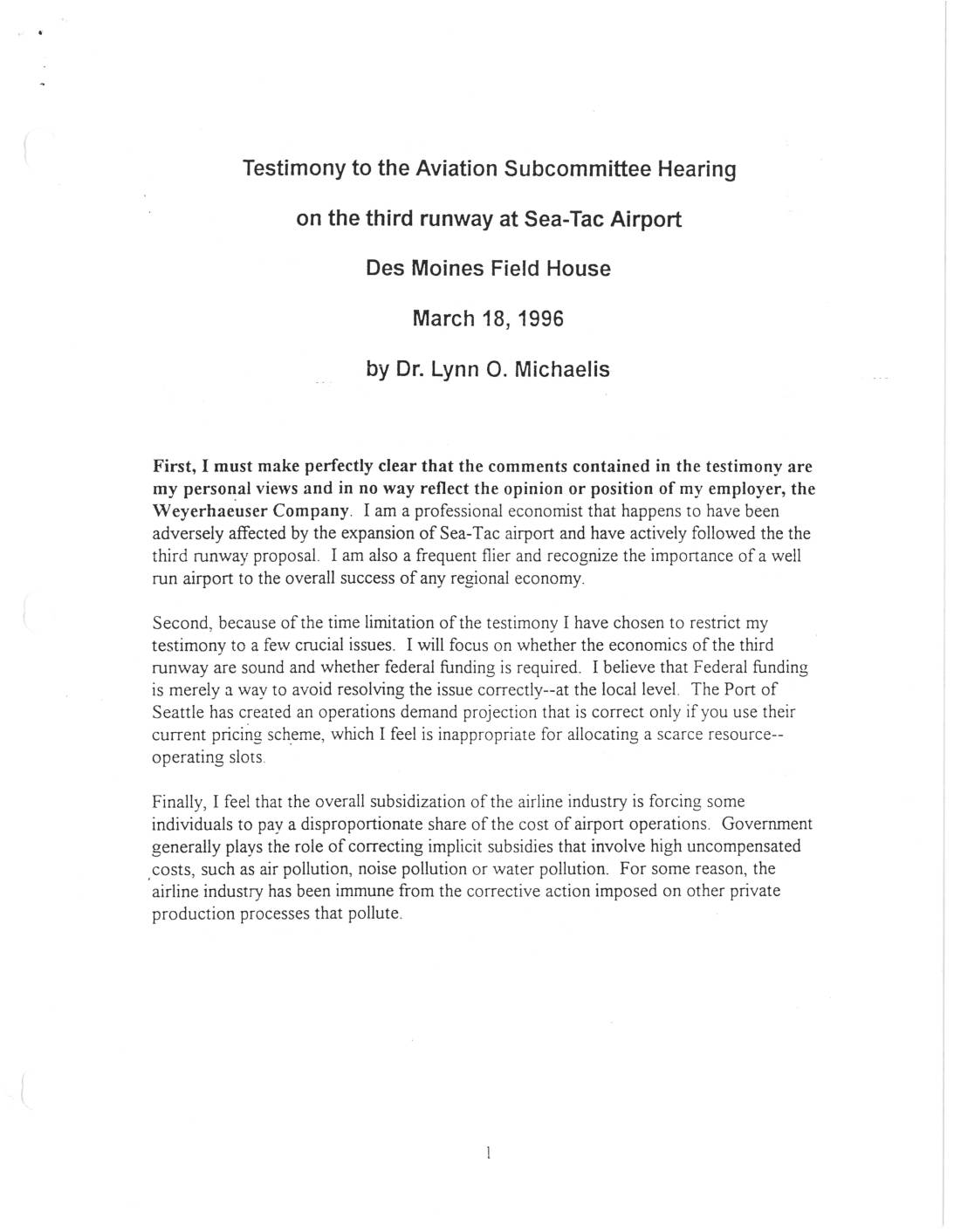
Testimony of Dr. Lynn O. Michaelis on the Third Runway at Sea-Tac Airport, Aviation Subcommittee Hearing, Des Moines Field House, March 18, 1996
In this 1996 testimony to the Aviation Subcommittee, economist Dr. Lynn O. Michaelis argues that the proposed third runway at Seattle-Tacoma International Airport is economically unjustified, citing flawed pricing schemes that fail to account for peak-hour demand and encourage inefficient small-plane operations. He contends that federal funding is being used to bypass local accountability, masking the project's poor return on investment — estimated at less than 1% on a $500 million expenditure. Michaelis also criticizes the airline industry's exemption from pollution-related cost corrections that apply to other industries, arguing that nearby residents bear a disproportionate share of the environmental costs. -
1996-03-18
Testimony of Dr. Lynn O. Michaelis on the Third Runway at Sea-Tac Airport, Aviation Subcommittee Hearing, Des Moines Field House, March 18, 1996
Testimony by Dr. Lynn O. Michaelis, economist at Weyerhaeuser Company, to the Aviation Subcommittee hearing on the proposed third runway at Sea-Tac Airport, delivered at Des Moines Field House on March 18, 1996. Michaelis argues that the Port of Seattle’s demand projections are based on a faulty per-pound landing pricing scheme that fails to allocate -
 1993-12-22
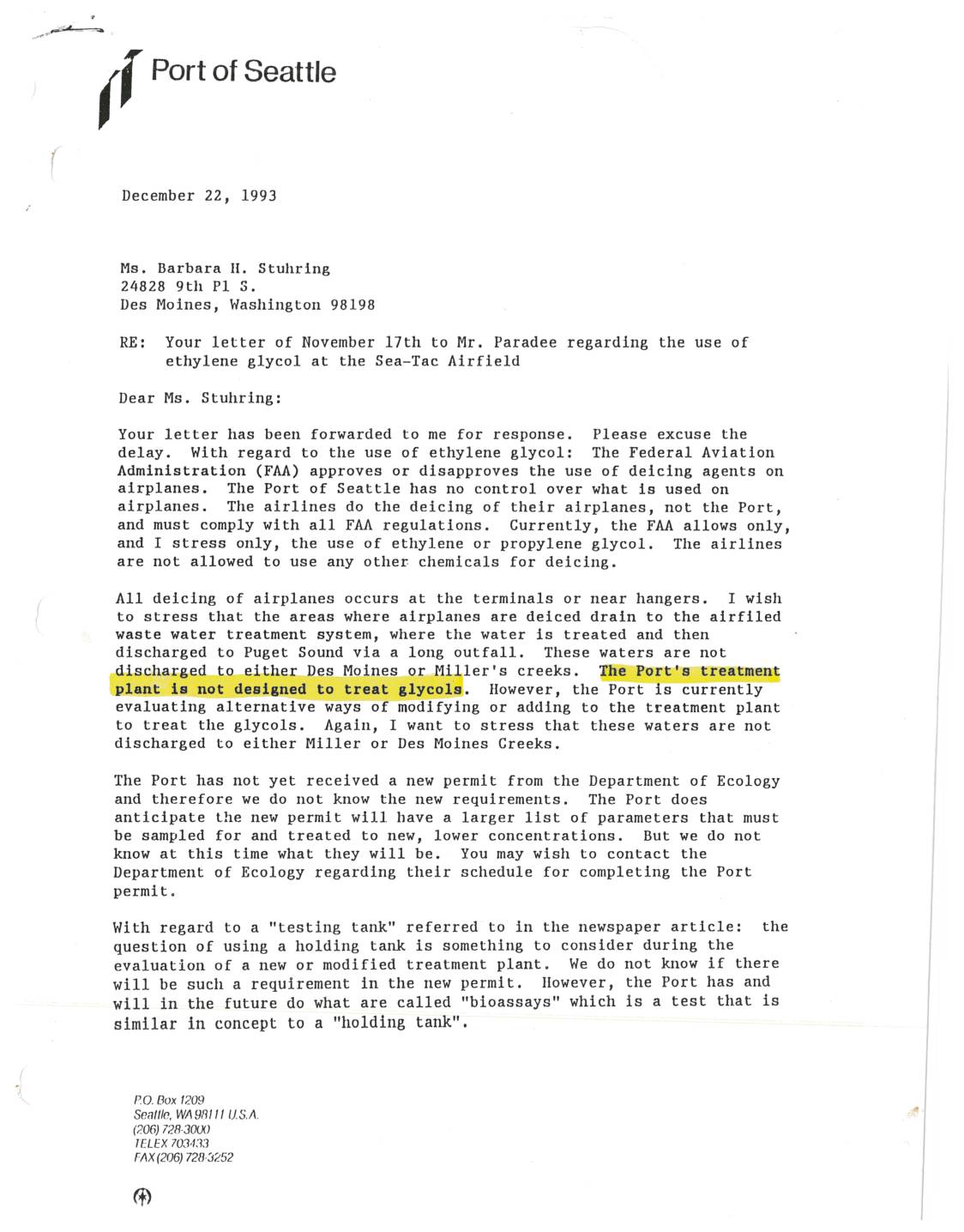
Port Of Seattle Letter to Barbara Stuhring: Ethylene Glycol Deicing at Sea-Tac Airport and Wastewater Treatment
December 22, 1993 letter from Port of Seattle to Barbara H. Stuhring of Des Moines, WA responding to her November 17 inquiry about ethylene glycol and propylene glycol deicing fluid use at Sea-Tac Airport. Letter states FAA requires only ethylene or propylene glycol for aircraft deicing, that deicing areas drain to the airfield wastewater treatment -
1993-12-22
Port Of Seattle Letter to Barbara Stuhring: Ethylene Glycol Deicing at Sea-Tac Airport and Wastewater Treatment
A 1993 letter from the Port of Seattle to a Des Moines resident explains that airline deicing at Sea-Tac Airport uses only FAA-approved ethylene or propylene glycol, and that wastewater from deicing drains to the airport's treatment system before being discharged to Puget Sound — not to Miller or Des Moines Creeks. The Port acknowledged its treatment plant was not designed to handle glycols and was evaluating upgrades. A follow-up 1996 letter challenges a contradictory statement in the airport's Final Environmental Impact Statement, which claimed most deicing fluids were contained and treated by the Port's Industrial Wastewater System. -
 1993-03-03
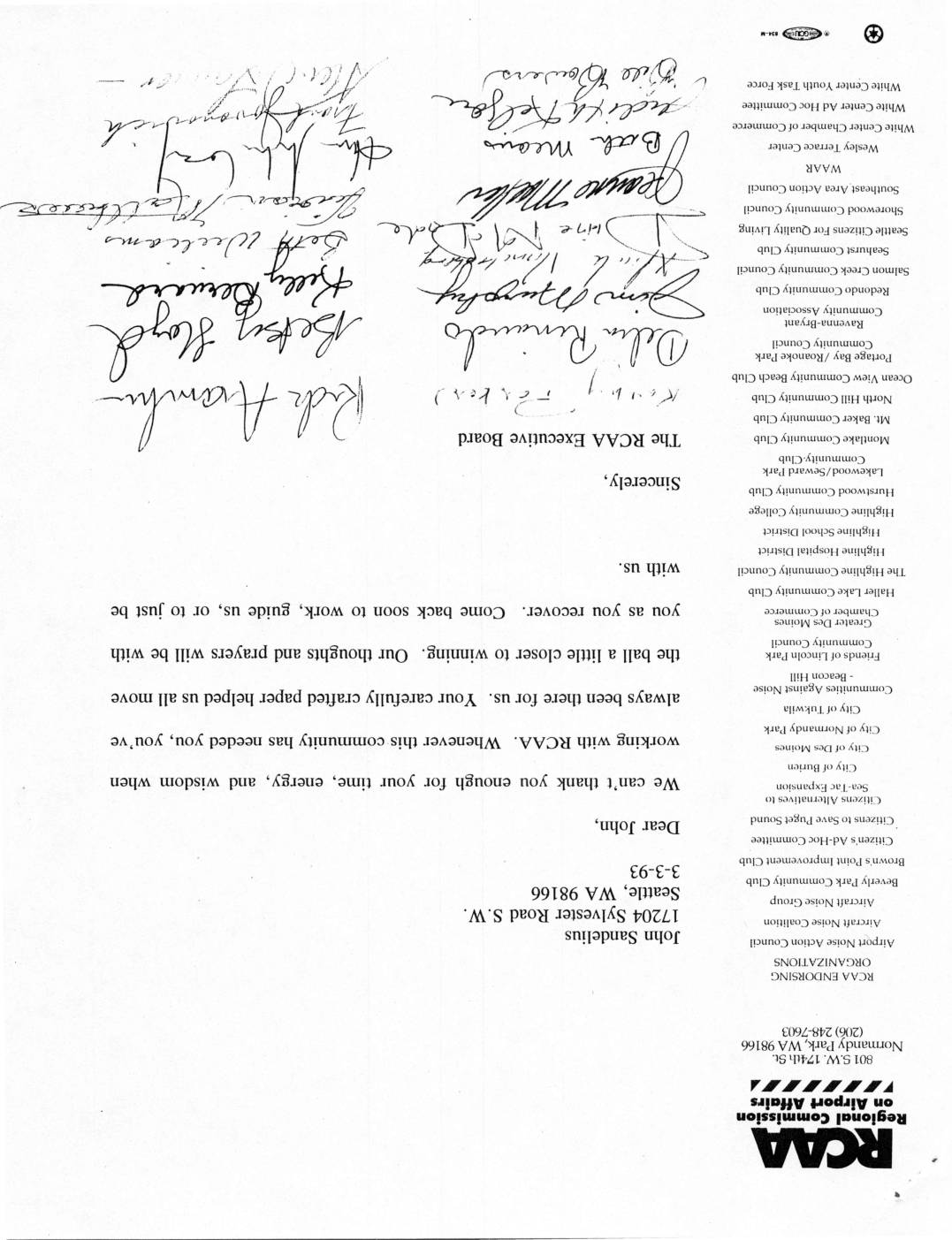
RCAA letter to John Sandelius
A March 1993 letter from the RCAA (Regional Commission on Airport Affairs) Executive Board addressed to John Sandelius of Seattle, thanking him for his time, energy, and wisdom contributed to the organization's efforts regarding Sea-Tac Airport noise issues. The letter expresses well-wishes for his recovery and notes that his work was valued whenever the community needed him. The document is endorsed by a wide coalition of over 50 community organizations, city governments, and civic groups from the greater Seattle and South King County area opposing airport noise expansion.