TagEPA(100)
-
 2020-02-01
Model-extrapolated estimates of airborne lead concentrations at U.S. airports
This EPA technical report estimates airborne lead concentrations near U.S. airports caused by piston-engine aircraft burning leaded aviation gasoline (avgas). Using air quality modeling and extrapolation methods, the study identifies airports where lead levels may exceed national air quality standards, particularly in areas close to aircraft run-up zones. While not specific to Sea-Tac Airport, the findings are relevant to understanding aviation-related air quality impacts at airports nationwide. -
 2019-11-07
EPA Region 10 response to Debi Wagner regarding Sea-Tac Airport environmental impacts and SAMP Near-Term Projects
These two letters from 2019 address community concerns about noise and environmental impacts from Seattle-Tacoma International Airport (Sea-Tac). The EPA's Region 10 Regional Administrator responds to a Burien resident, explaining the agency's limited role in the NEPA review process and directing her to engage with the FAA regarding the Sustainable Airport Master Plan (SAMP) Environmental Assessment. Separately, the Port of Seattle's Executive Director responds to Burien's mayor, acknowledging community concerns about aircraft noise and emphasizing the Port's commitment to collaboration through forums such as the Sea-Tac Stakeholder Advisory Round Table (StART). -
 2019-09-01
Research, policies, and program options for improving indoor environmental quality
This EPA report, prepared by David Mudarri PhD in 2018, reviews the state of science on indoor environmental quality and outlines research, policy, and program options for improving it. The synthesis paper was developed to help the EPA establish research goals, objectives, and priorities across a wide range of indoor environmental topics and time frames. It is intended solely for internal EPA use due to the inclusion of copyrighted material from broad-based review articles. -
The Supreme Court’s Covert Plan to Gut the EPA’s Powers
Ian Millhiser/June 21, 2019 The conservative justices signaled they want to limit agencies’ ability to regulate. That could have disastrous consequences for the planet. Nearly four decades ago, Anne Gorsuch Burford resigned as the head of the Environmental Protection Agency. Though at the helm for less than two years, she left behind a notorious anti-environment -
 2018-12-21
Beacon Hill noise measurement project summer 2018
In summer 2018, Beacon Hill residents partnered with University of Washington researchers to measure noise levels at 52 locations across Seattle's Beacon Hill neighborhood over several months, collecting 136 separate 24-hour measurement periods. The study found that the neighborhood is heavily affected by aircraft noise from three nearby airports — Seattle-Tacoma International, King County International, and Renton Municipal — with Sea-Tac arrival flight paths directly overlying the area and King County International Airport runways located as close as a quarter mile away. The project represents the first quality-assured, community-led noise dataset of its kind for Beacon Hill, and was designed to inform future research into the health impacts of airport noise on residents. -
 2018-12-19
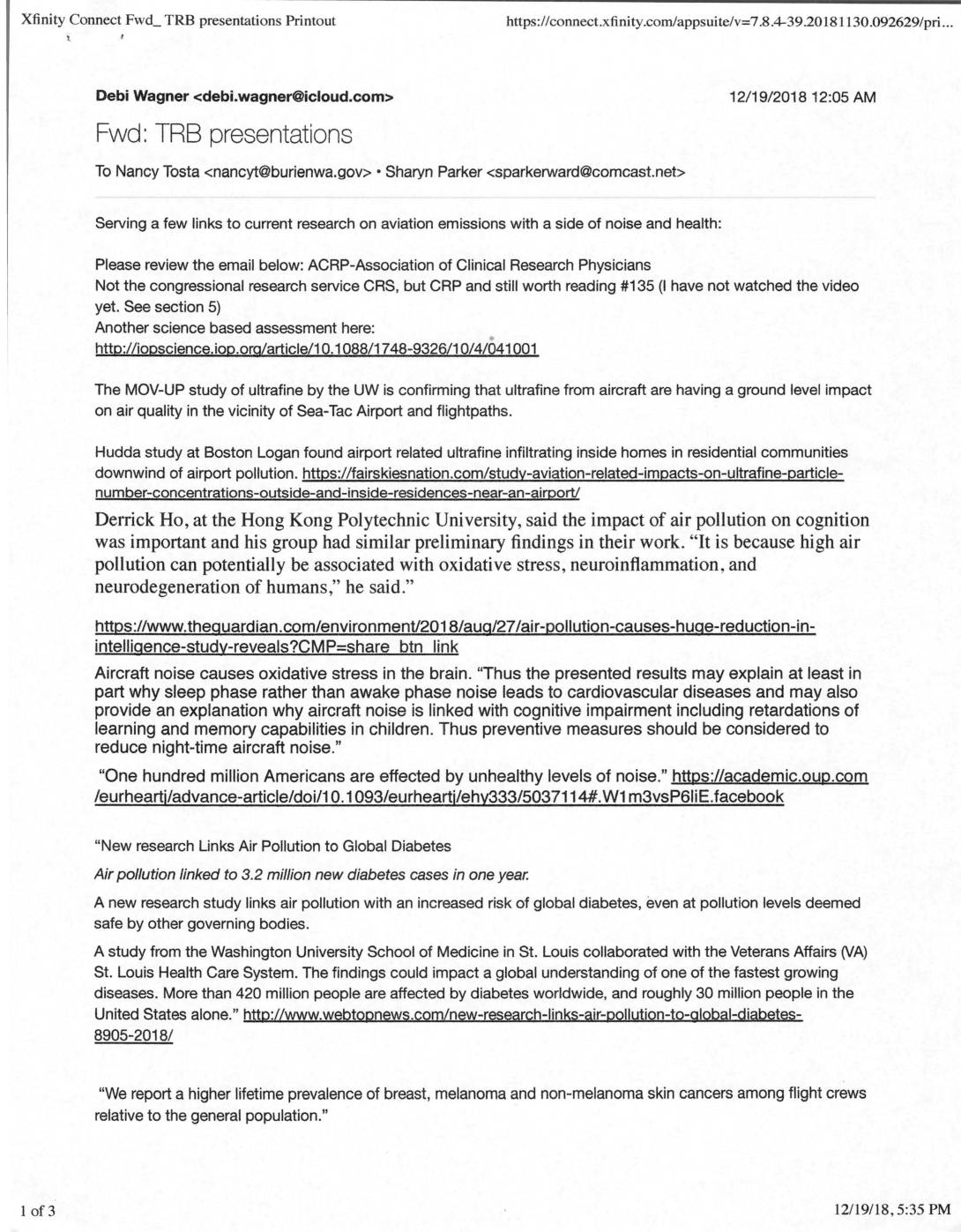
Fwd: TRB presentations
A December 2018 email chain forwarded by community advocate Debi Wagner to Burien city officials shares research links connecting aviation emissions and aircraft noise to serious public health concerns, including ultrafine particle pollution, cognitive impairment, cardiovascular disease, and cancer. The email references studies such as the University of Washington's MOV-UP study confirming ground-level ultrafine particle impacts near Sea-Tac Airport, as well as EPA Region X recommendations for resources on airport air quality and public health. The correspondence highlights growing community and regulatory interest in understanding the health effects of airport operations on neighborhoods surrounding Sea-Tac. -
 2018-07-01
Residential air cleaners: A technical summary
This EPA technical guide explains how residential air cleaners and HVAC filters work to reduce indoor air pollutants, covering different device types, their effectiveness, and health impacts. It reviews technologies such as fibrous media filters, HEPA filters, electrostatic precipitators, and ionizers, while noting important cautions about byproduct emissions like ozone. Though focused on home air quality rather than airport noise policy, it offers useful background on indoor environmental controls for residential settings near noise-impacted areas. -
 2018-04-10
Commission agenda memorandum: Amendment with Just Health Action for Duwamish Valley community engagement project
The Port of Seattle Commission considered a request to amend a contract with Just Health Action, a local community health nonprofit, to continue a pilot project engaging residents of the Duwamish Valley neighborhoods of South Park and Georgetown. The project, supported by a U.S. EPA Stakeholder Engagement and Capacity Building grant awarded in 2017, focuses on improving the Port's community outreach practices and addressing environmental health concerns in low-income and minority communities near Port operations. The total estimated project cost was $175,000, with the amended contract value reaching $224,999. -
 2018-01-30
Notice of Near-port Community Capacity Building Pilot Project Extension
In January 2018, EPA project lead Sabrina Johnson notified partners that the Near-port Community Capacity Building Pilot Project deadline was extended from June to September 30, 2018. The extension was granted to better address project partners' concerns and support more durable outcomes, while still encouraging participants to maintain an expeditious pace. Capacity building under this EPA initiative focuses on improving conditions and removing barriers to effective community functioning near port areas.