TagEnvironmental Review(48)
-
 2024-02-28
Sustainable Airport Master Plan Near-Term Projects Environmental Review
The Port of Seattle presented an environmental review of near-term construction projects at Seattle-Tacoma International Airport as part of its Sustainable Airport Master Plan. Projects include expanded passenger terminals and gates to handle a projected 56 million annual passengers, additional cargo facilities, airfield safety upgrades to meet FAA standards, taxiway efficiency improvements, and new fuel storage to support Sustainable Aviation Fuel initiatives. The review maps out how these developments will be assessed for their environmental impacts across the airport and surrounding areas. -
 2023-09-26
SAMP Near Term Projects EA: Scoping Comments Received (Attachment 4a-c)
This document compiles public and agency scoping comments received during the environmental review process for Seattle-Tacoma International Airport's SAMP (Sustainable Airport Master Plan) Near Term Projects. Comments are organized into 22 topical categories, covering issues such as noise, air quality, transportation, water resources, and human health, and are labeled to indicate whether they directly relate to the SAMP Near Term Projects or address broader airport concerns. Each comment is coded for easy reference, allowing readers to track specific concerns raised by the public and agencies throughout the scoping process. -
 2023-08-14
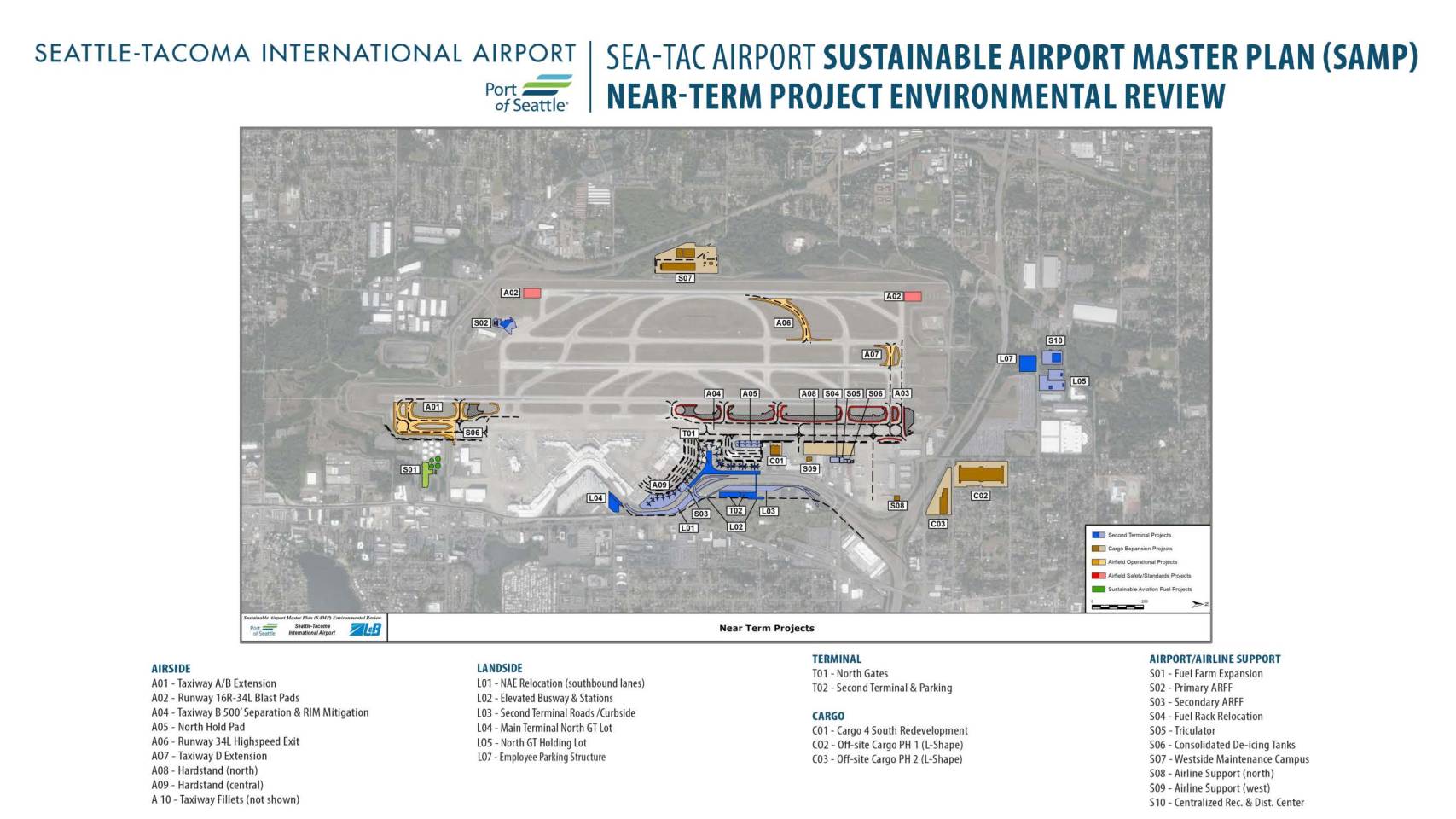
Sea-Tac Airport Sustainable Airport Master Plan (SAMP): Near-Term Project Environmental Review Map
The Sea-Tac Airport Sustainable Airport Master Plan (SAMP) Near-Term Project Environmental Review outlines a comprehensive set of planned improvements at Seattle-Tacoma International Airport, covering airside, landside, terminal, cargo, and airport support facilities. Key projects include taxiway and runway upgrades, a new second terminal with associated roads and parking, cargo facility expansions, and sustainability initiatives such as sustainable aviation fuel infrastructure and consolidated de-icing tanks. These near-term projects are intended to enhance airport capacity, safety, and operational efficiency while supporting the airport's long-term growth strategy. -
 2023-04-28
The foundational elements of the Federal Aviation Administration civil aviation noise policy: The noise measurement system, its component noise metrics, and noise thresholds
The FAA is reviewing its civil aviation noise policy, which is based on decades-old research, to better address how aircraft noise affects communities near airports like Sea-Tac. The review examines noise measurement systems, acceptable noise thresholds, and the impact of aviation noise on residents—including annoyance, sleep disturbance, and health effects. Public and stakeholder input is being sought to help modernize the policy. -
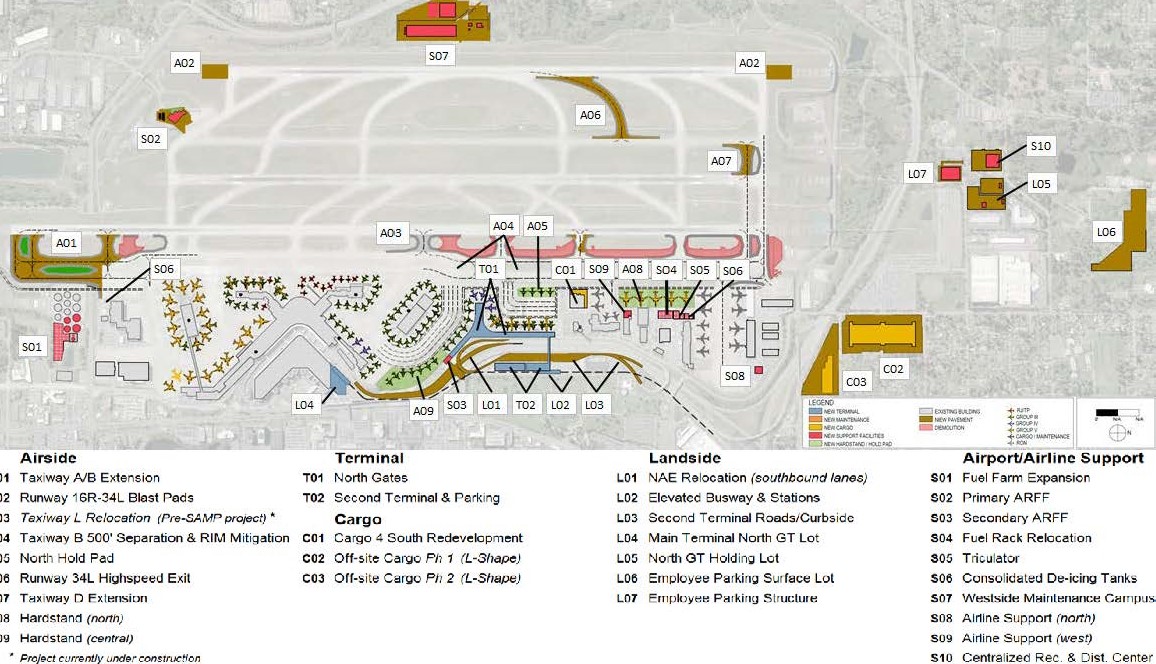
180620-SAMP NTP Presentation-Public-Meeting 16-NTP-Environmental Review-cropped
An aerial planning map of Seattle-Tacoma International Airport (Sea-Tac) showing proposed capital improvement projects categorized into Airside, Terminal, Cargo, Landside, and Airport/Airline Support elements. Projects are color-coded by type (new terminal, new pavement, new cargo, new support facilities, demolition, new hardstand/hold pad) and labeled with alphanumeric identifiers including runway extensions, taxiway relocations, new terminal gates, cargo redevelopment areas, and employee parking structures. -
 2022-06-23
Sustainable Airport Master Plan Near Term Projects: Environmental Review Update
This June 2022 presentation by Des Moines Chief Strategic Officer Susan Cezar provides an update on the environmental review of Near Term Projects under the Port of Seattle's Sustainable Airport Master Plan (SAMP). It outlines the history of the review process dating back to 2015, including a multi-city inter-local agreement between Des Moines, Burien, Normandy Park, and SeaTac to coordinate responses to the Port's environmental documents. City staff continue to monitor the Port's compliance with federal (NEPA) and state (SEPA) environmental requirements as airport capital projects move forward. -
 2021-09-20
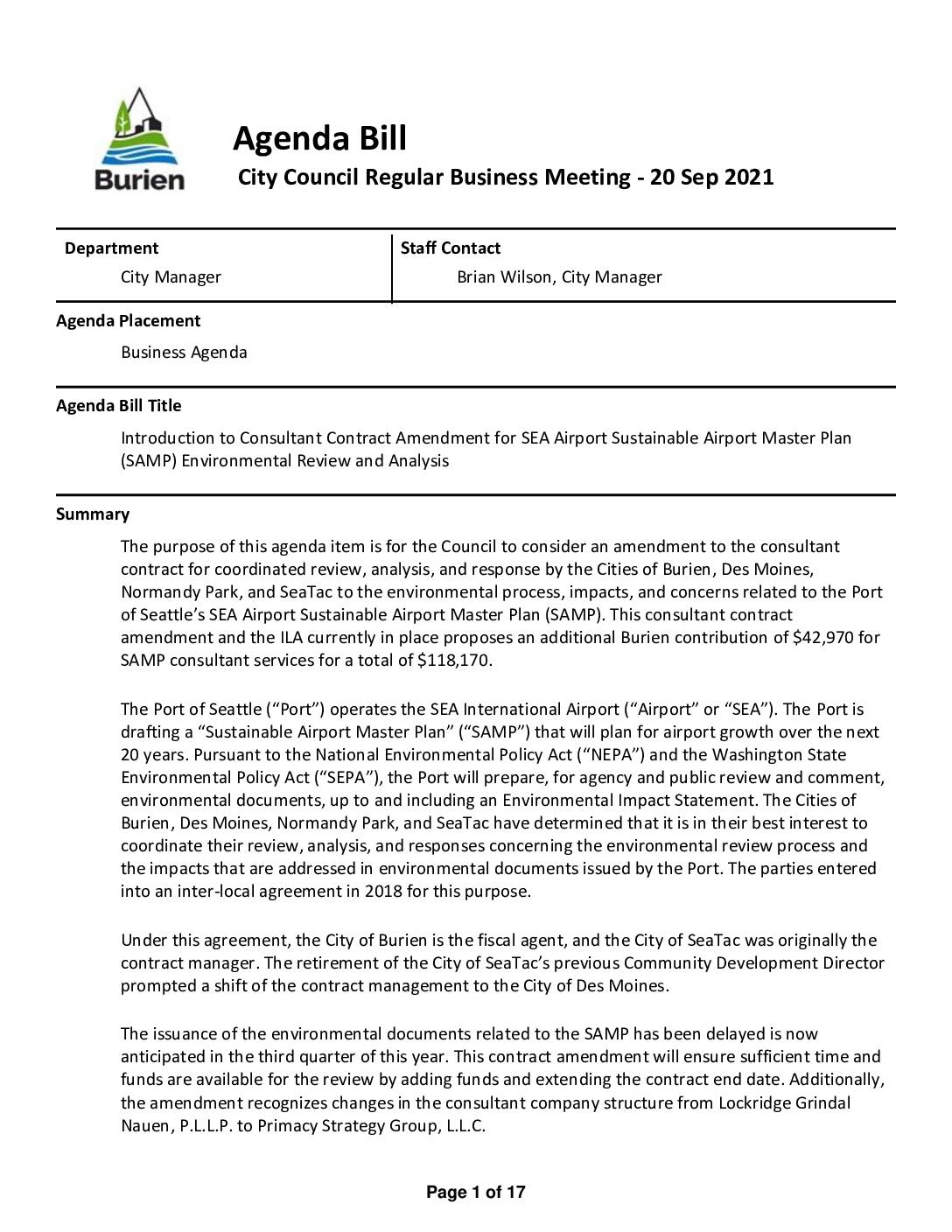
Burien consultant contract amendment for sustainable airport master plan (SAMP) environmental review and analysis
In September 2021, the City of Burien considered approving an additional $42,970 contribution to a shared consultant contract with the cities of Des Moines, Normandy Park, and SeaTac to review and respond to the Port of Seattle's Sustainable Airport Master Plan (SAMP), which outlines airport growth over the next 20 years. The four cities entered into an inter-local agreement in 2018 to coordinate their environmental review and formal comments on noise and other impacts associated with SEA International Airport expansion. The contract amendment also extended the agreement's end date from 2021 to 2023 and recognized a change in the consulting firm from Lockridge Grindal Nauen to Primacy Strategy Group. -
 2021-06-03
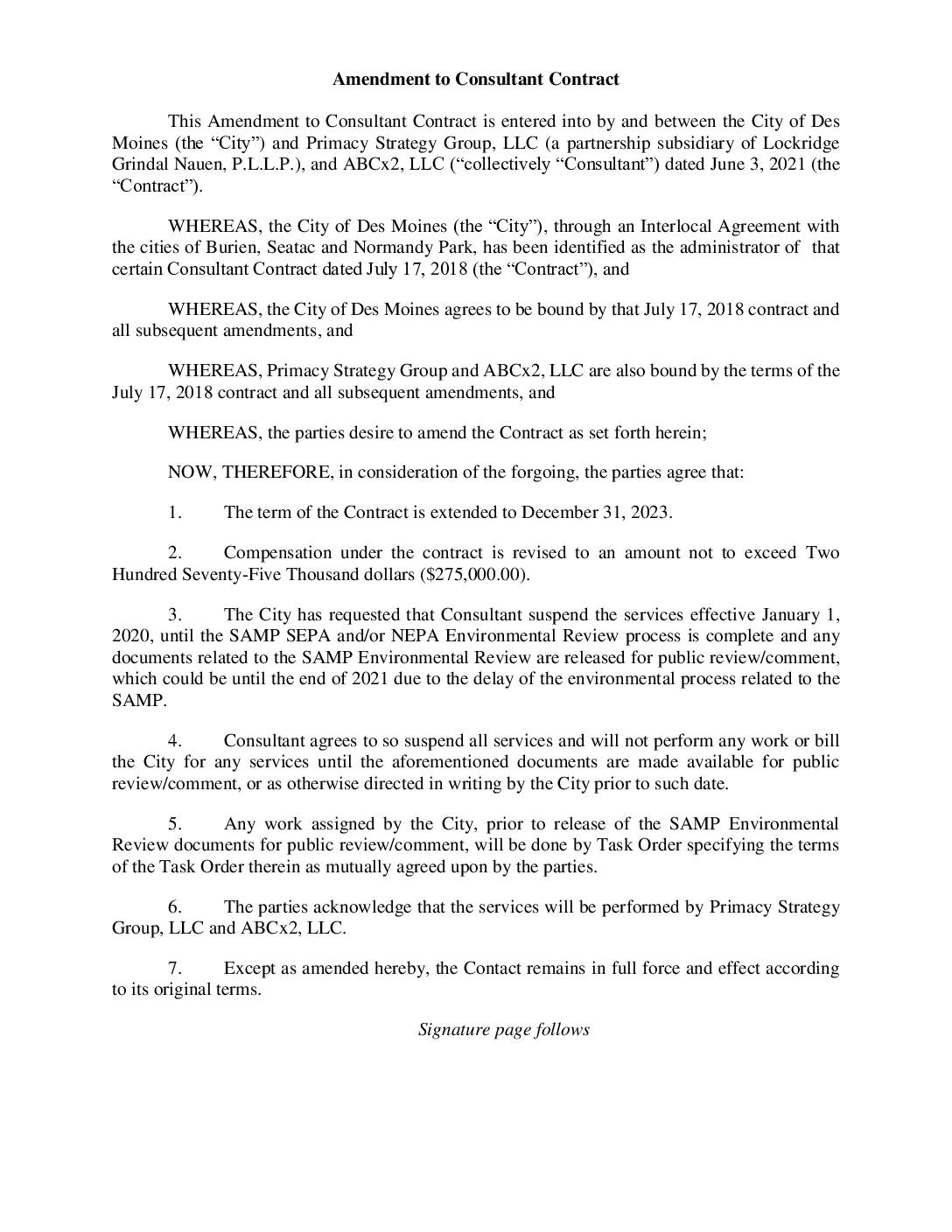
Amendment to consultant contract
This June 2021 amendment to a consultant contract extends an agreement between the City of Des Moines, WA and two consulting firms—Primacy Strategy Group, LLC and ABCx2, LLC—through December 31, 2023, with a maximum compensation of $275,000. The contract, originally signed in 2018 and administered by Des Moines on behalf of a partnership with the cities of Burien, SeaTac, and Normandy Park, relates to advocacy and consulting work connected to Sea-Tac Airport's environmental review process (SAMP SEPA/NEPA). Consulting services were suspended as of January 1, 2020, pending the public release of SAMP Environmental Review documents, with any interim work to be authorized by the City through individual Task Orders. -
 2020-02-01
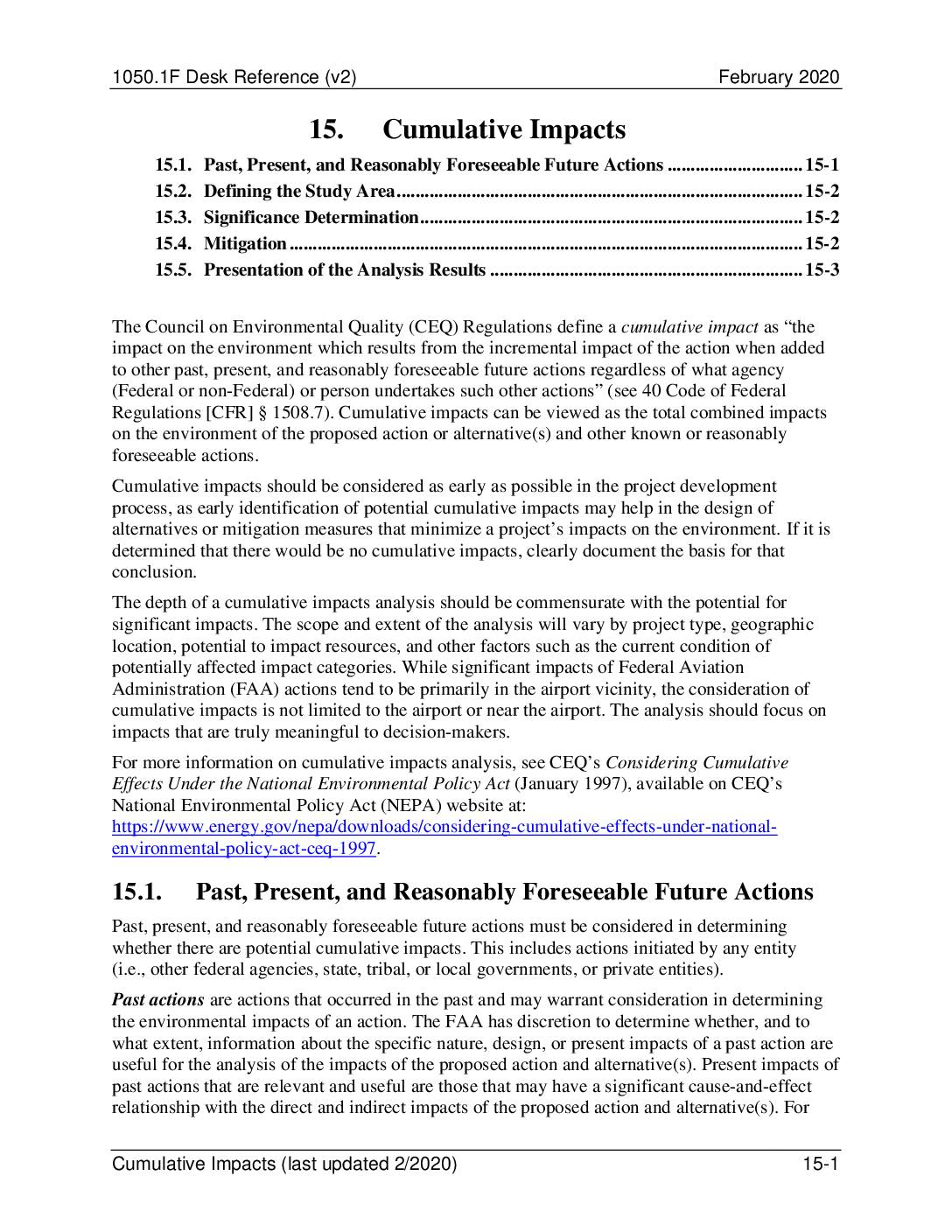
Cumulative impacts: 1050.1F desk reference (v2)
★ 32This FAA guidance document explains how to analyze cumulative environmental impacts for aviation projects, meaning the combined effect of an airport action together with other past, present, and foreseeable future actions by any agency or party. It outlines how to define the study area, determine significance, and consider mitigation, noting that even individually minor impacts can together become significant. While focused on FAA projects broadly, it is relevant to noise and environmental planning at airports like Sea-Tac, where surrounding development and multiple simultaneous projects can compound environmental effects. -
 2019-11-18
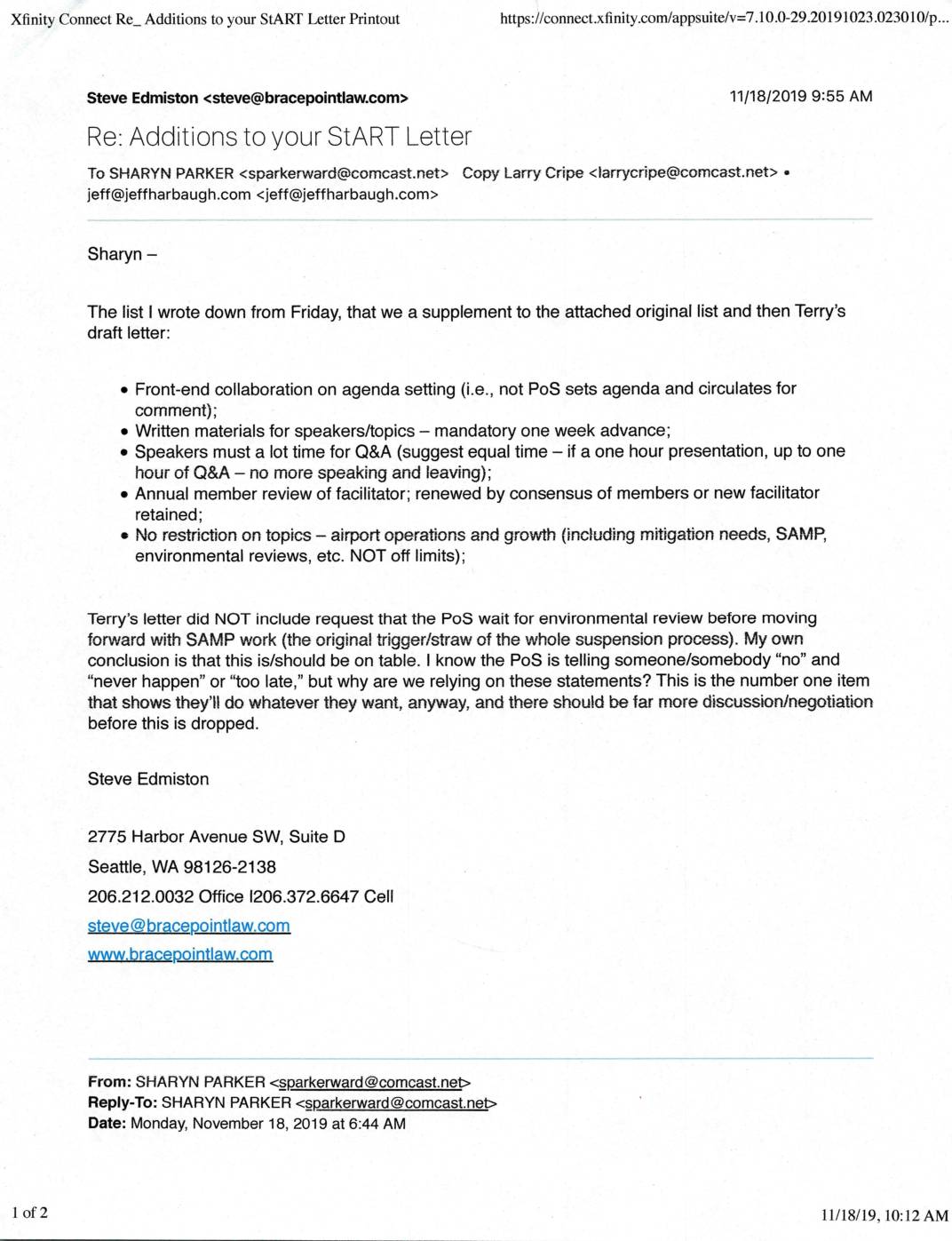
Re: Additions to your StART letter
In November 2019, attorney Steve Edmiston and community members Sharyn Parker and others discussed conditions for re-engaging with the StART (Sea-Tac Airport Roundtable) community advisory process, which had been suspended. Key demands included collaborative agenda-setting, mandatory advance distribution of written materials, equal time for public Q&A, annual review of the facilitator, no restrictions on topics including the airport's growth and environmental reviews, and a request that the Port of Seattle pause its SAMP (Sustainable Airport Master Plan) work pending environmental review. Sharyn Parker's written responses indicated support for re-engagement only if those conditions were met, and called for the Port to conduct a new Part 150 noise study, accelerate sound mitigation, and create a 'second-chance' insulation program for affected residents.