TagDNL65(39)
-
 2023-06-07
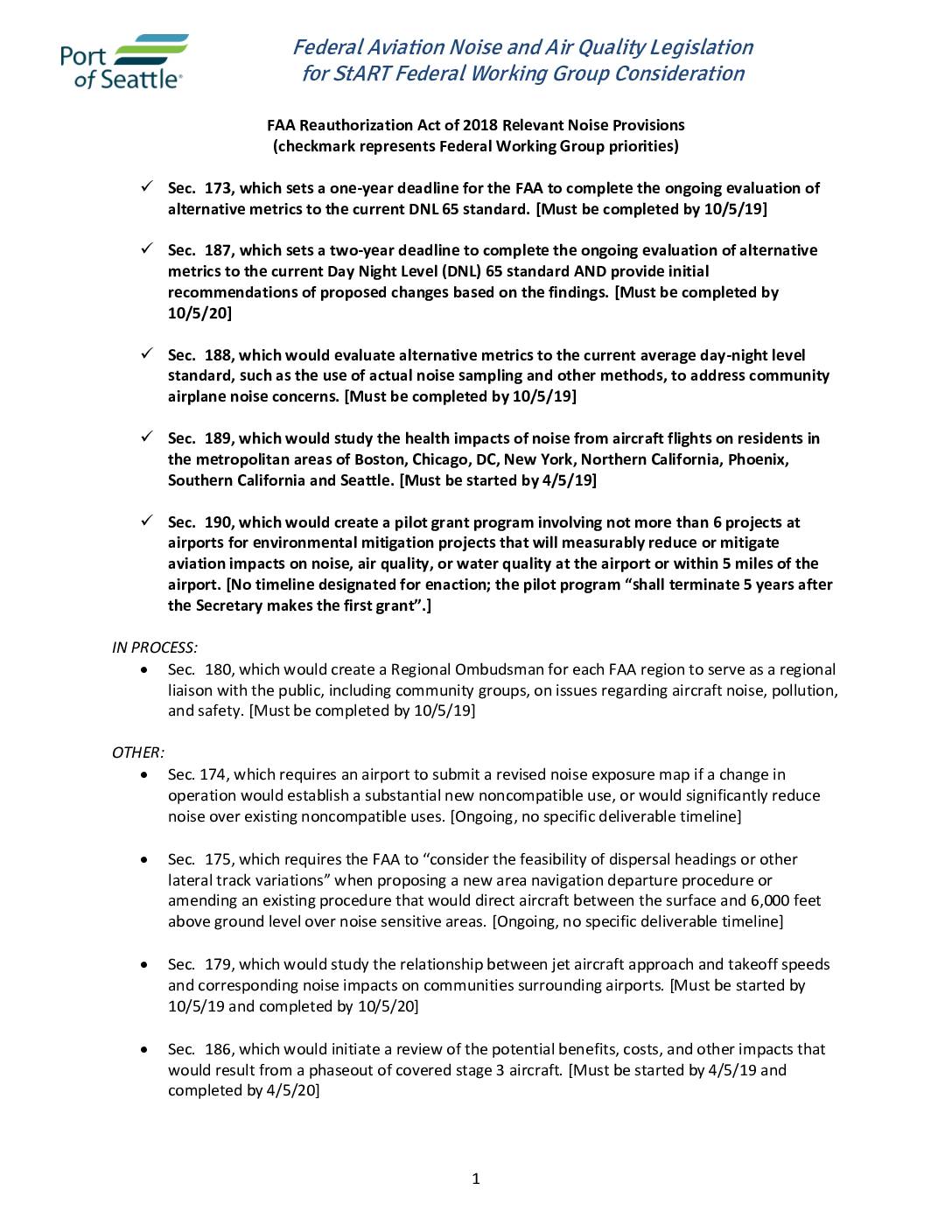
Federal aviation noise and air quality legislation for StART Federal Working Group consideration
This Port of Seattle document outlines key federal aviation noise and air quality legislation relevant to the StART (Sea-Tac Airport Roundtable) Federal Working Group, including provisions from the FAA Reauthorization Act of 2018 and proposed 2019 legislation. It highlights priority items such as evaluating alternatives to the DNL 65 noise standard, studying health impacts of aircraft noise in major metro areas including Seattle, and creating environmental mitigation grant programs for airports. Additional considerations include secondary noise insulation, increased funding for federal noise programs, and greater flexibility for local communities to address aviation impacts. -
 2023-04-24
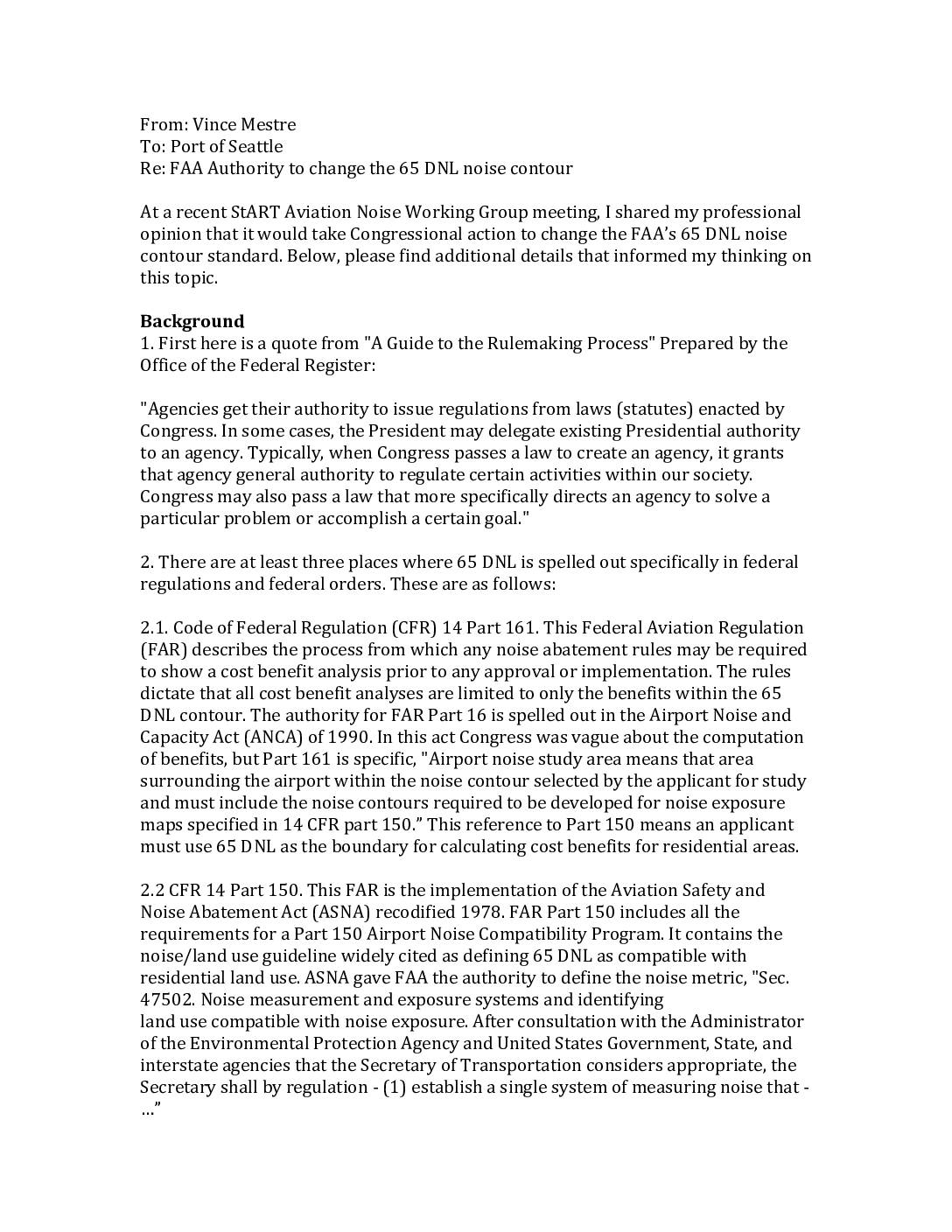
FAA authority to change the 65 DNL noise contour
Aviation noise consultant Vince Mestre explains to the Port of Seattle why changing the FAA's 65 DNL noise contour standard — the threshold used to determine acceptable aircraft noise near residential areas — would likely require an act of Congress rather than a simple regulatory update. The 65 DNL standard is embedded in at least three federal regulations and orders (CFR 14 Parts 150 and 161, and FAA Order 1050.1F), all of which trace their authority back to enabling legislation such as the Aviation Safety and Noise Abatement Act (ASNA) of 1978 and the Airport Noise and Capacity Act (ANCA) of 1990. Because the FAA's rulemaking authority is granted and bounded by those Congressional statutes, modifying ASNA would most likely be required before the FAA could formally lower or otherwise change the noise compatibility standard. -
 2022-12-05
The FAA’s 65 dBA DNL is not a safe noise exposure level for the American public
Academic paper presented at the 183rd Meeting of the Acoustical Society of America arguing that the FAA’s 65 dBA day-night average sound level standard is not safe for public health. The paper discusses how the EPA calculated safer levels at 55 dB for outdoor activities and 45 dB for indoor activities, and examines the non-auditory -
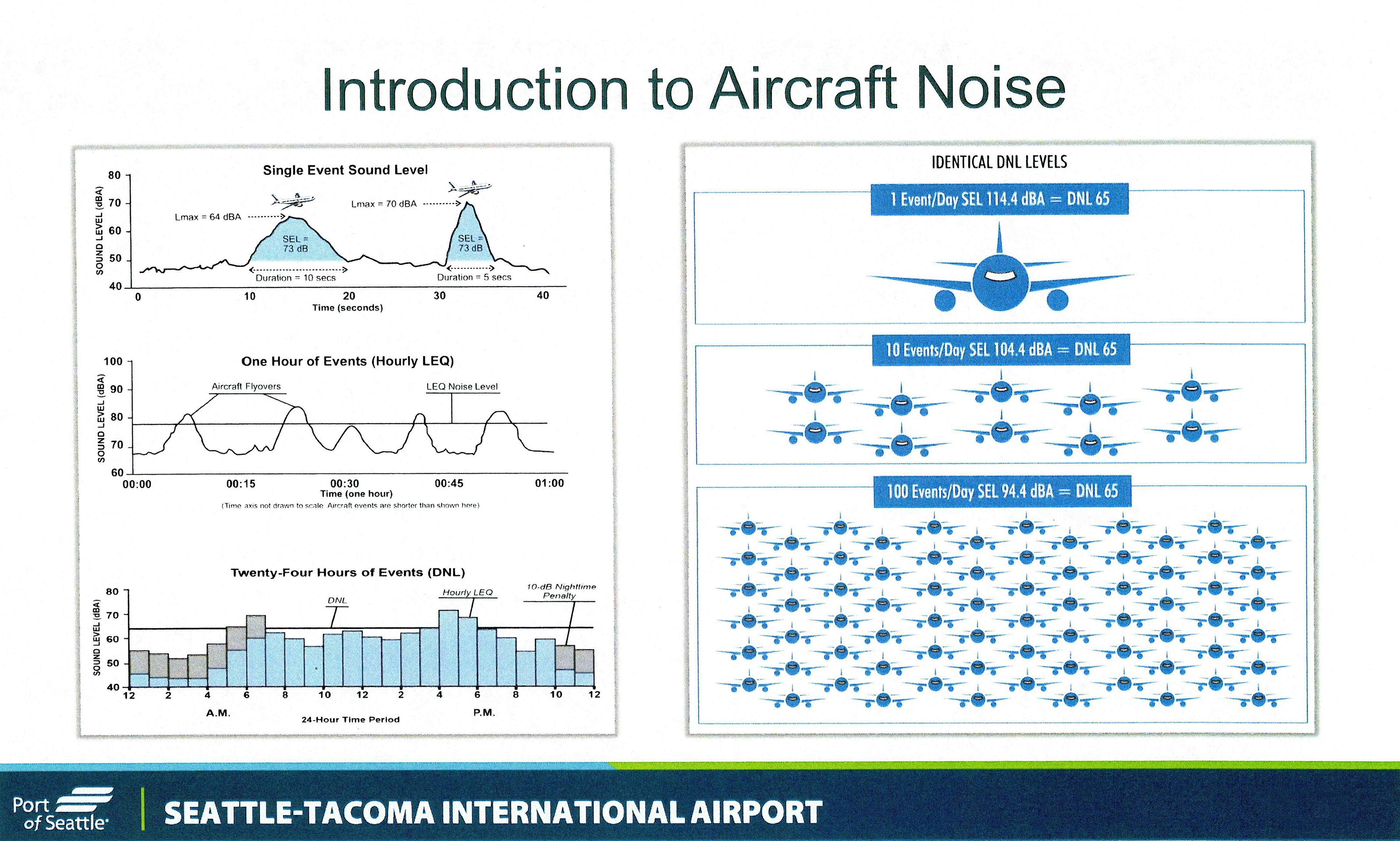
Calculating DNL65
We’ve often made the claim that DNL65 is not really a unit of measure. And when we say that it comes off as both condescending and patronizing. Okeedokee… If you want to understand DNL65, you should probably start by going to the regulations governing Airport Noise Compatibility and Planning aka Part 150. Got it? Great. -
x2-NEMPLOT_Future (2018) NEM NCP
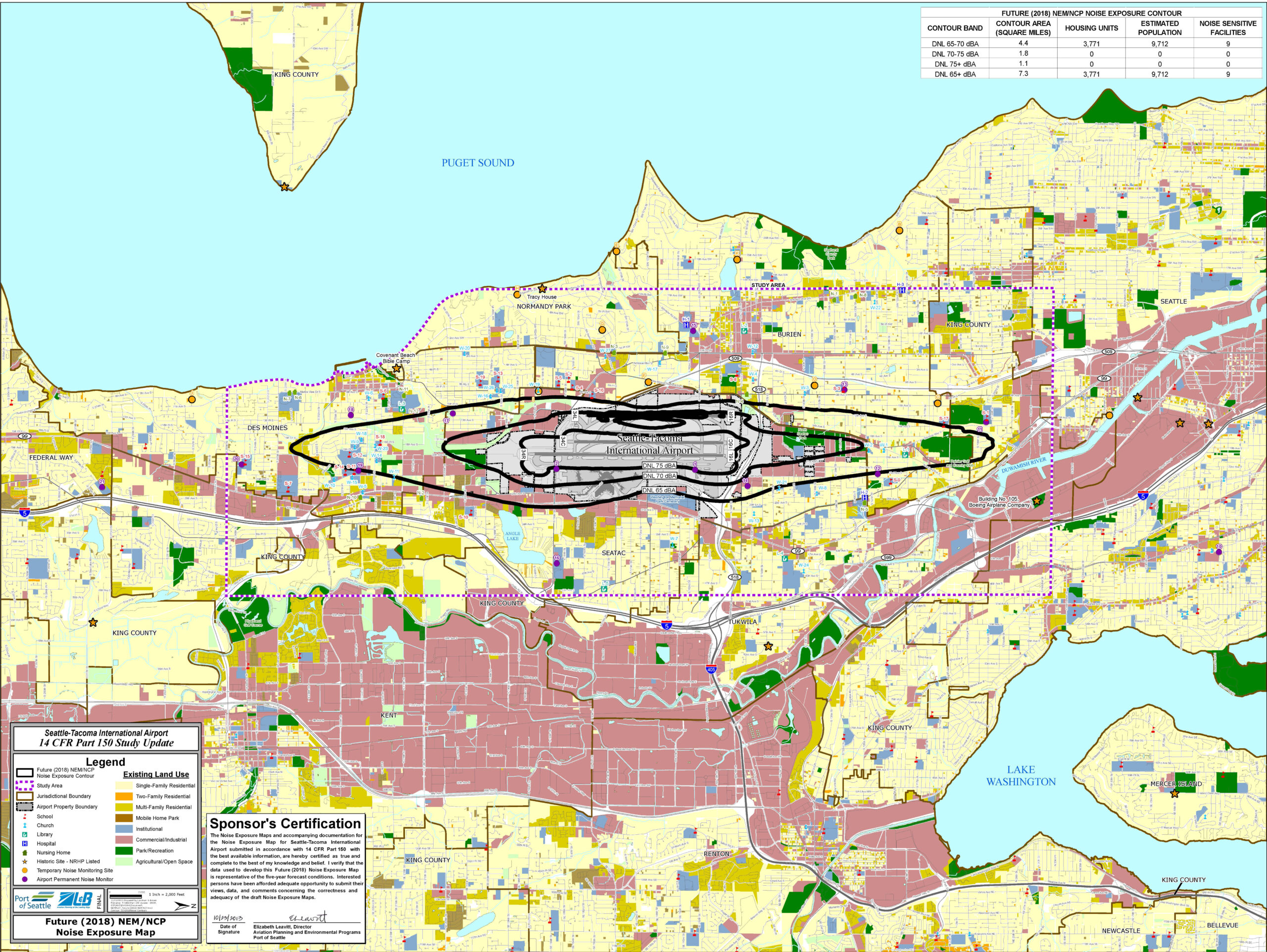
This is the Future (2018) Noise Exposure Map (NEM/NCP) for Seattle-Tacoma International Airport, produced as part of a 14 CFR Part 150 Study Update by the Port of Seattle. The map displays DNL noise contour bands (65–70, 70–75, and 75+ dBA) over surrounding communities including SeaTac, Des Moines, Normandy Park, Burien, and Tukwila, with a data table showing an estimated 9,712 residents and 3,771 housing units within the DNL 65+ dBA contour area of 7.3 square miles. -
 2022-09-15
Compliance Guidance Letter 2022-03, FAA guidance regarding the use of airport revenue for noise insulation projects within the DNL 65 dBA and noise monitoring equipment purchases
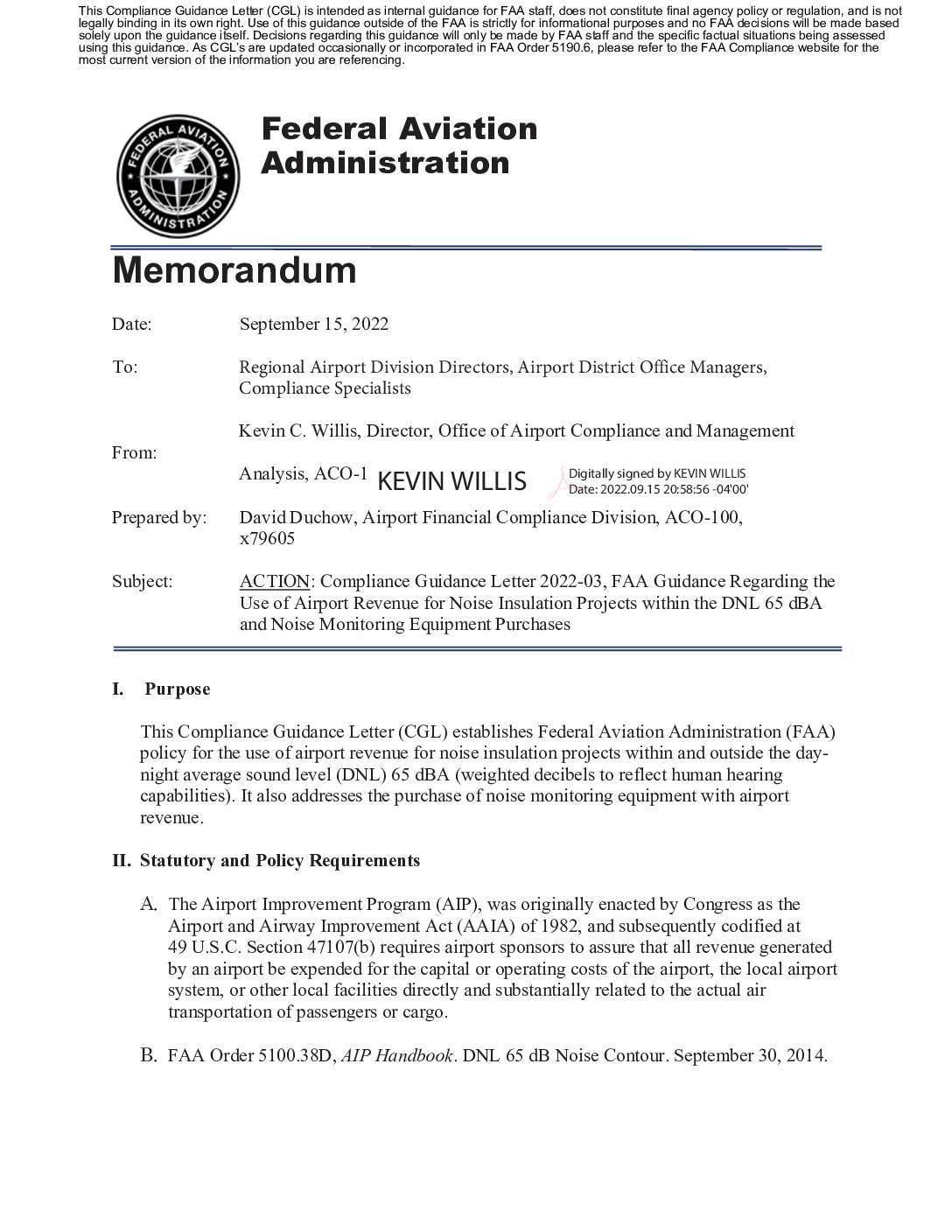
This 2022 FAA guidance letter explains how airports can legally spend airport revenue on noise insulation projects, such as new windows, doors, and air conditioning, for homes and schools located within the DNL 65 dBA noise contour — the federal threshold for significant aircraft noise impact. Spending airport revenue on noise insulation for properties outside that noise boundary is generally prohibited as revenue diversion, unless a lower local noise standard has been officially adopted or 'block rounding' has been approved. The letter also clarifies that airports may purchase mobile or permanent noise monitoring equipment using airport revenue, provided certain conditions are met, but monitors cannot be used to enforce noise abatement flight procedures. -
DNL65 NEM Part 150 Noise Contour Boundary 2018 Pages from 2016_10_11_SM_6b_supp
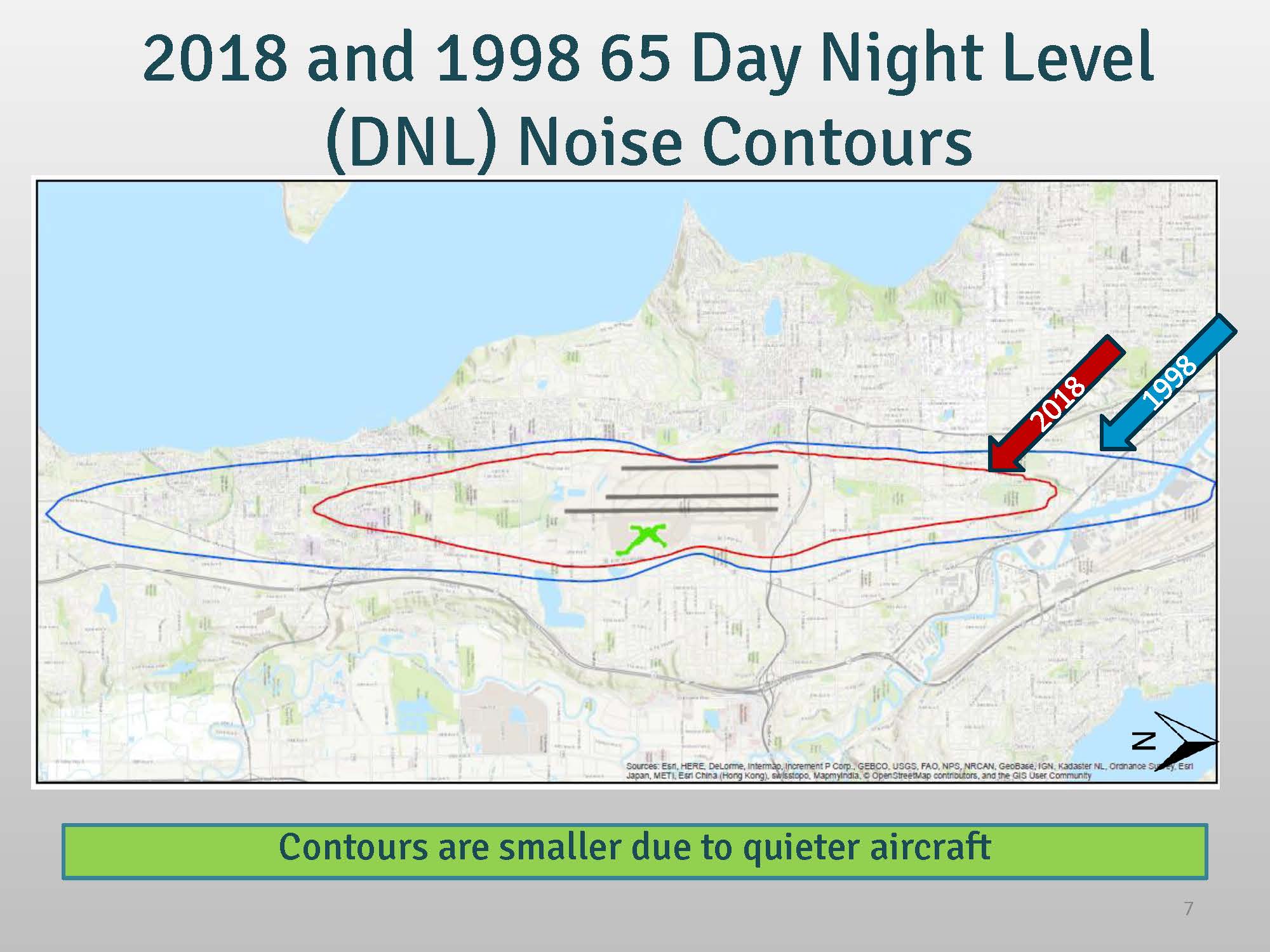
Slide 7 from a Sea-Tac Airport presentation comparing the 65 Day Night Level (DNL) noise contours for 1998 (blue outline) and 2018 (red outline), overlaid on a regional map. The caption notes that the 2018 contour is smaller than the 1998 contour due to quieter aircraft technology. -
2021 Projected Noise Boundary Map
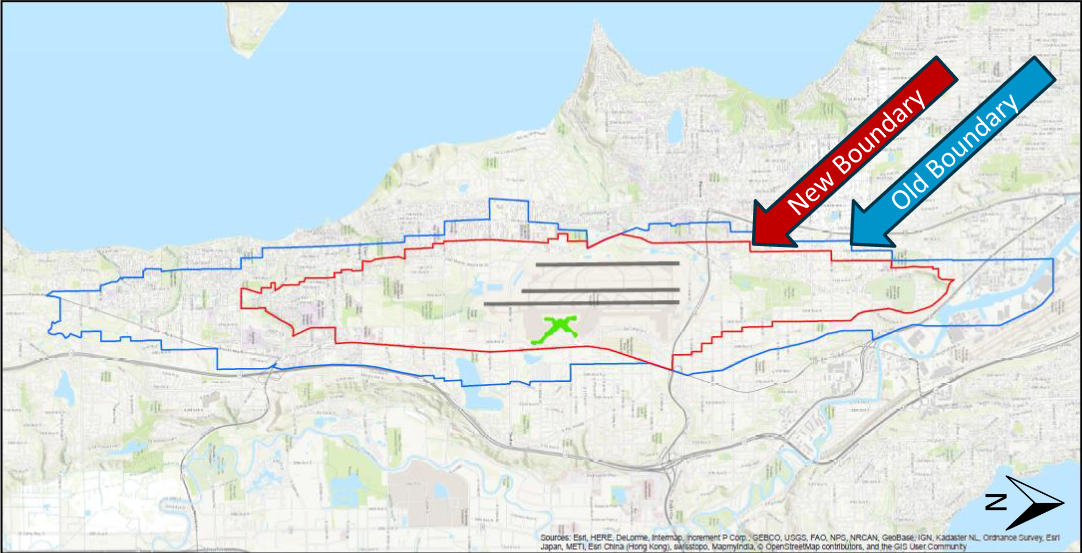
A GIS map comparing the old noise boundary (blue line) and new noise boundary (red line) around Seattle-Tacoma International Airport, with runway layout and airport symbol visible at center. Map data credited to Esri, HERE, DeLorme, Intermap, GEBCO, USGS, NPS, NRCAN, and other contributors. -
 2021-02-01
Analysis of the Neighborhood Environmental Survey
This 2021 FAA report analyzes the Neighborhood Environmental Survey (NES), a large-scale study examining how aircraft noise affects communities around 20 U.S. commercial airports. Researchers surveyed over 10,000 residents and found that annoyance with aircraft noise increases steadily as noise levels rise, with significantly more people reporting high annoyance than older studies had suggested. The findings provide an updated national curve showing the relationship between measured noise exposure (DNL) and community annoyance, which can inform airport noise policy decisions. -
 2020-09-23
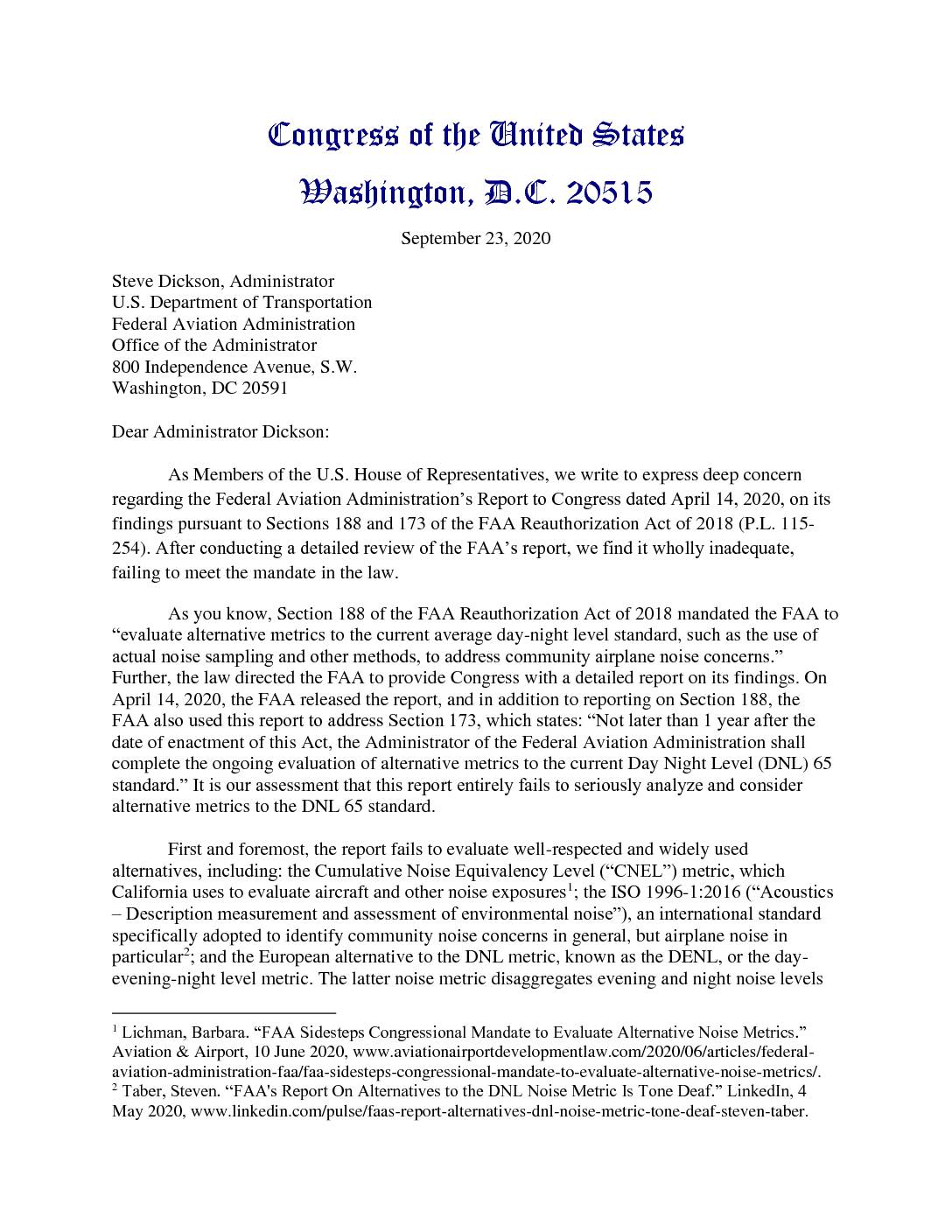
Congressional letter to FAA Administrator Steve Dickson on alternative noise metrics report
Currently, FAA law has extremely complicated rules for establishing a noise boundary around airports. (A noise boundary is a geographic area inside which there is a certain acceptable noise level.) This is referred to as the DNL65. and it has several major flaws. The FAA Reauthorization Act Of 2018 attempted to address these flaws in several ways. This letter, from a caucus of Congressmen engaged on airport community issues complains to the Administrator that the spirit of the law is not being adhered to and demands that he make attempts to put his agency into compliance. The language is fairly technical, however there are a couple of basic points they raise: First, that the noise boundary be determined by actual noise measurements (currently the noise boundaries are 'modeled' and those calculations often do not reflect in any way the lived experience for residents.) Second, that the 'acceptable' noise level of sixty five decibels (hence DNL65) has been determined to be far too high to conform with current understandings of healthy living.