TagDNL65(39)
-
2010-04-01
From Whence Came Ldn / DNL 65?
by Nick Miller With FAA developing a research roadmap, and fears (hopes?) expressed by many in our airport noise community that the compatibility guideline might change, I became “curiouser and curiouser” about the real origin of 65 DNL as various claims were made about its origin, its immutability, its arbitrariness, and its scientific basis or -
 2009-01-01
Compilation of noise programs in areas outside DNL 65
This 2009 report from the Airport Cooperative Research Program (ACRP) examines how airports across the country manage aircraft noise in communities that fall outside the standard DNL 65 decibel threshold typically used in federal noise policy. Compiled by consultants from Harris Miller Miller & Hanson, Inc., the synthesis documents real-world airport practices for addressing noise concerns in lower-noise areas that are nonetheless affected by flight operations. The findings are intended to help airport operators, planners, and policymakers develop more responsive and comprehensive noise mitigation strategies beyond federally mandated boundaries. -
 1998-07-01
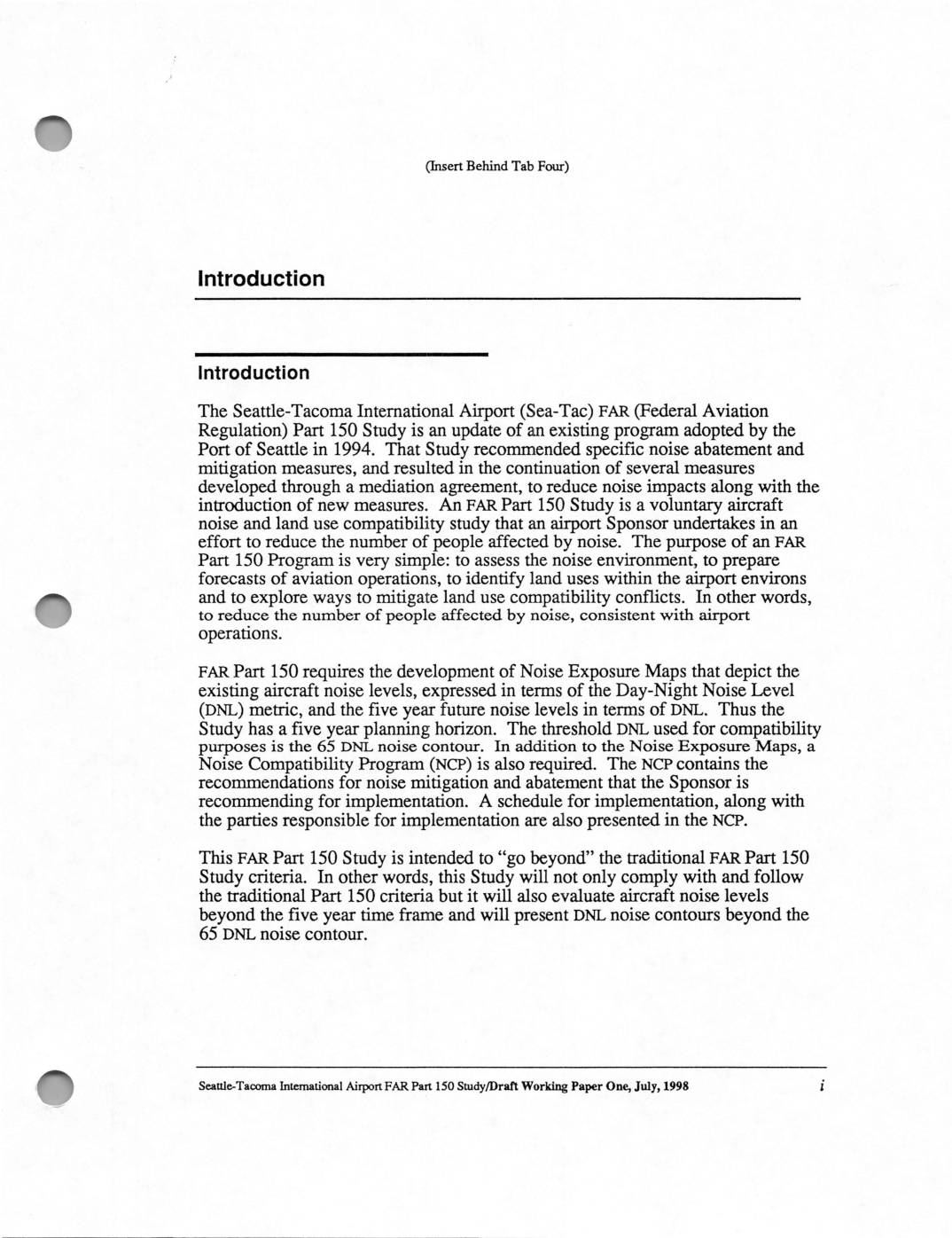
Part 150 Study-Draft Working Paper One July 1998
Draft Working Paper One of the Seattle-Tacoma International Airport (Sea-Tac) FAR Part 150 Study, dated July 1998, prepared by Port Of Seattle. This inventory chapter updates the 1994 Part 150 program and covers airport physical facilities, air traffic operations activity, airspace/air traffic control, ANOMS radar data, current noise abatement program, noise complaint history, airport environs, -
 1998-06-01
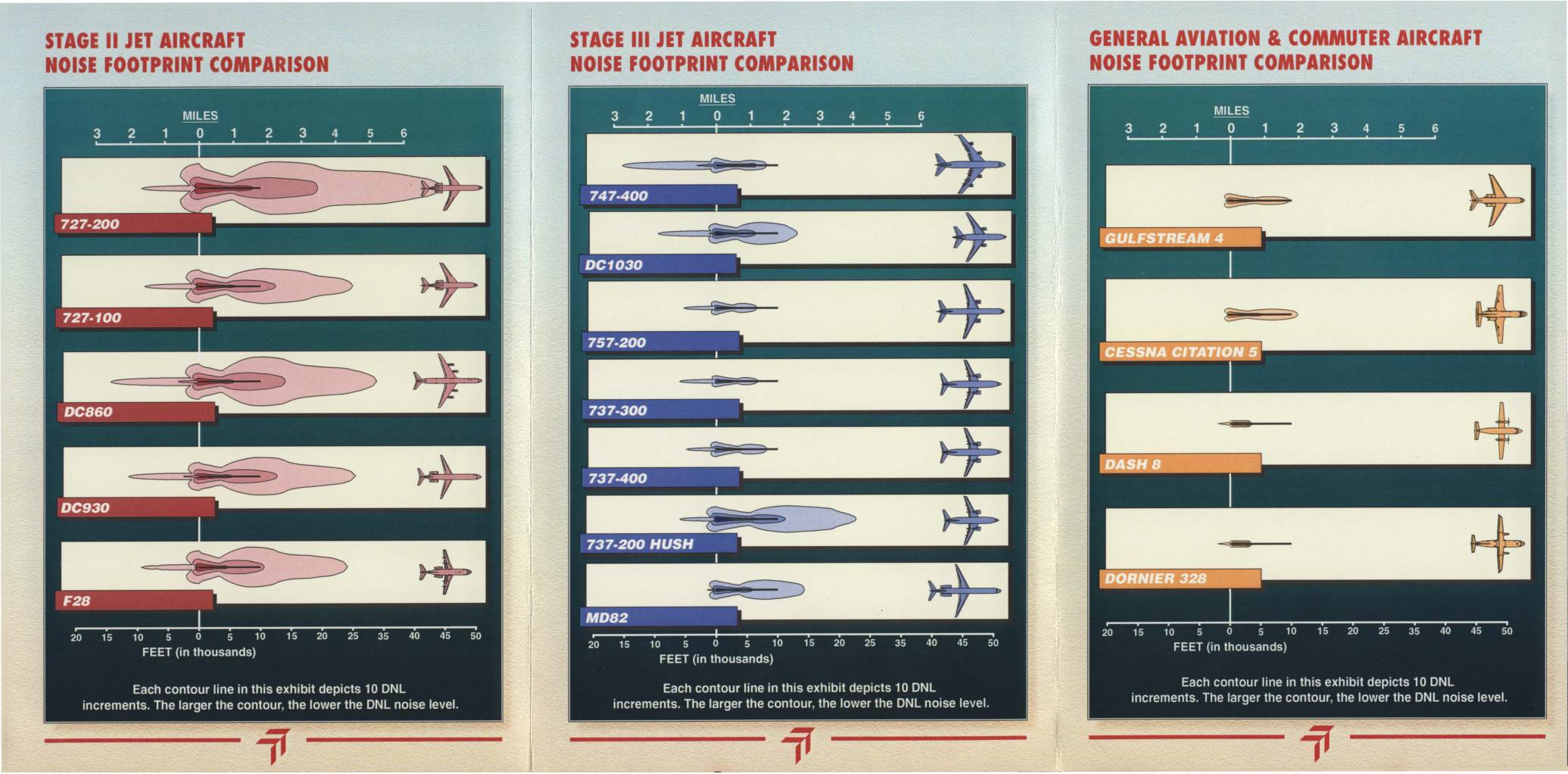
Sea-Tac International Airport: Commercial Aircraft Noise Footprint Comparison
This Sea-Tac International Airport brochure, prepared by the Port of Seattle in Summer 1998, compares the noise footprints of Stage II jets, Stage III jets, and general aviation/commuter aircraft to help residents understand the noise impacts of different aircraft types. It explains that Stage III aircraft are significantly quieter than Stage II aircraft, and that replacing older Stage II planes with newer Stage III models would meaningfully reduce noise levels in surrounding communities. The document also defines key noise measurement terminology, including DNL (Day-Night Average Sound Level), and notes that nighttime flights carry a 10-decibel penalty in noise accounting. -
Seattle Community Council Federation v. FAA 961 F.2d 929
961 F.2d 829 SEATTLE COMMUNITY COUNCIL FEDERATION, a Washington nonprofit corporation, Petitioner, v. FEDERAL AVIATION ADMINISTRATION; Samuel Skinner, Respondents. No. 90-70253. United States Court of Appeals, Ninth Circuit. Argued and Submitted Jan. 8, 1991. Decided April 9, 1992. Peter J. Eglick and Henryk J. Hiller, Seattle, Washington, for petitioner. Peter R. Steenland, Jr., and J. -
 1991-01-01
Part 150 Noise Exposure Map 1991 — Ldn 65 Contour Area and Population
Text states that the Ldn 65 noise contour contains approximately 14,128 acres and 67,000 people. This figure relates to the noise impact area around Sea-Tac Airport as defined by the Day-Night Average Sound Level (Ldn) metric. -
 1990-03-16
Day Night Average Sound Level (DNL): The Descriptor of Choice for Airport Noise Assessment
This 1990 FAA document explains why the Day Night Average Sound Level (DNL) was chosen as the standard metric for measuring airport noise. DNL averages noise exposure over a full 24-hour period, applying a penalty for nighttime flights, and has been adopted by multiple federal agencies—including the EPA, DOT, HUD, and DOD—as the most reliable way to assess how aircraft noise affects surrounding communities. The FAA formally incorporated DNL into federal regulation through FAR Part 150, Airport Noise Compatibility Planning, in 1981. -
 1982-01-21
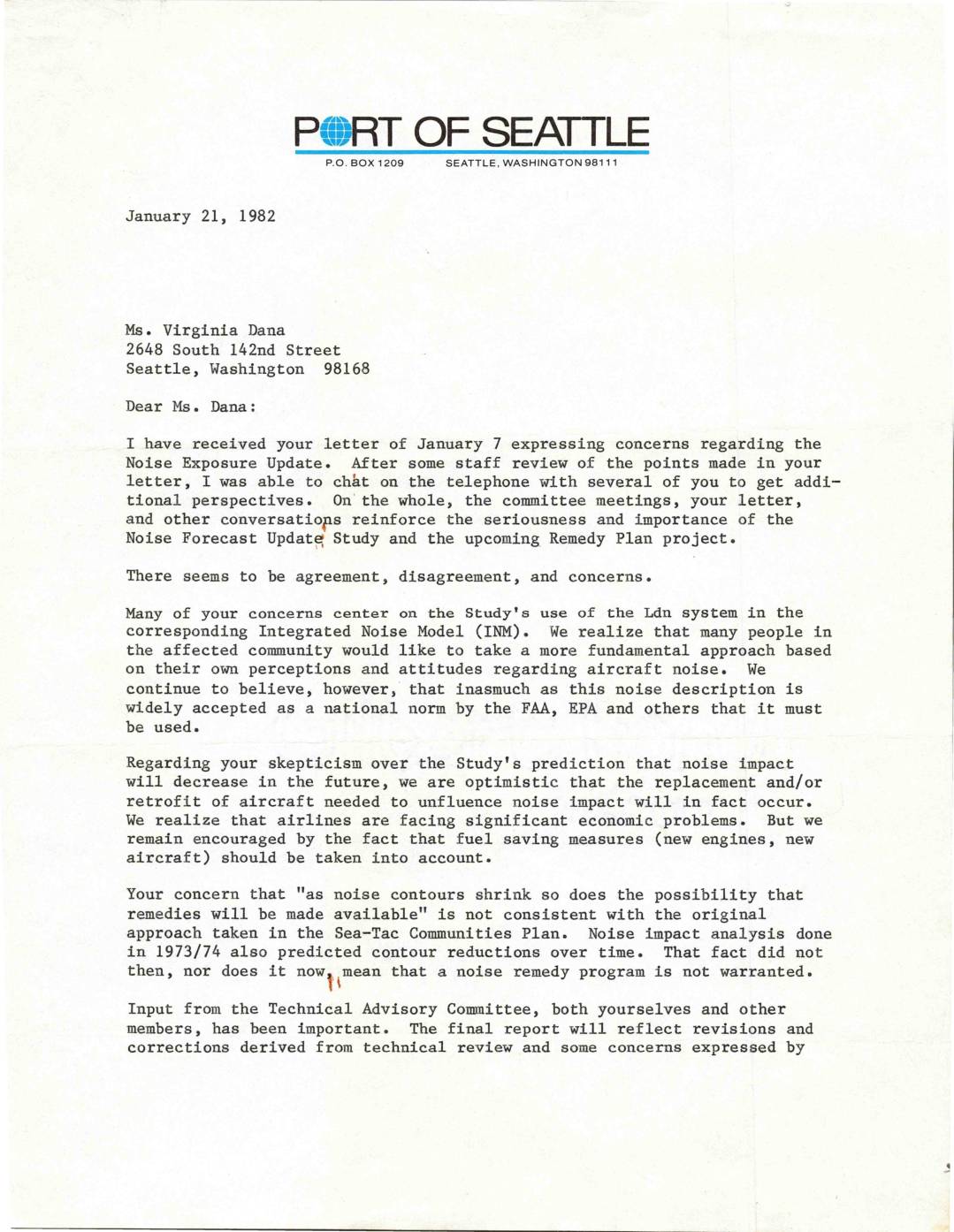
Letter from Clifford C. Muller to Virginia Dana Regarding Noise Exposure Update
In this January 1982 letter, Port of Seattle Planning Director Clifford C. Muller responds to community member Virginia Dana's concerns about the Sea-Tac Airport Noise Exposure Update Study. He addresses skepticism over the Ldn noise measurement system, defends the study's prediction that noise impact will decrease as airlines adopt quieter aircraft, and reassures Dana that shrinking noise contours do not eliminate eligibility for noise remedy programs. Muller acknowledges that the Technical Advisory Committee's input has been valuable and indicates that the upcoming Remedy Plan project will be the primary venue for addressing ongoing community concerns. -
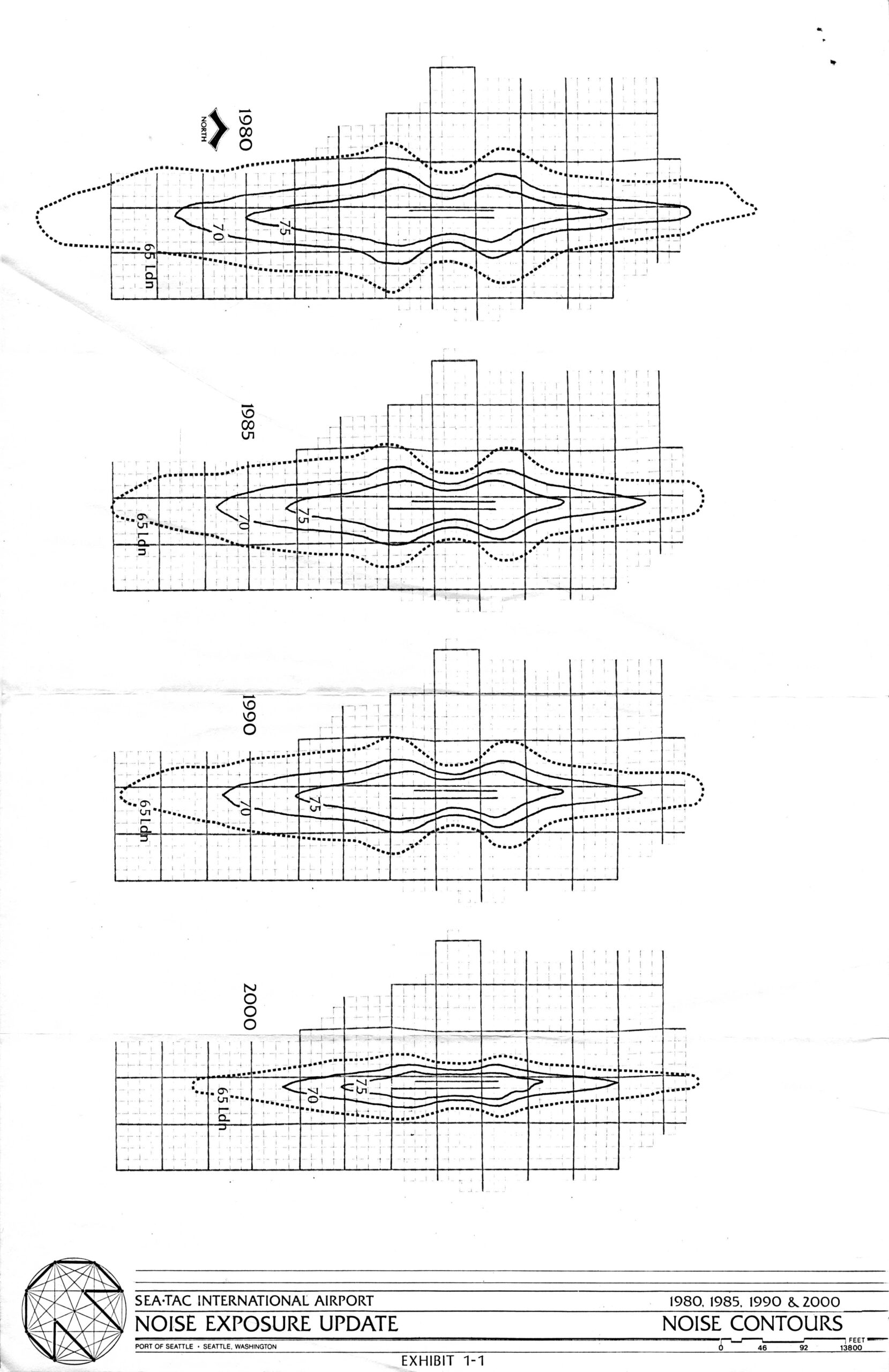
Forecasted Noise Contour Map 1980, 1985,1990, 2000
Exhibit 1-1 from the Port of Seattle's Sea-Tac International Airport Noise Exposure Update, showing four panels of DNL (Ldn) noise contour maps at the 65, 70, and 75 dB levels for the years 1980, 1985, 1990, and 2000. The contours illustrate the projected lateral and longitudinal extent of aircraft noise impact around the airport's runway alignment over those two decades.