TagAir Quality Monitors(75)
-
 2023-05-03 14:12
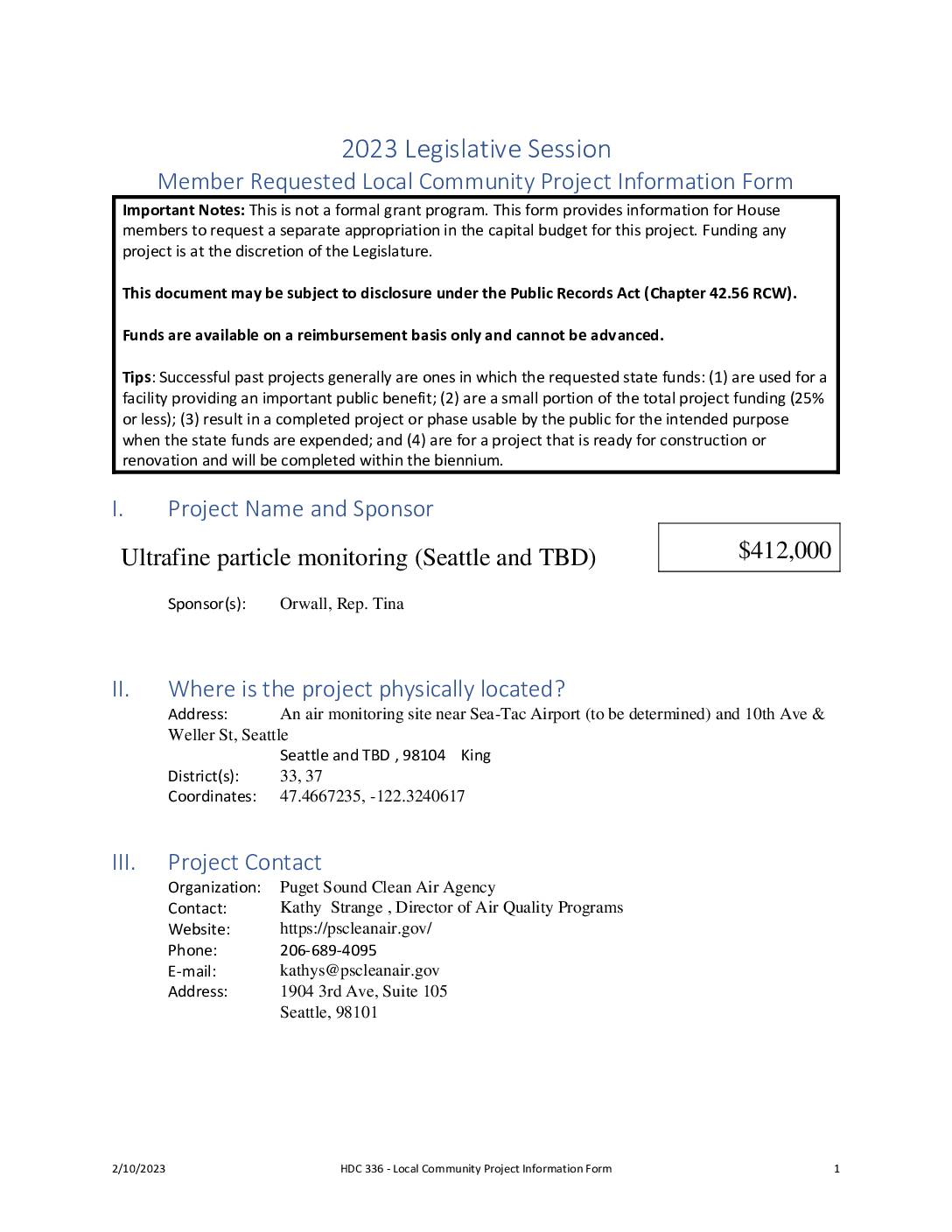
Ultrafine particle monitoring (Seattle/Chinatown and Sea-Tac Airport) HDC2 11 12 42
2/10/2023 HDC 336 - Local Community Project Information Form 1 2023 Legislative Session Member Requested Local Community Project Information Form Important Notes: This is not a formal grant program. This form provides information for House members to request a separate appropriation in the capital budget for this project. Funding any project is at the discretion of the Legislature. This document may be subject to disclosure under the Public Records Act (Chapter 42.56 RCW). Funds are available on a reimbursement basis only and cannot be advanced. Tips: Successful past projects generally are ones in which the requested state funds: (1) are used for a facility providing an important public benefit; (2) are a small portion of the total project funding (25% or less); (3) result in a completed project or phase usable by the public for the intended purpose when the state funds are expended; and (4) are for a project that is ready for construction or renovation and will be completed within the biennium. I. Project Name and Sponsor Ultrafine particle monitoring (Seattle and TBD) $412,000 Sponsor(s): Orwall, Rep. Tina II. Where is the project physically located? Address: An air monitoring site near Sea-Tac Airport (to be determined) and 10th Ave & Weller St, Seattle Seattle and TBD , 98104 King District(s): 33, 37 Coordinates: 47.4667235, -122.3240617 III. Project Contact Organization: Puget Sound Clean Air Agency Contact: Kathy Strange , Director of Air Quality Programs Website: https://pscleanair.gov/ Phone: 206-689-4095 E-mail: kathys@pscleanair.gov Address: 1904 3rd Ave, Suite 105 Seattle, 98101 -
 2022-11-04 22:59
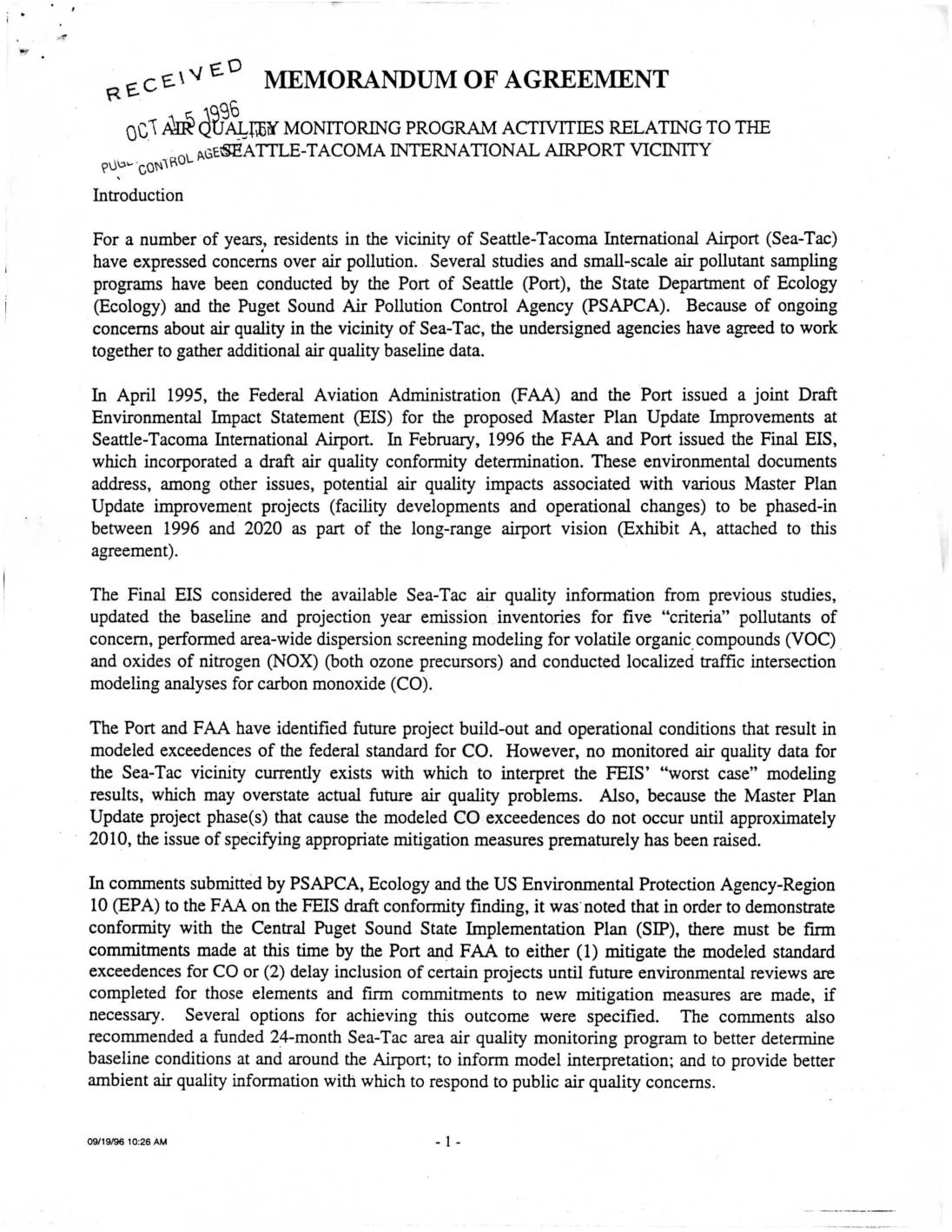
MOA – Air Quality Monitoring at Sea-Tac Vicinity, October 15, 1996
. €. c s '-J €. 0 MEMORANDUM OF AGREEJ.IIENT R . oCI ~ d~~r;Eti MONITORING PROGRAM ACTIVITIES RELATING TO THE . . · oL p..Gt~ATTLE-TACOMA INTERNATIONAL AIRPORT VICINITY ~0~-- cotf ~ Introduction For a number ·of years, residents in the vicinity of Seattle-Tacoma International Airport (Sea-Tac) have expressed concerns over air pollution . . Several studies and small-scale air pollutant sampling programs have been conducted by the Port of Seattle (Port), the State Department of Ecology (Ecology) and the Puget Sound Air Pollution Control Agency (PSAPCA). Because of ongoing concerns about air quality in the vicinity of Sea-Tac, the undersigned agencies have agreed to work together to gather additional air quality baseline data. In April 1995, the Federal Aviation Administration (FAA) and the Port issued a joint Draft Environmental Impact Statement (EIS) for the proposed Master Plan Update Improvements at Seattle-Tacoma International Airport. In February, 1996 the FAA and Port issued the Final EIS, which incorporated a draft air quality conformity determination. These environmental documents address, among other issues, potential air quality impacts associated with various Master Plan Update improvement projects (facility developments and operational changes) to be phased-in between 1996 and 2020 as part of the long-range airport vision (Exhibit A, attached to this agreement). The Final EIS considered the available Sea-Tac air quality information from previous studies, updated the baseline and projection year emission . inventories for five "criteria" pollutants of concern, performed area-wide dispersion screening modeling for volatile organic. compounds (VOC) _ and oxides of nitrogen… -
2022-09-09 23:35
Washington Air Monitoring Network: Air Quality Program
Washington State Department of Ecology -
 2022-08-20 22:07
The Effect of Occupational Exposures to Aircraft Ultrafine Particles on Acute Cardiorespiratory Health, and Control Using Personal Protective Equipment
> Habre, et al., 2018 study in LA compared asthmatic adults walking in an area affected by aircraft pollution vs walking in an area “not affected” by aircraft pollution. > Study found evidence of increased inflammatory marker (IL6) in blood when walking in the aircraft area > But roadway traffic contributed to different cardiorespiratory health risks (lower FEV1 and elevated sTNFrII) > But, some limitations of the study Evidence from previous studies Mariah’s Pilot crossover study Exposed to UFPs Not-exposed to UFPsHealthy Asthmatic Baseline 30m 60m 90m Health measurements at different times > Powered Air Purifying Respirator (PAPR) – “Non-exposure” when installed with HEPA + VOC filter – “Exposure” when installed with a sham filter Method for Controlling Exposure SeaTac Community Center: 13735 24th Ave S, SeaTac, WA Study Location Study Design (cont.) Baseline Health Measurements Min Walk Min Rest Min Walk Min Rest Min Health Measurements Min Rest Min Walk Min Rest Min Walk Min Rest Min Health Measurements Min Rest Min Walk Min Rest Min Walk Min Rest Min Health Measurements Data Collection: Exposure Assessment TSI OPS 3330: PM (#/cc) TSI NanoScan SMPS: UFPs (#/cc) microAeth AE51: BC (ng/cc) Aerodyne CAPS: NO2 (ppb) 3M SoundDetector SD- 200: Noise UFP Concentration and PAPR Effectiveness Data Collection: Health Measurements Instrument/Measurement Health Outcome Stress EMA tense/anxious, anger/hostility, depression, frustration, unhappiness Stroop Test Congruent, incongruent, Stroop effect Pulse Oximeter %SpO2, HR, PI Omron BP SBP, DBP, HR Apple Watch HR, HRV Spirometer FEV1, FVC, PEF, FEV1/FVC For the Pilot Study: asthmatics non-asthmatics… -
 2021-09-19 00:00
Characterization of annual average traffic-related air pollution levels (particle number,1 black carbon, nitrogen dioxide, PM2.5 , carbon dioxide) in the greater Seattle area from a2 year-long mobile monitoring campaign 2021.09.18.2 (pre-print)
Characterization of annual average traffic-related air pollution levels (particle number, 1 black carbon, nitrogen dioxide, PM2.5, carbon dioxide) in the greater Seattle area from a 2 year-long mobile monitoring campaign 3 Magali N. Blanco,a Amanda Gassett,a Timothy Gould,b Annie Doubleday,a David L. Slager,a 5 Elena Austin,a Edmund Seto,a Timothy Larson,a,b Julian Marshall,b Lianne Shepparda,c 6 aDepartment of Environmental and Occupational Health Sciences, School of Public Health, 9 University of Washington, Hans Rosling Center for Population Health, 3980 15th Ave NE, 10 Seattle, WA 98195 11 bDepartment of Civil & Environmental Engineering, College of Engineering, University of 13 Washington, 201 More Hall, Box 352700, Seattle, WA 98195 14 cDepartment of Biostatistics, School of Public Health, University of Washington, Hans Rosling 16 Center for Population Health, 3980 15th Ave NE, Seattle, WA 98195 17 . CC-BY-NC-ND 4.0 International licenseIt is made available under a is the author/funder, who has granted medRxiv a license to display the preprint in perpetuity. (which was not certified by peer review) The copyright holder for this preprint this version posted February 14, 2022. ; https://doi.org/10.1101/2021.09.18.21263522doi: medRxiv preprint NOTE: This preprint reports new research that has not been certified by peer review and should not be used to guide clinical practice. https://doi.org/10.1101/2021.09.18.21263522 http://creativecommons.org/licenses/by-nc-nd/4.0/ Abstract 19 Growing evidence links traffic-related air pollution (TRAP) to adverse health effects. We 21 designed an innovative and extensive mobile monitoring campaign to characterize TRAP 22 exposure levels for the Adult Changes in Thought (ACT) study, a Seattle-based cohort. The 23 campaign measured particle… -
 2021-01-18 11:38
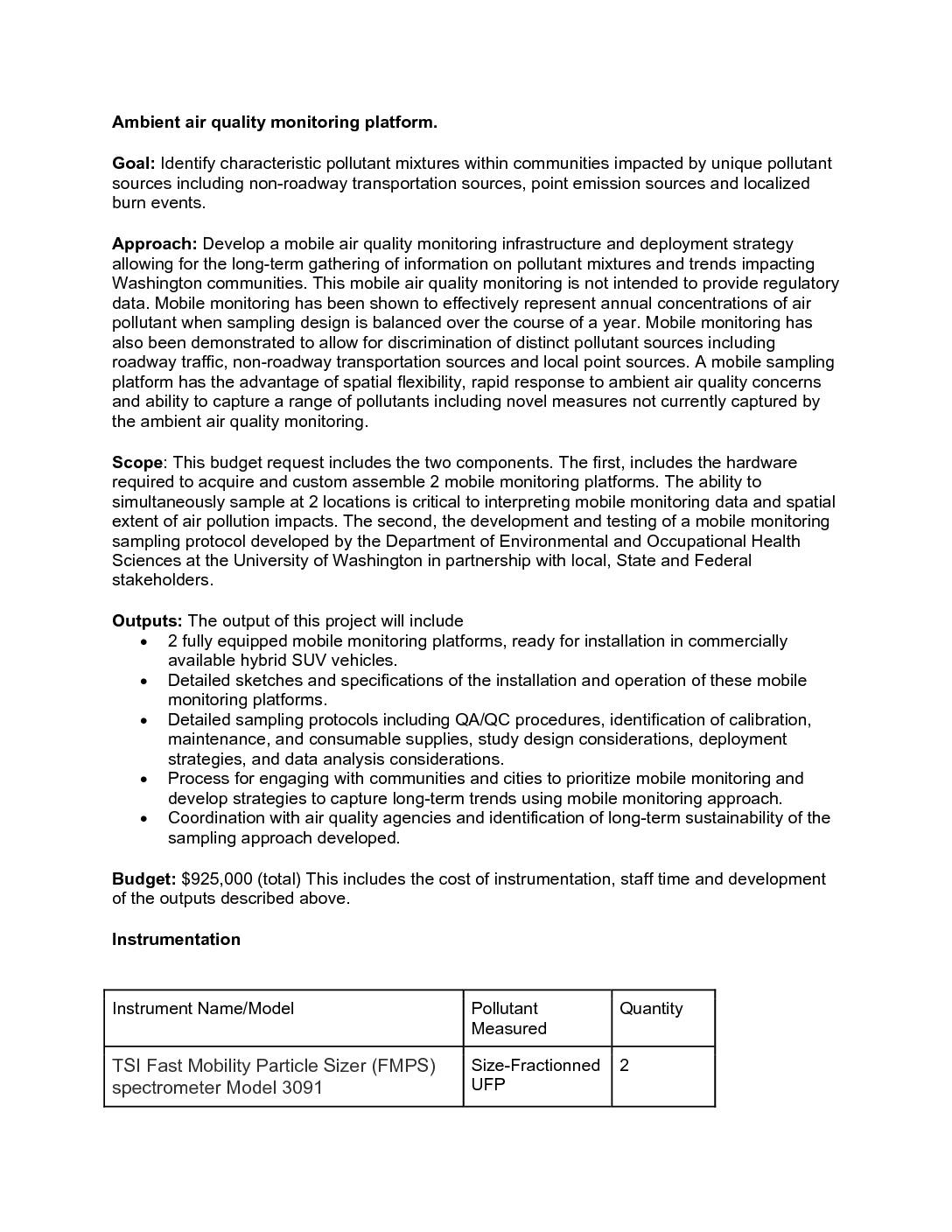
UW DEOHS Ambient air quality monitoring platform
Goal: Identify characteristic pollutant mixtures within communities impacted by unique pollutant sources including non-roadway transportation sources, point emission sources and localized burn events. Approach: Develop a mobile air quality monitoring infrastructure and deployment strategy allowing for the long-term gathering of information on pollutant mixtures and trends impacting Washington communities. This mobile air quality monitoring is not intended to provide regulatory data. Mobile monitoring has been shown to effectively represent annual concentrations of air pollutant when sampling design is balanced over the course of a year. Mobile monitoring has also been demonstrated to allow for discrimination of distinct pollutant sources including roadway traffic, non-roadway transportation sources and local point sources. A mobile sampling platform has the advantage of spatial flexibility, rapid response to ambient air quality concerns and ability to capture a range of pollutants including novel measures not currently captured by the ambient air quality monitoring. Scope: This budget request includes the two components. The first, includes the hardware required to acquire and custom assemble 2 mobile monitoring platforms. The ability to simultaneously sample at 2 locations is critical to interpreting mobile monitoring data and spatial extent of air pollution impacts. The second, the development and testing of a mobile monitoring sampling protocol developed by the Department of Environmental and Occupational Health Sciences at the University of Washington in partnership with local, State and Federal stakeholders. Outputs: The output of this project will include • 2 fully equipped mobile monitoring platforms, ready for installation in commercially available hybrid SUV vehicles.… -
2021-01-17 21:25
The Sea-Tac Airport Annual Air Quality Monitoring Proposal (STAAQM)
This post describes a proposal we have put forward to Washington State legislators Senator Karen Keiser (33rd) and Representative Jesse Johnson (30th). In one sentence, we want an annual report of all key aviation-related emissions for every neighborhood affected by the operations from Sea-Tac Airport. We refer to this proposal as Sea-Tac Airport Annual Air -
 2021-01-17 20:44
Bay Area Air Quality Management District (BAAQM) Review of Current Air Monitoring Capabilities Near Refineries
Eric M. Fujita and David E. Campbell Division of Atmospheric Sciences Desert Research Institute, Nevada System of Higher Education Objectives • Identify the primary risk drivers • Review and evaluate current air monitoring capabilities. • Develop a matrix of instrumentation, methodologies and/or other exposure assessment tools to: – enhance monitoring capabilities – provide information about emissions • Prepare a short report describing the process used and how the matrix was developed. Identifying primary risk drivers Risk factors Potential emissions from upset conditions Emissions from normal operations Chronic effects Acute effects Fu gi ti ve em is si n s Target compounds, RELs, and monitoring methods Open Path 500m OpenPath 100m Area Target Compound Acute (µg/m3) Chronic (µg/m3) Photo- metric Auto-GC XRF tape sampler 6 UV-DOAS OP-FTIR 7 DIAL Canister Chemically active adsorbent FRM filter sampler Passive lpm filter sampler Benzene 1300 60 0.03 3 50 3 0.06 0.3 1,3 Butadiene 20 0.02 1 10 0.04 0.03 Formaldehyde 55 9 10 10 8 µg/m3 h 0.15 Acetaldehyde 470 140 20 6 µg/m3 h 0.05 Perchloro- ethylene 20000 35 40 0.02 Napthalene 9 0.05 2 ? NO2 470 100 3 0.2 2 25 0.16 SO2 660 0.8 2 10 25 1.5 H2S 42 10 0.2 0.2 0.15 Ni 0.2 0.014 0.0002 0.26 µg/m3 h 0.001 Mn 0.17 0.019 0.0003 0.35 µg/m3 h 0.001 Cr VI 0.2 Hg 0.6 0.03 0.0002 0.66 µg/m3 h 0.0008 As 0.2 0.015 0.0001 0.35 µg/m3 h 0.001 Continuous Point Time-integrated Point sample (up to 24 hrs) Saturation… -
2020-12-14 17:34
A Letter To Congressman Adam Smith – AQM
The Sea-Tac Annual Air Quality Monitoring Program – a proposal Background Since 1971 there have roughly thirteen ‘studies’ of various air toxins around Sea-Tac Airport. We put the word ‘studies’ in air quotes because almost all of them have been limited either to a single toxin or to a subset of the complete Sea-Tac air -
2020-11-16 13:32
Letter to electeds on the importance of data collection
This letter is in support of a legislative proposal we have made concerning air quality monitors around Sea-Tac Airport. Senator Keiser, Rep. Orwall, Rep. Johnson. I know how busy you all are. I hope you will take 4 minutes to listen to this very good piece of audio. You can start at about 1:40. https://seatacnoise.info/otm111320_cms1067654_pod/