TagThird Runway(1084)
-
 2001-09-26
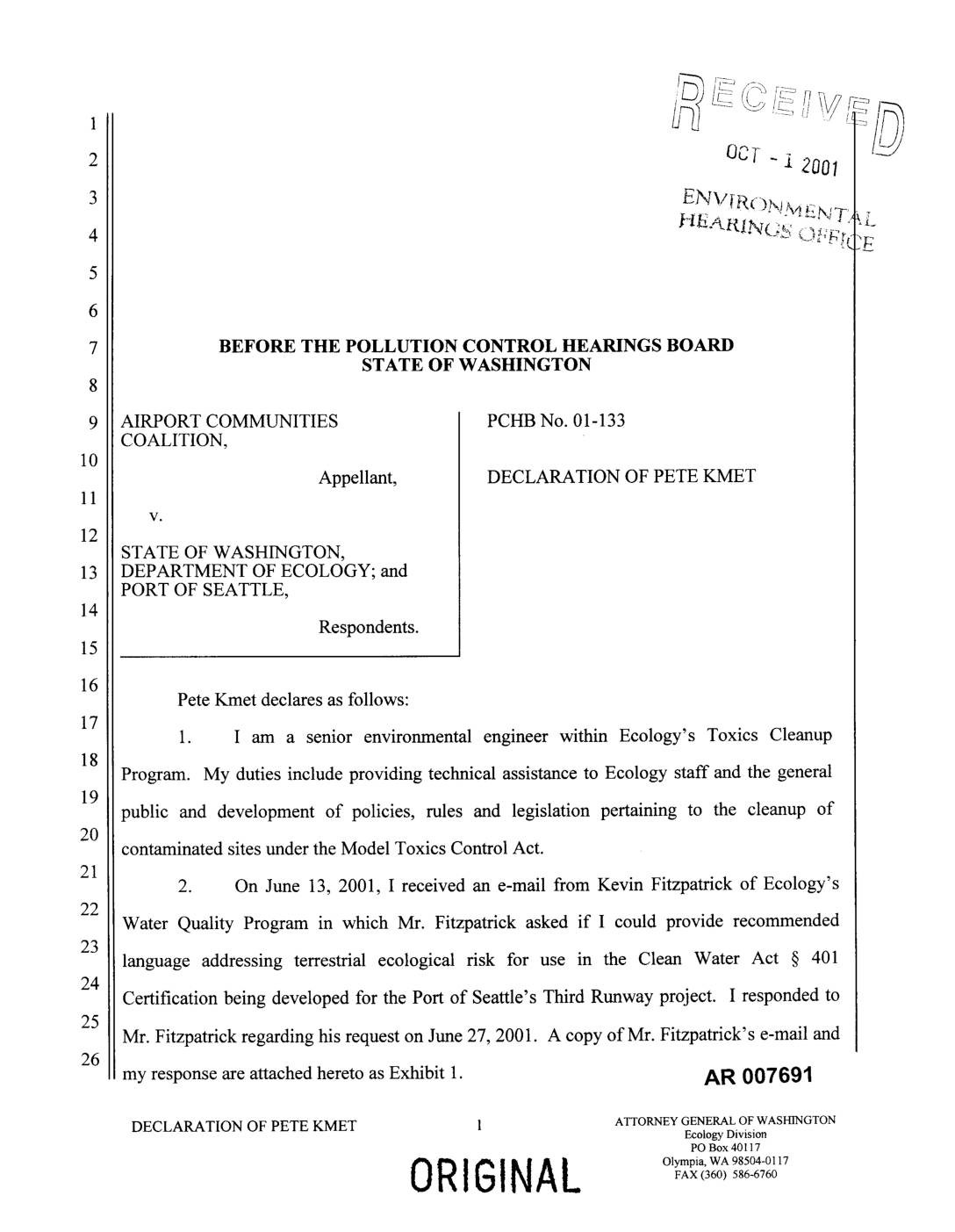
PCHB Doc 01-133: Declaration of Pete Kmet — ACC v. Ecology and Port Of Seattle
Declaration of Pete Kmet, senior environmental engineer in Ecology’s Toxics Cleanup Program, filed in PCHB No. 01-133 (Airport Communities Coalition v. State of Washington Department of Ecology and Port Of Seattle). Kmet clarifies his June 27, 2001 response to Kevin Fitzpatrick (Water Quality Program) regarding terrestrial ecological risk language for the Clean Water Act § -
 2001-09-26
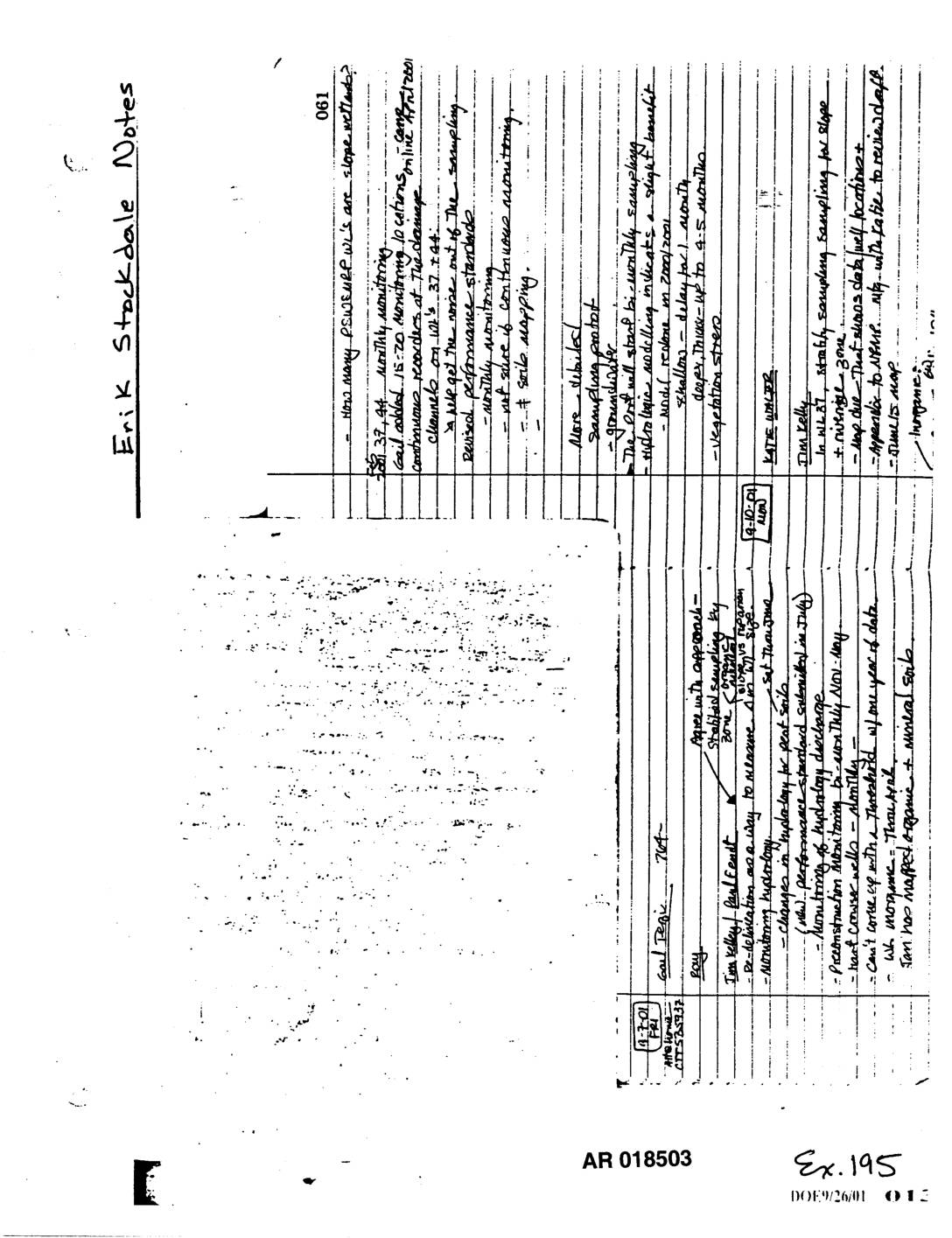
EXH 195: Erik Stockdale Notes — Wetlands Monitoring
Meeting notes from Erik Stockdale discuss wetland monitoring activities, including monthly groundwater sampling, continuous recorders at drainage channels, and vegetation mapping. Topics covered include hydrology monitoring changes, performance standards for hydrological discharge, and sampling schedules running bi-monthly from November through May. The notes reference coordination among multiple parties regarding soil sampling, data thresholds, and revised performance standards. -
 2001-09-26
EXH AR052045: Geotechnical Engineering Analyses and Recommendations, Third Runway Embankment, Phase 5, Sea-Tac International Airport
Draft geotechnical engineering report prepared by Hart Crowser, Inc. for HNTB regarding the Third Runway Embankment, Phase 5 at Sea-Tac International Airport, SeaTac, Washington (project no. 4978-28, AR 052045). Authored by Josepha D. Celes (Senior Staff Geotechnical Engineer) and Michael Bailey, P.E. (Project Manager). Covers site preparation, subgrade improvement, embankment fill construction, TESC Pond A, -
 2001-09-25
EXH AR012942: Declaration of James L. Morasch in Support of Port Of Seattle Third Runway, PCHB 01-133
Declaration of James L. Morasch, Director of Airports for the Port of Pasco, filed in PCHB case No. 01-133 (Airport Communities Coalition v. Department of Ecology and Port of Seattle). Morasch supports the new all-weather third runway at Seattle-Tacoma International Airport (Sea-Tac). States Sea-Tac is the #1 destination for Tri-Cities Airport passengers, accounting for 47% -
 2001-09-25
EXH AR012945: Declaration of Alan C. Ralston in Support of Third Runway at Sea-Tac Airport
Declaration of Alan C. Ralston, Director of Northwest State and Local Government Relations for The Boeing Company, filed in PCHB Case No. 01-133 (Airport Communities Coalition v. Department of Ecology and Port of Seattle) before the Pollution Control Hearings Board for the State of Washington. Ralston declares Boeing’s support for expeditious construction of the Third -
 2001-09-24
Exhibit 104: NW Update — Sea-Tac Third Runway Water Quality Certification Reissuance
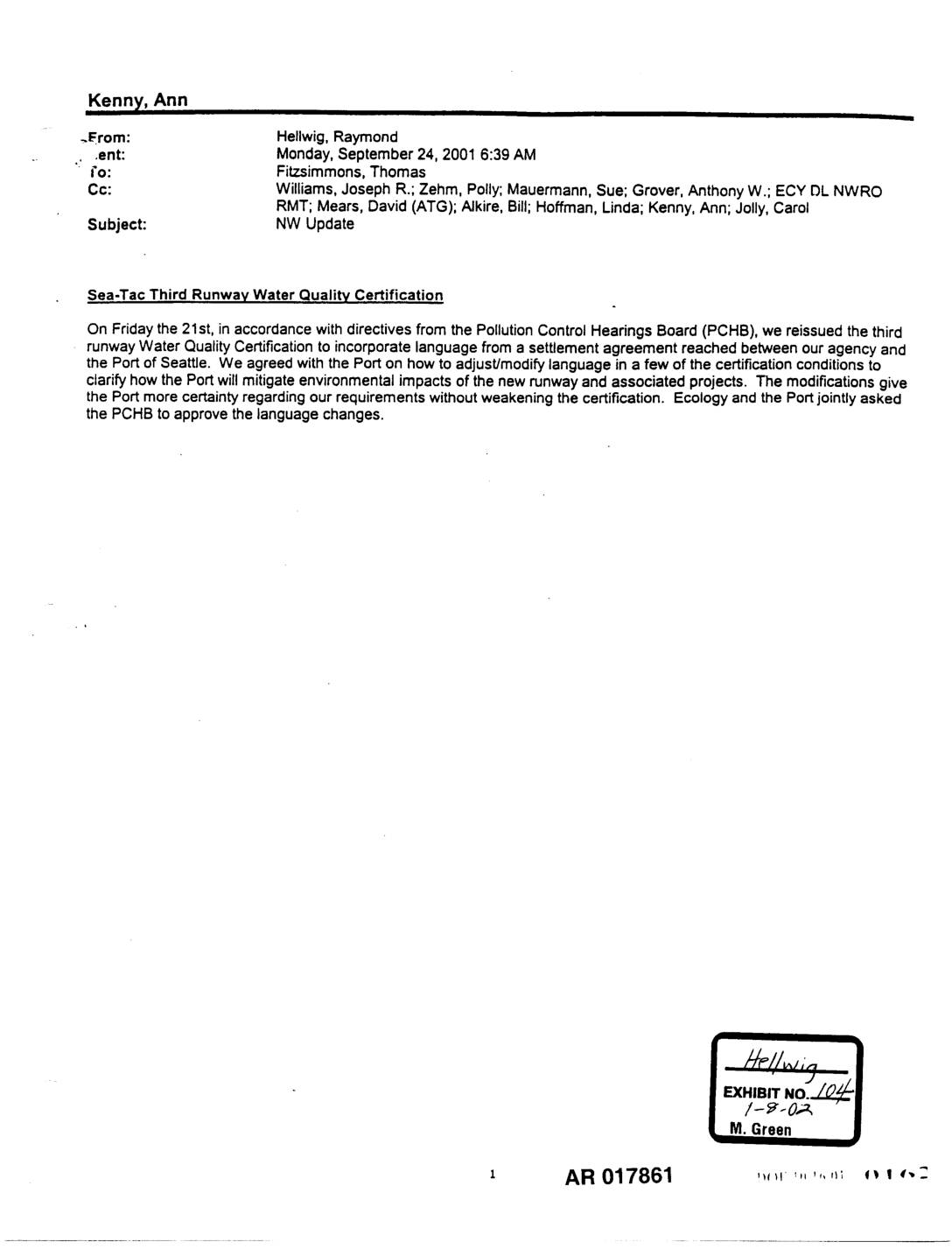
Email from Raymond Hellwig (Ecology) to Thomas Fitzsimmons, September 24, 2001, reporting that on September 21, 2001, Ecology reissued the Sea-Tac Third Runway Water Quality Certification per directives from the Pollution Control Hearings Board (PCHB). The reissuance incorporated language from a settlement agreement between Ecology and Port Of Seattle, adjusting certification conditions to clarify how -
 2001-09-21
PCHB Doc 007768: Agreement and Order Re Rescission of 401 Certification — Port Of Seattle and ACC v. Ecology
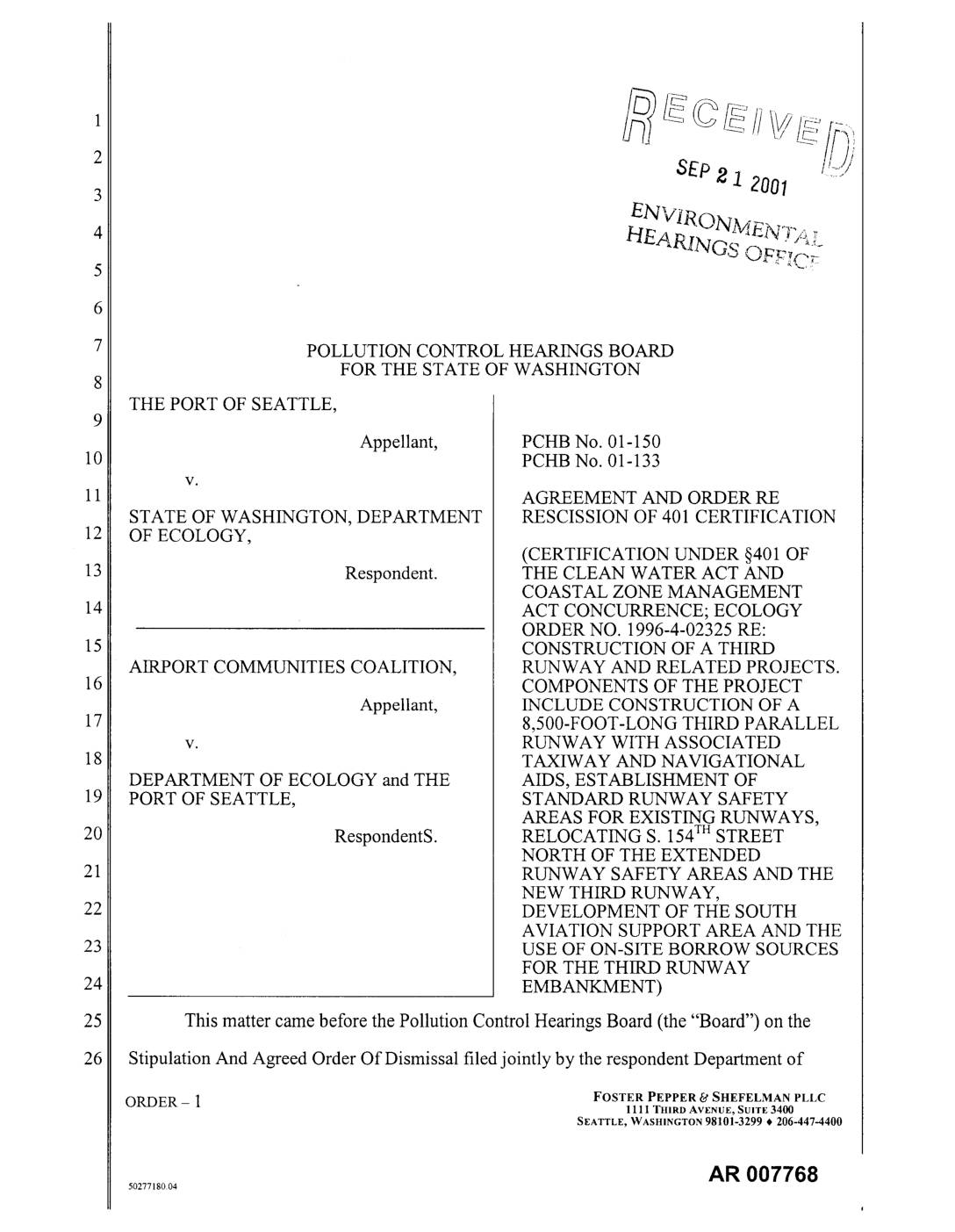
Pollution Control Hearings Board (PCHB) Agreement and Order Re Rescission of 401 Certification, PCHB No. 01-150 and No. 01-133, involving Port Of Seattle and Airport Communities Coalition (ACC) as appellants against Washington State Department of Ecology. Ecology Order No. 1996-4-02325 issued August 10, 2001 included a Section 401 Clean Water Act water quality certification and -
 2001-09-21
EXH AR022903: Sec 401 Cert Synthetic Precipitation Leaching Procedure Work Plan, Attach E — Water Quality Cert #1996-4-02325 (Amended -1)
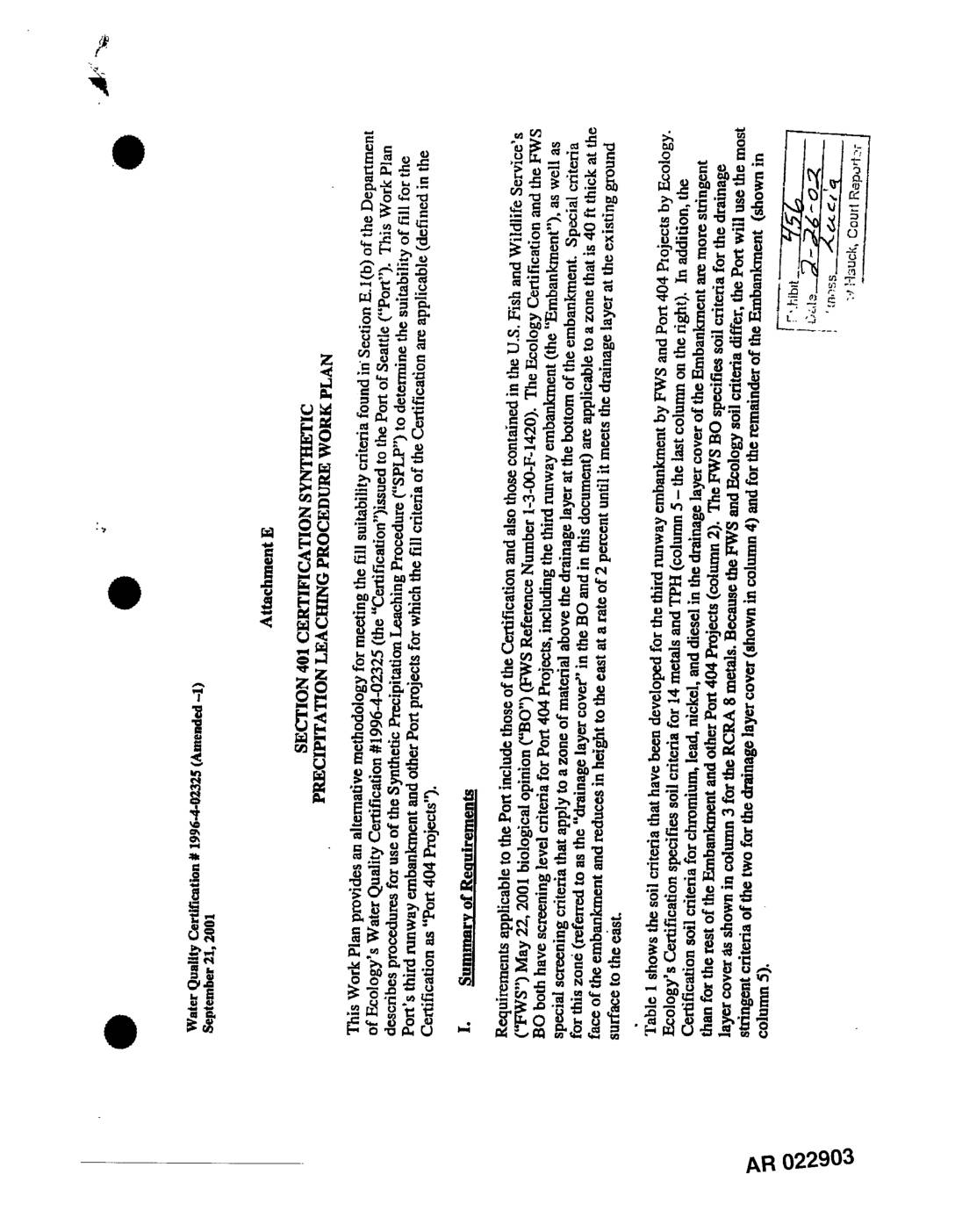
This September 2001 Work Plan Attachment describes the fill suitability testing procedures required for the Port of Seattle's third runway embankment construction at Sea-Tac Airport, outlining how soil and fill materials must meet Washington State and U.S. Fish and Wildlife Service environmental standards. It explains the Synthetic Precipitation Leaching Procedure (SPLP), a laboratory test used to determine whether fill materials could release harmful metals or chemicals into groundwater. Materials failing the screening criteria must be rejected or undergo additional testing before being approved for use in the embankment. -
 2001-09-21
EXH AR012548: Declaration of C. Linn Gould in Support of Port Of Seattle’s Response Opposing ACC’s Motion for Stay
Declaration of C. Linn Gould (Risk Assessor, soil scientist, MS soil science, BA geology) filed in PCHB No. 01-133, Airport Communities Coalition v. State of Washington Department of Ecology and Port Of Seattle. Gould supports Port Of Seattle’s opposition to ACC’s motion for stay of the Third Runway 401 Certification issued September 21, 2001. Declaration -
 2001-09-21
EXH AR026656: BMP Screening Study — Filtration Media Zinc & Toxicity Reduction Stormwater STIA
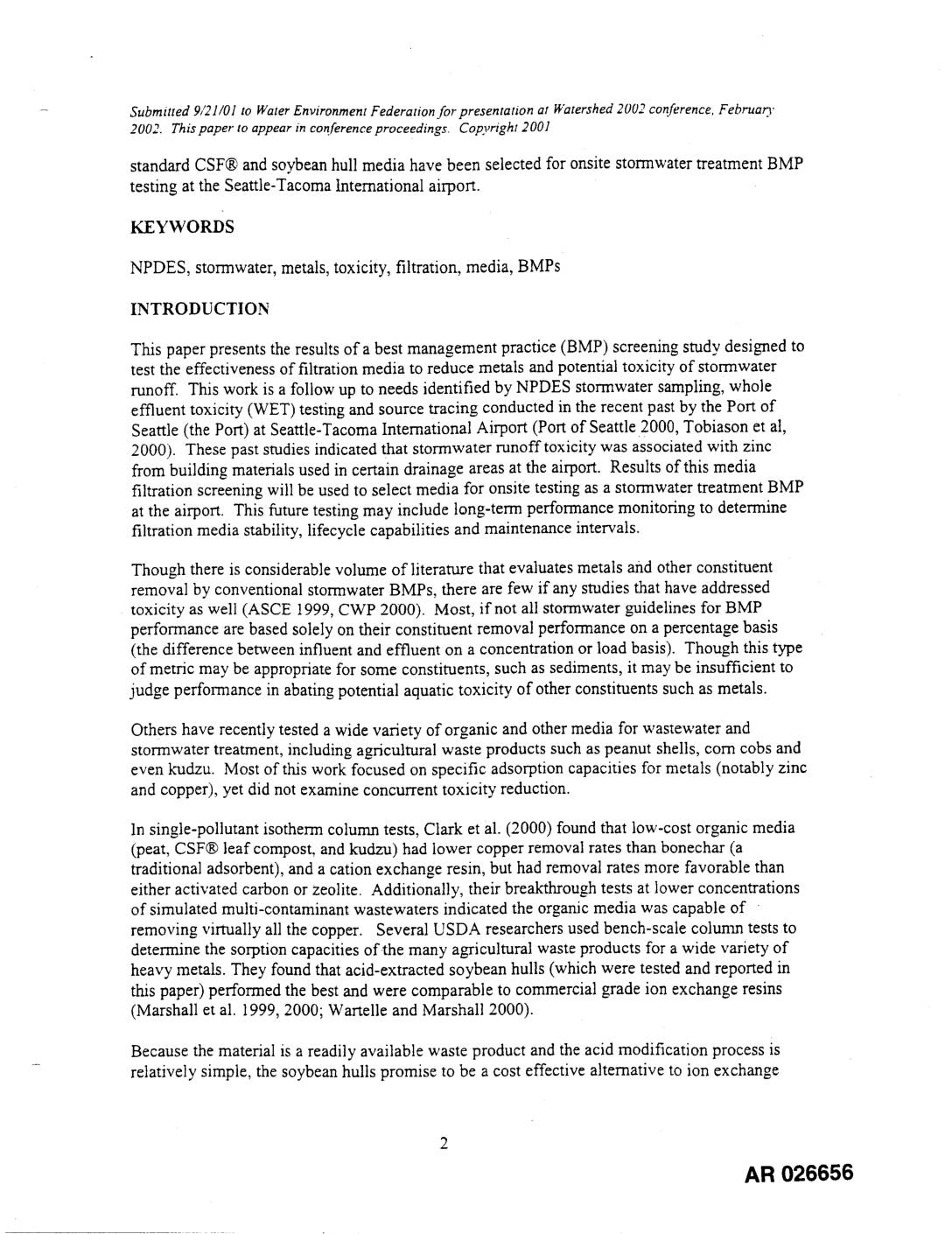
Researchers tested several filtration media, including leaf compost (CSF®) and soybean hulls, for their ability to remove zinc and reduce toxicity from stormwater runoff at Seattle-Tacoma International Airport. The study was prompted by prior water quality monitoring that linked stormwater toxicity to zinc from building materials in certain airport drainage areas. Results from these controlled laboratory tests were used to select the best-performing media for future on-site stormwater treatment trials at the airport.