TagThird Runway(1084)
-
 1997-06-30
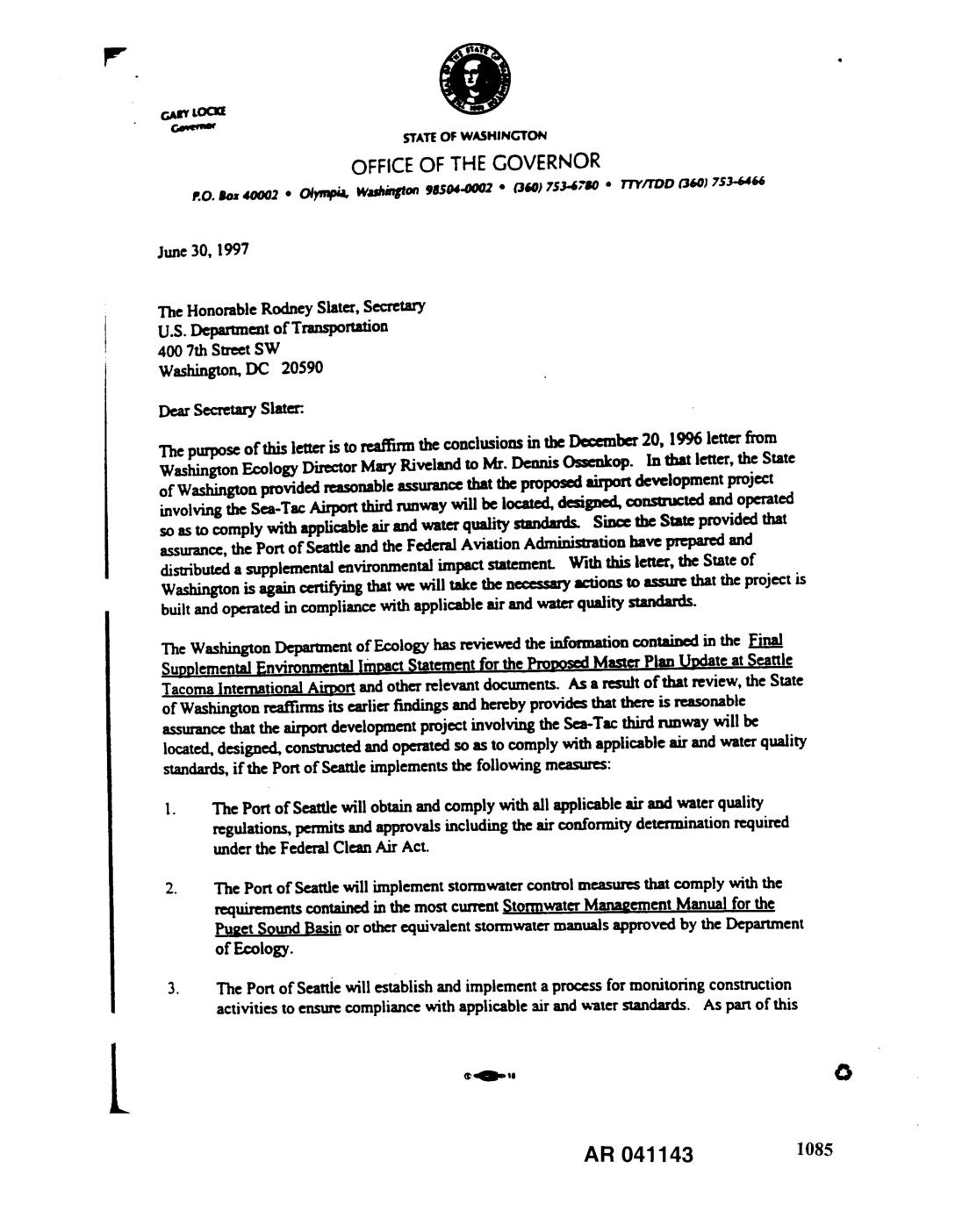
EXH AR041143: Letter from Governor Gary Locke to Secretary Rodney Slater Re: State Certification for Sea-Tac Third Runway Air and Water Quality Compliance
June 30, 1997 letter from Washington Governor Gary Locke to U.S. Department of Transportation Secretary Rodney Slater, reaffirming and superseding the December 20, 1996 letter from Ecology Director Mary Riveland to Dennis Ossenkop. Constitutes state certification required under 49 U.S.C. 47101 et seq. that the Sea-Tac Airport third runway development project will comply with applicable -
 1997-06-30
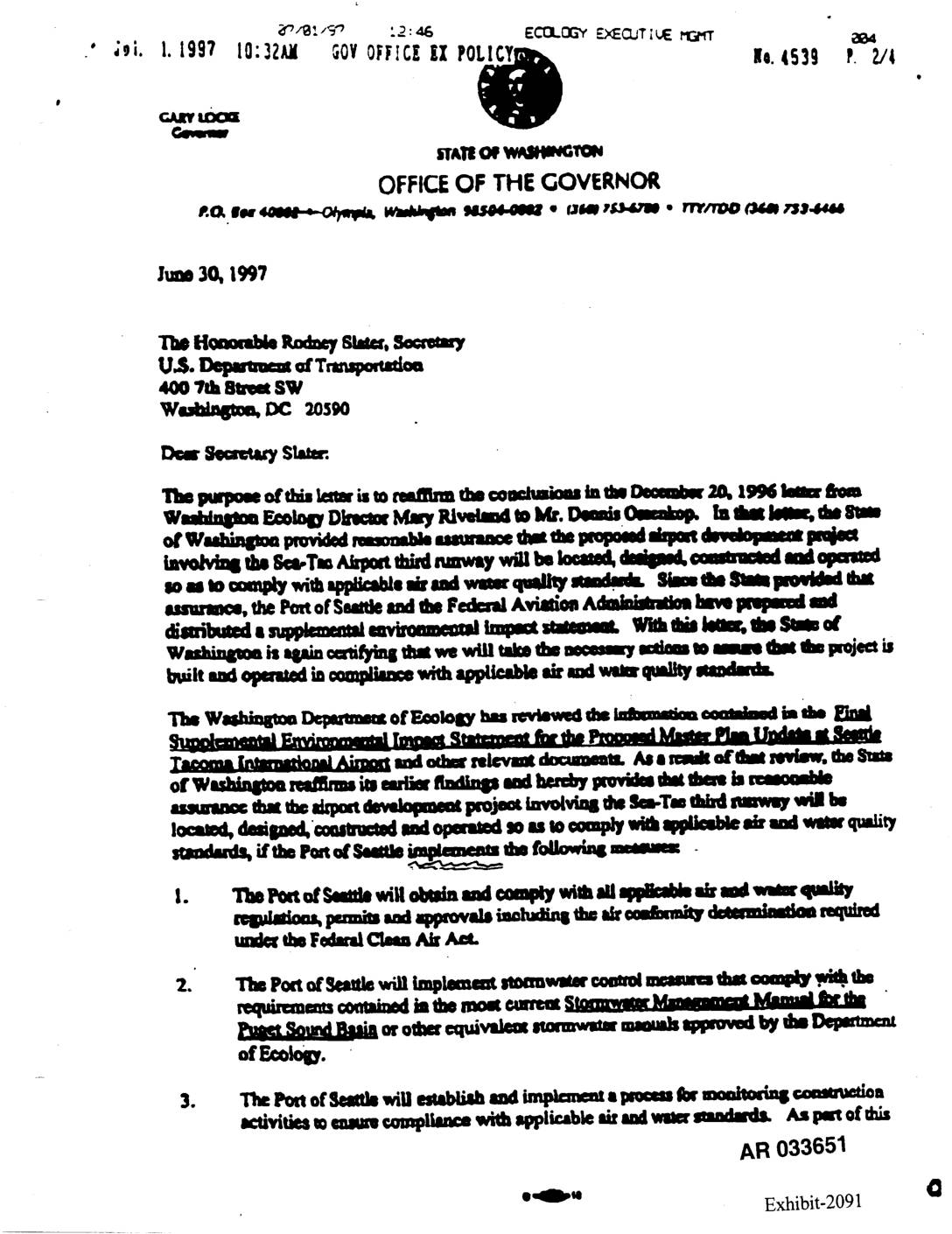
Exhibit 2091: Governor Gary Locke Letter to Secretary Rodney Slater Re: Sea-Tac Airport Third Runway Air and Water Quality Assurance
June 30, 1997 letter from Washington Governor Gary Locke to U.S. Department of Transportation Secretary Rodney Slater reaffirming state certification under 49 U.S.C. 47101 for the Sea-Tac Airport third runway development project. Supersedes December 20, 1996 letter from Ecology Director Mary Riveland to Dennis Ossenkop. Port of Seattle required to: obtain air and water quality -
 1997-06-08
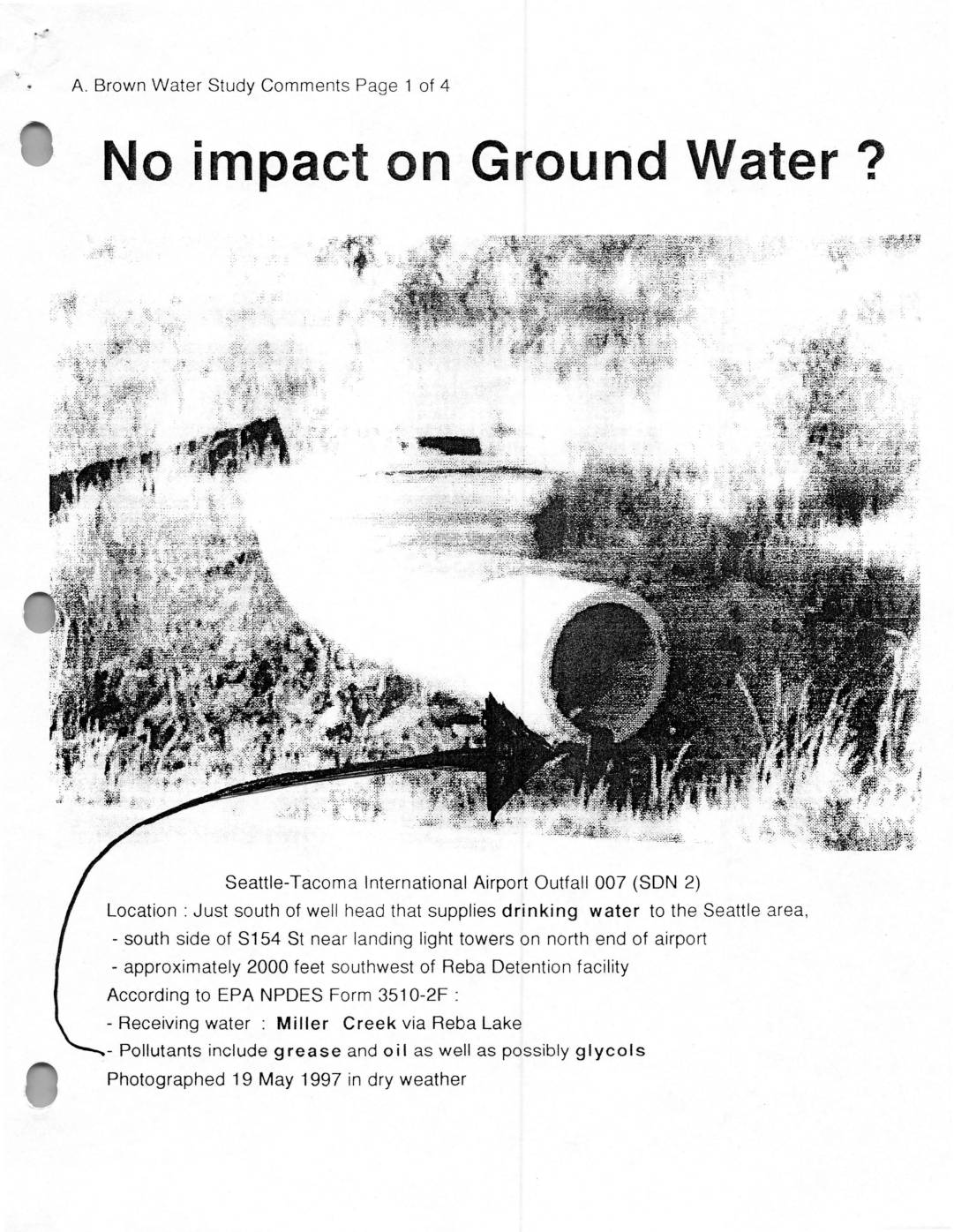
No Impact on Ground Water? Comments on DOE and Port Of Seattle Agreement for Ground Water Study at Sea-Tac Airport
A 1997 public comment letter from a Seattle resident raises concerns that a planned ground water study near Seattle-Tacoma International Airport is too limited in scope to accurately assess pollution risks to local drinking water. The author documents an airport outfall discharging oil, grease, and glycols just south of a drinking water well head, and argues the study must be expanded to include outfalls, fuel depot leaks, abandoned underground tanks, and the effects of massive planned construction. The letter urges regulators to require more rigorous sampling conditions and to openly address the water quality impacts of the airport's proposed Third Runway expansion. -
 1997-05-28
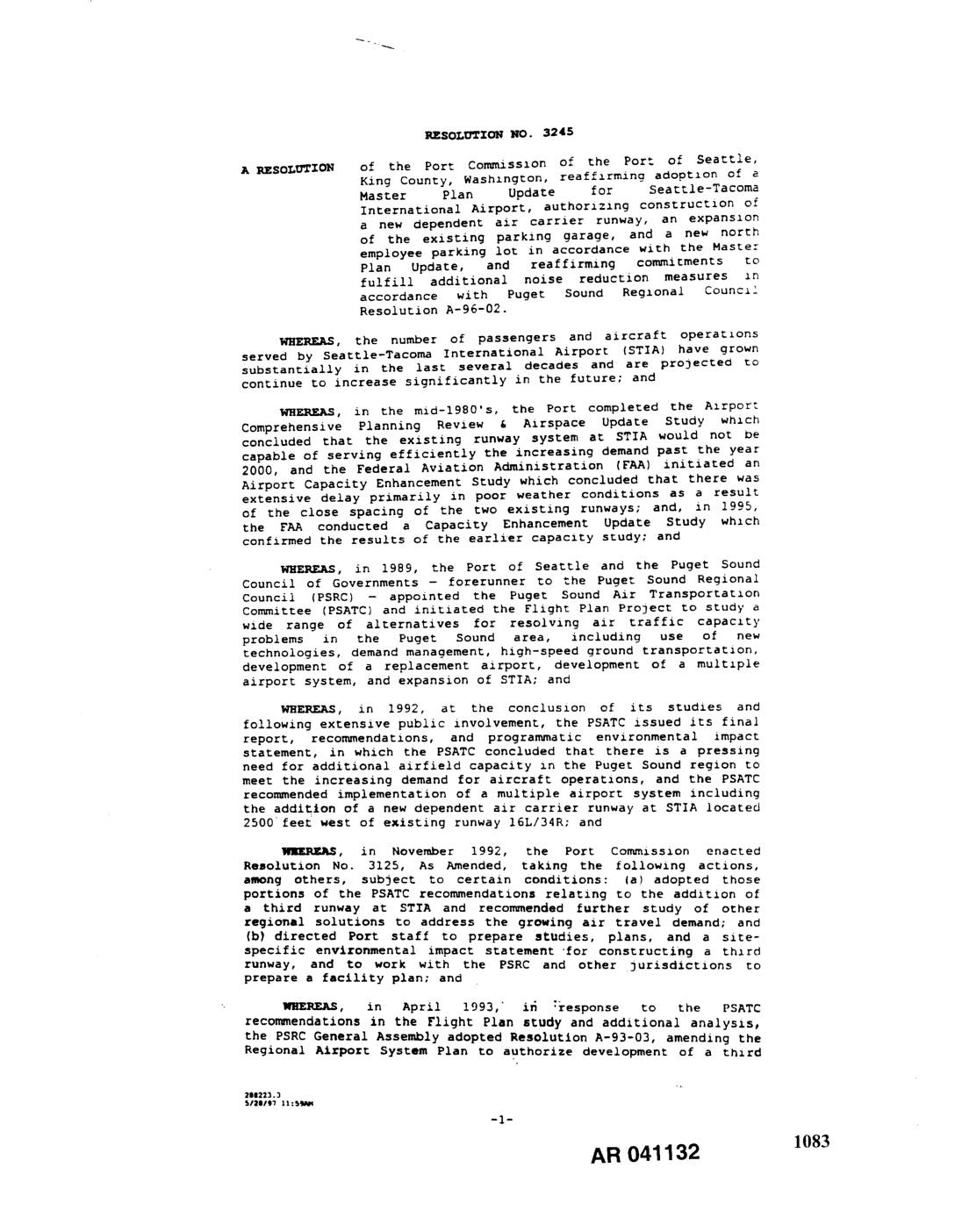
EXH AR041132: Port Of Seattle Commission Resolution No. 3245 — Reaffirming Master Plan Update and Authorizing Third Runway Construction at STIA
Port Of Seattle Commission Resolution No. 3245 reaffirms adoption of the Airport Master Plan Update for Seattle-Tacoma International Airport (STIA), authorizes construction of a new dependent air carrier runway (third runway) located 2500 feet west of existing runway 16L/34R, expansion of the existing parking garage, and a new north employee parking lot. References PSRC Resolution -
 1997-05-13
Final Supplemental Environmental Impact Statement for the Proposed Master Plan Update Development Actions at Seattle-Tacoma International Airport, Volume 1: Main Text and Appendices A through C-1
This 1997 Final Supplemental Environmental Impact Statement (SEIS) examines the environmental effects of proposed expansion plans at Seattle-Tacoma International Airport, including construction of a new third parallel runway, terminal improvements, and parking upgrades. The study was prompted by faster-than-expected growth in air travel demand during the mid-1990s, which exceeded earlier forecasts and required updated analysis of noise, air quality, wetland, and community impacts. The document was jointly prepared by the FAA and the Port of Seattle to ensure the proposed developments met federal and Washington State environmental policy requirements. -
 1997-05-01
Sea-Tac Airport Master Plan Update Final EIS: Appendix R — Response to Comments on the Draft Environmental Impact Statement
This document is Appendix R of the Sea-Tac Airport Master Plan Update Final Environmental Impact Statement (EIS), containing official responses to public comments received during a 90-day comment period in 1995. Two public hearings gathered testimony on topics including noise impacts, land use, air quality, and surface transportation. A key finding was that airport activity levels were expected to grow regardless of whether improvements were built, driven by regional population and income growth rather than airport capacity alone. -
 1997-05-01
Final Supplemental EIS, Appendix F: DSEIS Response to Comments — Forecasts, Do-Nothing/With Project Capacity, and Forecast Ranges
This document is part of the Final Supplemental Environmental Impact Statement for Seattle-Tacoma International Airport, addressing public comments on aviation demand forecasts and runway capacity planning. It explains how the 'Do-Nothing' and 'With Project' (Third Runway) alternatives were evaluated based on projected passenger and operations data through 2010, noting that the existing airfield has a maximum capacity of 460,000 annual operations. The document also acknowledges the inherent uncertainty in long-range aviation forecasts and clarifies that neither NEPA nor SEPA require the use of worst-case data in environmental reviews. -
 1997-05-01
EXH AR040519: Final Supplemental Environmental Impact Statement for Proposed Master Plan Update Development Actions at Seattle-Tacoma International Airport
Final Supplemental Environmental Impact Statement (SEIS) dated May 1997, prepared jointly by the FAA Northwest Mountain Region (responsible official Dennis Ossenkop) and Port Of Seattle (SEPA contact Barbara Hinkle), for proposed Master Plan Update development actions at Seattle-Tacoma International Airport. Covers proposed 8,500-foot third parallel runway (Runway 16X/34X) located 2,500 feet west of existing Runway -
 1997-05-01
Appendix D: Environmental Evaluation of Year 2020 Impacts and a Forecast Greater Than the New Forecast
This appendix from Seattle-Tacoma International Airport's Final Supplemental Environmental Impact Statement evaluates potential environmental impacts through the year 2020 under three scenarios, including the new Port forecast and cases where aviation demand grows 10% faster than projected. Key findings indicate that noise impacts are expected to remain below current levels in all scenarios, with 'With Project' improvements producing roughly 53% of current noise conditions by 2020. The analysis also examines air quality, enplanement levels, and aircraft operations across both Do-Nothing and preferred alternatives to guide long-term airport planning. -
 1997-05-01
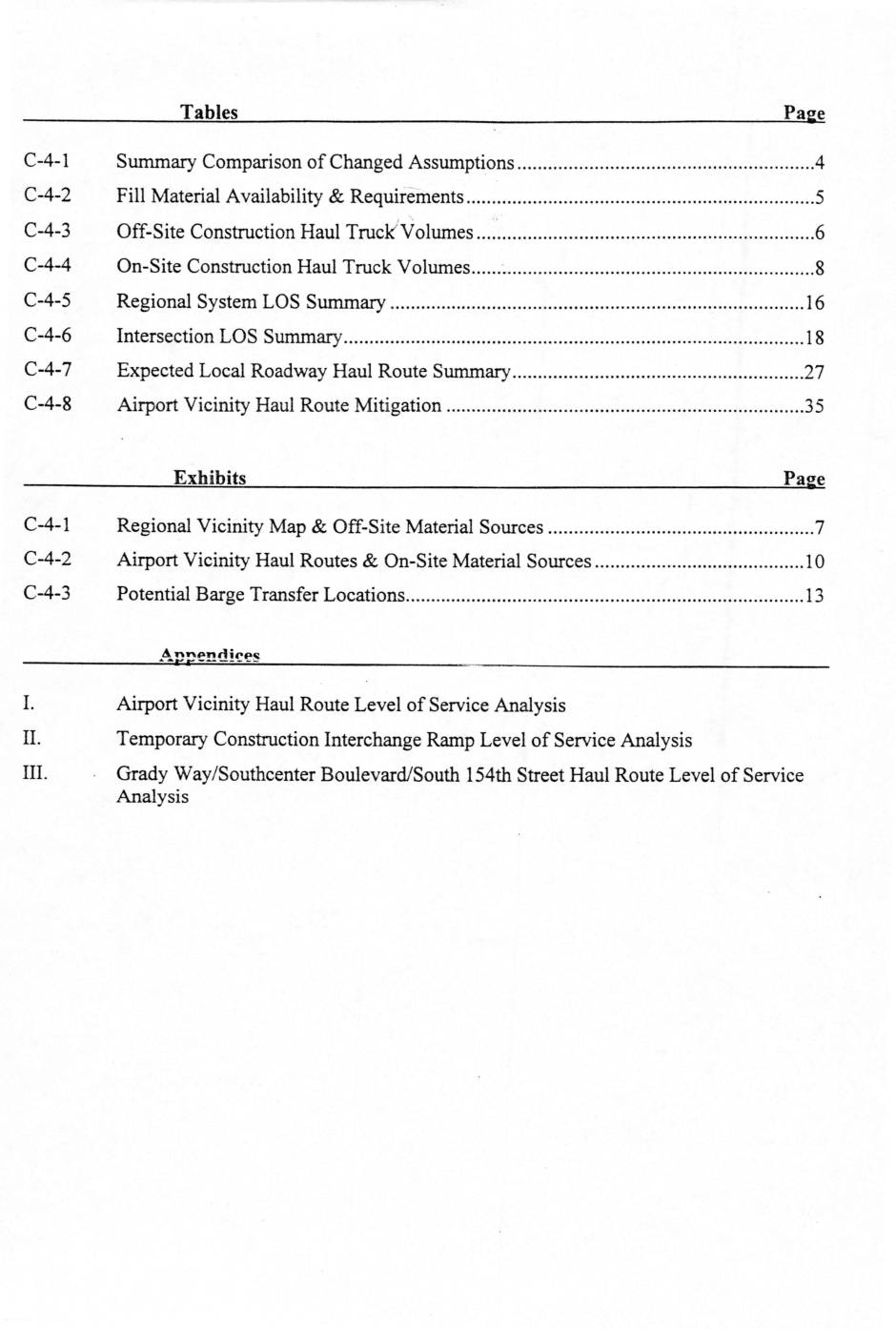
Appendix C-4: Construction Impacts Report — Seattle-Tacoma International Airport Final Supplemental Environmental Impact Statement
This technical report supplements the Final Environmental Impact Statement for Seattle-Tacoma International Airport's Master Plan Update, focusing on construction impacts related to the proposed Third Runway and associated projects. It analyzes fill material requirements estimated at 17.25 million cubic yards, haul routes, and truck traffic volumes, noting that the construction timeline was extended from three to five years, which reduced the number of average daily truck trips compared to earlier estimates. The report examines both on-site and off-site material sources and assesses potential traffic congestion impacts on regional roadways during the construction period.