TagSea-Tac Airport(1835)
-
 2019-01-15
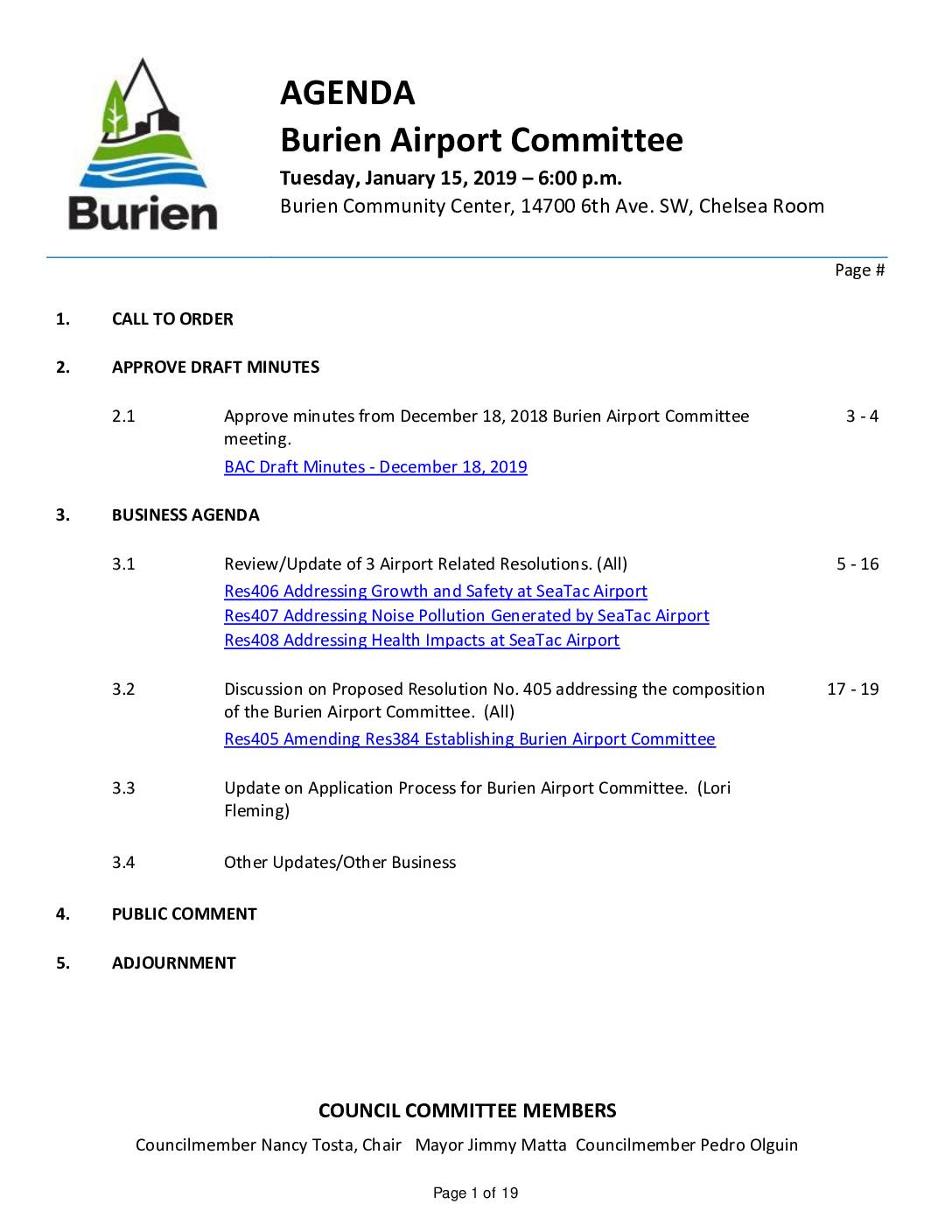
Burien Airport Committee agenda and draft minutes, January 15, 2019
The Burien Airport Committee met on January 15, 2019 to review and update three proposed city resolutions addressing growth and safety, noise pollution, and health impacts related to Seattle-Tacoma International Airport. The committee also discussed a proposed resolution to restructure its own membership by removing the distinction between business and resident members and adding ex-officio seats for representatives from other airport-related groups. Additional agenda items included an update on open applications to fill vacant committee seats. -
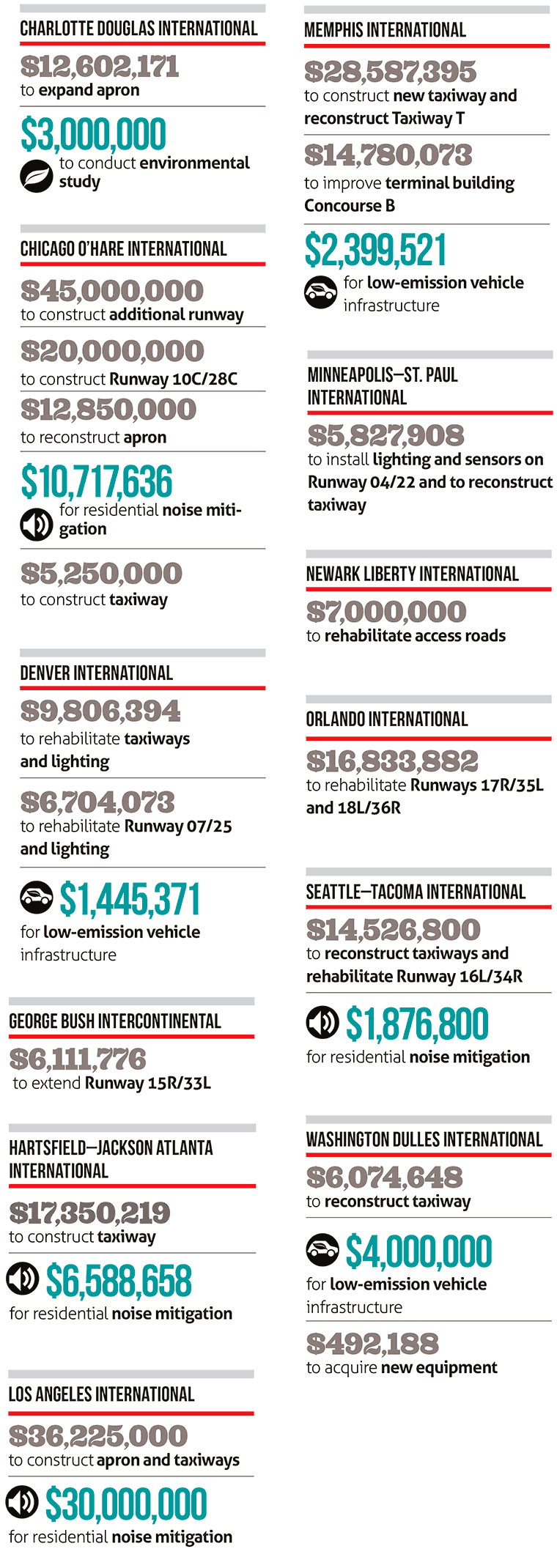
Airport Improvement Program Comparison
Seattle-Tacoma International Airport received $14,526,800 to reconstruct taxiways and rehabilitate Runway 16L/34R, plus $1,876,800 for residential noise mitigation, as part of a multi-airport FAA funding infographic covering major U.S. airports. -
 2019-01-07
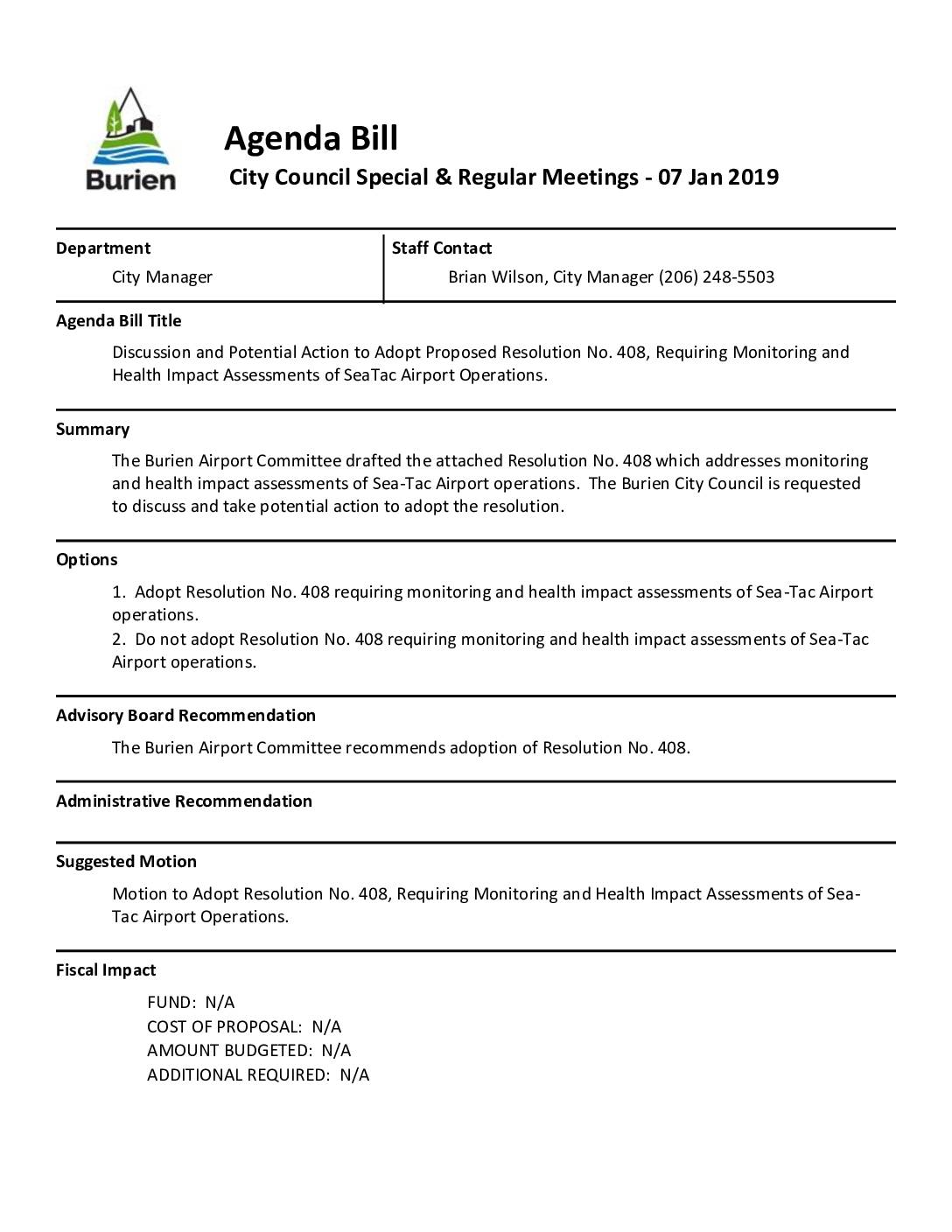
Resolution No. 408 requiring monitoring and health impact assessments of Sea-Tac Airport operations
In January 2019, the City of Burien, Washington considered Resolution No. 408, which called for air quality monitoring and health impact assessments of Sea-Tac Airport operations. The resolution highlighted that air traffic had exceeded the airport's projected levels by over 30% and that no air quality monitors existed near the six closest cities to the airport. The Burien Airport Committee recommended adopting the resolution, citing concerns about residents' exposure to pollutants linked to cancer, cardiovascular disease, and other serious health conditions. -
 2019-01-07
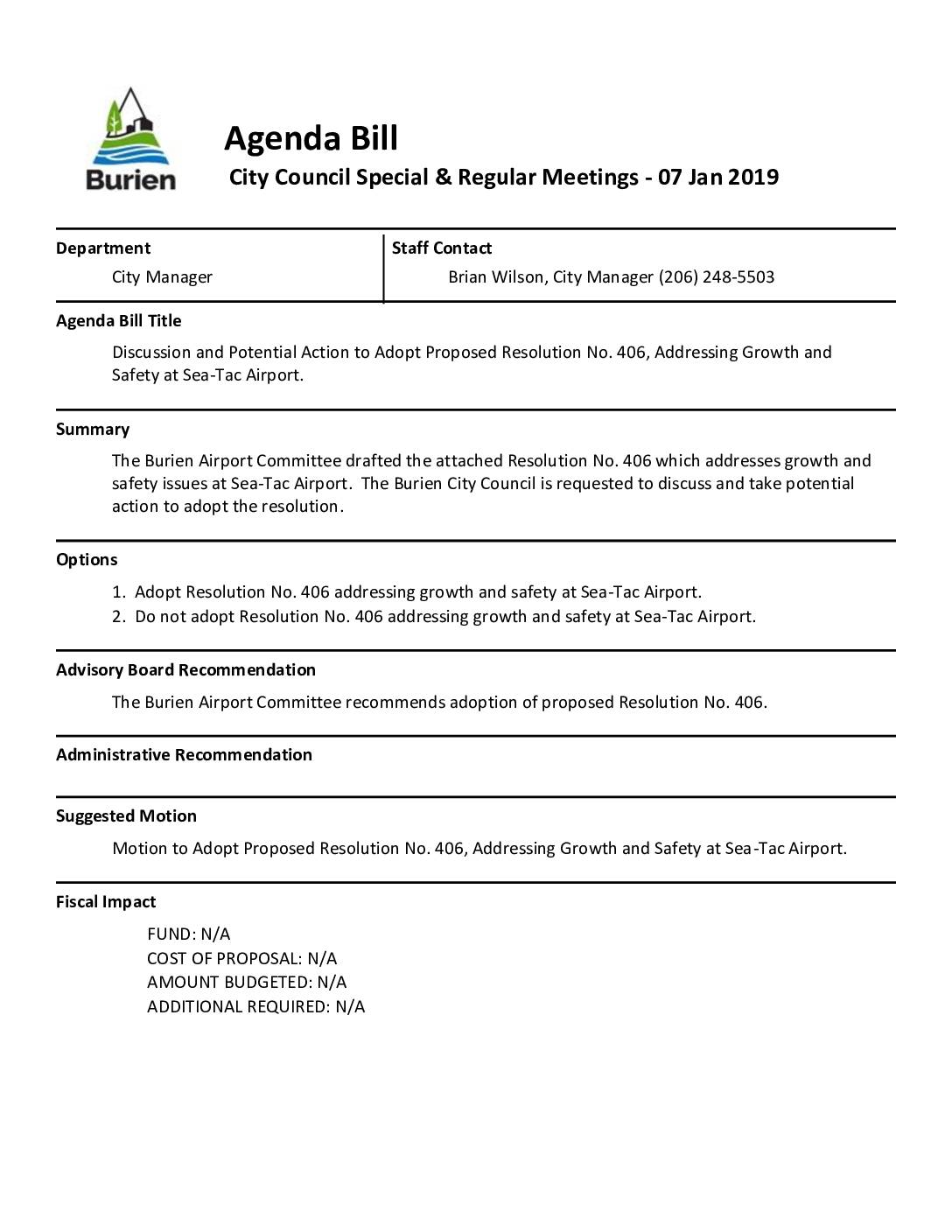
Resolution No. 406 addressing growth and safety at Sea-Tac Airport
In January 2019, the City of Burien, Washington considered Resolution No. 406, calling for action on growth and safety concerns at Seattle-Tacoma International Airport. The resolution highlights the negative health, environmental, and economic impacts on Burien residents due to the city's proximity to the airport, and notes that even with a planned $10 billion expansion under the Sustainable Airport Master Plan, the airport would still lack sufficient capacity within a decade. The city supported ongoing state and federal studies into regional aviation capacity and the impacts of airport operations on surrounding communities. -
 2019-01-07
Resolution No. 407 addressing noise pollution generated by Sea-Tac Airport
In January 2019, the City of Burien, Washington considered Resolution No. 407, a measure drafted by the Burien Airport Committee to address noise pollution from nearby Sea-Tac Airport. The resolution highlighted that the airport's rapid growth had caused serious health, environmental, and economic harm to Burien residents, with current FAA noise level standards far exceeding the safer thresholds recommended by the World Health Organization. The Burien Airport Committee recommended adoption of the resolution, which called for updated noise impact assessments and greater consideration of off-site noise effects. -
 2019-01-01
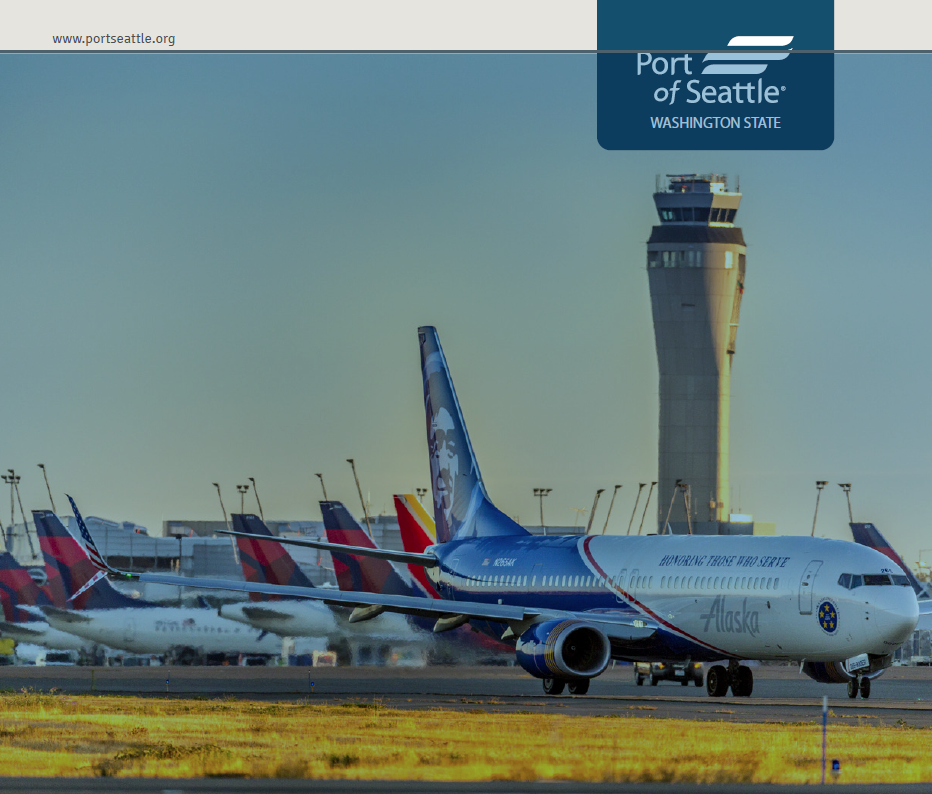
Port Of Seattle CAFR Cover Page 2019
An Alaska Airlines Boeing 737 featuring the special 'Honoring Those Who Serve' military tribute livery taxis at Seattle-Tacoma International Airport (Sea-Tac), with the airport's FAA air traffic control tower visible in the background. The image is watermarked with the Port of Seattle, Washington State logo and website (www.portseattle.org), indicating it is an official Port of Seattle publication or archive document. -
 2019-01-01
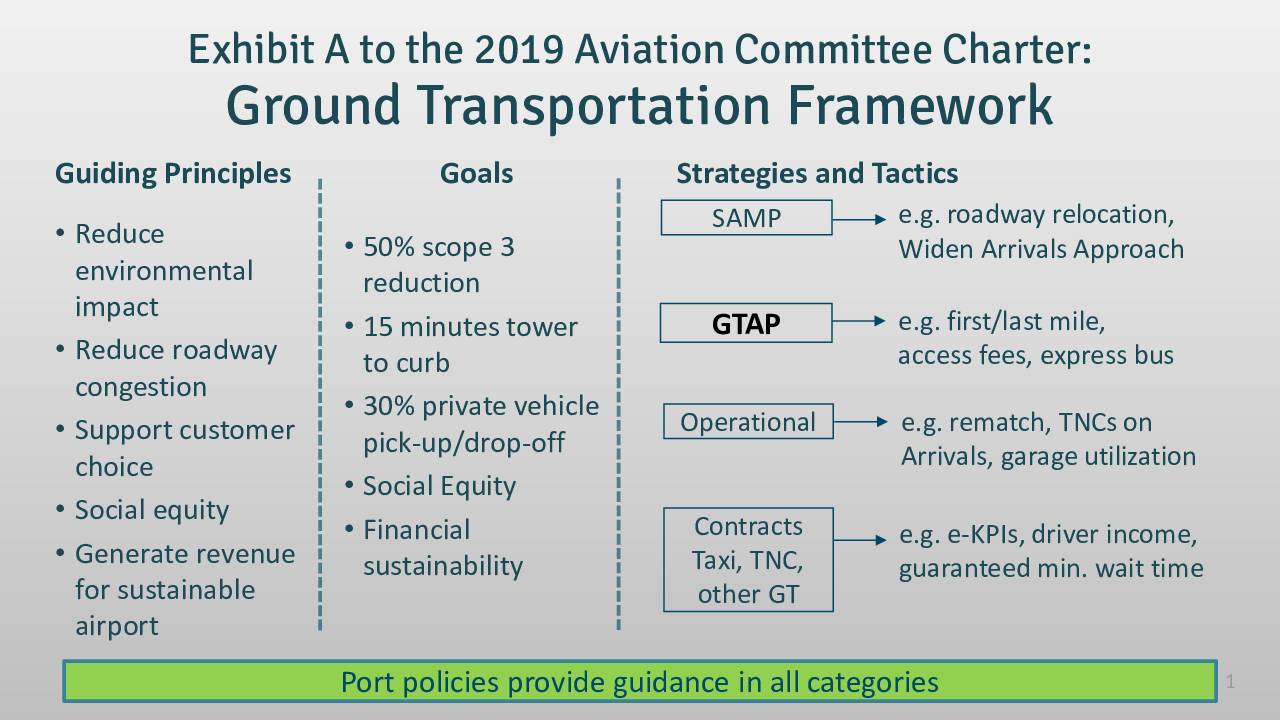
Exhibit A to the 2019 Aviation Committee Charter: Ground Transportation Framework
This 2019 Aviation Committee document outlines Sea-Tac Airport's Ground Transportation Framework, detailing the guiding principles, goals, and strategies for managing how passengers and vehicles move through the airport. Key goals include reducing environmental impact (50% scope 3 emissions reduction), cutting private vehicle pick-up and drop-off to 30% of trips, and achieving a 15-minute tower-to-curb travel time. Strategies span infrastructure planning (SAMP), access policy (GTAP), day-to-day operations, and taxi/TNC contracts, with Port policies providing overarching guidance across all areas. -
 2019-01-01
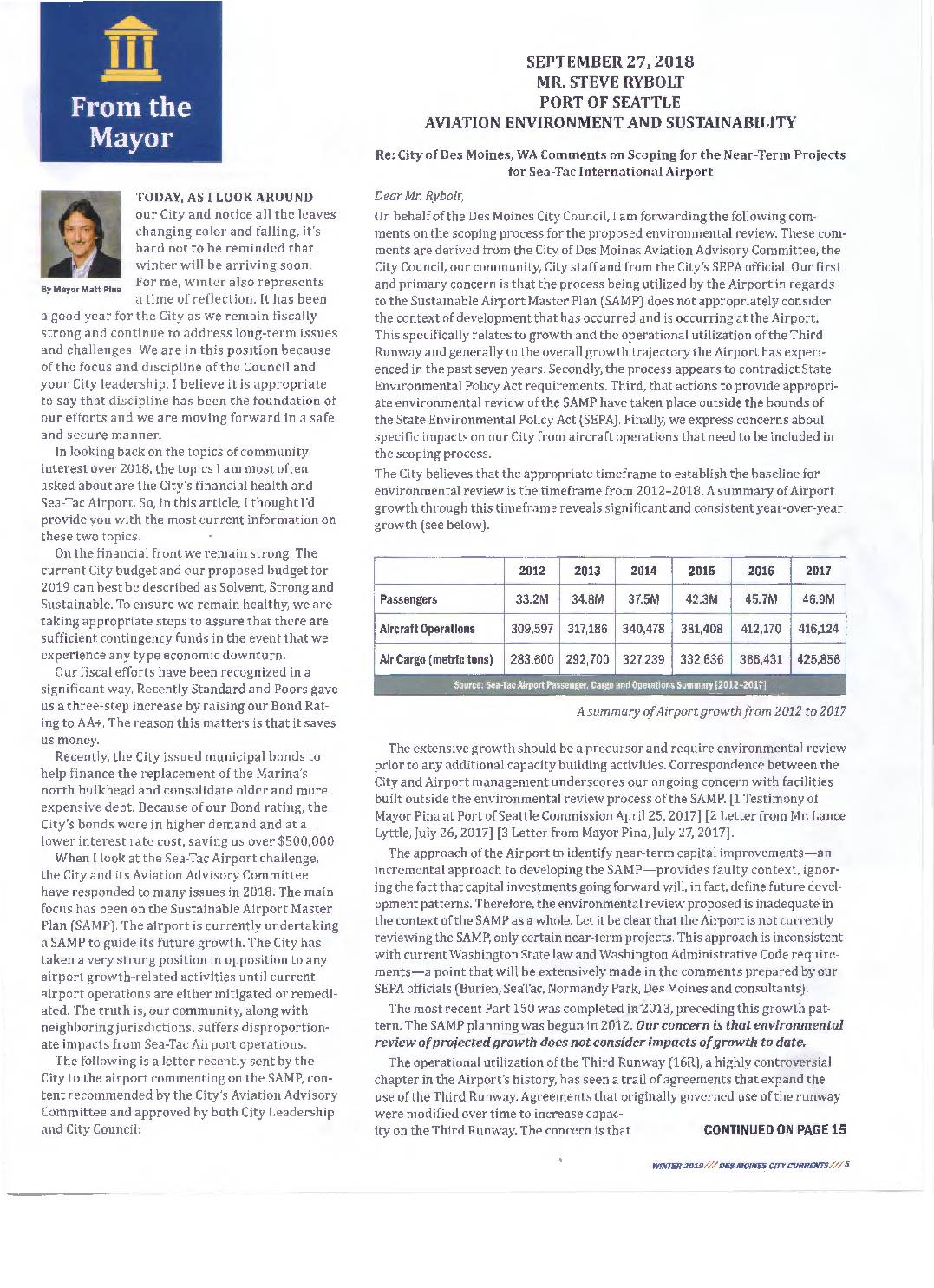
From the Mayor: City finances and Sea-Tac Airport update
In this Winter 2019 edition of Des Moines City Currents, Mayor Matt Pina outlines the city's strong opposition to Sea-Tac Airport's expansion plans, arguing that rapid growth between 2012 and 2017—including surging passenger numbers, aircraft operations, and air cargo—has already caused disproportionate noise, health, and environmental impacts on surrounding communities. The city formally called on the Port of Seattle to conduct a comprehensive environmental review under Washington State's SEPA laws before approving any further capacity-building projects, and specifically demanded that issues such as nighttime flight noise, fuel dumping, ultra-fine particle emissions, and Third Runway usage be included in the scoping process. Members of the city's Aviation Advisory Committee also voiced concerns about the health toll on residents, outdated federal standards, and the need for alternatives such as a second regional airport. -
 2018-12-19
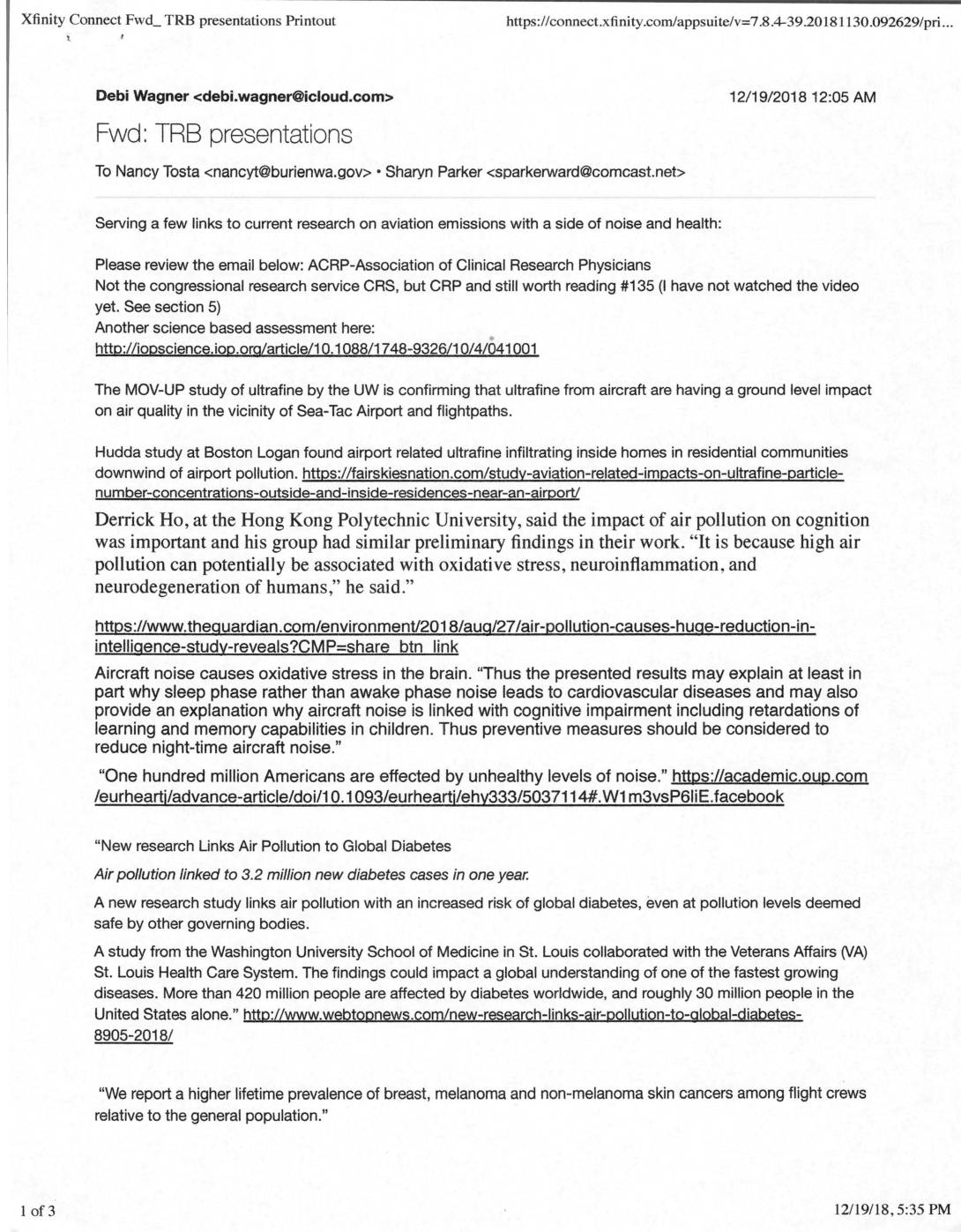
Fwd: TRB presentations
A December 2018 email chain forwarded by community advocate Debi Wagner to Burien city officials shares research links connecting aviation emissions and aircraft noise to serious public health concerns, including ultrafine particle pollution, cognitive impairment, cardiovascular disease, and cancer. The email references studies such as the University of Washington's MOV-UP study confirming ground-level ultrafine particle impacts near Sea-Tac Airport, as well as EPA Region X recommendations for resources on airport air quality and public health. The correspondence highlights growing community and regulatory interest in understanding the health effects of airport operations on neighborhoods surrounding Sea-Tac. -
 2018-12-14
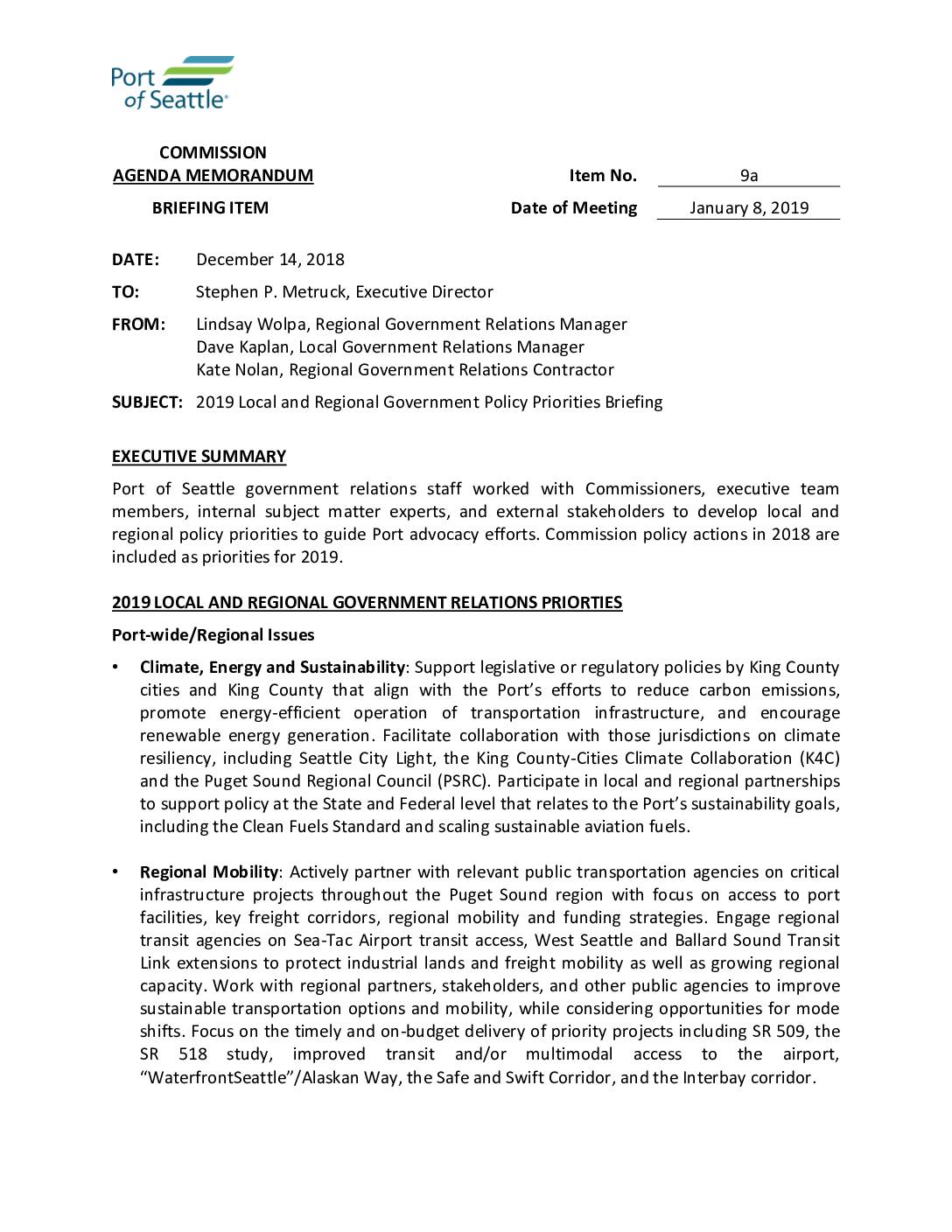
2019 local and regional government policy priorities briefing
This January 2019 Port of Seattle Commission briefing outlines the agency's local and regional government policy priorities for 2019, covering areas such as climate and sustainability, regional transportation, workforce development, maritime projects, and aviation. On the airport side, key priorities include advancing the Sustainable Airport Master Plan (SAMP) near-term projects to address regional demand, and engaging surrounding South King County communities through forums like the Sea-Tac Stakeholder Advisory Round Table (StART). The document reflects the Port's broader effort to balance airport growth with community concerns, economic opportunity, and environmental responsibility.