TagSea-Tac Airport(1835)
-
 2019-06-01
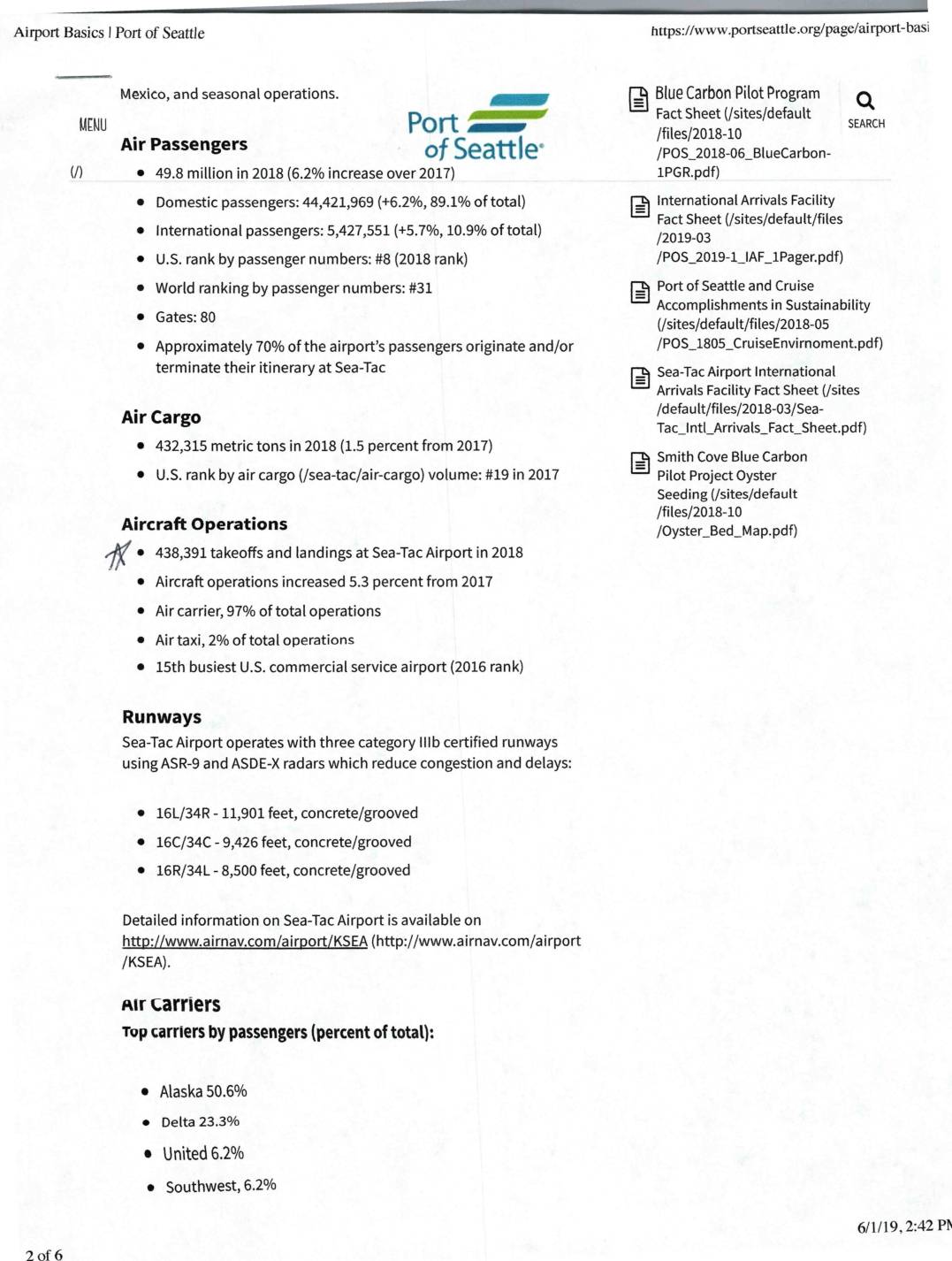
Airport basics | Port Of Seattle
Seattle-Tacoma International Airport handled 49.8 million passengers and 438,391 aircraft operations in 2018, ranking 8th in the U.S. by passenger volume. A noise compatibility study forecasted total annual aircraft operations to grow from approximately 301,870 in 2009 to 399,200 by 2021, driven by increases in both domestic and international air carrier activity. The airport operates three category IIIb certified runways and is dominated by Alaska Airlines, which carries over 50% of its passengers. -
 2019-05-31
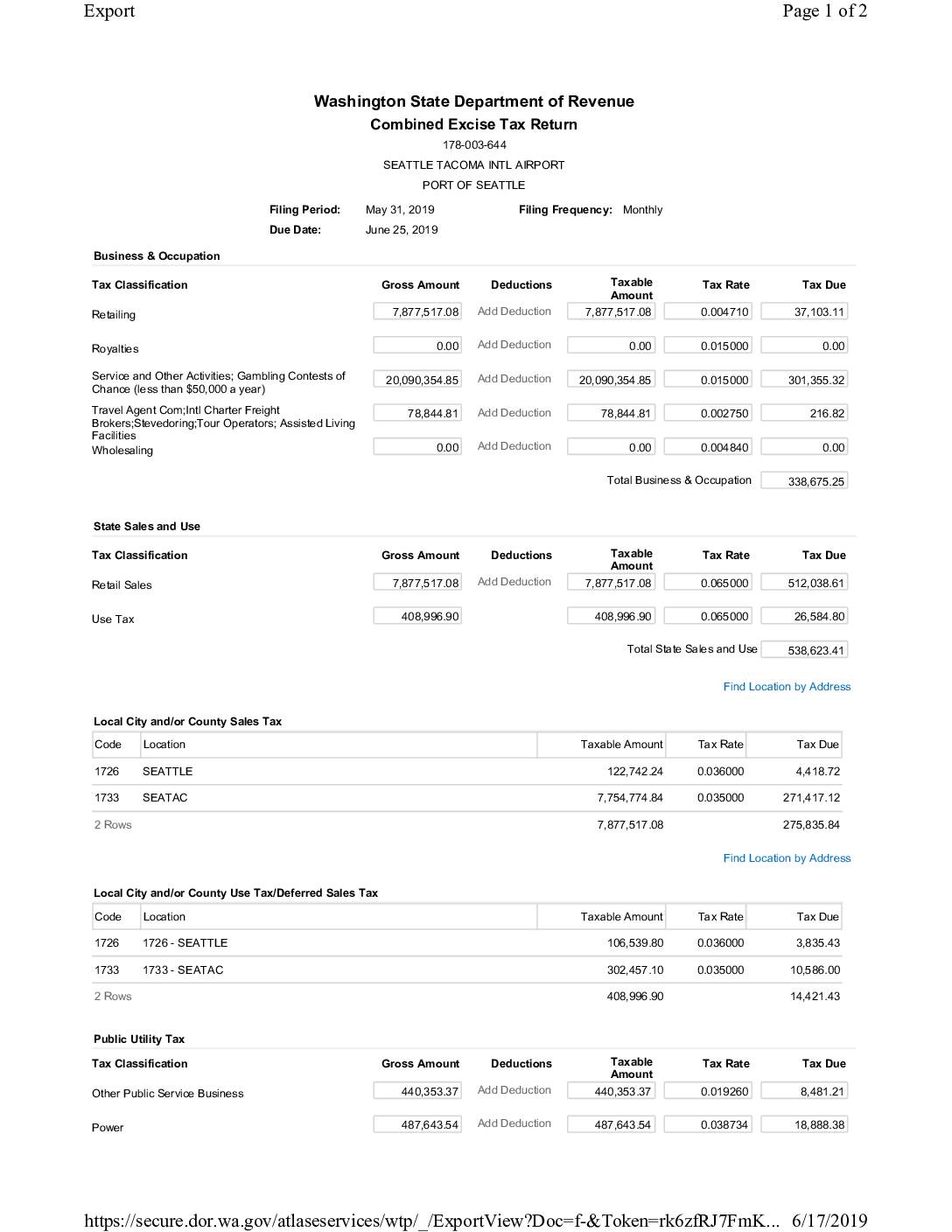
Port Of Seattle: Combined Excise Tax Return, May 2019
This document is a Washington State Combined Excise Tax Return filed by the Port of Seattle for Seattle-Tacoma International Airport, covering the period ending May 31, 2019. It details Business & Occupation taxes, state and local sales and use taxes, and public utility taxes across multiple classifications, totaling $1,205,917.95 in taxes due. The return was prepared by Bonnie McArthur and submitted on June 17, 2019, with payment scheduled via ACH debit on June 25, 2019. -
 2019-05-07
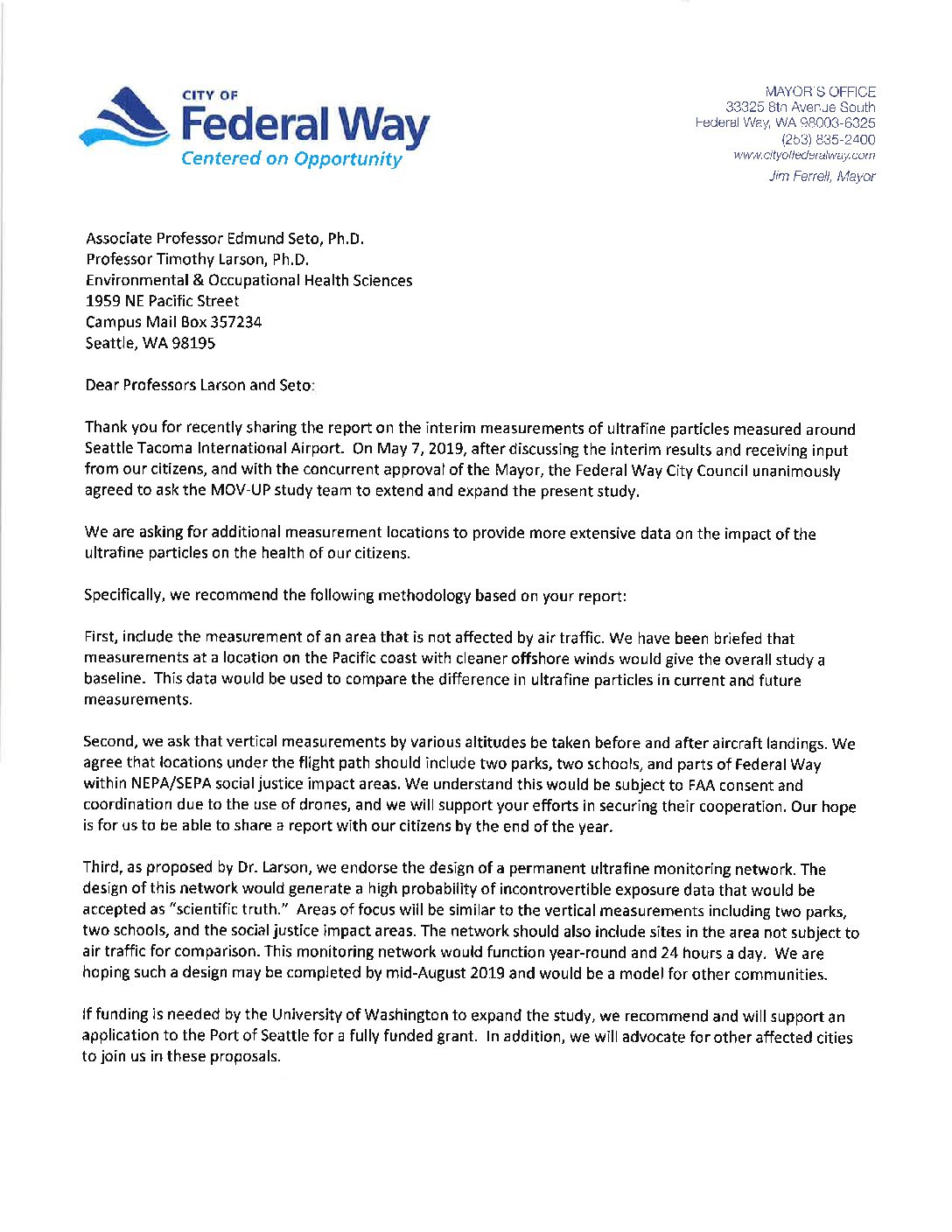
Federal Way Mayor and City Council Letter to UW Professors Larson and Seto Requesting Expansion of MOV-UP Ultrafine Particle Study Near Sea-Tac Airport
In May 2019, Federal Way Mayor Jim Ferrell and the unanimous City Council wrote to University of Washington researchers requesting an expansion of the MOV-UP study measuring ultrafine particle pollution around Seattle-Tacoma International Airport. The letter calls for three key additions: a baseline measurement site unaffected by air traffic, drone-based vertical air sampling before and after aircraft landings at parks, schools, and social justice impact areas, and the design of a permanent 24/7 ultrafine particle monitoring network. The city also offered to support a Port of Seattle grant application to fund the expanded research and pledged to encourage other affected communities to join the effort. -
 2019-05-01
Billing Backup for City Shares of Lockridge Grindal Nauen Invoices for Sea-Tac Airport SAMP Review
This document details billing records for the City of Burien, Washington, related to a joint environmental review of the Sea-Tac Airport Sustainable Airport Master Plan (SAMP). Four cities — Burien, Des Moines, Normandy Park, and SeaTac — shared costs for hiring law firm Lockridge Grindal Nauen PLLP under a March 2018 Interlocal Agreement, with expenses divided based on each city's population at approximately $1.50 per capita. The total contract was $175,000, and the fourth invoice (dated May 1, 2019) covered April 2019 legal work totaling $1,625.00, including document review and environmental assessment modeling. -
 2019-05-01
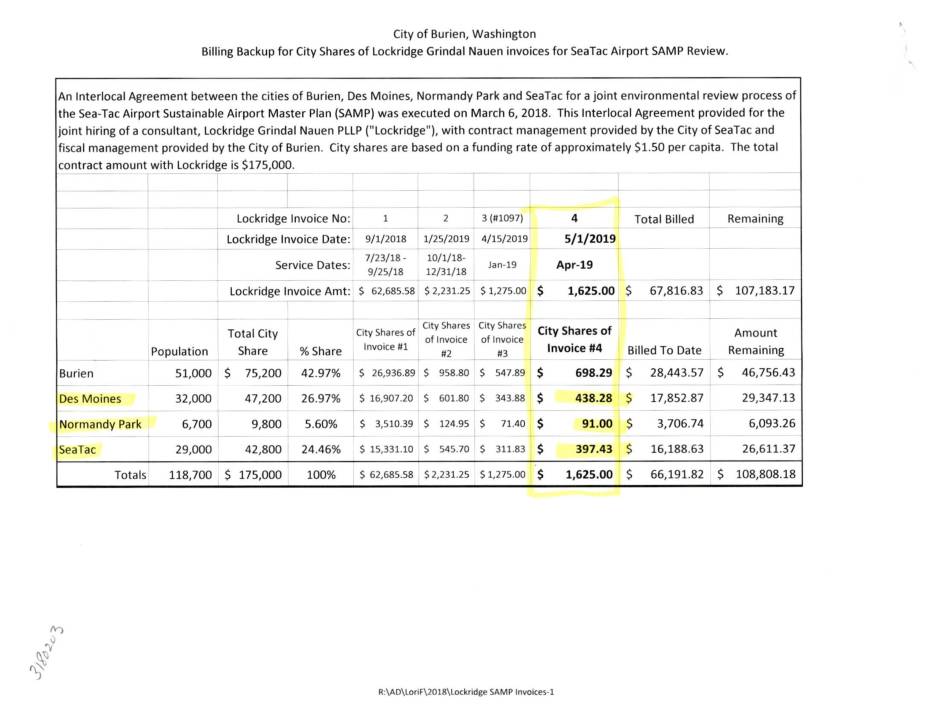
Billing Backup for City Shares of Lockridge Grindal Nauen Invoices for Sea-Tac Airport SAMP Review
This document details billing records for the City of Burien, Washington, related to a joint environmental review of the Sea-Tac Airport Sustainable Airport Master Plan (SAMP). Four cities — Burien, Des Moines, Normandy Park, and SeaTac — share costs for legal consulting services provided by Lockridge Grindal Nauen PLLP under a $175,000 contract, with each city's share calculated at approximately $1.50 per capita. Invoice #4, dated May 1, 2019, covers April 2019 legal work including document review and environmental assessment modeling, totaling $1,625.00 across all cities. -
 2019-05-01
Billing Backup for City Shares of Lockridge Grindal Nauen Invoices for Sea-Tac Airport SAMP Review
This document details billing records for the City of Burien, Washington, related to a joint environmental review of the Sea-Tac Airport Sustainable Airport Master Plan (SAMP). Four cities — Burien, Des Moines, Normandy Park, and SeaTac — share costs for legal consulting services provided by Lockridge Grindal Nauen PLLP under a $175,000 contract, with each city's share calculated at approximately $1.50 per capita. Invoice #4, dated May 1, 2019, covers April 2019 legal work including document review and environmental assessment modeling, totaling $1,625.00 across all cities. -
 2019-05-01
Billing Backup for City Shares of Lockridge Grindal Nauen Invoices for Sea-Tac Airport SAMP Review
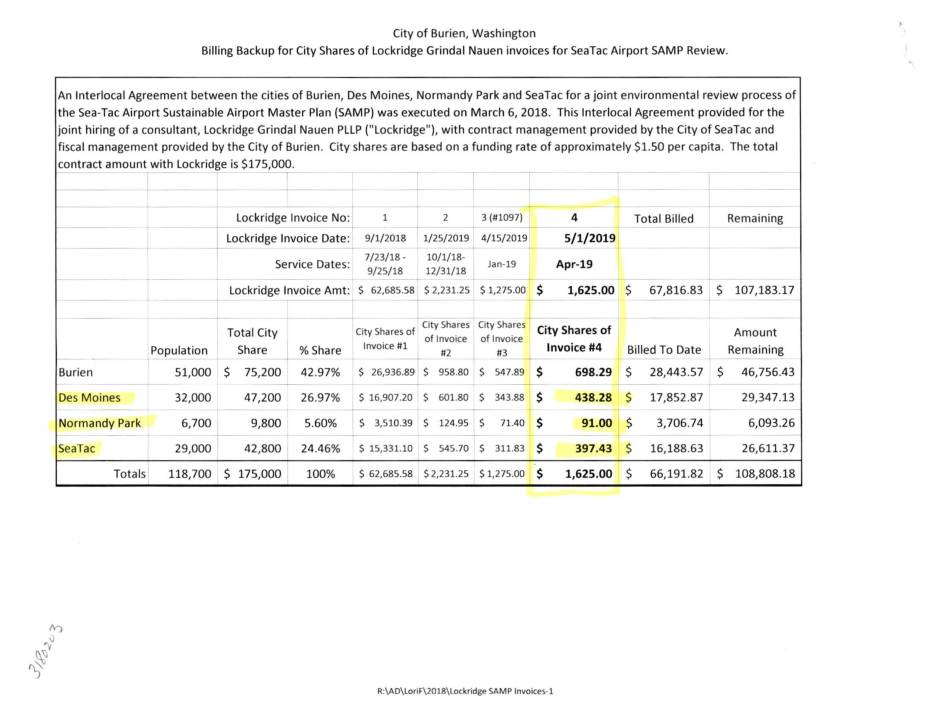
This document details billing records for the City of Burien, Washington, related to a joint environmental review of the Sea-Tac Airport Sustainable Airport Master Plan (SAMP). Four cities — Burien, Des Moines, Normandy Park, and SeaTac — shared costs for hiring law firm Lockridge Grindal Nauen PLLP under an Interlocal Agreement executed in March 2018, with each city's share based on a per-capita funding rate of approximately $1.50. The total contract was $175,000, of which roughly $66,192 had been billed across four invoices by May 2019, leaving approximately $108,808 remaining. -
 2019-05-01
Billing Backup for City Shares of Lockridge Grindal Nauen Invoices for Sea-Tac Airport SAMP Review
This document details billing records for the City of Burien, Washington, related to a joint environmental review of the Sea-Tac Airport Sustainable Airport Master Plan (SAMP). Four cities — Burien, Des Moines, Normandy Park, and SeaTac — shared costs for hiring law firm Lockridge Grindal Nauen PLLP under an Interlocal Agreement executed in March 2018, with each city's share based on a per-capita funding rate of approximately $1.50. The total contract was $175,000, of which roughly $66,192 had been billed across four invoices by May 2019, leaving approximately $108,808 remaining. -
 2019-05-01
Lockridge Grindal Nauen Invoice and Approval Correspondence — Sea-Tac Airport SAMP, April 2019
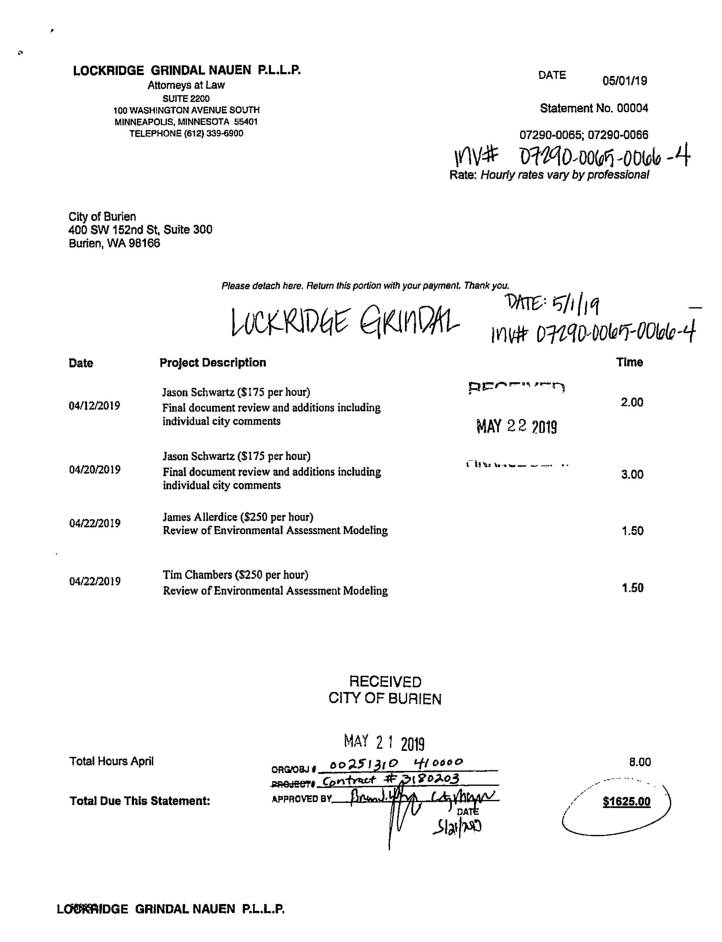
This document contains a May 2019 invoice from law firm Lockridge Grindal Nauen P.L.L.P. to the City of Burien for $1,625.00, covering 8 hours of legal work in April 2019 related to the SeaTac Airport Surface Access Management Plan (SAMP), including document review, individual city comments, and Environmental Assessment Modeling analysis. Accompanying emails show City of Burien staff seeking and receiving approval from SeaTac's Director of Community & Economic Development to pay the bill. -
 2019-05-01
Lockridge Grindal Nauen Invoice and Approval Correspondence — Sea-Tac Airport SAMP, April 2019
This document contains a May 2019 invoice from law firm Lockridge Grindal Nauen P.L.L.P. to the City of Burien for $1,625.00, covering 8 hours of legal work in April 2019 related to the SeaTac Airport Surface Access Management Plan (SAMP), including document review, individual city comments, and Environmental Assessment Modeling analysis. Accompanying emails show City of Burien staff seeking and receiving approval from SeaTac's Director of Community & Economic Development to pay the bill.