TagSea-Tac Airport(1855)
-
Op-Ed: Port Of Seattle Commissioner Election Ballot
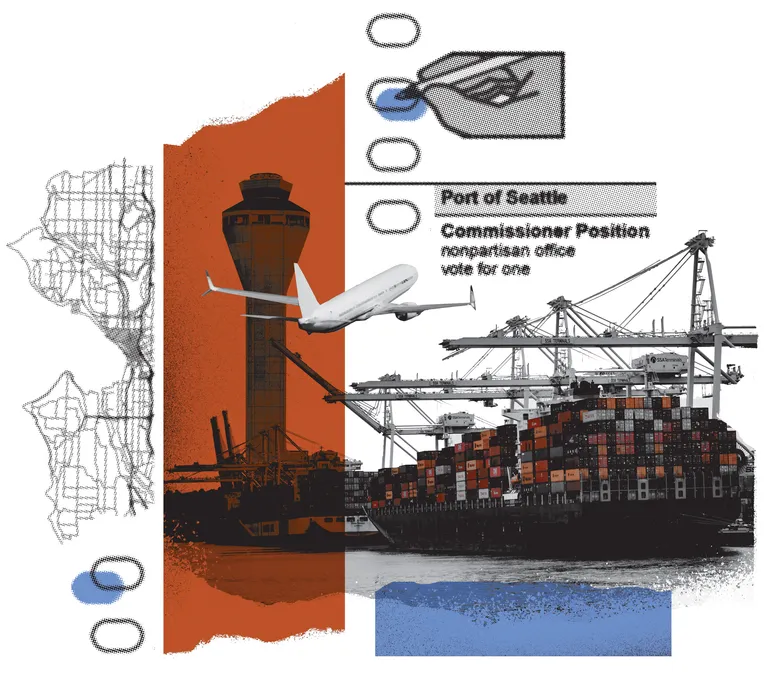
A collage depicting a Port of Seattle Commissioner Position ballot (labeled 'nonpartisan office, vote for one'), alongside imagery of a cargo ship loaded with shipping containers, an airport control tower, a departing airplane, and an outline map of Washington State. The composition relates to Port of Seattle electoral and operational themes, including aviation and maritime commerce. -
 2024-02-22
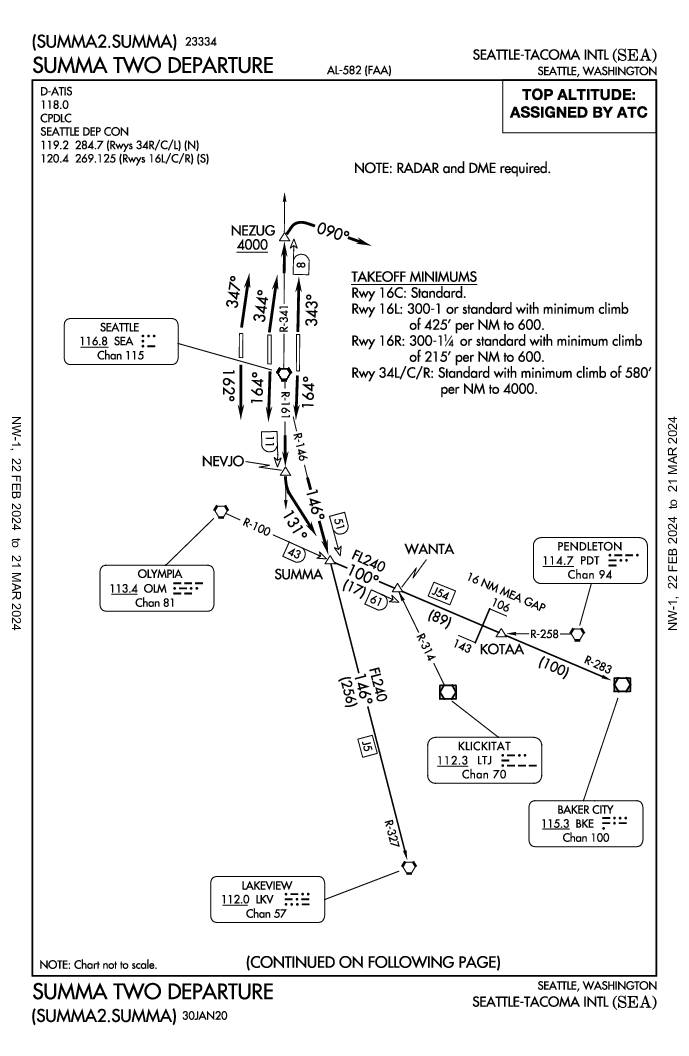
SUMMA Two Departure (SUMMA2.SUMMA) — Seattle-Tacoma International Airport Standard Instrument Departure
The SUMMA TWO Departure (SUMMA2.SUMMA) is a standard instrument departure procedure for Seattle-Tacoma International Airport (SEA) in Seattle, Washington, requiring both RADAR and DME equipment. Aircraft departing on runways 16L, 16C, 16R, 34L, 34C, and 34R follow specific headings and VOR radials through waypoints NEVJO, NEZUG, and SUMMA intersection before proceeding on assigned transitions toward destinations such as Baker City or Lakeview. Takeoff minimums vary by runway, with some requiring minimum climb gradients of up to 580 feet per nautical mile, and top altitude is assigned by ATC up to FL240. -
 2024-02-22
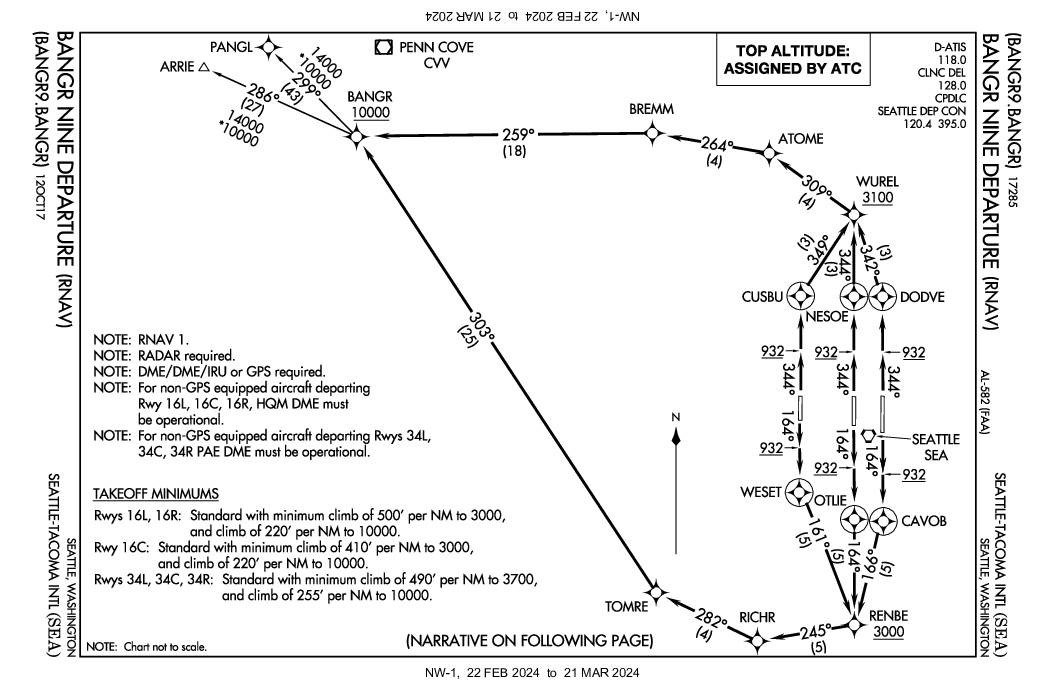
BANGR Nine Departure (RNAV) — Seattle-Tacoma International Airport (SEA)
The BANGR Nine Departure is a standardized instrument departure procedure (SID) for pilots flying out of Seattle-Tacoma International Airport (SEA), directing aircraft on specific headings and altitudes depending on which runway they use. Aircraft departing on northbound runways (34L, 34C, 34R) climb to at least 932 feet before routing through waypoints like CUSBU, NESOE, or DODVE, crossing WUREL at or above 3,100 feet, while southbound runway departures (16L, 16C, 16R) follow similar climb profiles through waypoints like CAVOB, OTLIE, or WESET, crossing RENBE at or above 3,000 feet. All routes converge at the BANGR waypoint, which must be crossed at or above 10,000 feet, with specific minimum climb gradients established to manage aircraft noise and terrain clearance in the surrounding communities. -
 2024-02-22
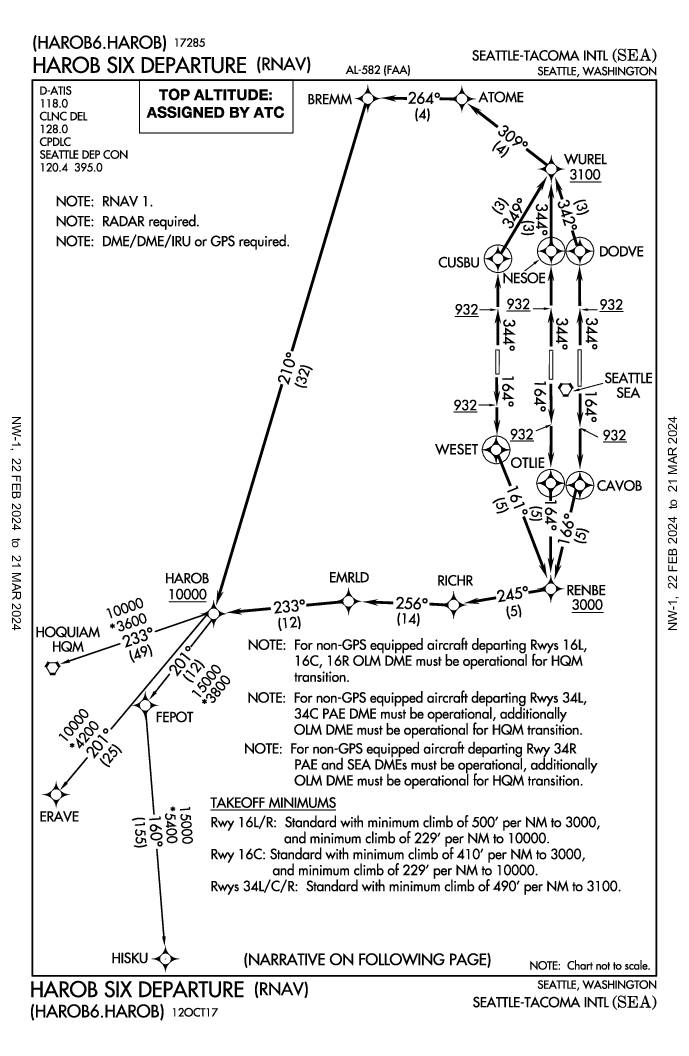
HAROB Six Departure (RNAV) — Seattle-Tacoma International Airport Standard Instrument Departure
The HAROB Six Departure (RNAV) is a standard instrument departure procedure for Seattle-Tacoma International Airport (SEA) that defines specific climbing routes and altitude requirements for aircraft departing on runways 16L, 16C, 16R, 34L, 34C, and 34R. Aircraft must follow prescribed headings, reach minimum altitudes at designated waypoints, and cross the HAROB fix at or above 10,000 feet before proceeding on one of four available transitions toward destinations such as Hoquiam or Hisku. The procedure requires RNAV 1 navigation capability, radar contact, and DME/DME/IRU or GPS equipment, with specific minimum climb gradients designed to manage aircraft noise and obstacle clearance in the Seattle area. -
 2024-02-22
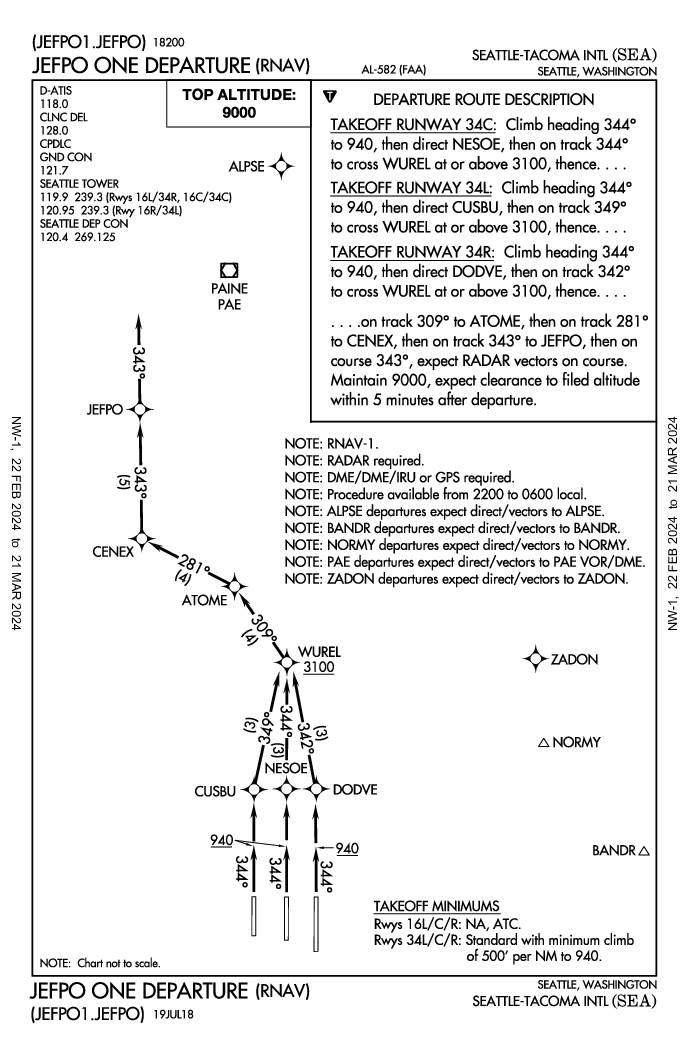
JEFPO One Departure (RNAV) — Seattle-Tacoma International Airport Standard Instrument Departure Procedure
The JEFPO One Departure is an RNAV instrument departure procedure at Seattle-Tacoma International Airport (SEA), available only between 10 PM and 6 AM local time, designed to route departing aircraft northwestward via a series of waypoints toward JEFPO. Aircraft departing runways 34L, 34C, and 34R must climb on a heading of 344° and maintain a minimum climb rate of 500 feet per nautical mile up to 940 feet, then follow specific tracks depending on their runway. Departures from runways 16L, 16C, and 16R are not authorized under this procedure, reflecting noise abatement and air traffic control considerations for the surrounding communities. -
 2024-02-22
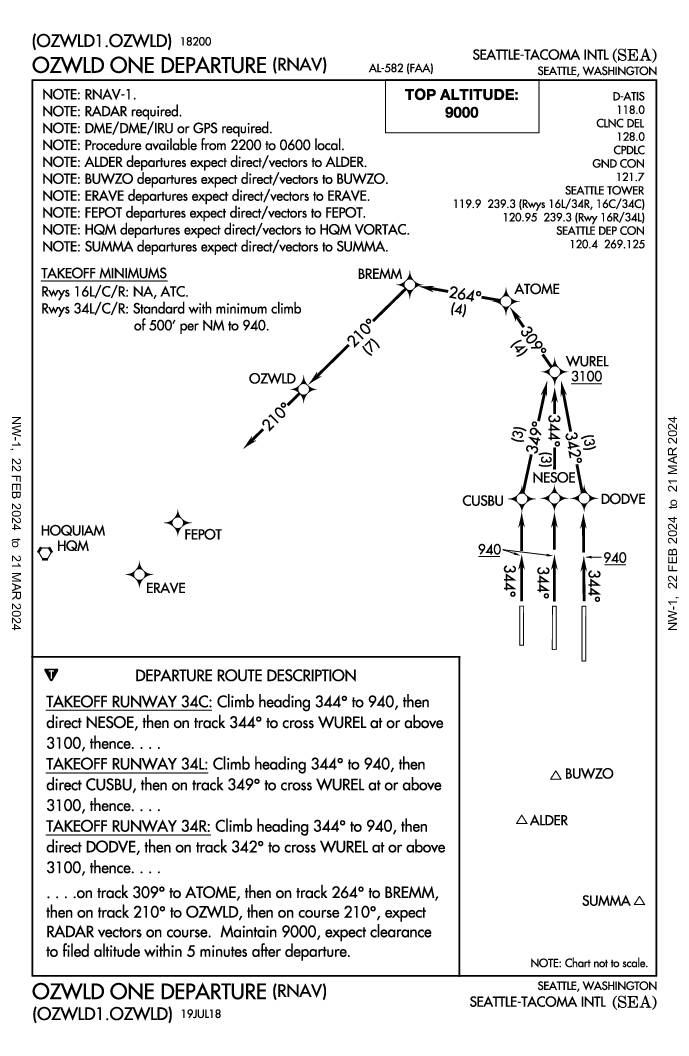
OZWLD One Departure (RNAV): Seattle-Tacoma International Airport Standard Instrument Departure Chart
The OZWLD One Departure (RNAV) is an instrument departure procedure for Seattle-Tacoma International Airport (SEA) that routes aircraft departing from runways 34L, 34C, and 34R northwestward through a series of waypoints—including NESOE, CUSBU, DODVE, WUREL, ATOME, BREMM, and OZWLD—before continuing on course. The procedure is only available between 2200 and 0600 local time, a restriction that reflects noise-mitigation efforts limiting certain departure routes to overnight hours. Aircraft must maintain a minimum climb gradient of 500 feet per nautical mile to 940 feet, cross WUREL at or above 3,100 feet, and maintain 9,000 feet until cleared to their filed altitude. -
 2024-02-19
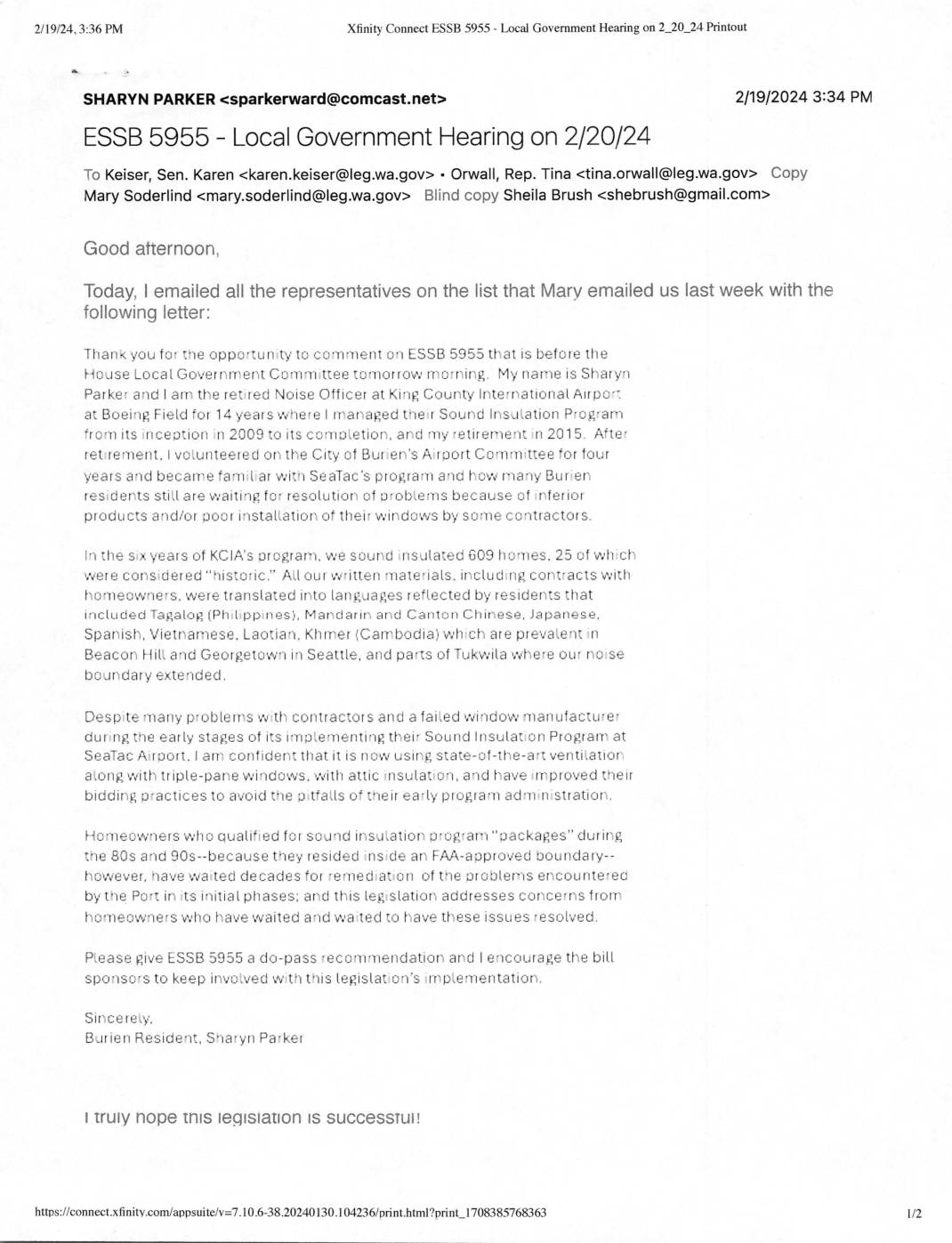
ESSB 5955 – Local Government Hearing on 2/20/24
Sharyn Parker, a retired Noise Officer and Sound Insulation Program Manager at King County International Airport, submitted public comments in February 2024 supporting Washington State bill ESSB 5955, which aims to address longstanding sound insulation repair and replacement issues for homeowners near Sea-Tac Airport. Parker, who managed Boeing Field's Sound Insulation Program from 2009 to 2015, raised concerns about unrealistic timelines, FAA funding eligibility, and the Port of Seattle's early program mismanagement, noting that some homeowners have waited nearly three decades for remediation of defective window installations. She urged legislators to pass the bill and called on the Port to improve contractor oversight, translation services, and public outreach for affected residents. -
 2024-02-16
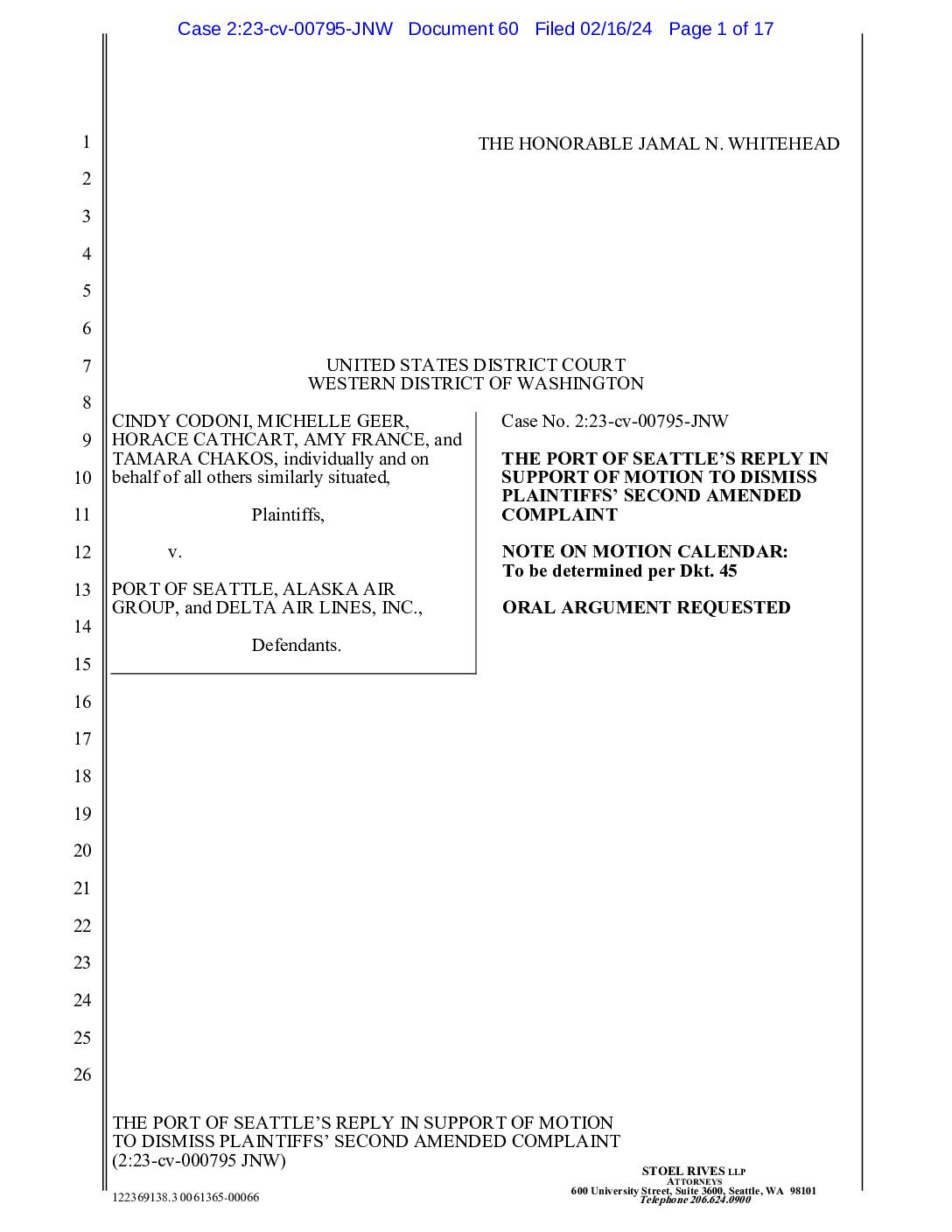
Port Of Seattle’s Reply in Support of Motion to Dismiss Plaintiffs’ Second Amended Complaint
The Port of Seattle filed this legal reply brief seeking dismissal of a lawsuit brought by five plaintiffs (Codoni, Geer, Cathcart, France, and Chakos) related to Seattle-Tacoma International Airport operations. The Port argues that the plaintiffs' claims are barred by federal preemption under the Civil Aeronautics Act, the Airline Deregulation Act, and the Federal Aviation Act, which collectively give the federal government exclusive authority over aviation and airport operations. The Port also contends that the plaintiffs lack legal standing to bring inverse condemnation claims under the 'subsequent purchaser rule.' -
 2024-02-13
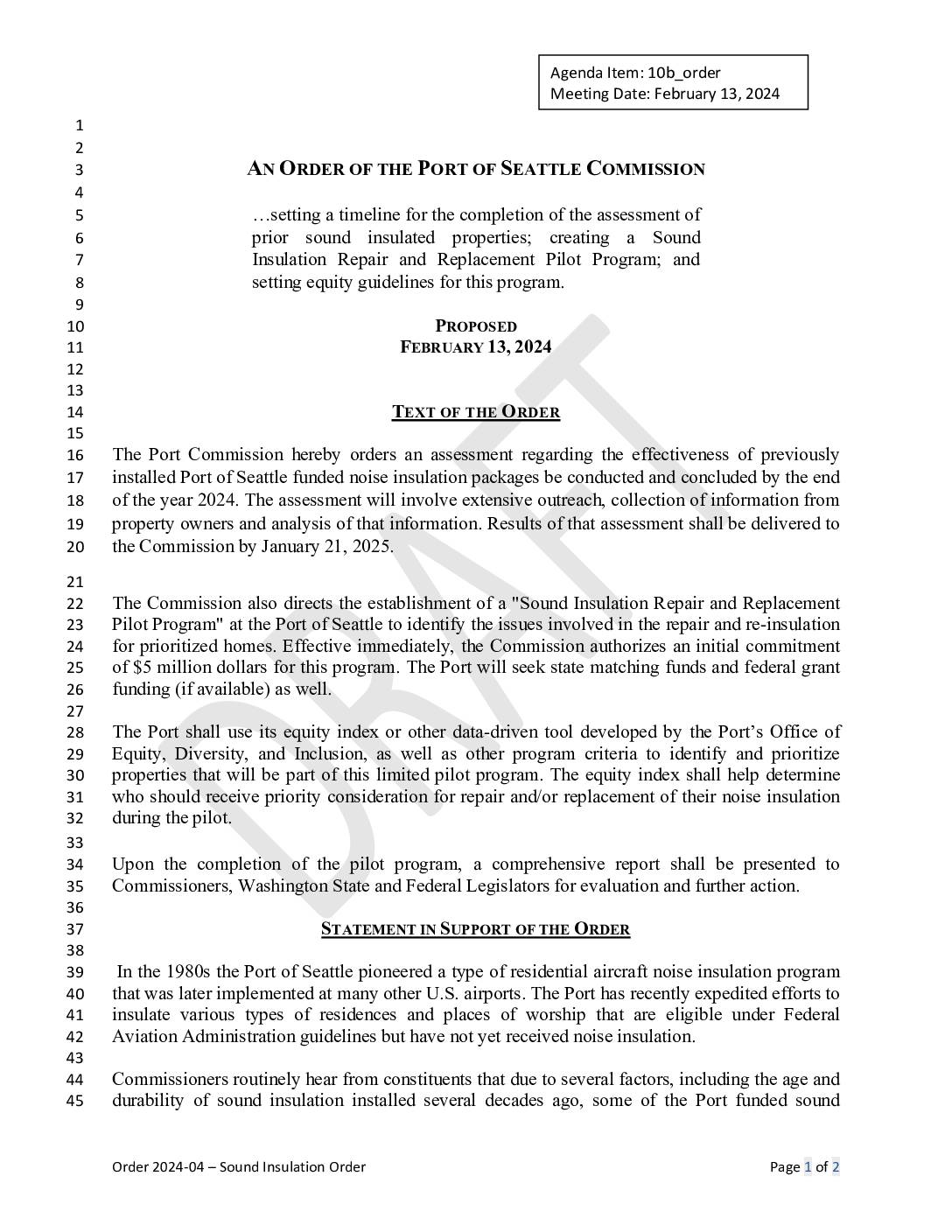
Order 2024-04: Sound Insulation Repair and Replacement Pilot Program
In February 2024, the Port of Seattle Commission proposed Order 2024-04, directing an assessment of previously installed noise insulation packages to be completed by end of 2024, with findings reported to Commissioners by January 21, 2025. The order also establishes a Sound Insulation Repair and Replacement Pilot Program, backed by an initial $5 million commitment, to identify and fix aging or ineffective insulation in homes near Seattle-Tacoma International Airport. Priority for repairs will be determined using the Port's equity index to ensure underserved communities are considered first. -
Runway Diagram
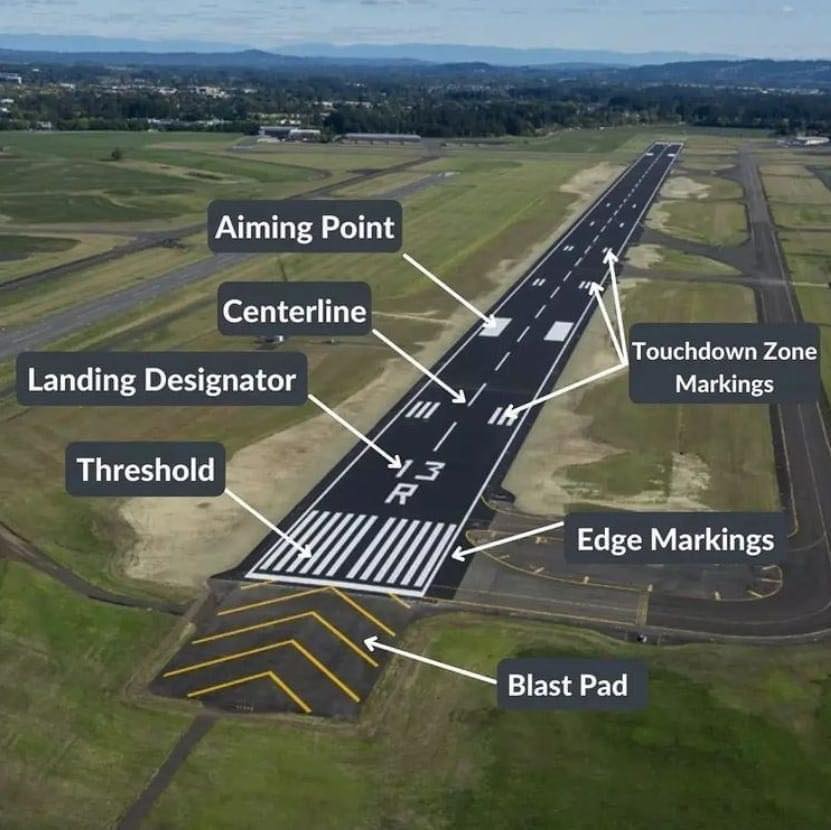
Aerial photograph of an airport runway with labeled markings including Threshold, Centerline, Aiming Point, Landing Designator, Touchdown Zone Markings, Edge Markings, and Blast Pad. The runway designator visible is '13R', but the specific airport is not confirmed from visible text alone.