TagSea-Tac Airport(1855)
-
 2024-01-15
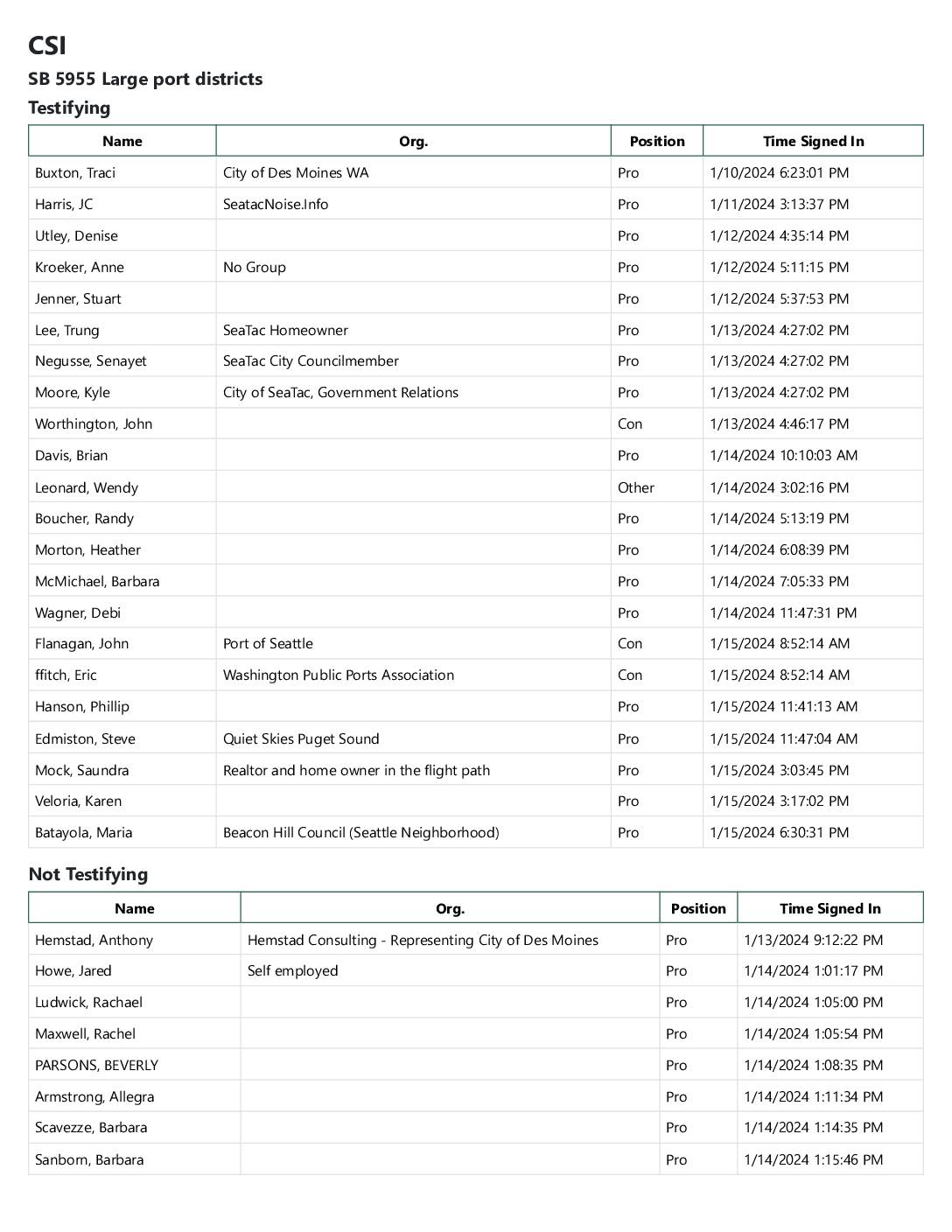
SB 5955 Large port districts – committee sign-in sheet
This document lists sign-ins for a Washington State legislative hearing on SB 5955, a bill concerning large port districts, held in January 2024. The overwhelming majority of participants — including residents, neighborhood groups, and city officials from communities like SeaTac, Des Moines, and Seattle — registered in support of the bill, while only two individuals, representing the Port of Seattle and the Washington Public Ports Association, registered in opposition. The bill and its broad community backing appear to be driven by concerns about airport noise and its impact on neighborhoods surrounding Seattle-Tacoma International Airport. -
 2024-01-15
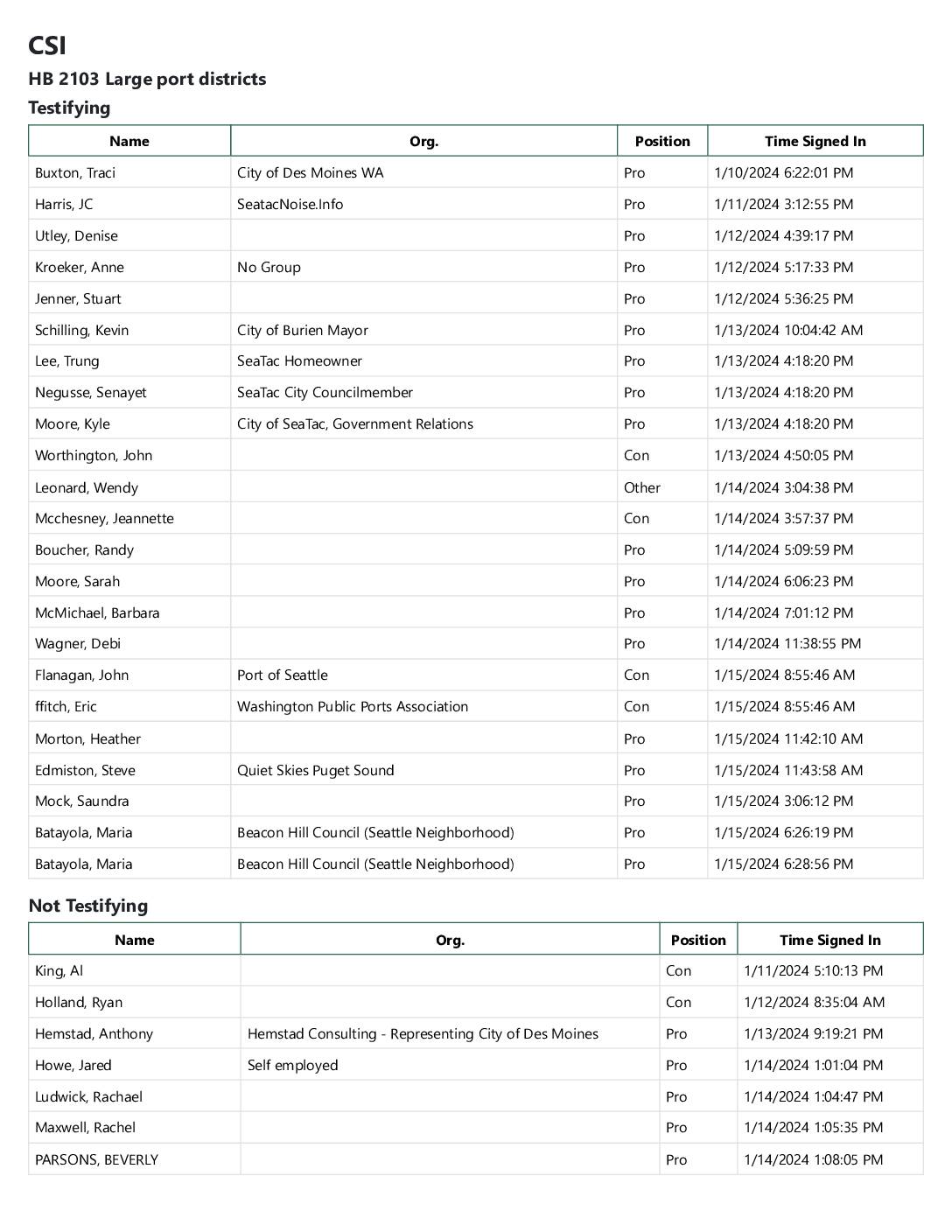
HB 2103 large port districts – CSI sign-in sheet
This document is a sign-in sheet for public testimony on Washington State House Bill 2103, concerning large port districts, recorded in January 2024. The bill drew significant public interest, with the majority of participants — including representatives from the cities of Des Moines, Burien, and SeaTac, as well as noise advocacy groups like SeatacNoise.Info and Quiet Skies Puget Sound — expressing support, while opponents included the Port of Seattle and the Washington Public Ports Association. The testimony period reflects an ongoing community debate over local government oversight of large port districts, particularly in relation to aircraft noise impacts around Seattle-Tacoma International Airport. -
 2024-01-01
Appendix F: Hazardous Materials, Solid Waste, and Pollution Prevention Technical Report: Sustainable Airport Master Plan Near-Term Projects
This technical report, prepared by Landrum & Brown for the Port of Seattle in January 2024, assesses hazardous materials, solid waste, and pollution prevention concerns related to near-term construction projects under the Sustainable Airport Master Plan at Seattle-Tacoma International Airport. It includes investigations of contaminated fuel farm sites, environmental baseline studies, and regulated building materials surveys (such as asbestos and lead) for several airport facilities slated for redevelopment. The report compiles findings and regulatory correspondence from Washington State Department of Ecology to guide safe handling and cleanup of hazardous materials during planned airport improvements. -
 2024-01-01
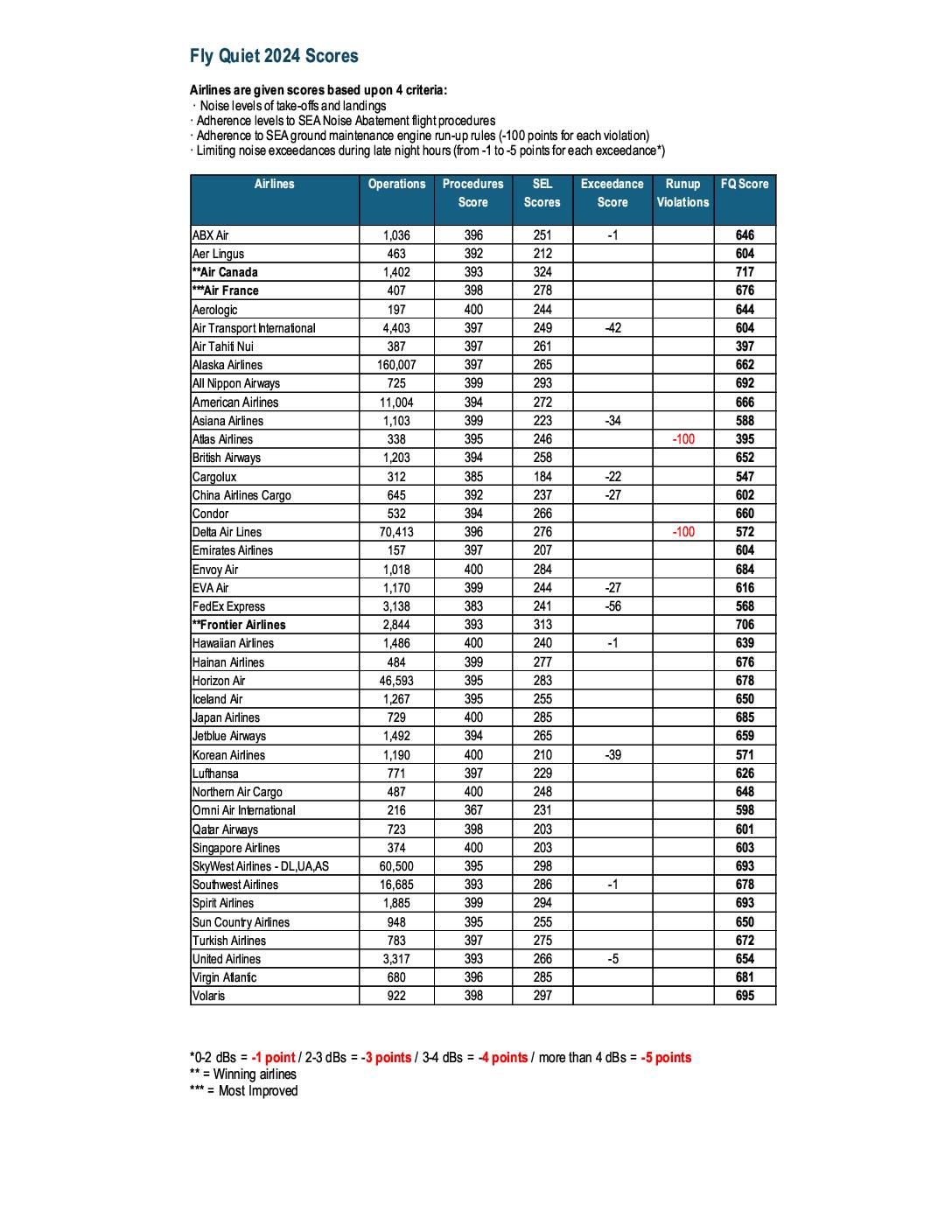
Fly Quiet 2024 Scores
Port Of Seattle Fly Quiet 2024 annual scores for airlines operating at Sea-Tac Airport, scored on four criteria: noise levels of take-offs and landings, adherence to SEA Noise Abatement flight procedures, adherence to SEA ground maintenance engine run-up rules (-100 points per violation), and limiting late-night noise exceedances (-1 to -5 points per exceedance). Table -
 2024-01-01
2024 budget in brief
The Port of Seattle's 2024 Budget in Brief outlines the organization's financial plans and priorities, including a historic $5.6 billion five-year capital improvement plan spanning aviation, maritime, and economic development facilities. Seattle-Tacoma International Airport (SEA) reported record-breaking passenger volumes in 2023, with 2024 forecasted to be the strongest year ever for airport and cruise traffic. The budget reflects a strategic approach to balancing bold investment in infrastructure with long-term financial sustainability amid challenges such as inflation and global uncertainty. -
 2024-01-01
Hazardous Materials, Solid Waste, and Pollution Prevention Technical Report: Sustainable Airport Master Plan – Near-Term Projects
This technical report, prepared by Landrum & Brown for the Port of Seattle in January 2024, addresses hazardous materials, solid waste, and pollution prevention as part of the Sustainable Airport Master Plan's near-term projects at Seattle-Tacoma International Airport. It documents environmental assessments of various airport sites, including fuel farm areas, cargo buildings, and airline maintenance facilities, examining issues such as soil contamination, regulated building materials like asbestos and lead, and fueling site investigations. The report compiles findings and supporting attachments from multiple environmental studies conducted across the airport campus. -
2024-01-01
Fly Quiet 2024 Scores
The Fly Quiet 2024 Scores report ranks airlines operating at Seattle-Tacoma International Airport based on four criteria: noise levels during take-offs and landings, adherence to SEA Noise Abatement flight procedures, compliance with ground maintenance engine run-up rules, and limiting late-night noise exceedances. Airlines receive a composite FQ Score, with top performers including Air Canada (717) and Frontier Airlines (706), while carriers with runup violations or poor noise adherence, such as Delta Air Lines (572) and Atlas Airlines (395), scored significantly lower. The report identifies Air Canada as a winning airline and Air France as the most improved, serving as a public accountability tool for noise management at Sea-Tac Airport. -
 2024-01-01
Hazardous Materials, Solid Waste, and Pollution Prevention Technical Report: Appendix F — Hazardous Materials and Solid Waste
This technical report, prepared by Landrum & Brown for the Port of Seattle in January 2024, covers hazardous materials, solid waste, and pollution prevention as part of the Sustainable Airport Master Plan's near-term projects at Seattle-Tacoma International Airport. It includes assessments of contaminated fuel farm sites, regulated building materials such as asbestos and lead in airport structures, and environmental investigation reports for fueling sites. Supporting attachments document findings from agencies like Washington State Ecology and surveys of specific airport buildings managed by tenants including United Airlines and Swissport. -
 2023-12-30
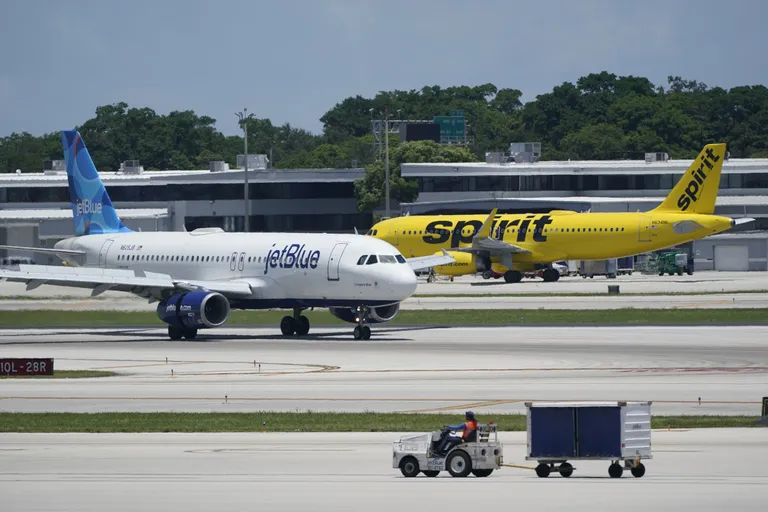
JetBlue and Spirit Airlines Aircraft at Airport
A JetBlue Airways Airbus A320 taxis on the runway while a Spirit Airlines aircraft (in its distinctive yellow livery) is visible in the background. A ground crew vehicle tows baggage equipment in the foreground at what appears to be a busy commercial airport. -
 2023-12-27
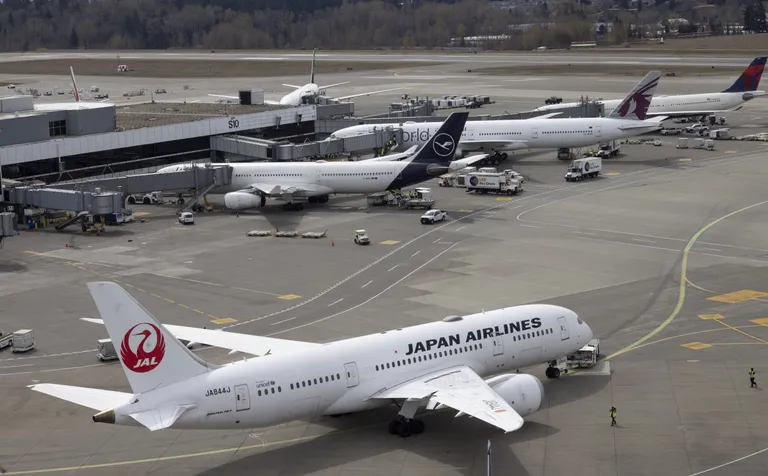
Airport Terminal with Japan Airlines and Lufthansa Aircraft
A Japan Airlines (JAL) Boeing 787 Dreamliner, registration JA844J, taxis on the apron at Seattle-Tacoma International Airport. In the background, aircraft from Lufthansa (World Business Class livery), Qatar Airways, and Delta Air Lines are visible at the terminal gates.