TagSea-Tac Airport(1855)
-
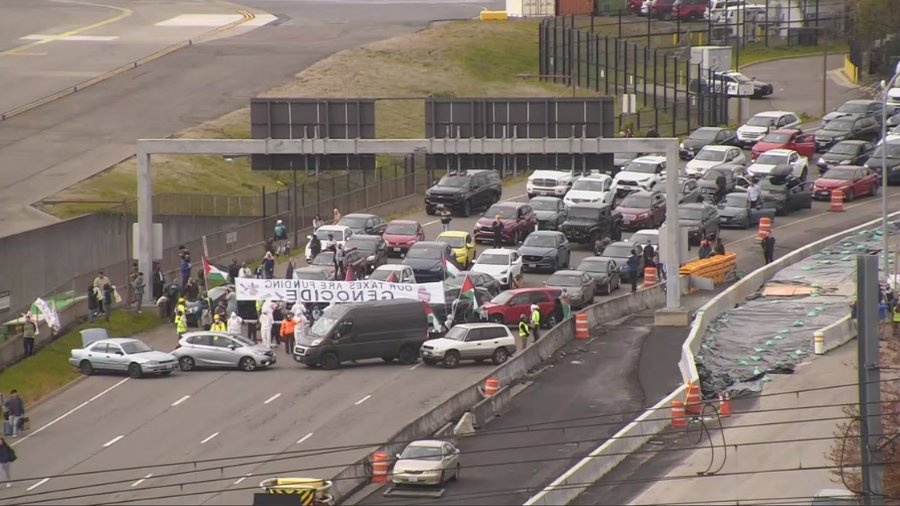
Protest Near Sea-Tac Airport Over Gaza War
Protesters holding Palestinian flags and a banner reading 'Our Taxes Are Funding Genocide' block a multi-lane highway near what appears to be Sea-Tac Airport. The demonstration has caused a significant traffic backup with dozens of vehicles stopped on the roadway. -

Port Of Seattle Police Ford F-150 (Unit #2149) in Sea-Tac Airport Parking Garage
A Port of Seattle Police Ford F-150 (unit #2149) is parked in what appears to be a multi-level parking garage, likely at Seattle-Tacoma International Airport. The Port of Seattle Police badge/logo is clearly visible on the hood of the black patrol vehicle. -
 2024-04-11
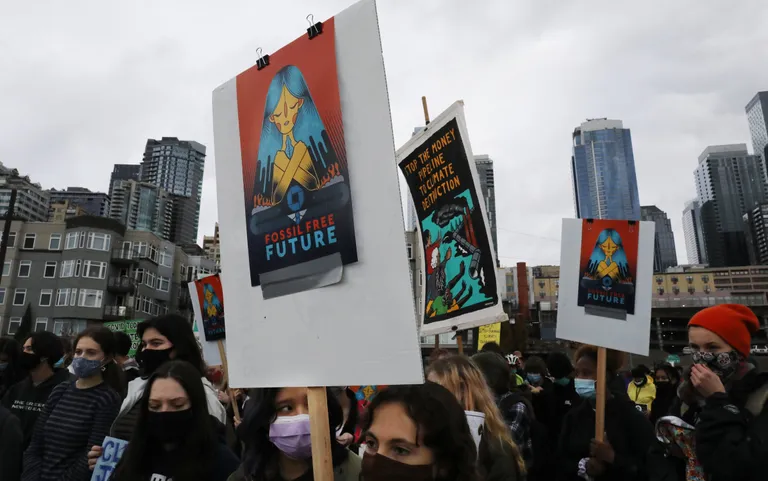
Climate Protest Signs with Fossil Free Future Theme
Protesters march through an urban area carrying signs reading 'Fossil Free Future' and 'Stop the Money Pipeline to Climate Destruction.' Many participants wear face masks, suggesting the event took place during the COVID-19 pandemic era. -
 2024-04-03
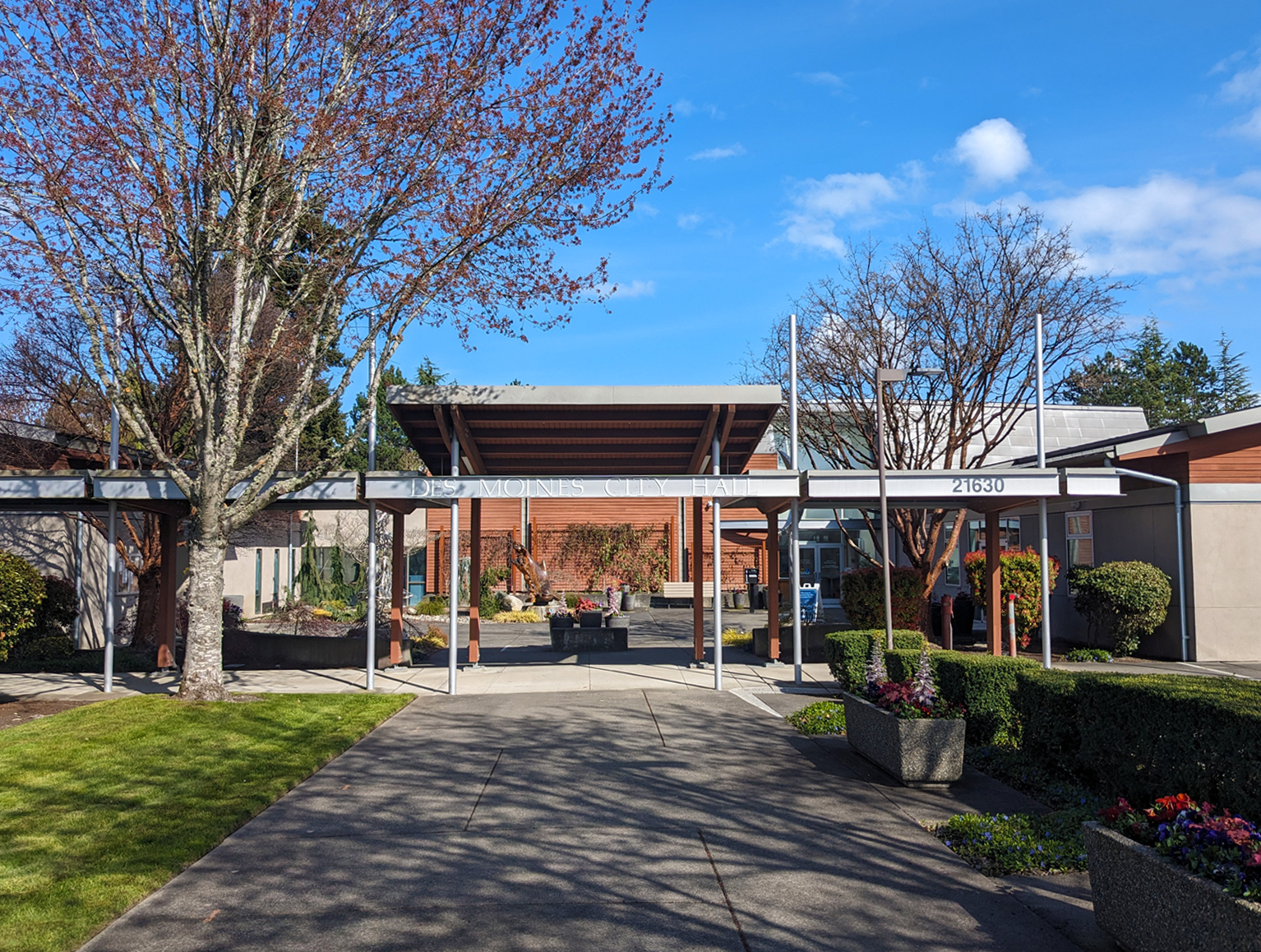
Des Moines City Hall Exterior
Exterior view of Des Moines City Hall, address 21630, located in Des Moines, Washington — a city directly affected by Sea-Tac Airport flight operations and noise policy. The building features a covered entry walkway with wood-panel canopy, landscaped grounds, and signage reading 'Des Moines City Hall.' -
Upgrade SEA — The Next Era of Capital Projects Takes Flight
By Aly Lande, Capital Project Marketing Specialist Picture an airport journey without long lines and overflowing crowds. You follow a predictable and easy path from curb to gate with the space, services, and amenities that make your trip just right. There is more of what you know and love about Seattle-Tacoma International Airport (SEA), plus more -
 2024-03-19
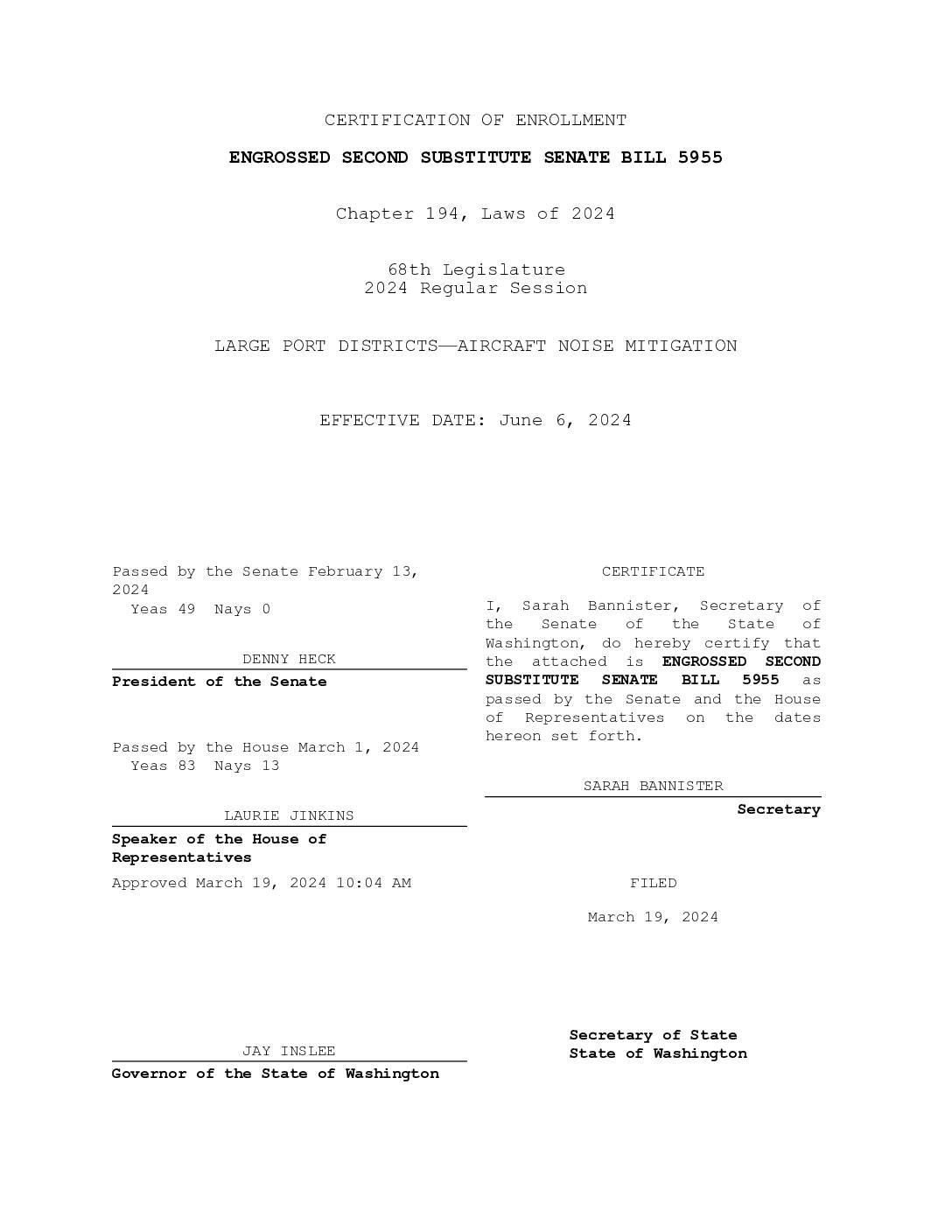
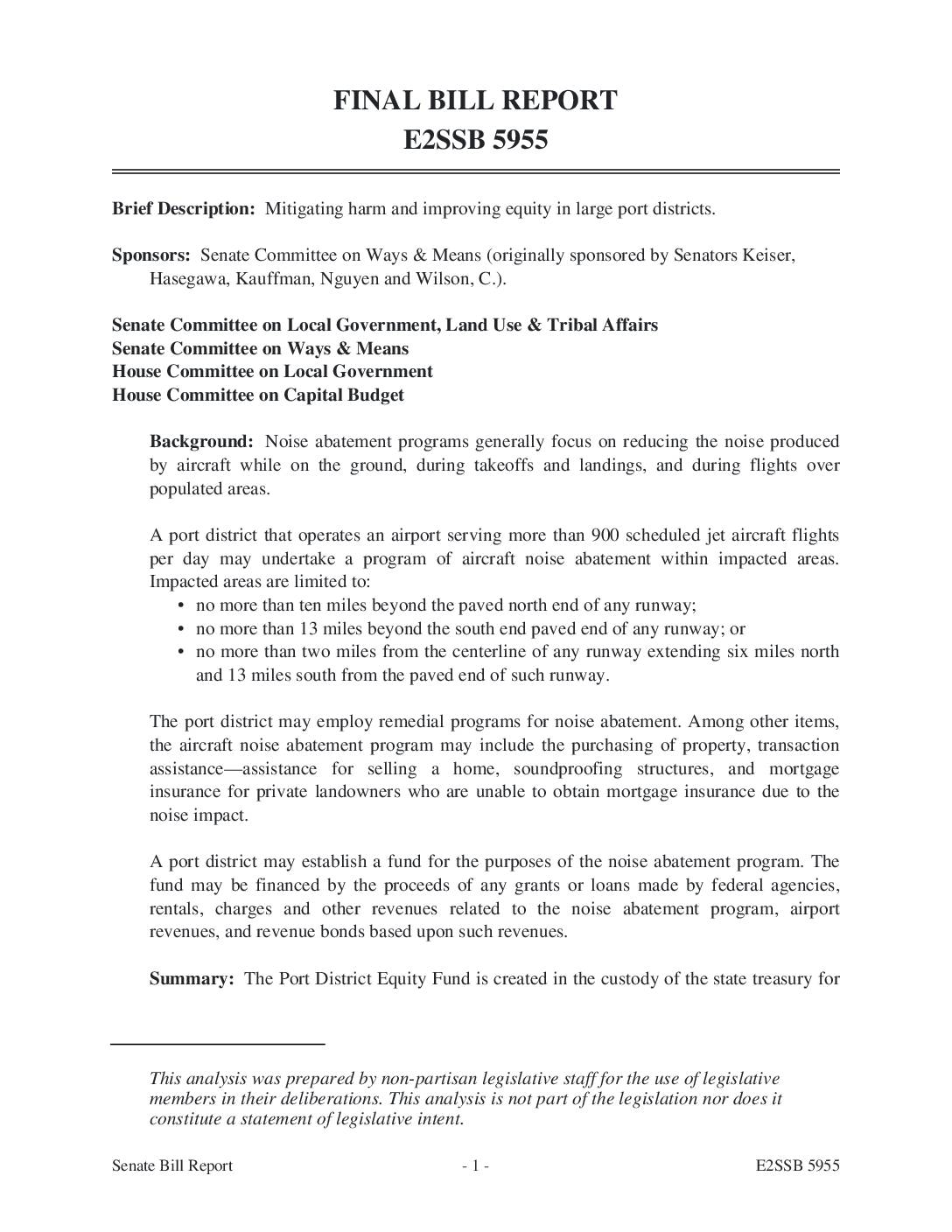
Engrossed Second Substitute Senate Bill 5955: Large Port Districts—Aircraft Noise Mitigation
Washington State's Engrossed Second Substitute Senate Bill 5955, signed into law on March 19, 2024, addresses aircraft noise mitigation for large port districts like the Port of Seattle, which operates Seattle-Tacoma International Airport. The law allows the port to repair or replace noise mitigation equipment that is no longer functioning properly or has caused structural damage to nearby properties, using non-federal local funding. It also acknowledges that communities of color — including Black, Hispanic, Native Hawaiian, and Pacific Islander residents in King County — are disproportionately impacted by airport noise, and establishes a state partnership to improve equity and responsiveness in noise mitigation efforts. -
 2024-03-13
Final Bill Report: E2SSB 5955 — Mitigating Harm and Improving Equity in Large Port Districts
Washington State E2SSB 5955 creates the Port District Equity Fund to help large port districts, such as the Port of Seattle, repair or replace failing aircraft noise mitigation equipment in nearby homes and properties. The Department of Commerce administers the grant program, which requires port districts to match at least half of state funding, and mandates annual public reporting on inspections and repairs. The program is set to expire July 1, 2029, with a legislative audit review, and will be fully repealed by July 1, 2030. -
 2024-03-13
IWS Alternatives Analysis Technical Memorandum: Seattle-Tacoma International Airport
Gresham Smith engineers prepared this March 2024 technical memo for the Port of Seattle, analyzing cost-saving alternatives for planned upgrades to Seattle-Tacoma International Airport's Industrial Wastewater Treatment Plant (IWTP). The study evaluated options for managing airport deicer runoff while maintaining compliance with water discharge permits, using 52 years of historical weather data to simulate system performance. Note: despite its placement in an airport policy archive, this document addresses industrial wastewater and stormwater management rather than noise policy. -
2024-03-13
IWS Alternatives Analysis Technical Memorandum: Seattle-Tacoma International Airport
Gresham Smith engineers prepared this March 2024 technical memo for the Port of Seattle, analyzing cost-saving alternatives for planned upgrades to Seattle-Tacoma International Airport's Industrial Wastewater Treatment Plant (IWTP). The study evaluated options for managing airport deicer runoff while maintaining compliance with water discharge permits, using 52 years of historical weather data to simulate system performance. Note: despite its placement in an airport policy archive, this document addresses industrial wastewater and stormwater management rather than noise policy. -
 2024-03-01
Sustainable Airport Master Plan – Near-Term Projects: Noise Technical Report
This Noise Technical Report, prepared by Landrum & Brown for the Port of Seattle in March 2024, analyzes noise impacts associated with near-term projects outlined in the Sustainable Airport Master Plan for Seattle-Tacoma International Airport. It is part of a broader Appendix J covering noise and noise-compatible land use, which also includes a Noise Modeling Protocol and a Construction Noise Technical Report. The report provides technical assessments to support planning decisions related to aircraft and construction noise in communities surrounding Sea-Tac Airport.