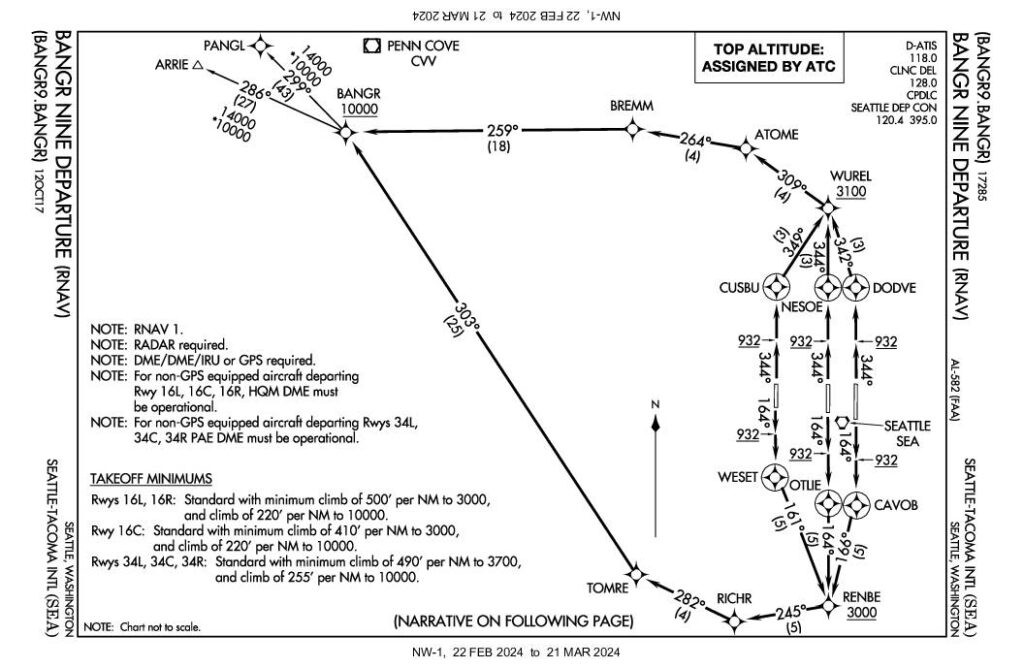
The BANGR Nine Departure is a standardized instrument departure procedure (SID) for pilots flying out of Seattle-Tacoma International Airport (SEA), directing aircraft on specific headings and altitudes depending on which runway they use. Aircraft departing on northbound runways (34L, 34C, 34R) climb to at least 932 feet before routing through waypoints like CUSBU, NESOE, or DODVE, crossing WUREL at or above 3,100 feet, while southbound runway departures (16L, 16C, 16R) follow similar climb profiles through waypoints like CAVOB, OTLIE, or WESET, crossing RENBE at or above 3,000 feet. All routes converge at the BANGR waypoint, which must be crossed at or above 10,000 feet, with specific minimum climb gradients established to manage aircraft noise and terrain clearance in the surrounding communities.Open full document
Notes
FAA instrument departure procedure chart AL-582: BANGR Nine Departure (RNAV) for Seattle-Tacoma International Airport (SEA/KSEA), Seattle, Washington. Depicts departure routes from runways 16L, 16C, 16R, 34L, 34C, and 34R through waypoints RENBE (3000), WUREL (3100), BANGR (10000), CAVOB, OTLIE, WESET, NESOE, CUSBU, DODVE, ATOME, BREMM, TOMRE, RICHR, and transitions to ARRIE (BANGR9.ARRIE) and PANGL (BANGR9.PANGL). Specifies RNAV 1 requirement, radar required, DME/DME/IRU or GPS required. Takeoff minimums include climb gradients of 500’/NM to 3000 (Rwys 16L/16R), 410’/NM to 3000 (Rwy 16C), and 490’/NM to 3700 (Rwys 34L/34C/34R). Top altitude assigned by ATC. Seattle DEP CON 120.4/395.0, CPDLC 128.0, CLNC DEL 118.0, D-ATIS. Effective NW-1, 22 FEB 2024 to 21 MAR 2024.