TagSAMP(650)
Articles tagged with the Sustainable Airport Master Plan.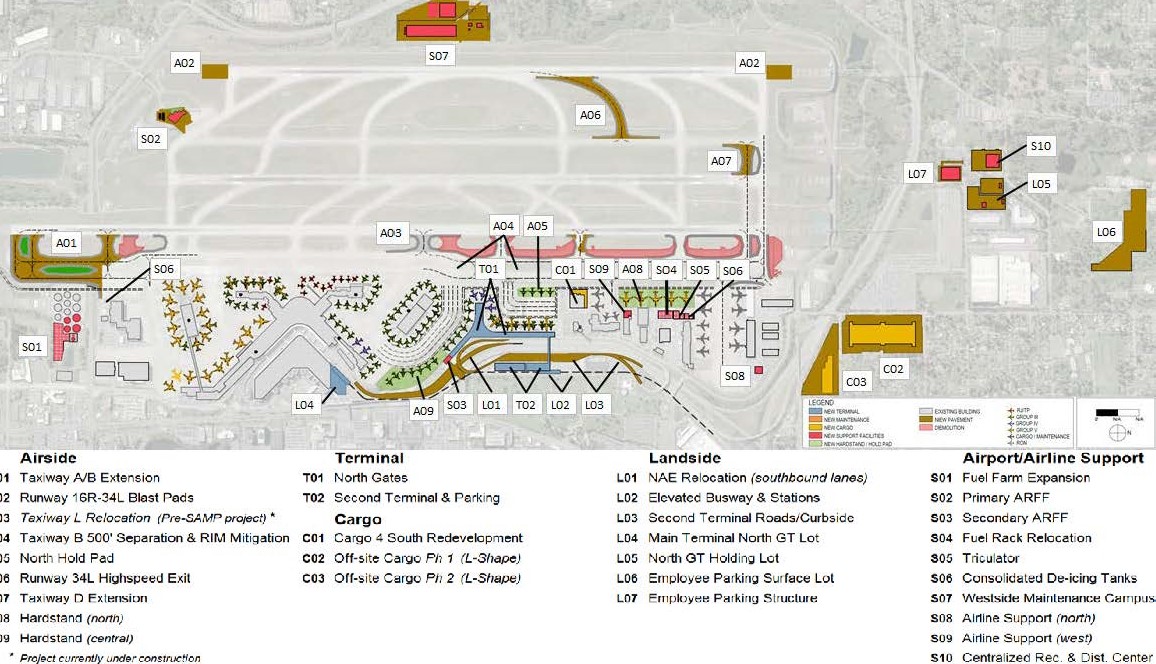
-
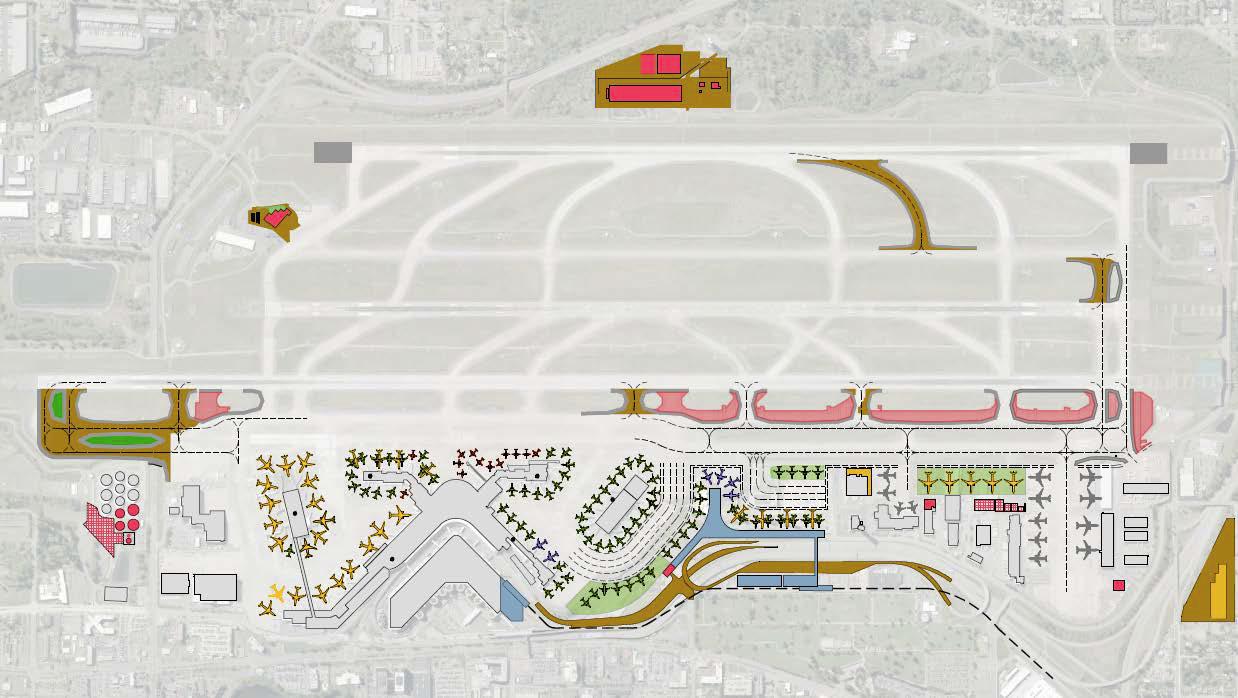
180620 SAMP Presentation Public Meeting NTP
A color-coded airport master plan or development concept drawing overlaid on an aerial photograph, showing terminal buildings, taxiways, runways, and aircraft parking positions. No visible text, logos, dates, or watermarks are legible at this resolution to confirm the specific airport or project. -
 2022-07-14
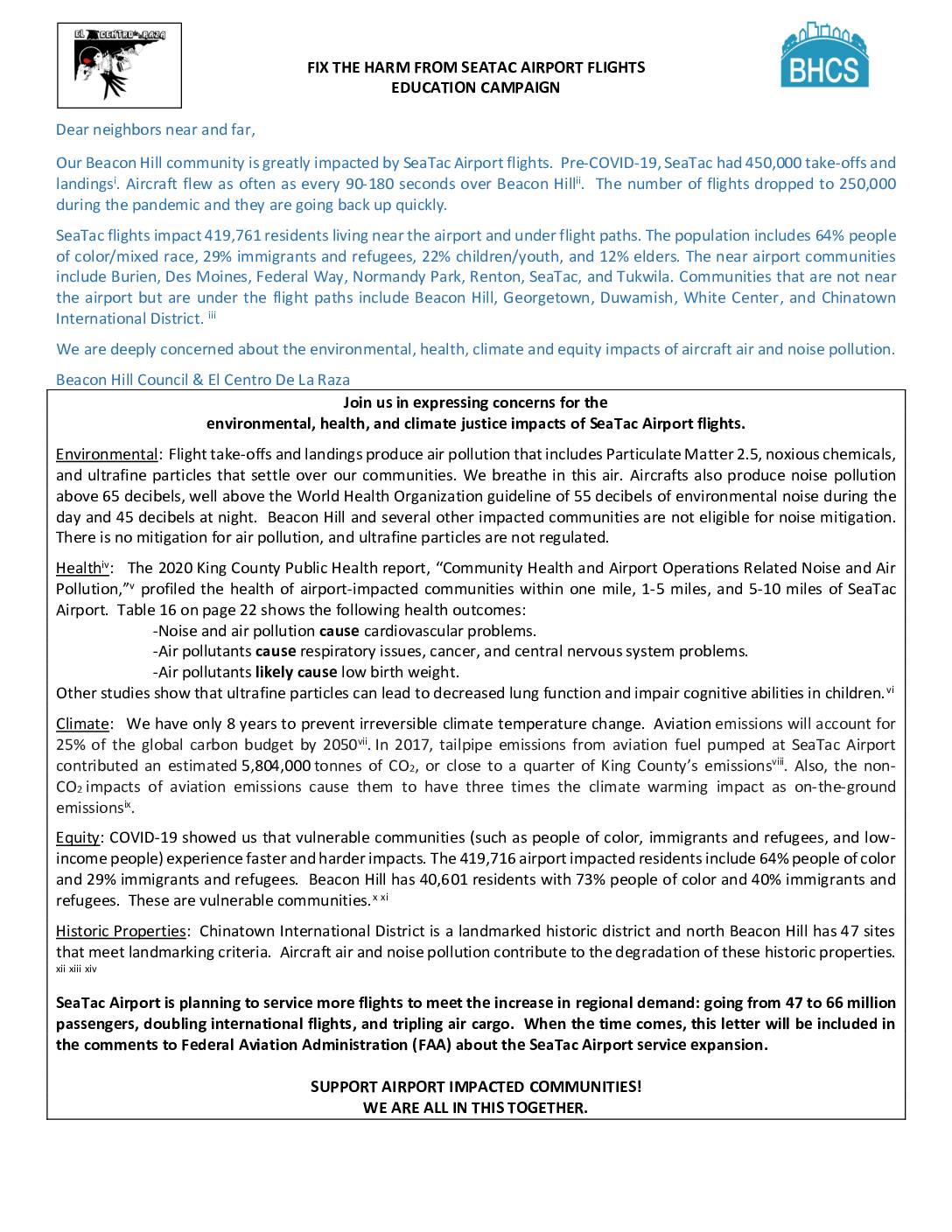
Fix the Harm from Sea-Tac Airport Flights: Education Campaign Fact Sheet
The Beacon Hill Council and El Centro De La Raza are calling on community members to take action against the environmental, health, and equity harms caused by SeaTac Airport flight operations, which affect nearly 420,000 residents — including large proportions of people of color, immigrants, and refugees. Aircraft noise regularly exceeds World Health Organization safe limits, while air pollution from flights contributes to cardiovascular disease, respiratory illness, and developmental harm in children, with no current mitigation available for many impacted neighborhoods. The campaign also warns that SeaTac's planned expansion — from 47 to 66 million passengers, doubled international flights, and tripled air cargo — will worsen these impacts, and pledges to submit community concerns to the FAA during the expansion review process. -
The Fourth Runway
We’ve begun using the term “Fourth Runway” to describe two large projects (SR-509 and the Sustainable Airport Master Plan) as one system, which they are. The two projects have always been part of a regional plan begun over fifty years ago to meet the strategic goals of the Port Of Seattle and regional planners. The construction of SR-509 will affect the communities are great deal. But starting in 2027 the projects will also increase flight operations at least 33% and cargo operations by 300%. -
 2022-06-23
Sustainable Airport Master Plan Near Term Projects: Environmental Review Update
This June 2022 presentation by Des Moines Chief Strategic Officer Susan Cezar provides an update on the environmental review of Near Term Projects under the Port of Seattle's Sustainable Airport Master Plan (SAMP). It outlines the history of the review process dating back to 2015, including a multi-city inter-local agreement between Des Moines, Burien, Normandy Park, and SeaTac to coordinate responses to the Port's environmental documents. City staff continue to monitor the Port's compliance with federal (NEPA) and state (SEPA) environmental requirements as airport capital projects move forward. -
 2022-06-23
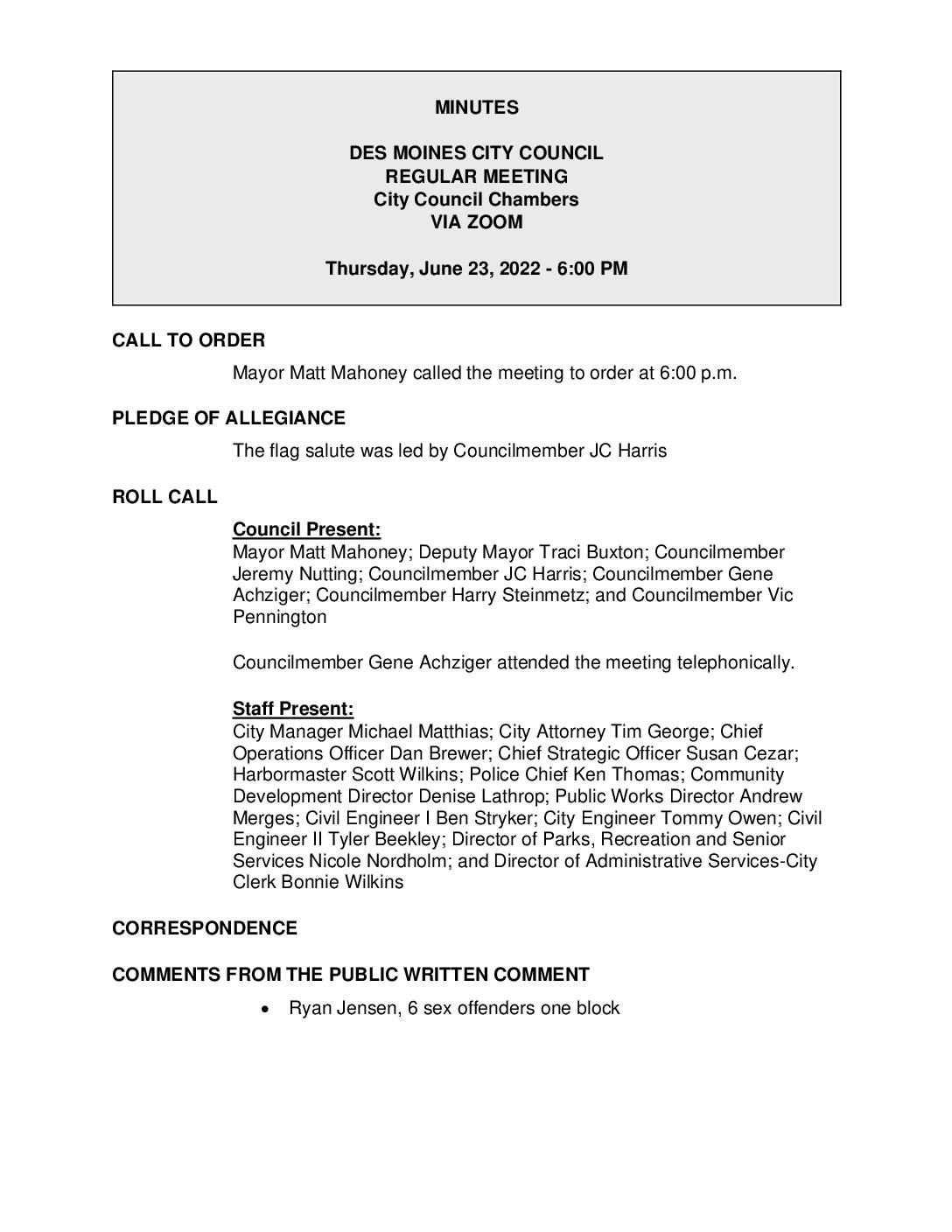
Des Moines City Council regular meeting minutes, June 23, 2022
The Des Moines City Council held a regular meeting on June 23, 2022, during which staff presented updates on several topics relevant to the SeaTac Airport area, including a Sustainable Airport Master Plan (SAMP) overview delivered by Chief Strategic Officer Susan Cezar. The council also conducted a public hearing on the city's 2023-2042 Transportation Improvement Plan, which passed unanimously, and received a Marina Redevelopment update. Additional agenda items included routine consent calendar approvals and community presentations on small business development and summer parks events. -
 2022-06-21
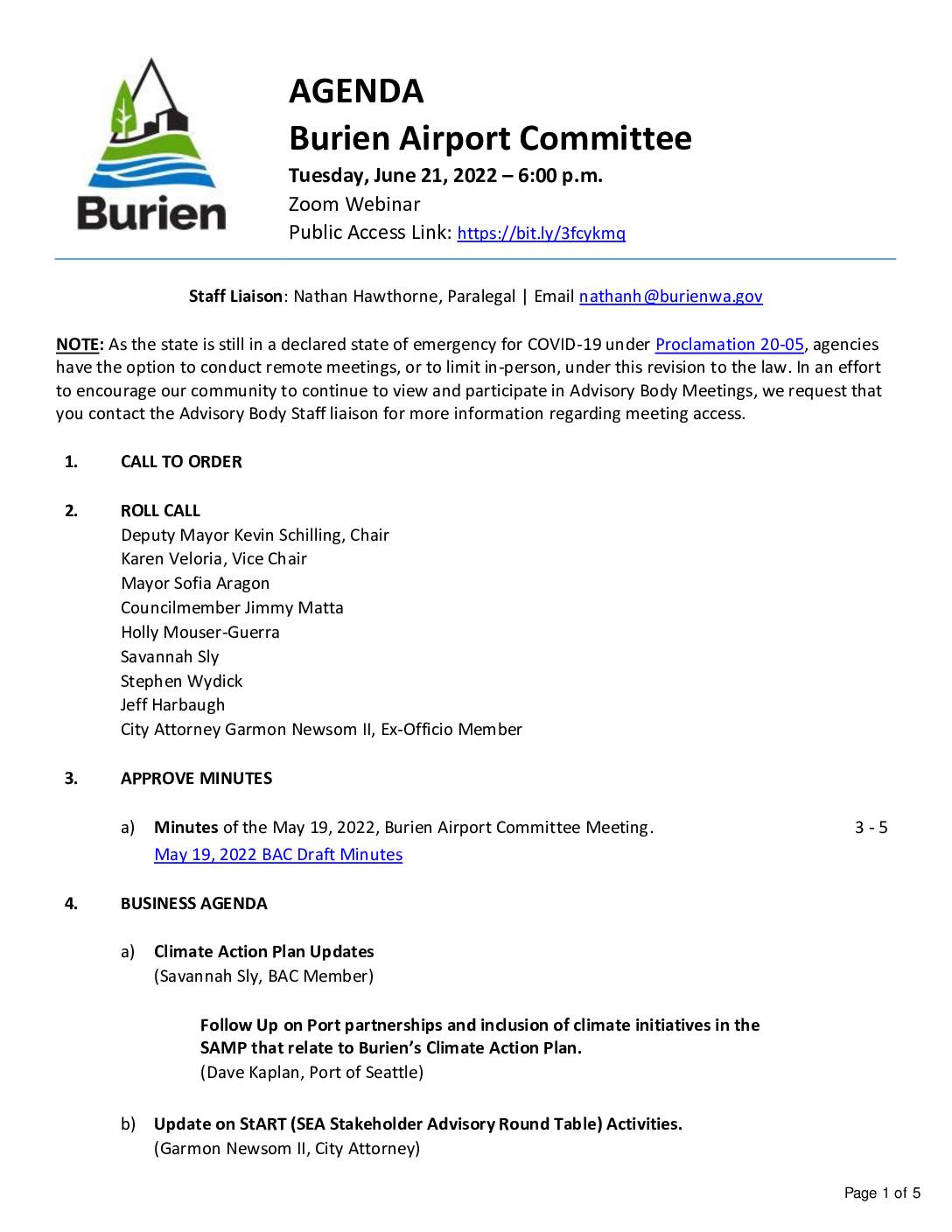
Burien Airport Committee agenda, June 21, 2022
The Burien Airport Committee held a meeting on June 21, 2022, via Zoom to discuss topics related to Seattle-Tacoma International Airport, including updates on the Port of Seattle's climate initiatives and their connection to Burien's Climate Action Plan, activities from the SEA Stakeholder Advisory Round Table (StART), and federal legislative updates. The committee also reviewed draft minutes from its May 19, 2022, meeting. Public participation was accepted via email, text, or online Zoom attendance, with comments limited to two minutes per speaker. -
 2022-05-19
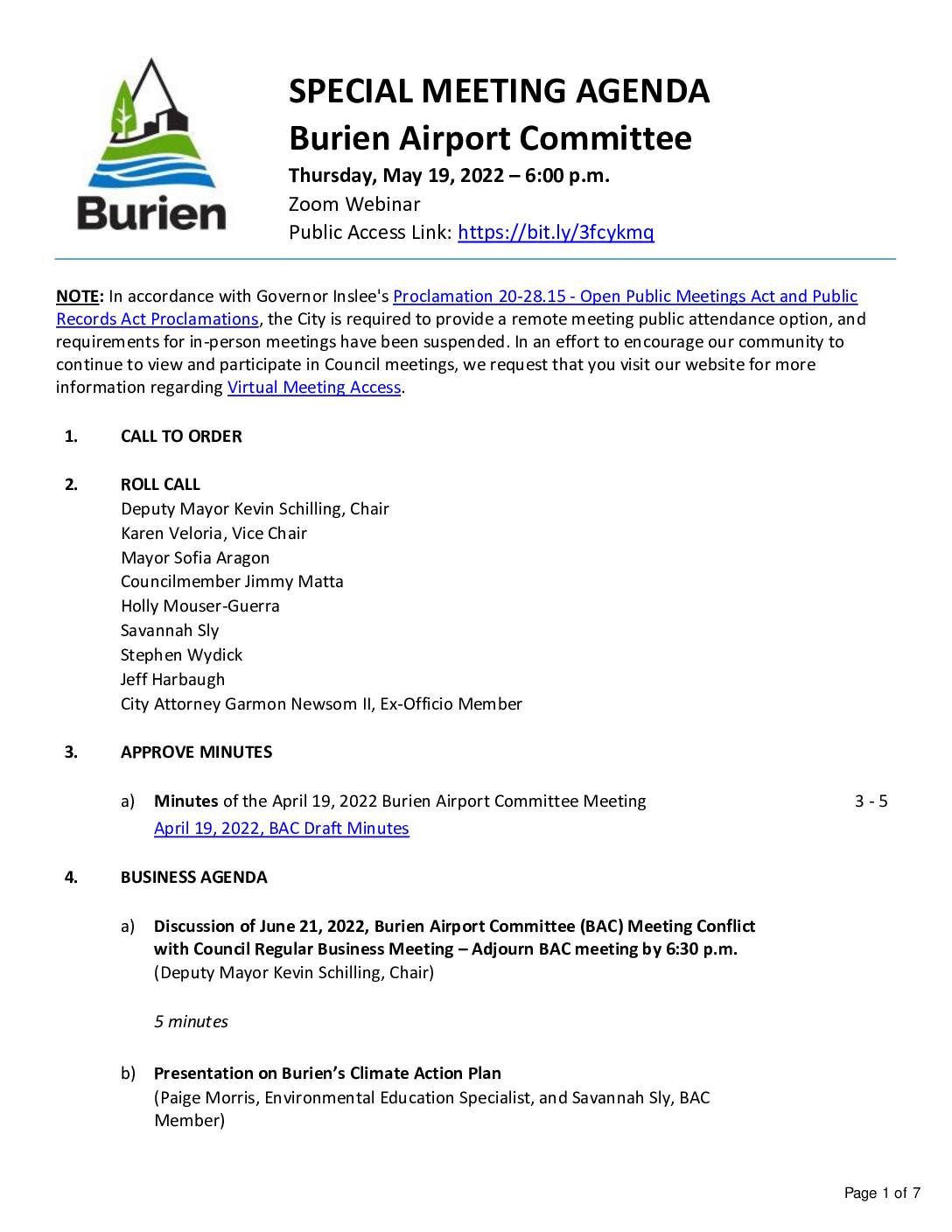
Special meeting agenda: Burien Airport Committee, May 19, 2022
This document contains the agenda and draft minutes for the Burien Airport Committee's special meeting held on May 19, 2022, covering topics related to Seattle-Tacoma International Airport (Sea-Tac). Key agenda items included a presentation on Burien's Climate Action Plan, an update on the SEA Stakeholder Advisory Round Table (StART), and consideration of a draft letter requesting that the Port of Seattle ask the FAA for a longer review period for the Sustainable Airport Master Plan (SAMP). The attached April 19, 2022 draft minutes document the prior meeting's proceedings, including unanimous approval of the March 15, 2022 meeting minutes. -
 2022-05-17
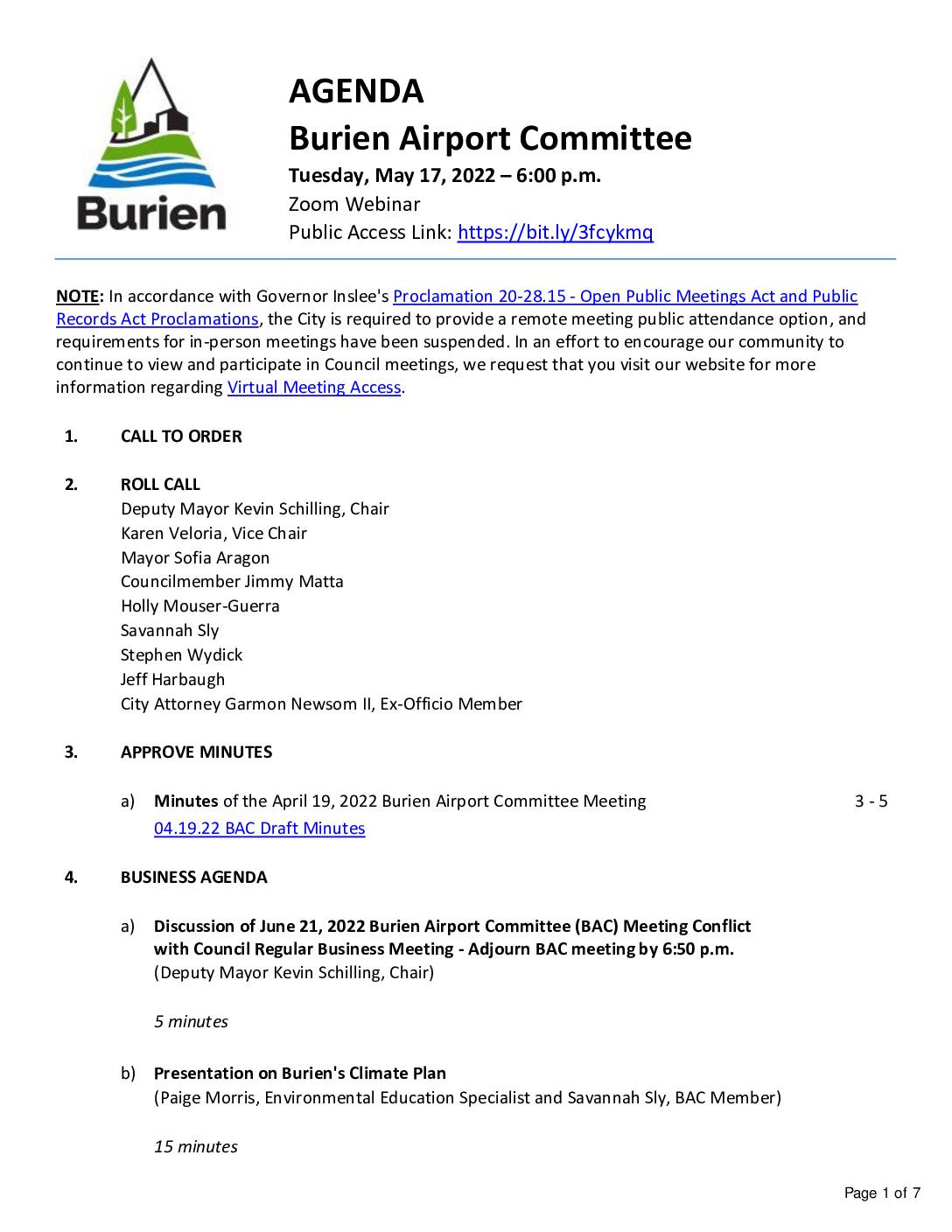
Burien Airport Committee agenda, May 17, 2022
The Burien Airport Committee held a meeting on May 17, 2022, to discuss several aviation-related topics, including a request to the Port of Seattle to seek a longer FAA review period for the Sustainable Airport Master Plan (SAMP), updates on federal legislation, and a presentation on Burien's Climate Plan. The committee also reviewed draft minutes from its April 19, 2022 meeting, during which all members were present and routine business was conducted. Public participation was available remotely via Zoom, email, or text due to ongoing pandemic-related restrictions on in-person meetings. -
 2022-01-11
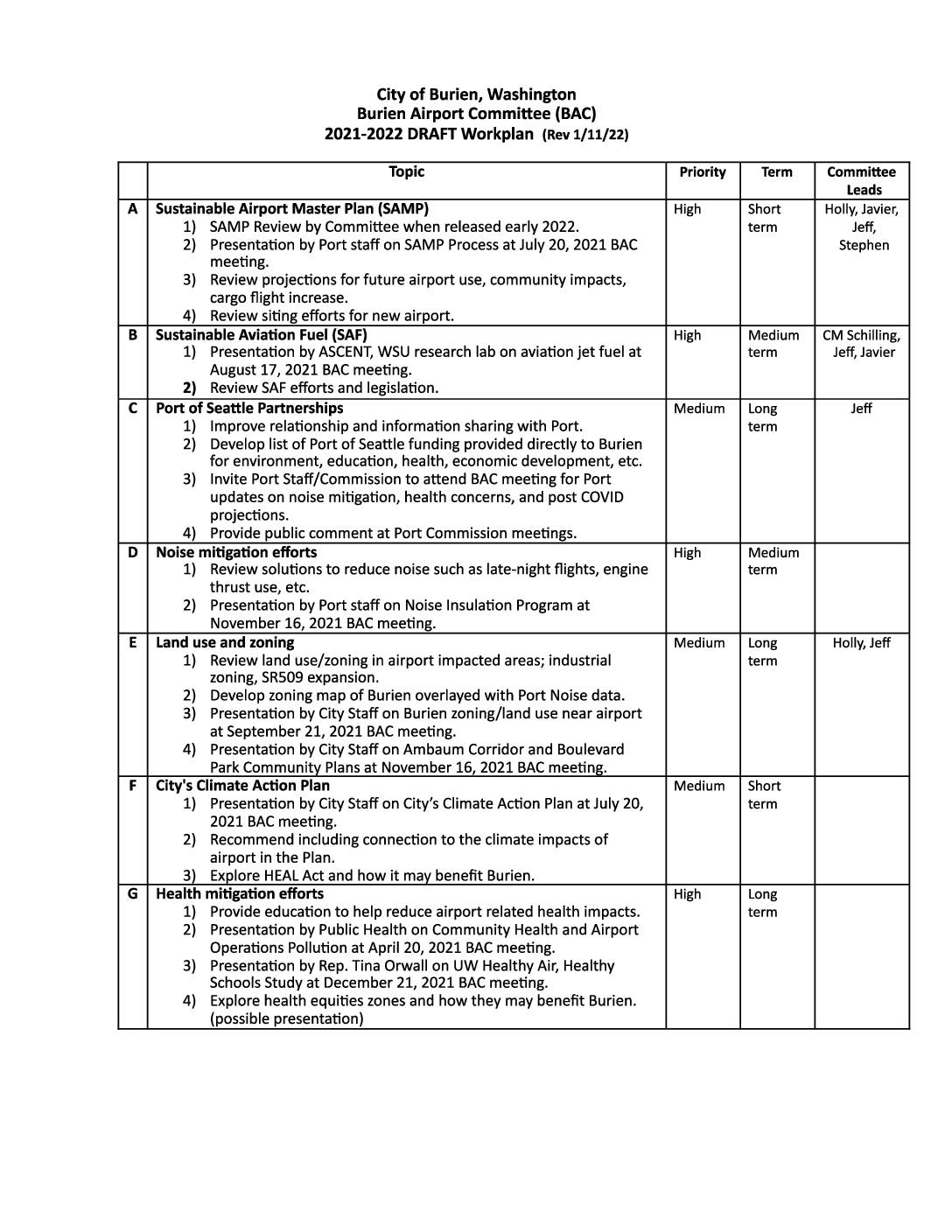
City of Burien, Washington Burien Airport Committee (BAC) 2021-2022 DRAFT Workplan
The Burien Airport Committee's 2021-2022 Draft Workplan outlines the city's priorities for addressing impacts from Seattle-Tacoma International Airport, with a focus on noise mitigation, health impacts, land use, and sustainable aviation. High-priority items include reviewing the Sustainable Airport Master Plan, exploring noise reduction solutions such as limiting late-night flights, and providing community health education to reduce airport-related health impacts. The committee also aims to strengthen partnerships with the Port of Seattle and advocate for policies around sustainable aviation fuel and climate action. -
 2021-12-21
Burien Airport Committee agenda, December 21, 2021
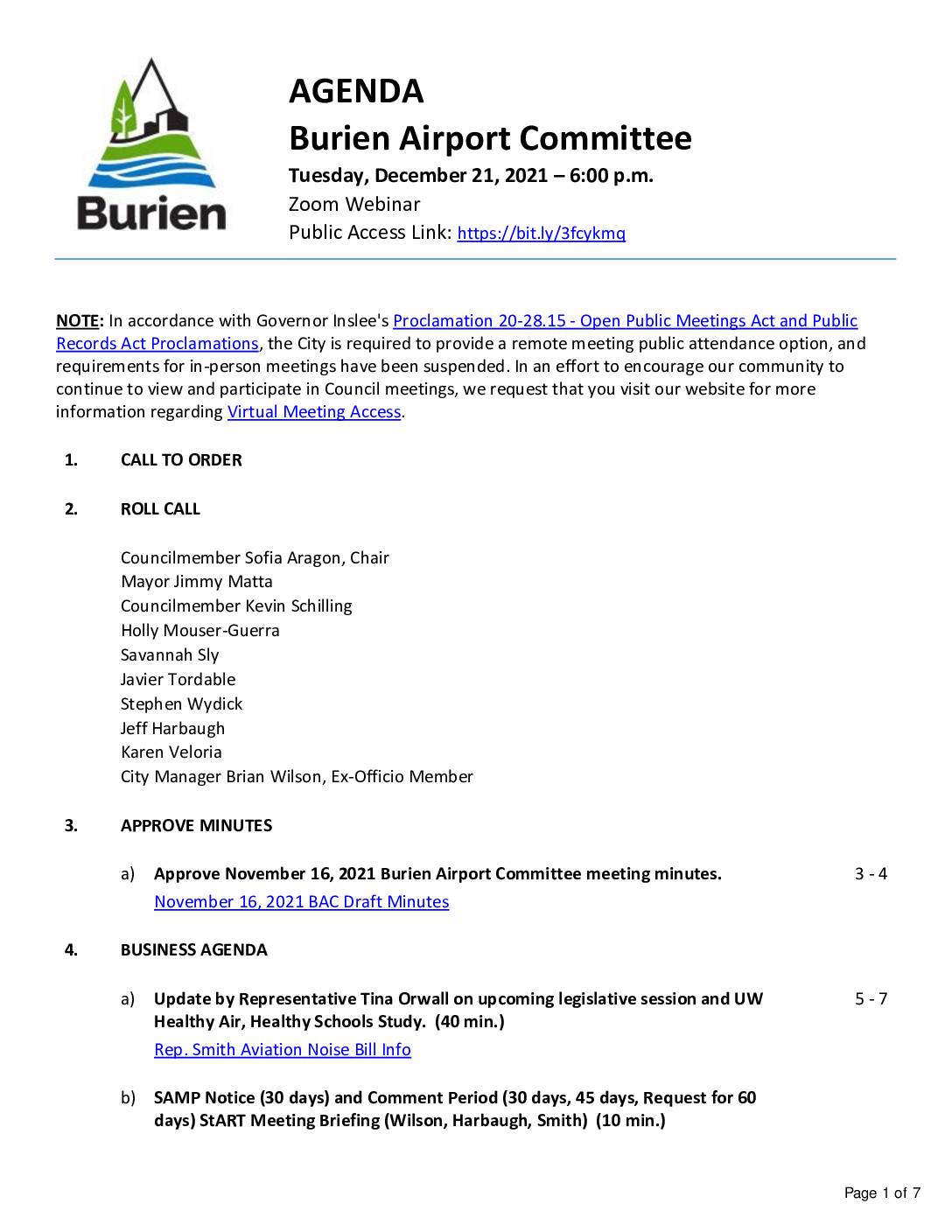
The Burien Airport Committee held meetings in November and December 2021 to discuss issues related to Seattle-Tacoma International Airport noise impacts on the surrounding community. Key topics included the Port of Seattle's Sound Insulation Program for homes built before 1987, an upcoming legislative session update from Representative Tina Orwall, and the UW Healthy Air, Healthy Schools Study. The committee also reviewed the Sustainable Airport Master Plan (SAMP) comment period and received updates on the SEA Stakeholder Advisory Round Table (StART) activities.