TagPort Of Seattle(2349)
-
 2021-01-27
Highline Forum agenda: 2021 legislative agendas, operational items, and StART update
The Highline Forum held a virtual meeting on January 27, 2021 via MS Teams to discuss 2021 state legislative agendas, forum operational issues including Community Co-Chair selection, and a StART (Sea-Tac Airport Roundtable) update presented by Port of Seattle Aviation Director Lance Lyttle. Due to the Governor's Stay at Home Order, public comments were accepted by email or via MS Teams link. The forum was scheduled to meet six times throughout 2021, with the next meeting set for March 24, 2021, focused on the 2020 StART Annual Report. -
 2021-01-22
Lora Lake Apartments site construction as-built report
This January 2021 report documents the as-built construction details of the Lora Lake Apartments Site, a project managed by the Port of Seattle's Aviation Environmental Programs at Seattle-Tacoma International Airport. Prepared by engineering firm Floyd|Snider, it captures the completed state of construction work at the site, which is located near the airport and subject to aviation noise considerations. The report was prepared under the supervision of licensed Professional Engineer Megan King and is intended for use by the Port of Seattle and relevant regulatory agencies. -
 2021-01-01
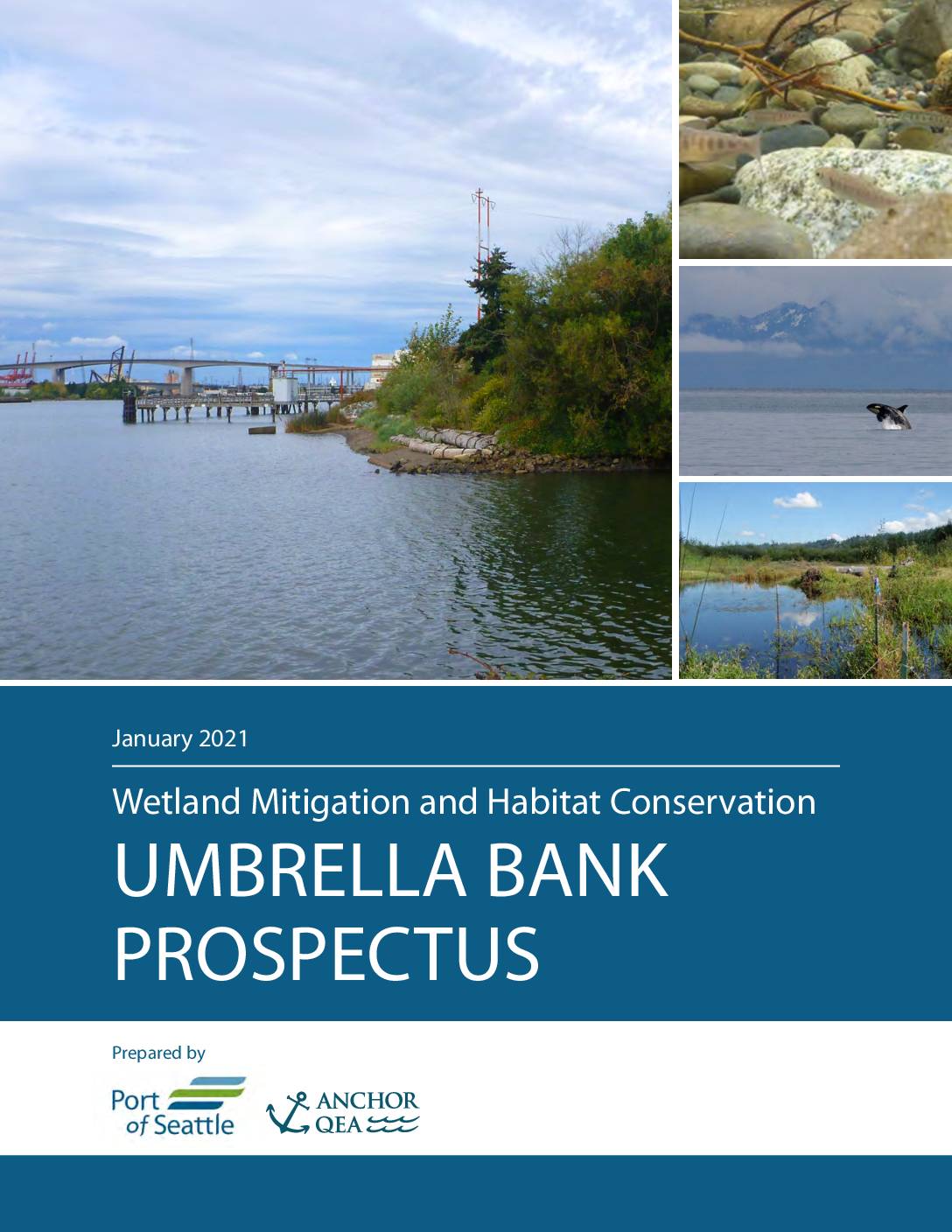
Wetland mitigation and habitat conservation umbrella bank prospectus
This prospectus, prepared by the Port of Seattle and Anchor QEA, outlines a wetland mitigation and habitat conservation umbrella bank program. It describes proposed initial and future mitigation sites including Terminal 25, Terminal 117, and an Auburn site, along with the proposed service area and site protection measures. The document provides conceptual designs, existing conditions -
 2021-01-01
SEA Stakeholder Advisory Round Table 2021 update
The SEA Stakeholder Advisory Round Table (StART) is a forum established by the Port of Seattle in early 2018 to facilitate information sharing between the airport and surrounding communities on issues related to Seattle-Tacoma International Airport. Developed in consultation with Highline Forum member cities, StART also involves Alaska Airlines, Delta Air Lines, and the FAA. This 2021 update, presented by Port of Seattle staff, recaps the group's meetings and ongoing efforts to address airport community concerns. -
 2021-01-01
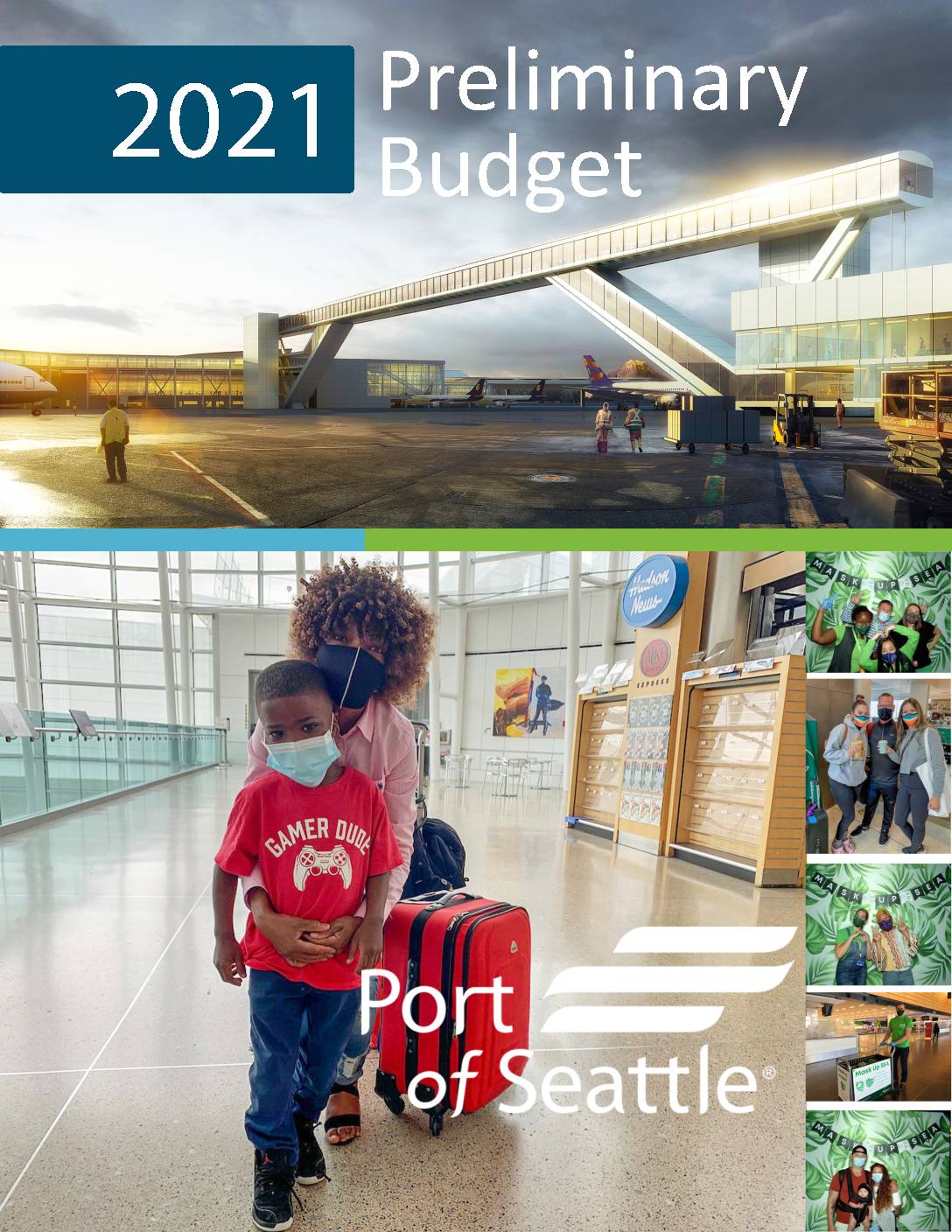
2021 preliminary budget
The Port of Seattle's 2021 Preliminary Budget document was prepared by the Finance and Budget Departments and covers the organization's financial plans for the coming year. The Port previously received a Government Finance Officers Association (GFOA) Distinguished Budget Presentation Award for its 2020 Annual Budget, recognizing it as an effective policy document, financial plan, operations guide, and communications tool. Note: this document does not appear to contain specific Sea-Tac Airport noise policy content. -
 2020-12-31
Annual financial report: As of December 31, 2020 and 2019, and for the years ended December 31, 2020, 2019, and 2018
The Port of Seattle's 2020 Annual Financial Report covers the financial position and activity of the Port as of December 31, 2020 and 2019, and for the fiscal years ending 2020, 2019, and 2018. Prepared by the Port's Accounting and Financial Reporting Department, the report includes audited financial statements, management's discussion and analysis, pension fund information, and ten-year statistical trends. It provides a comprehensive overview of the Port's enterprise operations, which include Seattle-Tacoma International Airport and maritime facilities. -
 2020-12-21
Airfield Simulation Modeling History and Summary: Sustainable Airport Master Plan, Seattle-Tacoma International Airport
LeighFisher memorandum summarizing airfield simulation modeling conducted for the Port Of Seattle Sustainable Airport Master Plan (SAMP) and follow-on NEPA review at Sea-Tac Airport. Covers TAAM (Total Airport and Airspace Modeller) model development from 2015 through mid-2017, including initial calibration to 2014 activity, FAA-requested recalibration to 2016 activity, maximum sustainable throughput experiments, and revised future-year -
2020-12-21
Airfield Simulation Modeling History and Summary: Sustainable Airport Master Plan, Seattle-Tacoma International Airport
LeighFisher memorandum summarizing airfield simulation modeling conducted for the Port Of Seattle Sustainable Airport Master Plan (SAMP) and follow-on NEPA review at Sea-Tac Airport. Covers TAAM (Total Airport and Airspace Modeller) model development from 2015 through mid-2017, including initial calibration to 2014 activity, FAA-requested recalibration to 2016 activity, maximum sustainable throughput experiments, and revised future-year -
 2020-12-17
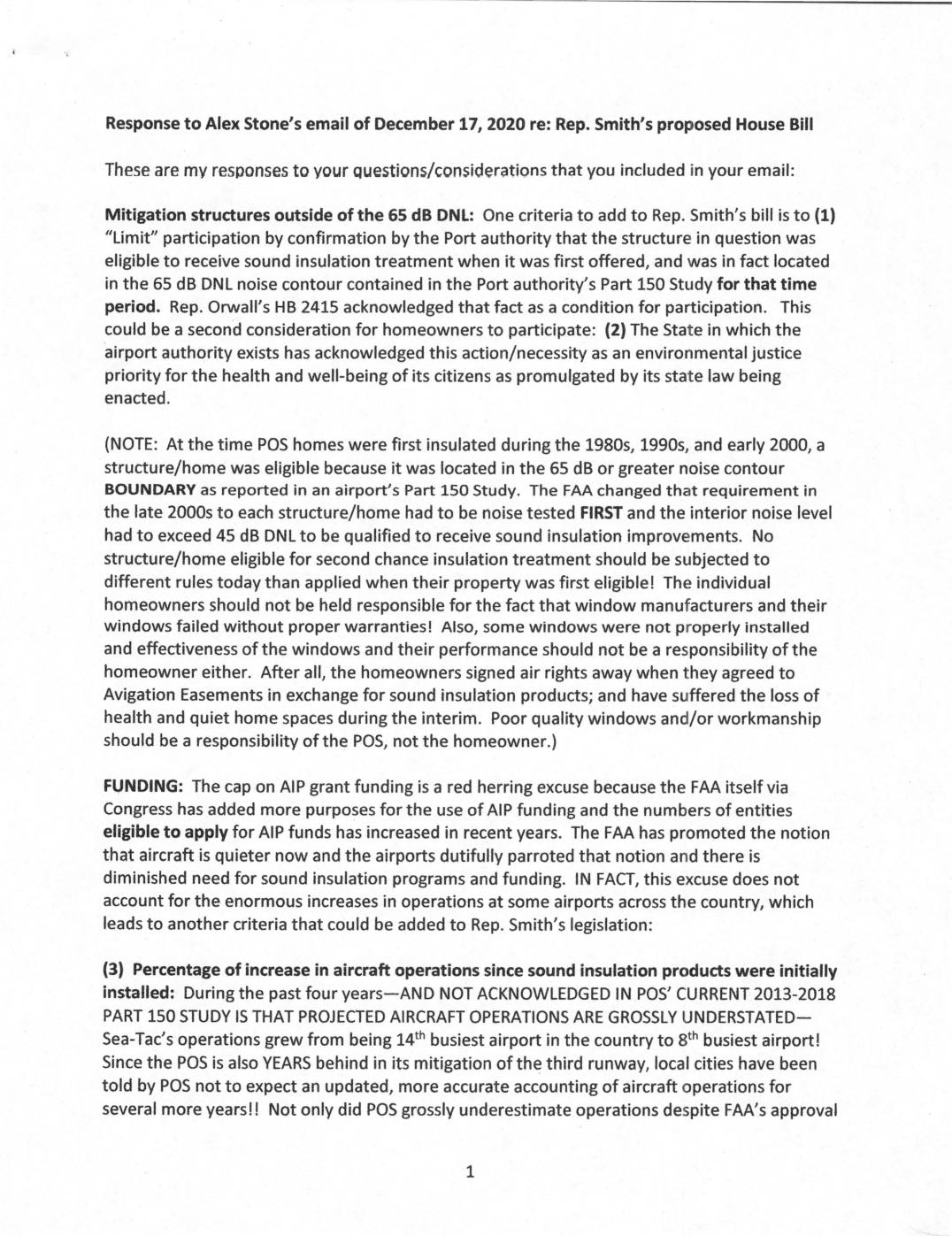
Response to Alex Stone’s email of December 17, 2020 re: Rep. Smith’s proposed House Bill
This document is a detailed response regarding a proposed Washington State house bill on airport sound insulation, arguing that homeowners near Sea-Tac Airport who received faulty or inadequate noise insulation in the 1980s–2000s should qualify for a second round of repairs at no fault of their own. The author contends that poor contractor quality, a bankrupt window manufacturer, and dramatically increased flight operations have left many residents without the noise protection they were promised in exchange for signing away air rights. Key recommendations include limiting eligibility to homes originally certified under the 65 dB DNL noise contour, using certified engineers to assess repair needs, and tying funding criteria to documented increases in aircraft operations over time. -
 2020-12-15
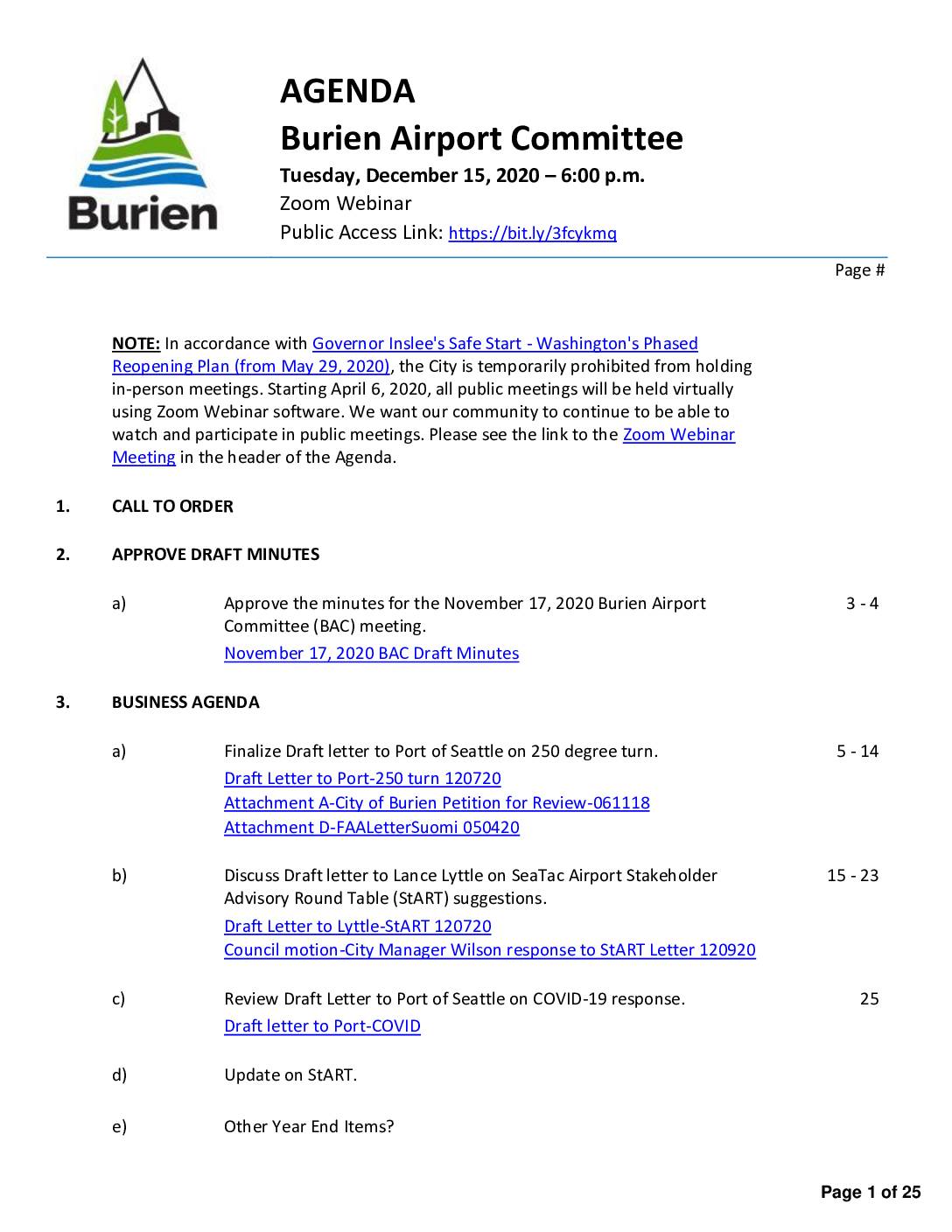
Burien Airport Committee agenda – December 15, 2020
The Burien Airport Committee held a virtual meeting on December 15, 2020, to address several issues related to Seattle-Tacoma International Airport, including finalizing a letter to the Port of Seattle regarding a controversial 250-degree flight turn, discussing improvements to the SeaTac Airport Stakeholder Advisory Round Table (StART), and reviewing a letter concerning the Port's COVID-19 response. The committee also reviewed draft minutes from its November 17, 2020 meeting, during which members discussed adding more community representatives from areas such as Beacon Hill, Shoreline, and Vashon to improve StART's reach. All meetings were conducted remotely via Zoom in compliance with Governor Inslee's COVID-19 public gathering restrictions.