TagPart 150(269)
-
 2020-09-15
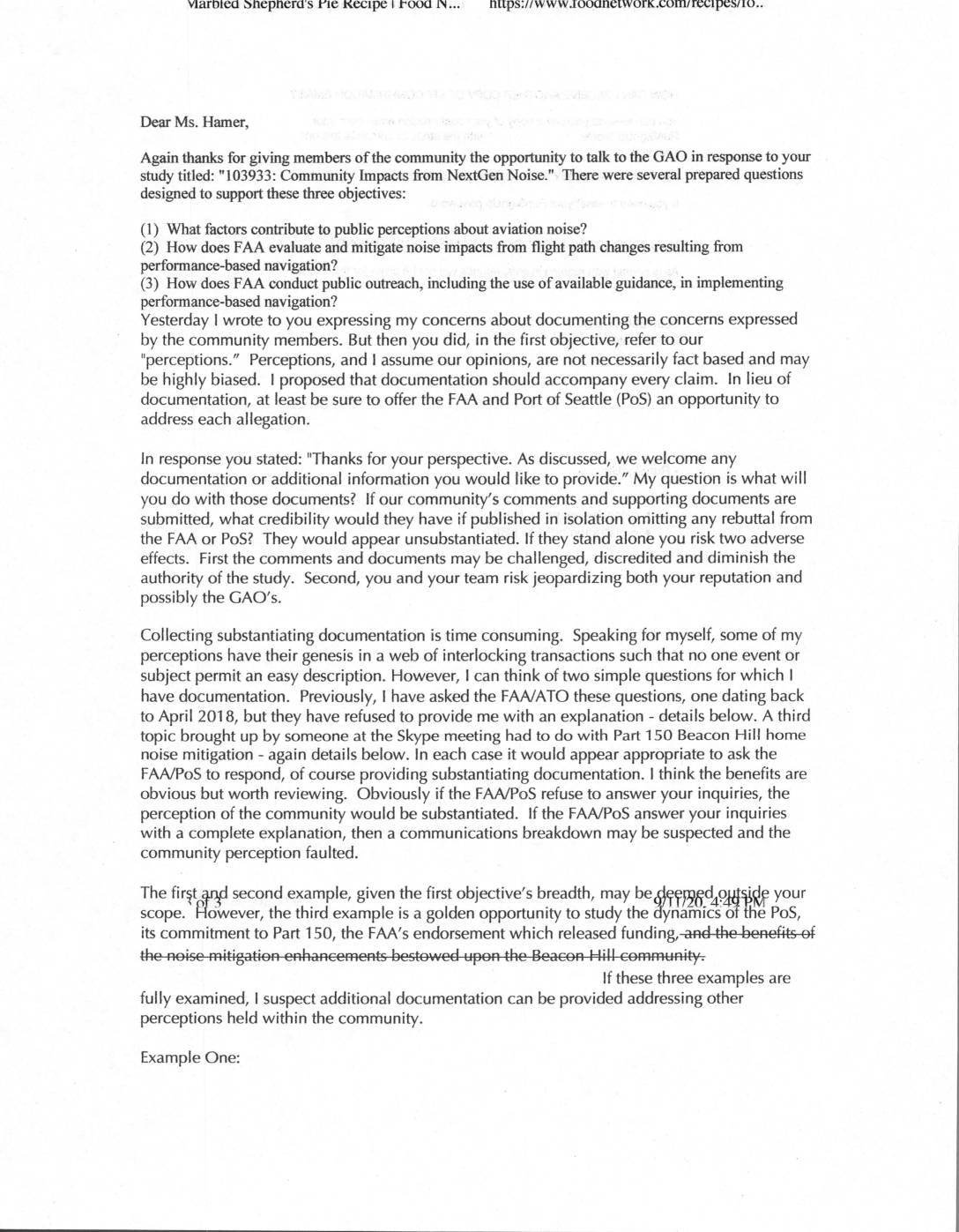
Letter to Ms. Hamer regarding GAO study 103933: Community impacts from NextGen noise
A community member wrote to a GAO researcher studying NextGen aviation noise impacts near Seattle-Tacoma International Airport, urging that community complaints be paired with responses from the FAA and Port of Seattle to ensure credibility. Key concerns raised include an outdated noise exposure map that has not been updated despite significant growth in air traffic, and the FAA's alleged refusal to answer questions submitted as far back as April 2018. The letter argues that without official rebuttals or supporting documentation, community perceptions risk appearing unsubstantiated and could undermine the integrity of the GAO study. -
 2020-03-12
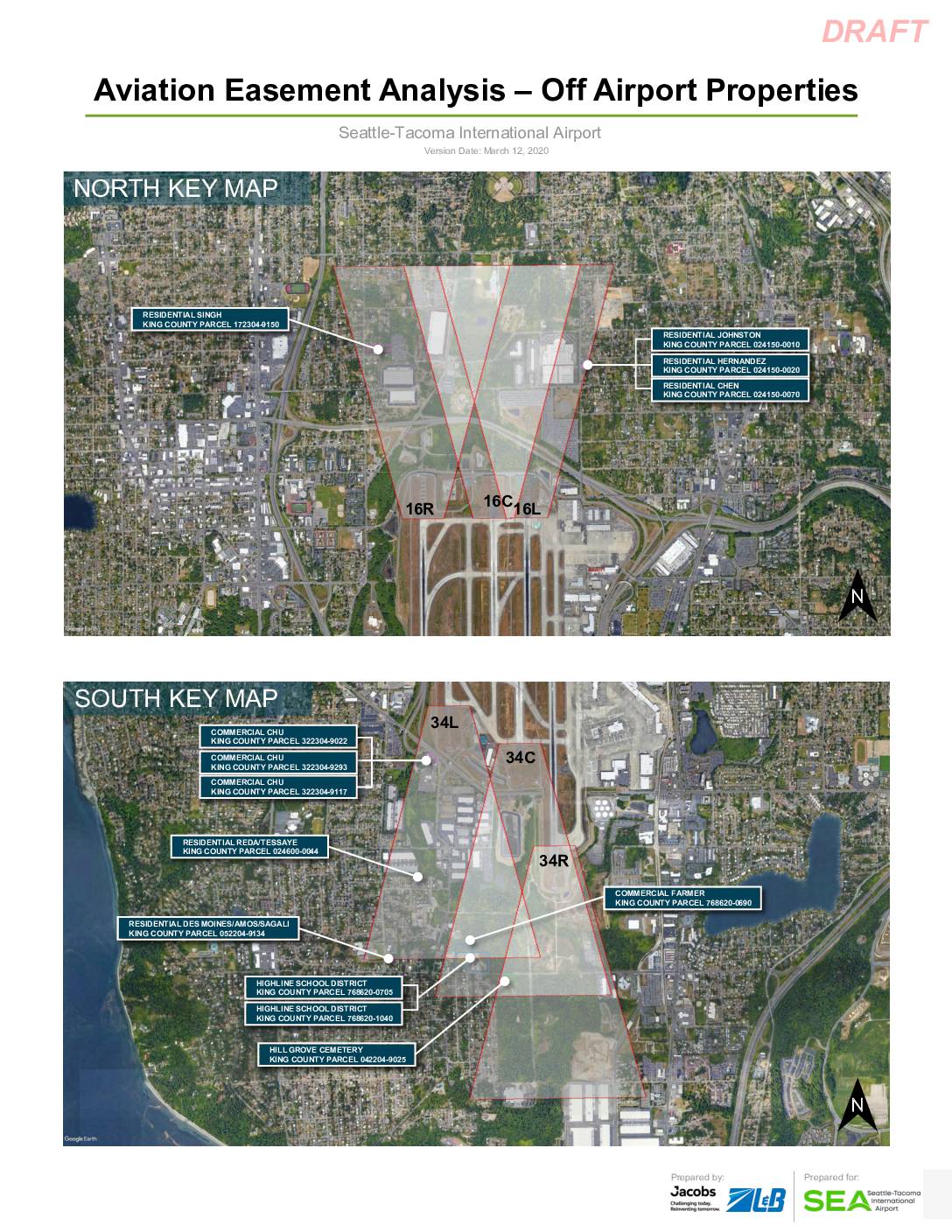
Aviation Easement Analysis – Off Airport Properties: Seattle-Tacoma International Airport (Highline School District Parcels 768620-0705 and 768620-1040)
This draft report, prepared by Jacobs and ZLB for Seattle-Tacoma International Airport in March 2020, analyzes aviation easements for off-airport properties located near the airport's runways. It focuses on two Highline School District parcels (King County Parcels 768620-0705 and 768620-1040), documenting the removal of 26 trees that previously penetrated federally defined airspace protection surfaces, including approach, departure, and transitional surfaces. The analysis confirms that all identified obstacles have been removed as part of a construction package, and provides detailed elevation and coordinate data for parcel boundary points relative to runway thresholds. -
HR 5874 – Decrease Noise Levels Act
116th CONGRESS 2d Session H. R. 5874 To require the Administrator of the Federal Aviation Administration to amend regulations concerning the day-night average sound level, and for other purposes. IN THE HOUSE OF REPRESENTATIVES February 12, 2020 Ms. Meng (for herself, Mr. Smith of Washington, Mr. Espaillat, Ms. Brownley of California, Mr. Beyer, Mr. -
 2019-10-27
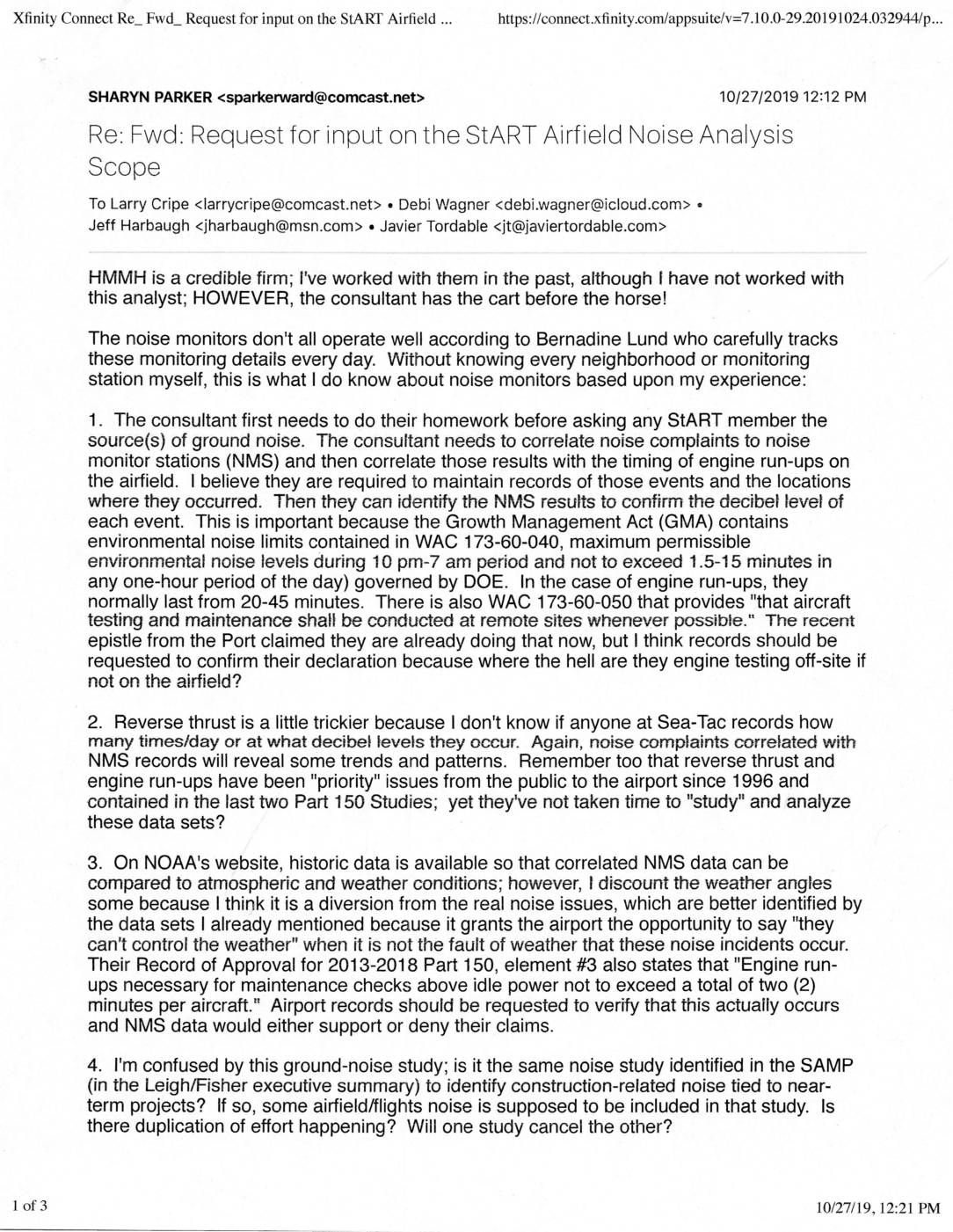
Re: Fwd: Request for input on the StART Airfield Noise Analysis Scope
In October 2019, community advocate Sharyn Parker responded to a request for public input on a Sea-Tac Airport airfield ground noise study being conducted by consulting firm HMMH. Parker argued that the consultant should first analyze existing noise monitor station data, correlate it with engine run-up records and resident complaints, and review compliance with Washington State noise regulations (WAC 173-60) before seeking community feedback. She also raised concerns about non-functioning noise monitors, the airport's unverified claims about off-site engine testing, and potential overlap with a separate noise study tied to the airport's master planning process. -
 2019-10-22
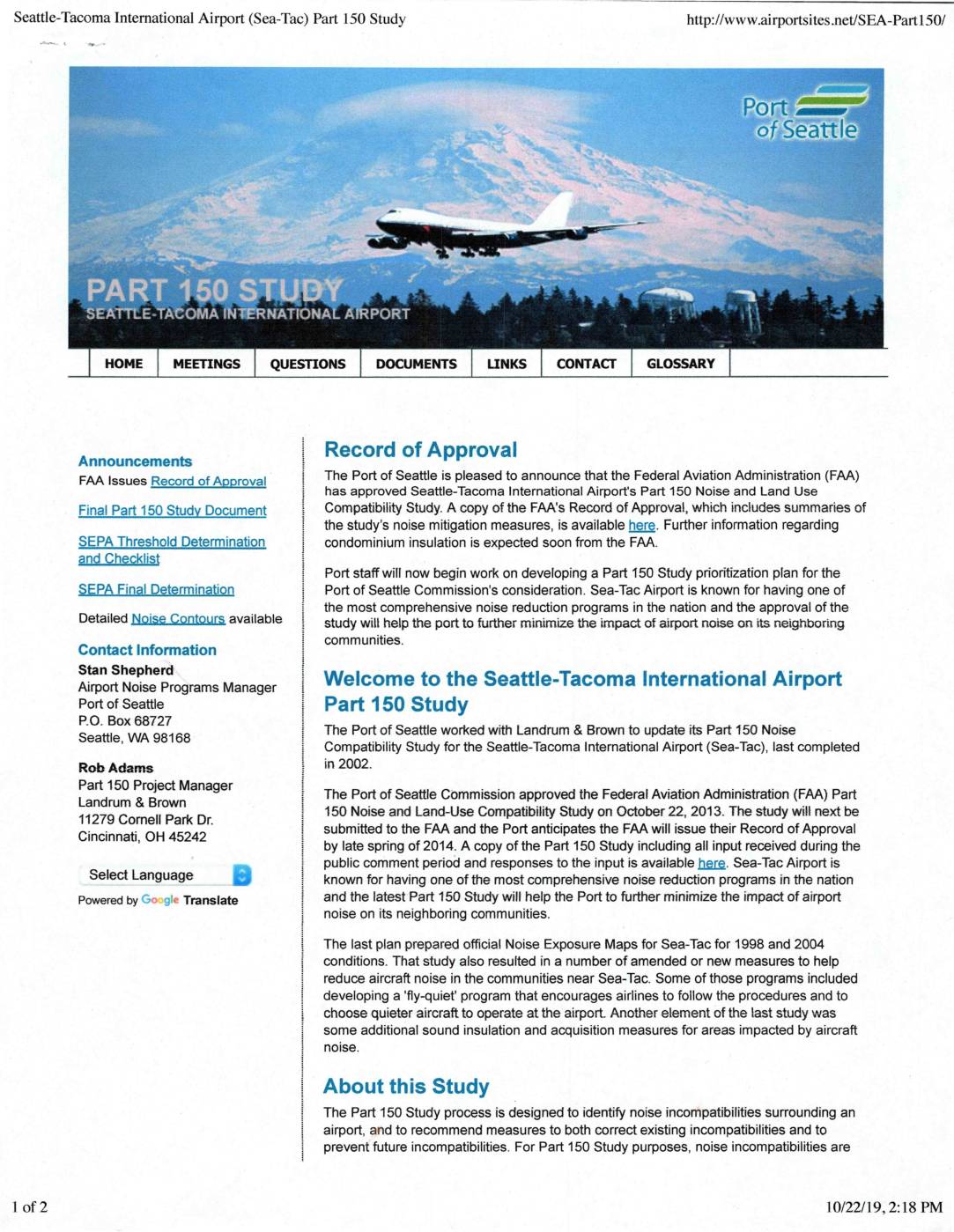
Seattle-Tacoma International Airport (Sea-Tac) Part 150 Study
The Port of Seattle completed an updated Part 150 Noise and Land Use Compatibility Study for Seattle-Tacoma International Airport (Sea-Tac), which was approved by the Port of Seattle Commission in October 2013 and subsequently received a Record of Approval from the Federal Aviation Administration (FAA). The study identifies noise incompatibilities in communities surrounding Sea-Tac and recommends measures to reduce aircraft noise, building on earlier programs such as a 'fly-quiet' initiative and sound insulation efforts. Sea-Tac is recognized as having one of the most comprehensive airport noise reduction programs in the nation, and this updated study is intended to further minimize the impact of aircraft noise on neighboring communities. -
 2019-10-18
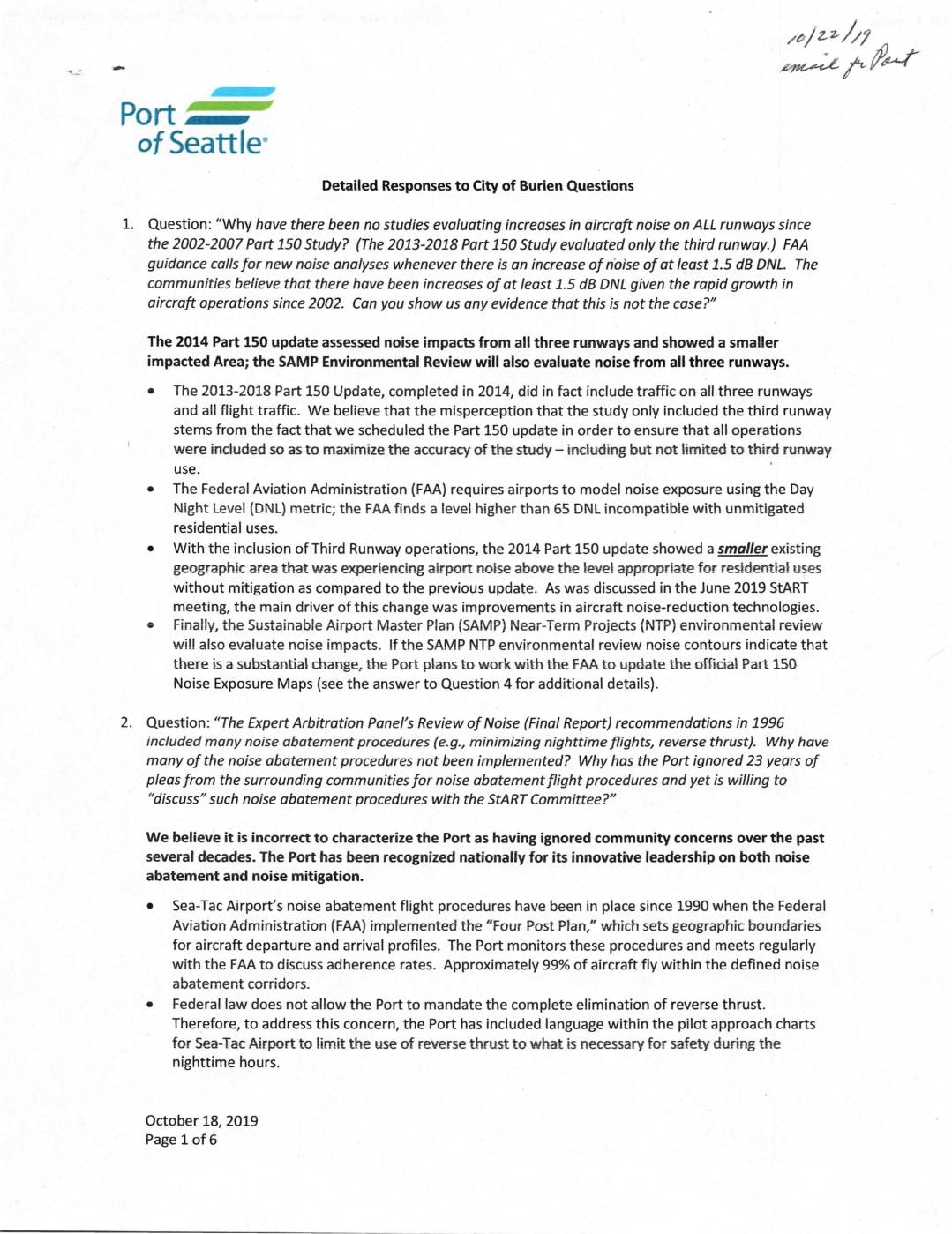
Detailed responses to City of Burien questions
The Port of Seattle responded in October 2019 to detailed questions from the City of Burien about aircraft noise management at Sea-Tac Airport, addressing concerns about noise studies, abatement procedures, sound insulation programs, and community engagement. The Port defended its 2014 Part 150 noise study as covering all three runways and argued that improved aircraft technology has actually reduced the noise-impacted area since the previous study. It also outlined ongoing mitigation efforts, including a Late-Night Noise Limitation Program, over $300 million spent on sound insulation for thousands of homes, and the upcoming Sustainable Airport Master Plan environmental review, which will reassess noise impacts across all runways. -
 2019-10-18
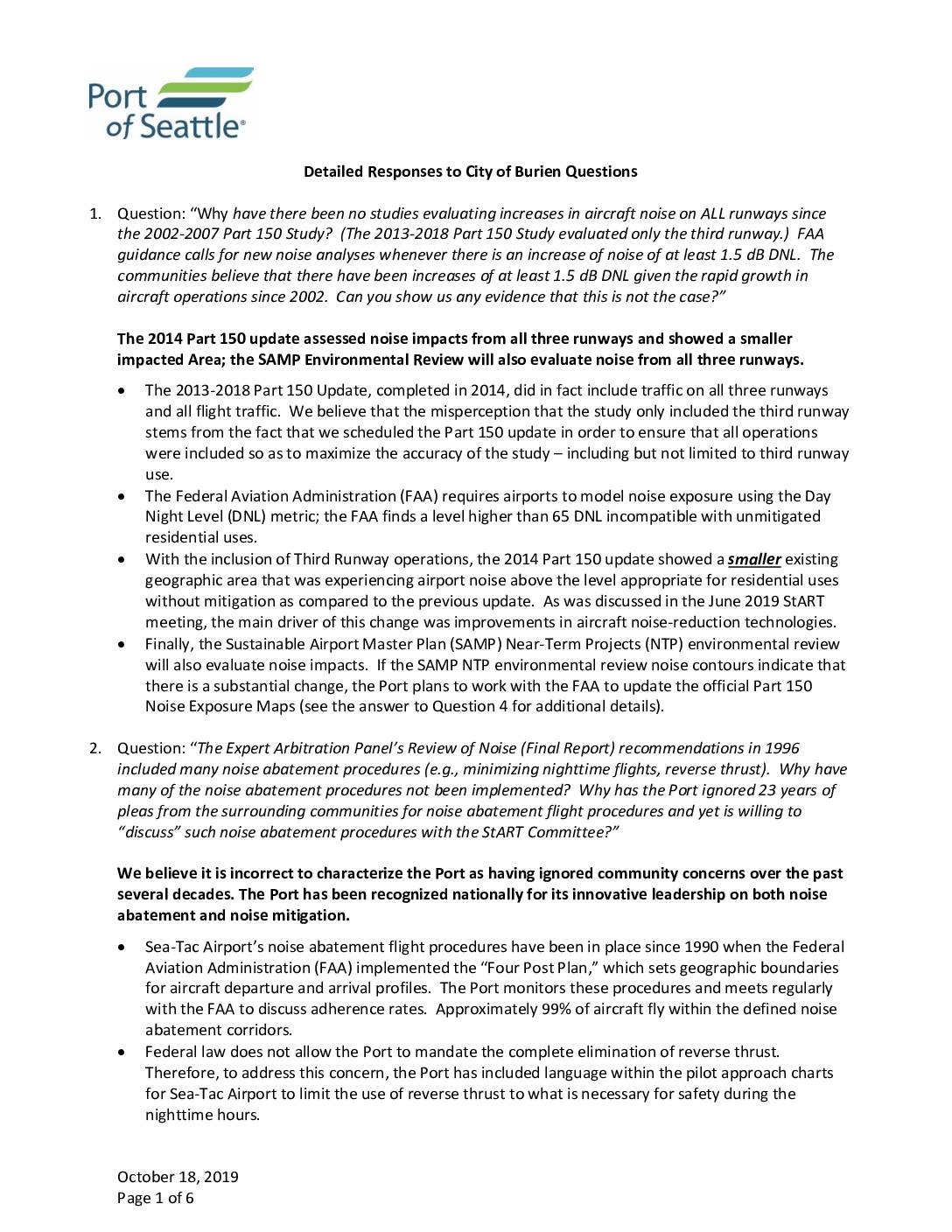
Detailed Responses to City of Burien Questions
The Port of Seattle responds to questions from the City of Burien about aircraft noise studies, noise abatement procedures, and community mitigation programs at Seattle-Tacoma International Airport. The Port clarifies that its 2014 Part 150 noise study covered all three runways and actually showed a smaller noise-impacted area due to quieter aircraft technology, and that the upcoming Sustainable Airport Master Plan environmental review will further assess noise impacts. The document also addresses concerns about the pace of sound insulation programs, the transparency of the StART community advisory process, and the legal and regulatory constraints that limit the Port's ability to mandate certain noise reduction measures. -
 2019-10-18
Detailed Responses to City of Burien Questions
The Port of Seattle responds to questions from the City of Burien about aircraft noise studies, noise abatement procedures, and community mitigation programs at Seattle-Tacoma International Airport. The Port clarifies that its 2014 Part 150 noise study covered all three runways and actually showed a smaller noise-impacted area due to quieter aircraft technology, and that the upcoming Sustainable Airport Master Plan environmental review will further assess noise impacts. The document also addresses concerns about the pace of sound insulation programs, the transparency of the StART community advisory process, and the legal and regulatory constraints that limit the Port's ability to mandate certain noise reduction measures. -
 2019-08-28
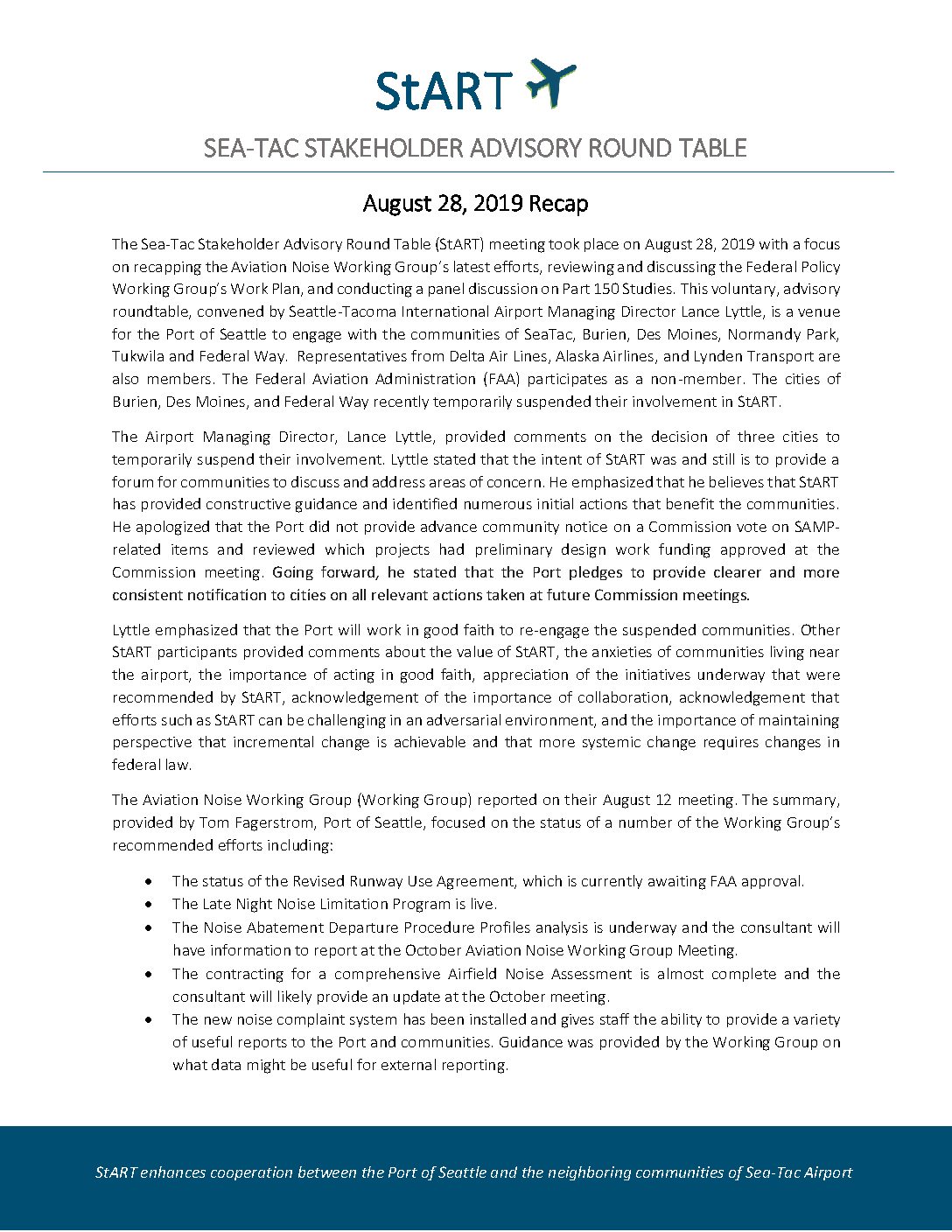
StART August 28, 2019 Meeting Recap
The Sea-Tac Stakeholder Advisory Round Table (StART) met on August 28, 2019 to discuss airport noise reduction efforts, federal policy priorities, and an overview of Part 150 noise studies. Key updates included progress on a Revised Runway Use Agreement, the launch of a Late Night Noise Limitation Program, and a new noise complaint system. The meeting also addressed the temporary suspension of three neighboring cities from StART, with airport leadership pledging improved communication and good-faith efforts to re-engage those communities. -
 2019-08-19
City of Burien Letter to Port Of Seattle Executive Director and Commissioners Regarding Sea-Tac Airport Noise and Community Impacts
In August 2019, the City of Burien sent a formal letter to the Port of Seattle's Executive Director and Commissioners raising nine pointed questions about Sea-Tac Airport's noise policies and community health impacts. The city challenged the Port's failure to conduct updated noise studies across all runways since 2002, slow implementation of sound insulation programs, and lack of transparency in the StART community committee process. Burien concluded by calling for an honest public dialogue about whether continued airport growth is sustainable given the environmental and quality-of-life consequences for neighboring residents.