TagNoise Monitors(39)
-
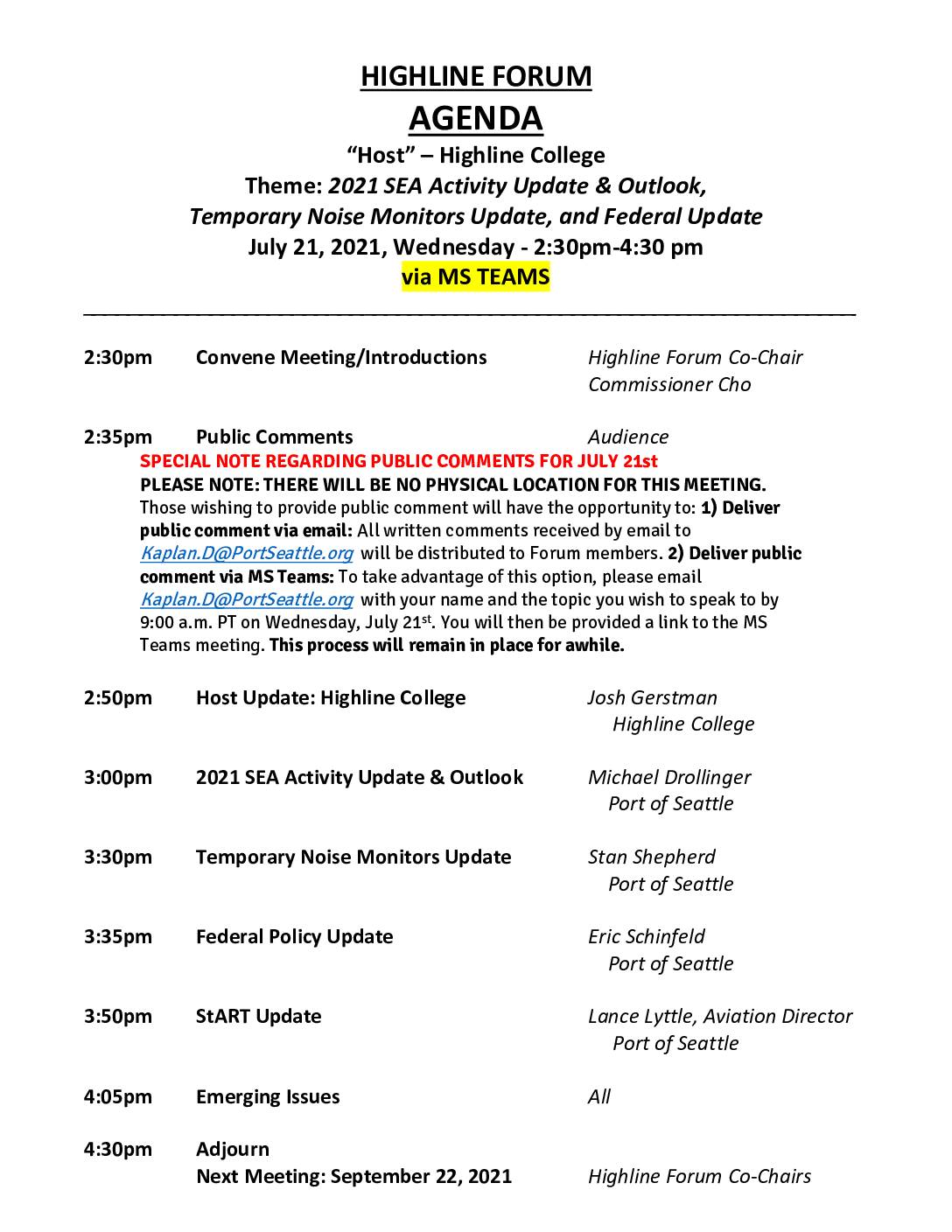 2021-07-21
Highline Forum agenda, July 21, 2021
The Highline Forum held a virtual meeting on July 21, 2021, hosted by Highline College, covering updates on 2021 Seattle-Tacoma International Airport (SEA) flight activity, temporary noise monitor installations, and federal aviation policy. The meeting, conducted via Microsoft Teams, featured presentations by Port of Seattle staff and Aviation Director Lance Lyttle, with public comments accepted by email or live video link. The document also lists all six Highline Forum meeting dates for 2021, with hosts rotating among local entities including the cities of Burien, Federal Way, Tukwila, and SeaTac. -
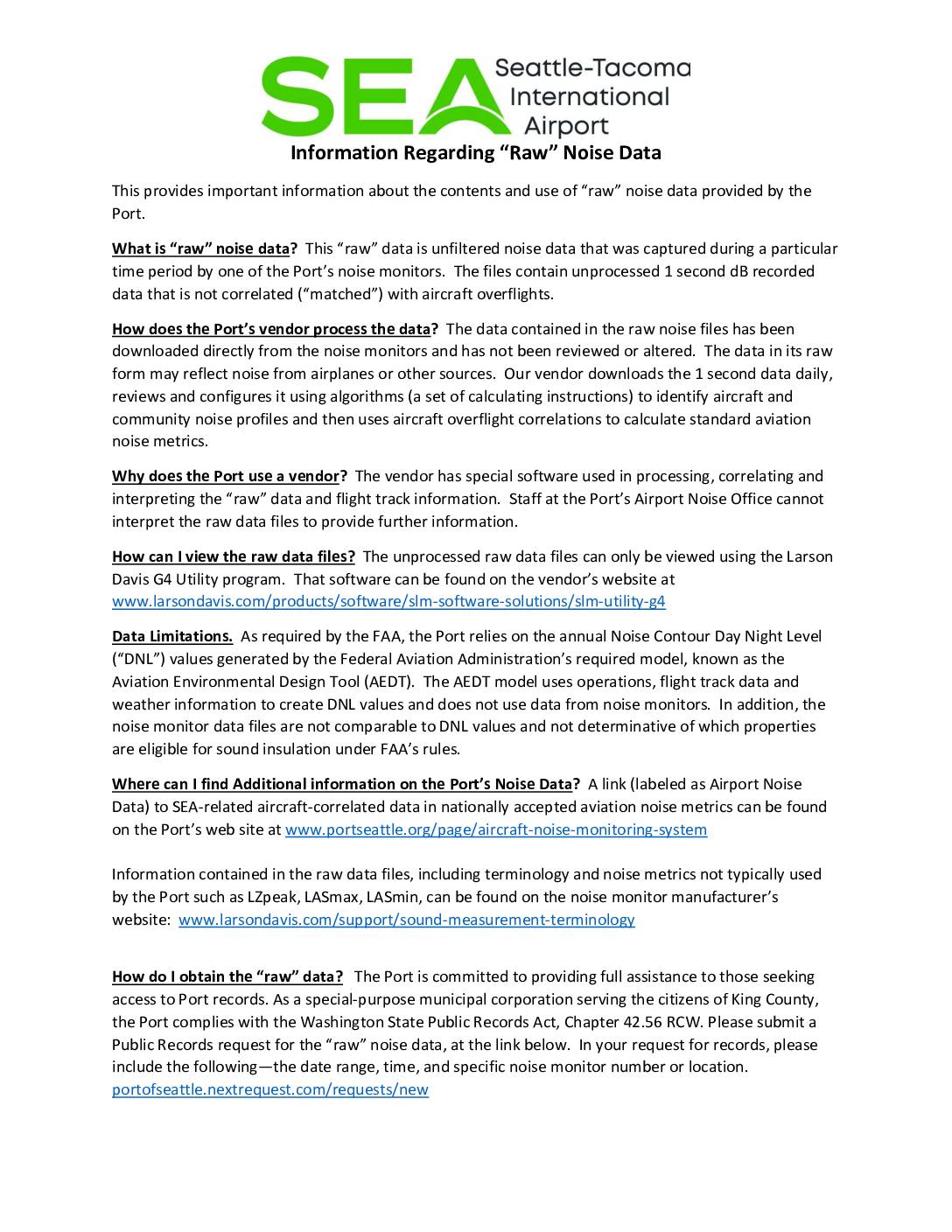 2020-10-01
Information Regarding “Raw” Noise Data
This document from Seattle-Tacoma International Airport explains what 'raw' noise data is, how it is collected and processed, and how the public can request it. The unfiltered, one-second decibel readings captured by the Port's noise monitors are not matched to specific aircraft and must be viewed with specialized Larson Davis software; a vendor processes the data using algorithms to produce standard aviation noise metrics. Residents can request raw data through the Washington State Public Records Act portal, though the Port disclaims any liability for how the data is used and notes it cannot be directly compared to the FAA-required DNL noise contour values used for sound insulation eligibility. -
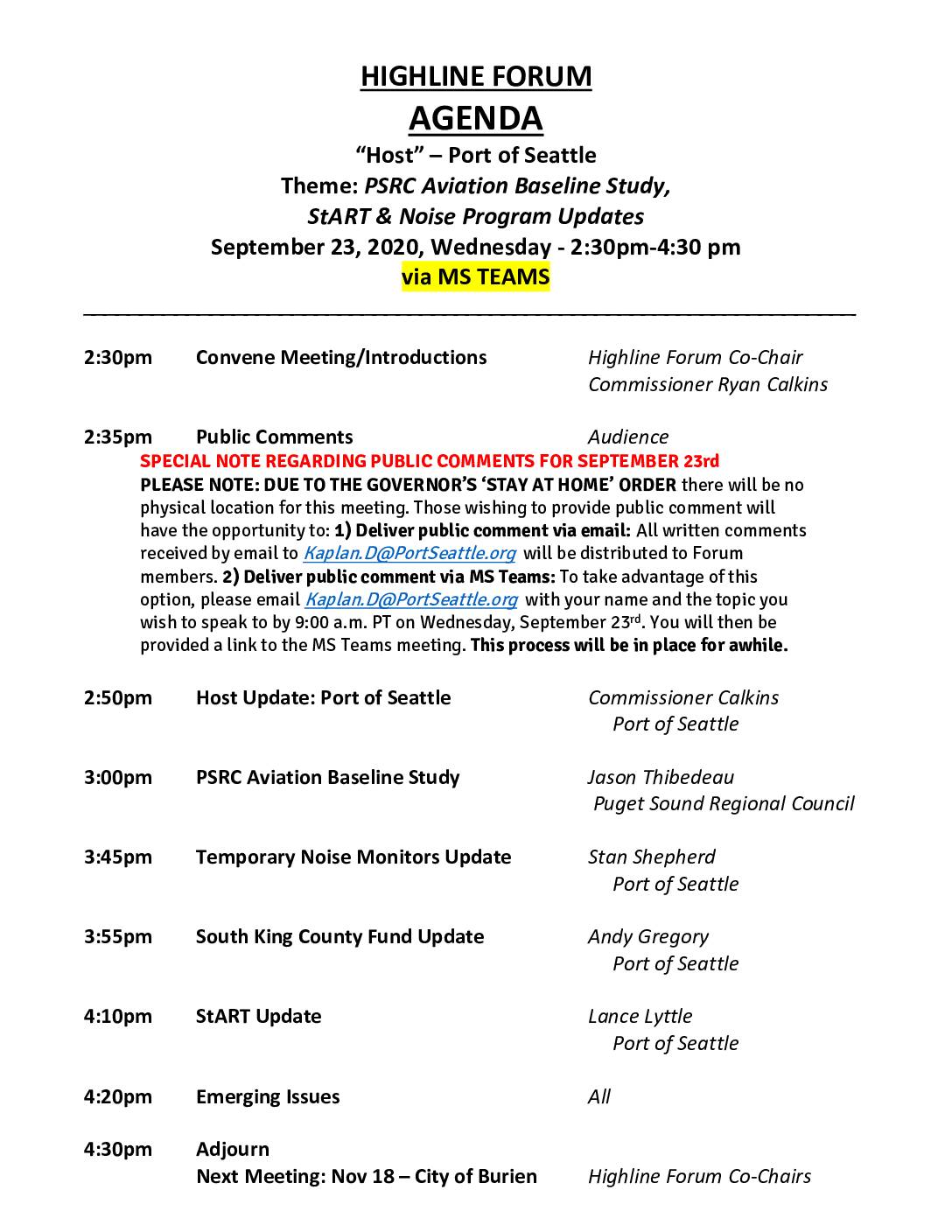 2020-09-23
Highline Forum Agenda: PSRC Aviation Baseline Study, StART & Noise Program Updates
The Highline Forum held its September 23, 2020 meeting virtually via Microsoft Teams, hosted by the Port of Seattle, covering key topics including the PSRC Aviation Baseline Study, temporary noise monitor updates, and a StART (Sea-Tac Airport Roundtable) program update. Due to the Governor's Stay-at-Home Order, members of the public could submit comments by email or join the MS Teams session by registering in advance. The meeting was part of a series of 2020 forums addressing aviation noise policy and community impact around Seattle-Tacoma International Airport. -
Port Of Seattle Commission Meeting
Item 8b: renewal of noise monitoring system: https://meetings.portseattle.org/portmeetings/attachments/2020/2020_09_08_RM_8b.pdf To be held in virtually via Skype in accordance with the Governor’s ‘Stay at Home’ order and Proclamation 20-28. You may view the full meeting live at meetings.portseattle.org. To listen live, call in at +1 (425) 660-9954 and code796815952# Item No.8bACTION ITEMDate of MeetingSeptember 8, 2020DATE:September 1, -
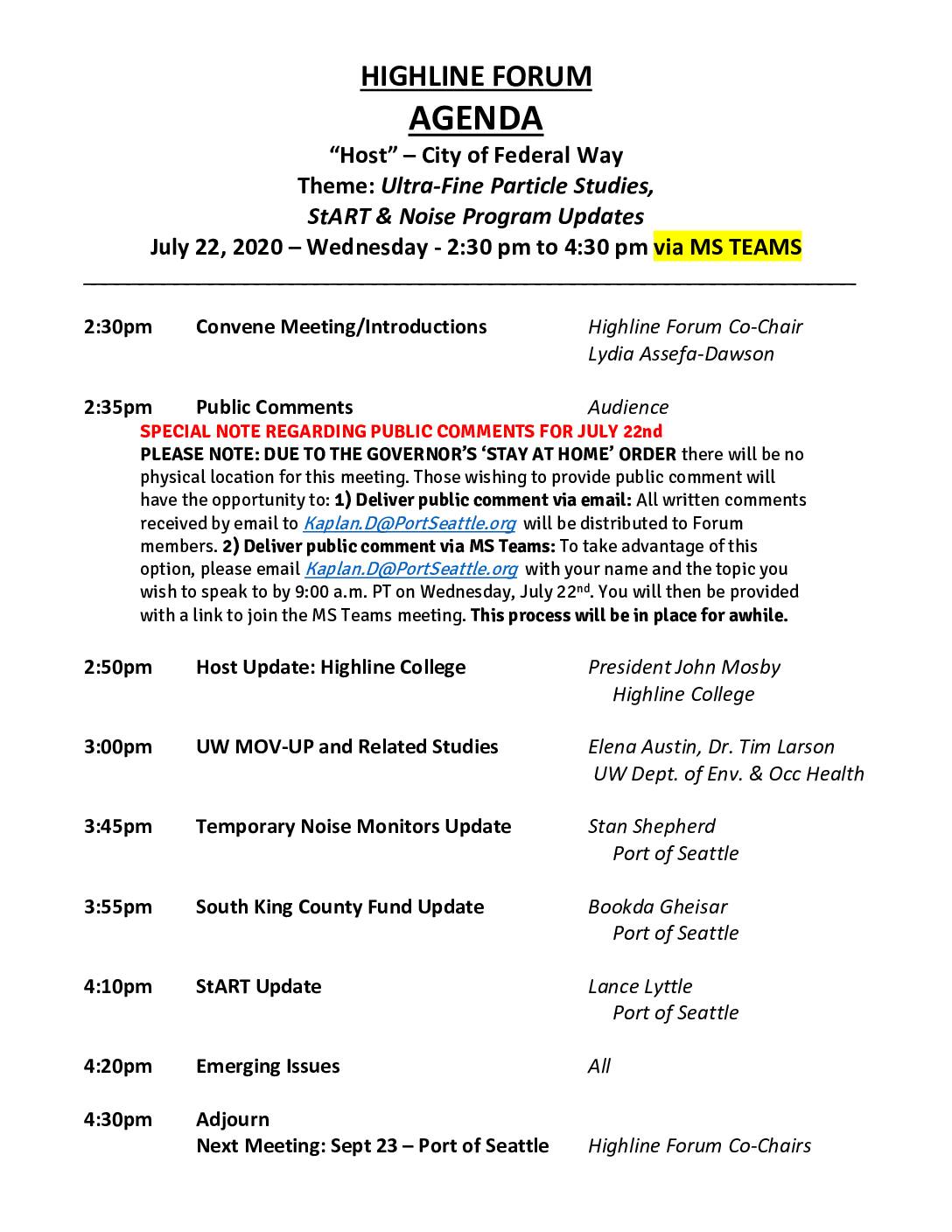 2020-07-22
Highline Forum agenda: Ultra-fine particle studies, StART & noise program updates
The Highline Forum held its July 22, 2020 meeting virtually via Microsoft Teams, hosted by the City of Federal Way, focusing on ultra-fine particle studies, noise program updates, and StART (Sea-Tac Airport Roundtable) developments near Seattle-Tacoma International Airport. Key presentations included University of Washington air quality research (MOV-UP study), a temporary noise monitors update from the Port of Seattle, and a South King County Fund update. The meeting was conducted remotely due to the Governor's Stay-at-Home Order, with public comments accepted via email or MS Teams. -
 2020-07-22
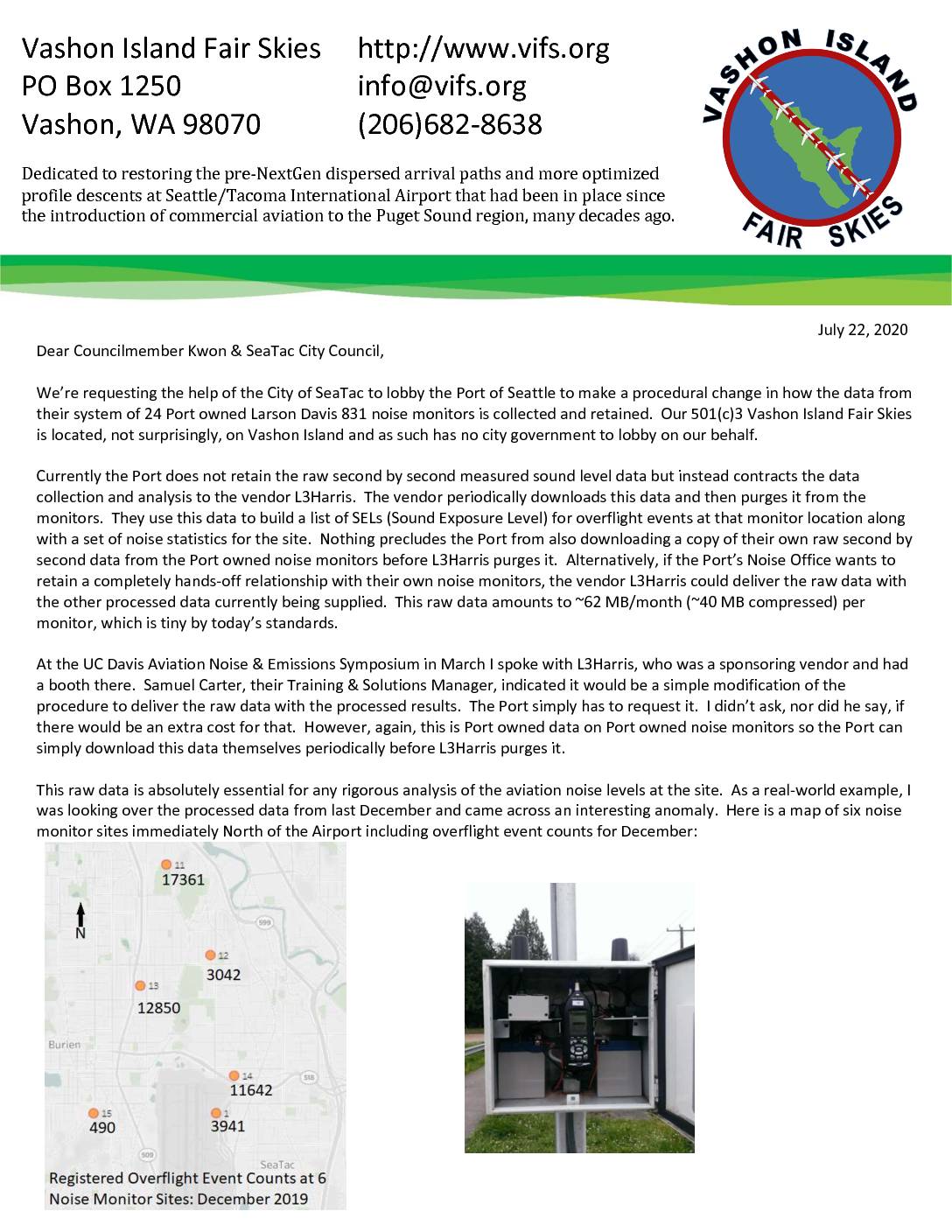
Letter From Vashon Island Fair Skies to City of Sea-Tac Requesting Lobbying Support for Port Of Seattle Noise Monitor Raw Data Retention
Vashon Island Fair Skies, a 501(c)3 nonprofit, wrote to the SeaTac City Council in July 2020 requesting help pressuring the Port of Seattle to retain raw second-by-second data from its 24 airport noise monitors, which vendor L3Harris currently purges after processing. The letter argues this raw data is essential for accurate noise analysis, demonstrating with December 2019 monitor data that high background noise at some sites causes the processing software to miss many actual aircraft overflight events. The group asks the city to urge the Port to make a simple procedural change — either downloading the data itself or requiring L3Harris to deliver it — noting the storage requirement is a modest ~62 MB per monitor per month. -
 2020-07-21
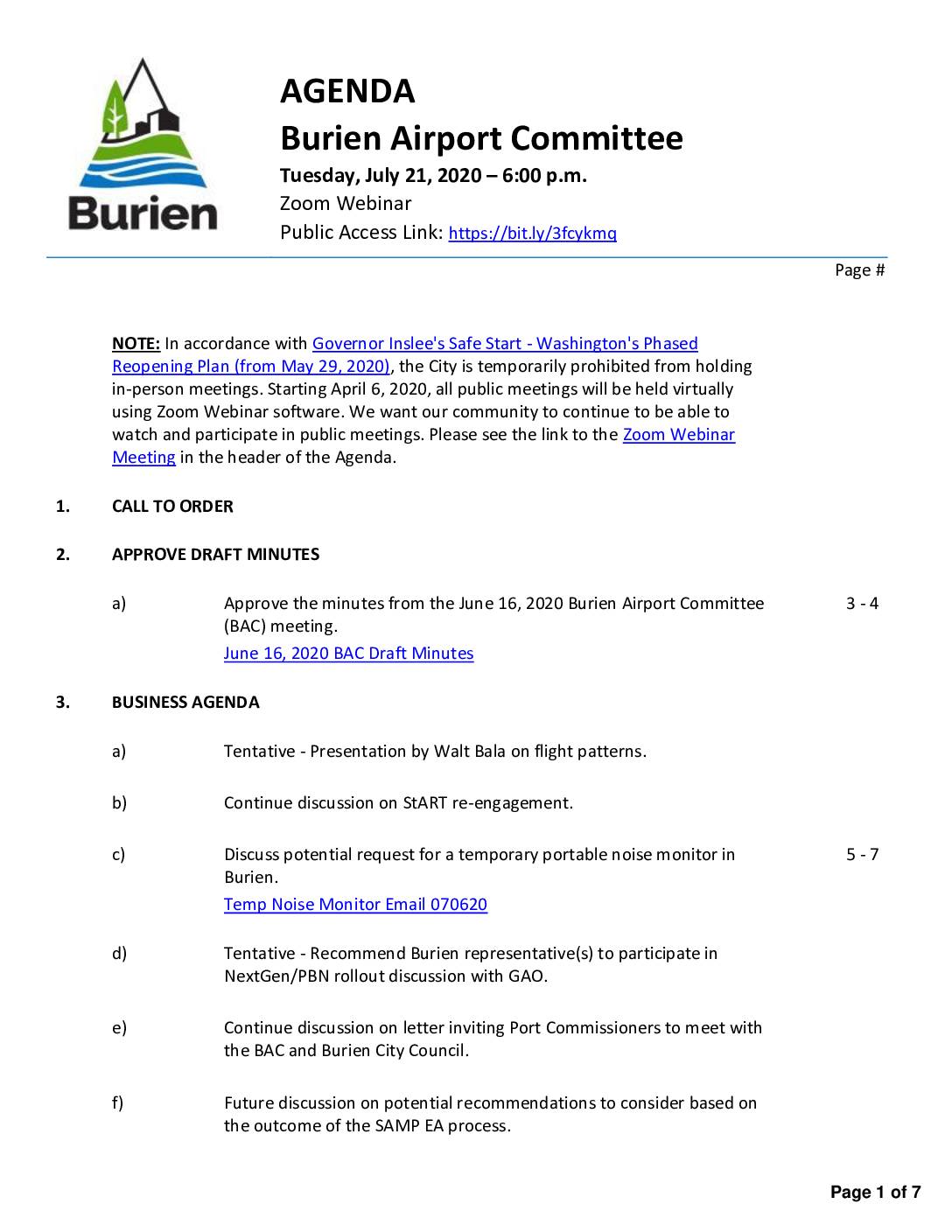
Burien Airport Committee agenda and draft minutes, July 21, 2020
The Burien Airport Committee held a virtual meeting on July 21, 2020, to discuss several airport-related issues affecting the community, including flight patterns, noise monitoring, and re-engagement with the SeaTac Airport Roundtable (StART). Key agenda items included a potential request for a temporary portable noise monitor in Burien, recommending representatives for NextGen/PBN rollout discussions with the GAO, and continuing discussions on inviting Port Commissioners to meet with the committee and City Council. Draft minutes from the June 16, 2020 meeting also reflected earlier discussions about airport impact mitigation, equity concerns, and a proposed letter to the Port Commission addressing a post-COVID 'new normal' for airport operations. -
 2020-07-17
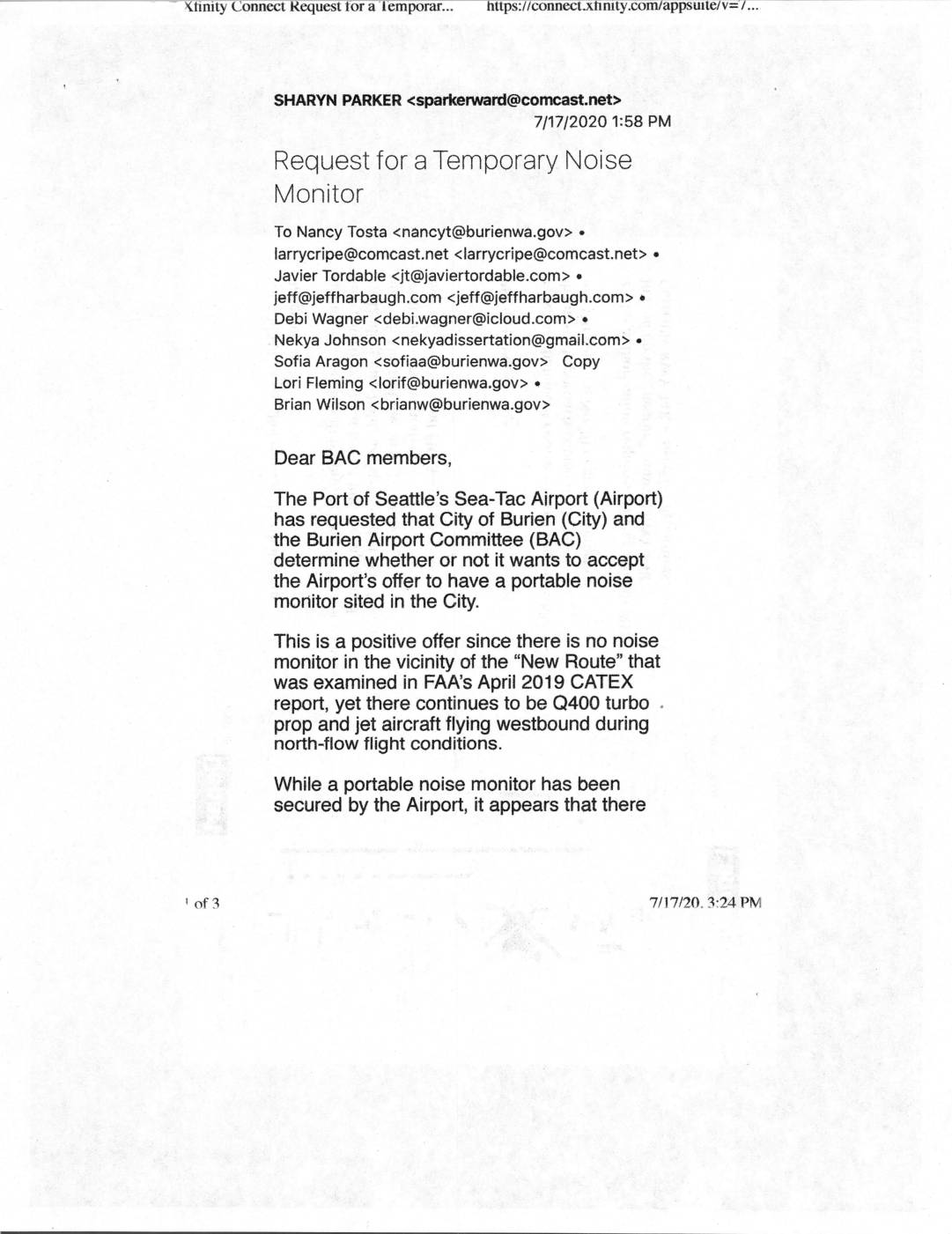
Request for a temporary noise monitor
In a July 17, 2020 email to Burien Airport Committee members, Sharyn Parker urges the City of Burien to accept Sea-Tac Airport's offer to place a temporary portable noise monitor in the city, noting there is currently no monitor near the 'New Route' where Q400 turboprop and jet aircraft continue to fly westbound during north-flow conditions. Parker cautions that site selection is a complex process requiring careful attention to obstacles, noise buffers, and power availability, drawing on her experience with King County International Airport where similar projects took two to four years. She recommends the city respond with a simple 'yes' by the July 24, 2020 deadline and request an extension if needed to properly identify one or two suitable monitoring locations. -
 2019-10-27
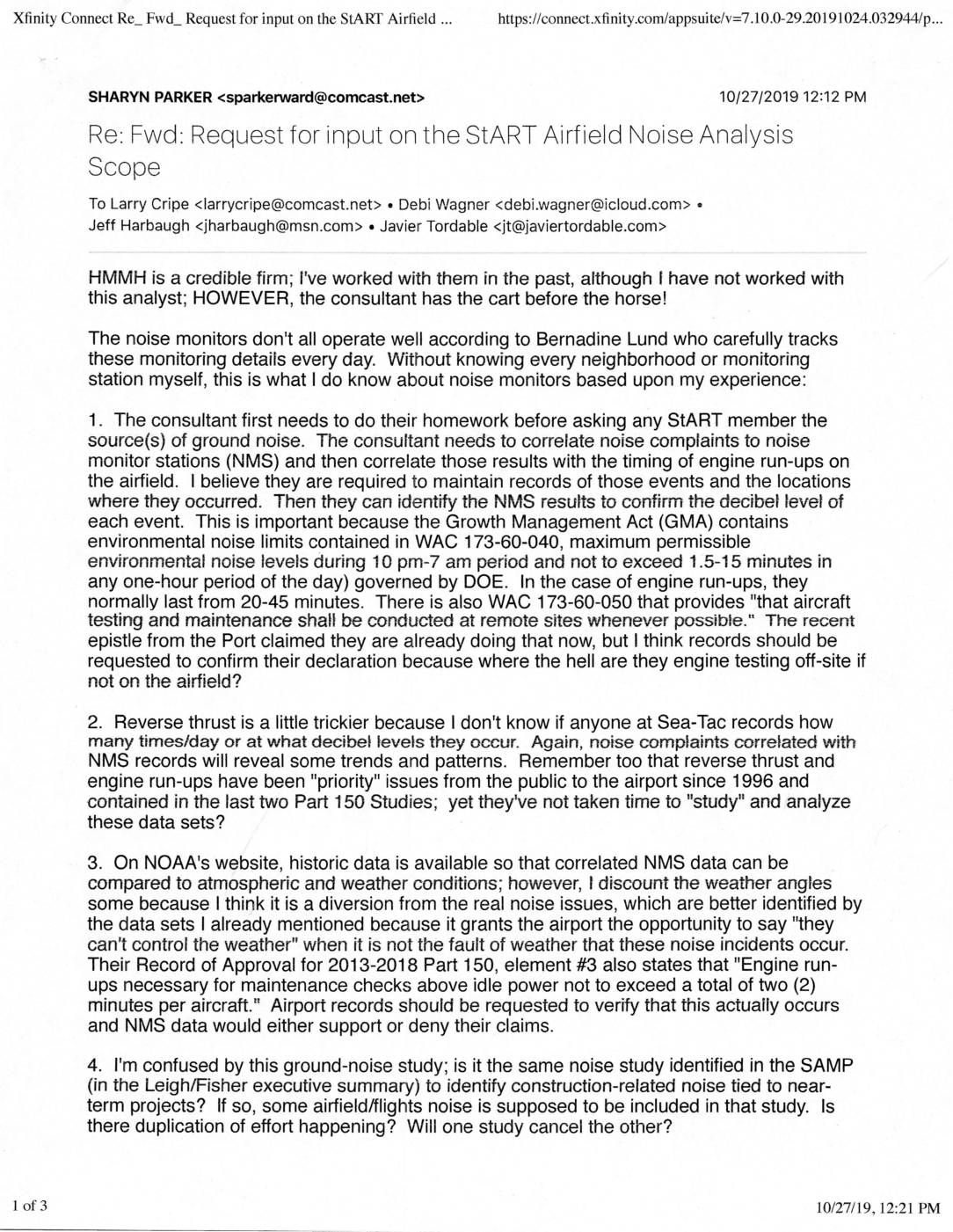
Re: Fwd: Request for input on the StART Airfield Noise Analysis Scope
In October 2019, community advocate Sharyn Parker responded to a request for public input on a Sea-Tac Airport airfield ground noise study being conducted by consulting firm HMMH. Parker argued that the consultant should first analyze existing noise monitor station data, correlate it with engine run-up records and resident complaints, and review compliance with Washington State noise regulations (WAC 173-60) before seeking community feedback. She also raised concerns about non-functioning noise monitors, the airport's unverified claims about off-site engine testing, and potential overlap with a separate noise study tied to the airport's master planning process. -
 2019-10-25
Request for input on the StART airfield noise analysis scope
These emails, dated October–November 2019, relate to a study of ground-level noise at Seattle-Tacoma International Airport initiated by the StART Aviation Noise Working Group. Noise consultant Brad Nicholas of HMMH sought input from surrounding cities, including Burien (which had suspended its StART membership), on which noise sources to analyze and where to place monitoring equipment. Community advocate Sharyn Parker responded with detailed recommendations, arguing the consultant should first correlate existing noise complaints and monitor records with engine run-up events before soliciting public input, and identifying engine run-ups and reverse thrust as the two primary sources of airfield ground noise.