TagNEPA(390)
-
 2001-03-22
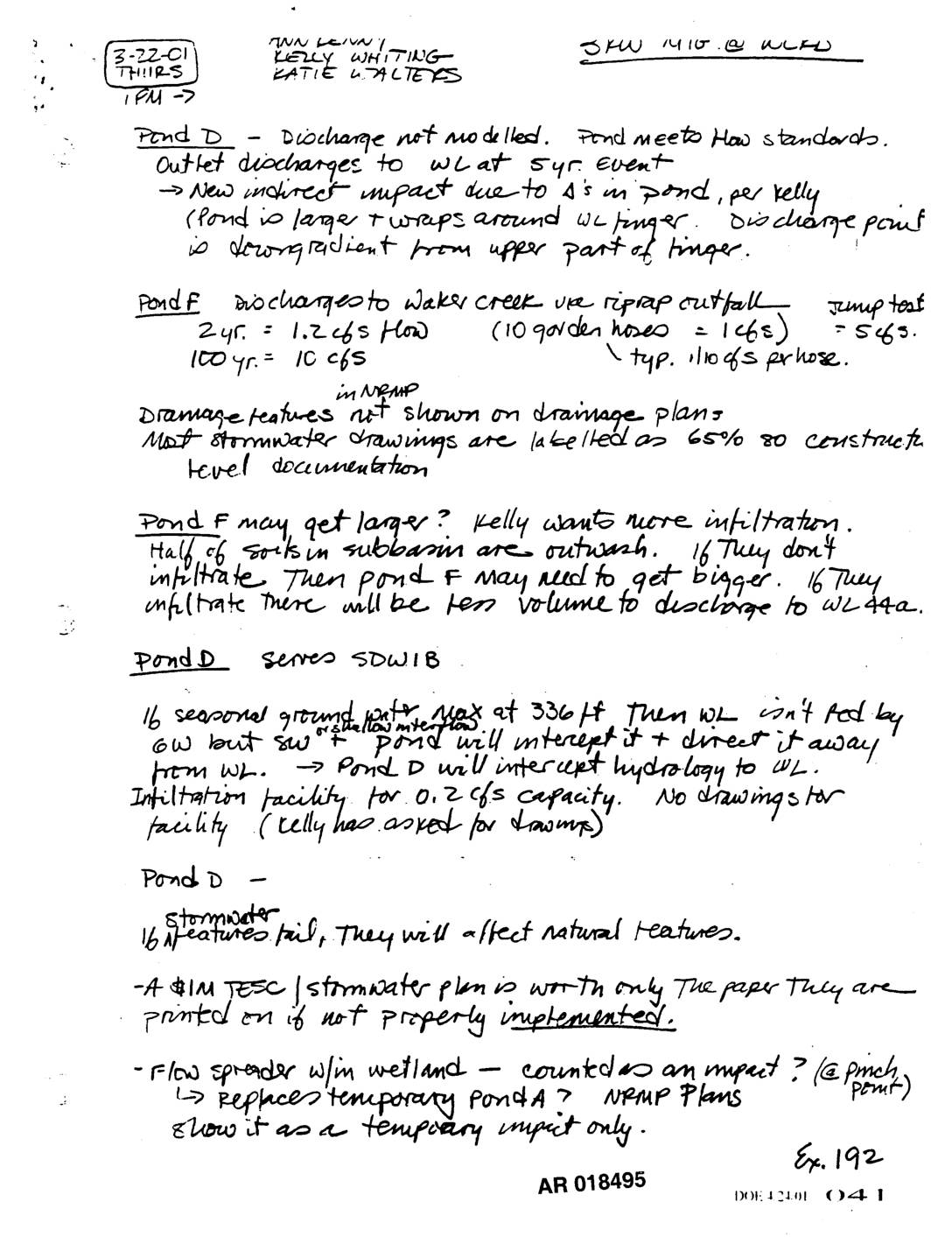
Exhibit 192: Handwritten Meeting Notes on Stormwater Ponds D, F, and G — Wetland Hydrology and Drainage
Handwritten meeting notes dated 3-22-01 (AR 018495–018497, Exhibit 192) from a meeting involving Kelly Whiting, Katie Walters, and others (SKW MIG at WLRD). Notes cover Pond D (discharge not modelled, meets flow standards, indirect impacts to wetlands, SDW1B, seasonal groundwater at 336 ft, infiltration facility 0.2 cfs), Pond F (discharges to Walker Creek via riprap -
 2001-03-13
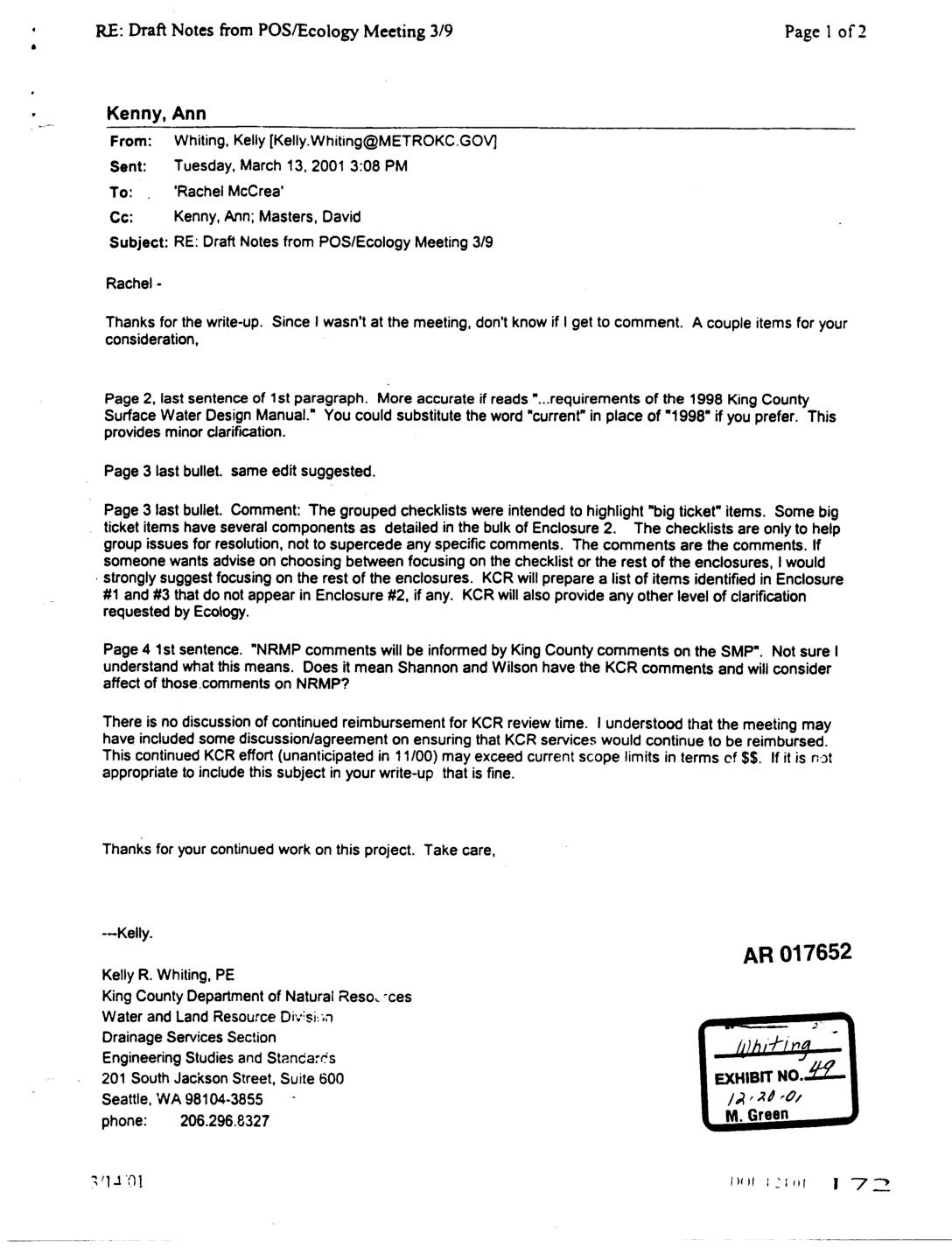
Exhibit 49: RE: Draft Notes from POS/Ecology Meeting 3/9
Email from Kelly R. Whiting (King County Department of Natural Resources, Water and Land Resource Division, Drainage Services Section) to Rachel McCrea (Floyd & Snider, Inc.), cc Ann Kenny and David Masters, dated March 13, 2001. Whiting provides editorial comments on draft meeting notes from a POS/Ecology 401 permit ‘process and logistics’ meeting held March -
 2000-10-20
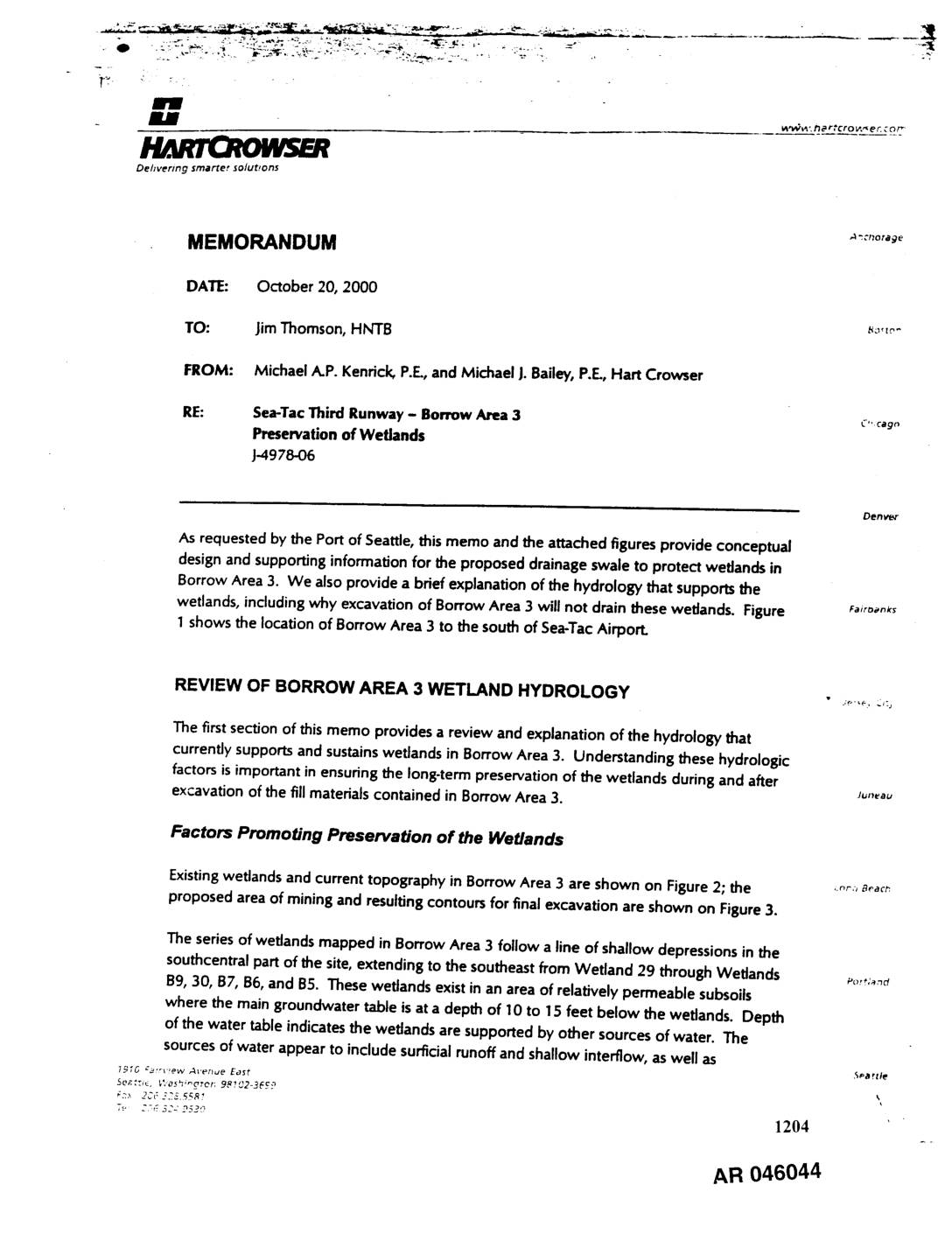
EXH AR046044: Sea-Tac Third Runway – Borrow Area 3 Preservation of Wetlands Memorandum
Memorandum dated October 20, 2000 from Michael A.P. Kenrick, P.E. and Michael J. Bailey, P.E. of Hart Crowser to Jim Thomson of HNTB regarding Sea-Tac Third Runway Borrow Area 3 wetland preservation, project J-4978-06, prepared for Port Of Seattle. Covers hydrology sustaining Wetlands 29, B9, 30, B7, B6, and B5 in Borrow Area 3, including -
 2000-10-13
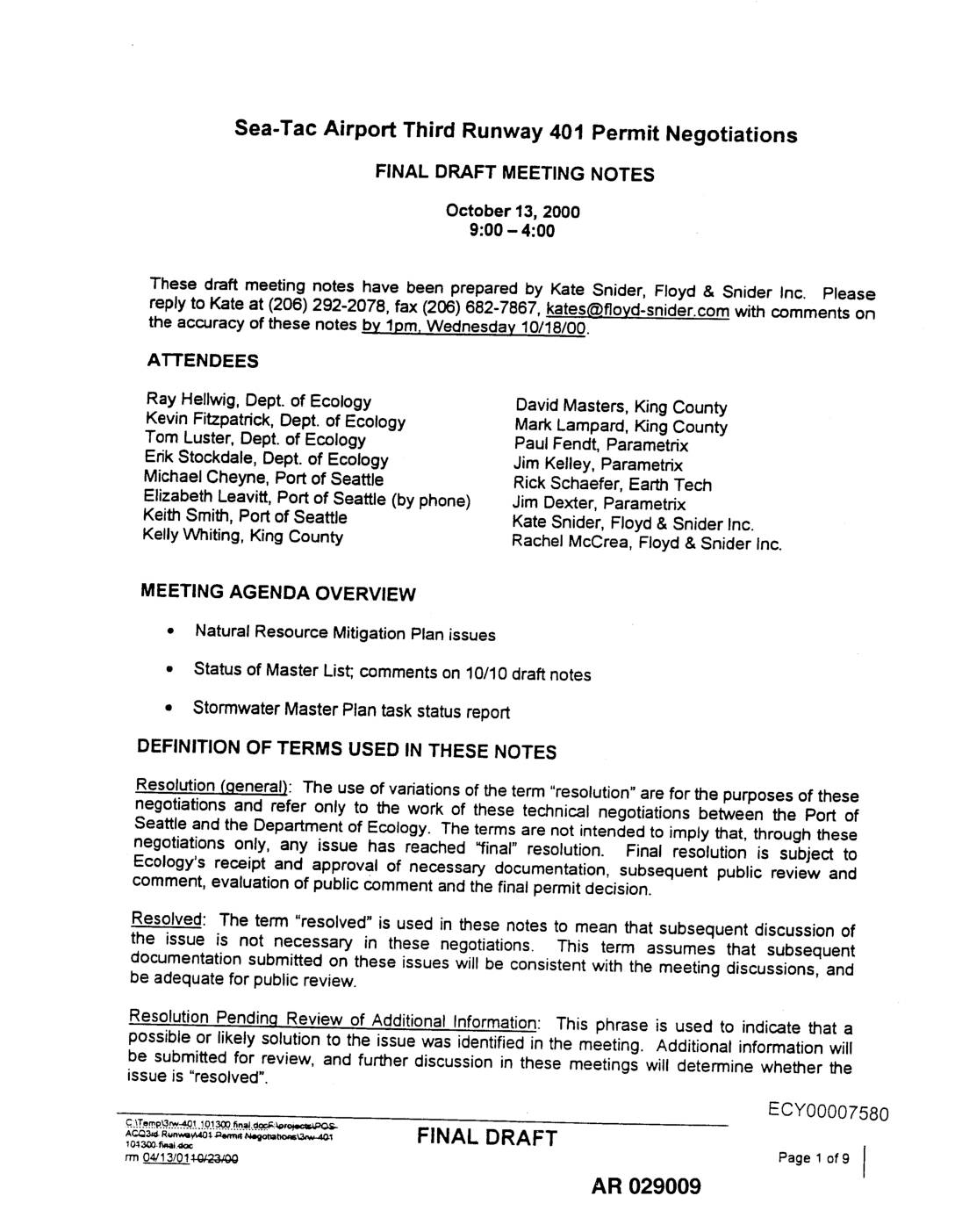
EXH AR029009: Sea-Tac Airport Third Runway 401 Permit Negotiations — Final Draft Meeting Notes, October 13, 2000
Final draft meeting notes prepared by Kate Snider of Floyd & Snider Inc. for the Sea-Tac Airport Third Runway 401 Permit Negotiations held October 13, 2000. Attendees include representatives from Washington State Department of Ecology (Ray Hellwig, Kevin Fitzpatrick, Tom Luster, Erik Stockdale), Port Of Seattle (Michael Cheyne, Elizabeth Leavitt, Keith Smith), King County (Kelly -
 2000-10-10
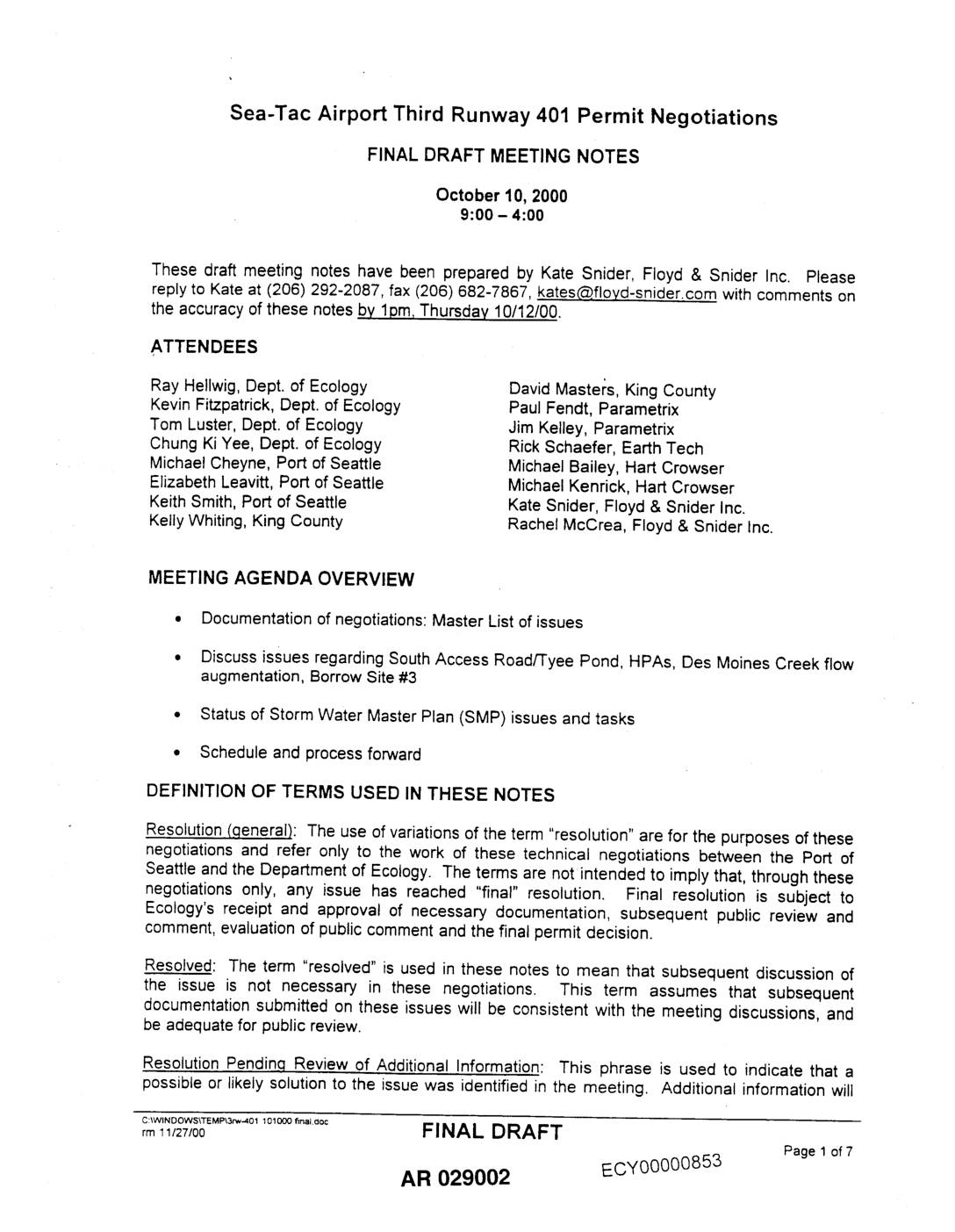
EXH AR029002: Sea-Tac Airport Third Runway 401 Permit Negotiations — Final Draft Meeting Notes, October 10, 2000
Final draft meeting notes prepared by Kate Snider of Floyd & Snider Inc. for the Sea-Tac Airport Third Runway Section 401 Permit Negotiations meeting held October 10, 2000, 9:00–4:00. Attendees included representatives from Washington State Department of Ecology (Ray Hellwig, Kevin Fitzpatrick, Tom Luster, Chung Ki Yee), Port Of Seattle (Michael Cheyne, Elizabeth Leavitt, Keith -
 2000-10-09
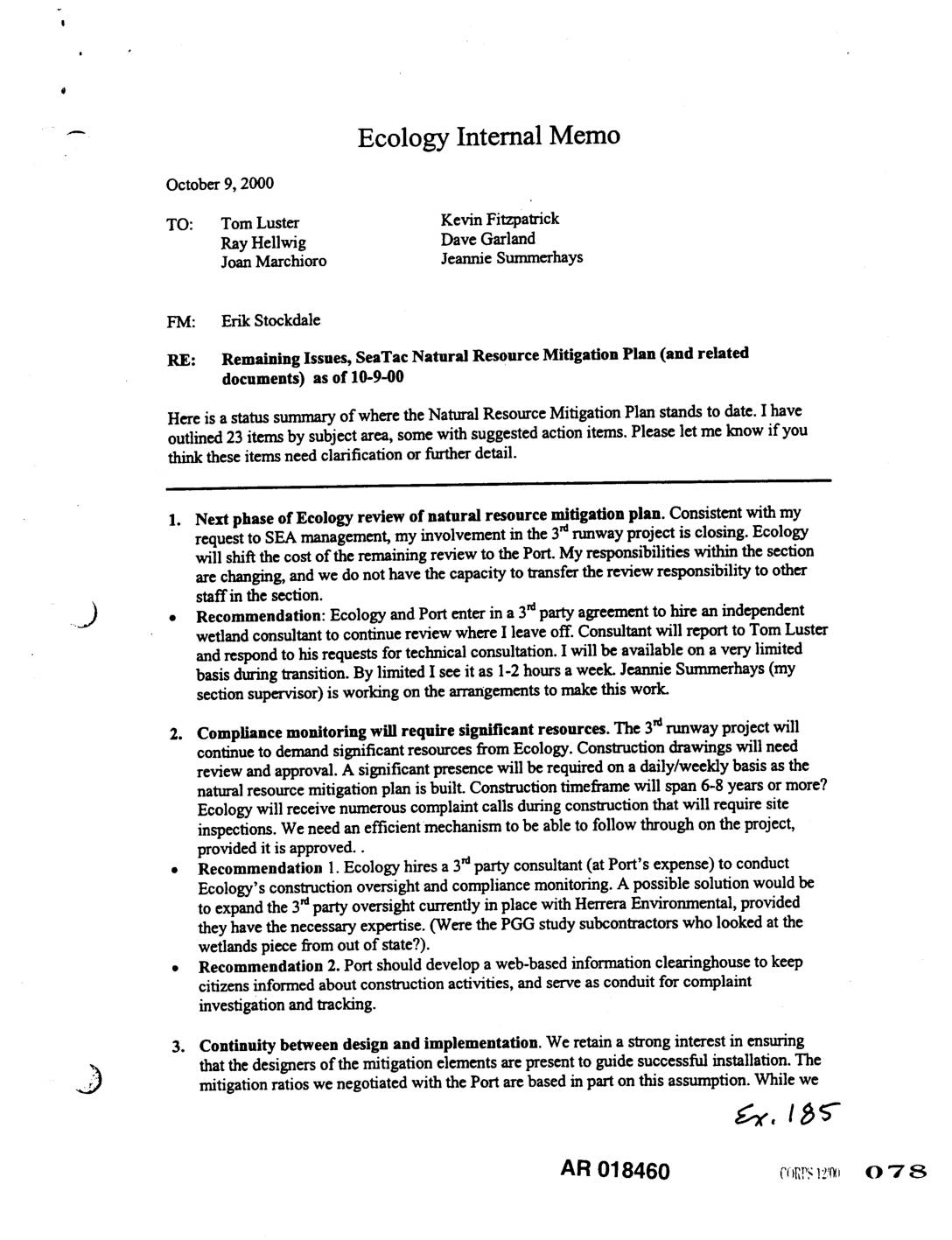
EXH AR018460: Ecology Internal Memo — Remaining Issues, Sea-Tac Natural Resource Mitigation Plan, October 9, 2000
Internal memo from Erik Stockdale (Ecology) to Tom Luster, Kevin Fitzpatrick, Ray Hellwig, Dave Garland, Joan Marchioro, and Jeannie Summerhays, dated October 9, 2000, summarizing 23 remaining issues with the SeaTac Natural Resource Mitigation Plan (NRMP) for the Third Runway project at Seattle-Tacoma International Airport. Topics include: Ecology review transition and 3rd party wetland consultant -
 2000-07-17
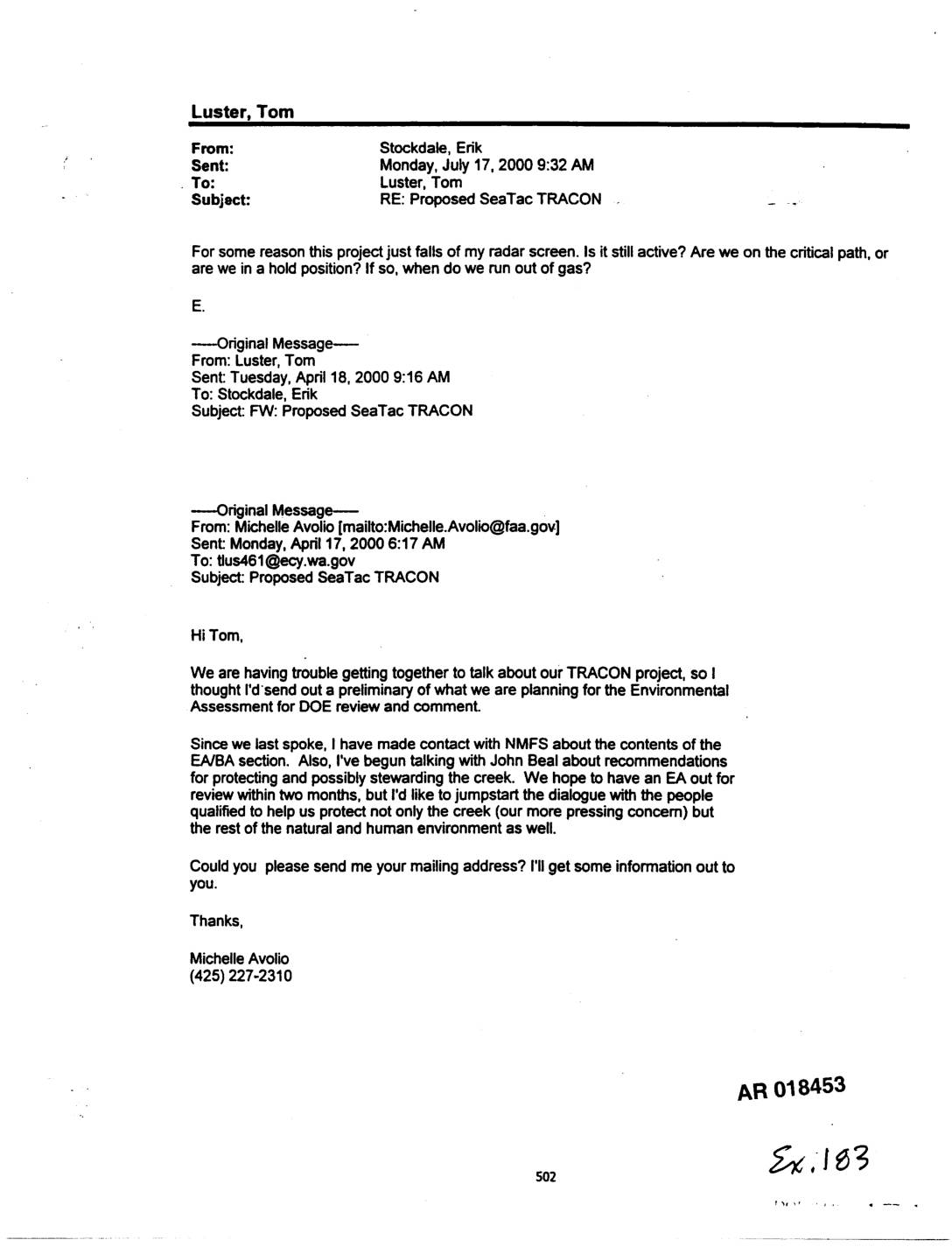
Exhibit 183: Email Chain RE: Proposed Sea-Tac TRACON — Stockdale, Luster, Avolio
Email chain (AR 018453) among Erik Stockdale, Tom Luster (Ecology, tlus461@ecy.wa.gov), and Michelle Avolio (FAA, Michelle.Avolio@faa.gov) regarding the proposed SeaTac TRACON project. Avolio’s April 17, 2000 email to Luster describes FAA planning for an Environmental Assessment (EA) and Biological Assessment (BA) for DOE review and comment, contact with NMFS regarding EA/BA section contents, and discussions -
 2000-06-15
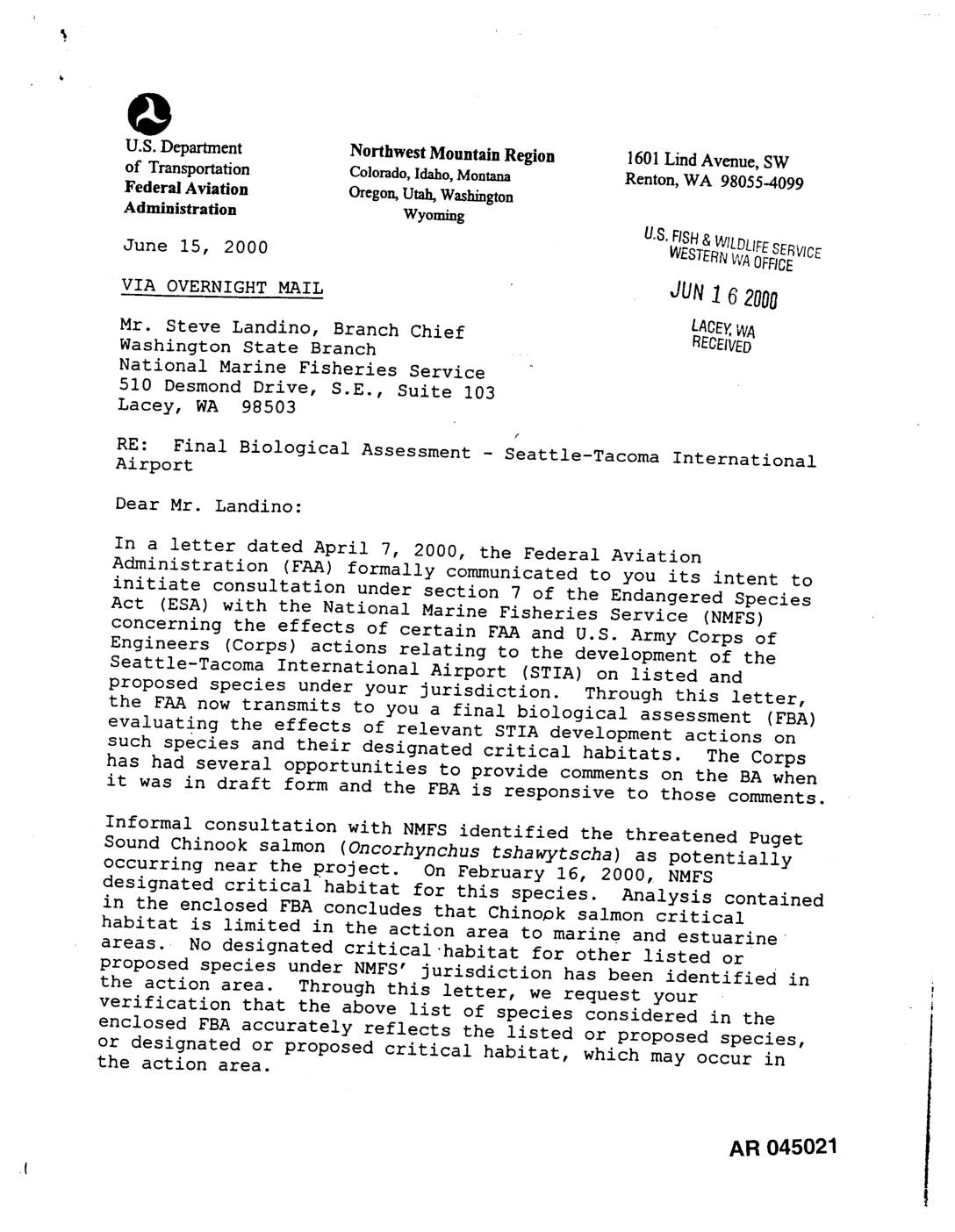
EXH AR045021: FAA Letter to NMFS Transmitting Final Biological Assessment for Seattle-Tacoma International Airport
Letter dated June 15, 2000 from Lowell H. Johnson, Manager of FAA Northwest Mountain Region Airports Division, to Steve Landino, Branch Chief of the Washington State Branch of the National Marine Fisheries Service (NMFS), transmitting the Final Biological Assessment (FBA) for Seattle-Tacoma International Airport (STIA) development actions under ESA section 7 consultation. The FBA evaluates -
 2000-05-23
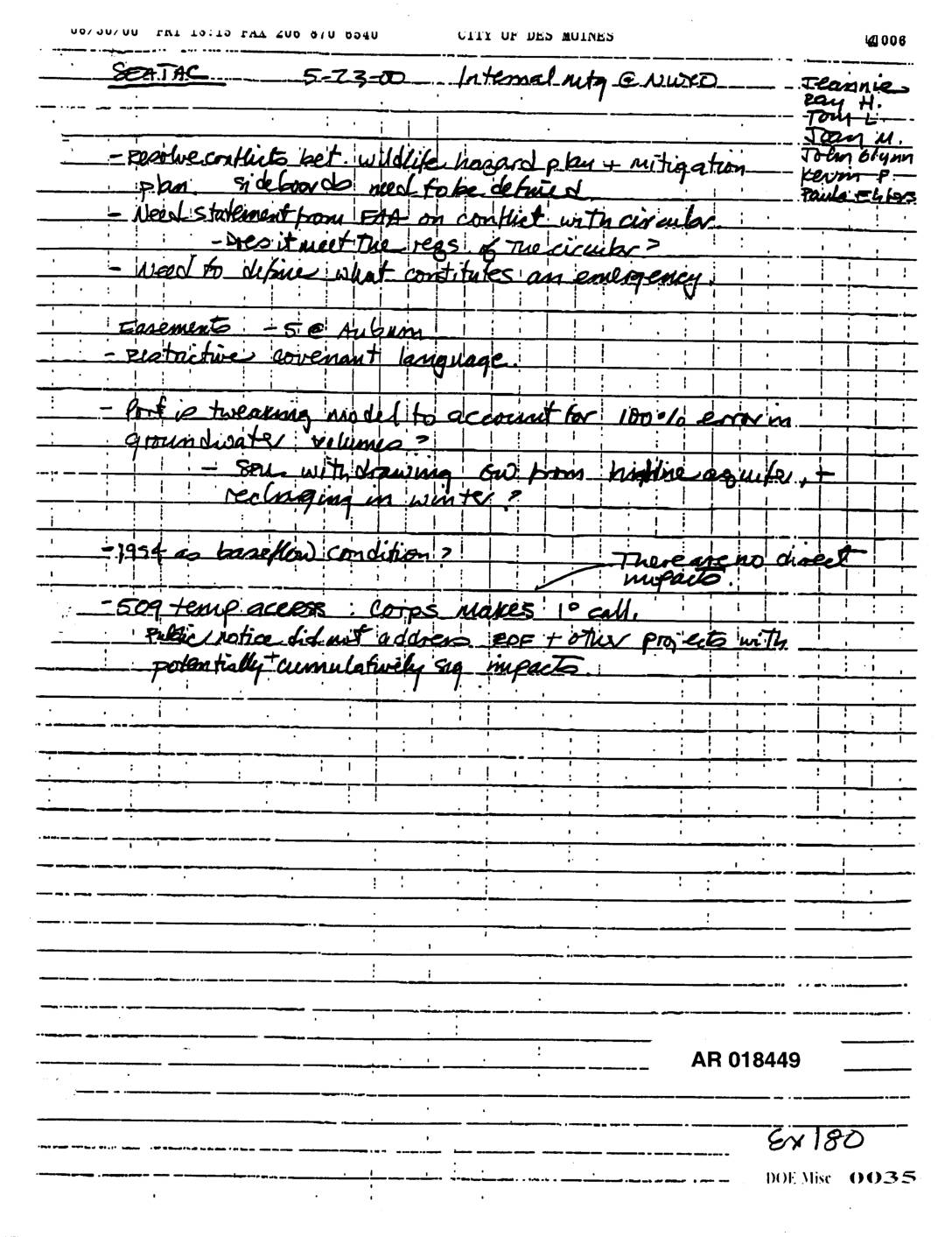
EXH AR018449: Sea-Tac Internal Meeting Notes — Wildlife Hazard Plan, Easements, Groundwater Model, Cumulative Impacts
Handwritten notes from a SeaTac internal meeting on 5-23-00 (AR 018449, Exhibit 180), attended by Jeannie, Ray H., Tom L., Joan M., John Glynn, Kevin P., and Paula Chlos. Topics include resolving conflicts between wildlife hazard plan and mitigation plan, sideboard definitions needed; need for ETA statement on conflict with circular and whether it meets -
 2000-05-22
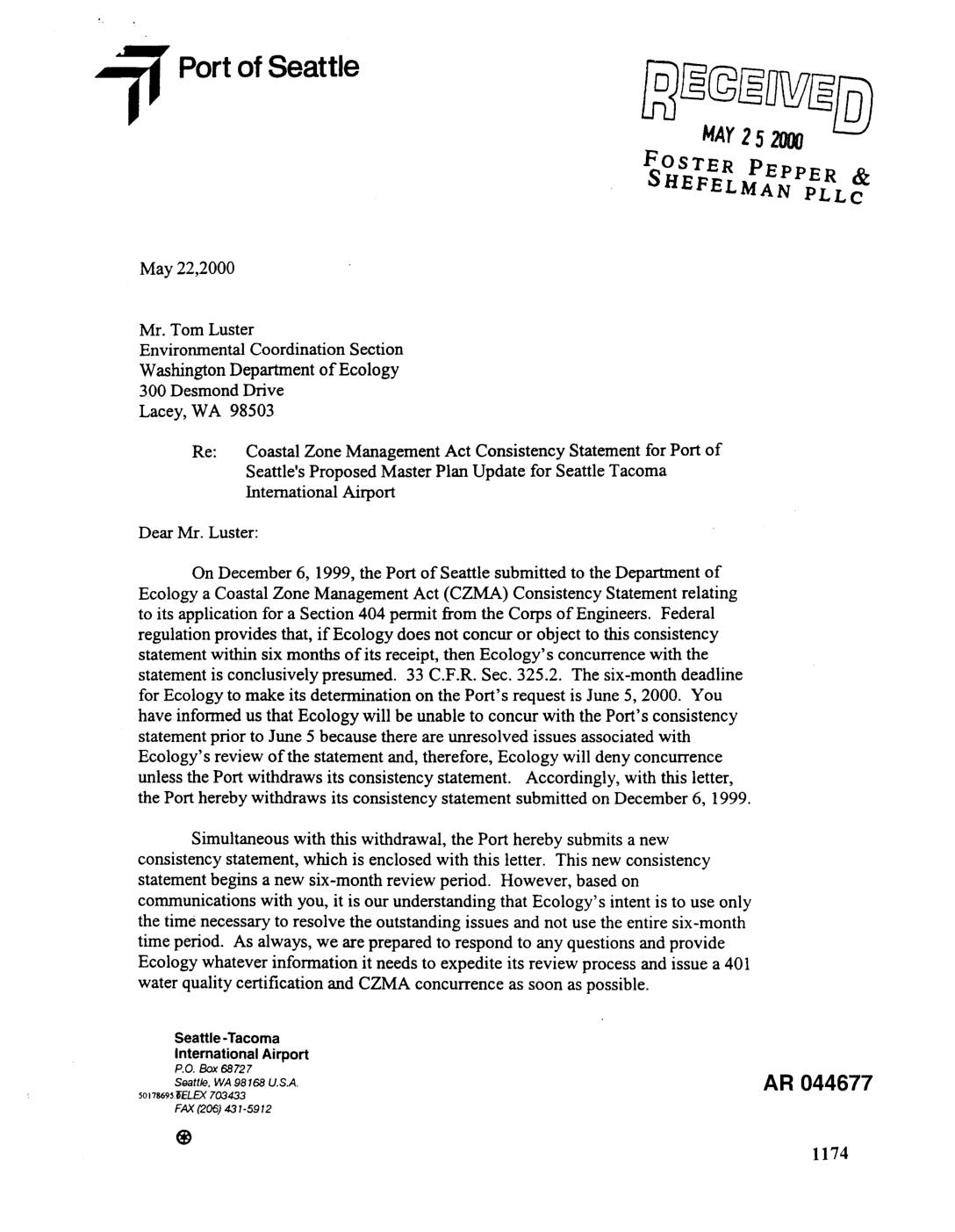
EXH AR044677: Port Of Seattle Letter Withdrawing and Resubmitting CZMA Consistency Statement for Sea-Tac Airport Third Runway
Letter dated May 22, 2000 from Elizabeth Leavitt, Manager of Aviation Environmental Programs at Port Of Seattle, to Tom Luster at Washington Department of Ecology (Environmental Coordination Section), withdrawing the December 6, 1999 CZMA Consistency Statement and simultaneously submitting a new one to reset the six-month review period under 33 C.F.R. Sec. 325.2. The withdrawal