TagEnvironmental Impact Statement(328)
-
 2001-04-30
EXH AR050083: Response to Comments — Master Plan Update Improvements at Seattle-Tacoma International Airport, Permit 1996-4-02325
Port of Seattle response to agency and public comments on Section 404 Clean Water Act permit application (JARPA, reference 1996-4-02325) for Master Plan Update improvements at Seattle-Tacoma International Airport. Covers U.S. Army Corps of Engineers public notice history (December 19, 1997; September 30, 1999; December 27, 2000), wetland fill acreages, Miller Creek channel relocation, Highline -
 2001-04-30
EXH AR050378: Response to Comments — Master Plan Update Improvements at Seattle-Tacoma International Airport, Permit 1996-4-02325
Port Of Seattle response to agency and public comments on Section 404 Clean Water Act permit application (JARPA, permit 1996-4-02325) for Master Plan Update improvements at Seattle-Tacoma International Airport. Document AR050378 covers comments received following the December 27, 2000 second revised public notice issued by the U.S. Army Corps of Engineers. Responds to Tom Luster, -
 2001-04-23
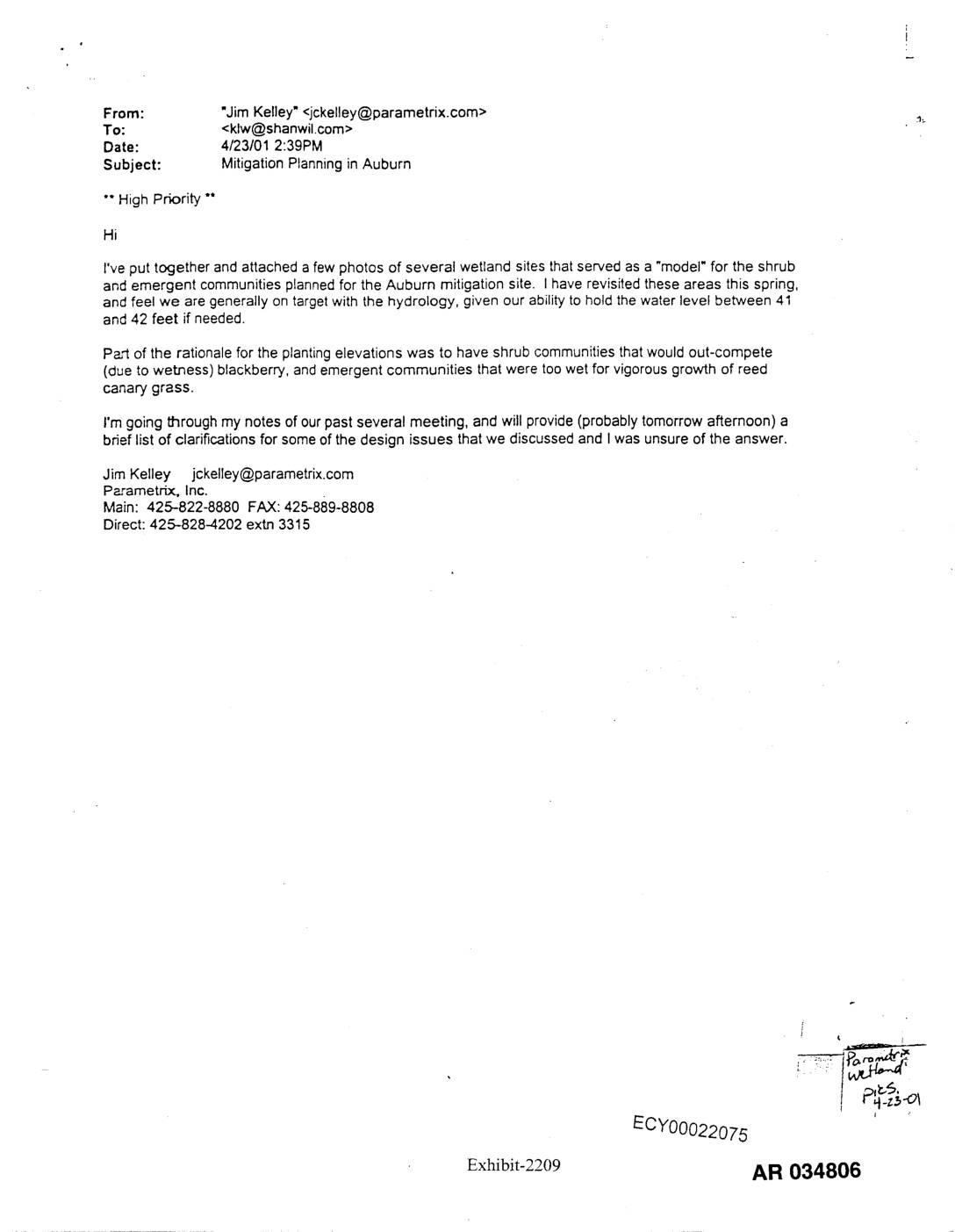
Exhibit 2209: Email and Photos — Mitigation Planning in Auburn, STIA Master Plan Update Improvements
Email from Jim Kelley (Parametrix, Inc.) to klw@shanwil.com dated April 23, 2001, regarding wetland mitigation planning for the Auburn mitigation site associated with Seattle-Tacoma International Airport Master Plan Update Improvements. Kelley discusses shrub and emergent plant community design, water level management between 41 and 42 feet, planting elevations to out-compete blackberry and reed canary grass, -
 2001-03-22
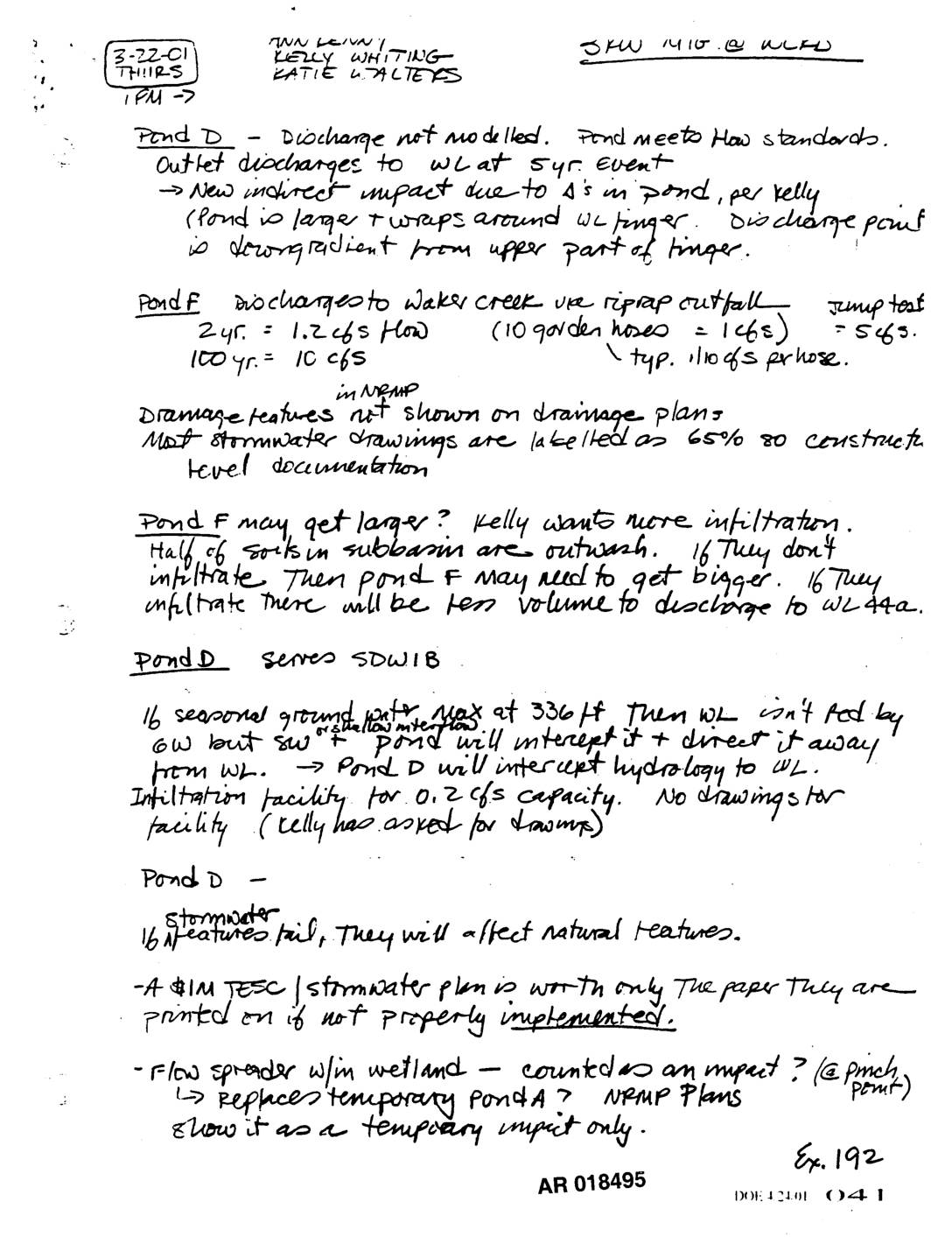
Exhibit 192: Handwritten Meeting Notes on Stormwater Ponds D, F, and G — Wetland Hydrology and Drainage
Handwritten meeting notes dated 3-22-01 (AR 018495–018497, Exhibit 192) from a meeting involving Kelly Whiting, Katie Walters, and others (SKW MIG at WLRD). Notes cover Pond D (discharge not modelled, meets flow standards, indirect impacts to wetlands, SDW1B, seasonal groundwater at 336 ft, infiltration facility 0.2 cfs), Pond F (discharges to Walker Creek via riprap -
 2001-03-01
EXH AR049873: Essential Fish Habitat Assessment — Master Plan Update Improvements, STIA
Essential Fish Habitat (EFH) Assessment prepared by Parametrix, Inc. for the Federal Aviation Administration and Port Of Seattle for Master Plan Update Improvements at Seattle-Tacoma International Airport (STIA), March 2001. Document AR049873 (project 556-2912-001) evaluates Pacific Coast salmon EFH — Chinook, Coho, and Puget Sound Pink salmon — in Miller Creek Basin, Des Moines Creek -
 2001-03-01
EXH AR050023: Draft Conceptual Reclamation Permit Package, Borrow Areas 3 and 4, Sea-Tac International Airport
Draft Conceptual Reclamation Permit Package for Borrow Areas 3 and 4 at Sea-Tac International Airport, City of SeaTac, Washington. Prepared by Hart Crowser for Port Of Seattle for presentation to the Washington Department of Natural Resources (DNR), March 1, 2001, project J-4978-62. Document covers site preparation activities, mining practices, operating plan, conceptual reclamation plan, revegetation -
 2001-02-14
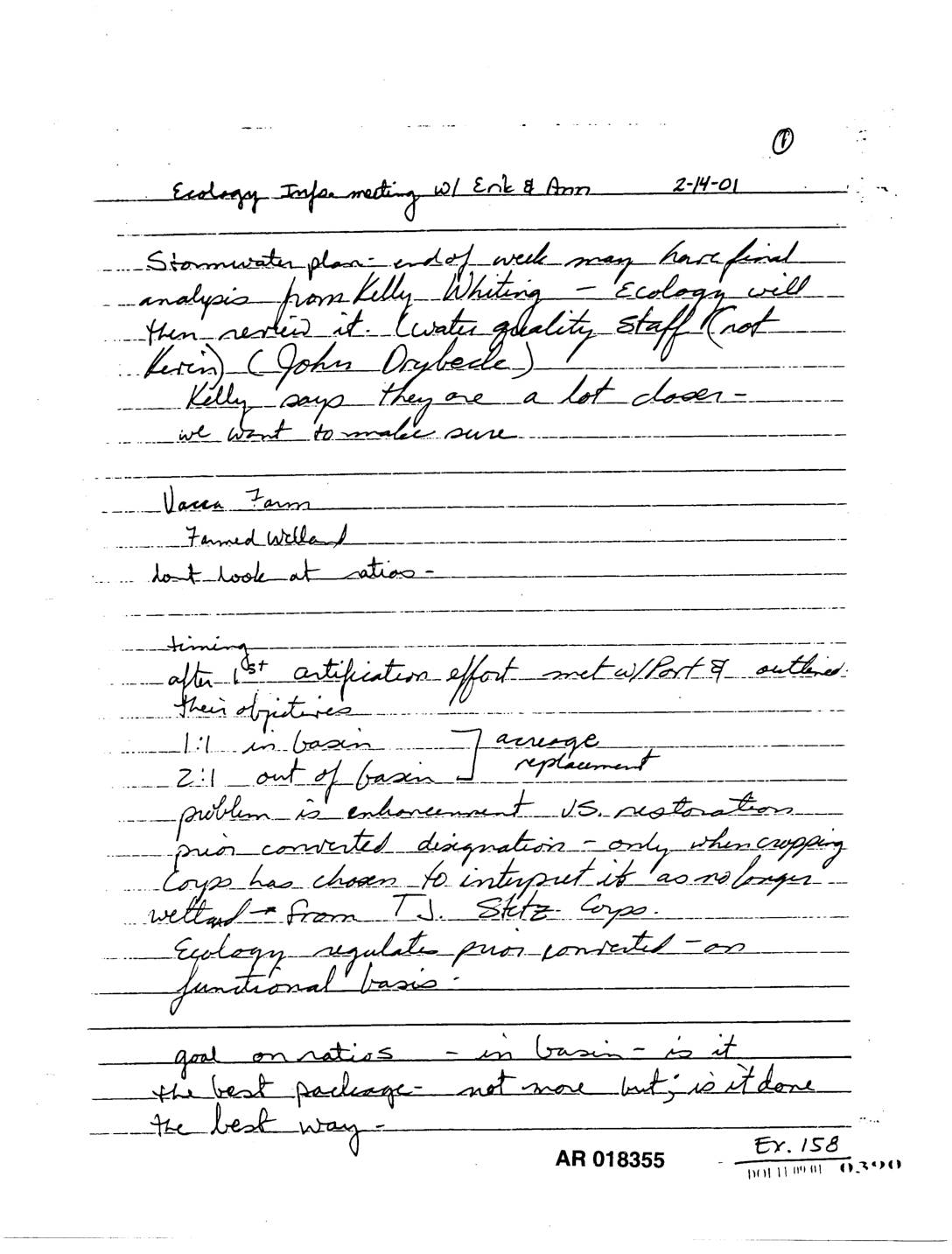
Exhibit 158: Ecology Informational Meeting Notes with Erik and Ann, 2-14-01
Handwritten notes from an Ecology informational meeting with Erik and Ann dated February 14, 2001 (AR 018355-018357). Topics include stormwater plan analysis from Kelly Whiting and John Drybeck (water quality staff), Vasen Farm farmed wetland ratios (1:1 in-basin acreage, 2:1 out-of-basin replacement), enforcement vs. restoration, prior converted designation, Corps of Engineers wetland determinations, 509 overpass, -
 2000-12-08
EXH AR049771: Third Runway Project, Borrow Areas 1, 3, and 4 — Projected Impacts to Wetlands (Revised)
Memorandum from Reese P. Hastings and Michael J. Bailey, P.E., Hart Crowser, Inc. to Ralph Wessels, Port Of Seattle, dated December 8, 2000, quantifying potential impacts to wetland resources from development of Borrow Areas 1, 3, and 4 and an on-site haul route for the Third Runway embankment at Sea-Tac Airport. Document J-4978-62 details 17 -
 2000-12-01
EXH AR049788: Supplement Biological Assessment — Master Plan Update Improvements, Seattle-Tacoma International Airport
Supplement Biological Assessment prepared by Parametrix, Inc. (December 2000) for the Federal Aviation Administration and Port Of Seattle for reinitiation and initiation of ESA Section 7 consultation on STIA Master Plan Update Improvements. AR 049788. Document covers hydrologic impacts and mitigation for Miller Creek, Walker Creek, and Des Moines Creek watersheds, including stormwater detention facility -
 2000-12-01
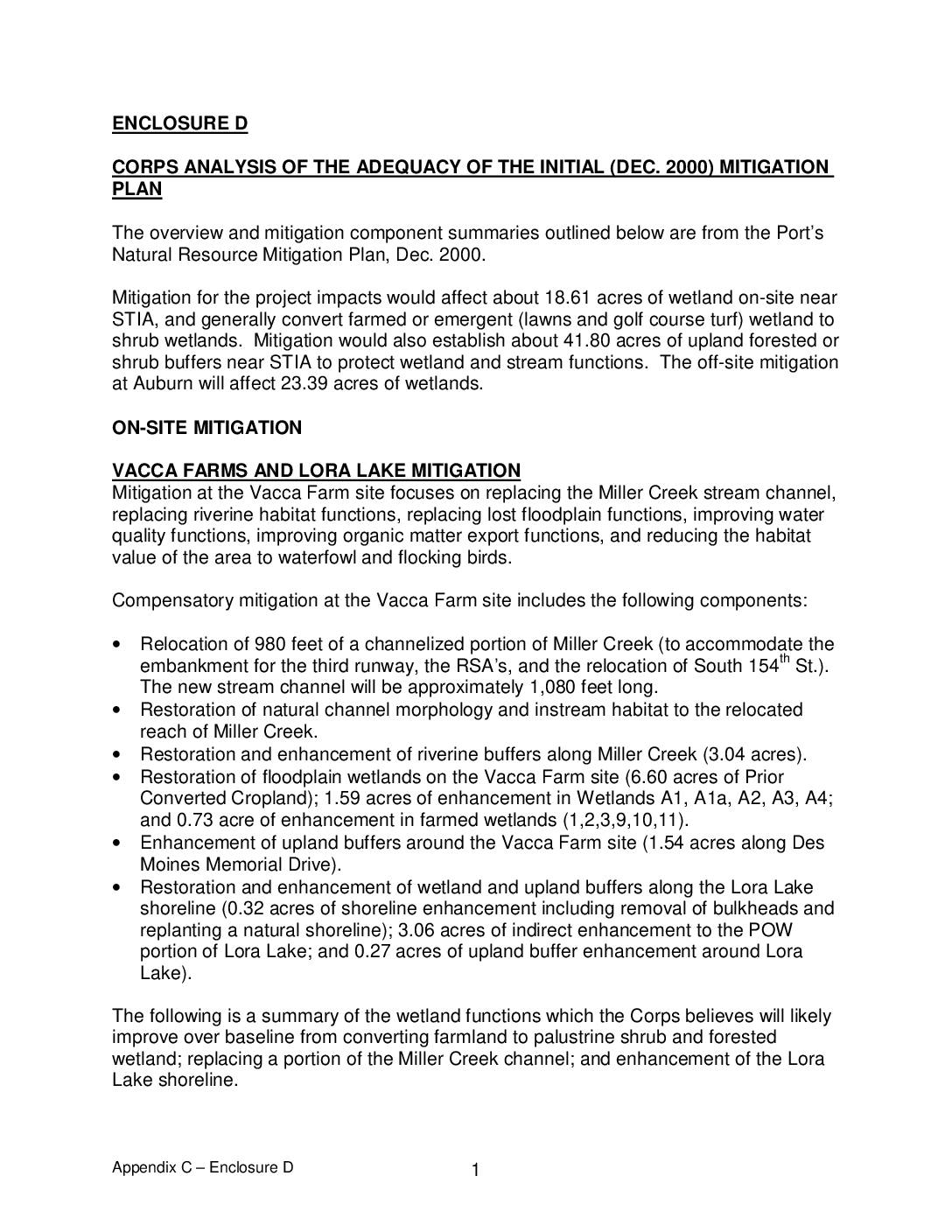
Corps analysis of the adequacy of the initial (Dec. 2000) mitigation plan
This document outlines the U.S. Army Corps of Engineers' analysis of a December 2000 mitigation plan developed by the Port of Seattle to offset wetland impacts caused by the construction of a third runway at Seattle-Tacoma International Airport. The plan covers roughly 18.6 acres of on-site wetland restoration near the airport—including the relocation of a stretch of Miller Creek and improvements to Lora Lake's shoreline—as well as 23.39 acres of off-site wetland mitigation in Auburn. Key goals include improving water quality, restoring floodplain and fish habitat, and managing vegetation to reduce wildlife hazards such as bird strikes near the airfield.