TagEnvironmental Impact Statement(328)
-
 2000-10-20
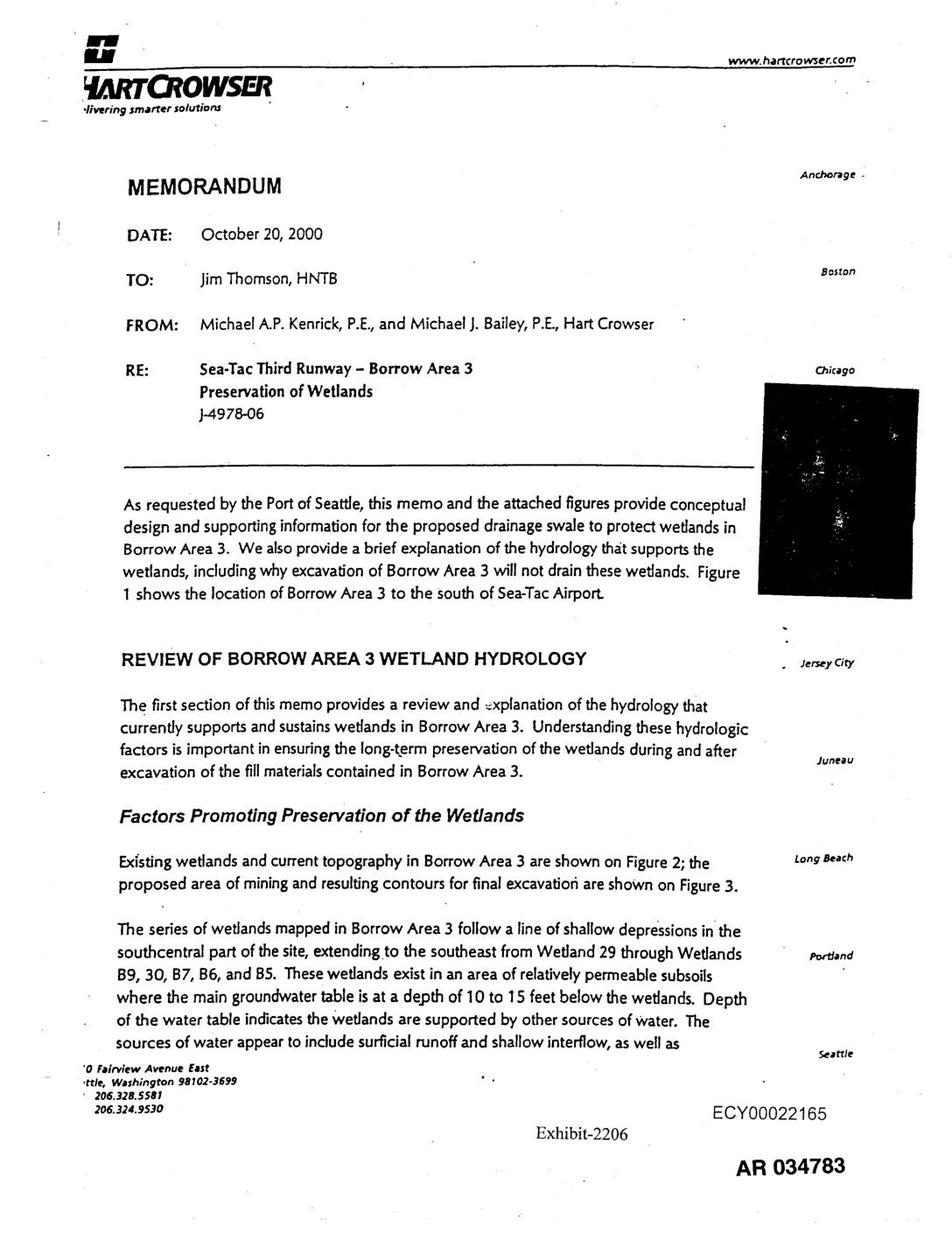
Exhibit 2206: Hart Crowser Memorandum on Sea-Tac Third Runway Borrow Area 3 Wetland Preservation
Memorandum dated October 20, 2000 from Michael A.P. Kenrick, P.E. and Michael J. Bailey, P.E. of Hart Crowser to Jim Thomson at HNTB Boston, regarding Sea-Tac Third Runway Borrow Area 3 wetland preservation (project J-4978-06). Document provides conceptual design for a proposed drainage swale to protect wetlands in Borrow Area 3 located south of Sea-Tac -
 2000-10-20
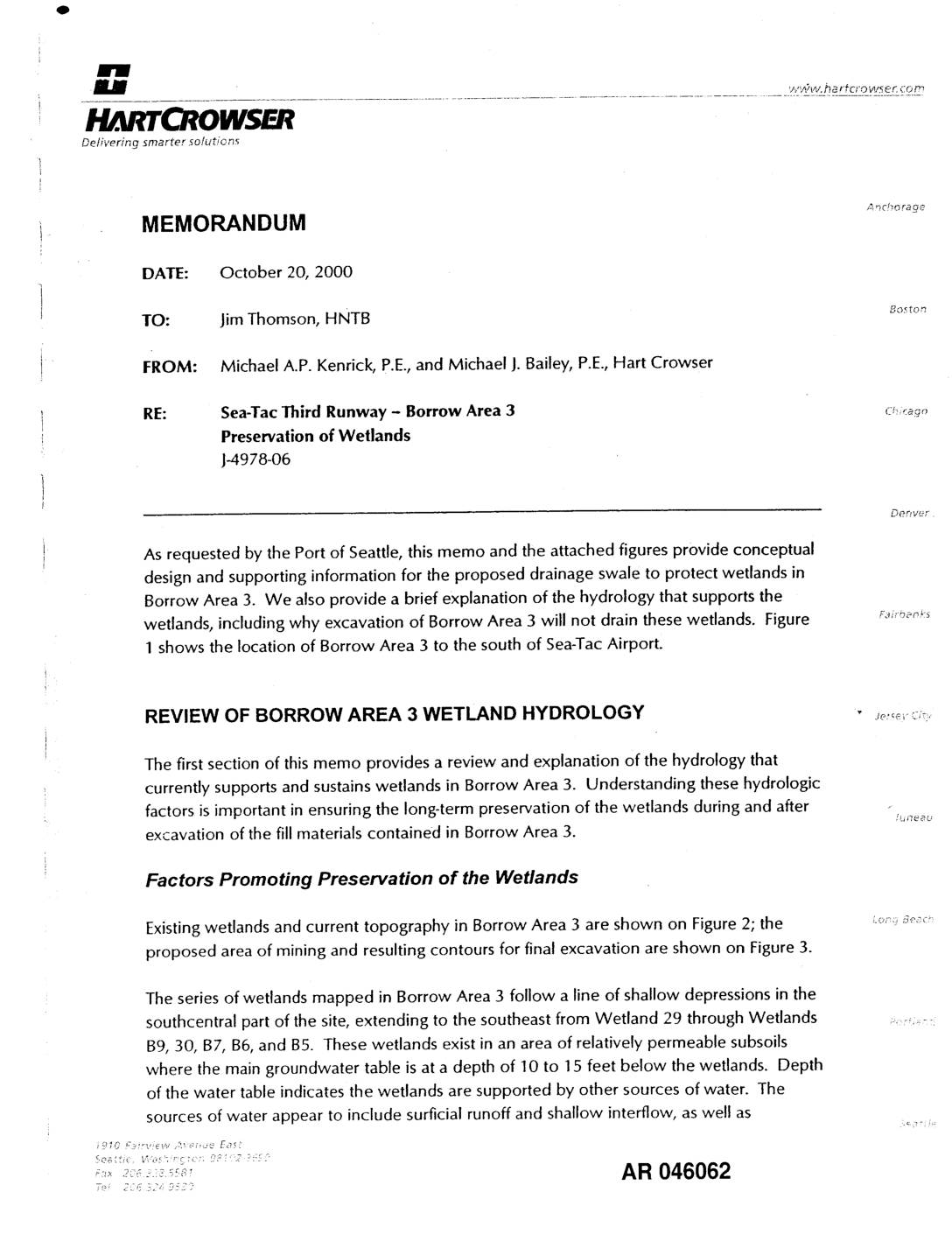
EXH AR046062: Hart Crowser Memorandum — Sea-Tac Third Runway Borrow Area 3 Preservation of Wetlands
Memorandum dated October 20, 2000 from Michael A.P. Kenrick, P.E., and Michael J. Bailey, P.E. of Hart Crowser to Jim Thomson at HNTB (project J-4978-06), prepared for Port Of Seattle regarding Sea-Tac Third Runway Borrow Area 3 wetland preservation. Reviews hydrology sustaining Wetlands 29, B9, 30, B7, B6, and B5 in Borrow Area 3, located -
 2000-10-13
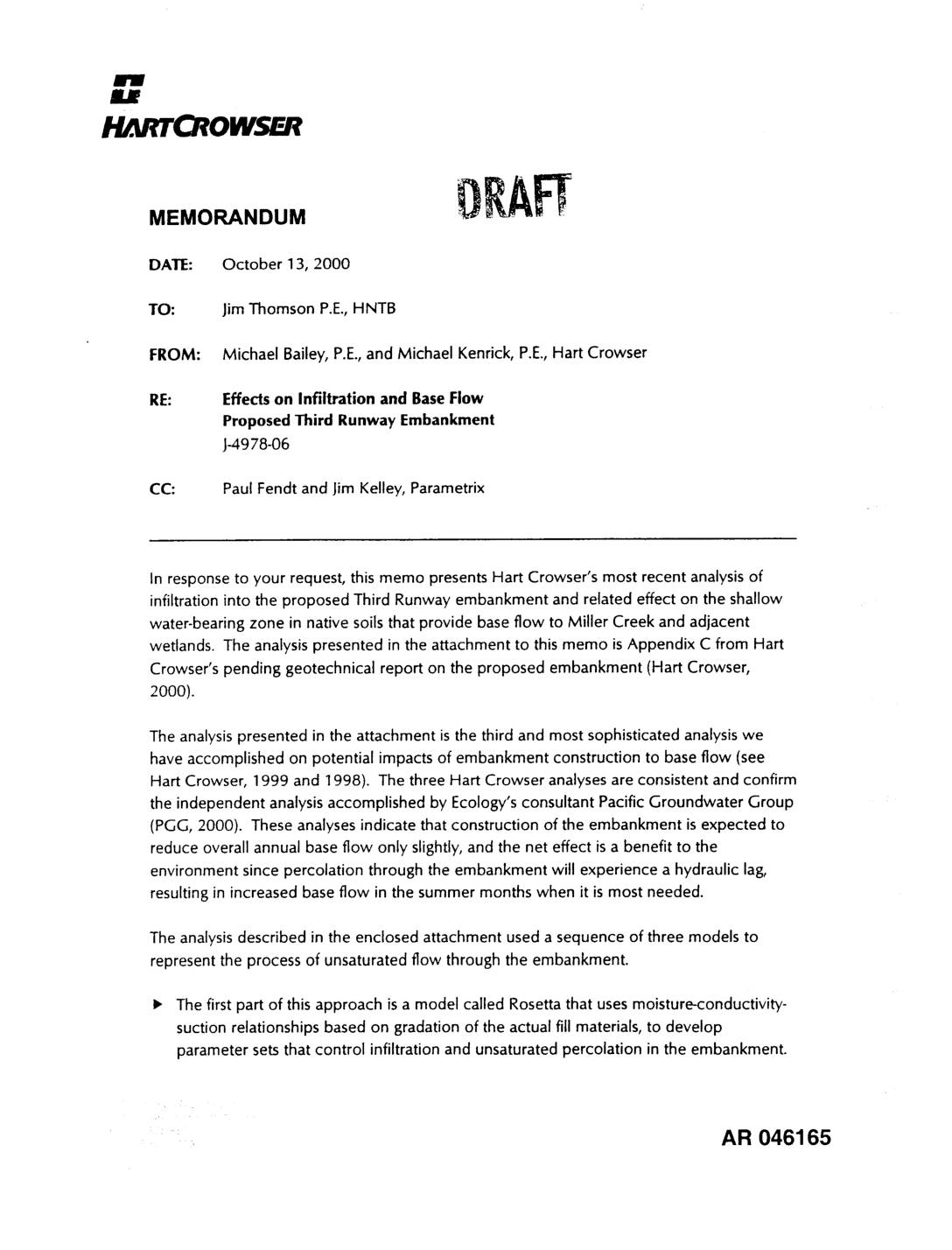
EXH AR046165: Hart Crowser Memorandum — Effects on Infiltration and Base Flow, Proposed Third Runway Embankment
Memorandum dated October 13, 2000 from Michael Bailey P.E. and Michael Kenrick P.E. of Hart Crowser to Jim Thomson P.E. at HNTB (project J-4978-06), analyzing infiltration into the proposed Third Runway embankment at Sea-Tac Airport and effects on shallow water-bearing zone base flow to Miller Creek and adjacent wetlands. Analysis uses three sequential models — -
 2000-10-11
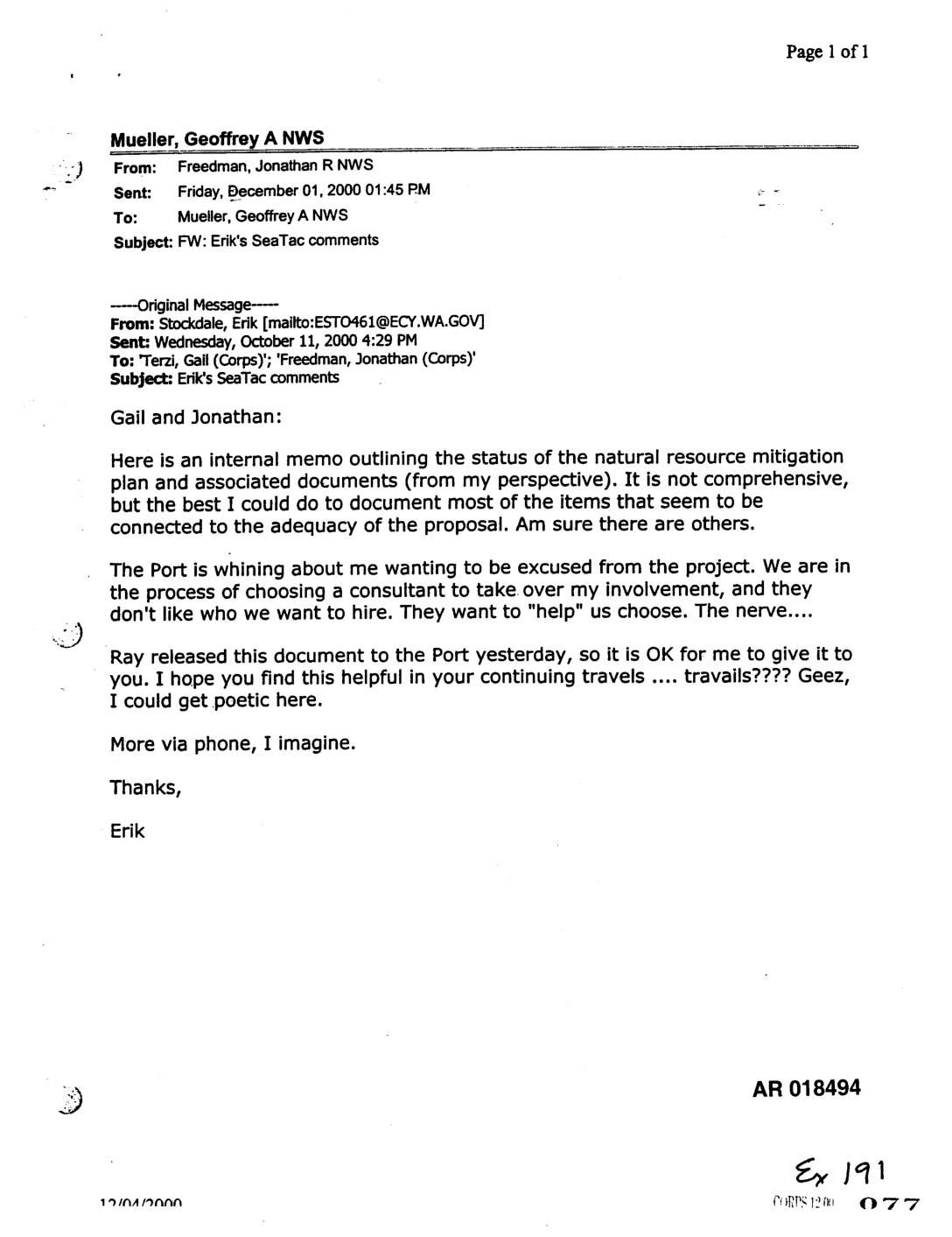
Exhibit 191: Email Chain Forwarding Erik Stockdale’s Sea-Tac Natural Resource Mitigation Plan Comments
Email chain AR 018494 in which Erik Stockdale (Washington State Department of Ecology, ESTO461@ECY.WA.GOV) sends internal memo to Gail Terzi and Jonathan Freedman (Army Corps of Engineers) outlining status of the natural resource mitigation plan and associated documents for Sea-Tac Airport expansion. Stockdale notes the Port of Seattle is objecting to Ecology’s choice of consultant -
 2000-08-09
EXH AR045601: Evaluation of Perched Zone Interception and Possible Impacts to Wetland Hydrology, Borrow Area 3, Sea-Tac Third Runway
Hart Crowser draft report prepared for Port of Seattle, August 9, 2000 (J-4978-13), evaluating perched groundwater zone interception and potential wetland hydrology impacts from Borrow Area 3 excavation for the Sea-Tac Third Runway project. Addresses Pacific Groundwater Group (PGG, 2000) concerns commissioned by Washington State Department of Ecology regarding impacts to Wetland 29. Includes ModFlow -
 2000-06-01
EXH AR044681: Biological Assessment — Master Plan Update Improvements, STIA
Biological Assessment prepared by Parametrix, Inc. for the Federal Aviation Administration and Port Of Seattle regarding reinitiation and initiation of Section 7 ESA consultation for Seattle-Tacoma International Airport Master Plan Update Improvements. Covers ESA-listed species managed by USFWS and NMFS including Chinook salmon, bull trout, and essential fish habitat (EFH). Analyzes hydrologic systems including Miller -
 2000-05-05
EXH AR044544: SEPA Addendum — Auburn Wetland Mitigation Project, Port Of Seattle Master Plan Update, STIA
Port Of Seattle SEPA Addendum (POS SEPA No. 00-07) dated May 5, 2000, to the Final Supplemental Environmental Impact Statement for the Proposed Master Plan Update Development Actions at Seattle-Tacoma International Airport (STIA), issued jointly by FAA and Port Of Seattle in May 1997. Documents the Auburn Wetland Mitigation Project on an approximately 67-acre parcel -
 2000-05-03
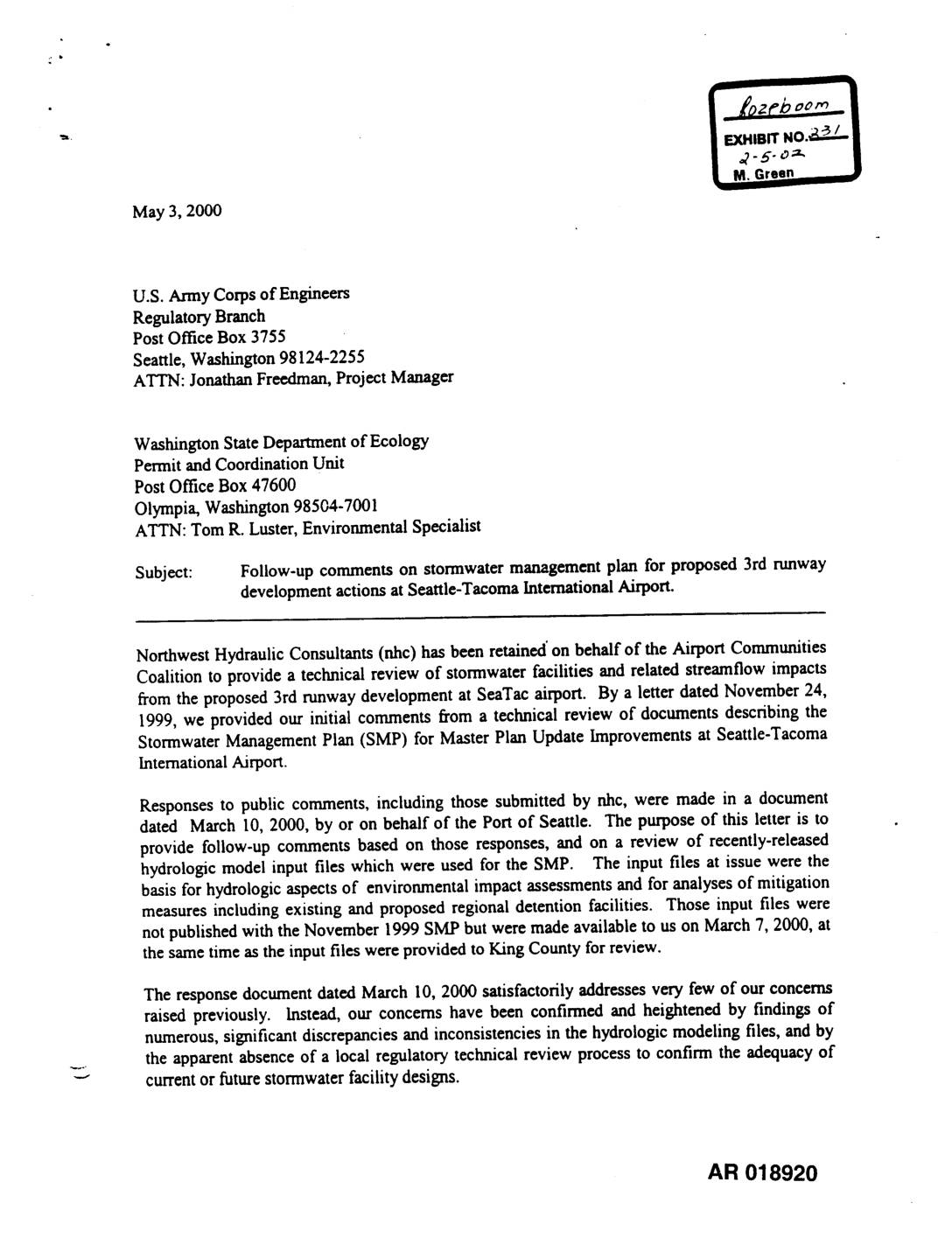
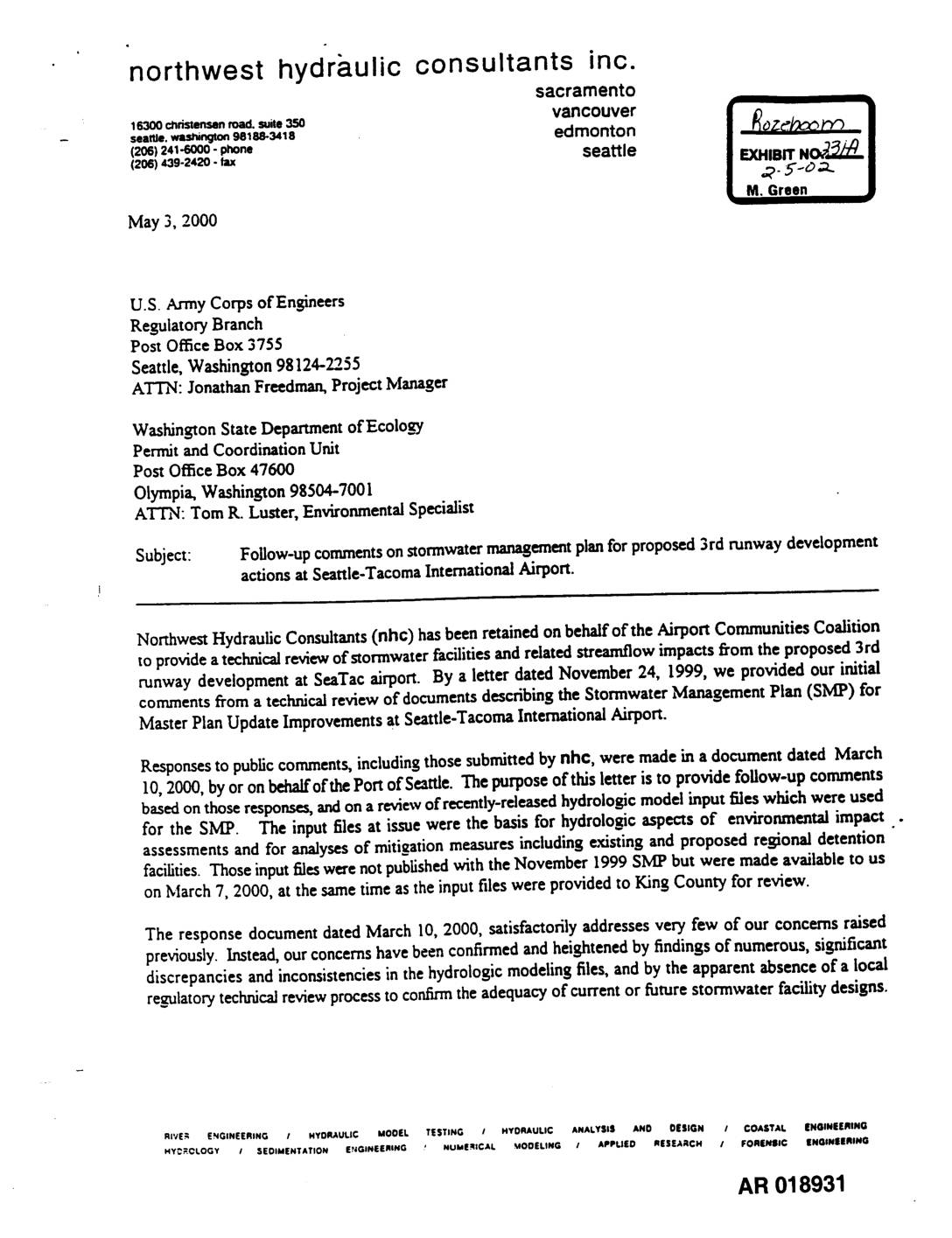
Exhibit 231: Follow-Up Comments by Northwest Hydraulic Consultants on Stormwater Management Plan for Proposed Third Runway at Sea-Tac Airport
Northwest Hydraulic Consultants submitted follow-up technical comments in May 2000 raising serious concerns about flawed stormwater modeling used to assess the impact of a proposed third runway at Seattle-Tacoma International Airport. The consultants identified major inconsistencies in soil-type assumptions and runoff parameters in the hydrologic models, concluding that the Stormwater Management Plan's predictions of detention facility performance were unreliable and required a complete overhaul. The letter also flagged a lack of adequate local regulatory oversight to ensure that Port of Seattle stormwater designs complied with King County surface water standards. -
 2000-05-03
Exhibit AR018931: NHC Follow-Up Comments on Stormwater Management Plan for Proposed Third Runway Development at Seattle-Tacoma International Airport
A technical review by Northwest Hydraulic Consultants, submitted to the U.S. Army Corps of Engineers and Washington State Department of Ecology in May 2000, raises serious concerns about the stormwater management plan for Seattle-Tacoma International Airport's proposed third runway. The report identifies major flaws in the hydrologic modeling used to assess drainage impacts, including inconsistent soil-type assumptions and unreliable flow predictions for Miller Creek. The consultants call for a complete overhaul of the modeling process, independent technical review, and clearer regulatory oversight of the Port of Seattle's stormwater design work. -
 2000-03-01
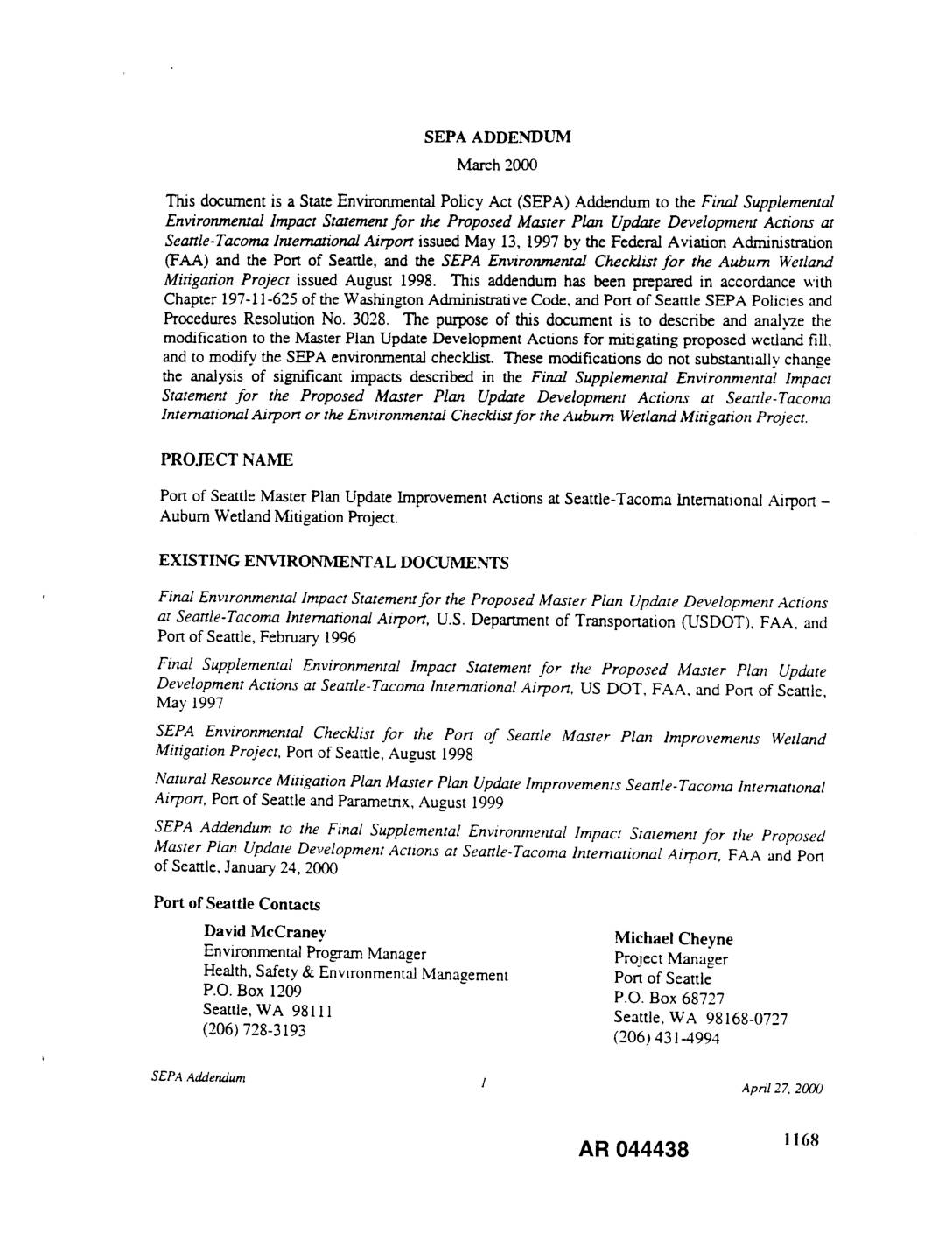
EXH AR044438: SEPA Addendum — Port Of Seattle Master Plan Update, Auburn Wetland Mitigation Project, STIA
SEPA Addendum (April 27, 2000) prepared by Port Of Seattle and FAA as addendum to the Final Supplemental Environmental Impact Statement for the Proposed Master Plan Update Development Actions at Seattle-Tacoma International Airport (STIA), and to the SEPA Environmental Checklist for the Auburn Wetland Mitigation Project (August 1998). Documents modification to Master Plan Update wetland