TagBoeing Field(54)
-
 2006-02-27
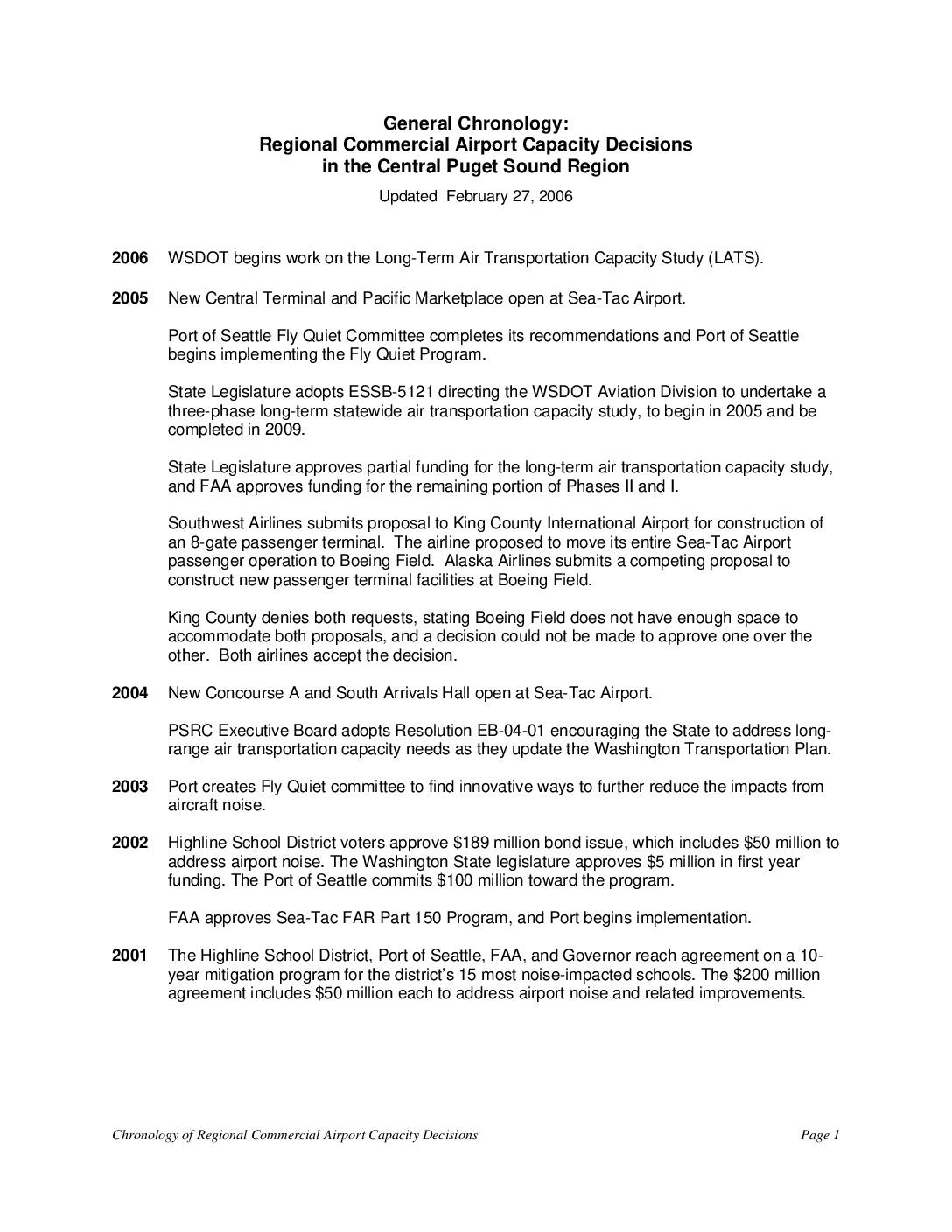
PSRC General chronology: Regional commercial airport capacity decisions in the Central Puget Sound Region
This document traces the history of commercial airport capacity and noise policy decisions in the Central Puget Sound region from 1973 to 2006, focusing on Sea-Tac Airport. It covers key milestones such as the Port of Seattle's various noise mitigation programs, agreements with the Highline School District, and debates over building a third runway and expanding Boeing Field. The chronology highlights the ongoing tension between meeting growing air travel demand and addressing the noise impacts on surrounding communities and schools. -
 2005-10-11
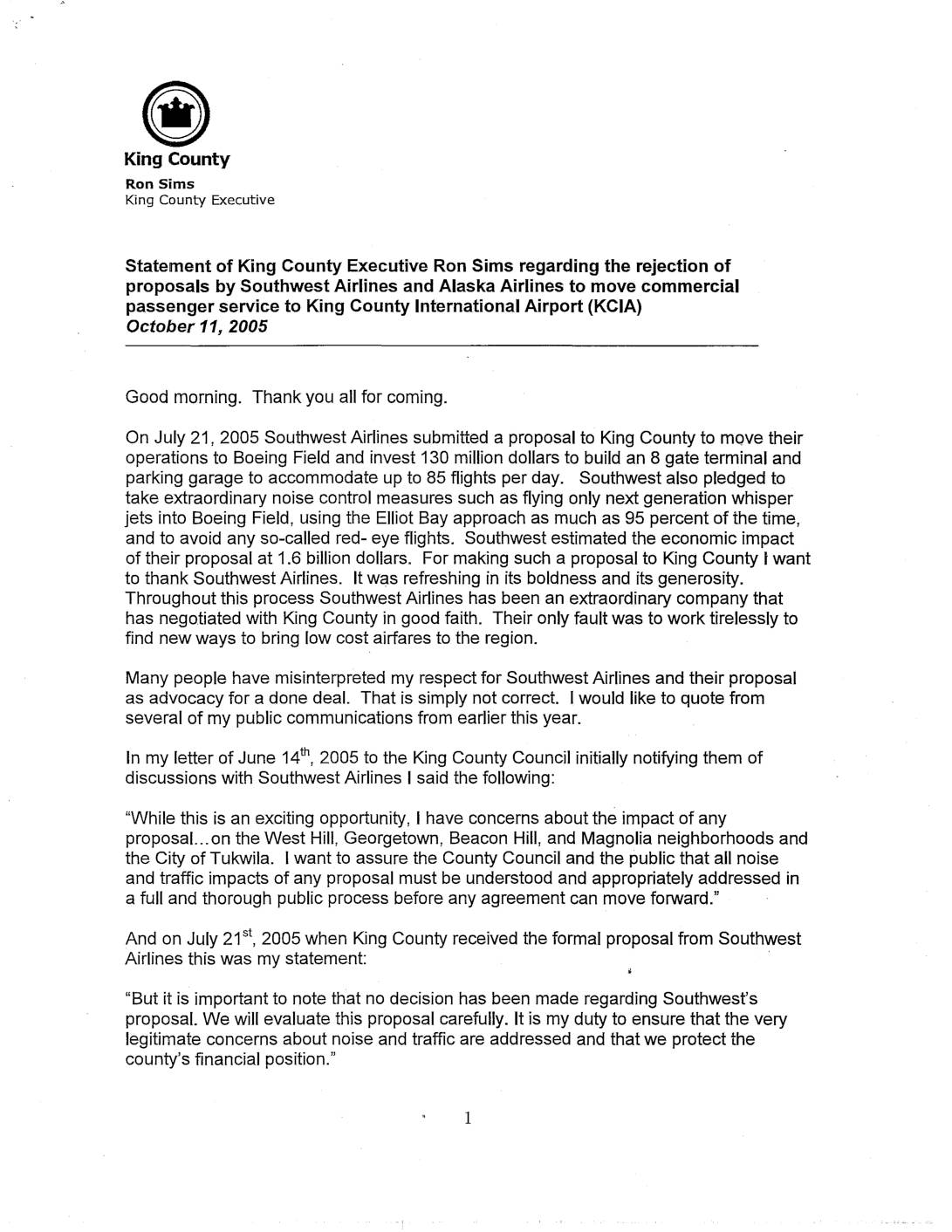
Statement of King County Executive Ron Sims Regarding the Rejection of Proposals by Southwest Airlines and Alaska Airlines to Move Commercial Passenger Service to King County International Airport (KCIA)
In October 2005, King County Executive Ron Sims rejected proposals from Southwest Airlines and Alaska Airlines to move commercial passenger service to Boeing Field (King County International Airport). Southwest had proposed an $130 million, 8-gate terminal for up to 85 flights per day, while Alaska Airlines followed with a $150 million proposal for up to 100 flights per day, but the competing proposals together would have required costly environmental review, significant public funding, and were projected to cause major noise and traffic impacts on surrounding neighborhoods. Sims concluded that while either proposal alone might have been feasible, accommodating both was impossible under his criteria of no taxpayer subsidies and no significant noise or traffic harm to communities. -
 2005-07-26
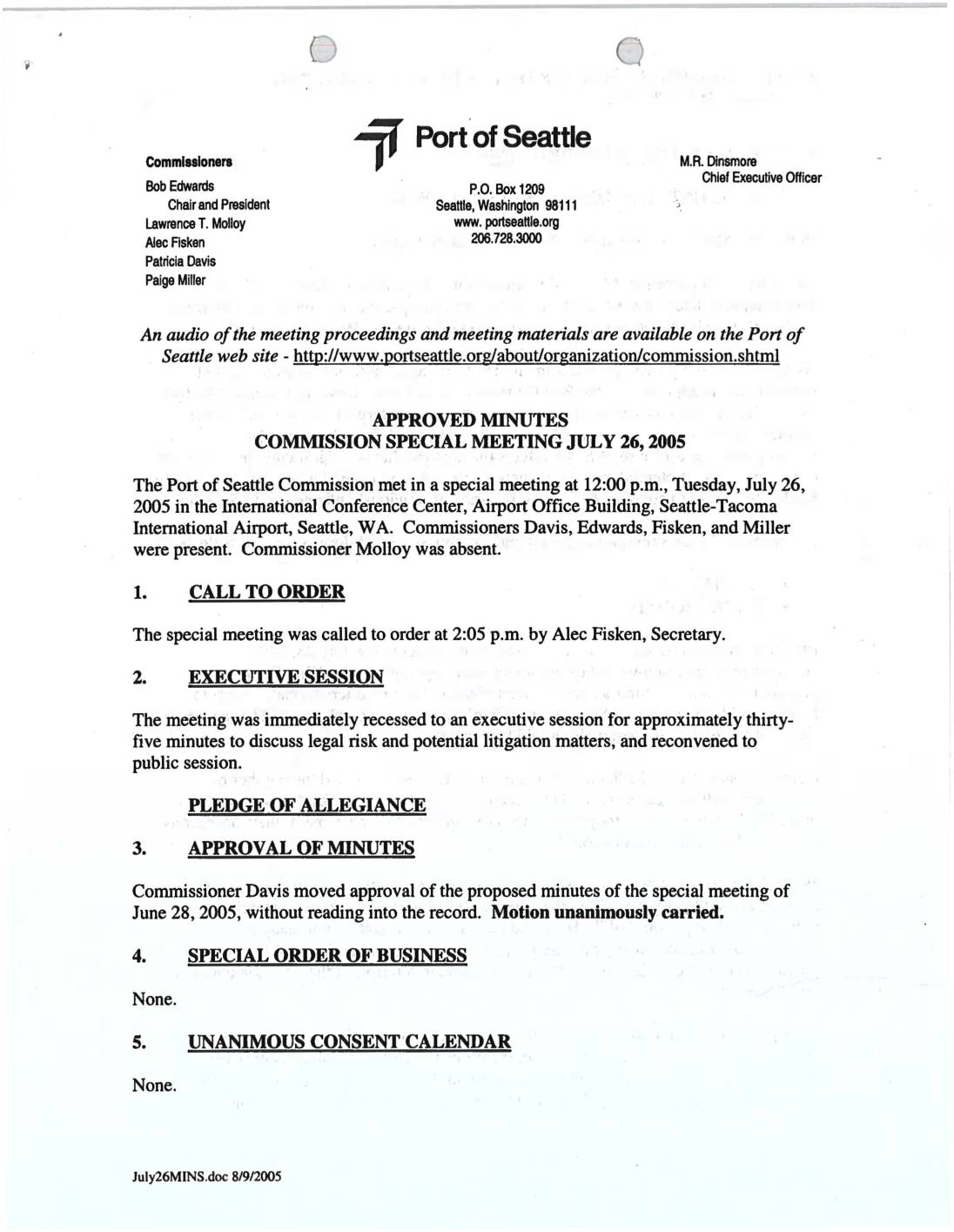
Port Of Seattle Commission Special Meeting Minutes: July 26, 2005
Approved minutes of the Port Of Seattle Commission special meeting held July 26, 2005 at the International Conference Center, Airport Office Building, Seattle-Tacoma International Airport. Commissioners Davis, Edwards, Fisken, and Miller present; Molloy absent. Meeting included executive session on legal risk and potential litigation, followed by a policy and staff briefing by Mark Reis, Managing -
2005-07-26
Port Of Seattle Commission Special Meeting Minutes: July 26, 2005
Approved minutes of the Port Of Seattle Commission special meeting held July 26, 2005 at the International Conference Center, Airport Office Building, Seattle-Tacoma International Airport. Commissioners Davis, Edwards, Fisken, and Miller present; Molloy absent. Meeting included executive session on legal risk and potential litigation, followed by a policy and staff briefing by Mark Reis, Managing -
 2004-02-23
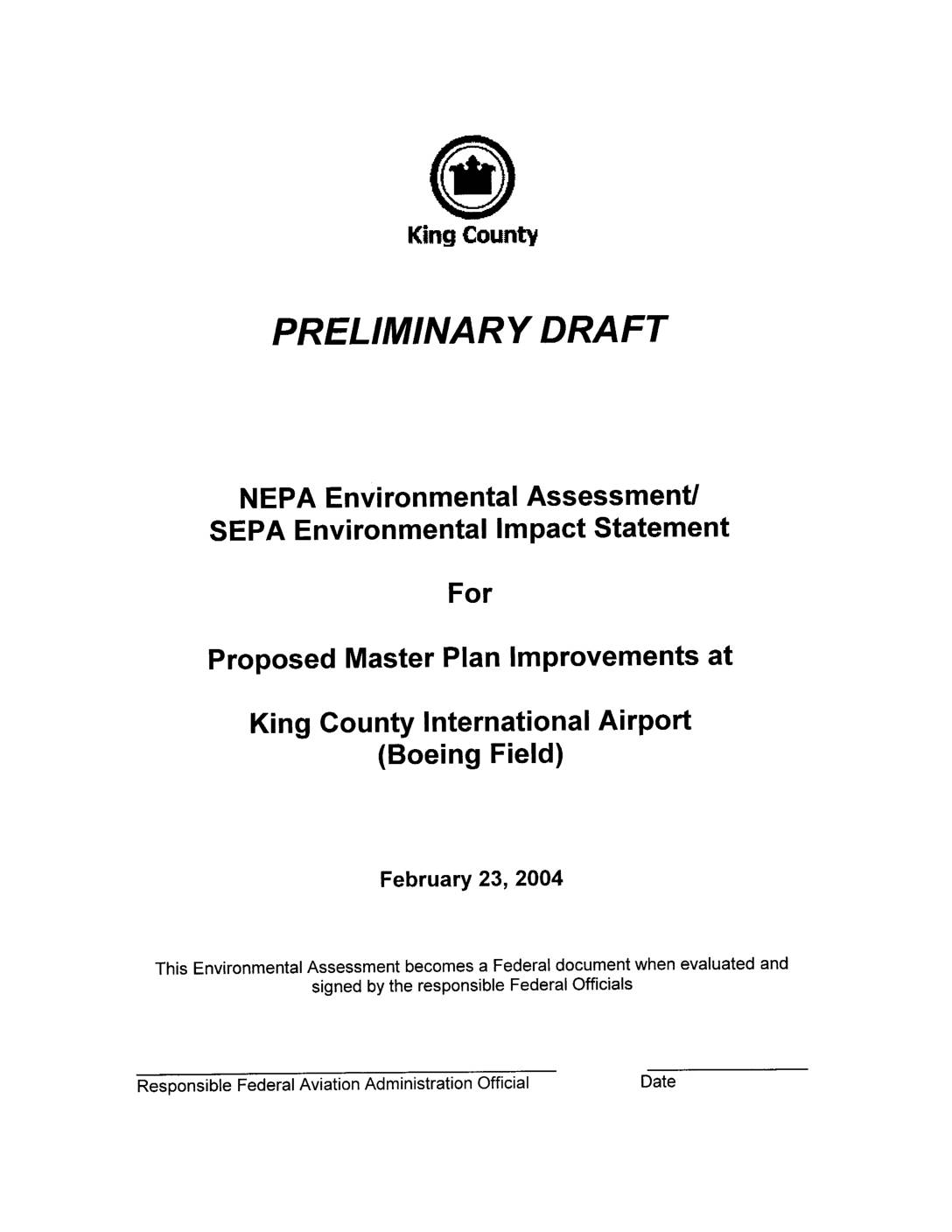
NEPA Environmental Assessment/SEPA Environmental Impact Statement for Proposed Master Plan Improvements at King County International Airport (Boeing Field)
Preliminary Draft NEPA Environmental Assessment (EA) and SEPA Environmental Impact Statement (EIS) prepared by King County for proposed Master Plan improvements at King County International Airport (Boeing Field/BFI), dated February 23, 2004. Covers FAA review process, public comment period with hearing scheduled April 5, 2004, and potential outcomes including Finding of No Significant Impact (FONSI) -
 2004-02-23
NEPA Environmental Assessment/SEPA Environmental Impact Statement for Proposed Master Plan Improvements at King County International Airport (Boeing Field)
Preliminary Draft NEPA Environmental Assessment (EA) and SEPA Environmental Impact Statement (EIS) prepared by King County for proposed Master Plan improvements at King County International Airport (Boeing Field/BFI), dated February 23, 2004. Covers FAA review process, public comment period with hearing scheduled April 5, 2004, and potential outcomes including Finding of No Significant Impact (FONSI) -
 2002-10-23
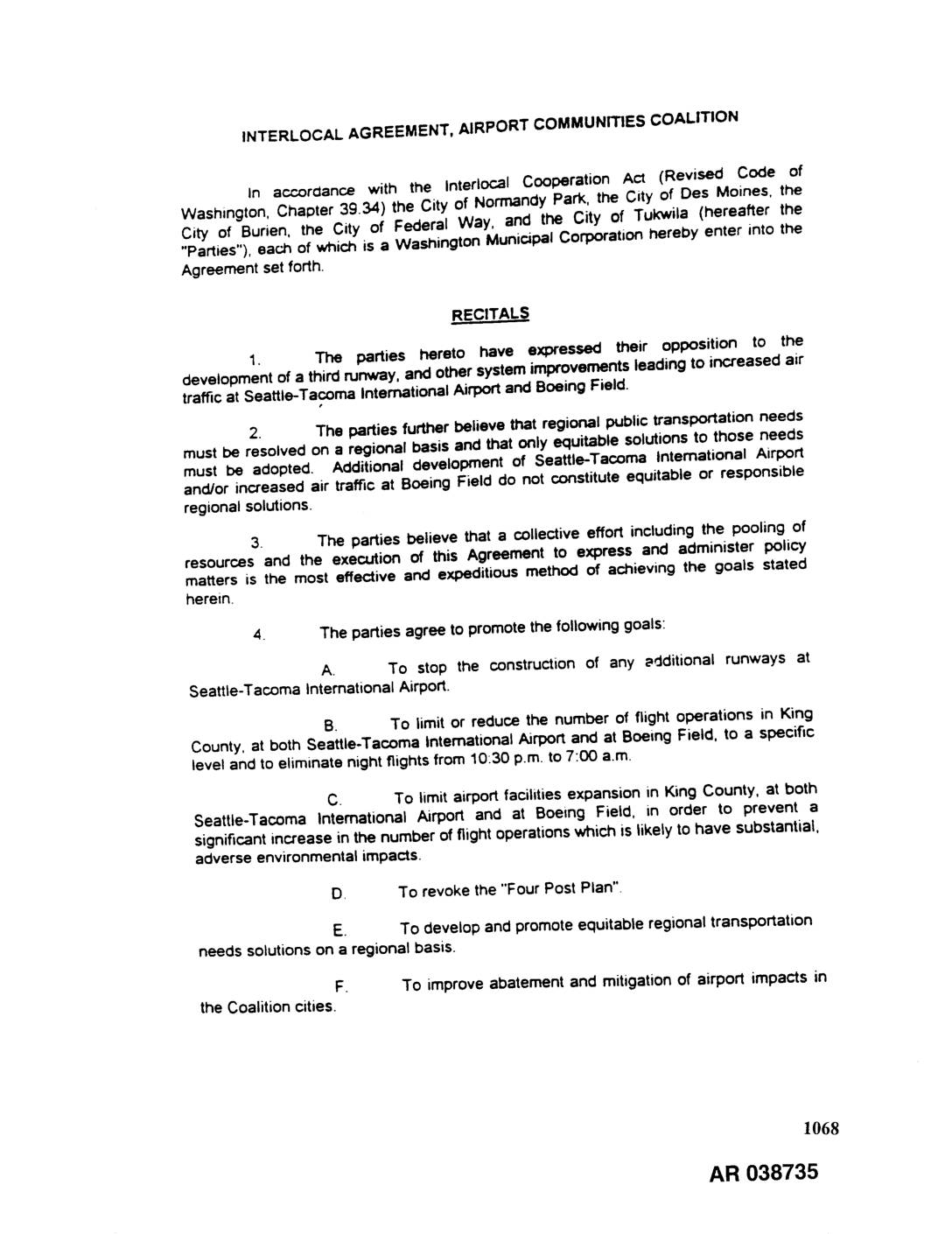
EXH AR038735: Interlocal Agreement, Airport Communities Coalition
Interlocal Agreement establishing the Airport Communities Coalition (ACC) under the Interlocal Cooperation Act (RCW Chapter 39.34), signed by the cities of Normandy Park, Des Moines, Burien, Federal Way, and Tukwila, each a Washington Municipal Corporation. The agreement opposes construction of a third runway at Seattle-Tacoma International Airport, opposes increased air traffic at Boeing Field, seeks -
 2001-06-22
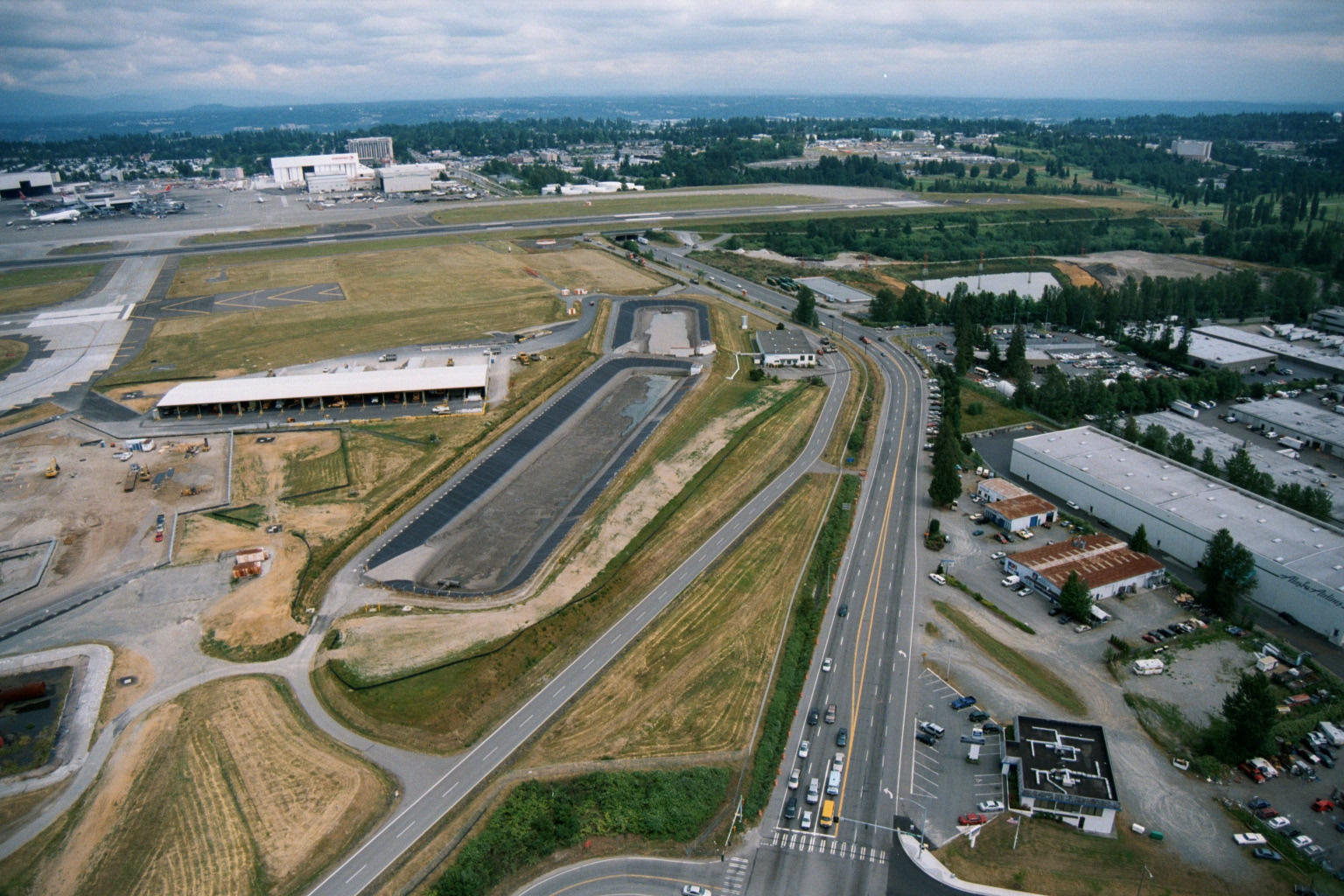
Aerial View of Sea-Tac Airport Construction and East Airfield Development
Aerial photograph looking north over Sea-Tac Airport showing active construction, including what appears to be a new terminal or cargo facility under development on the airfield's east side, a retention pond, and the main runway complex. The Boeing facility and hangars are visible in the upper left, consistent with the airport's proximity to Boeing Field/King County International Airport area. -
 1992-07-01
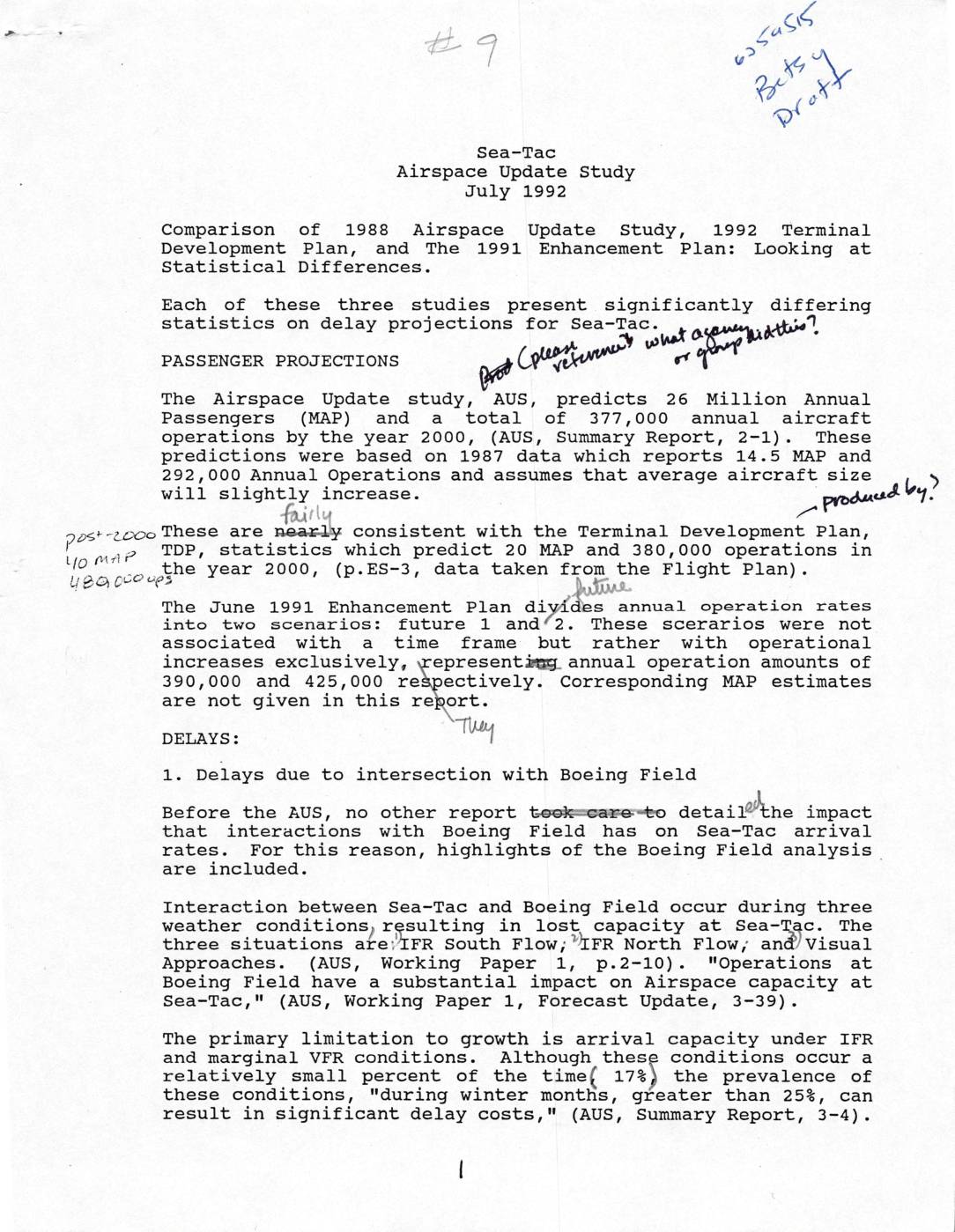
Sea-Tac Airspace Update Study: Comparison of 1988 Airspace Update Study, 1992 Terminal Development Plan, and the 1991 Enhancement Plan
This 1992 study compares three planning reports on Sea-Tac Airport's future capacity and delays: the 1988 Airspace Update Study, the 1992 Terminal Development Plan, and the 1991 Enhancement Plan. The reports differ significantly in their passenger and flight operation projections for the year 2000, and show striking discrepancies in delay estimates — with the Enhancement Plan projecting delay hours more than five times higher than the Airspace Update Study. The document also outlines proposed solutions to reduce delays, including new runway construction, airspace conflict resolution with nearby Boeing Field, and improved approach procedures. -
 1982-10-27
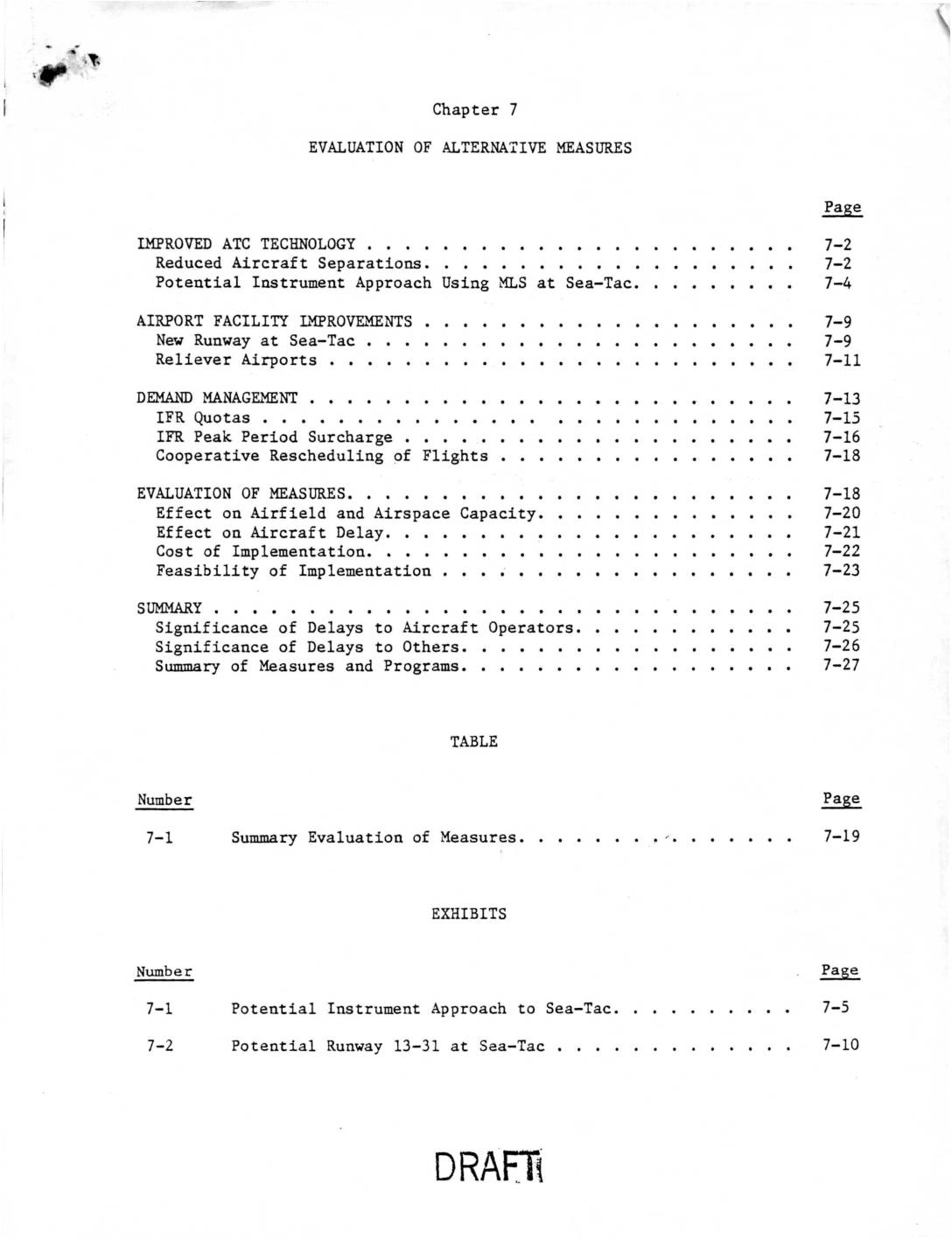
Evaluation of Alternative Measures: Chapter 7, Shared Airspace Study
This draft chapter evaluates alternative measures to reduce growing aircraft delays caused by airspace interactions between Seattle-Tacoma International Airport (Sea-Tac) and Boeing Field, which are projected to worsen significantly between 1990 and 2000. Three main approaches are examined: improving air traffic control (ATC) technology to allow reduced aircraft separations, expanding airport facilities through new runways or reliever airports, and managing demand through flight quotas or peak-period pricing. The chapter concludes that a combination of these measures will likely be necessary, and that action should begin immediately since implementation could take until 1990 when the delays are expected to become critical.