TagAirport Noise Law(31)
-
 1985-01-25
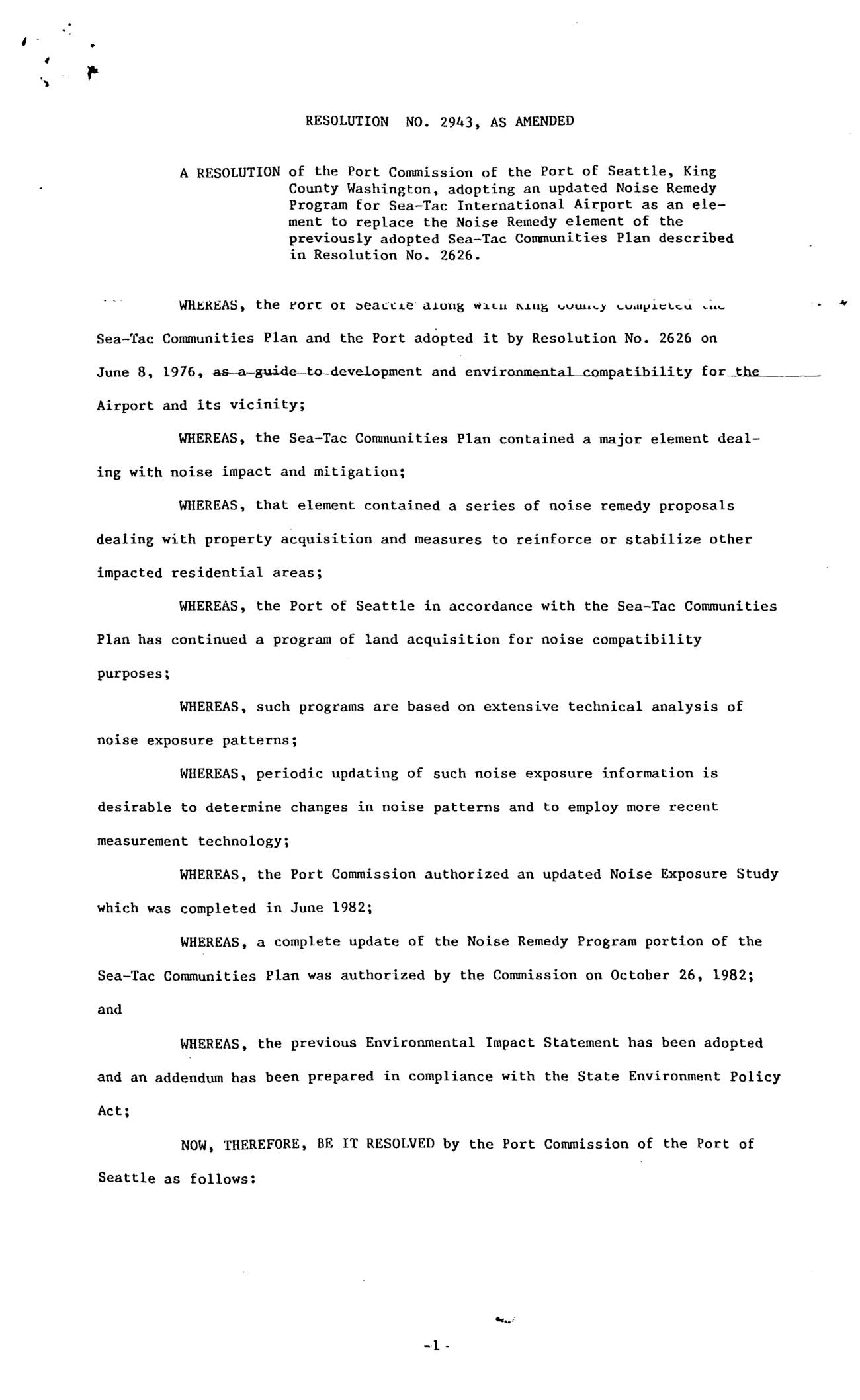
Resolution No. 2943 – Updated Noise Remedy Program
★ 32Resolution No. 2943 was adopted by the Port Commission of the Port of Seattle to update the Noise Remedy Program for Sea-Tac International Airport, replacing the earlier noise remedy element from the 1976 Sea-Tac Communities Plan. The resolution authorizes property acquisition in high-noise areas, implementation of nine noise abatement measures, and a Demonstration Project (budgeted at up to $1 million) to test alternatives to acquisition such as noise insulation and transaction assistance for affected homeowners. Priority for remedies is given based on noise intensity, length of residency, and financial hardship, with annual progress reports required to guide ongoing program evaluation. -
Petersen v. Port of Seattle
AVIATION NOISE LAW Petersen v. Port of Seattle Cite as: 618 P.2d 67, 94 Wash.2d 479 SUPREME COURT OF WASHINGTON Tom E. PETERSEN and Ruby Petersen, Appellants, v. The PORT OF SEATTLE, a municipal Corporation, Respondent/Cross-Appellant. No. 45817 Oct. 9, 1980 As Changed Nov. 10, 1980 COUNSEL: Jones, Grey & Bayley, E. Michele -
 1980-04-21
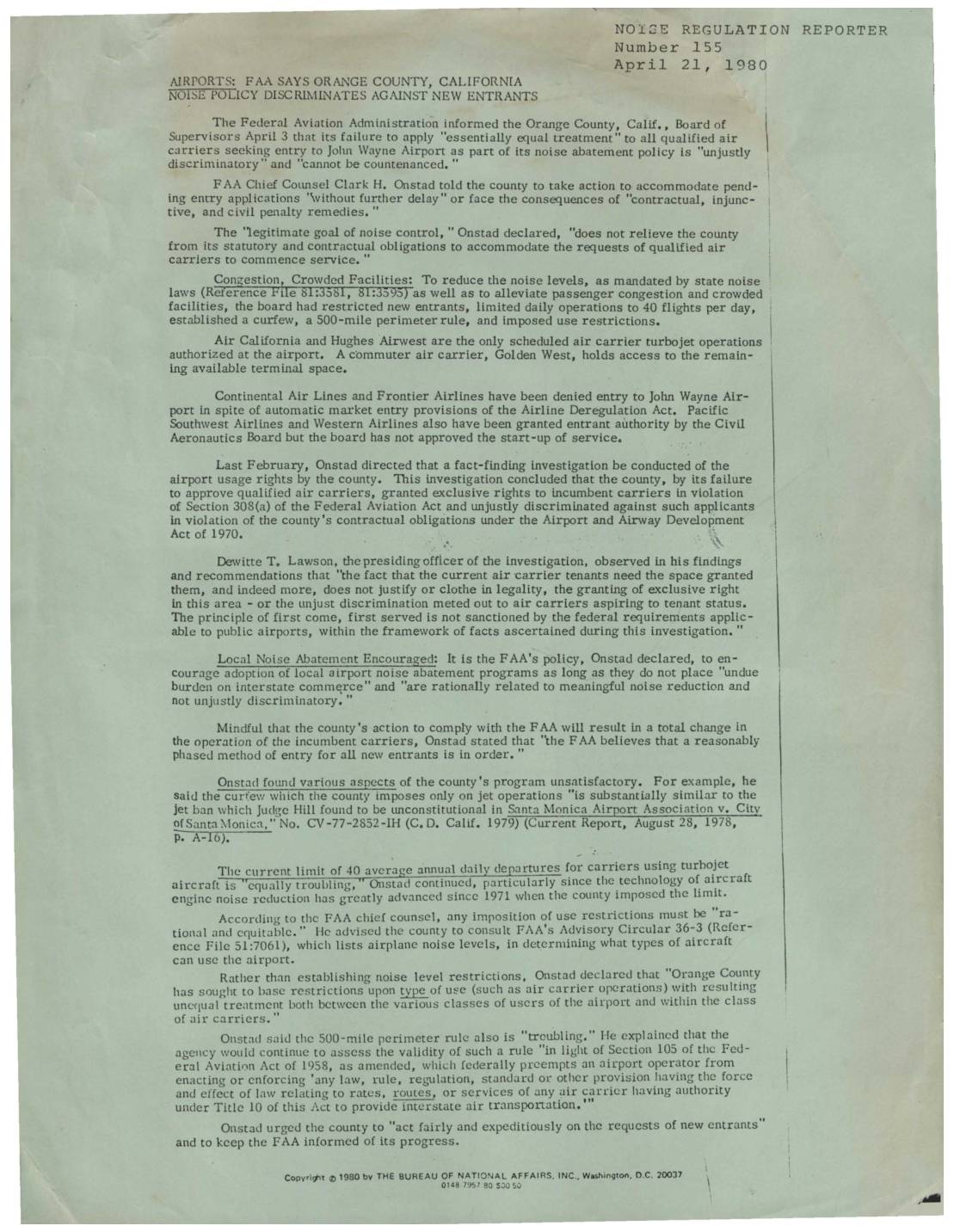
FAA Says Orange County, California Noise Policy Discriminates Against New Entrants
In April 1980, the Federal Aviation Administration ruled that Orange County, California's noise abatement policy at John Wayne Airport was unlawfully discriminatory because it blocked new airlines from entering while protecting existing carriers. The FAA warned the county to accommodate pending entry applications from airlines like Continental and Frontier without further delay, or face legal and financial penalties. While the FAA supported local noise control efforts, it made clear that such policies must treat all qualified air carriers equally and not place undue burdens on interstate commerce. -
 1979-11-01
Airport Noise Control Procedure Manual
This 1979 Airport Noise Control Procedure Manual, approved by Oregon's Department of Environmental Quality, outlines the procedural steps required for compliance with noise control regulations for airports (OAR 340-35-045). It describes how the Department calculates Noise Impact Boundaries for non-air-carrier airports, including the flight operational data and mapping information needed to make accurate assessments. The manual was issued under the authority of ORS Chapter 467 and was designed to minimize the administrative burden on smaller airport facilities. -
 1979-01-25
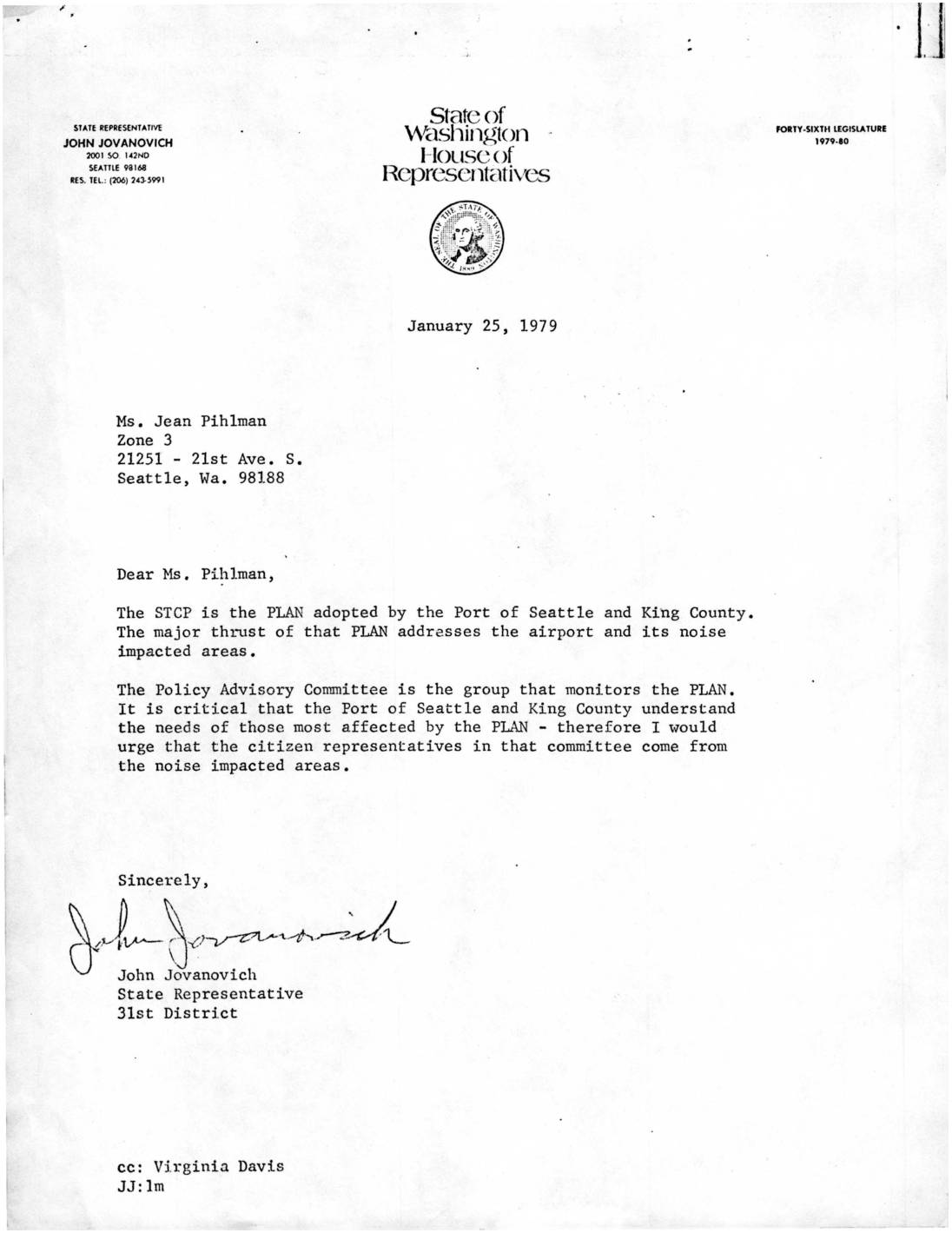
Letter from State Representative John Jovanovich to Jean Pihlman regarding STCP Policy Advisory Committee
In this January 25, 1979 letter, Washington State Representative John Jovanovich (31st District) writes to Ms. Jean Pihlman explaining that the Sea-Tac Comprehensive Plan (STCP), adopted by the Port of Seattle and King County, primarily addresses the airport and its noise-impacted areas. He urges that citizen representatives on the Policy Advisory Committee — the body responsible for monitoring the plan — should come directly from the noise-impacted communities, so that their needs are properly understood by decision-makers. -
 1979-01-01
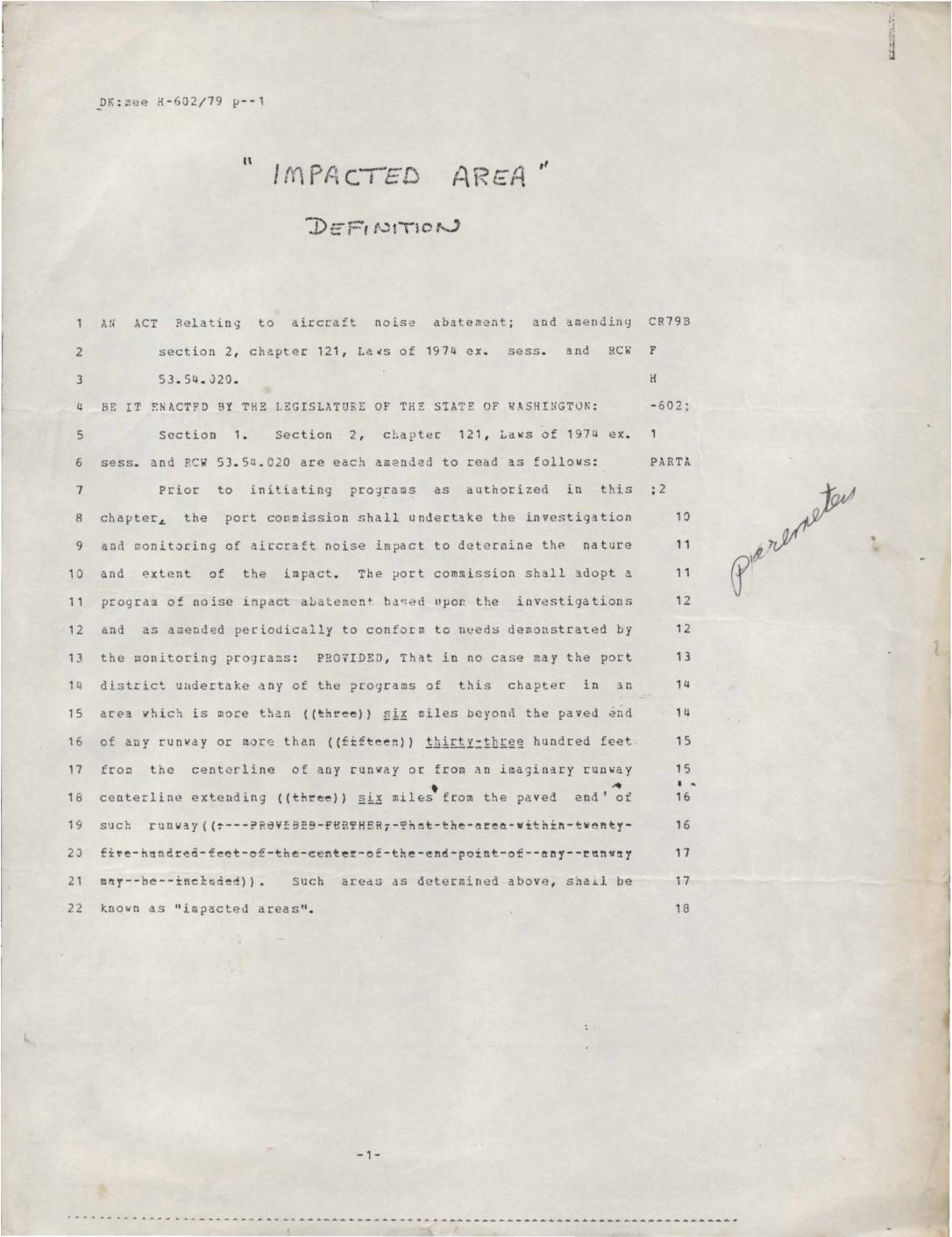
“Impacted area” definition: An act relating to aircraft noise abatement
This 1979 Washington State legislative act amends the definition of an 'impacted area' for aircraft noise abatement purposes near airports. It expands the eligible zone from three to six miles beyond the paved end of any runway, and from fifteen hundred to thirty-three hundred feet from the runway centerline, within which port districts may undertake noise mitigation programs. Areas meeting these geographic criteria are officially designated as 'impacted areas' subject to noise investigation and abatement efforts. -
 1978-12-05
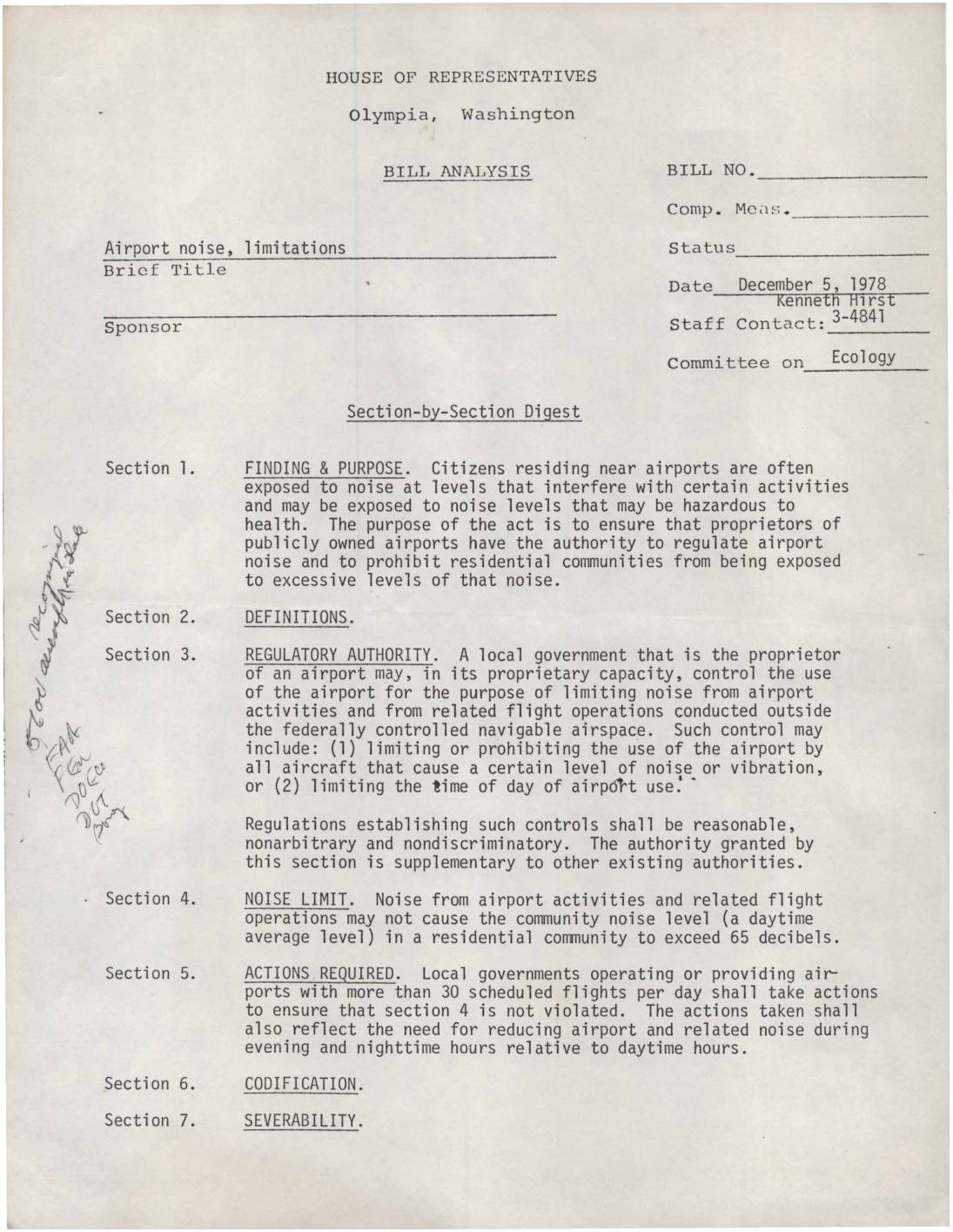
Bill analysis: Airport noise, limitations
A 1978 Washington State House of Representatives bill analysis outlines proposed legislation to limit airport noise, giving local governments that own airports the authority to restrict aircraft use and flight times to keep residential community noise levels below 65 decibels. Airports with more than 30 scheduled flights per day would be required to take action to meet this standard, with special attention to reducing noise during evening and nighttime hours. A public hearing on the legislation was held on December 7, 1978, at the Burien Public Library near Sea-Tac Airport. -
 1978-09-01
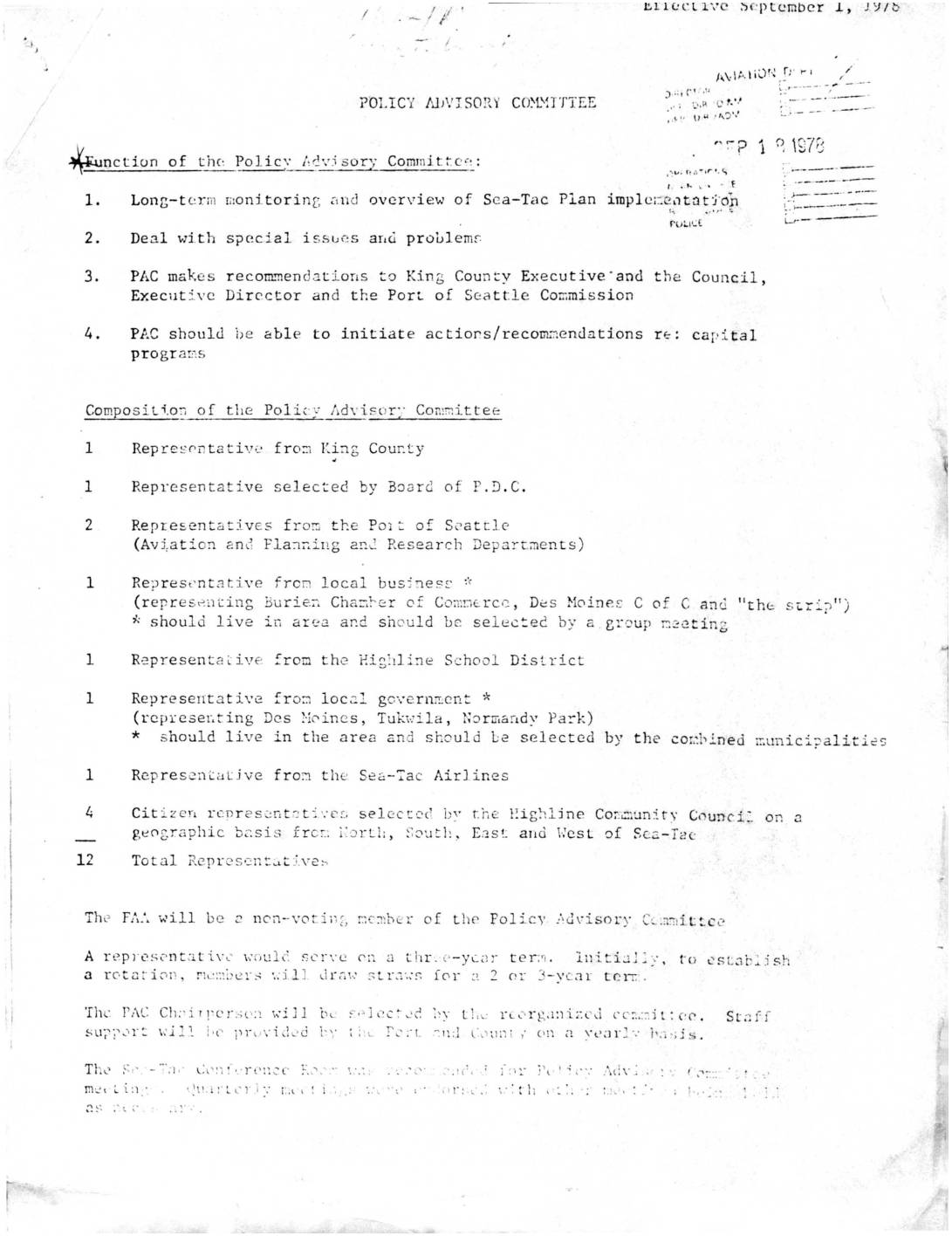
Policy Advisory Committee for Sea-Tac Plan Implementation
★This 1978 document outlines the structure and functions of a Policy Advisory Committee (PAC) formed to oversee implementation of the Sea-Tac Airport Communities Plan, including long-term monitoring of airport noise issues and making recommendations to King County and Port of Seattle officials. The 12-member committee draws representatives from King County, local governments, businesses, schools, airlines, and community citizens. It also details noise exemption rules for daytime aircraft testing and maintenance at Seattle-Tacoma International Airport, specifying conditions such as permitted hours (7 a.m. to 10 p.m.) and geographic boundaries defined by the 'NEF 45' noise exposure contour line. -
 1978-08-28
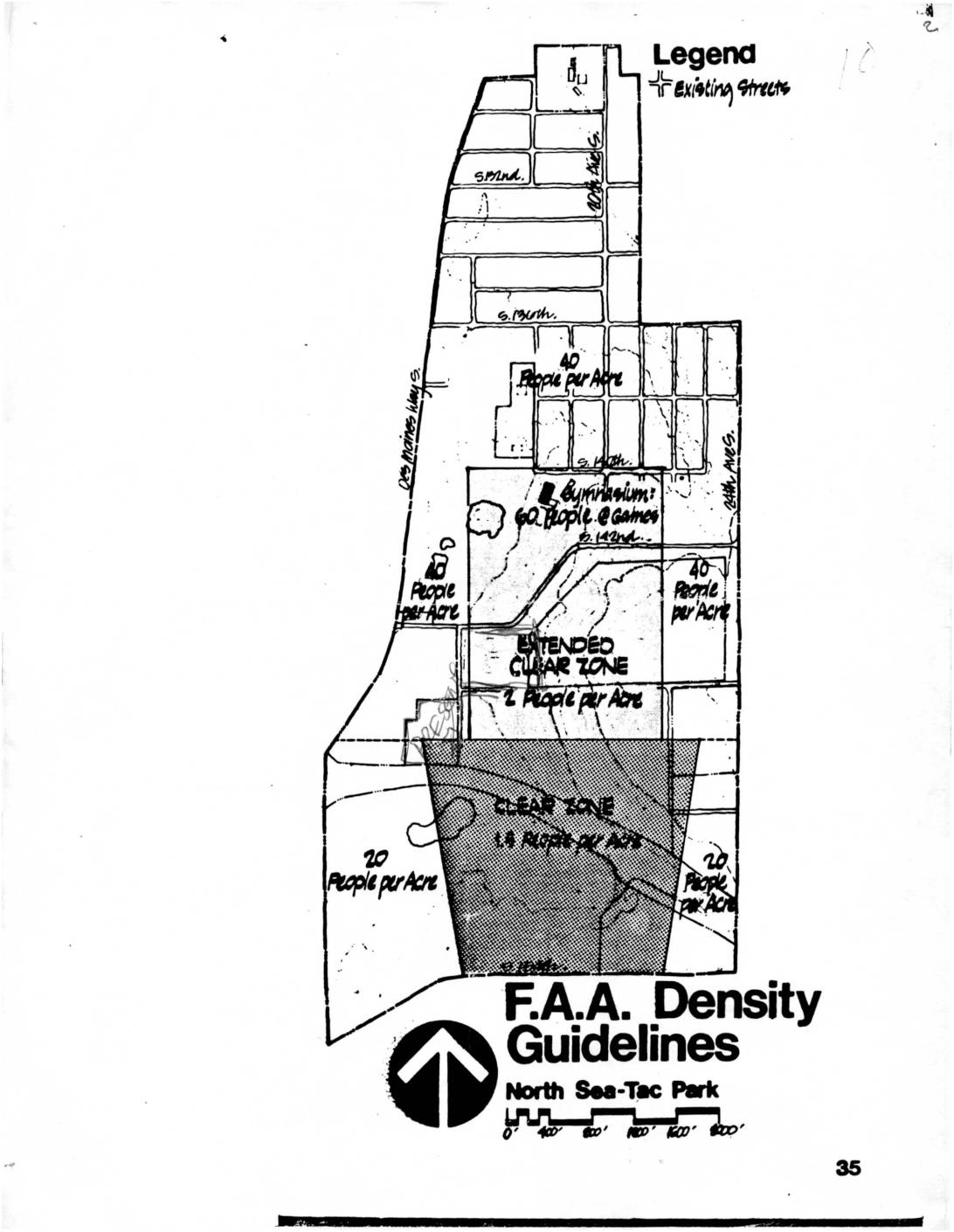
FAA Noise Density Guidelines North Sea-Tac Park
This document presents F.A.A. Density Guidelines for North Sea-Tac Park, a neighborhood near Seattle-Tacoma International Airport. It maps out population density limits across different zones, ranging from 1.5 people per acre in the Clear Zone closest to the airport, to 2 people per acre in the Extended Clear Zone, up to 20-40 people per acre in areas farther from the runway. The guidelines reflect FAA safety and noise policy restrictions that limit how many residents can live in areas most directly affected by airport flight paths. -
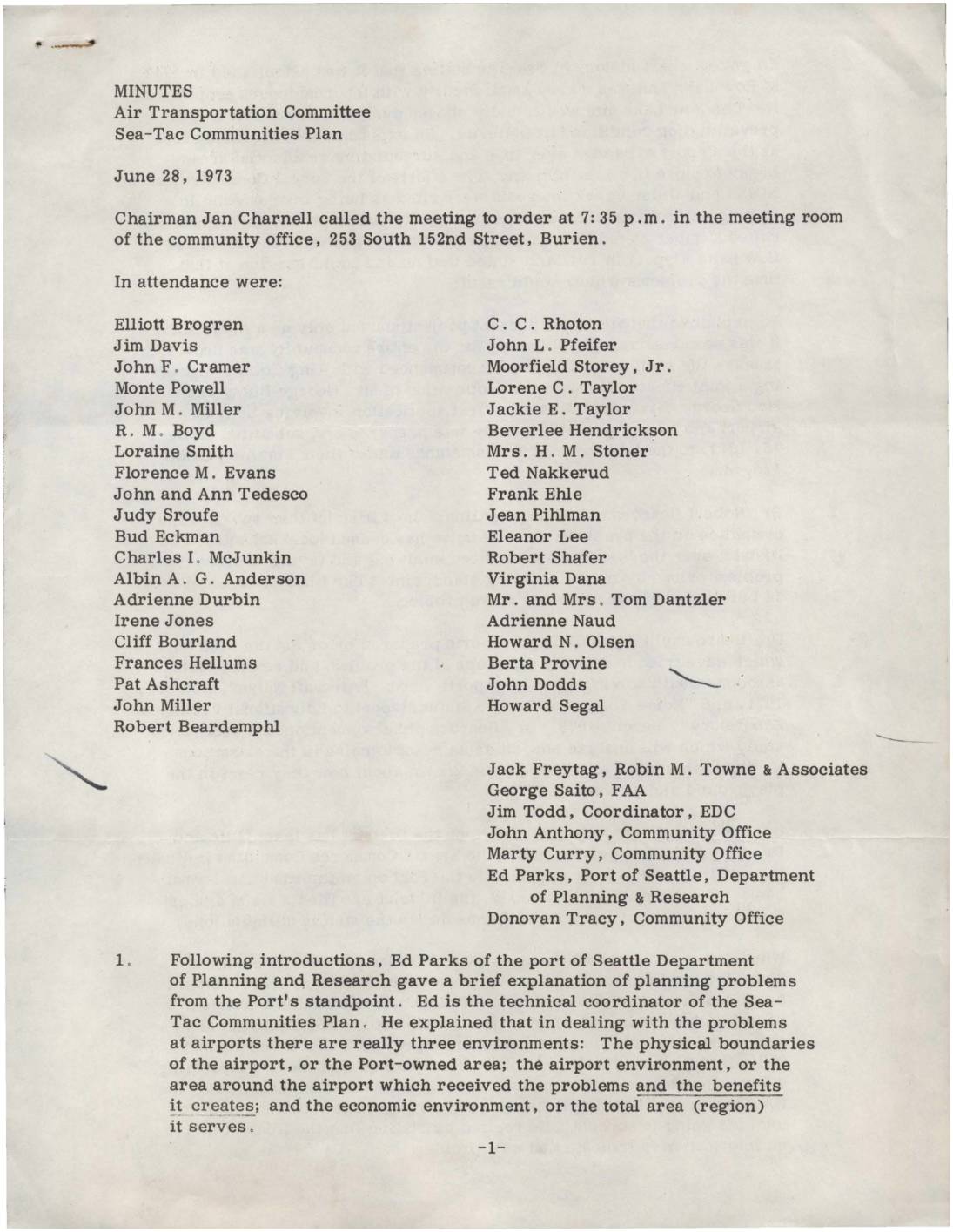 1973-06-28
Minutes: Air Transportation Committee, Sea-Tac Communities Plan
Minutes from a June 28, 1973 Air Transportation Committee meeting on the Sea-Tac Communities Plan, held in Burien, Washington. Representatives from the Port of Seattle, FAA, Highline School District, and local community groups discussed the history of Sea-Tac Airport's expansion, the impact of aircraft noise on nearby schools and neighborhoods, and ongoing efforts to measure and reduce noise exposure. Key topics included new comprehensive noise measurement methods, federal agency roles in noise regulation, and strategies for noise abatement such as modified flight procedures and sound-absorbing materials.