TagAirport Layout Plans(31)
-
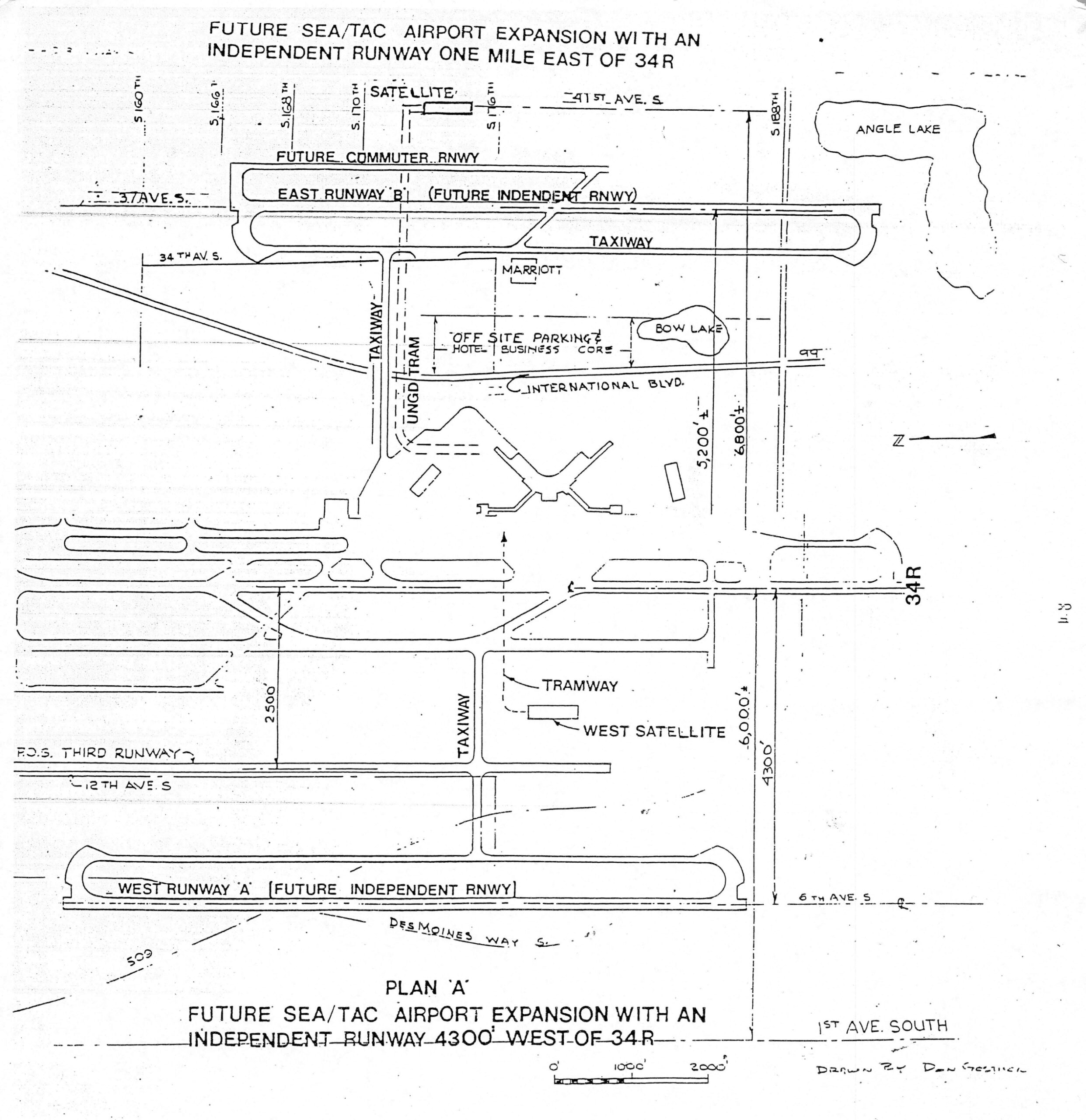
Future Sea-Tac Airport Expansion — Independent Runway Plans East (Runway B, 1 Mile) and West (Runway A, 4,300 ft) of 34R
Architectural/planning drawing titled 'Future Sea/Tac Airport Expansion with an Independent Runway One Mile East of 34R,' showing Plan A layout with an independent runway 4,300 feet west of runway 34R. The drawing, credited to Don Getsick, depicts proposed runways (East Runway B, West Runway A), taxiways, satellite terminals, tramway, underground tram, off-site parking/hotel/business core, and surrounding streets including International Blvd, Des Moines Way S, and 1st Ave South, with Angle Lake and Bow Lake visible. -
 2022-10-17
Comments on Docket Number FAA 2022-1203: Draft Policy regarding processing land use changes on federally acquired or federally conveyed airport land
Charlotte Douglas International Airport (CLT) submitted comments to the FAA in October 2022 opposing a proposed new policy on land use changes at federally acquired airport land, arguing that existing regulations already adequately govern non-aeronautical land use. CLT requested that if the policy moves forward, the FAA clarify approval timelines, lease evaluation procedures, and criteria for mixed-use land decisions. The letter emphasizes that non-aeronautical development is essential for airports to remain financially self-sustaining and to ensure compatible land use around airport property. -
 2022-10-17
Comments on the draft FAA policy regarding processing land use changes on federally acquired or federally conveyed airport land
The Huntsville-Madison County Airport Authority submitted comments to the FAA in October 2022, objecting to a proposed federal policy governing land use changes on federally acquired or conveyed airport property. The authority argues the policy creates unnecessary regulatory burdens that hamper airports' ability to pursue compatible non-aeronautical developments, and calls for clearer, simpler rules — such as broader definitions of 'airport purpose' and airport-led category determinations rather than FAA approval for every land use change. -
Section 163
Section 163 of the FAA Reauthorization Act of 2018 regulates the uses of properties acquired by airport sponsors using FAA funds. These include property buyouts for noise mitigation and other non-aeronautical uses. SEC. 163. LIMITED REGULATION OF NON-FEDERALLY SPONSORED PROPERTY. (a) <> In General.--Except as provided in subsection (b), the Secretary of Transportation may not -
 2022-09-12
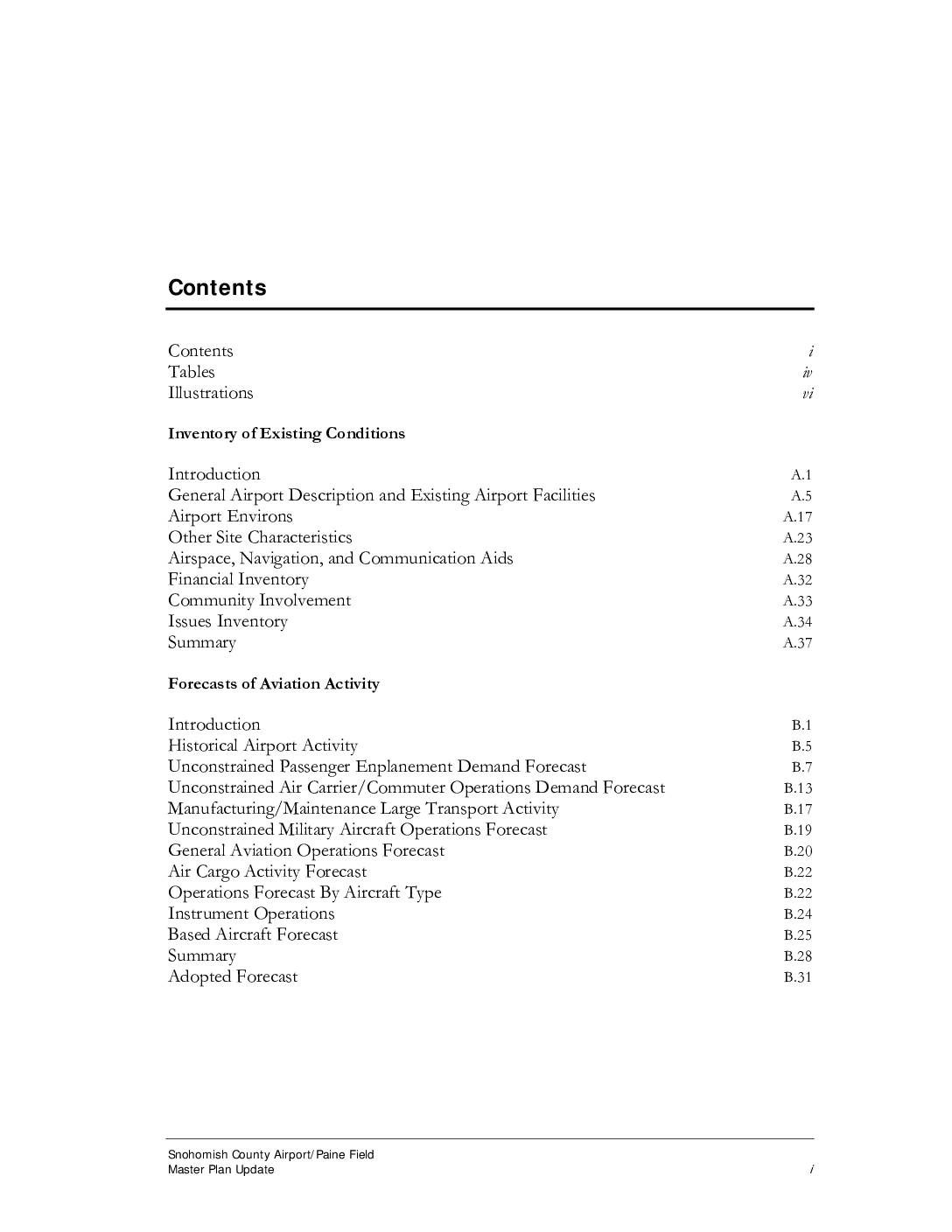
Snohomish County Airport/Paine Field master plan update
This document is the Master Plan Update for Snohomish County Airport/Paine Field, covering a comprehensive range of planning topics including existing airport conditions, aviation activity forecasts, capacity analysis, facility requirements, and a long-term development program. It outlines airfield and landside infrastructure needs, environmental considerations, and financial planning strategies for the airport's future growth. Note that this plan pertains to Paine Field in Snohomish County and does not directly address noise policy at Seattle-Tacoma International Airport. -
 2022-09-01
Navigating Section 163: A guide to facilitating non-aeronautical development at your airport
This guide explains how airports can pursue non-aeronautical development under Section 163 of federal aviation law, with a 2022 update covering key FAA policy changes. The update clarifies that if any part of a development project requires FAA approval, the agency now claims approval authority over the entire project — limiting a previous practice of splitting projects into smaller pieces to bypass oversight. It also covers a proposed FAA land use policy affecting how airports may lease or repurpose federally acquired or grant-funded airport land for non-aviation uses. -
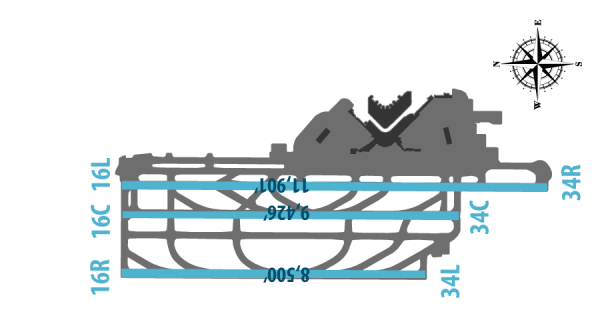
Sea-Tac Airport Three Parallel Runway Diagram
Aerial diagram of Seattle-Tacoma International Airport (Sea-Tac) showing three parallel runway pairs labeled 16L/34R, 16C/34C, and 16R/34L, with runway lengths annotated: 11,901', 9,426', and 8,500' respectively. A compass rose is visible in the upper right corner. -
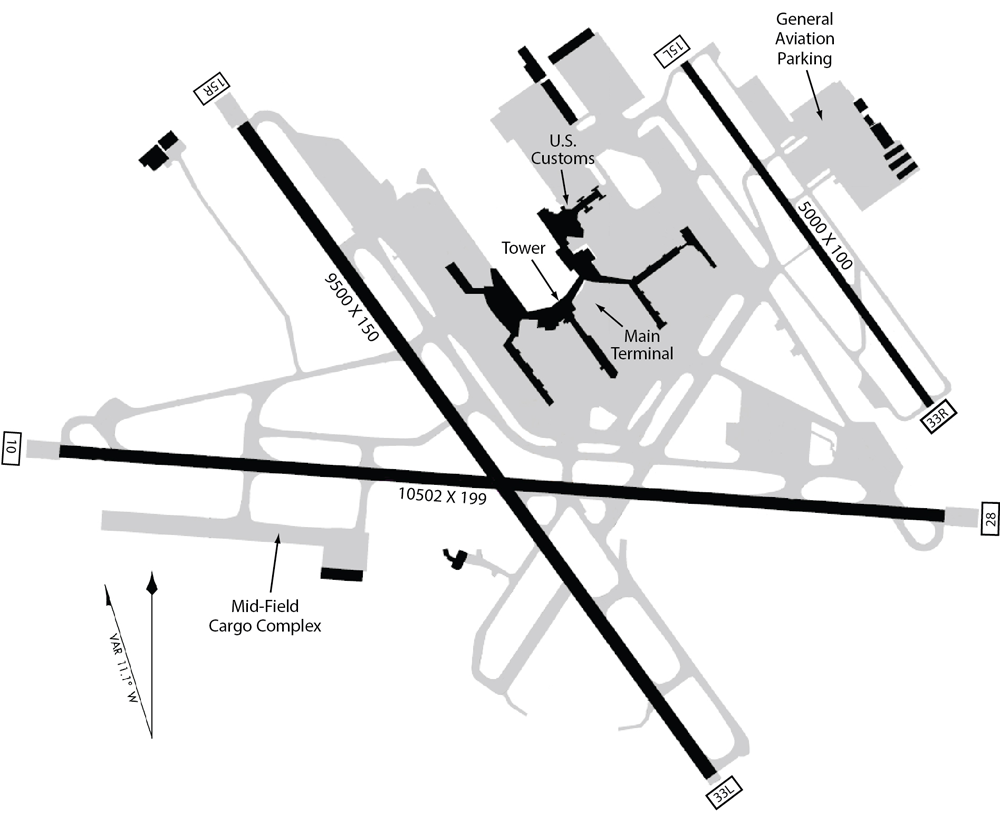
Airport Runway Layout Diagram (For Illustration Purposes Only) — Terminal, Tower, Customs, and Mid-Field Cargo Complex
This is an airport diagram showing multiple runways including one labeled 10502 x 199 feet and another 9500 x 150 feet, with facilities marked including a Main Terminal, U.S. Customs, Tower, Mid-Field Cargo Complex, and General Aviation Parking. Runway end identifiers visible include 10, 28, 15R, 33L, 33R, and 75L, consistent with a large international airport layout, though no airport name or ICAO/IATA code is explicitly shown. -
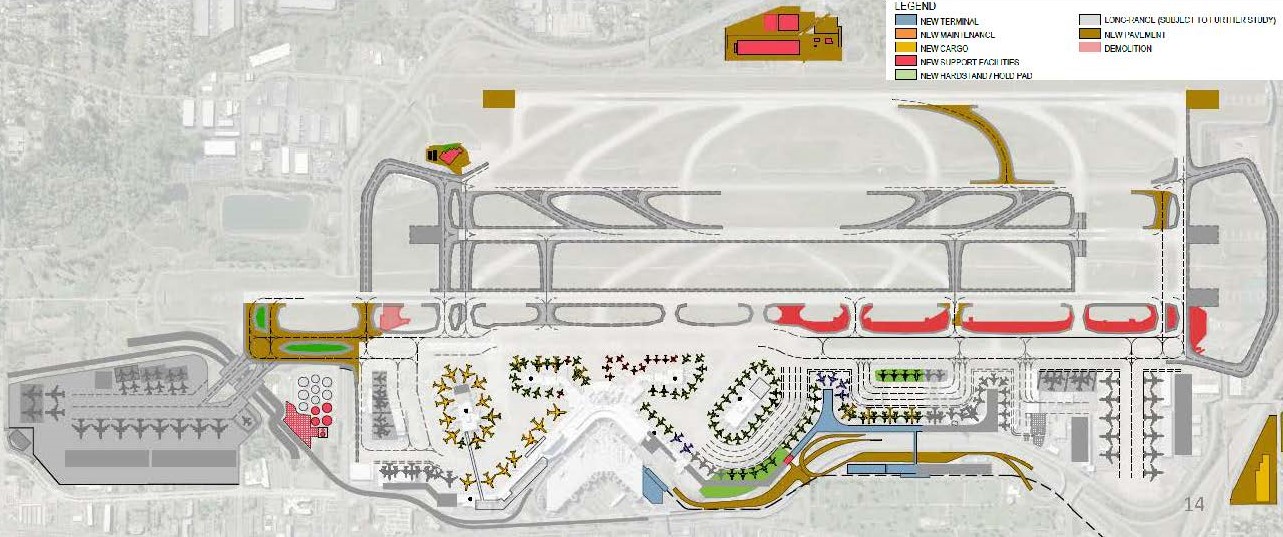
180620-SAMP-Presentation-Public-Meeting 14 LTP-cropped
A color-coded airport master plan layout showing proposed development elements including new terminal, new main entrance, new cargo facilities, new support facilities, new hardstand/hold pad, long-range study areas, new pavement, and demolition zones. The legend distinguishes elements by color, and the drawing appears to be page 14 of a planning document, depicting a large airfield with multiple concourses and gate areas. -
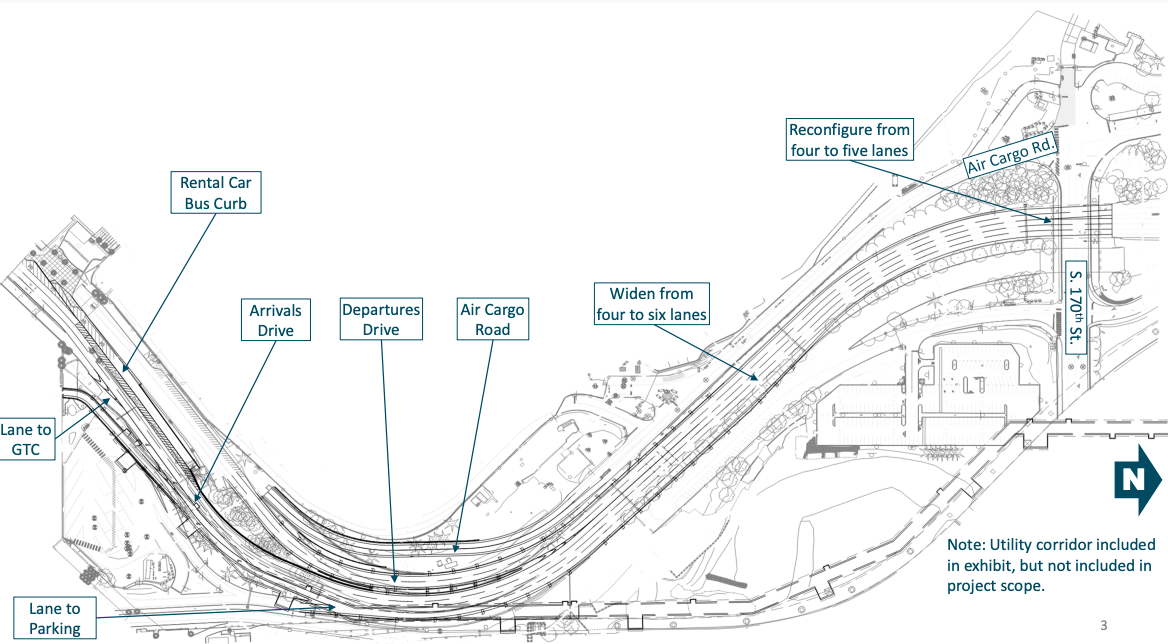
Sea-Tac Airport Roadway Reconfiguration Site Plan
An architectural/engineering site plan for Seattle-Tacoma International Airport showing proposed roadway modifications including widening Air Cargo Road from four to six lanes, reconfiguring from four to five lanes near Air Cargo Rd. and S. 170th St., and labeled features including Arrivals Drive, Departures Drive, Rental Car Bus Curb, and lanes to GTC and Parking. A note indicates the utility corridor is shown but not included in project scope.