TagAIP(61)
-
 2006-03-30
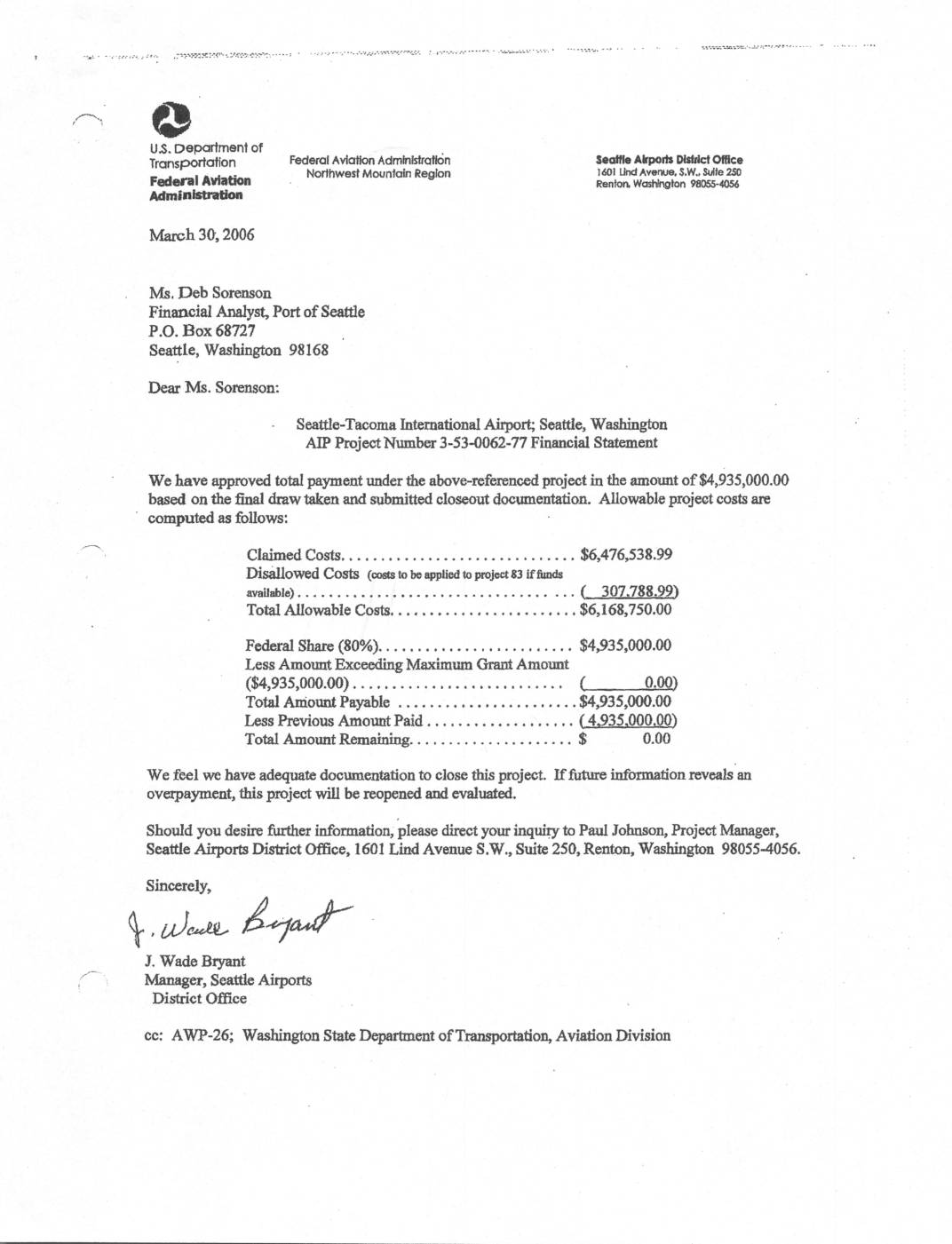
Sea-Tac International Airport acoustical insulation AIP project no. 3-53-0062-77 financial statement
The Federal Aviation Administration approved a total grant payment of $4,935,000 to the Port of Seattle for AIP Project Number 3-53-0062-77, covering acoustical insulation work at Seattle-Tacoma International Airport. Out of $6,476,538.99 in claimed costs, $6,168,750.00 was deemed allowable after disallowing $307,788.99, with the federal share set at 80%. The Port of Seattle submitted closeout documentation in March 2006, though a Circular A-133 audit by Deloitte & Touche and final acoustic test results for Seawind Condominiums were still pending completion at the time of closure. -
 2003-08-26
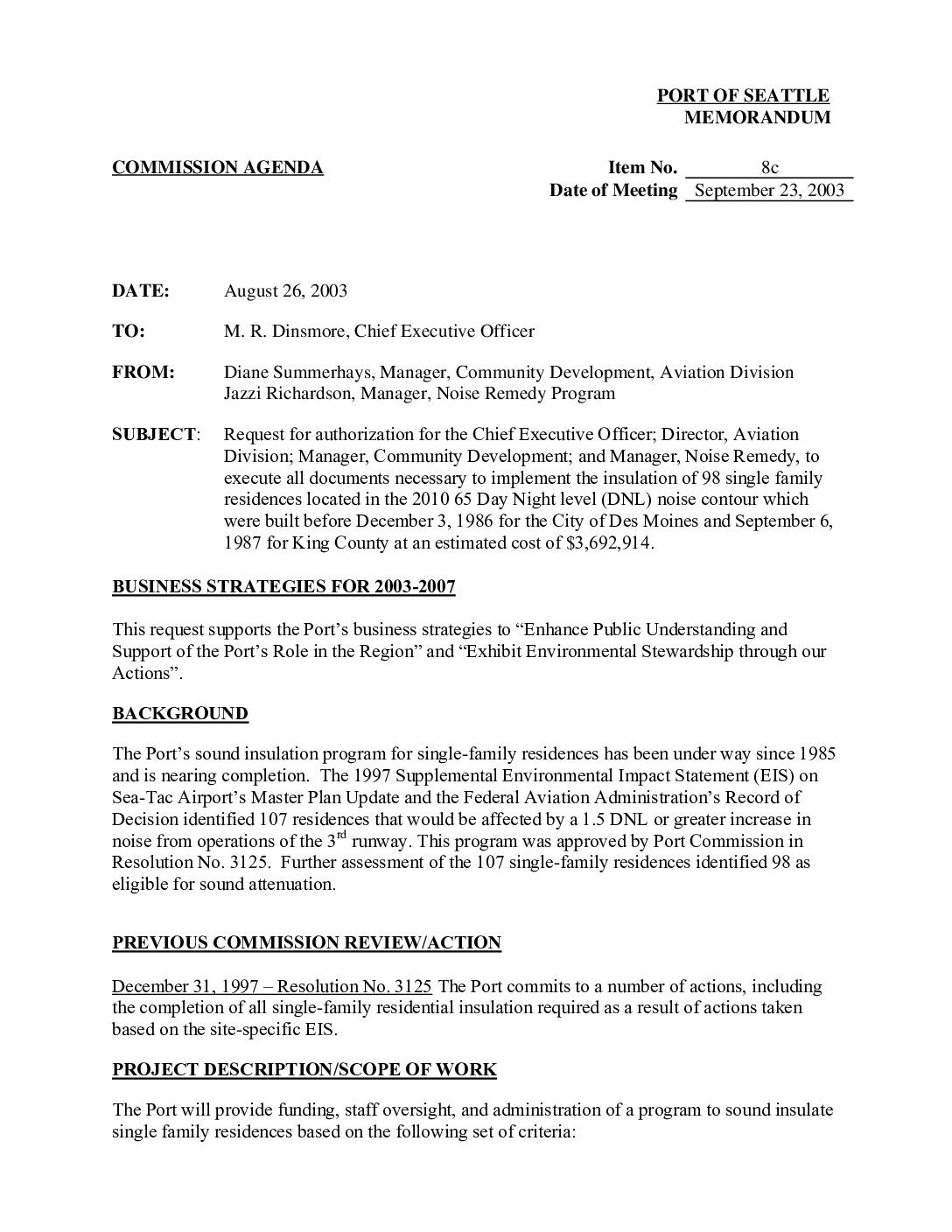
Request for authorization to implement sound insulation of 98 single family residences in the 2010 65 DNL noise contour
In September 2003, the Port of Seattle Commission considered authorizing a $3.69 million program to sound-insulate 98 single-family homes near Sea-Tac Airport that fell within the projected 2010 65 DNL noise contour and were built before local noise codes took effect. The project, stemming from a 1997 Environmental Impact Statement related to the airport's third runway, aimed to reduce interior noise levels by at least 5 decibels in eligible homes in Des Moines and unincorporated King County. Funding was to come primarily from federal Airport Improvement Program grants (80%), with the remainder drawn from the Airport Development Fund, and homeowners were required to grant the Port an avigation easement in exchange for the insulation work. -
 2000-05-30
Passenger facility charges; final rule
★In May 2000, the FAA issued a final rule updating the Passenger Facility Charge (PFC) program, allowing airports to increase per-passenger fees from a maximum of $3 to up to $4.50, as authorized by the Wendell H. Ford Aviation Investment and Reform Act for the 21st Century (AIR 21). The updated rules set eligibility requirements for projects funded at the higher fee levels, including a requirement that projects at medium and large hub airports make a significant contribution to goals such as reducing aviation noise impacts on nearby communities. Airports seeking the higher PFC levels must also demonstrate that proposed projects cannot be adequately funded through the existing Airport Improvement Program. -
 1998-12-28
Airport Improvement Program: FAA complying with requirement for local involvement in noise mitigation projects
A 1998 U.S. General Accounting Office report examined whether the FAA was required to enforce a policy mandating written declarations of local support before awarding noise mitigation grants to Seattle-Tacoma International Airport. The report found that while FAA policy called for such written declarations from affected cities and counties, neither federal law nor FAA regulations legally required them. FAA officials maintained they still met the broader statutory requirement of ensuring noise mitigation projects were consistent with local plans. -
 1998-01-01
MAC Part 150 Residential Sound Insulation Program: 1992–1997 Completion & Funding Summary
The MAC Part 150 Residential Sound Insulation Program completed sound insulation work on 3,673 homes near Minneapolis-St. Paul International Airport between 1992 and 1997, at a total cost of $76.6 million. Funding came from two sources: $28.7 million in FAA Airport Improvement Program (AIP) grants and $48.6 million in MSP Passenger Facility Charges (PFC). The program grew significantly over its six-year run, peaking in 1996 with 1,002 homes insulated at a cost of $20.7 million. -
 1990-01-08
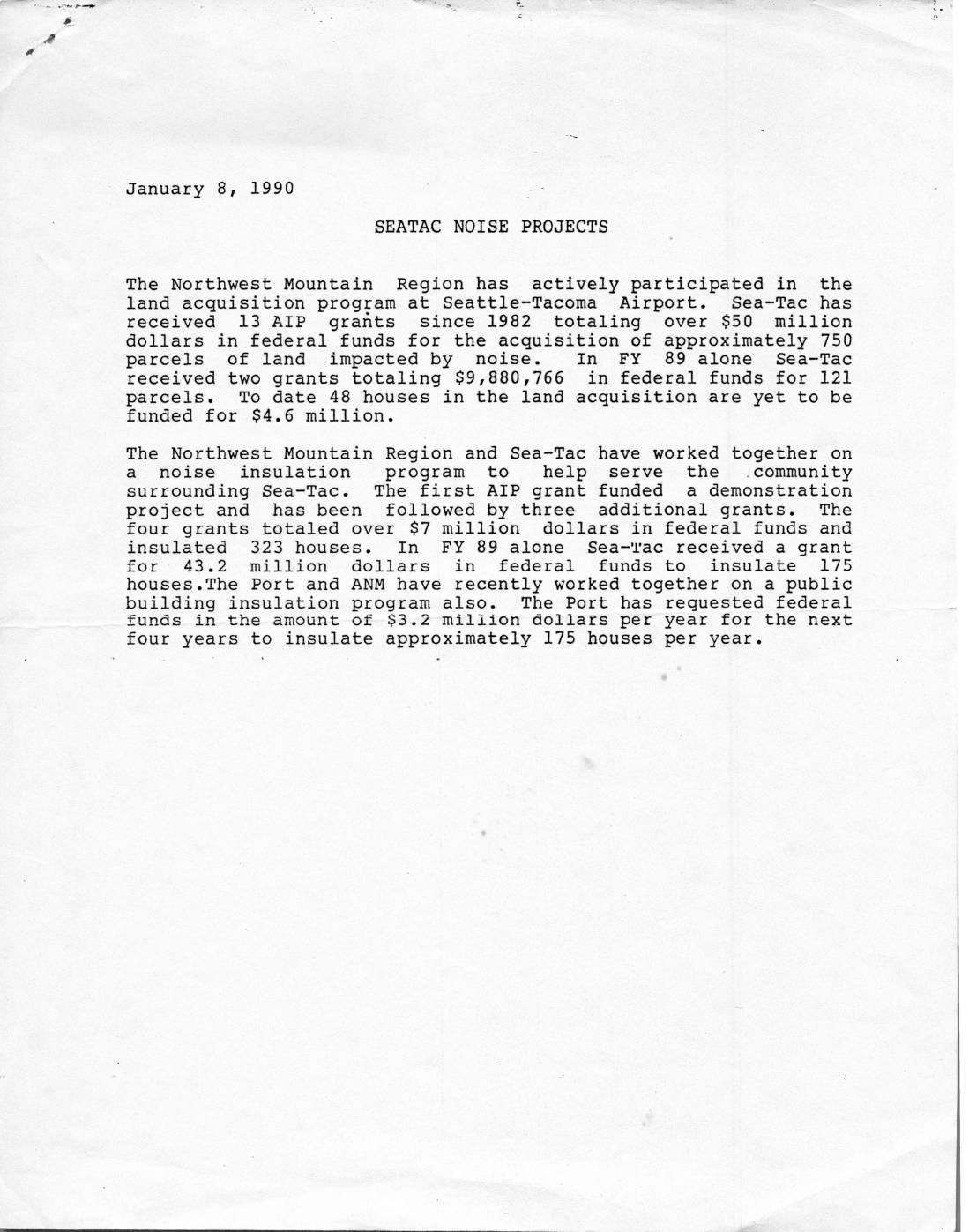
SeaTac noise projects
Since 1982, Seattle-Tacoma Airport (Sea-Tac) has received 13 federal AIP grants totaling over $50 million to acquire approximately 750 noise-impacted land parcels near the airport. In addition, four federal grants totaling over $7 million have funded a noise insulation program that has treated 323 homes, with further funding of $3.2 million per year requested to insulate roughly 175 additional houses annually over the next four years. -
 1990-01-08
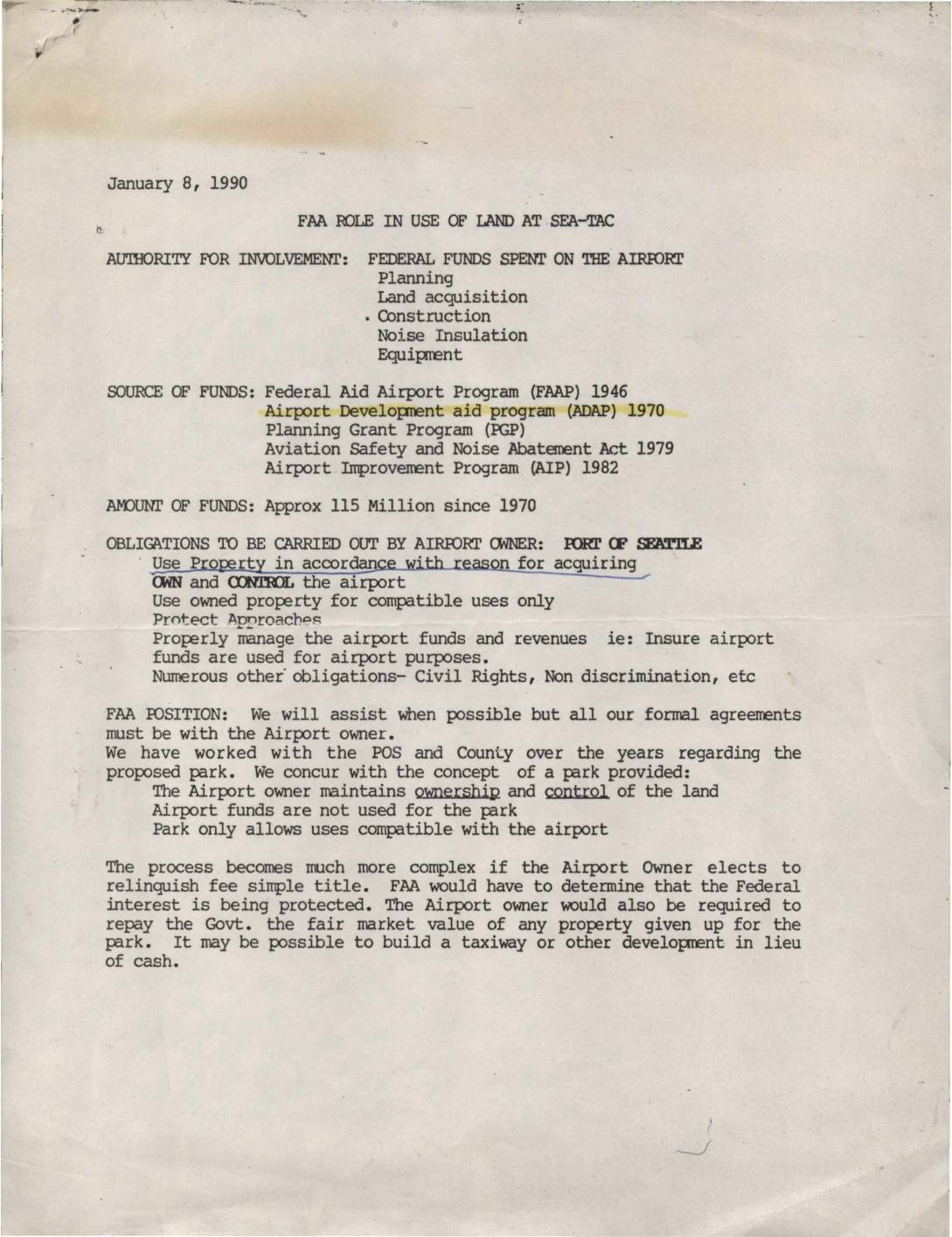
FAA role in use of land at Sea-Tac
★A January 1990 FAA briefing document outlines the agency's role in land use at Seattle-Tacoma International Airport, explaining that federal involvement stems from approximately $115 million in federal funds spent on the airport since 1970 for planning, land acquisition, construction, and noise insulation. The FAA supported the concept of a park on airport land, provided the Port of Seattle maintained ownership and control, airport funds were not used for the park, and only compatible uses were allowed. The document also details Sea-Tac's noise mitigation efforts, including over $50 million in federal grants to acquire roughly 750 noise-impacted land parcels and more than $7 million to insulate 323 homes near the airport. -
 1988-09-08
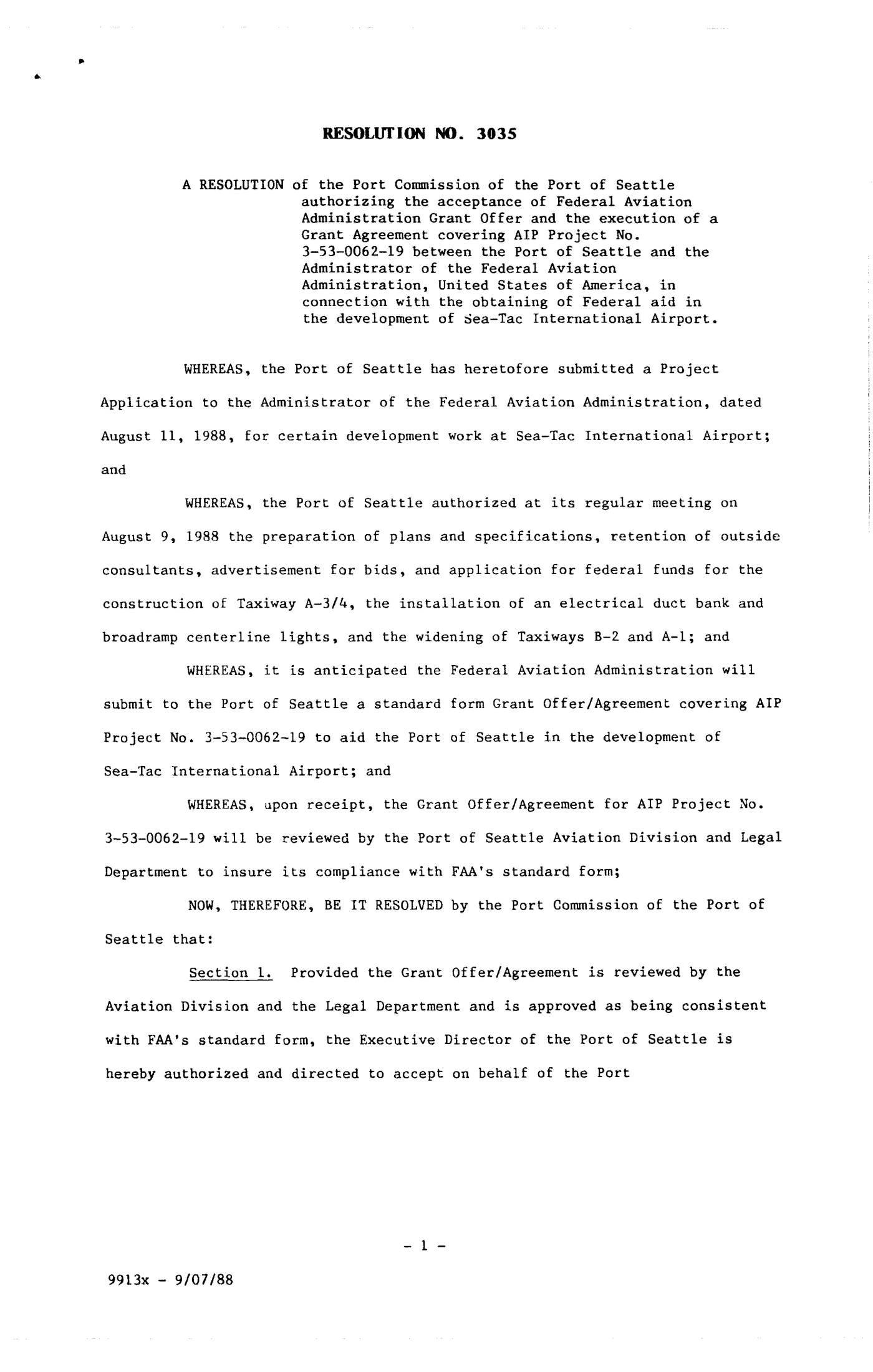
Resolution No. 3035: Authorization to accept FAA grant offer for AIP Project No. 3-53-0062-19
In September 1988, the Port of Seattle Port Commission passed Resolution No. 3035, authorizing the acceptance of a Federal Aviation Administration grant (AIP Project No. 3-53-0062-19) to fund development work at Sea-Tac International Airport. The project included construction of Taxiway A-3/4, installation of an electrical duct bank and broadramp centerline lights, and widening of Taxiways B-2 and A-1. The resolution directed the Executive Director to sign the grant agreement on the Port's behalf, provided it was reviewed and approved by the Aviation Division and Legal Department. -
 1985-09-24
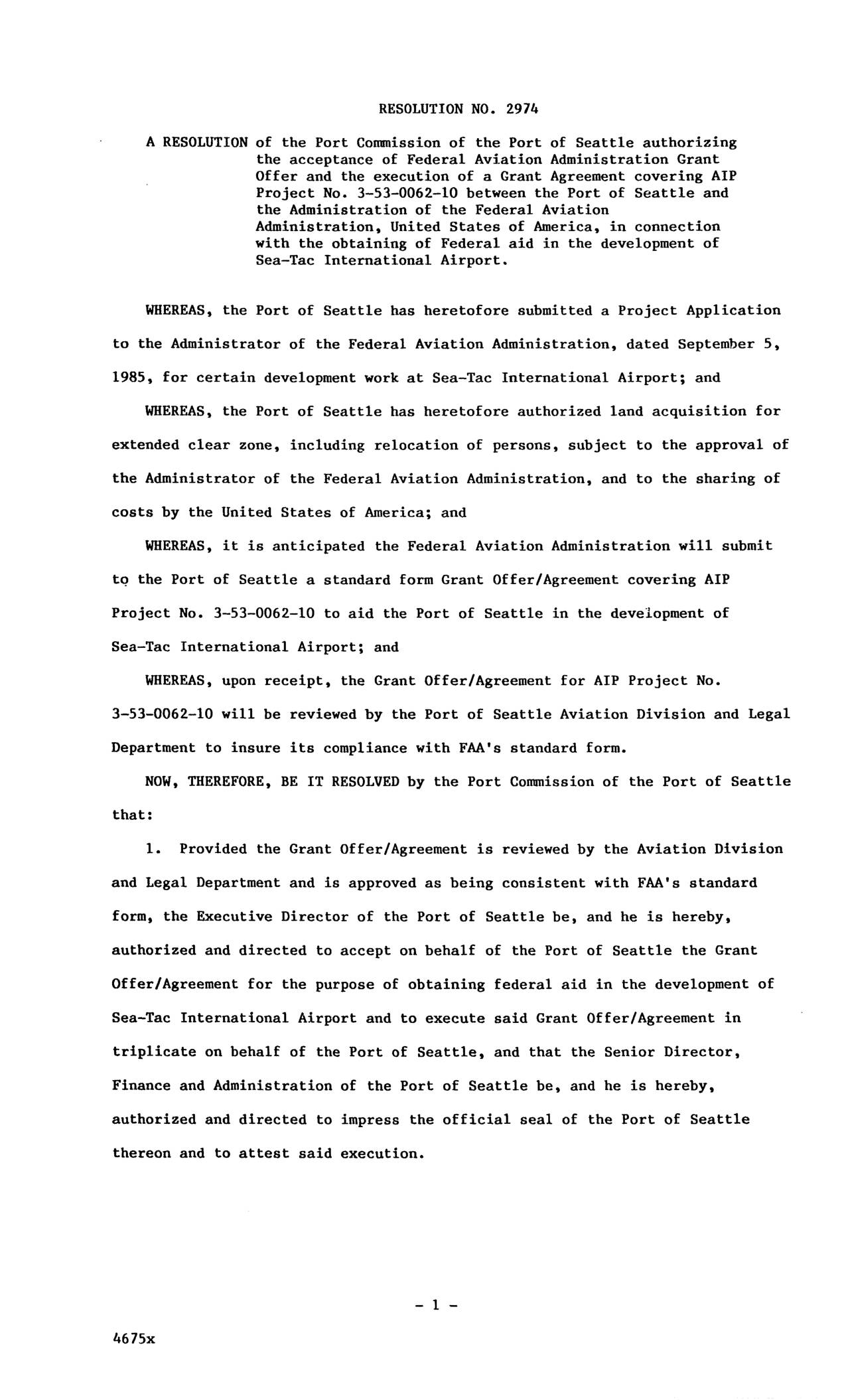
Resolution No. 2974: Authorization to accept FAA grant offer for AIP Project No. 3-53-0062-10
In September 1985, the Port of Seattle's Port Commission passed Resolution No. 2974, authorizing acceptance of a Federal Aviation Administration grant (AIP Project No. 3-53-0062-10) to fund land acquisition and relocation of residents in the extended clear zone around Seattle-Tacoma International Airport. The grant agreement, issued under Contract No. DOT-FA85NM-0062, covered nine specific land parcels (J-54, J-56, J-114, J-141, J-144, J-146, J-149, J-150, and J-151) adjacent to the airport. The resolution directed the Port's Executive Director to execute the agreement on the Port's behalf, provided it met FAA standard form requirements. -
 1984-08-28
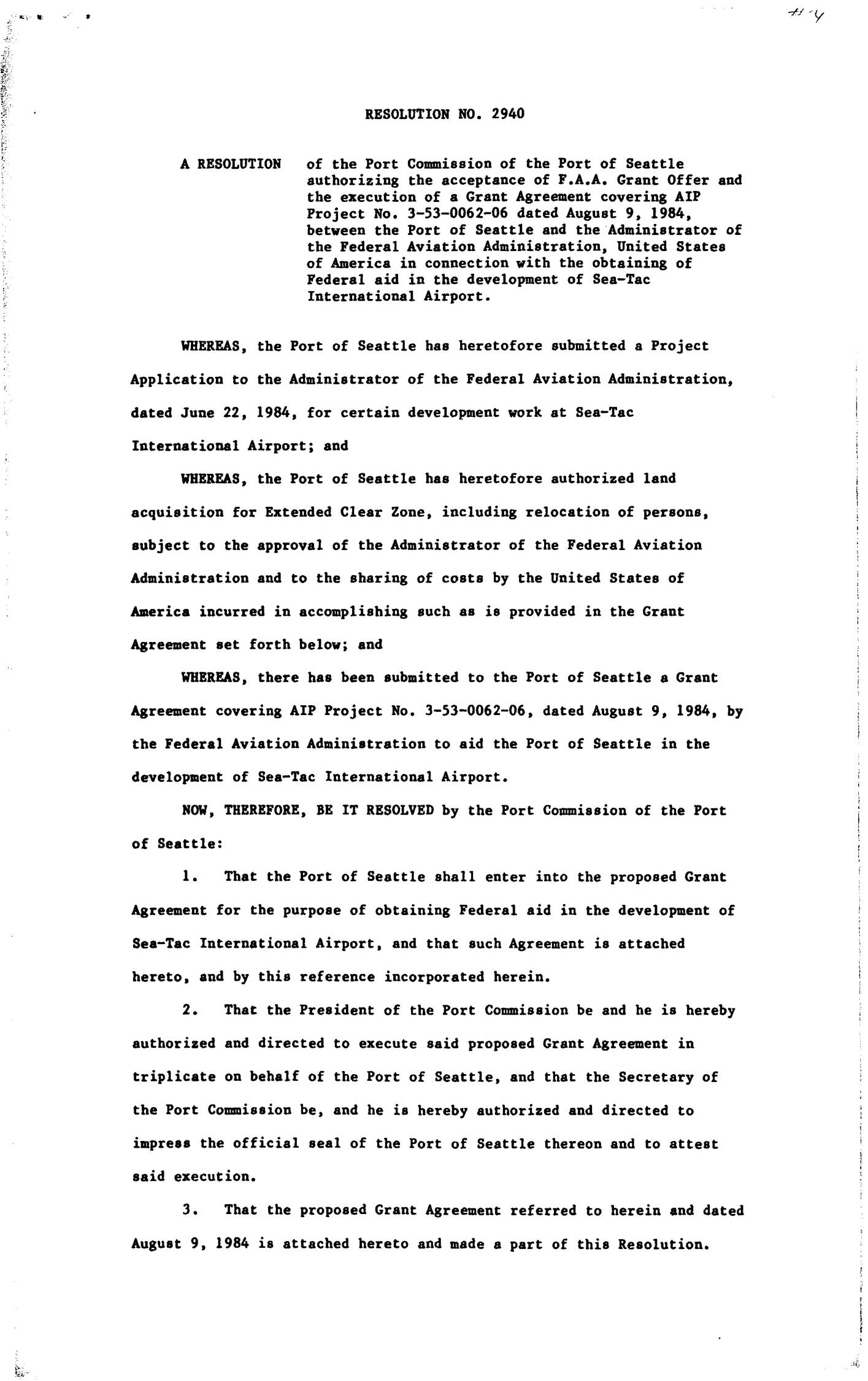
Commission Resolution no. 2940 FAA Grant AIP Clear Zone land acquisition
A resolution authorizing the Port of Seattle to accept an FAA grant offer and execute Grant Agreement for AIP Project No. 3-53-0062-06 to obtain federal aid for Sea-Tac International Airport development, specifically for land acquisition in Extended Clear Zone areas and relocation of persons. The resolution was adopted by the Port Commission on August 28,