Skip to content
  • STNI
  • Statistics
    • Ops and Passengers
      • King County International Airport (Boeing Field) Annual Operations
    • Financials
    • Aviation fuel uplift in the State of Washington 2018 – 2025
      • Aviation Fuel Uplift at Sea-Tac Airport
    • Air Quality Monitoring
    • Flight Tracking
      • Flow and Flight Tracks
      • Five Year Comparison
      • Busiest Hours and Days
    • SEL Noise Reports & Graphs
      • About The Permanent Noise Monitors
      • Minutes of Quiet by Noise Monitor
      • Noise Events mapped
      • Noise Events (SEL)
    • Runways
    • Employees
    • Real Estate
      • Port Properties and Trees mapped
    • Parking
  • Events
  • Protest
    • Regular Events
    • Legislation 2026
    • Complain about a particular flight
    • Advocacy Organizations
    • Media Outlets
    • People
    • The Port of Seattle
      • Commission Meetings
      • Public Records Requests
      • StART
      • Highline Forum
    • Contact Your Electeds
  • Resources
    • FAQs
      • FAA Occurrences/Accidents/Indents
    • The unSustainable Airport Master Plan
      • SAMP Public Comment Template
        • Two versions of Appendix K: NEPA/SEPA 2018 vs 2023
      • SAMP NTP: 31 projects by the numbers
      • SEPA Draft EIS (2026)
      • SAMP Record of Decision/FONSI (2025)
      • SAMP Draft EA (October 2024)
      • 2018 Scoping
    • Port Packages
      • Port Package Property Costs
      • Port Packages mapped
      • The Port Package Explainer
      • So you want a (first-time) Port Package? Start here
      • Port Package Looker Upper
      • How do I determine if I have a Port Package or Avigation Easement?
      • Progress on Port Package Update legislation
      • Having a Port Package Problem?
      • Port Package Site Visit Follow-Up
    • Document Library
    • Explainers
      • The Airport Law Cheat Sheet
      • The Grant Explainer
    • External Articles
    • History
      • Timeline
      • The Sea-Tac Communities Plan
        • Sea-Tac Communities Plan – Planning Maps
      • PSRC Third Runway Decision Process
    • Studies
    • Videos
  • Stories
  • Mission
  • Subscribe
  • Contact
Scroll down to content

Get InformedStay Informedx

I understand that you will never share my information with anyone, you will only use it to keep me updated on relevant events and that I may unsubscribe at any time.

STNI

STNISea-Tac Noise.Info

  • Solve for Sea-Tac. Solve for every airport.
  • Since 2016, working to obtain justice for everyone living under the flight path.
  • Less Noise. Cleaner Air. Better Public Health. Compensation.
  • Everything you think you know about the airport is wrong.

TagWashington State Legislature(136)

Advanced Search Options

  • Dates
  • Media
    • External Articles
    • Images
    • PDFs
    • Video
    • Audio
  • Order By
  • 2025-01-01

    Senate Bill 5652: Reducing Environmental and Health Disparities in Large Port Districts

    Washington Senate Bill 5652 requires large port districts, such as the Port of Seattle, to develop and adopt environmental justice implementation plans and community engagement plans by January 1, 2026. These plans must outline how the port will reduce environmental and health disparities in overburdened communities, particularly those affected by aircraft noise, and ensure meaningful participation from vulnerable populations in port decision-making. The bill also mandates compliance with federal civil rights laws and requires the use of screening tools to assess the health and demographic impacts of major port actions valued at $8 million or more.
    TagsEnvironmental Justice, Legislation, Port Of Seattle, RCW, SB5652, Washington State Legislature
  • 2024-12-17

    2023-24 State Tourism Program Operational Funding Request: Quick information

    The State of Washington Tourism program is requesting operational funding through companion bills HB 1258 and SB 5465, which would raise the general funds cap to $13 million per fiscal year and adjust industry matching requirements. Without this funding, the program faces budget cuts of 36% in 2023 and an additional 30% in 2024, threatening statewide tourism initiatives. The request represents just 1% of state sales tax collections from rental cars, lodging, and restaurants, and aims to support rural communities, responsible travel campaigns, and economic resilience across Washington State.
    TagsLegislation, local government funding, State of Washington, Tourism, Washington State Legislature
  • 2024-11-01

    Commercial Aviation Work Group Annual Report

    The Washington State Commercial Aviation Work Group submitted its first annual report to the Legislature in November 2024, summarizing early organizational steps taken since its July 2024 launch. The group, created to study airport capacity needs across Washington State over the next 20 years, held only two meetings in 2024 and remained understaffed, with just 13 of 19 required voting positions filled. Notably, Governor Inslee directed that expanding existing airports must be fully considered before any new airport site is selected, with SeaTac explicitly excluded from capacity expansion discussions.
    TagsCommercial Aviation Work Group, JBLM, Second Airport, Washington State Legislature, WSDOT
  • 2024-08-05

    Tukwila—Community at the Crossroads: The City of Tukwila Saves the Upper Duwamish Valley from Industrialization

    In the postwar decades, the Port of Seattle planned to transform the upper Duwamish Valley into a massive industrial district by straightening the river and filling its floodplains, a project that would have displaced small valley communities and caused severe environmental damage. The small City of Tukwila successfully fought back through strategic land annexations, restrictive zoning, coalition-building with state agencies, and a landmark lawsuit that challenged the Port's authority to levy a special property tax to fund the project. Tukwila's victory shaped the future of the entire King County region by preserving the valley from large-scale heavy industrialization.
    TagsDuwamish River, History, Port Of Seattle, Tukwila, Washington State Legislature
  • 2024-07-15

    Constitution of the State of Washington

    This document is the Constitution of the State of Washington, originally framed in 1889 and presented here in its currently amended form. It outlines the foundational legal framework for the state, covering individual rights, legislative powers, and executive responsibilities across multiple articles. Note that this document does not contain specific content related to Sea-Tac Airport noise policy.
    TagsLegislation, RCW, State of Washington, Washington State Legislature
  • 2024-07-12

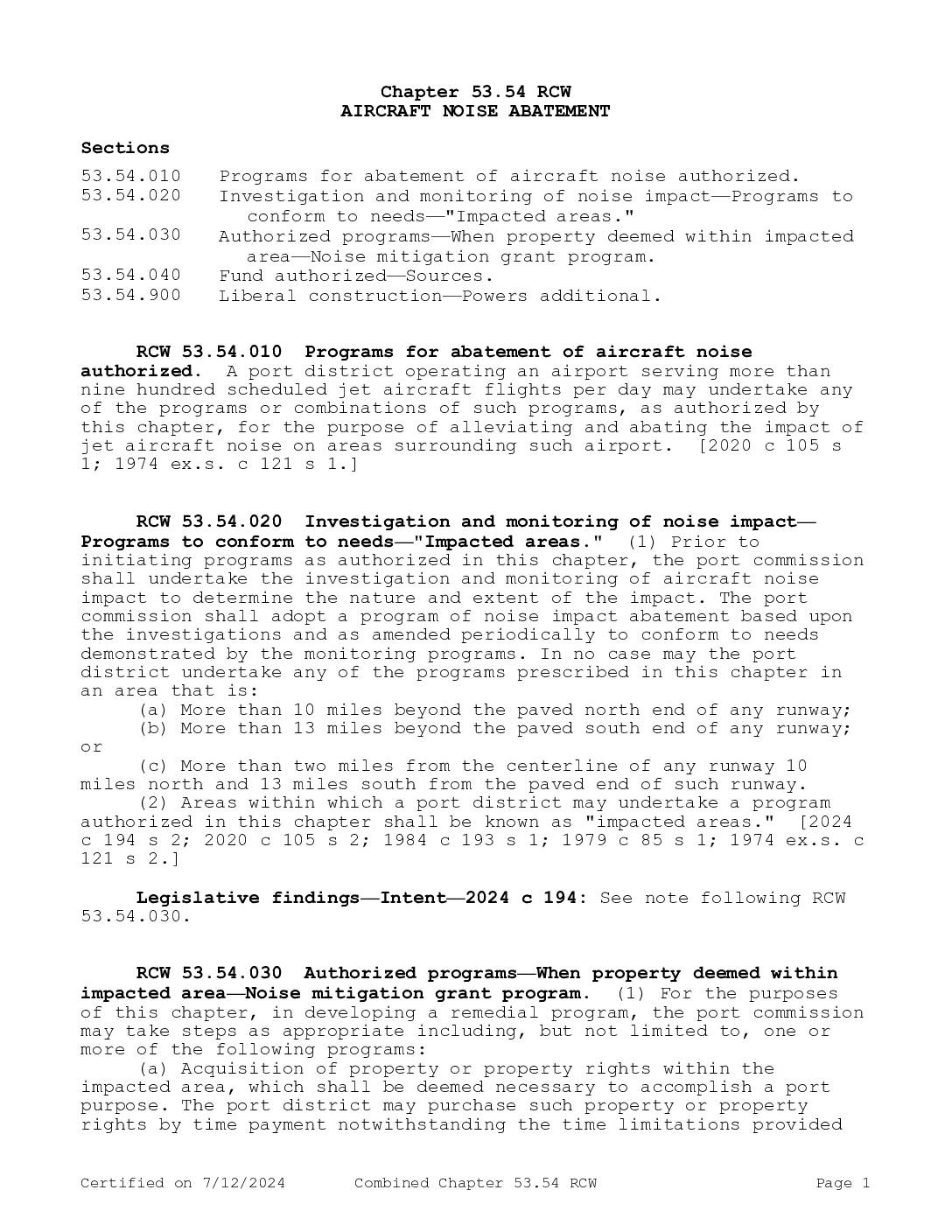
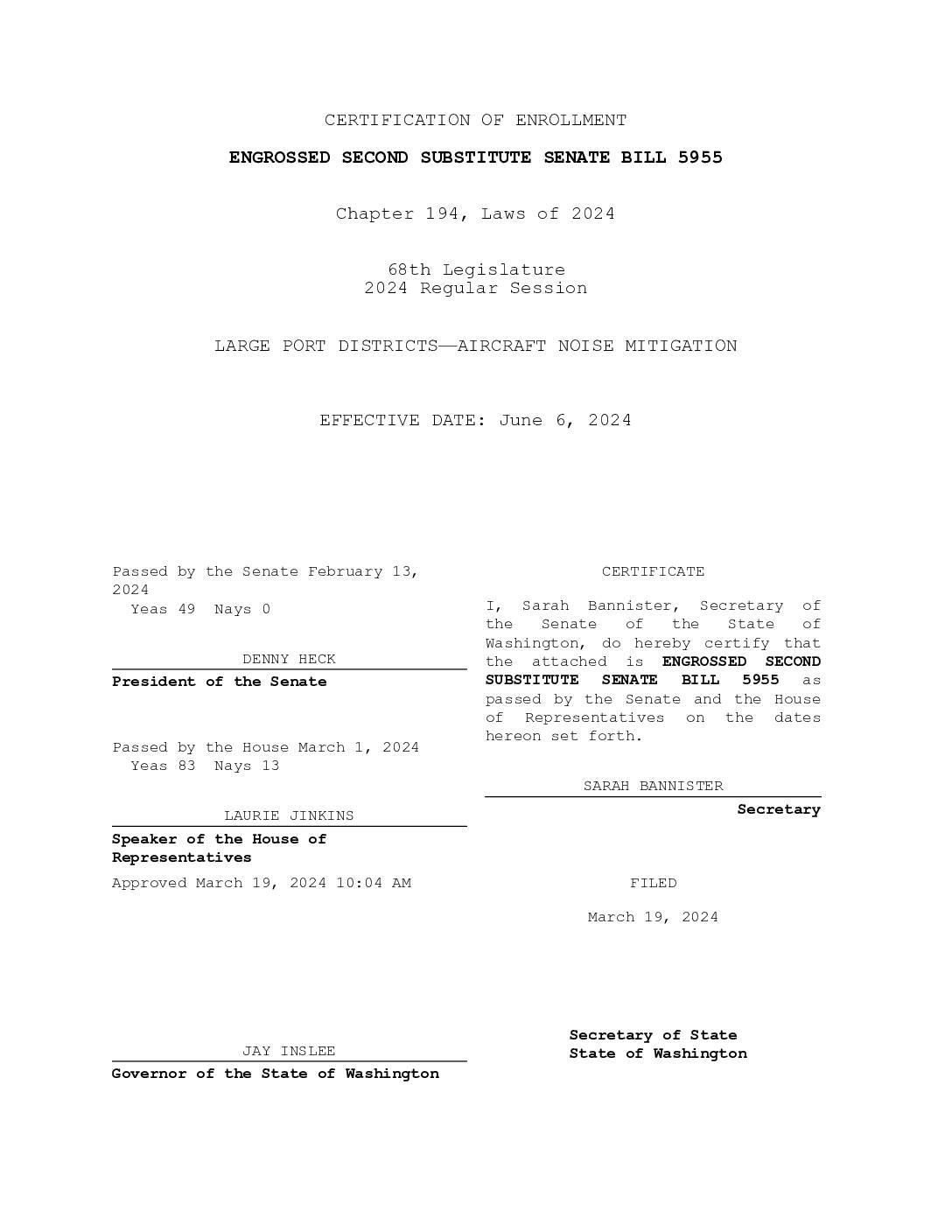
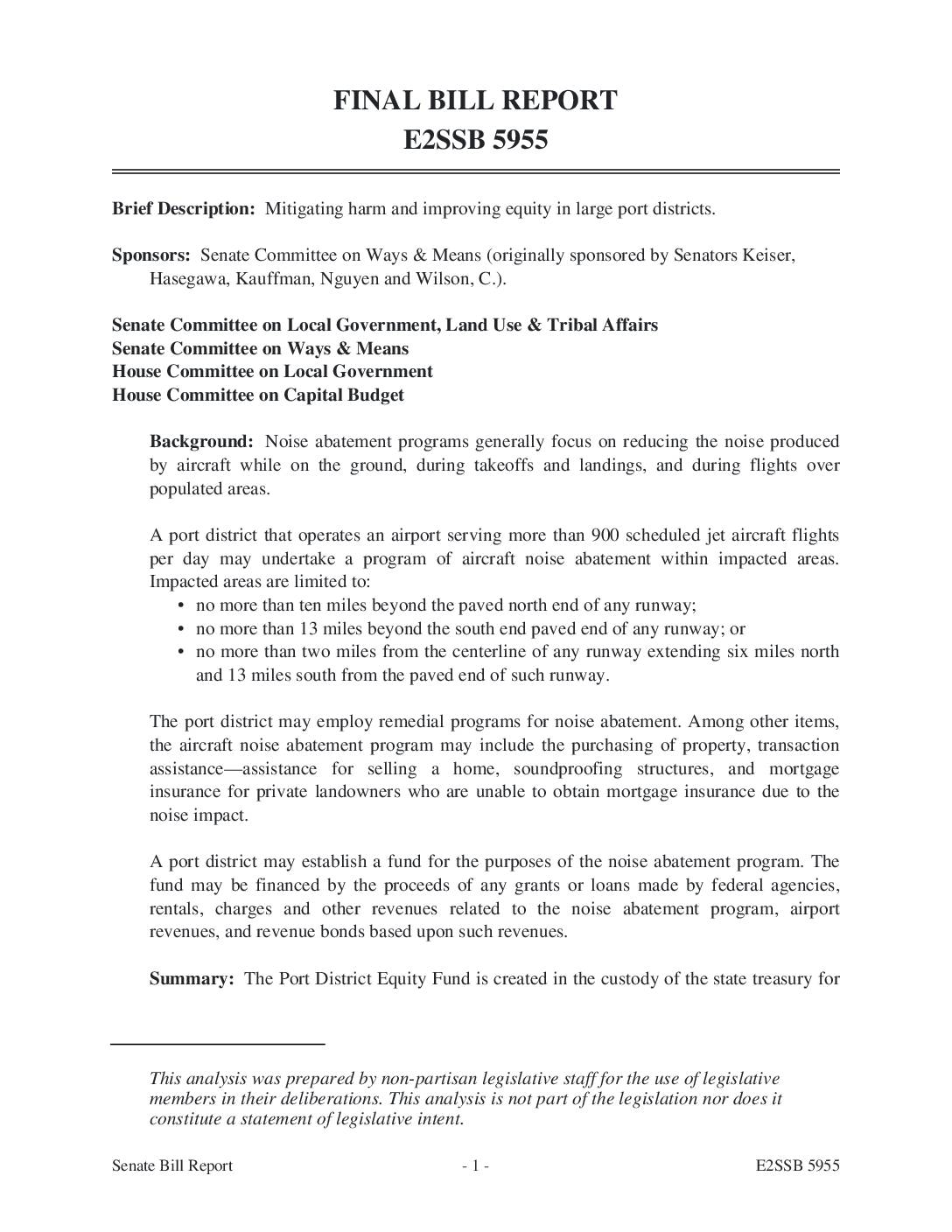
    Chapter 53.54 RCW: Aircraft noise abatement

    Chapter 53.54 RCW authorizes Washington port districts operating large airports (such as Sea-Tac) to carry out programs that reduce the impact of jet aircraft noise on surrounding neighborhoods, including purchasing properties, providing soundproofing, and offering transaction assistance to affected homeowners. The law defines 'impacted areas' with specific distance limits from runways and allows properties within those boundaries to receive noise mitigation benefits. Recent 2024 updates expand the program to allow inspection, repair, or replacement of previously installed noise mitigation equipment that is no longer working as intended or has caused structural damage.
    TagsNoise Abatement Procedures, Noise Mitigation, Port Of Seattle, RCW, Washington State Legislature
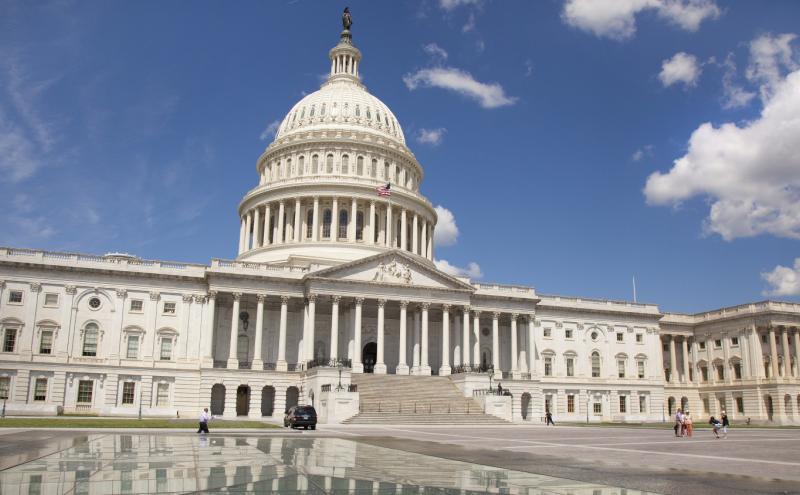
  • U.S. Capitol Building, East Front

    The East Front of the U.S. Capitol Building, seat of the U.S. Congress, photographed on a clear day. The neoclassical structure features its iconic cast-iron dome topped with the Statue of Freedom, with visitors visible on the plaza.
    TagsCongress.gov, Federal Aviation Administration, Washington State Legislature
  • 2024-05-13

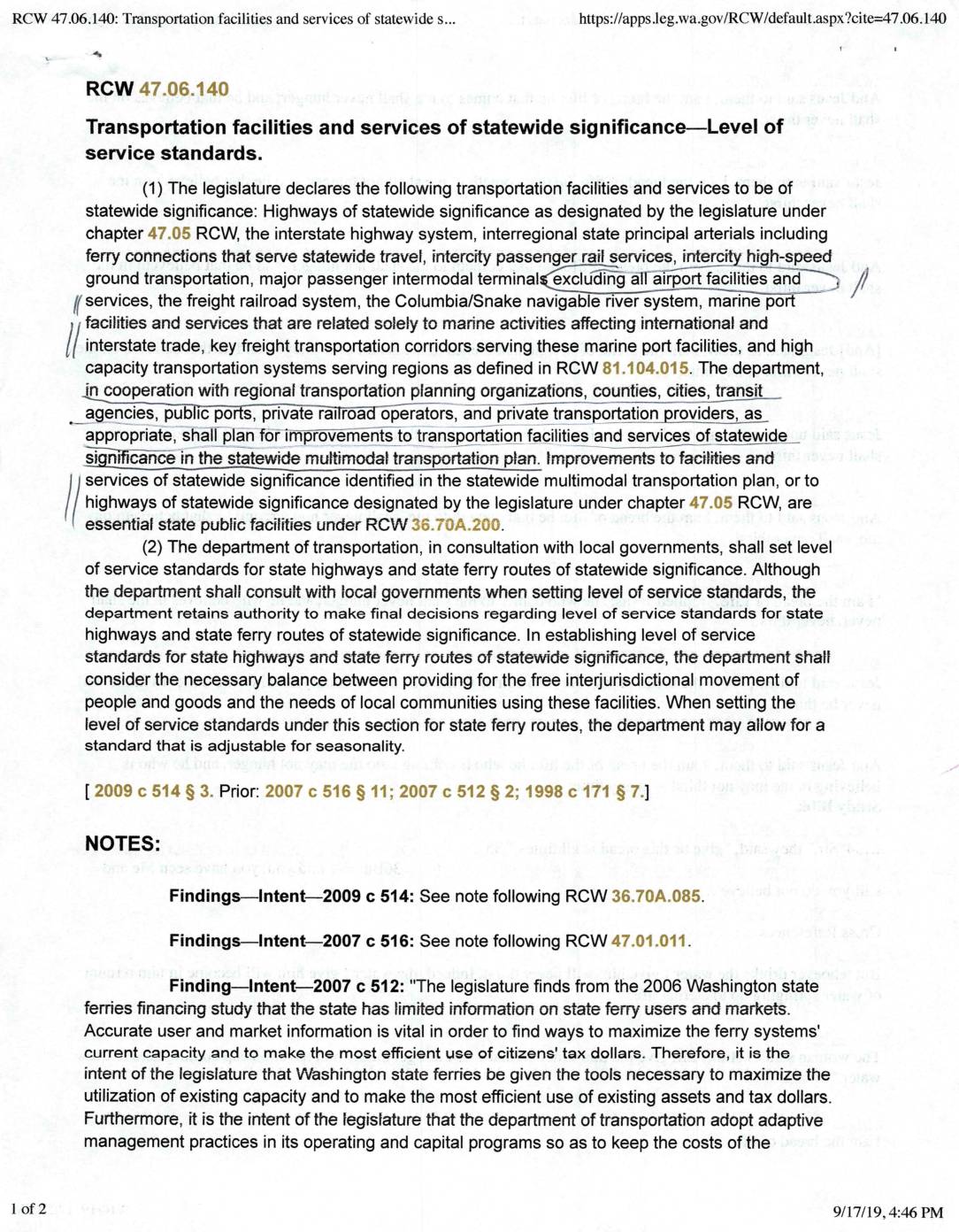
    RCW 47.06.140: Transportation facilities and services of statewide significance—Level of service standards

    RCW 47.06.140 defines transportation facilities and services of statewide significance in Washington State, including highways, the interstate system, ferry routes, freight railroads, and high-capacity transit systems, while explicitly excluding airport facilities and services from this designation. The law requires the Washington State Department of Transportation to set level of service standards for state highways and ferry routes, in consultation with local governments, while retaining final decision-making authority. Improvements to these statewide facilities are classified as essential state public facilities under RCW 36.70A.200.
    Tagsnon-aviation transportation, RCW, transportation, Washington State Legislature, WSDOT
  • 2024-05-13

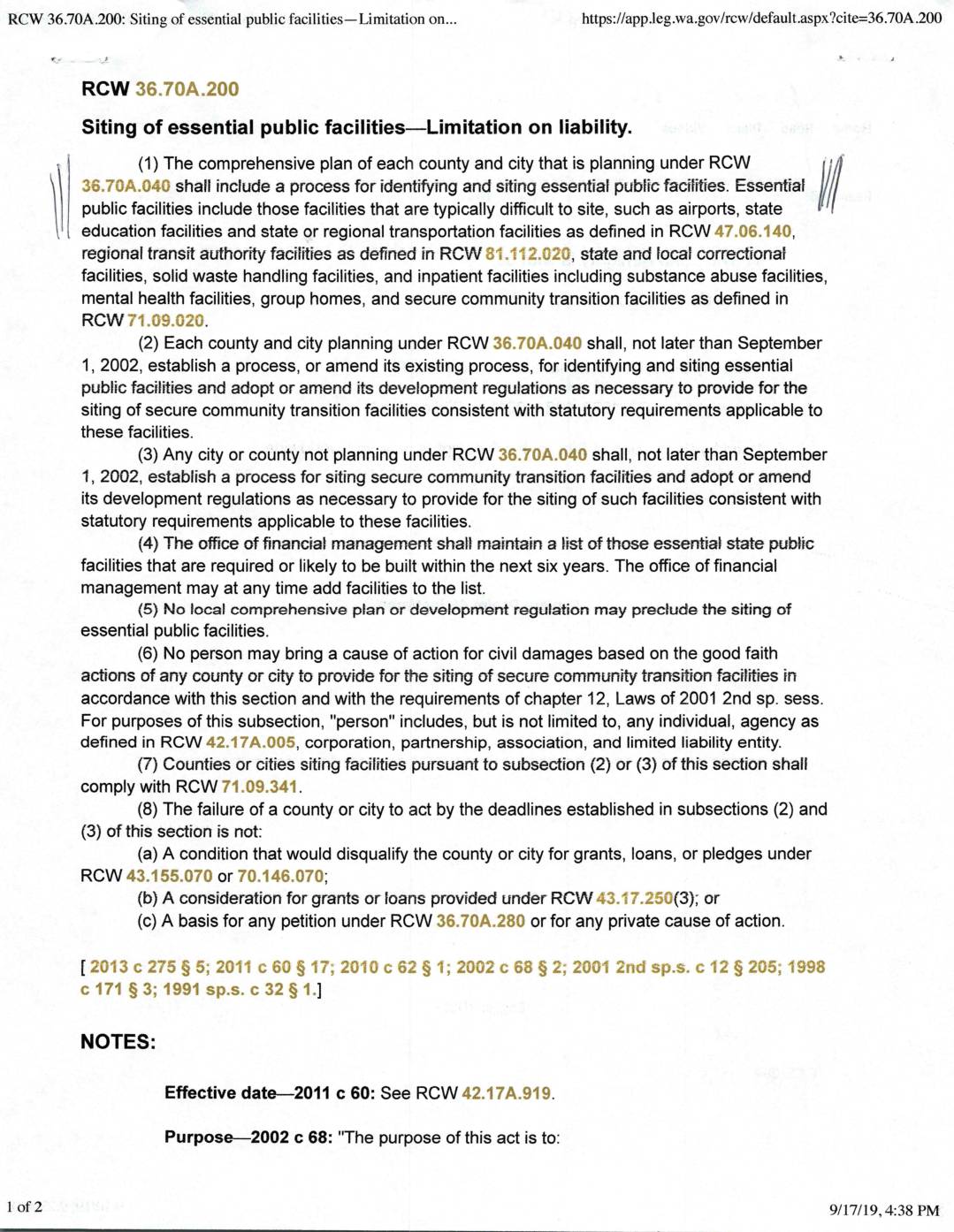
    RCW 36.70A.200: Siting of essential public facilities—Limitation on liability

    RCW 36.70A.200 requires counties and cities planning under Washington's Growth Management Act to include a process for identifying and siting essential public facilities — defined as those typically difficult to site, such as airports, state education facilities, regional transportation facilities, correctional facilities, solid waste handling facilities, and inpatient mental health or substance abuse facilities. The law explicitly prohibits any local comprehensive plan or development regulation from completely blocking the siting of such facilities. It also establishes liability protections for jurisdictions acting in good faith to site secure community transition facilities.
    TagsLand Use, Legislation, RCW, State of Washington, Washington State Legislature
  • 2024-05-13

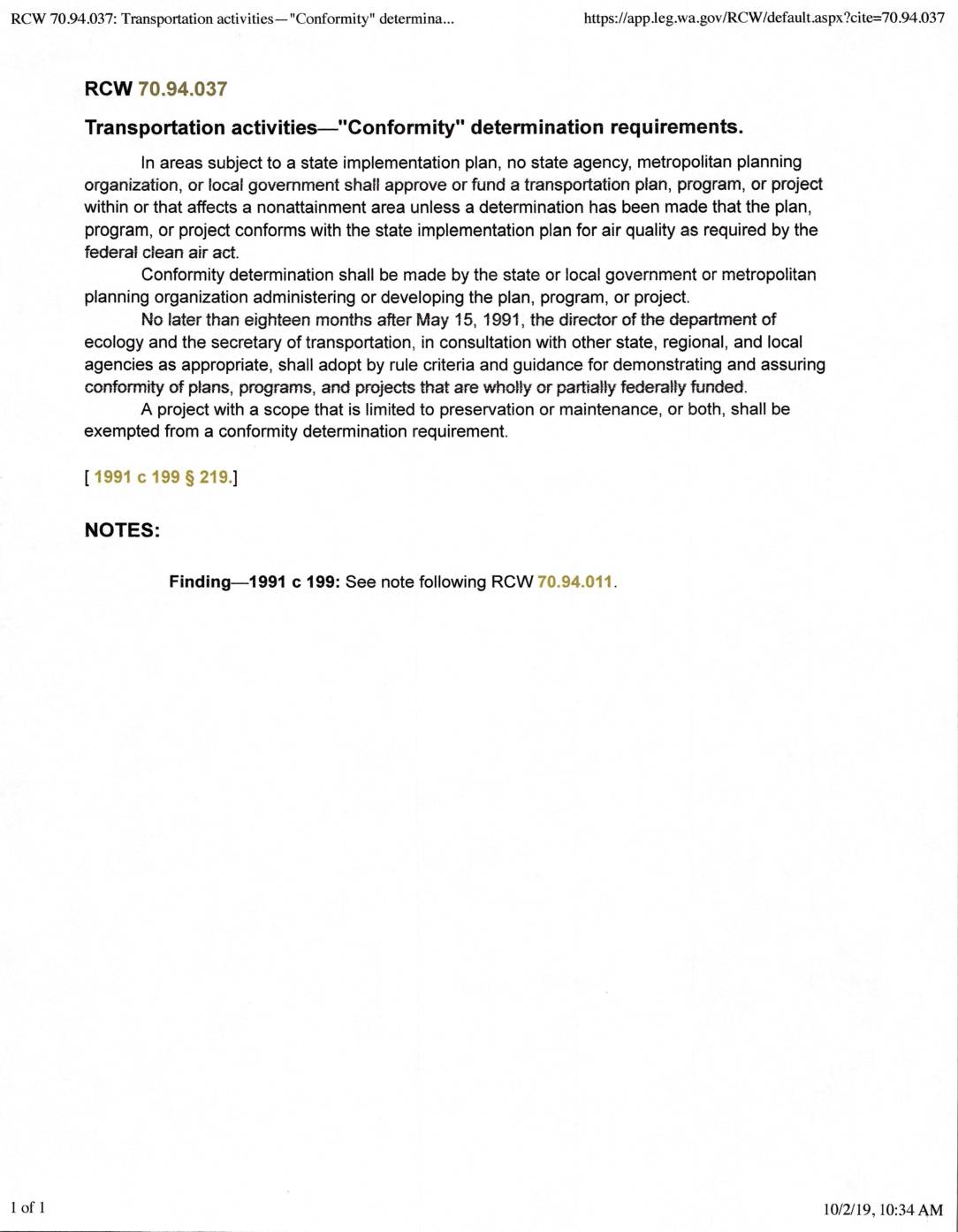
    RCW 70.94.037: Transportation activities—”Conformity” determination requirements

    Washington State law RCW 70.94.037 requires that any transportation plan, program, or project in areas that don't meet federal air quality standards must be shown to conform with the state's air quality implementation plan before it can be approved or funded. The conformity determination must be made by the responsible state agency, local government, or metropolitan planning organization overseeing the project. Projects limited strictly to preservation or maintenance work are exempt from this requirement.
    TagsClean Air Act, Conformity, RCW, transportation, Washington State Legislature

Posts pagination

Page 1 Page 2 Page 3 Page 4 Page 5 Page 6 … Page 14
Sidebar On/Off

Upcoming Events

  • StART SEA Stakeholder Advisory Round Table
    Add to CalendarMWednesday Aug 26, 5:00pm - 7:00pm
    Zoom (Virtual Meeting)
    START meetingagenda 2026826 final 0 pdf

    Meeting Objectives Introduce the primary feedback themes identified by StART members regarding StART’s Operating Procedures and determine areas that may warrant future discussion. 5:00 PM – Welcome Meeting Management Welcome Lead: Andrés Mantilla, Facilitator, Uncommon Bridges; Wendy Reiter, Airport Managing Director, POS 5:15 PM – Dinner: All participants eat. 5:30 PM – StART Operating Procedures

    [...]
  • Commercial Aviation Work Group
    Add to CalendarMThursday Sep 3, 10:00am - 1:30pm
    Virtual Meeting (Zoom)
    Cawg agenda sep 3 26 virtual pdf

    Meeting Agenda 10:00 a.m. – 10:15 a.m. | Welcome – Evan Nordby, Chair a. Introductions and Agenda Reviewb. Status of appointments and non-voting member invitationsc. Other updates as necessary 10:15 a.m. – 11:00 a.m. | Is it practical and legal to operate the western Washington [Puget Sound] airports as a single airport system? – Consultant

    [...]

[See all...]


Help study childhood asthma. Get free HEPA filter!

read more...

Issues

Sea-Tac Airport is currently undergoing the largest and longest expansion in its history, collectively known as the Sustainable Airport Master Plan (SAMP). Some of it you can already hear, but you’re probably not aware of what it all means. Here’s what you need to know.
read more...

Read This!

As the source for federal transportation grants, the Puget Sound Regional Council was charged with developing a system to meet the growing need for commercial aviation. When the search for a second airport failed, they authorized the Port of Seattle to build the Third Runway, with a mandate to develop a noise abatement and mitigation program. In their effort to stop the Third Runway, the ACC argued over every detail of the Port's efforts--including property buyouts and sound insulation. The dispute was meant to be settled by a three member Expert Arbitration Panel. This is their final report. It finds 2-1, that the Port's program was insufficient in several respects. Despite that, funding for the Third Runway was approved by the PSRC, and the 'Port Package' program, proceeded largely unchanged. Expert Arbitration Panel's final decision finding that the Port of Seattle had not shown sufficient reduction in real on-the-ground noise impacts to satisfy noise reduction conditions required for approval of a third runway at Sea-Tac International Airport. The majority decision concluded the Port's noise abatement programs were insufficient despite being impressive in scope.
continue...

The Podcast!

Subscribe to the only podcast devoted to policies, politics, history, impacts for people living under the flight path everywhere. It’s definitely not just about noise!
  • Sea-Tac Noise.Info
  • Connect with STNI

    • Subscribe
    • Port Package Problem?
    • Donate
    • Podcast
    • Socials
      • Facebook
      • X (Twitter)
      • Bluesky
      • Instagram

    "Highline Forum – 2026 World Cup Activities" — , 2026

  • Learn

    • Frequently Asked Questions
    • Explainers
    • Youtube
    • Research Requests
    • Make a complaint
  • Goals

    Fulfill the promises of 1976:
    • Compensation
    • Reduced noise
    • Improved air quality
    • Environmental remediation
Login/Register
©2026•Data Privacy

Message

We use cookies to provide basic functionality. We also provide access to search engines in order to provide site analytics. We do not sell or share your data.
V V