TagSea-Tac Airport(1855)
-
 1998-06-01
Sound Information: Sea-Tac Airport Noise Abatement Office Newsletter, Summer 1998
This Summer 1998 newsletter from the Seattle-Tacoma International Airport Noise Abatement Office covers the Noise Remedy/Home Sound Insulation Program, explaining how the program boundary was established using 65 DNL noise contours and noting that 6,375 of 10,000 eligible homes had been insulated by Q1 1998. It also includes a quarterly report on fleet noise compliance, flight pattern changes, and an update on the Part 150 Noise Study, which was set to be presented at a public open house on July 23, 1998. Additionally, the newsletter lists upcoming regional airshow events for summer 1998, including Seafair and the Blue Angels, along with associated noise complaint contact numbers. -
 1998-06-01
Port Of Seattle Sea-Tac Propeller Aircraft Flight Track Patterns
This Port of Seattle document explains flight track plots for propeller aircraft at Seattle-Tacoma International Airport, showing the ground paths of arrivals and departures during daytime hours (6 a.m. to 10 p.m.) for both north and south traffic flows. Aircraft flight paths vary due to pilot technique, weather, and air traffic control, meaning planes assigned the same route will not follow identical tracks. On average, Sea-Tac experiences south flow conditions 65% of the year and north flow 35%, with propeller aircraft kept on separate tracks from faster jet aircraft. -
 1998-06-01
Port Of Seattle Sea-Tac Jet Aircraft Flight Track Patterns: North Flow and South Flow, Summer 1998
This Port of Seattle document explains flight track plots for Seattle-Tacoma International Airport, which map the ground paths of jet aircraft arrivals and departures during daytime hours (6am–10pm). It describes how wind conditions determine whether aircraft fly in a north or south flow pattern, with south flow occurring about 65% of the year. The document also notes that even aircraft following identical routes will not fly the exact same path, due to variations in pilot technique, weather, air traffic control, and aircraft performance. -
 1998-05-01
Seattle-Tacoma International Airport FAR Part 150 Study Update: Regulatory Environmental Meeting
This May 1998 document from the Barnard Dunkelberg & Company Team presents a FAR Part 150 Study Update for Seattle-Tacoma International Airport, covering the history of federal aviation noise policy. It traces key regulatory milestones including the FAA Aviation Noise Abatement Policy of 1976, the Aviation Safety and Noise Abatement Act of 1979, and the Airport Noise and Capacity Act of 1990. The document explains what FAR Part 150 is, what it means for airport operators and surrounding communities, and how voluntary land-use compatibility studies evolved into formal regulatory requirements over time. -
 1998-04-15
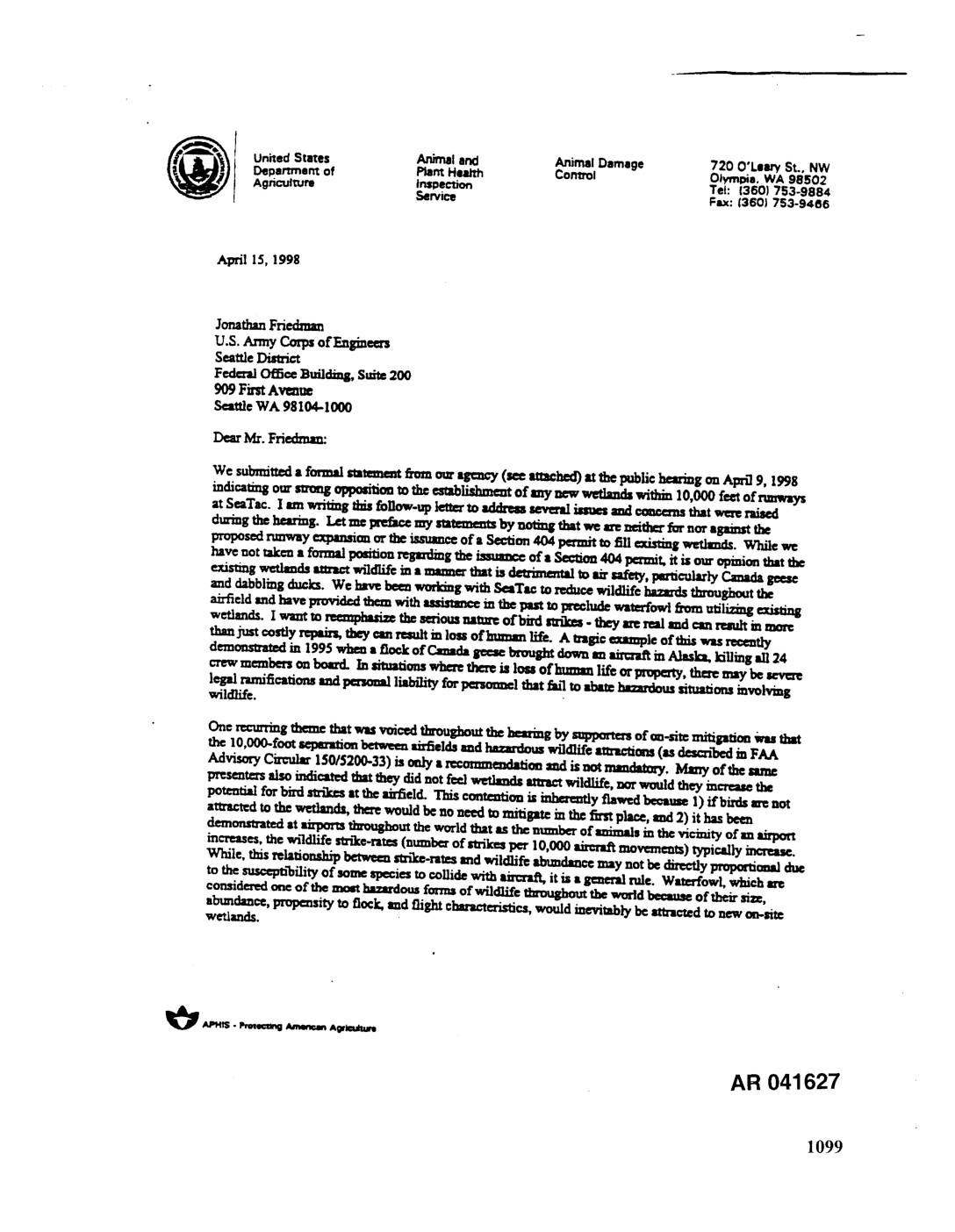
EXH AR041627: USDA APHIS Animal Damage Control Letter to U.S. Army Corps of Engineers Opposing New Wetlands Within 10,000 Feet of Sea-Tac Airport Runways
Letter dated April 15, 1998 from J. Gary Oldenburg, USDA Animal and Plant Health Inspection Service (APHIS) Animal Damage Control, State Director WA/AK/HI/Pacific Islands, to Jonathan Friedman, U.S. Army Corps of Engineers Seattle District, follow-up to public hearing of April 9, 1998. Strongly opposes establishment of any new wetlands within 10,000 feet of runways at -
 1998-04-09
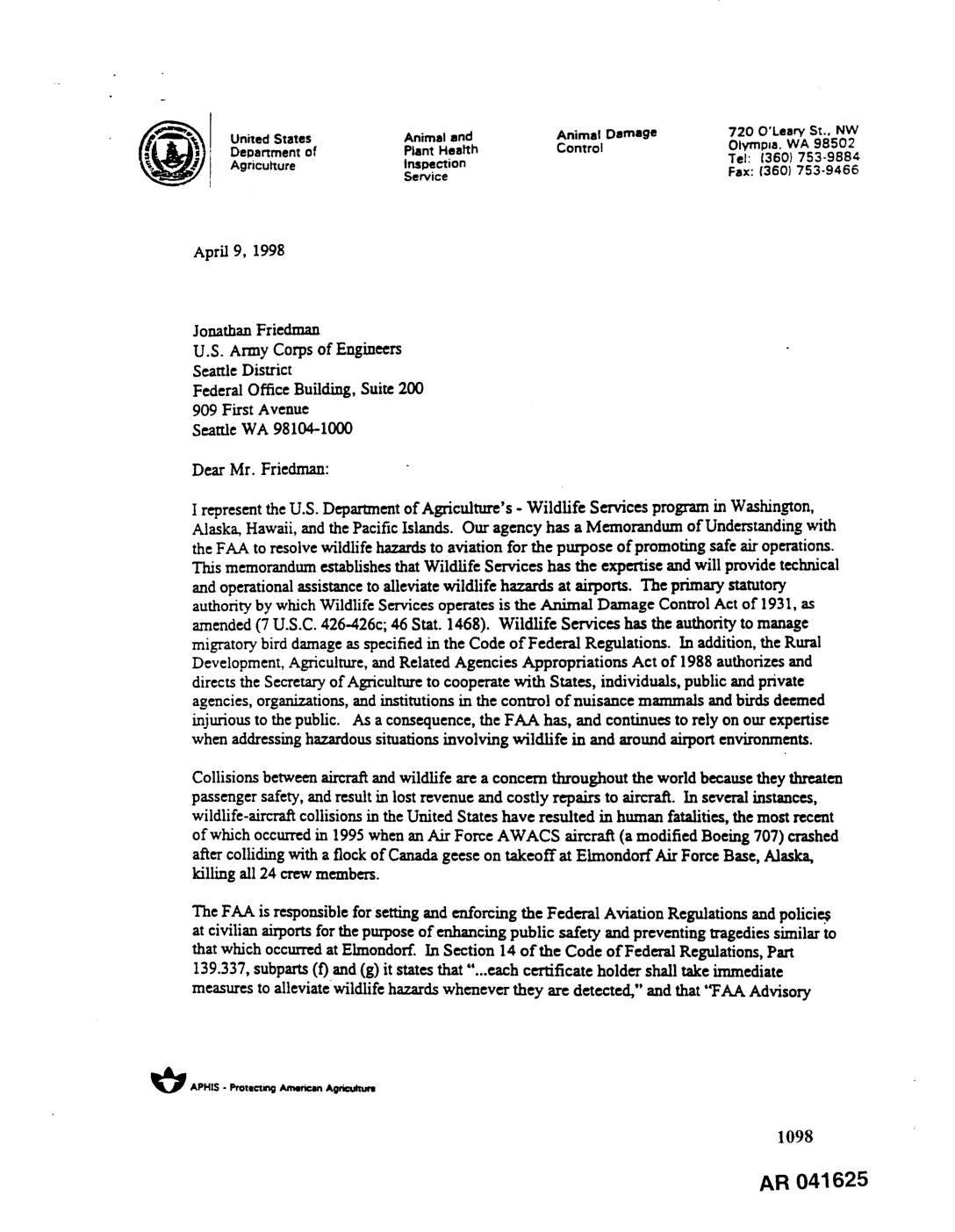
EXH AR041625: Letter from USDA Wildlife Services to U.S. Army Corps of Engineers Regarding Wetland Mitigation at Sea-Tac Airport
April 9, 1998 letter from Gary Oldenburg, USDA Animal and Plant Health Inspection Service (APHIS) Wildlife Services State Director for WA/AK/HI/Pacific Islands, to Jonathan Friedman, U.S. Army Corps of Engineers Seattle District, regarding wildlife hazards at Sea-Tac Airport. Argues that wetland mitigation measures at SeaTac Airport should be conducted off-site, citing FAA Advisory Circular 150/5200-33 -
 1998-04-06
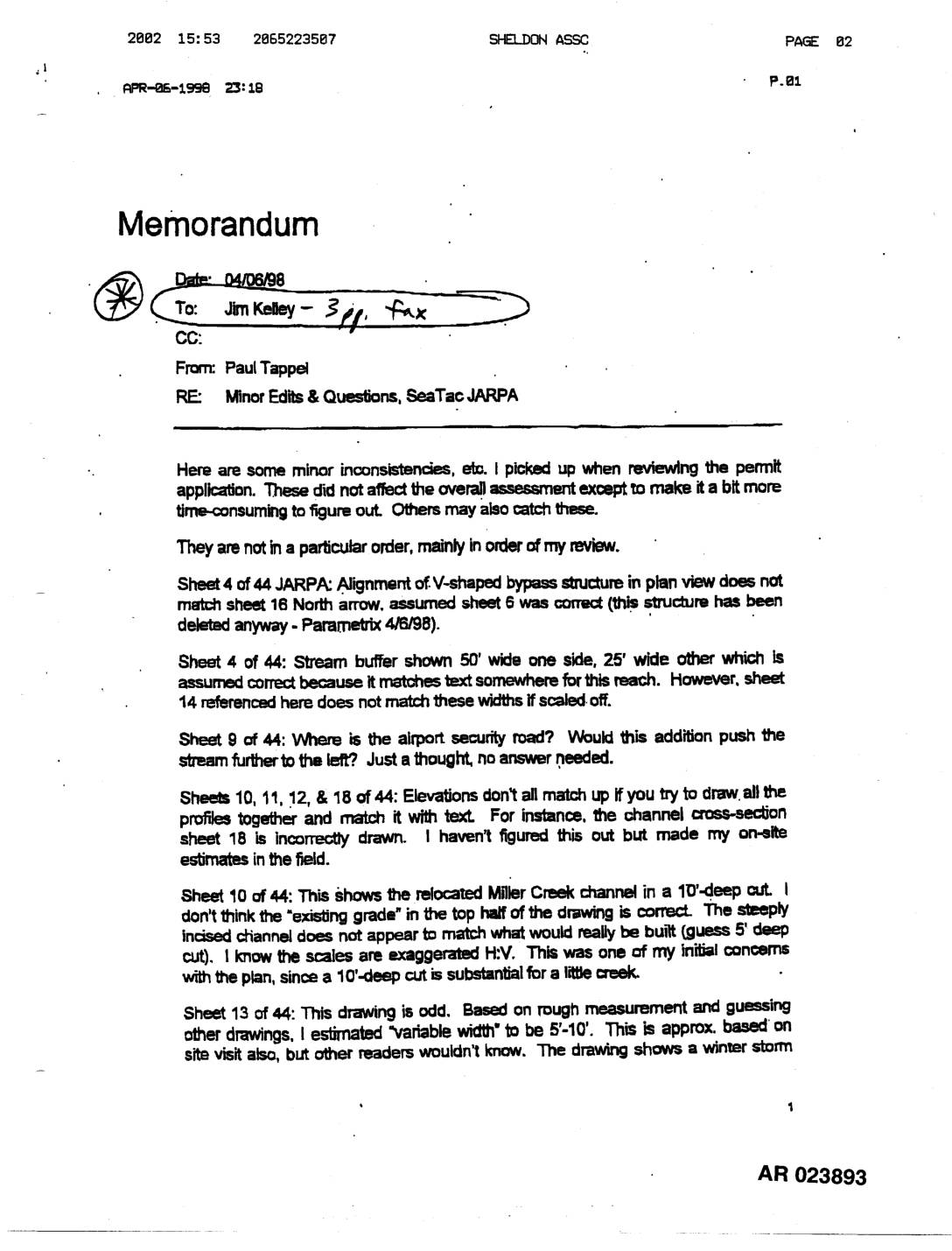
EXH AR023893: Memo Tappel to Kelley — Minor Edits & Questions, STIA JARPA
A April 6, 1998 internal memorandum from Paul Tappel to Jim Kelley identifies minor technical inconsistencies and questions in the Sea-Tac Airport JARPA permit application, focusing on discrepancies in engineering drawings, stream buffer widths, channel elevation profiles, and hydraulic calculations for a proposed Miller Creek relocation. Tappel raises concerns that the plan overstates the environmental benefits of the reconstructed creek channel and contains contradictory goals regarding wildlife habitat and airport bird-strike safety. He notes these issues are not critical to the overall assessment but could cause confusion as the design moves forward. -
 1998-04-01
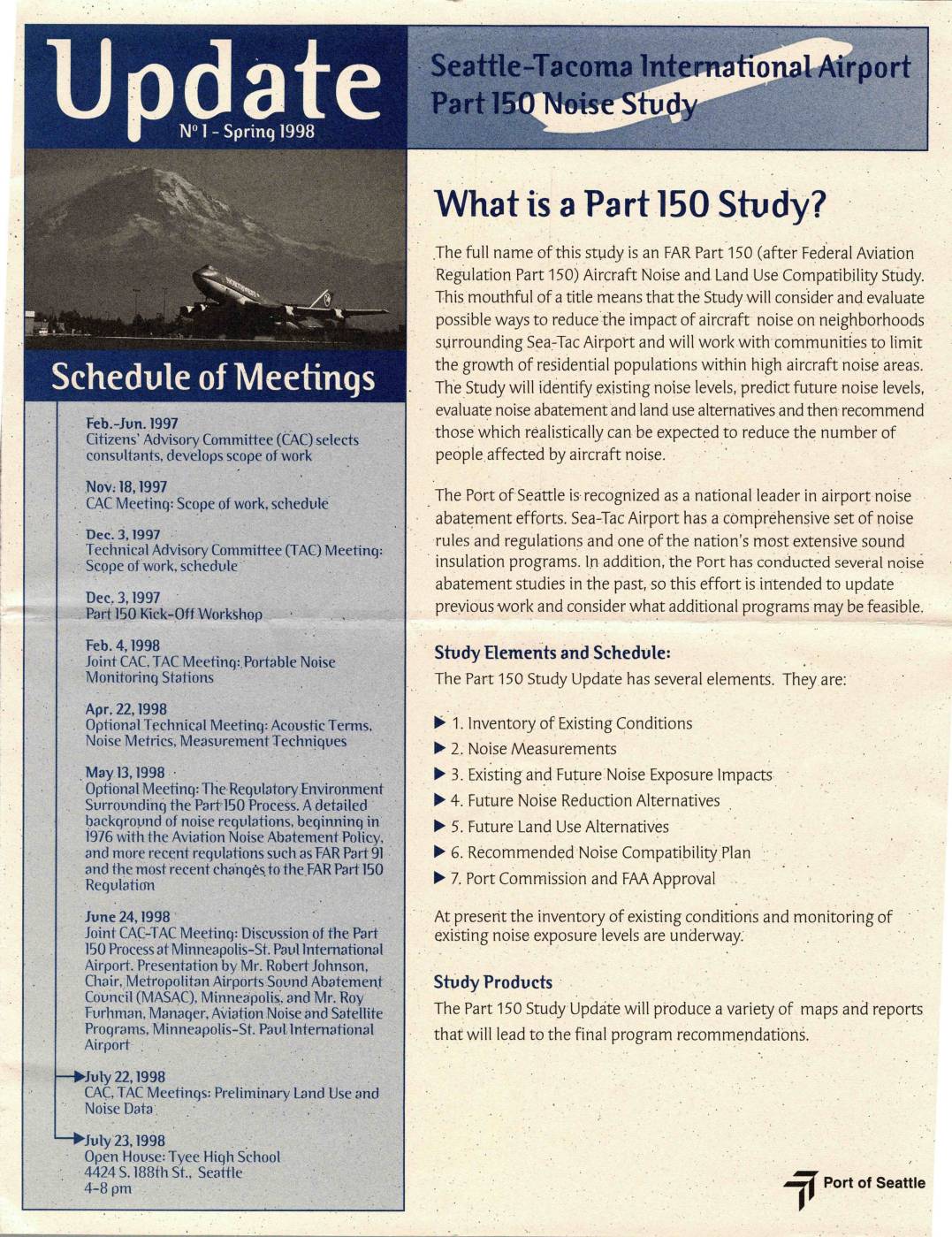
Seattle-Tacoma International Airport Part 150 Noise Study Update No. 1 – Spring 1998
This Spring 1998 newsletter from the Port of Seattle provides an update on the Seattle-Tacoma International Airport FAR Part 150 Aircraft Noise and Land Use Compatibility Study, which aims to reduce the impact of aircraft noise on surrounding neighborhoods. The study involves measuring existing and predicting future noise levels, evaluating noise reduction and land use alternatives, and producing noise exposure maps using the FAA's Integrated Noise Model. Citizens raised key concerns at an initial open house, including adherence to flight tracks, ground noise, and expansion of sound insulation programs, with findings to be presented at a second public open house on July 23, 1998. -
 1998-04-01
EXH AR027166: DMR April 1998 — Sea-Tac Airport Discharge Monitoring Report
Discharge Monitoring Report (DMR) for April 1998, permit number WA-002465-1, discharge number 001 (IWS), submitted by Port Of Seattle for Sea-Tac Airport (facility #681), P.O. Box 68727, Seattle WA 98168. Monitoring period covers April 1–30, 1998. Parameters monitored include flow (GPM), pH, oil and grease (mg/L), TSS (mg/L), BOD5 (mg/L), total glycols (mg/L), and TPH -
 1998-03-01
Truth in Aviation: The newsletter of the Regional Commission on Airport Affairs, Vol. 5, No. 1, Spring 1998
This 1998 newsletter from the Regional Commission on Airport Affairs covers several controversies surrounding Sea-Tac Airport's expansion, including a 24% cost overrun on the new parking garage, Port staff admitting they lack the capacity to manage over 100 simultaneous expansion projects, and the Highline School District launching an independent study of airport noise impacts on classrooms after failed negotiations with the Port. Additional issues covered include a proposed wetlands destruction permit for the third runway site, plans to extend King County International Airport's runway closer to Georgetown neighborhoods, and legal battles over city comprehensive plans that opposed airport expansion.