TagSea-Tac Airport(1855)
-
 2026-06-08
Part 150 Study Technical Review Committee Meeting #6
Presentation slides for the sixth meeting of the Part 150 Study Technical Review Committee (TRC) for Seattle-Tacoma International Airport, held June 8, 2026. The meeting covered potential Noise Compatibility Program (NCP) measures including noise abatement, land use, and program management. The agenda also included a review of the previous meeting summary, project schedule, and future -
 2026-06-05
Acoustical Testing Results for SIRRPP — June 2026
This technical memorandum from Harris Miller Miller & Hanson Inc. (HMMH), dated June 5, 2026, presents the results of interior sound insulation testing conducted in April 2026 for 30 homes near Seattle-Tacoma International Airport as part of the SEA Repair and Replacement Program. Acoustical engineers measured how well each room in these homes reduces outside aircraft noise, finding that only 4 of the 30 structures met the FAA's minimum threshold of 45 decibels of interior noise to qualify for sound insulation treatments. An additional 16 homes had at least one room exceeding that threshold, suggesting potential benefit from window and door upgrades, though current FAA policy does not require treatment based on individual room results alone. -
 2026-05-28
Formal Comment by Jeffrey Bogen: Aircraft Seat Capacity Estimates and Fleet Upgauging in the Seattle-Area Metroplex (SAMP) Environmental Impact Statement
A Des Moines resident's formal comment on the Seattle-Area Metroplex Environmental Impact Statement argues that Sea-Tac Airport's official planning assumption — that average aircraft size will grow by only 0.5% per year — is mathematically incompatible with the airport's own goal of 56 million annual passengers by 2032. The comment shows that reaching that passenger target under the current assumption would require roughly 880,000 flights per year, far exceeding the airport's infrastructure ceiling of about 517,000 operations. The author contends that airlines like Alaska and Delta are already ordering larger aircraft and expanding international routes at Sea-Tac, meaning faster fleet upgauging is not a worst-case scenario but a necessity for the plan to make sense. -
 2026-05-28
Formal Comment by Jeffrey Bogen: SAMP EIS Aircraft Fleet Mix Seat Estimates Assumptions Not Accurate Today
A Des Moines resident's formal comment on the Sea-Tac Airport Master Plan (SAMP) Environmental Impact Statement argues that the SAMP's aircraft seat capacity assumptions are now outdated, pointing to major 2026 fleet expansions by Alaska Airlines and Delta that include significantly more and larger widebody aircraft operating from SEA. The comment contends that because larger planes carry more passengers per flight, fewer total aircraft operations would be needed to reach the SAMP's 56 million passenger target, meaning the airport could handle projected growth with less noise impact than the SAMP currently estimates. The author presents revised seat-capacity scenarios suggesting the SAMP's low-growth assumption is internally inconsistent and that updated fleet data should be incorporated into the EIS before final conclusions are drawn. -
 2026-05-28
Technical Appendix: SEA Airport Capacity Analysis — Supporting Documentation for Capacity White Papers
This technical appendix, prepared by Jeffery Bogen of DAAC in May 2026, analyzes runway and airspace capacity at Seattle-Tacoma International Airport (SEA) to support the Port of Seattle's Sustainable Airport Master Plan (SAMP) environmental review process. It compares FAA 2016 baseline hourly flow rates against observed 2024–2026 performance data, documents current capacity improvements, and projects annual flight operations through 2037 under both constrained and unconstrained growth scenarios. The document is intended as supporting reference material for public comments on seating capacity impacts under SEPA/EIS review. -
 2026-05-26
Port Of Seattle regular commission meeting agenda, May 26, 2026
This document is the agenda for the Port of Seattle Regular Commission Meeting held on May 26, 2026, covering routine administrative and business items such as approval of meeting minutes, claims, and several construction and technology contracts. Key action items include authorizations related to the S Concourse Evolution project at Seattle-Tacoma International Airport, a shore power project at Pier 66, and an emergency power scope of work for the Main Terminal Improvement Program. The agenda does not contain any items specifically addressing airport noise policy. -
 2026-05-26
Sustainable airport master plan near-term projects state environmental policy act draft environmental impact statement and next steps
Presentation about the Port of Seattle’s Sustainable Airport Master Plan Near-Term Projects, covering the completed NEPA process and the required SEPA Draft Environmental Impact Statement. The document outlines various airport infrastructure projects including runway improvements, terminal facilities, maintenance facilities, and cargo operations planned for Sea-Tac Airport. -
TRACON S46
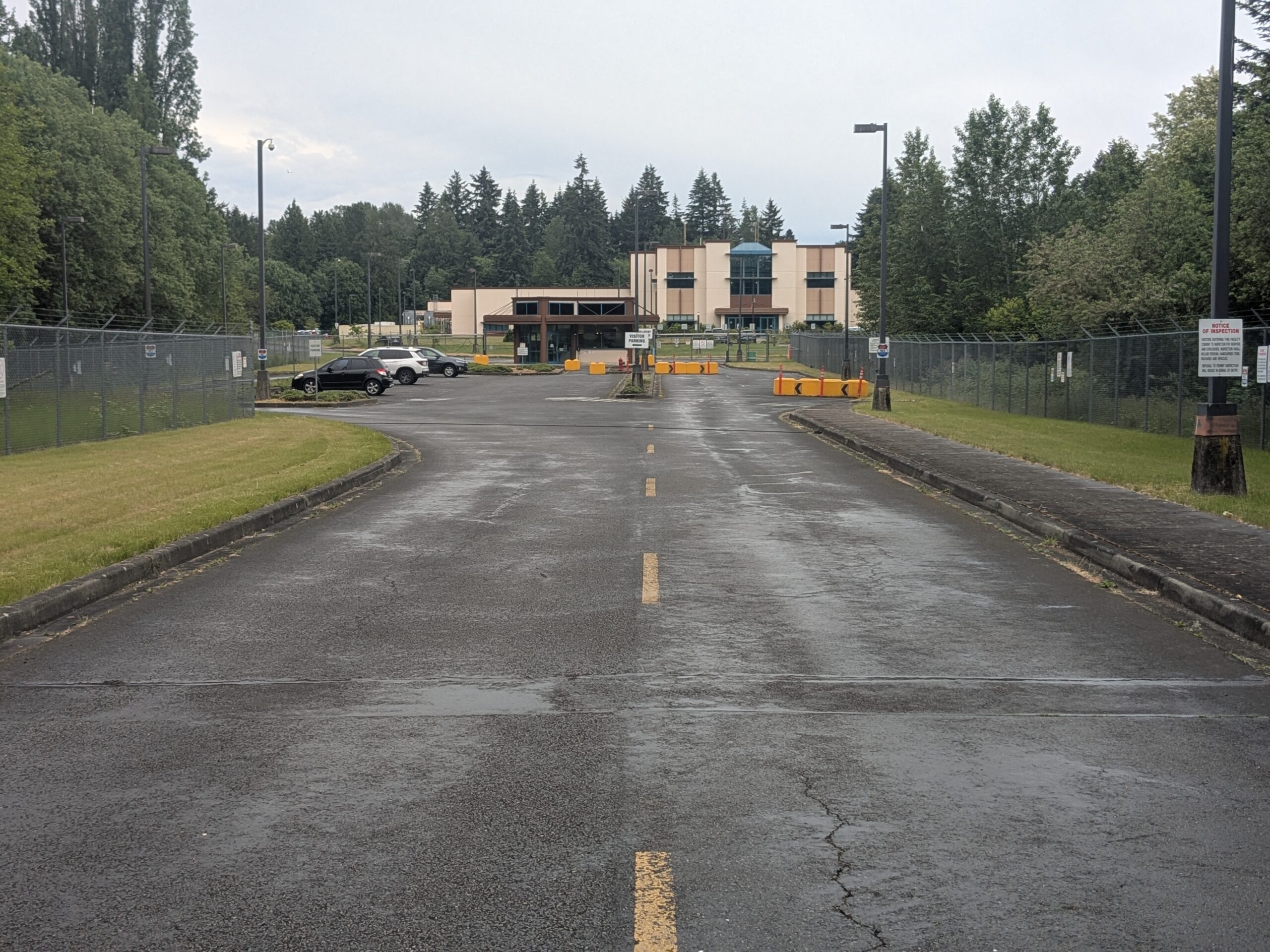
A secured facility entrance with chain-link fencing topped with razor wire, yellow vehicle barriers, and a 'Notice of Inspection' sign visible on the right fence post. The main building in the background has a multi-story institutional design consistent with a jail, prison, or detention center, surrounded by trees in a Pacific Northwest setting. -
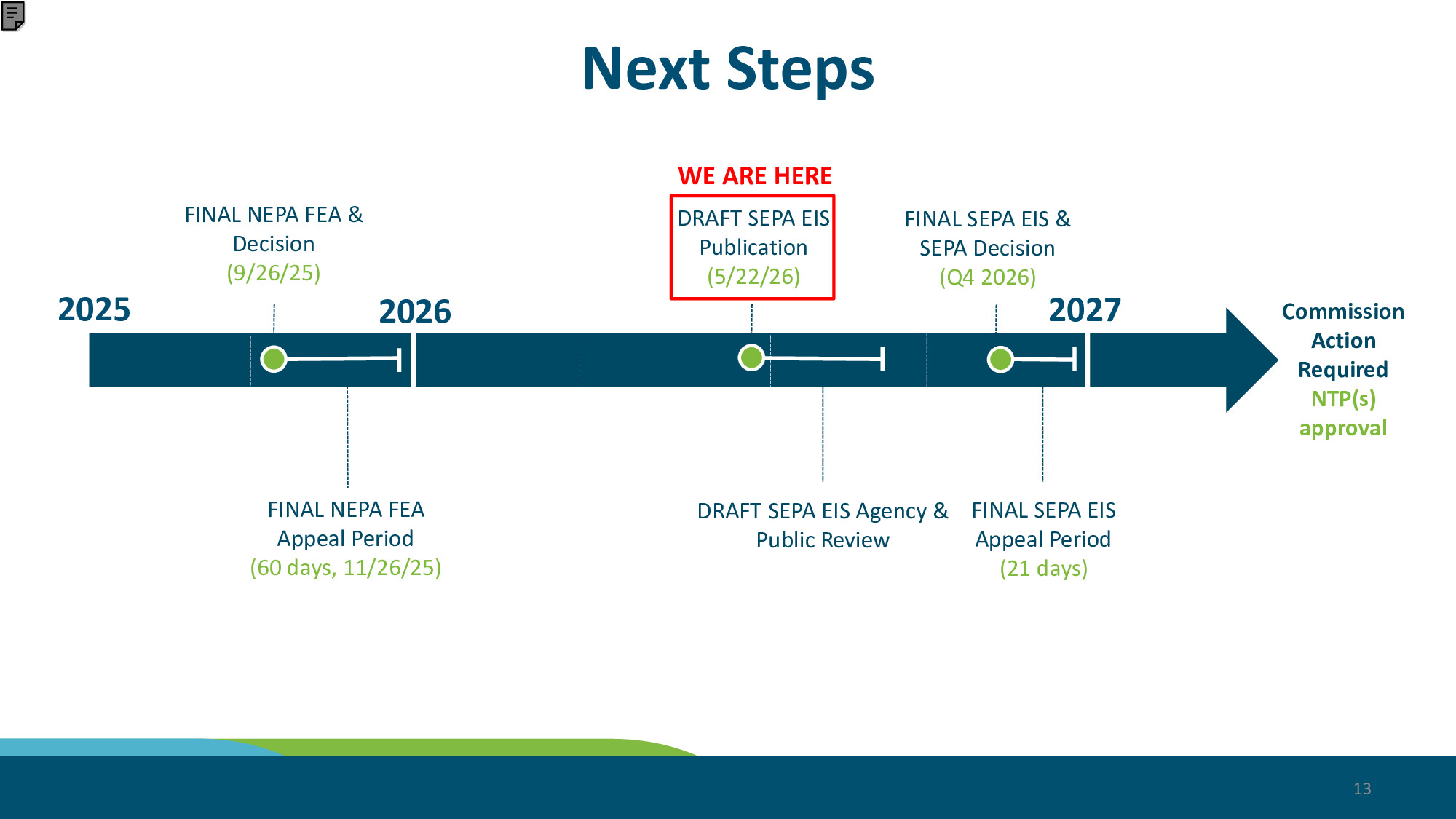
SAMP Near-Term Projects SEPA Draft EIS Timeline and Next Steps
A project timeline slide showing the environmental review process for a Sea-Tac Airport project, currently at the Draft SEPA EIS Publication stage (5/22/26). Key milestones include the Final NEPA FEA & Decision (9/26/25), Draft SEPA EIS Agency & Public Review, Final SEPA EIS & SEPA Decision (Q4 2026), and Commission Action Required for NTP(s) approval in 2027. -
 2026-05-04
Acoustical Testing Results for SIRRPP — May 2026
Harris Miller Miller & Hanson Inc. (HMMH) conducted sound insulation testing at 30 homes near Seattle-Tacoma International Airport (SEA) in March 2026 to measure how much aircraft noise penetrates indoors. The study found that none of the 30 homes exceeded the FAA's 45-decibel interior noise threshold required to qualify for sound insulation treatments under current federal policy. However, nine homes had at least one individual room where interior noise levels surpassed 45 decibels, suggesting those specific rooms could benefit from upgraded windows or doors.