Notes
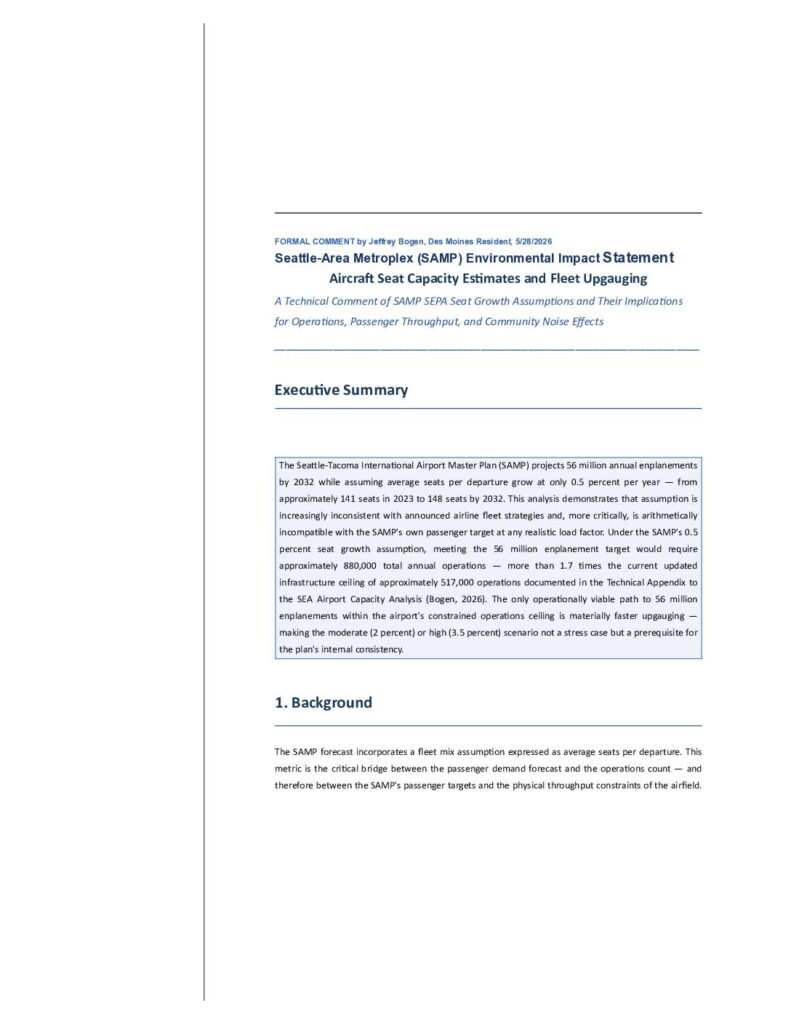
Formal SEPA comment filed by Jeffrey Bogen, Des Moines resident, dated May 28, 2026, on the Seattle-Area Metroplex (SAMP) Environmental Impact Statement. Argues that the SAMP’s assumption of 0.5 percent annual seat-per-departure growth (141 seats in 2023 to 148 seats by 2032) is arithmetically incompatible with the 56 million annual enplanement target at any realistic load factor, requiring approximately 880,000 annual operations — 1.7 times the infrastructure ceiling of ~517,000 operations. Analyzes post-baseline fleet developments by Alaska Airlines (105 Boeing 737-10 and 17 Boeing 787 orders, Tokyo Narita nonstop service) and Delta Air Lines (A330-900 transatlantic service to Rome and Barcelona, 60 Boeing 787-10 order, 18-gate long-term lease at Sea-Tac Airport). Proposes moderate (2.0%) and high (3.5%) seat growth scenarios as prerequisites for SAMP internal consistency. Includes Table 1 comparing SAMP baseline to revised scenarios. References Bogen (2026) SEA Airport Capacity Analysis Technical Appendix.