Notes
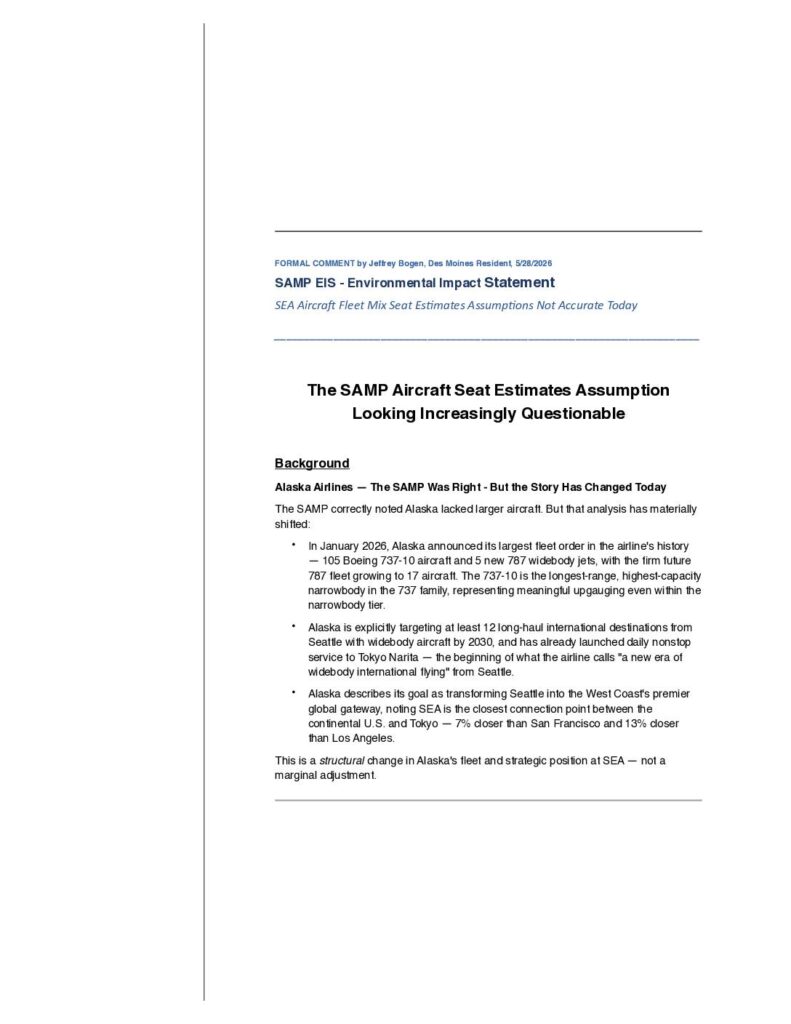
Formal public comment filed 2026-05-28 by Jeffrey Bogen, Des Moines resident, on the SAMP Environmental Impact Statement (EIS) challenging the accuracy of the SAMP’s aircraft seat estimates and fleet mix assumptions for Seattle-Tacoma International Airport (Sea-Tac Airport / SEA). Argues that Alaska Airlines’ January 2026 order of 105 Boeing 737-10 narrowbodies and 17 Boeing 787 widebody jets, plus daily nonstop Tokyo Narita service, and Delta Air Lines’ A330-900 widebody additions (Rome, Barcelona, Taipei), 18-gate lease at Concourses A and B, and 60-aircraft Boeing 787-10 order materially change the fleet mix assumed in SAMP. Presents revised seat capacity scenarios (0.5%, 2%, 3.5% annual growth) showing SAMP’s 148-seat-per-departure baseline requires 757K annual operations to serve 56M passengers — exceeding the ~450K ops ceiling — while higher-seat scenarios (168–182 seats/dep) are internally consistent with the ops ceiling. Contends the SAMP’s ops and noise modeling is internally inconsistent and must be updated.