TagPort Of Seattle(2349)
-
 2019-01-14
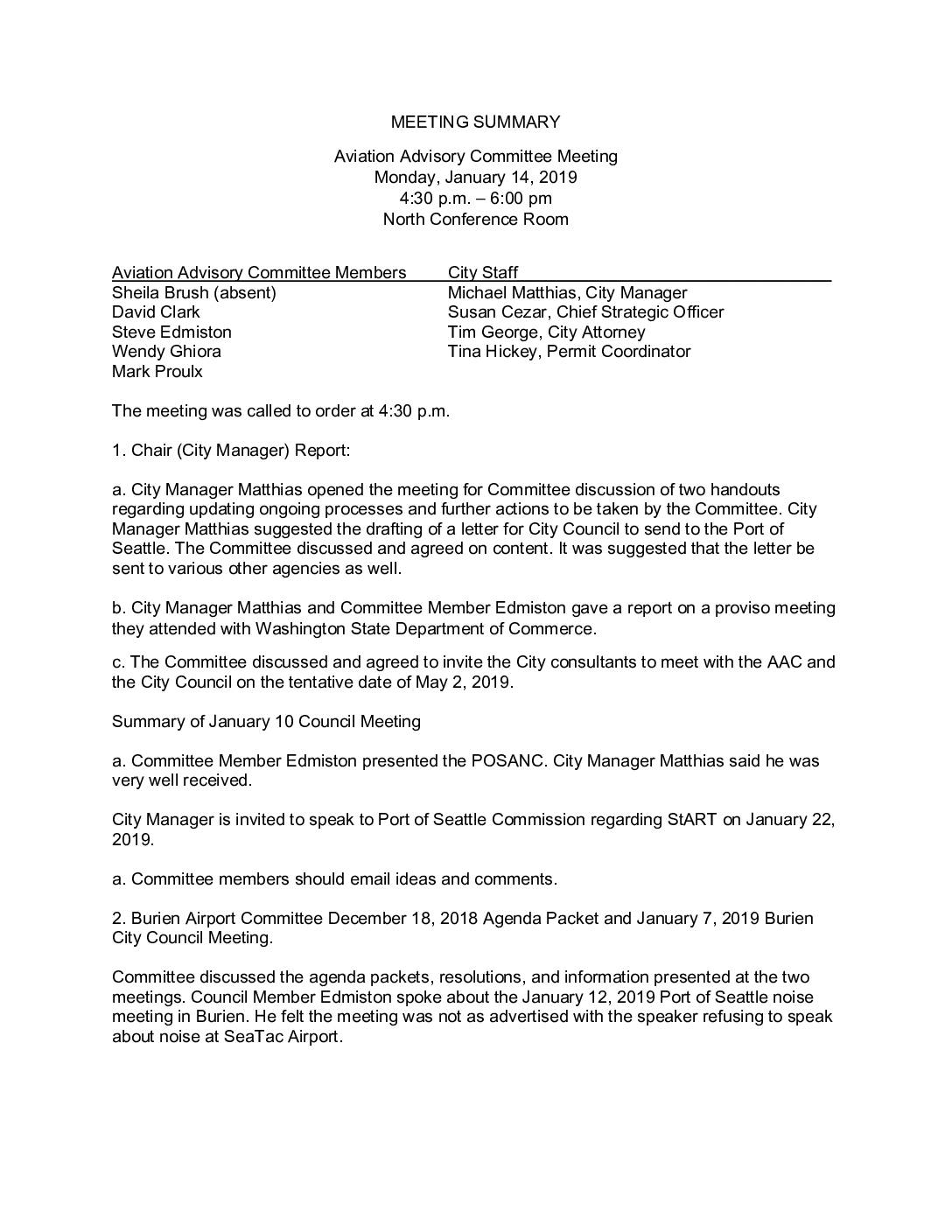
Aviation Advisory Committee Meeting Summary, January 14, 2019
The City's Aviation Advisory Committee met on January 14, 2019 to discuss ongoing efforts related to SeaTac Airport noise concerns, including drafting a letter to the Port of Seattle and planning a joint meeting with City consultants in May 2019. Committee members reported on a Port of Seattle noise meeting in Burien that drew criticism for the speaker's refusal to address airport noise issues. Three members of the public commented, with suggestions ranging from hiring a full-time airport lobbyist to increasing EPA involvement in reducing noise emissions. -
 2019-01-12
Noise 101 Symposium: Principles of Aviation Noise
This document is a presentation from a Noise 101 Symposium held on January 12, 2019, organized by the City of SeaTac and the Port of Seattle, and delivered by Steve Alverson of Environmental Science Associates (ESA). The symposium covered four key modules: the principles of aviation noise, methods for quantifying aircraft noise, aircraft noise regulations and guidance, and principles of aircraft noise control. The half-day session was designed to provide attendees with a foundational understanding of how aircraft noise is measured, regulated, and managed in the context of Seattle-Tacoma International Airport. -
 2019-01-08
Resolution No. 3754: Amendment of commission bylaws
Resolution No. 3754, adopted by the Port of Seattle Commission on January 8, 2019, amends the Commission's bylaws to clarify the roles and duties of officers during succession. Key changes remove the automatic succession of the vice president to the presidency and instead establish that the vice president temporarily assumes all prescribed presidential duties only during the president's physical absence. The resolution updates several sections of Article III to ensure consistent language around officer responsibilities throughout the bylaws. -
 2019-01-08
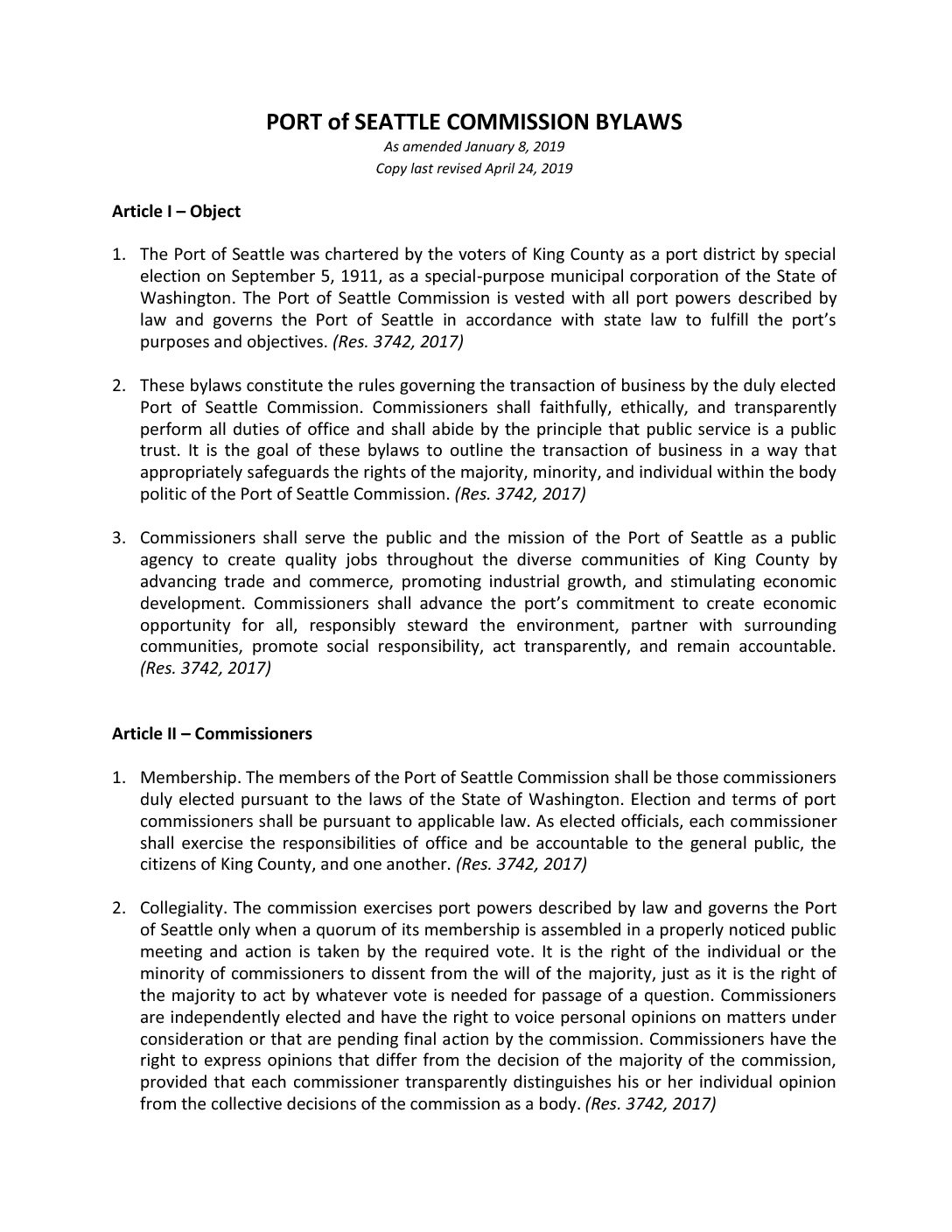
Port Of Seattle Commission bylaws, as amended January 8, 2019
The Port of Seattle Commission Bylaws, last amended in January 2019, outline the rules governing how the five elected commissioners conduct official business, including meeting procedures, voting requirements, ethical standards, and conflict-of-interest policies. Commissioners are required to serve the public transparently and accountably, signing an annual transparency pledge committing to open governance under Washington State's Open Public Meetings Act and Public Records Act. The bylaws also detail procedures for filling vacancies, administering oaths of office, and ensuring that both majority and minority commissioner voices are respected in decision-making. -
 2019-01-08
Draft 2019 local and regional government relations priorities
In January 2019, Port of Seattle staff presented draft local and regional government relations priorities to the Port Commission, covering areas such as climate and sustainability, regional mobility, workforce development, economic opportunity, and equity and inclusion. The presentation outlined priorities specific to maritime, aviation, and airport communities, along with additional supporting and monitoring activities. Commission feedback was to be incorporated before a formal adoption vote at the January 22, 2019 meeting. -
 2019-01-01
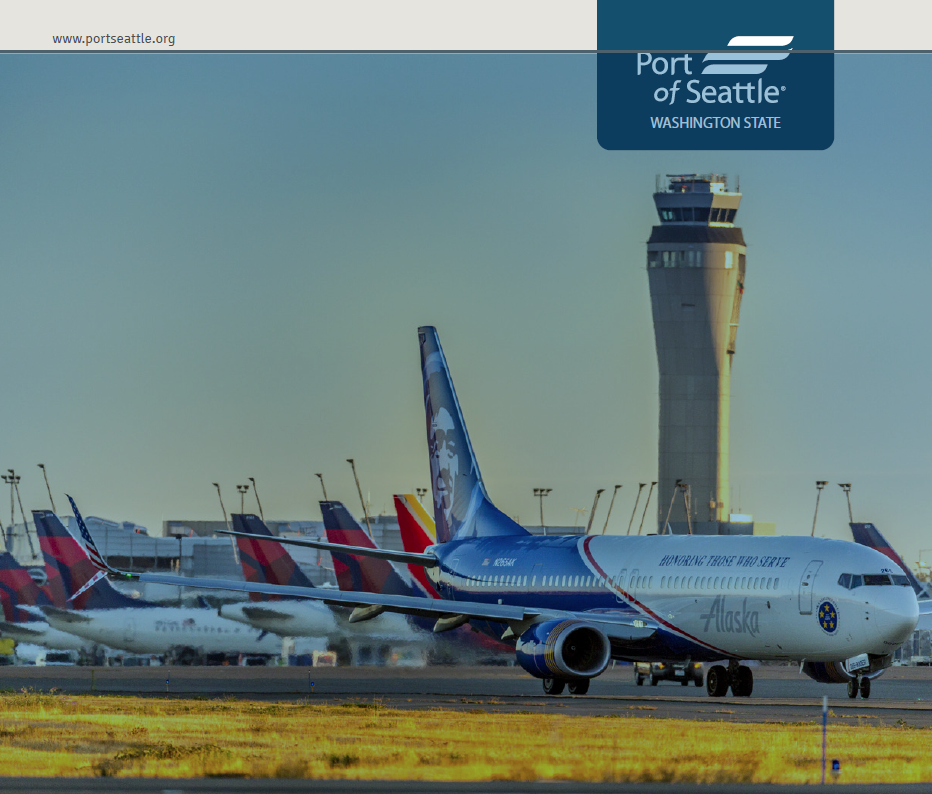
Port Of Seattle CAFR Cover Page 2019
An Alaska Airlines Boeing 737 featuring the special 'Honoring Those Who Serve' military tribute livery taxis at Seattle-Tacoma International Airport (Sea-Tac), with the airport's FAA air traffic control tower visible in the background. The image is watermarked with the Port of Seattle, Washington State logo and website (www.portseattle.org), indicating it is an official Port of Seattle publication or archive document. -
 2019-01-01
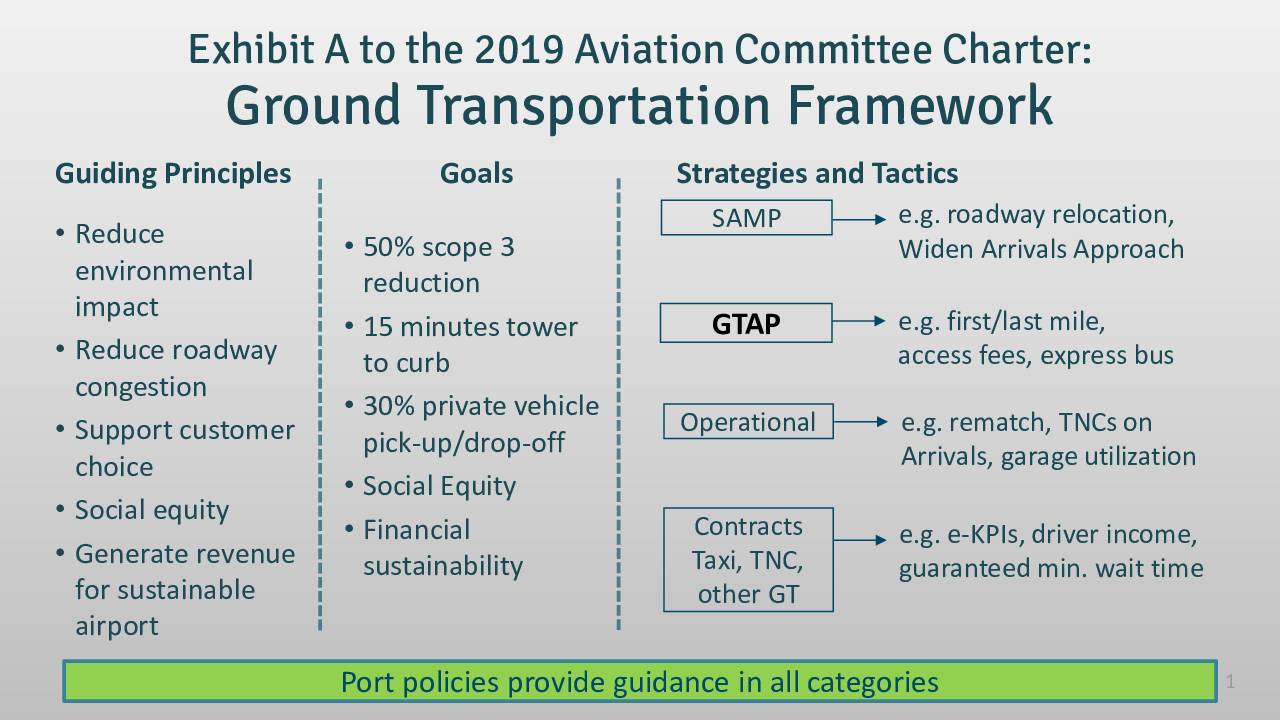
Exhibit A to the 2019 Aviation Committee Charter: Ground Transportation Framework
This 2019 Aviation Committee document outlines Sea-Tac Airport's Ground Transportation Framework, detailing the guiding principles, goals, and strategies for managing how passengers and vehicles move through the airport. Key goals include reducing environmental impact (50% scope 3 emissions reduction), cutting private vehicle pick-up and drop-off to 30% of trips, and achieving a 15-minute tower-to-curb travel time. Strategies span infrastructure planning (SAMP), access policy (GTAP), day-to-day operations, and taxi/TNC contracts, with Port policies providing overarching guidance across all areas. -
 2018-12-31
Comprehensive annual financial report
The Port of Seattle's 2018 Comprehensive Annual Financial Report covers the port's financial position and activity as of and for the years ending December 31, 2016–2018, including Seattle-Tacoma International Airport and maritime operations. Prepared by the Port's Accounting and Financial Reporting Department, it includes audited financial statements, management analysis, pension fund disclosures, and ten-year statistical trends. While focused on overall port finances, it serves as a key public record for understanding the economic context of Port operations, including airport-related activities that intersect with noise policy decisions. -
 2018-12-14
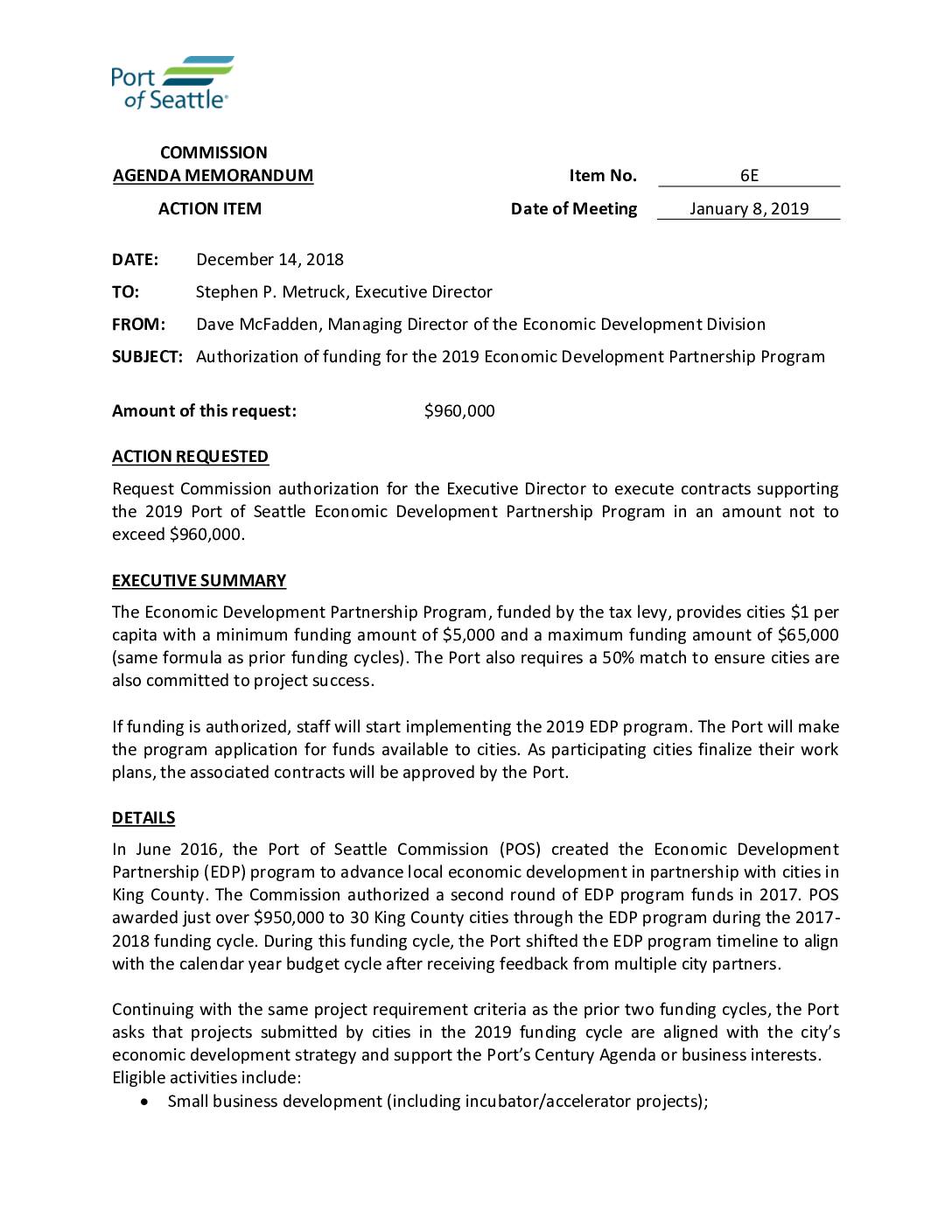
Authorization of funding for the 2019 Economic Development Partnership Program
The Port of Seattle Commission considered authorizing up to $960,000 for its 2019 Economic Development Partnership Program, which provides grant funding to King County cities based on a $1-per-capita formula (minimum $5,000, maximum $65,000) to support local economic development projects. Eligible activities include small business development, business recruitment, workforce development, tourism, and downtown revitalization, with cities required to provide a 50% funding match. The program, funded through the Port's property tax levy, has been running since 2016 and previously awarded about $950,000 to 30 King County cities during the 2017–2018 cycle. -
 2018-12-14
2019 local and regional government policy priorities briefing
This January 2019 Port of Seattle Commission briefing outlines the agency's local and regional government policy priorities for 2019, covering areas such as climate and sustainability, regional transportation, workforce development, maritime projects, and aviation. On the airport side, key priorities include advancing the Sustainable Airport Master Plan (SAMP) near-term projects to address regional demand, and engaging surrounding South King County communities through forums like the Sea-Tac Stakeholder Advisory Round Table (StART). The document reflects the Port's broader effort to balance airport growth with community concerns, economic opportunity, and environmental responsibility.