TagPort Of Seattle(2343)
-
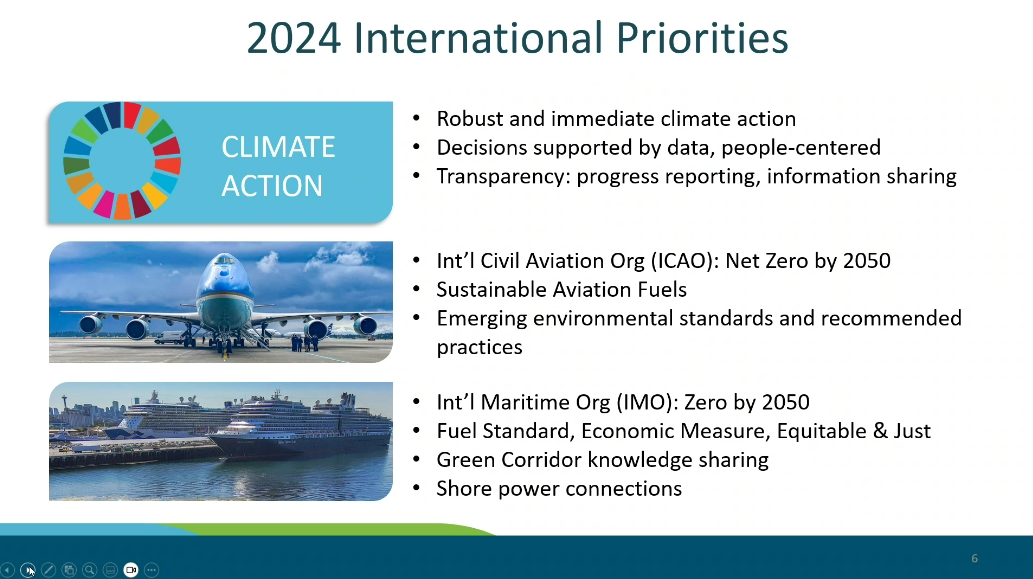
Port of Seattle International Policy Goals 2024
Slide 6 from a presentation outlining 2024 international priorities under three headings: Climate Action (robust action, data-driven decisions, transparency); International Civil Aviation Organization (ICAO) goals including Net Zero by 2050 and Sustainable Aviation Fuels; and International Maritime Organization (IMO) goals including Zero by 2050, fuel standards, Green Corridor knowledge sharing, and shore power connections. Images show a large commercial aircraft on a tarmac and cruise ships at a port. -
 2024-02-13
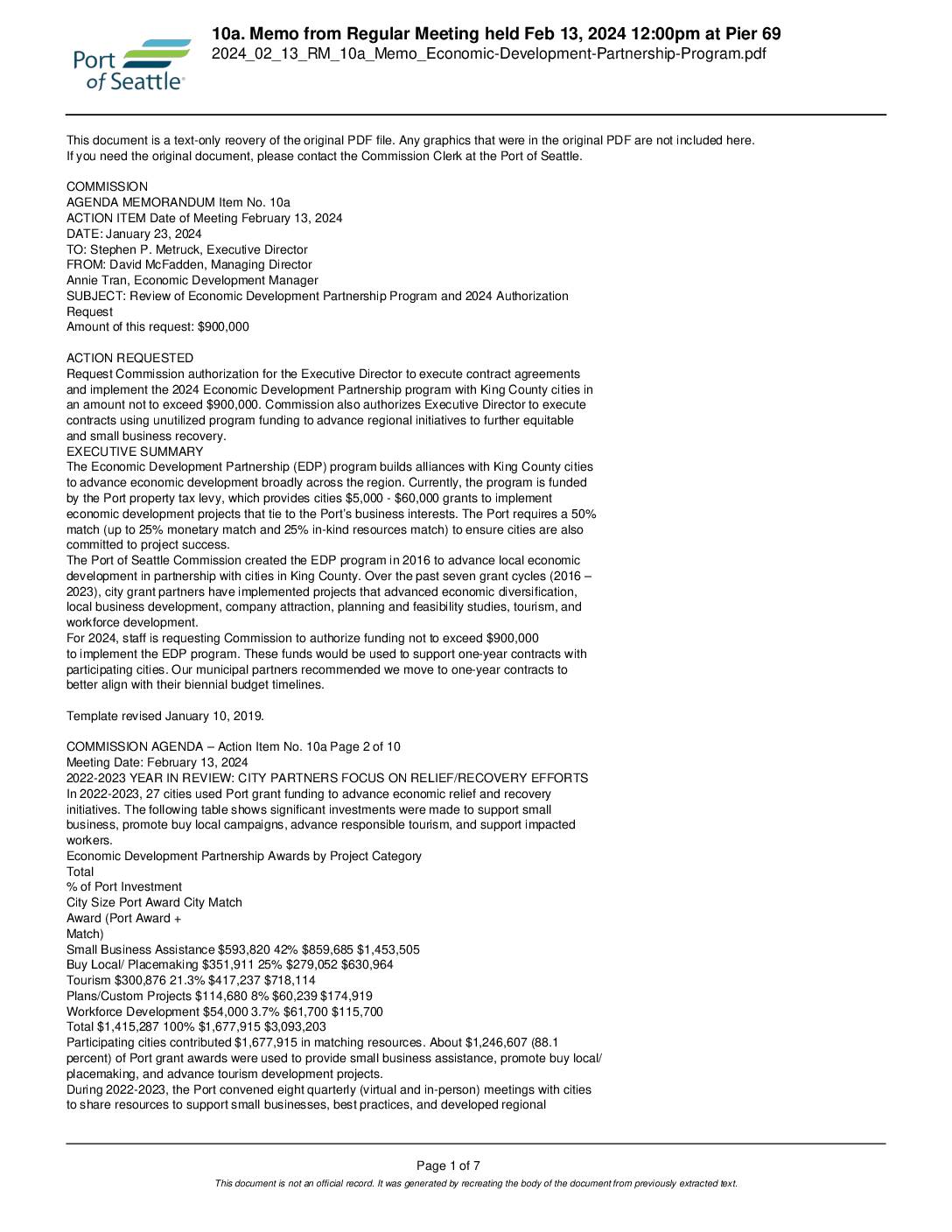
Port Of Seattle Commission Agenda Memorandum: Review of Economic Development Partnership Program and 2024 Authorization Request
The Port of Seattle is requesting $900,000 to continue its Economic Development Partnership (EDP) program, which provides grants of $5,000–$60,000 to King County cities for local economic development projects such as small business assistance, tourism promotion, and workforce development. In the 2022–2023 cycle, 27 cities participated and collectively leveraged over $1.6 million in matching resources, supporting nearly 700 businesses and generating millions of marketing impressions. For 2024, the program is shifting to one-year contracts to better align with cities' biennial budget timelines. -
 2024-02-05
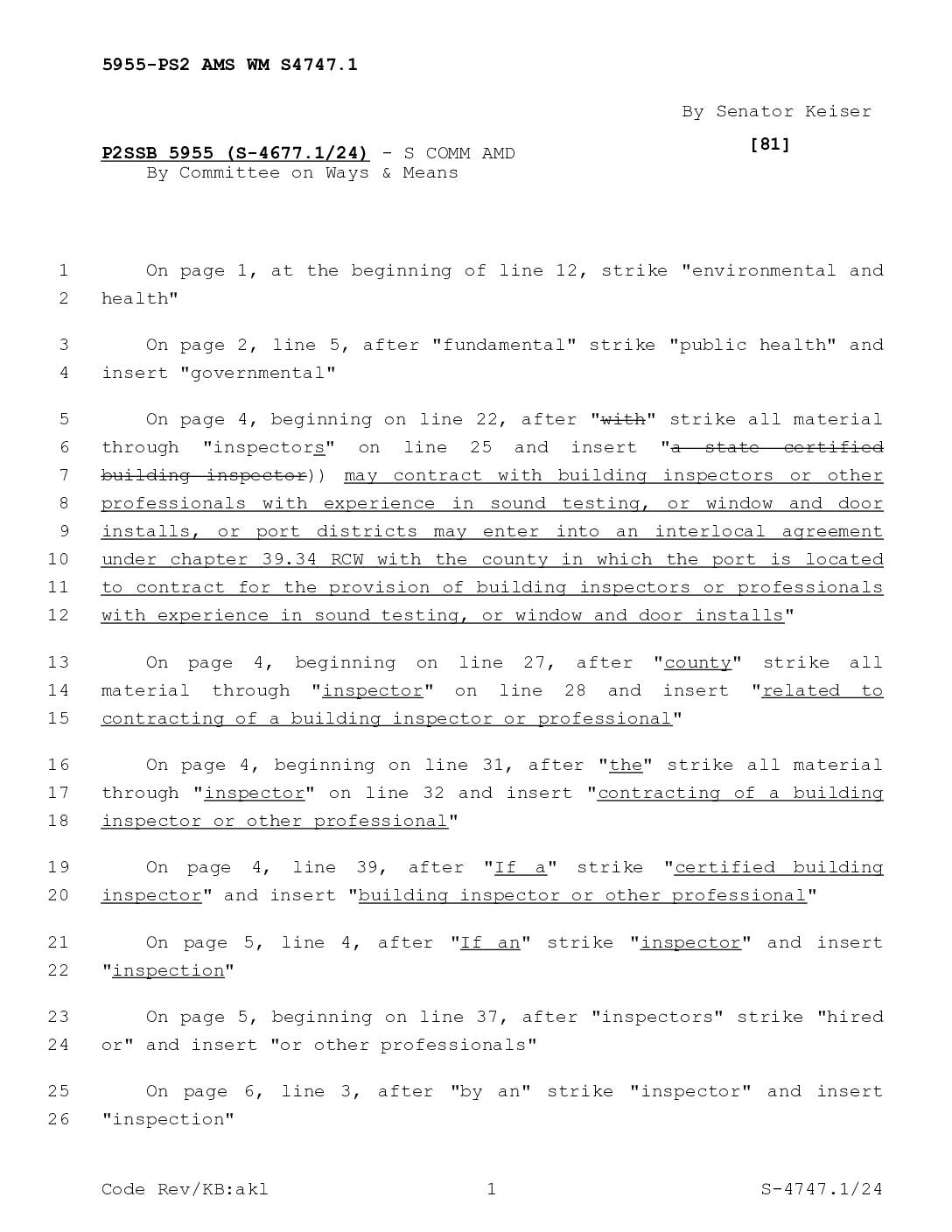
P2SSB 5955 (S-4677.1/24) – Senate Committee on Ways & Means amendment S-4747.1
This Washington State Senate amendment (S-4747.1/24), sponsored by Senator Keiser, modifies legislation related to airport noise mitigation programs administered by port districts. It expands the types of professionals that port districts—such as the Port of Seattle—can hire to inspect sound mitigation equipment, replacing the requirement for a 'state certified building inspector' with the broader option of building inspectors or other professionals experienced in sound testing or window and door installations. The amendment also allows port districts to enter into interlocal agreements with their host counties to contract for such inspection services, and makes technical language changes to the bill's intent section. -
 2024-02-01
Appendix M: SAMP Near Term Projects: Water Resources Wetlands and Streams Report
This technical report, prepared by Parametrix for the Port of Seattle in February 2024, documents the wetlands and streams found at Seattle-Tacoma International Airport as part of the Sustainable Airport Master Plan (SAMP) Near Term Projects. It covers the delineation of wetland and stream boundaries, assessments of potential impacts to these aquatic areas from planned airport projects, and proposed mitigation measures and permitting strategies to address those impacts. -
 2024-02-01
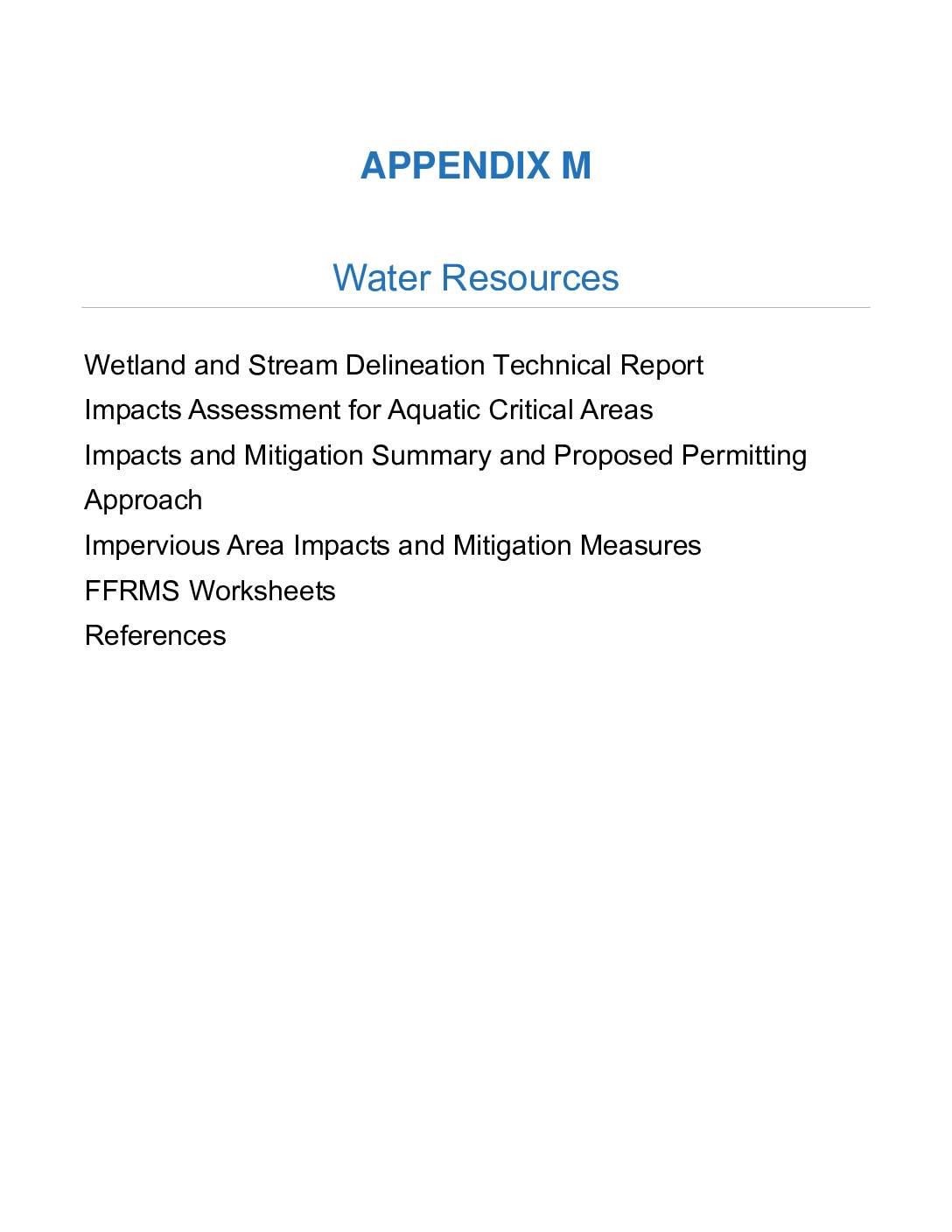
Appendix M: Water Resources — Wetland and Stream Delineation Technical Report, Seattle-Tacoma International Airport SAMP Near Term Projects
This technical report, prepared by Parametrix for the Port of Seattle in February 2024, documents the wetlands and streams found within and around Seattle-Tacoma International Airport as part of the Sustainable Airport Master Plan (SAMP) Near Term Projects. It covers the delineation of aquatic critical areas, assessments of potential project impacts on wetlands and waterways, proposed mitigation measures, and the permitting approach needed to address those impacts. The report also includes analysis of impervious surface changes and Federal Flood Risk Management Standard (FFRMS) compliance worksheets. -
 2024-02-01
Seattle-Tacoma International Airport SAMP Near Term Projects: Wetlands and Streams Report
This technical report, prepared by Parametrix for the Port of Seattle in February 2024, documents the wetlands and streams found at Seattle-Tacoma International Airport as part of the Sustainable Airport Master Plan (SAMP) Near Term Projects. It covers the delineation of wetland and stream boundaries, assesses potential impacts to these aquatic areas from planned airport improvements, and outlines mitigation measures and permitting approaches to address those impacts. -
 2024-02-01
Seattle-Tacoma International Airport SAMP Near Term Projects: Wetlands and Streams Report — Appendix A Background Information
This February 2024 technical report from the Port of Seattle documents the wetlands and streams located at and around Seattle-Tacoma International Airport as part of the Sustainable Airport Master Plan (SAMP). It includes mapped locations of wetlands surveyed across multiple years (2006, 2014, and 2017) along with stream corridors such as Miller Creek, Des Moines Creek, and Walker Creek. Field hydrology monitoring data from 2020 is also provided, recording groundwater depth and soil saturation measurements to assess wetland conditions across the airport property. -
 2024-01-24
Highline Forum Agenda: 2024 State and Federal Legislative Issues, January 24, 2024
The Highline Forum held its January 24, 2024 meeting at Seattle-Tacoma International Airport, hosted by the Port of Seattle, focusing on 2024 state and federal legislative issues affecting communities near the airport. The hybrid meeting covered administrative matters, a StART (Sea-Tac Airport Roundtable) update from Aviation Managing Director Lance Lyttle, and allowed public comment in person, via email, or through Microsoft Teams. The Forum's 2024 schedule includes six bimonthly meetings hosted by rotating local jurisdictions, including Federal Way, Tukwila, Highline College, Des Moines, and SeaTac. -
 2024-01-16
Senate bill report SB 5955: Mitigating harm and improving equity in large port districts
Washington Senate Bill 5955 would require large port districts operating airports with more than 900 daily flights — such as Sea-Tac — to launch a remedial mitigation program addressing failed soundproofing, air quality, green space, and community facilities in noise-impacted neighborhoods. The bill would fund these programs through a portion of the port's annual property tax levy revenue and establish a state environmental equity fund, managed by the Department of Commerce, to provide grants and loans to qualifying ports. Property owners within ten miles of the airport experiencing 55 decibels or more of aircraft noise would be eligible for free inspections and mitigation equipment, with priority given to homes where previously installed soundproofing has failed. -
 2024-01-16
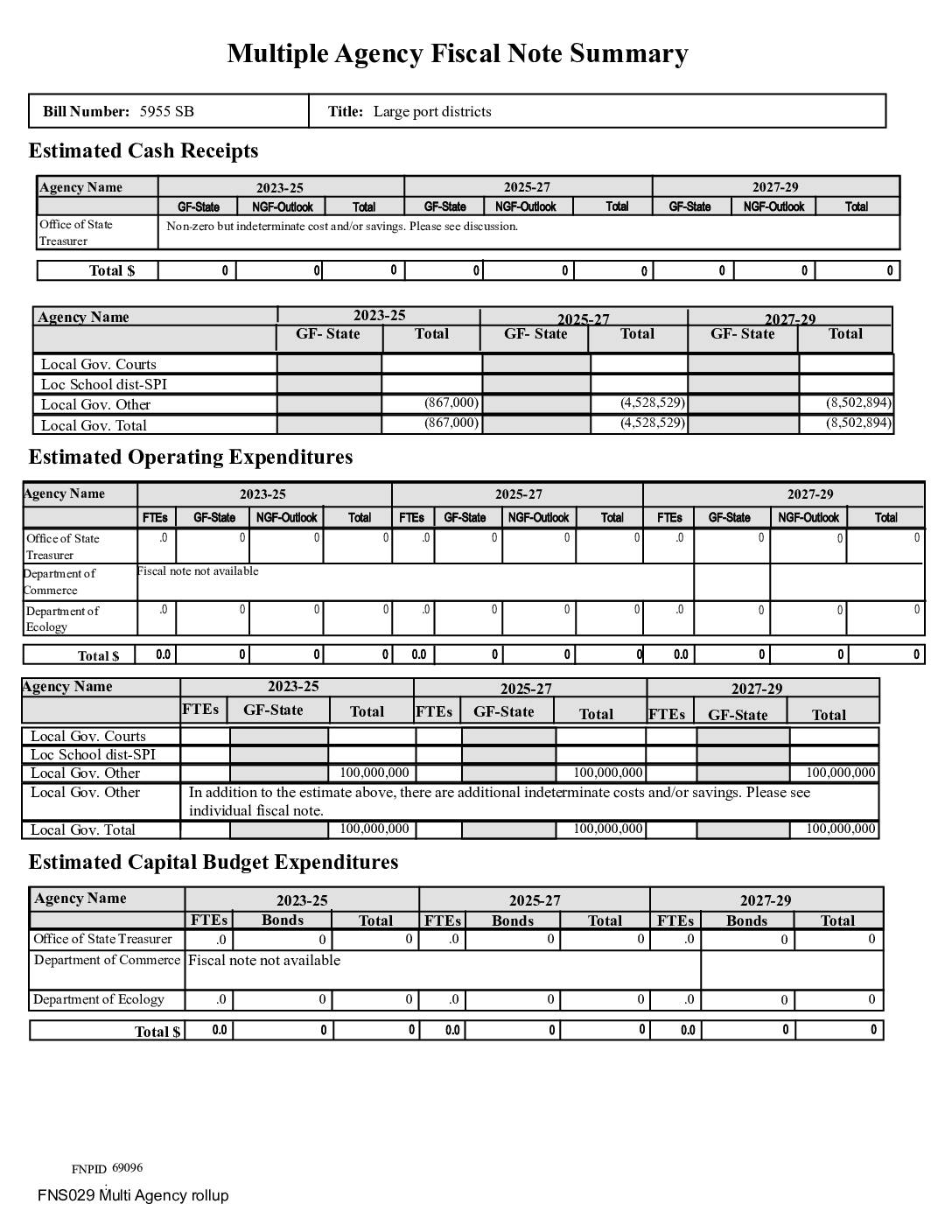
Multiple agency fiscal note summary: Large port districts (SB 5955)
This is a fiscal note summary for Washington State Senate Bill 5955, which concerns large port districts. The document estimates that local governments could face operating expenditures of $100 million per biennium across multiple budget periods, while also projecting declining cash receipt losses to local governments ranging from approximately $867,000 in 2023-25 to over $8.5 million by 2027-29. The Office of State Treasurer notes non-zero but indeterminate cost impacts, and the Department of Commerce's fiscal note was not available at the time of publication in January 2024.