TagPort Of Seattle(2343)
-
 2024-06-01
Environmental Justice Protocol: Seattle-Tacoma International Airport
This document is an Environmental Justice Protocol prepared by Landrum & Brown, Incorporated for the Federal Aviation Administration and the Port of Seattle in June 2024. It addresses socioeconomics, environmental justice, and children's health considerations related to Seattle-Tacoma International Airport. The protocol provides a framework for evaluating how airport-related impacts may affect minority, low-income, and other vulnerable populations in surrounding communities. -
 2024-05-22
Sound Insulation Repair and Replacement Pilot Program Update
Seattle-Tacoma International Airport launched a Sound Insulation Repair and Replacement Pilot Program following Commission Order 2024-04, approved on February 27, 2024, with a total budget of $6.5 million — including $5 million reserved for design and construction. The program, funded by tax levy, aims to assess and repair aging sound insulation in nearby homes, incorporating equity guidelines for participation. The 2024 assessment timeline includes resident surveys, acoustic testing, and a final report, with design and construction work planned for 2025. -
 2024-05-22
SEA Stakeholder Advisory Round Table 2023 Annual Report
The SEA Stakeholder Advisory Round Table (StART) 2023 Annual Report, presented by Port of Seattle staff Marco Milanese and Nate Caminos, summarizes the group's work addressing aviation noise and federal policy issues around Seattle-Tacoma International Airport. The report highlights efforts from two key working groups: the Aviation Noise Working Group and the Federal Policy Working Group, which engage community stakeholders in shaping airport noise mitigation strategies. The presentation also includes a Q&A section to allow stakeholder input and discussion. -
 2024-05-22
Part 150 Noise and Land Use Compatibility Study Update: Highline Forum Presentation
The Port of Seattle presented an update on the Part 150 Noise and Land Use Compatibility Study to the Highline Forum in May 2024. This federally required study, governed by FAA guidelines, maps aircraft noise contours around Seattle-Tacoma International Airport and identifies areas where noise levels exceed 65 decibels, helping determine which properties qualify for sound insulation and other mitigation measures. Airports that complete an FAA-approved Part 150 Study become eligible to receive federal Airport Improvement Program grants covering 80% of qualifying noise reduction projects. -
 2024-05-22
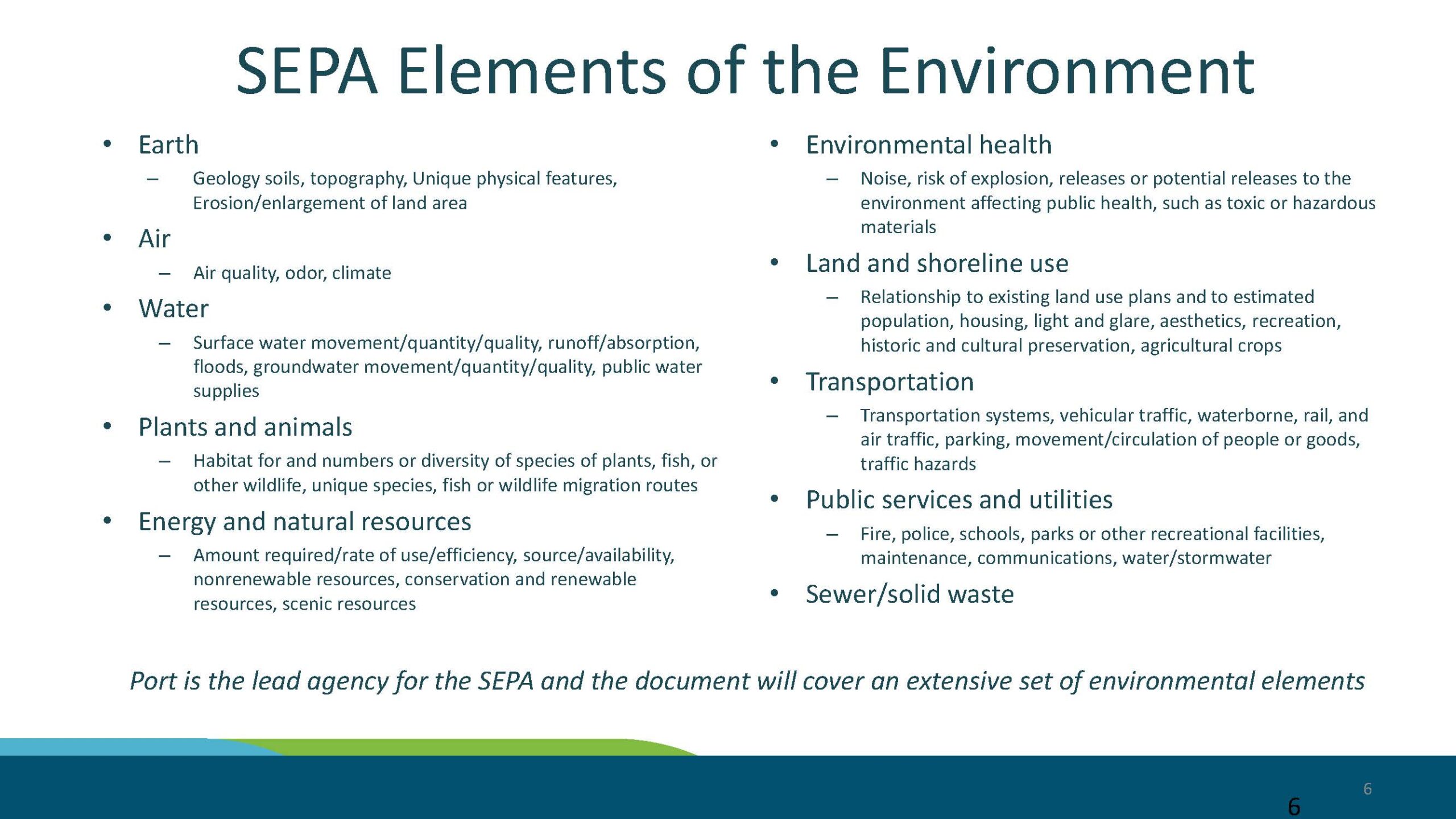
Highline Forum SAMP NTP Environmental Review Overview — SEPA Elements of the Environment, Slide 6 (May 2024)
A presentation slide titled 'SEPA Elements of the Environment' listing the environmental review categories required under Washington State's State Environmental Policy Act (SEPA), including Earth, Air, Water, Plants and Animals, Energy, Environmental Health, Land and Shoreline Use, Transportation, Public Services and Utilities, and Sewer/Solid Waste. A footer note states: 'Port is the lead agency for the SEPA and the document will cover an extensive set of environmental elements,' indicating this is part of a Port (likely Port of Seattle/Sea-Tac) environmental review presentation, slide 6. -
 2024-05-22
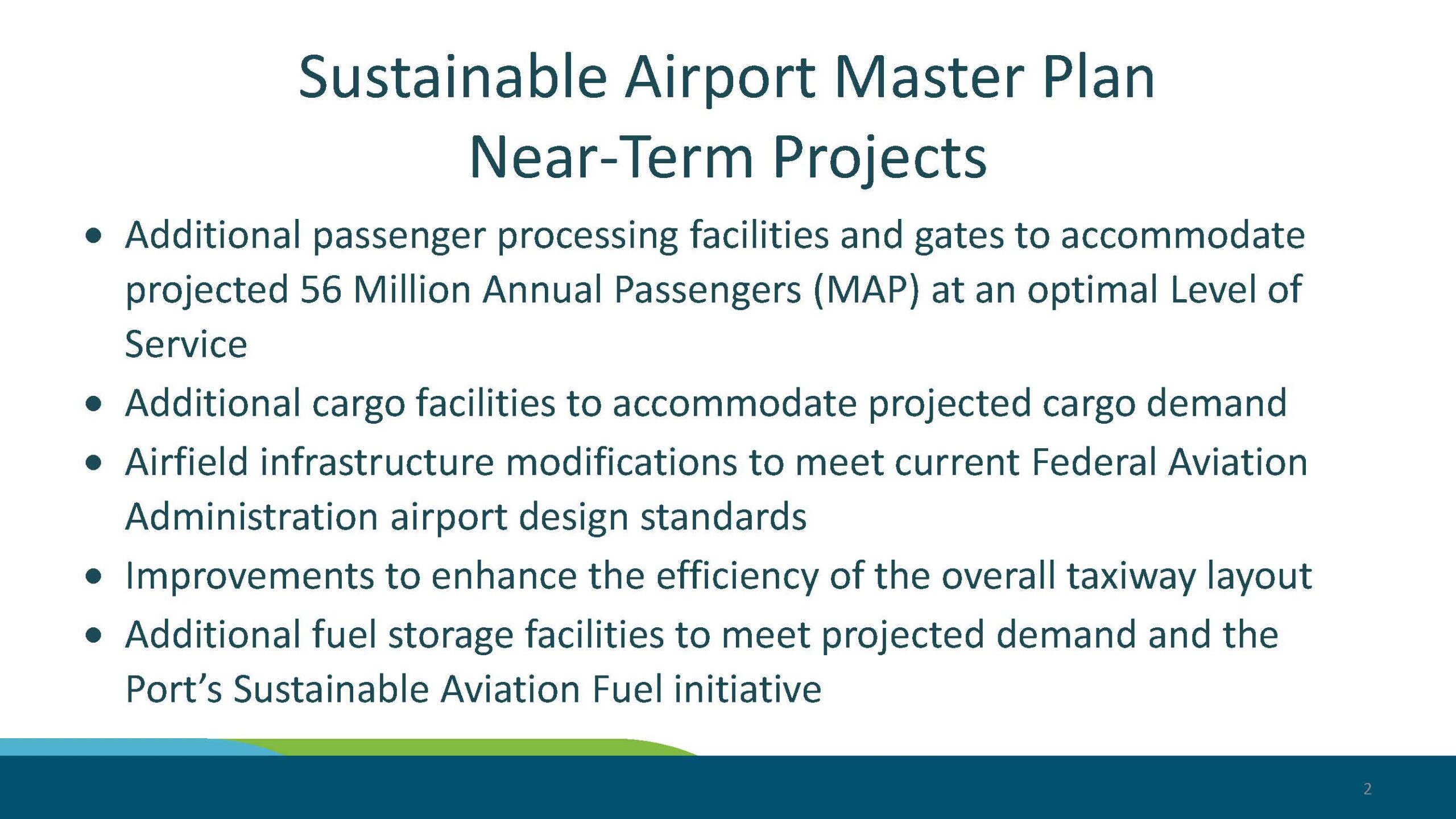
Highline Forum SAMP NTP Environmental Review Overview — Page 2 (May 22, 2024)
This presentation slide outlines near-term projects under the Sustainable Airport Master Plan, including expanded passenger processing facilities to accommodate a projected 56 Million Annual Passengers (MAP), additional cargo and fuel storage facilities, airfield infrastructure modifications to meet FAA design standards, and taxiway efficiency improvements. The mention of the Port's Sustainable Aviation Fuel initiative identifies this as a Port of Seattle document related to Seattle-Tacoma International Airport planning. -
 2024-05-22
Sustainable Airport Master Plan Near-Term Projects Environmental Review
The Port of Seattle presented an environmental review of near-term construction projects at Seattle-Tacoma International Airport as part of its Sustainable Airport Master Plan. The projects include expanding passenger terminals and gates to handle a projected 56 million annual passengers, adding cargo and fuel storage facilities, and upgrading airfield infrastructure to meet current FAA safety standards. The review was presented to the Highline Forum in May 2024 by Senior Environmental Program Manager Steve Rybolt. -
 2024-05-16
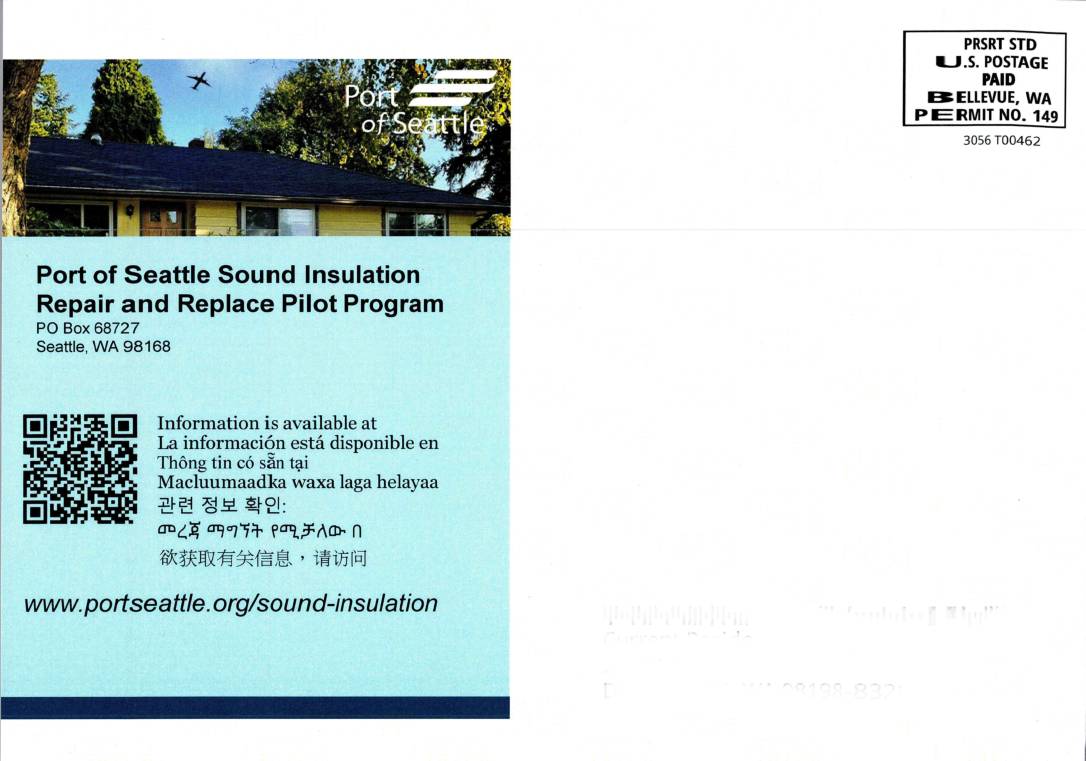
Port Of Seattle Sound Insulation Repair and Replace Pilot Program Survey Notice
The Port of Seattle mailed this notice to residents near Sea-Tac Airport informing them about the Sound Insulation Repair and Replace Pilot Program, which aims to address aircraft noise in affected homes. Recipients were advised that a formal survey about the program would be mailed to them in early June. Program information and resources are available in multiple languages at www.portseattle.org/sound-insulation. -
 2024-05-11
Read this, to start understanding the ‘Greener Skies’ fraud
The 'Greener Skies' program, approved by the FAA in late 2012 and promoted by the FAA and Port of Seattle, promised to dramatically reduce aircraft noise near Sea-Tac Airport by routing more than half of all arrivals over Elliott Bay, far from residential areas. Critics argue the program was fundamentally flawed and never delivered on its promises, as air traffic controllers rarely use the Elliott Bay routes due to the need to merge east- and west-side arrival streams. FAA and industry's own data are cited as evidence that the program amounted to an environmental fraud, with concentrated flight paths continuing to impact west-side communities while east-side routes were never given equivalent precision procedures. -
 2024-05-07
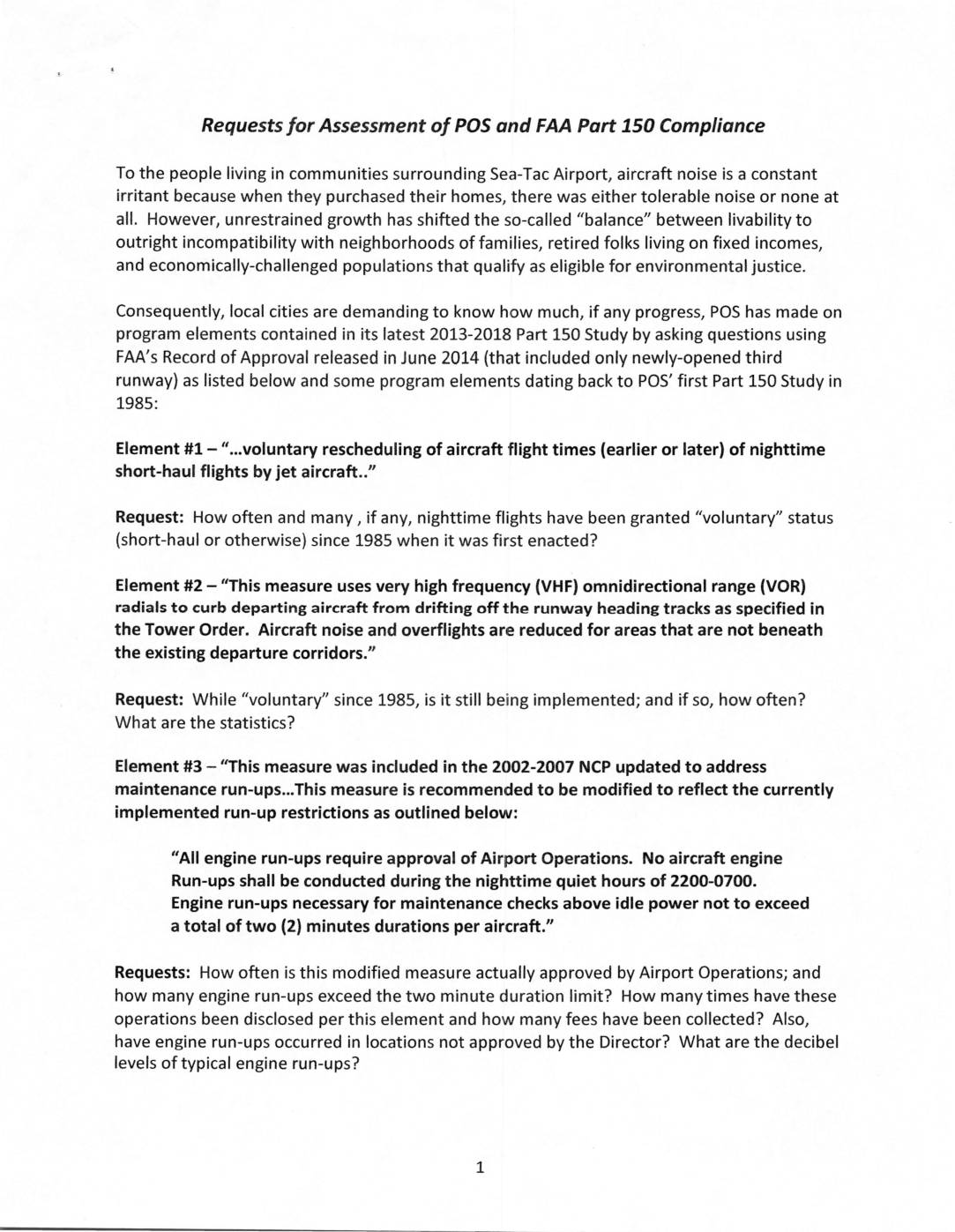
Requests for assessment of POS and FAA Part 150 compliance
Local communities surrounding Seattle-Tacoma International Airport are demanding accountability from the Port of Seattle (POS) regarding its compliance with FAA Part 150 noise mitigation measures, some dating back to 1985. The document raises detailed questions about ten specific program elements — including voluntary flight rescheduling, engine run-up restrictions, noise abatement corridors, the Fly Quiet Program, and home sound insulation — asking for data on how consistently and effectively each measure has actually been implemented. Critics argue that despite decades of commitments, key noise reduction tools such as a Ground Run-Up Enclosure have been quietly dropped, while growing air traffic continues to harm residential neighborhoods and environmentally vulnerable populations.