TagPort Of Seattle(2604)
-
 1982-04-01
Preliminary Assessment of Airspace Interactions: Seattle-Tacoma International Airport and King County International Airport
A 1982 draft working paper prepared by Peat, Marwick, Mitchell & Co. for the Port of Seattle assessed airspace interactions between Seattle-Tacoma International Airport (Sea-Tac) and King County International Airport (Boeing Field). The study analyzed existing and projected airfield capacities, aircraft delays, and the effects of overlapping airspace on both airports, taking into account factors such as air traffic demand, aircraft mix, weather conditions, and runway procedures. Its findings were intended to help the Port of Seattle determine whether more detailed investigation and mitigation measures were needed in a subsequent phase of the study. -
1982-04-01
Preliminary Assessment of Airspace Interactions: Seattle-Tacoma International Airport and King County International Airport
Draft working paper prepared by Peat Marwick Mitchell & Co. for the Port Of Seattle in April 1982, providing a preliminary assessment of airspace interactions between Seattle-Tacoma International Airport (Sea-Tac) and King County International Airport (Boeing Field). Analyzes airfield capacities and aircraft delays at both airports, including effects of airspace interactions on those metrics. Assessment -
 1982-03-23
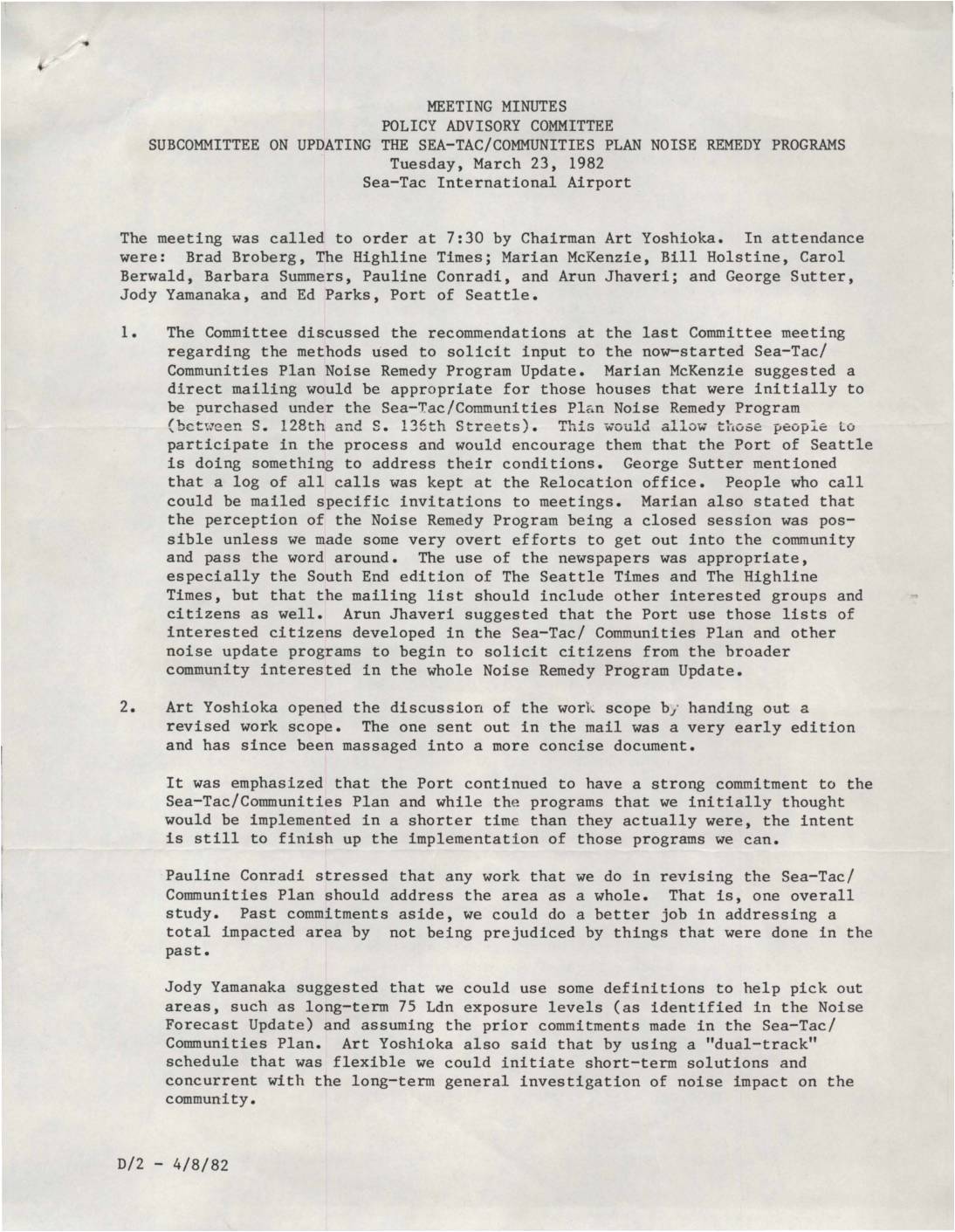
Meeting minutes: Policy Advisory Committee subcommittee on updating the Sea-Tac/Communities Plan noise remedy programs
These are the meeting minutes from a March 23, 1982 Policy Advisory Committee session at Sea-Tac International Airport, focused on updating the Sea-Tac/Communities Plan Noise Remedy Program. The committee discussed how to engage affected residents between South 128th and South 135th Streets through direct mailings and community outreach, debated whether to address noise impact areas individually or as a whole, and reviewed the status of ongoing housing acquisitions, with the Port having already spent $28–$29 million on housing acquisition and relocation. Key concerns included funding limitations, construction in potential acquisition zones, hardship cases for vulnerable residents, and the timeline for completing the program. -
 1982-02-24
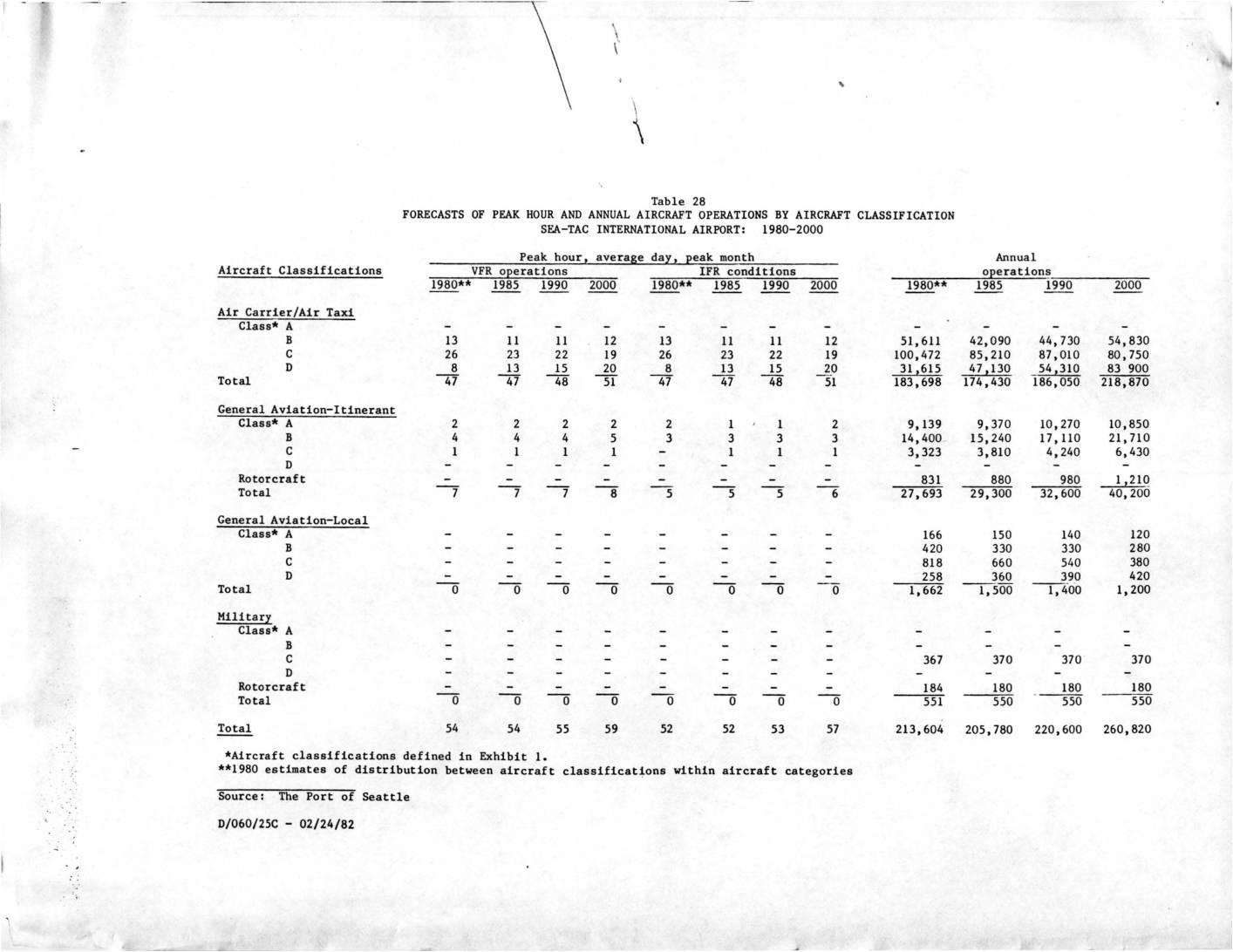
Forecasts of Peak Hour and Annual Aircraft Operations by Aircraft Classification: Sea-Tac International Airport and King County International Airport, 1980–2000
This document presents forecasts of aircraft operations at Seattle-Tacoma (Sea-Tac) International Airport and King County International Airport from 1980 to 2000, broken down by aircraft classification and flight category including air carrier, general aviation, and military. It projects that total annual operations at Sea-Tac will grow from approximately 213,600 in 1980 to over 260,800 by 2000, driven largely by increases in larger Class D air carrier aircraft. Peak hour operation estimates are provided for both Visual Flight Rules (VFR) and Instrument Flight Rules (IFR) conditions, offering planners a detailed basis for noise impact and capacity assessments. -
 1982-02-24
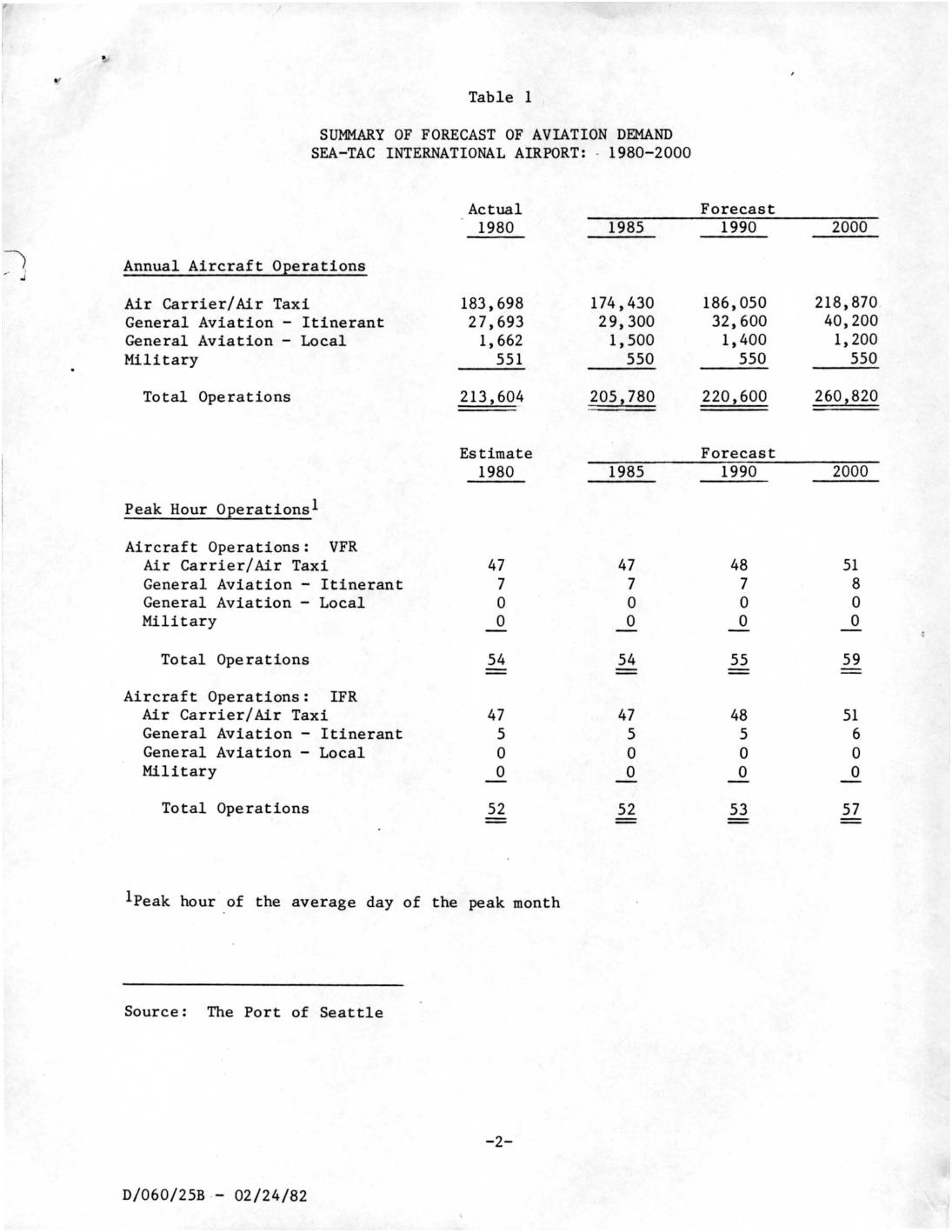
Summary of forecast of aviation demand Sea-Tac International Airport: 1980-2000
This 1982 Port of Seattle report forecasts aviation demand at Seattle-Tacoma International Airport from 1980 to 2000, projecting total annual aircraft operations to grow from approximately 213,600 to 260,800. The forecast covers air carrier, general aviation, and military operations, and includes peak hour operation estimates under both VFR and IFR conditions. The projections were developed in connection with the Sea-Tac International Noise Exposure Update and draw on passenger origination models tied to regional income and airfare trends. -
 1982-02-14
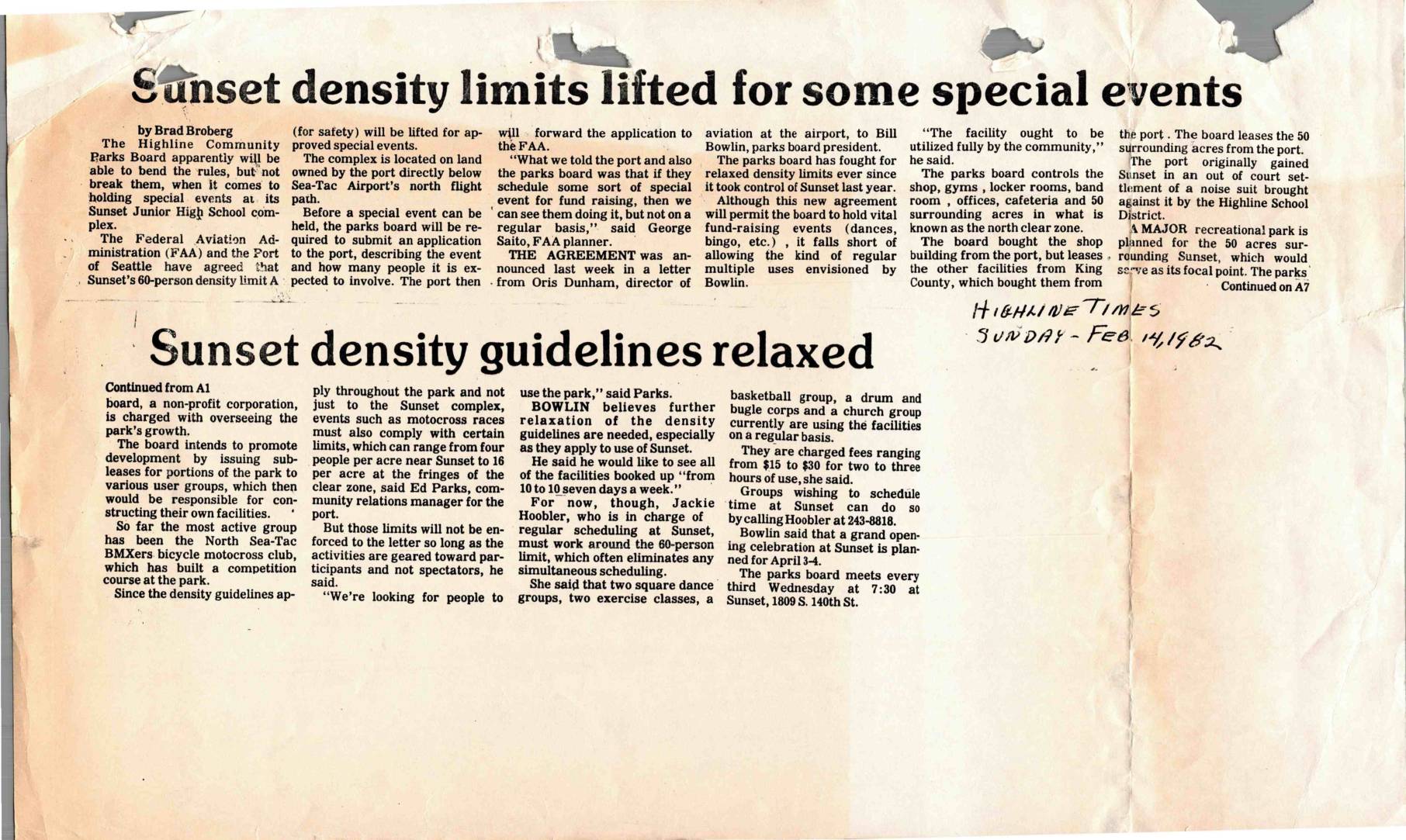
Sunset density limits lifted for some special events
A February 14, 1982 article from the Highline Times reports that the FAA and Port of Seattle agreed to temporarily lift the 60-person density limit at the Sunset Junior High School complex for approved special events, such as fundraising dances and bingo nights. The complex sits on port-owned land directly beneath Sea-Tac Airport's north flight path, where density restrictions exist for public safety reasons. While the agreement allows the Highline Community Parks Board to hold occasional large events, it falls short of permitting the regular, full-capacity scheduling the board had sought for the facility. -
 1982-02-11
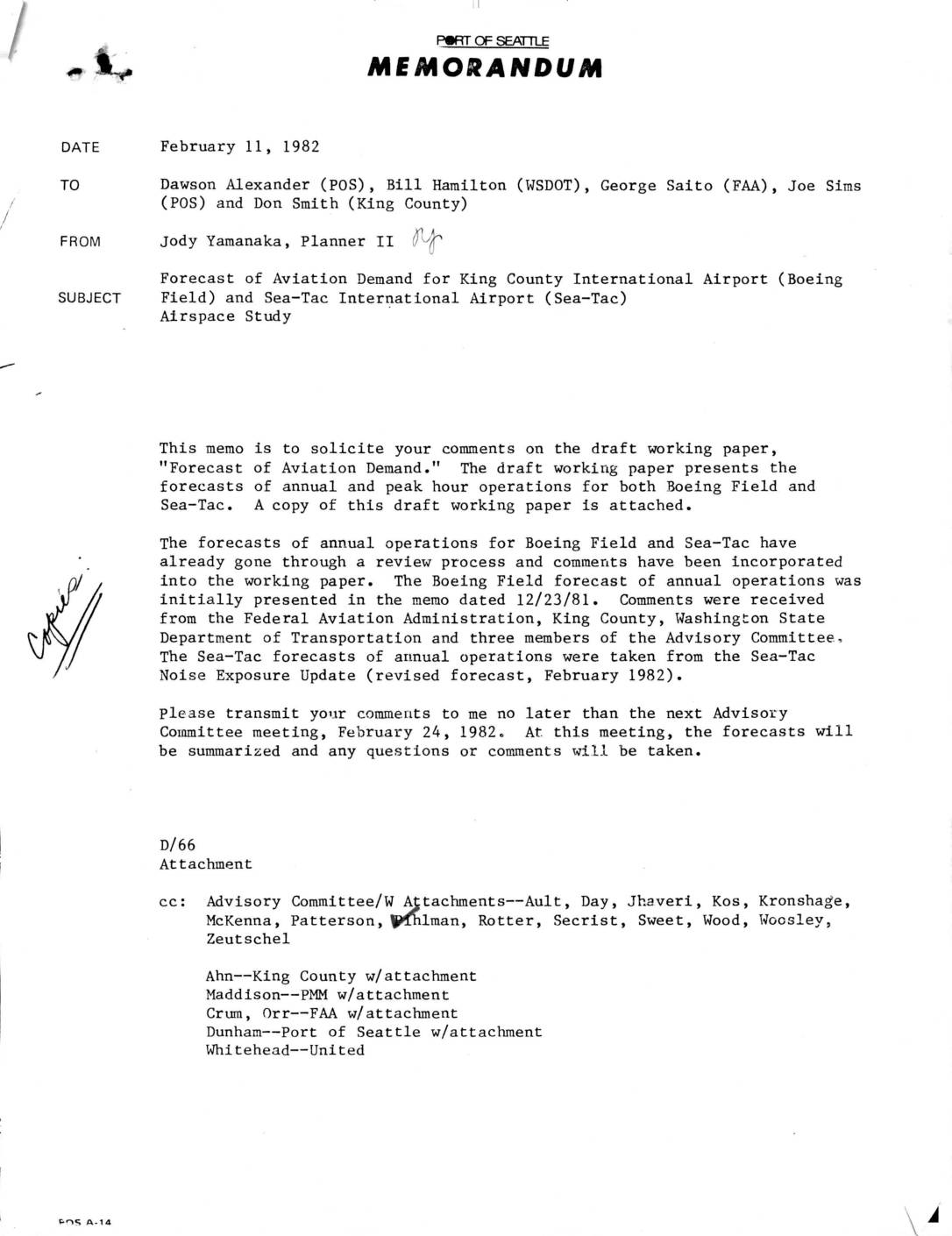
Port Of Seattle Memorandum: Forecast of Aviation Demand for King County International Airport (Boeing Field) and Sea-Tac International Airport — Airspace Study
A 1982 Port of Seattle memorandum presents draft forecasts of aviation demand for Sea-Tac International Airport and Boeing Field, projecting aircraft operations through the year 2000. The forecasts cover annual take-offs and landings as well as peak-hour traffic under both visual and instrument flight conditions, with Sea-Tac's total annual operations expected to grow from roughly 214,000 in 1980 to over 261,000 by 2000. The document was circulated to FAA, King County, and Washington State DOT representatives for review as part of an airspace capacity and noise planning study. -
 1982-02-02
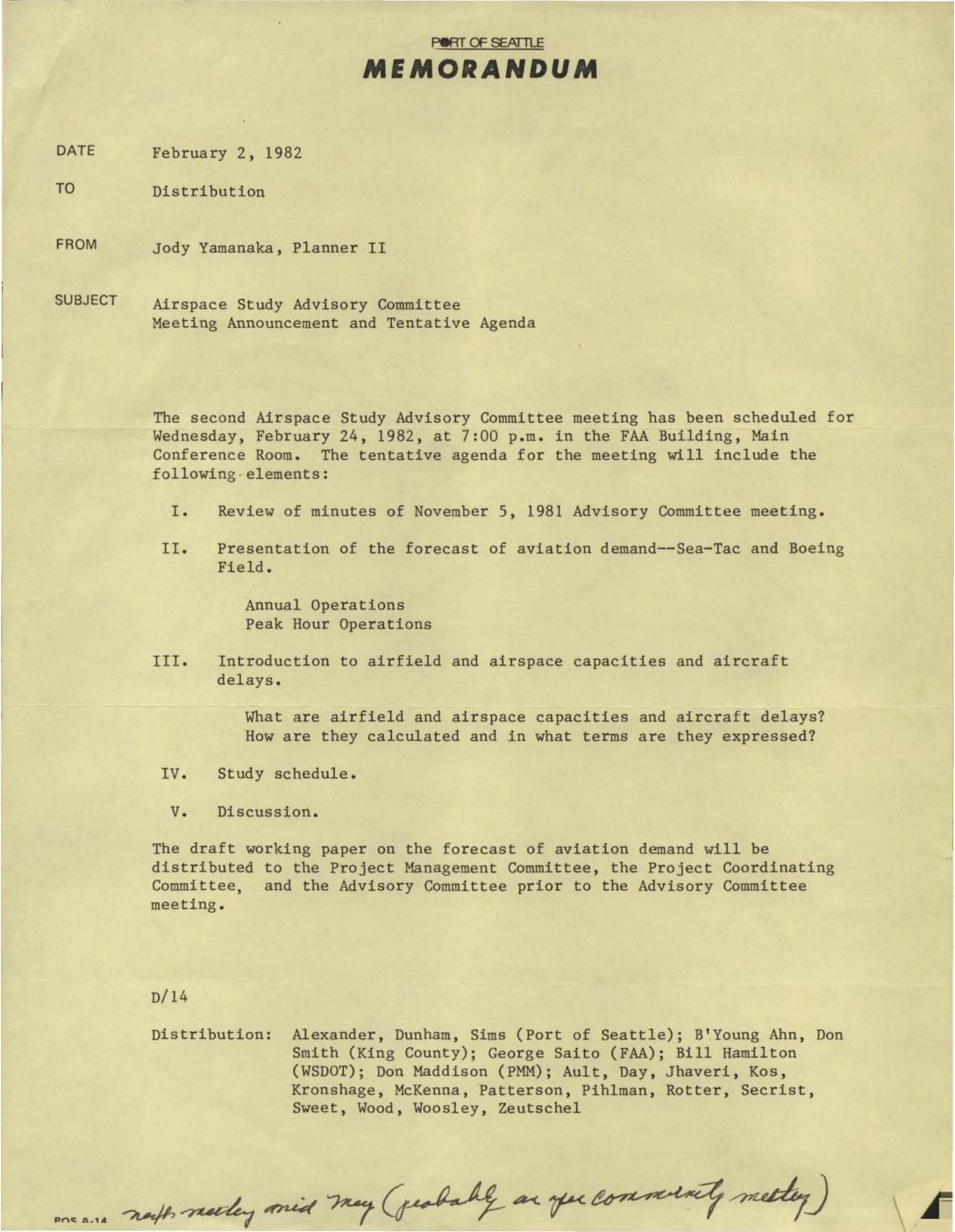
Airspace Study Advisory Committee Meeting Announcement and Tentative Agenda
Port of Seattle memorandum announcing the second Airspace Study Advisory Committee meeting scheduled for February 24, 1982. The agenda includes aviation demand forecasts for Sea-Tac and Boeing Field, discussion of airfield and airspace capacities, and aircraft delays. -
 1982-01-29
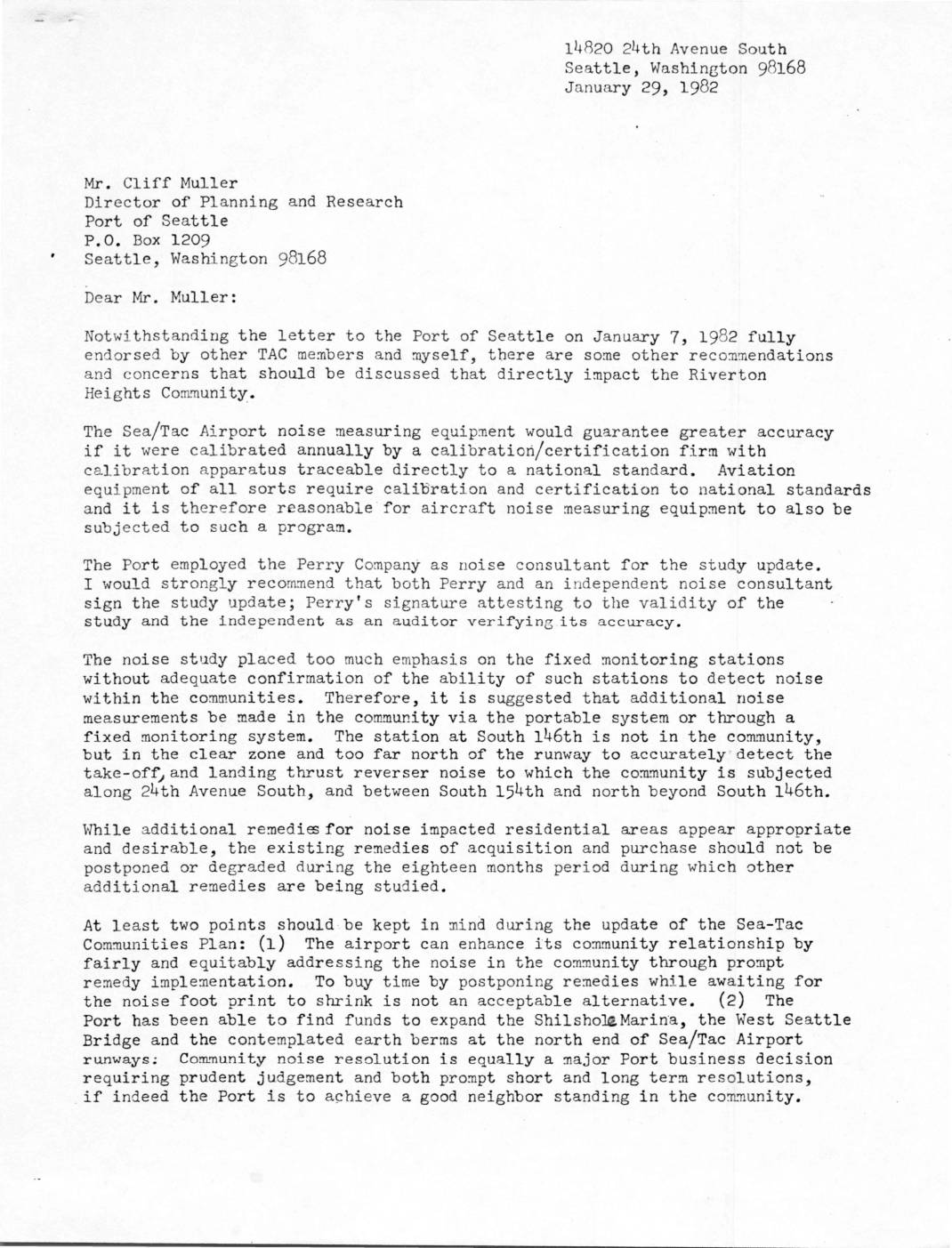
Letter from William C. Holstine to Cliff Muller Regarding Sea-Tac Airport Noise Monitoring and Remedy Program
In a January 29, 1982 letter to the Port of Seattle's Director of Planning and Research, Riverton Heights community representative William C. Holstine outlined several concerns about Sea-Tac Airport noise management, including calls for annual calibration of noise-measuring equipment, independent auditing of the Perry Company's noise study, and additional community-level noise measurements beyond the existing fixed monitoring stations. Holstine argued that existing remedies such as property acquisition and purchase guarantees should not be delayed while new solutions were being studied, and stressed that a five-to-ten-year timeline for resolving aircraft noise impacts—after already waiting ten years—was unacceptable to his community. He urged the Port to expedite and expand its noise remedy programs, drawing a comparison to the Port's willingness to fund other major projects like the Shilshole Marina expansion and the West Seattle Bridge. -
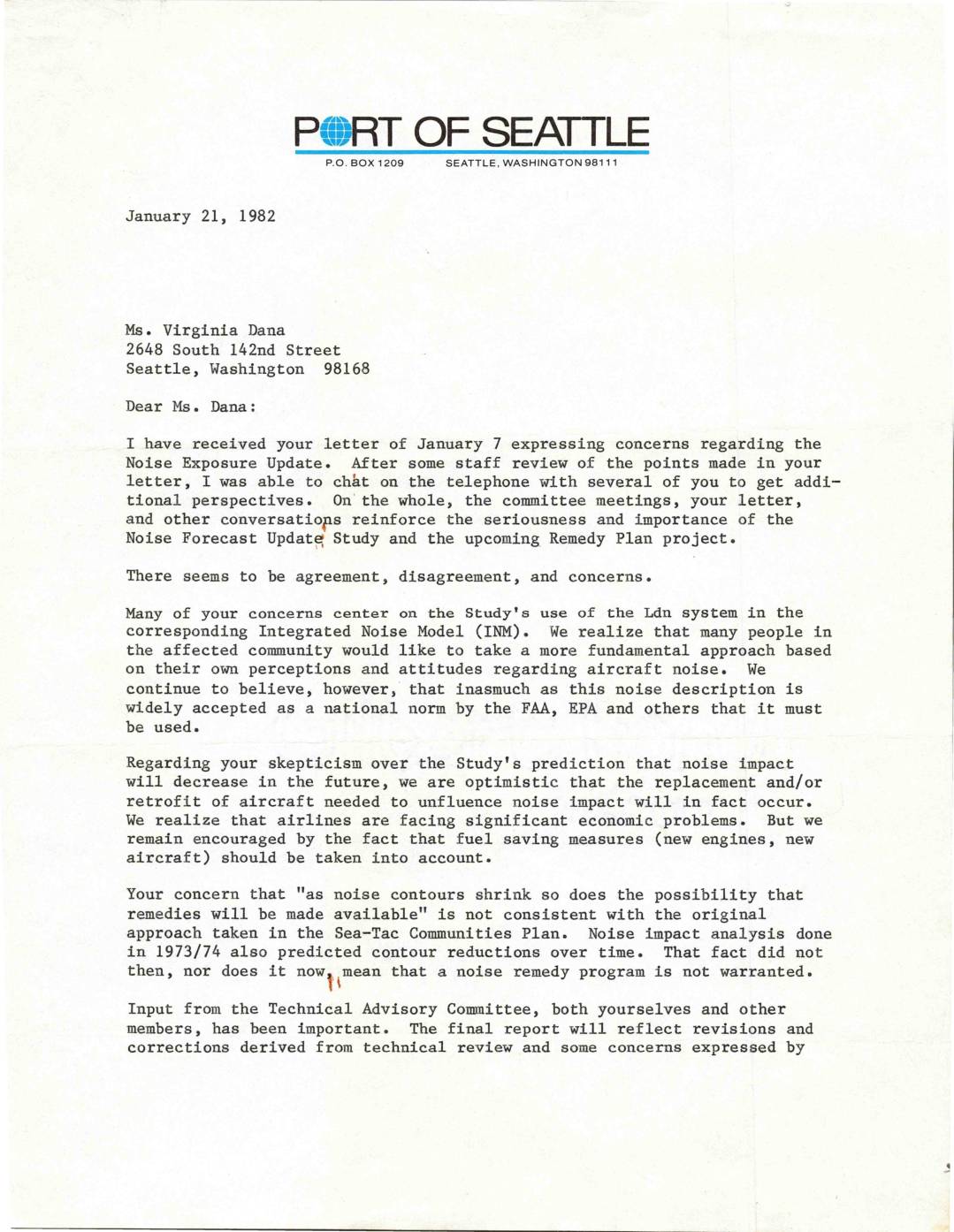 1982-01-21
Letter from Clifford C. Muller to Virginia Dana Regarding Noise Exposure Update
In this January 1982 letter, Port of Seattle Planning Director Clifford C. Muller responds to community member Virginia Dana's concerns about the Sea-Tac Airport Noise Exposure Update Study. He addresses skepticism over the Ldn noise measurement system, defends the study's prediction that noise impact will decrease as airlines adopt quieter aircraft, and reassures Dana that shrinking noise contours do not eliminate eligibility for noise remedy programs. Muller acknowledges that the Technical Advisory Committee's input has been valuable and indicates that the upcoming Remedy Plan project will be the primary venue for addressing ongoing community concerns.