TagPort Of Seattle(2343)
-
 1983-09-28
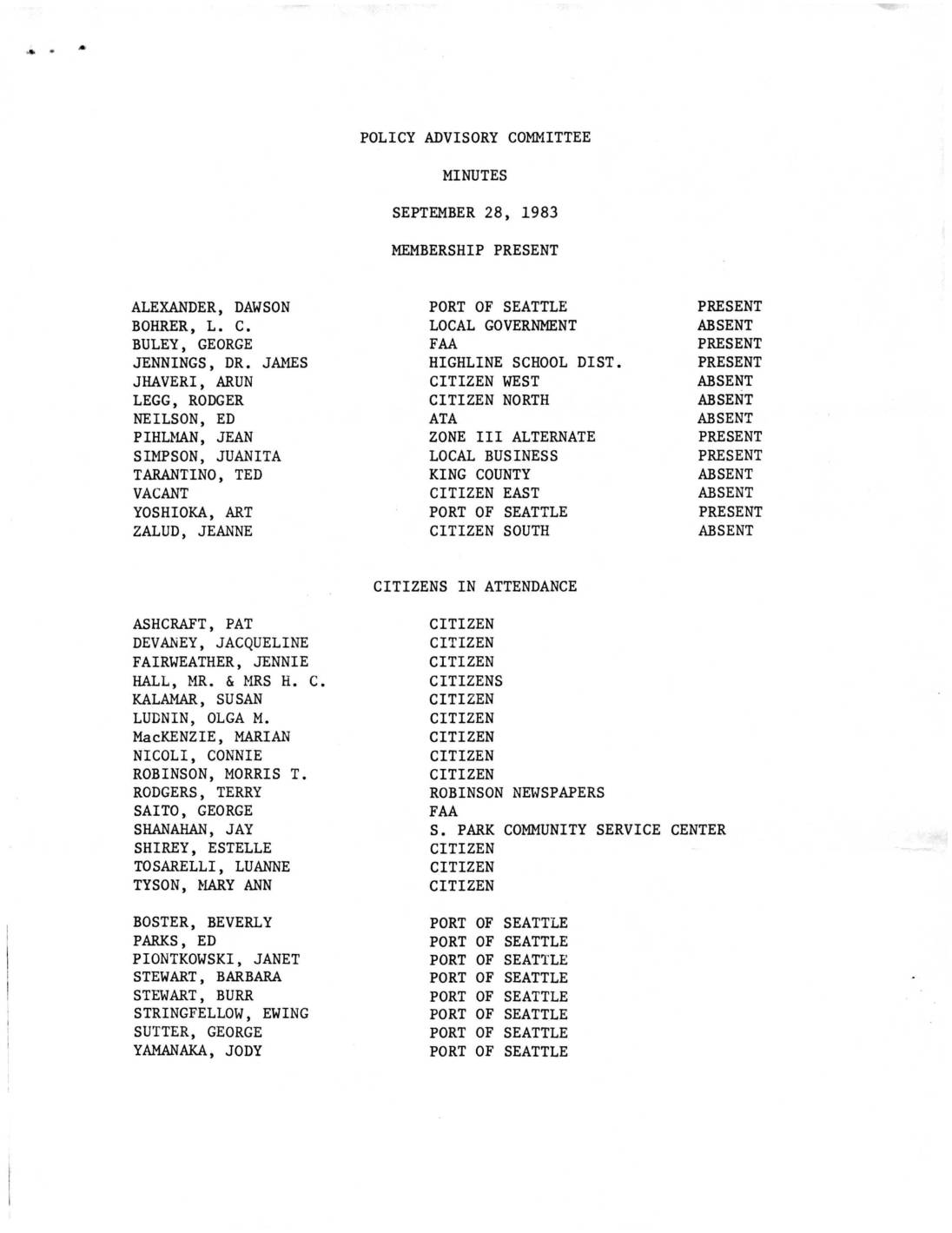
Policy Advisory Committee minutes, September 28, 1983
Minutes from the September 28, 1983 Policy Advisory Committee meeting at Sea-Tac Airport cover updates on noise reduction efforts, including new aircraft departure procedures, expanded noise monitoring stations, and a study on noise insulation and building codes. The committee also reviewed the 20-year Airport Master Plan, which will identify surplus Port-owned land that could be repurposed for commercial development or parks, and received updates on facilities improvements such as a new taxi holding area, completed runway safety zones, and the expanded South Satellite International Terminal. -
 1983-06-03
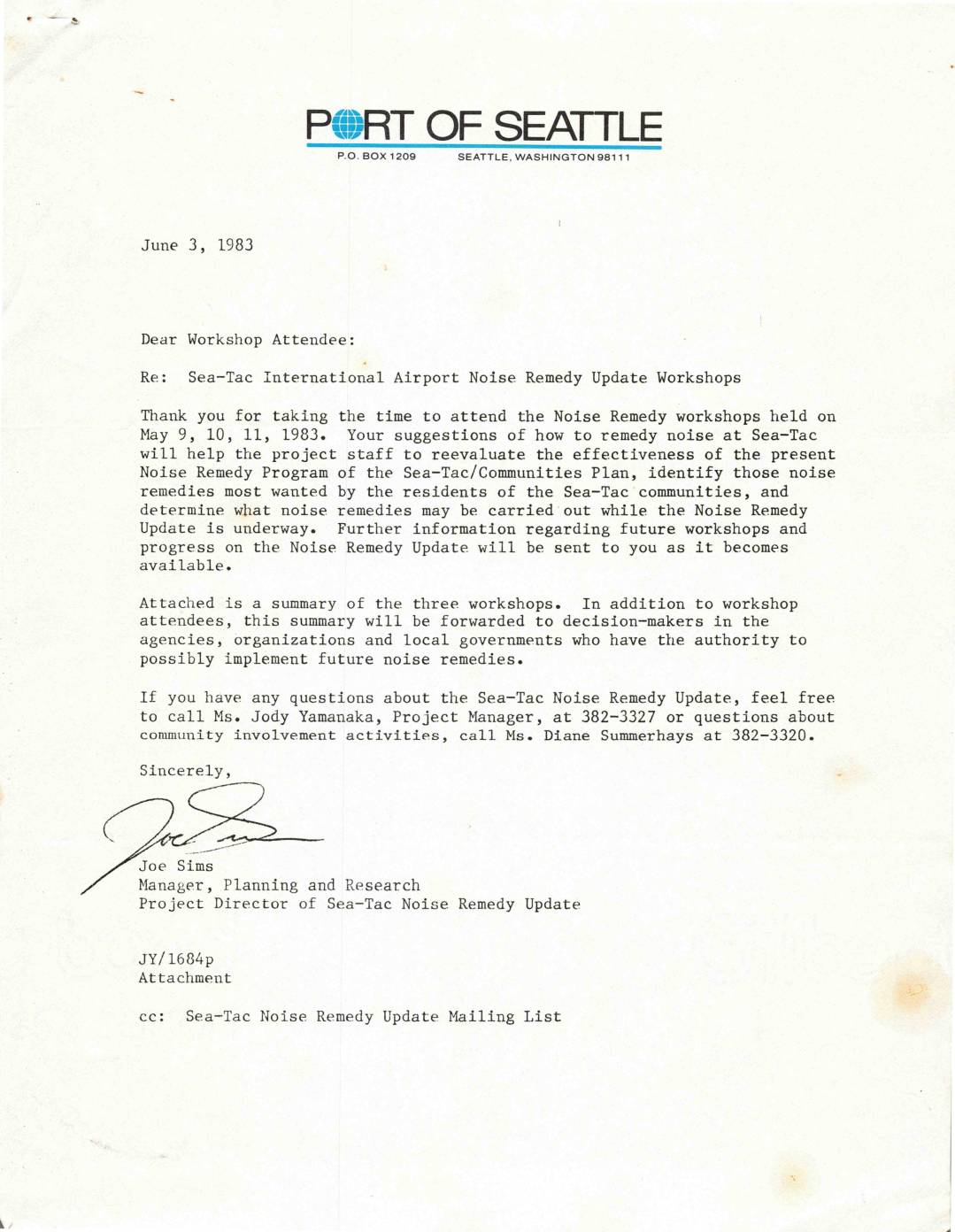
Summary of Sea-Tac International Airport Noise Remedy Update workshops
In May 1983, the Port of Seattle held three community workshops to gather resident input on noise remedies for Sea-Tac International Airport, drawing over 120 attendees from surrounding neighborhoods. Common concerns included faster program implementation, expanded land acquisition boundaries, stricter FAA noise abatement procedures, and a preference for quieter aircraft. The feedback was compiled into a summary forwarded to decision-makers in agencies and local governments with the authority to implement future noise remedies. -
 1983-05-24
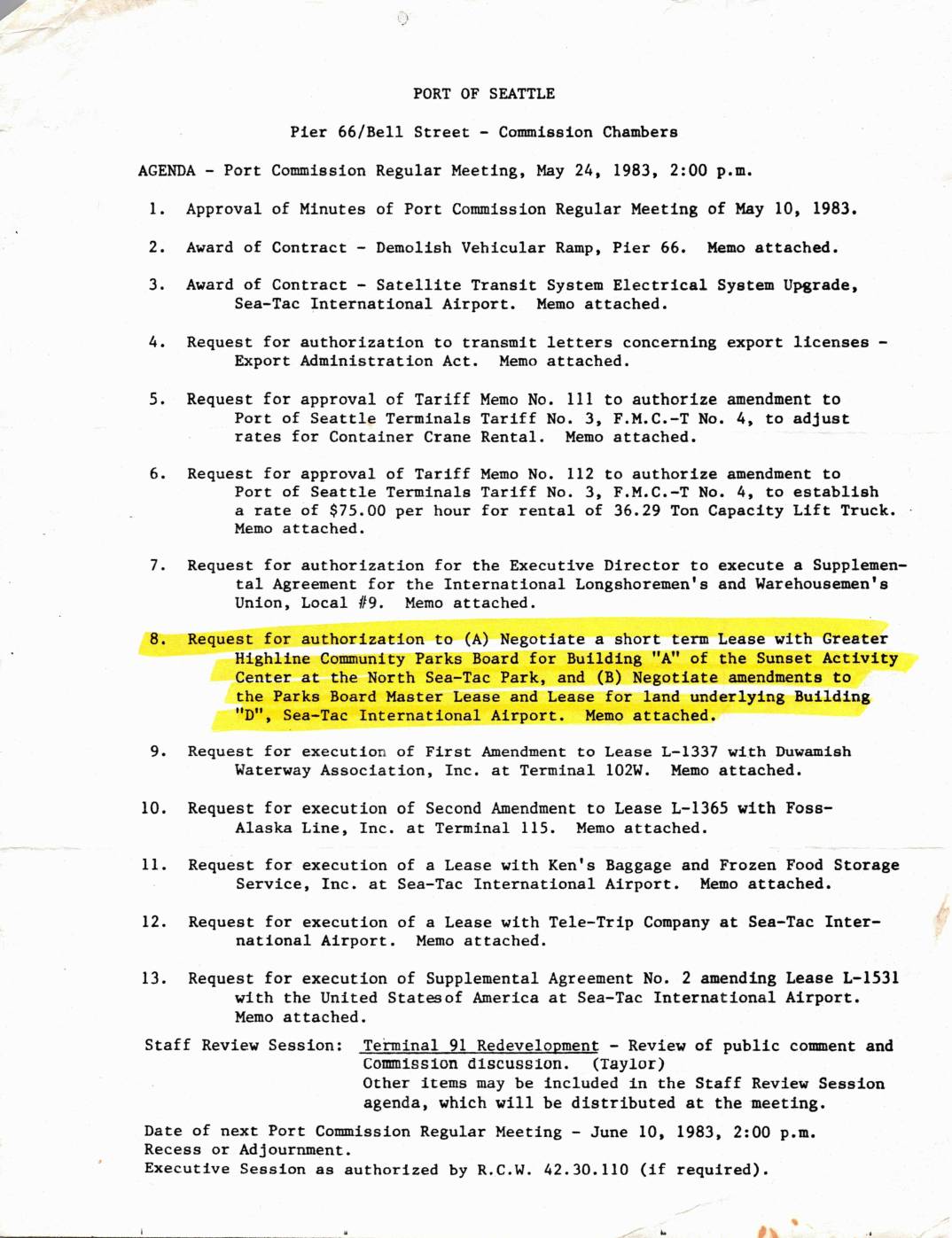
Agenda – Port Commission regular meeting, May 24, 1983
This is the agenda for the Port of Seattle Commission Regular Meeting held on May 24, 1983, covering a range of business items related to Sea-Tac International Airport and port terminals. Airport-related items include a contract award for a Satellite Transit System Electrical System Upgrade, lease negotiations with the Greater Highline Community Parks Board for facilities at the North Sea-Tac Park, and lease agreements with several companies operating at Sea-Tac. A Staff Review Session on Terminal 91 Redevelopment, including public comment and Commission discussion, was also scheduled. -
 1983-04-28
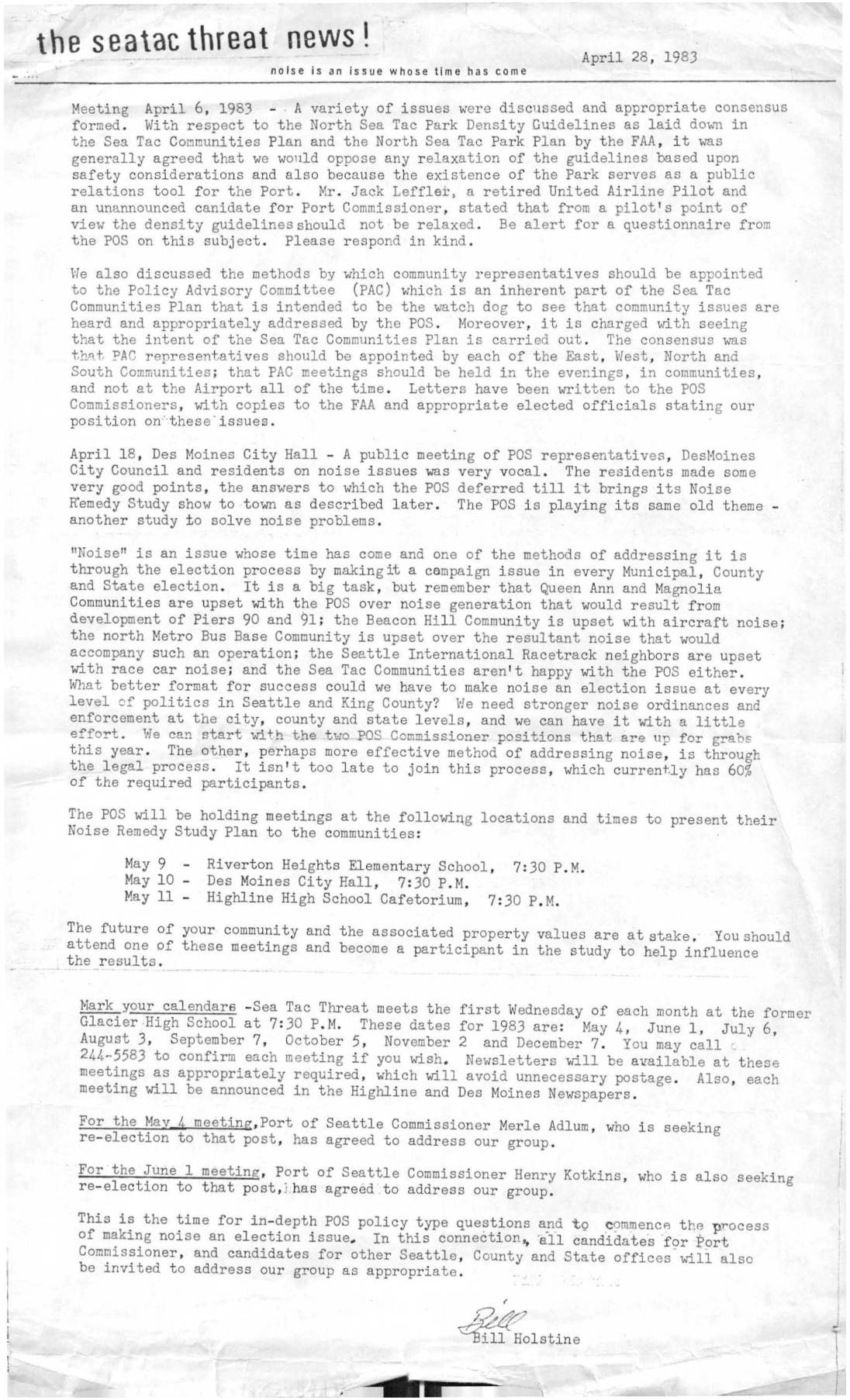
Sea-Tac Threat News: Noise Is an Issue Whose Time Has Come
This April 1983 newsletter from the SeaTac Threat community group outlines residents' opposition to airport noise and related Port of Seattle (POS) policies. It covers meetings where members agreed to resist relaxed density guidelines near North SeaTac Park, push for community-appointed representatives on the Policy Advisory Committee, and make noise a key issue in upcoming municipal, county, and state elections. The newsletter also announces a series of public meetings where the POS will present its Noise Remedy Study Plan, urging residents to attend and participate. -
 1983-04-26
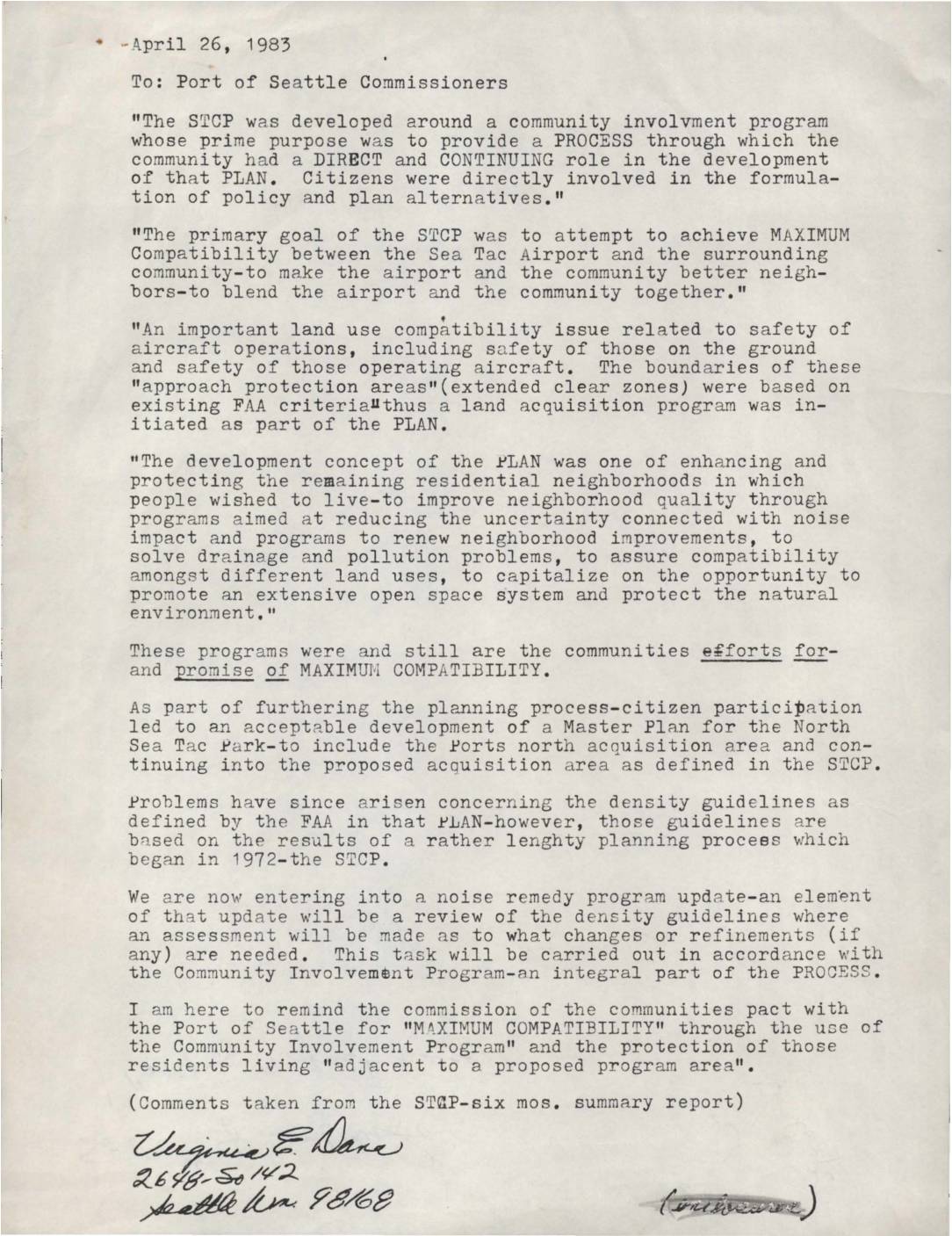
Letter to Port Of Seattle Commissioners regarding STCP and maximum compatibility
In this April 26, 1983 letter to the Port of Seattle Commissioners, resident Virginia E. Dare urges the commission to honor its commitment to 'maximum compatibility' between Sea-Tac Airport and surrounding neighborhoods, as originally promised under the Sea-Tac Community Plan (STCP) launched in 1972. The letter emphasizes that community members were guaranteed a direct, ongoing role in planning decisions—including noise mitigation, land acquisition, and density guidelines—through a formal Community Involvement Program. The author calls on commissioners to uphold that process as they enter a new noise remedy program update that will reassess FAA density guidelines affecting nearby residents. -
 1983-03-01
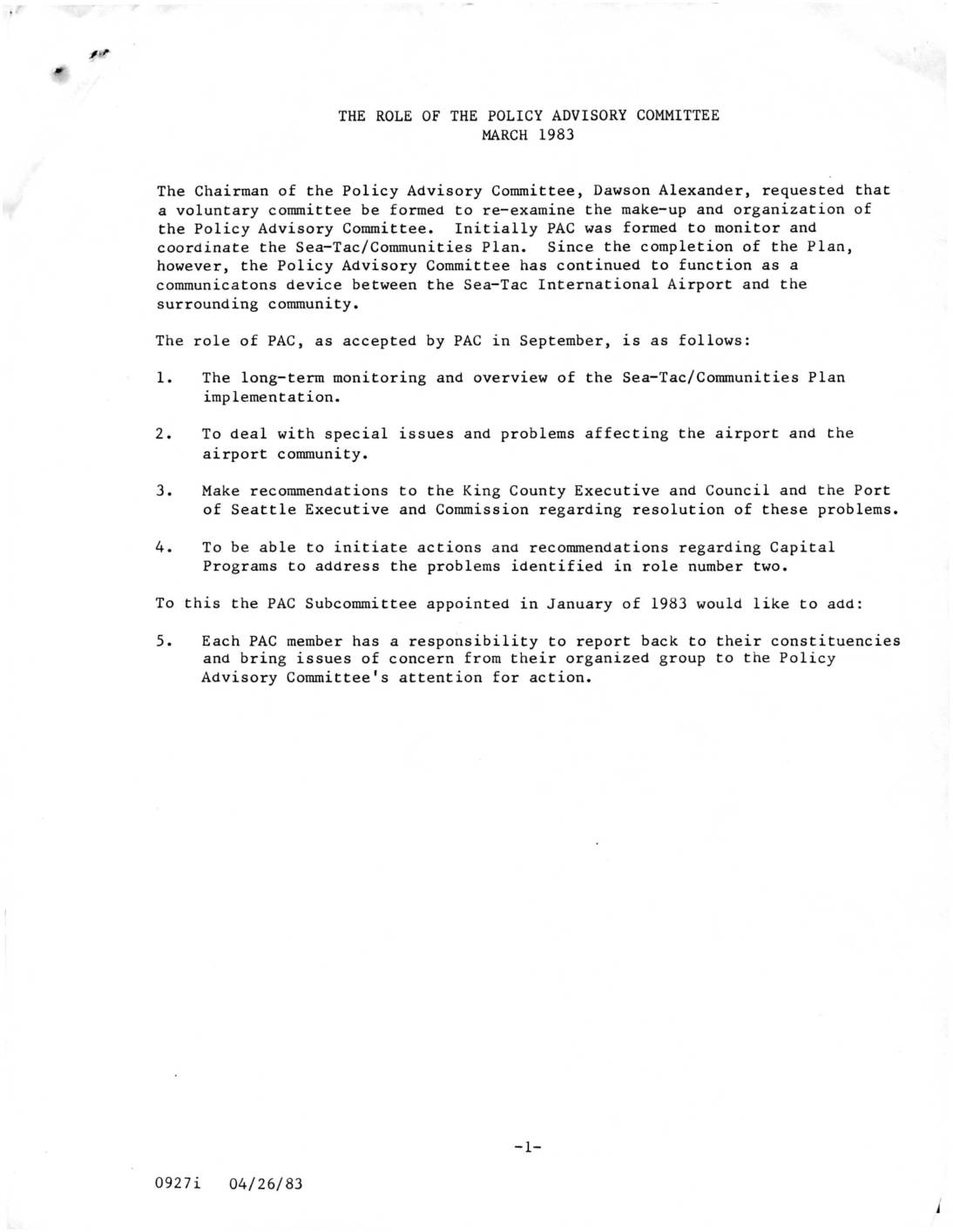
The Role of the Policy Advisory Committee, March 1983
This March 1983 document outlines the proposed role and restructured composition of the Policy Advisory Committee (PAC), a body formed to serve as a communication link between Sea-Tac International Airport and its surrounding communities. It defines five key responsibilities for PAC, including monitoring the Sea-Tac/Communities Plan, addressing airport-related issues, and making recommendations to King County and Port of Seattle officials. The document also proposes reforms to membership selection, including three-year terms, formal application procedures, public notification requirements, and geographically based citizen representation. -
 1983-02-01
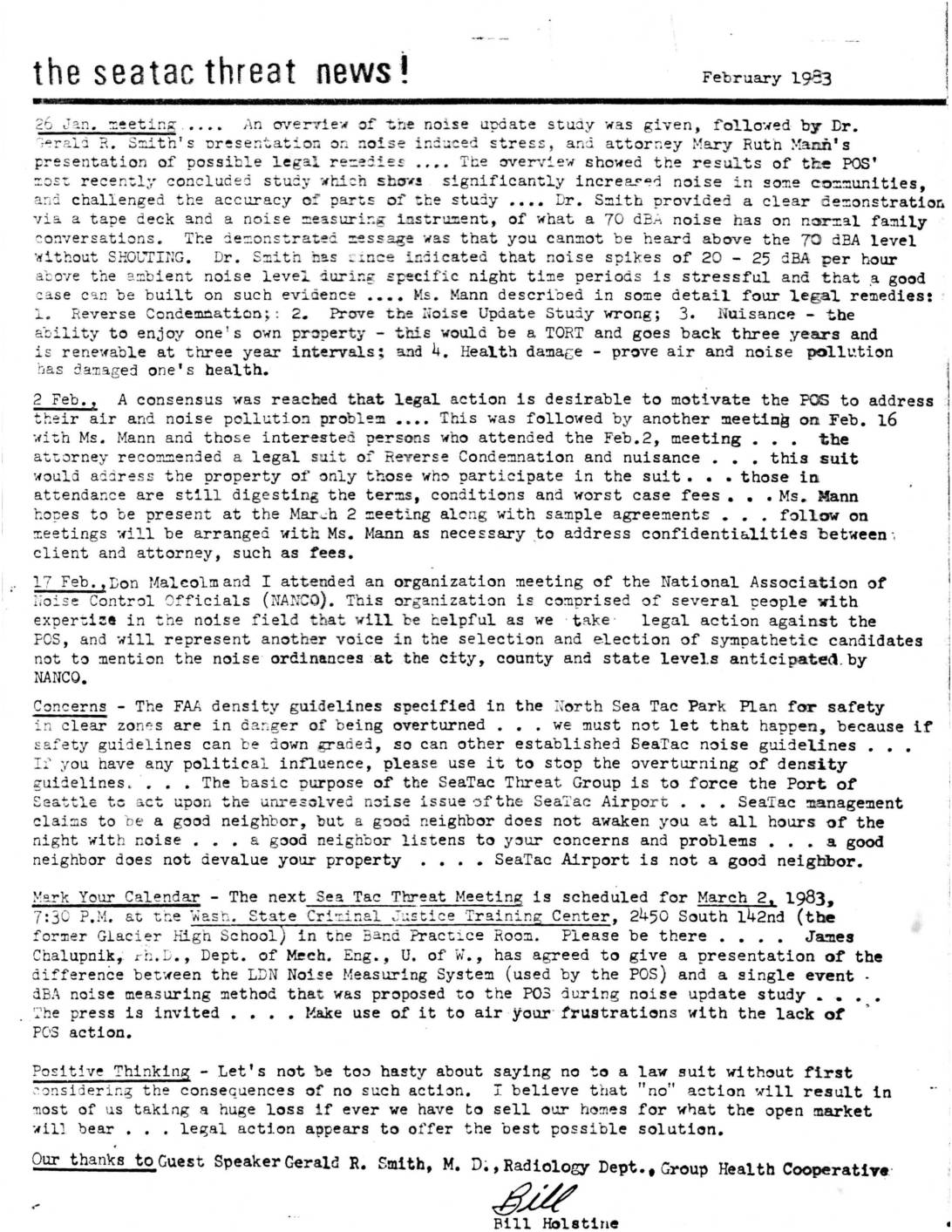
The Sea-Tac Threat News: February 1983
A February 1983 newsletter from the SeaTac Threat Group details community efforts to fight noise and air pollution from Seattle-Tacoma International Airport, including presentations on noise health impacts and four potential legal remedies such as reverse condemnation and nuisance suits. The group reached a consensus that legal action was the best way to pressure the Port of Seattle (POS) to address the airport's noise pollution, and members were encouraged to attend upcoming meetings with attorney Mary Ruth Mann to discuss terms and fees. The newsletter also highlights concerns about FAA safety density guidelines being overturned and urges residents with political influence to take action. -
 1983-01-26
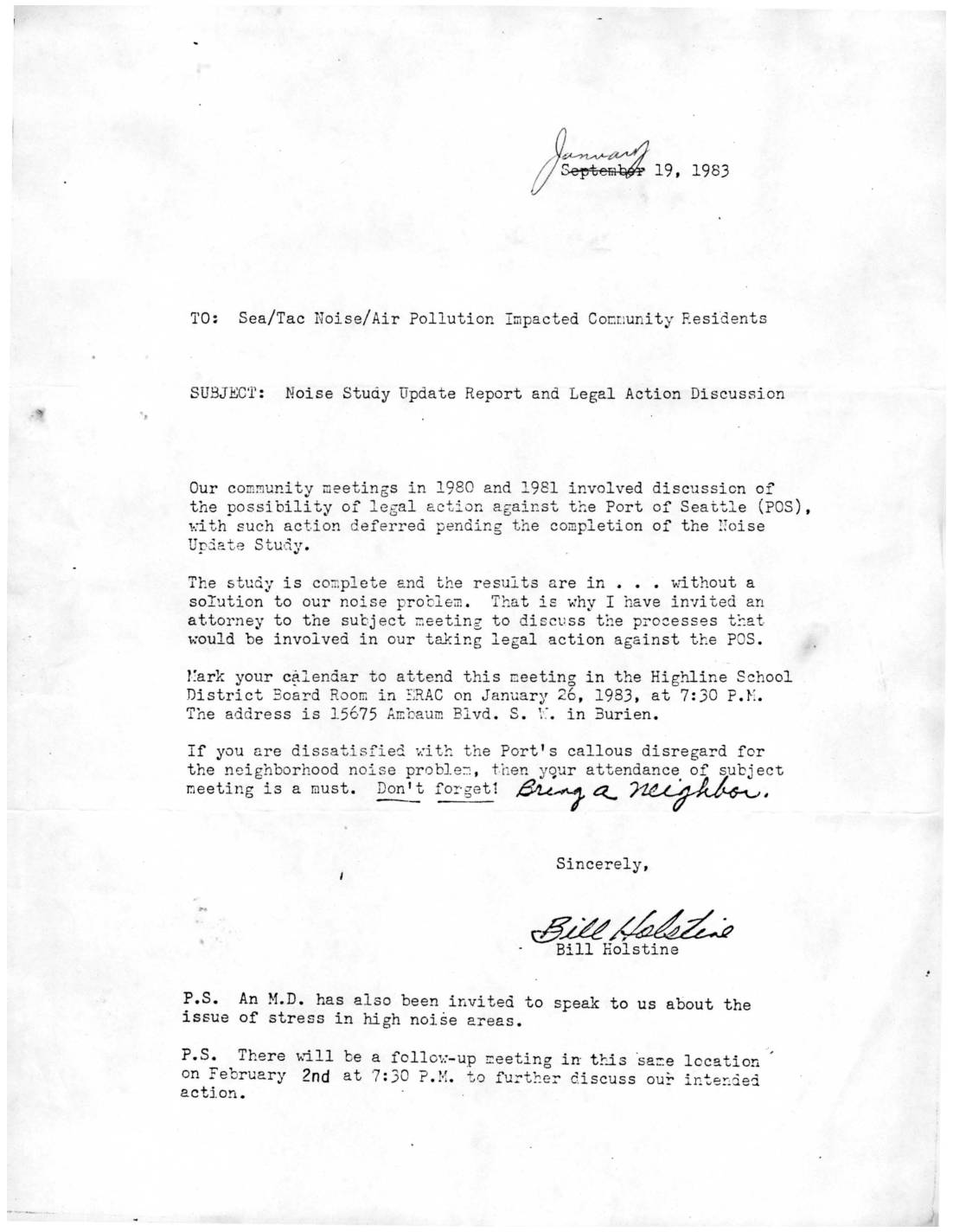
Community Meeting Notice for Noise Study Update and Legal Action Discussion
A letter from Bill Holstine to Sea/Tac noise and air pollution impacted community residents announcing a meeting to discuss the completed Noise Update Study results and potential legal action against the Port of Seattle. The meeting was scheduled for January 26, 1983, and would include an attorney to discuss legal processes and an M.D. to -
 1982-06-01
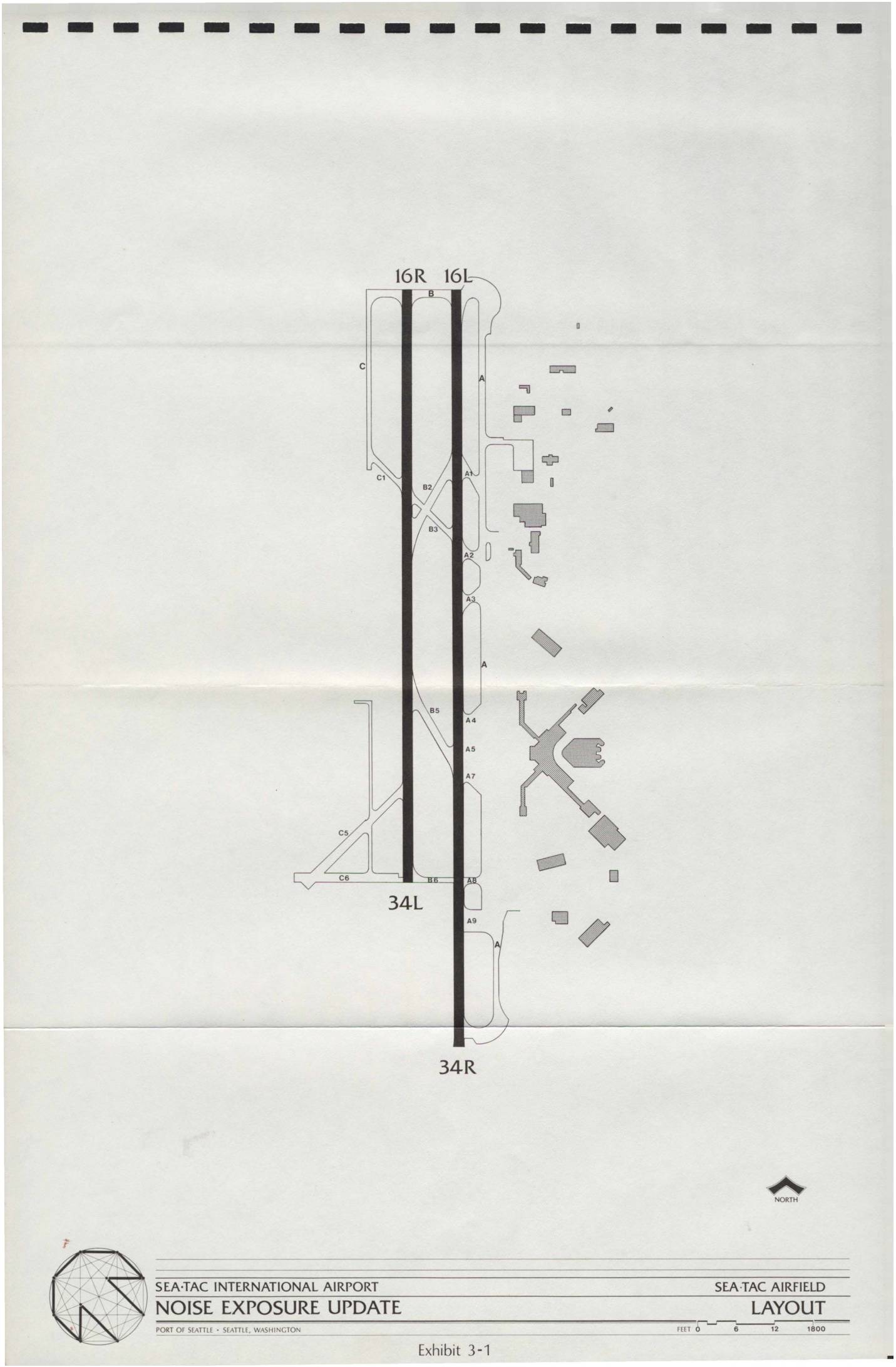
Sea-Tac International Airport Noise Exposure Update: Sea-Tac Airfield Layout and Flight Tracks
This document presents the Sea-Tac International Airport Noise Exposure Update prepared for the Port of Seattle, including a detailed airfield layout showing the two parallel runways (16R/16L and 34R/34L) and associated taxiways. It also includes flight track maps for both South Flow and North Flow operations, illustrating arrival and departure routes used by aircraft over the surrounding communities. The exhibits provide a geographic overview of how flight paths extend across the Seattle metropolitan area, informing noise exposure assessments for airport planning and policy purposes. -
 1982-05-14
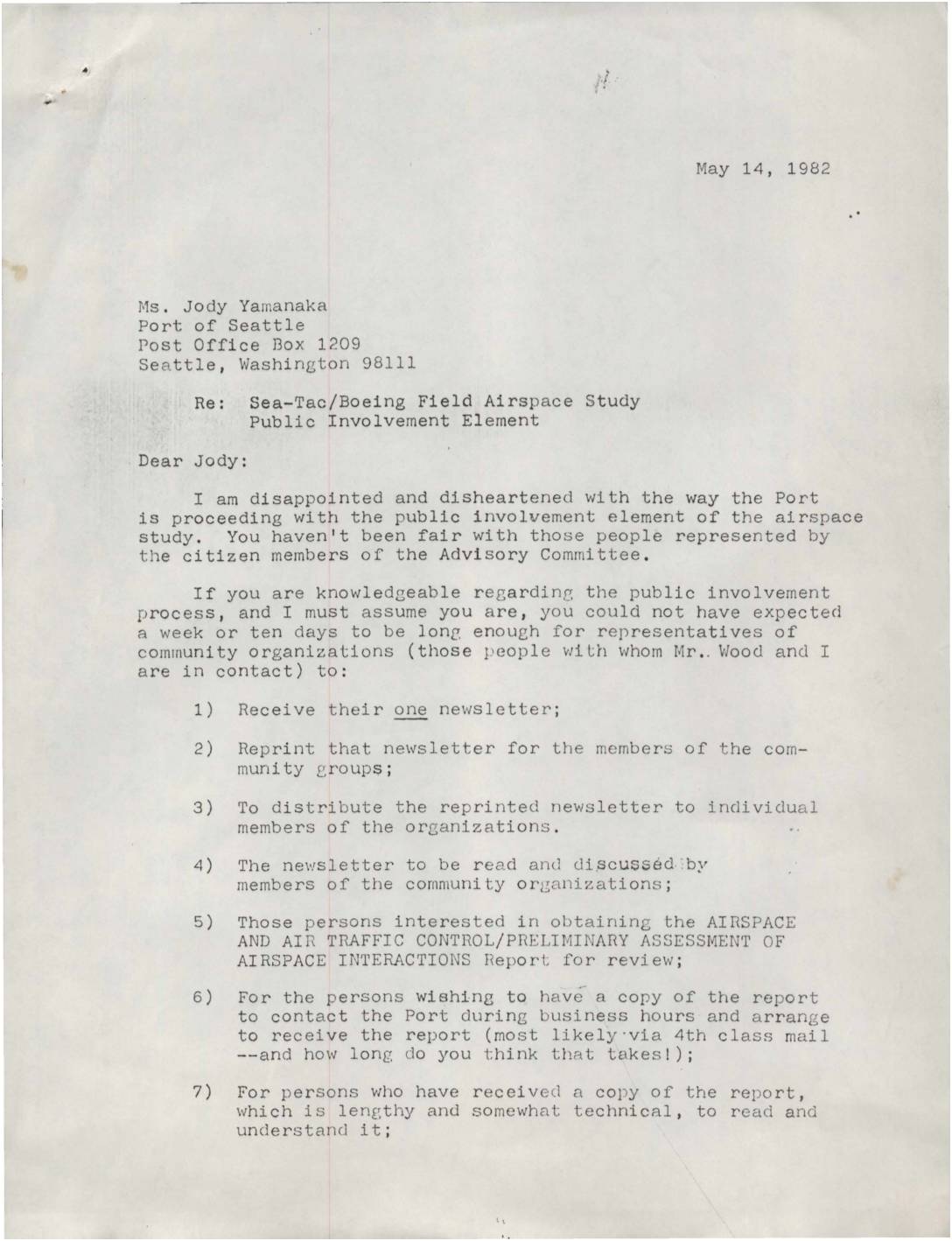
Letter to Port of Seattle Regarding Sea-Tac/Boeing Field Airspace Study Public Involvement
Letter from Rosemary Zeutschel criticizing the Port of Seattle’s inadequate public involvement process for the Sea-Tac/Boeing Field Airspace Study, arguing that insufficient time was provided for community organizations to review technical documents and provide meaningful input.