TagPort Of Seattle Commission(302)
As the owner/operator of Sea-Tac Airport, following Commission meetings is a must. https://meetings.portseattle.org/
-
 2018-06-26
Aviation Division 2019 business plan and budget preview
The Port of Seattle's Aviation Division presented its 2019 Business Plan and Budget Preview on June 26, 2018, outlining the process for translating long-term strategic goals into annual budgets and staffing plans. The presentation covers strategic priorities, anticipated budget needs, and staffing requirements for 2019, all grounded in the Port's broader Century Agenda framework. The planning process spans multiple time horizons, from a 5–10 year vision down to annual implementation through business plans, budgets, and performance plans. -
 2018-06-21
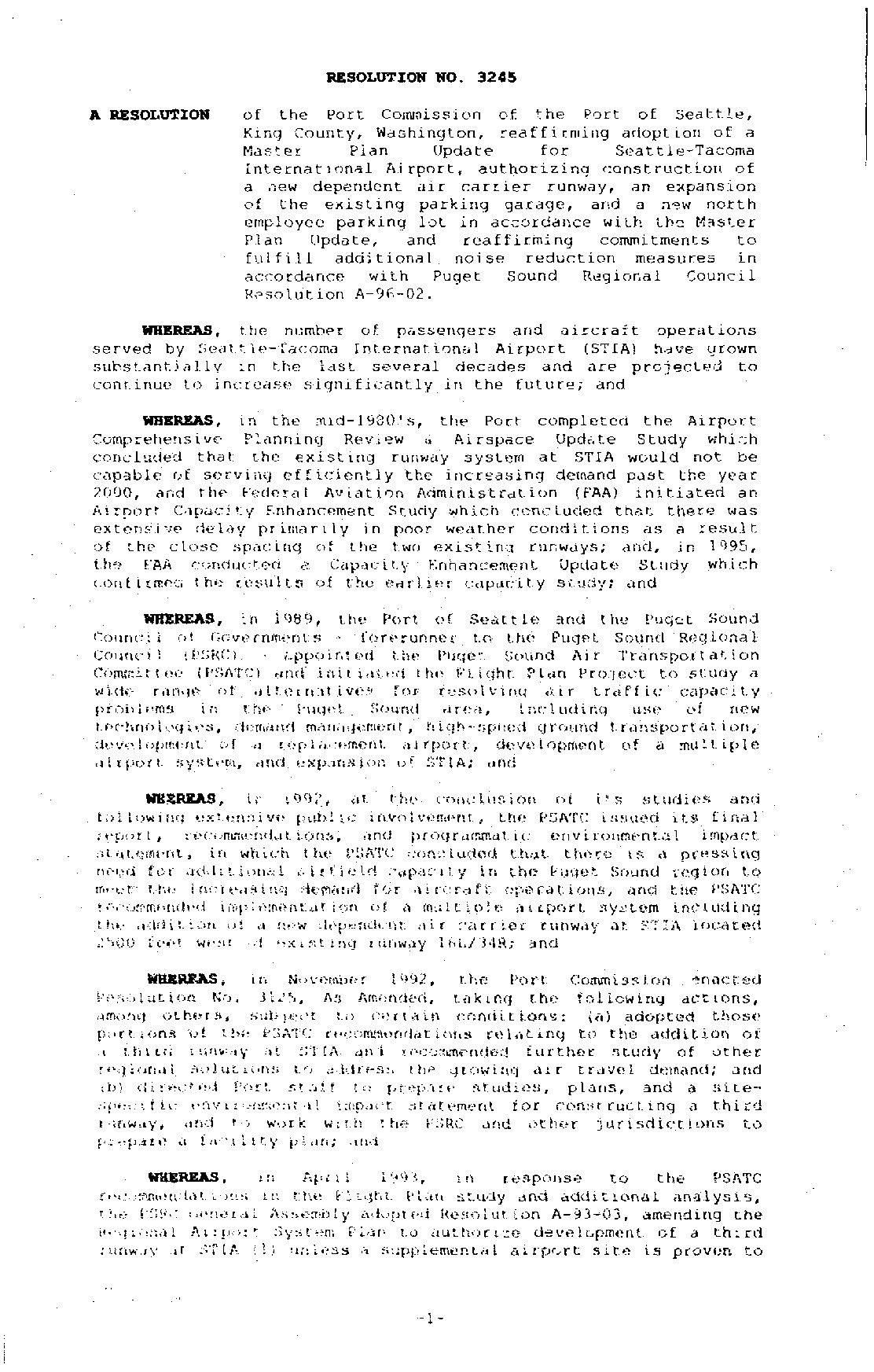
Resolution No. 3245: Reaffirming adoption of a Master Plan Update for Seattle-Tacoma International Airport
Passed before 3rd Runway -
 2018-05-08
Airport Financial Forecast & SAMP Impacts: Commission Briefing
A May 2018 Port of Seattle Commission briefing assessed the financial impact of the Sustainable Airport Master Plan (SAMP) on Sea-Tac Airport, finding that adding SAMP projects could push airline cost-per-enplaned-passenger (CPE) to an infeasible $36 by 2027. To keep costs within an acceptable range of $25–$30, the Port identified the need to increase non-aeronautical revenues, control operating and maintenance expenses, and reduce projected capital spending. The briefing concluded that SAMP is financially achievable, but only with vigilant cost management. -
 2018-04-26
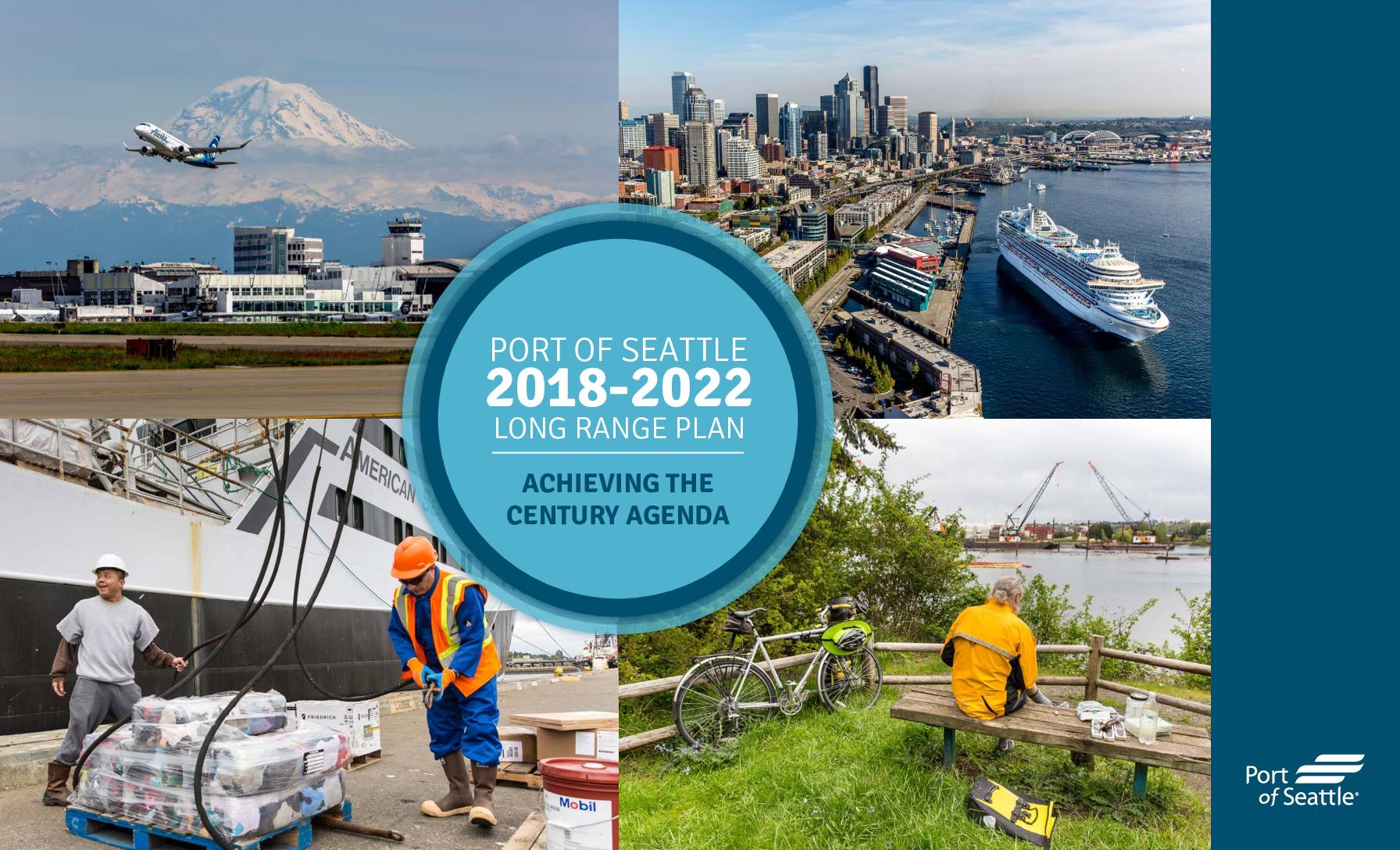
Port Of Seattle 2018-2022 Long Range Plan: Achieving the Century Agenda
The Port of Seattle's 2018–2022 Long Range Plan outlines the organization's mission to create economic opportunity and stronger communities by advancing trade, commerce, maritime growth, and environmental stewardship. The plan aims to add 100,000 jobs for a regional total of 300,000 port-related jobs while reducing the Port's environmental footprint. It uses a rolling five-year framework updated annually by the Commission to align all Port divisions around strategic goals established in the Century Agenda. -
 2018-04-10
Tourism Marketing Support Program 2018 funding recommendations
The Port of Seattle's 2018 Tourism Marketing Support Program allocated $200,000 to promote Washington state as a leading tourism destination, selecting 26 recipients from 45 applicants who had collectively requested $393,500 in funding. The selected projects, which include 22 culture, eco, and nature tourism initiatives, cover a range of marketing activities such as trade shows, digital media, international marketing, and event promotion. Recipients also contributed $148,008 in matching funds, demonstrating broad partnership across the state's travel and visitor industry. -
 2018-04-02
Airport drives traffic enhancement briefing
This 2018 Port of Seattle briefing outlines near-term traffic mitigation strategies for Sea-Tac Airport's increasingly congested roadway system, which was originally designed for 5 million annual passengers but now handles far greater volumes. Key measures include a Traffic Mitigation Plan that restricts access to southbound airport freeways during peak periods, and a new TNC 'Re-Match' program that allows rideshare drivers who have just dropped off passengers to immediately pick up new ones without returning to the remote 160th Street holding lot. The Re-Match pilot reduced passenger wait times by one-third and eliminated an estimated 30,000 deadheading trips in December 2017, while also reducing expressway congestion near the terminal. -
 2018-02-13
Draft 2018 local and regional government relations priorities
In February 2018, the Port of Seattle presented its draft local and regional government relations priorities to the Port Commission, covering areas such as workforce development, economic opportunity, equity and inclusion, regional mobility, and climate and sustainability. The briefing outlined priority items across Port-wide, Aviation, and Maritime divisions, along with additional issues being monitored or supported. The Commission was set to incorporate feedback and formally adopt the priorities at a follow-up meeting on February 27, 2018. -
 2018-02-05
2018 local and regional government relations priorities
This February 2018 Port of Seattle Commission memo outlines the agency's local and regional government relations priorities for the year, covering areas such as workforce development, regional mobility, and environmental sustainability. Among the aviation-related priorities, the Port committed to advancing the Sustainable Airport Master Plan (SAMP), strengthening community engagement with airport-area neighborhoods through forums like the Sea-Tac Stakeholder Advisory Round Table (StART), and pursuing noise insulation grant funding for public schools near the airport. The document also highlights the Port's interest in studying the relationship between aviation activity and ultrafine particulate emissions as part of its broader state and federal legislative agenda. -
 2018-01-30
Tourism Marketing Support Program summary
This January 2018 Port of Seattle presentation outlines the Tourism Marketing Support Program, which aims to grow the region's visitor economy by increasing tourist numbers and spending across Washington State while expanding use of Port assets. The program supports partnerships with travel organizations and positions the Port as a leader in the visitor industry, aligning with the Port's broader Century Agenda goal of advancing the Seattle region as a leading tourism destination. -
 2018-01-30
Sea-Tac International Airport economic impacts
A January 2018 Port of Seattle report presented to the Port Commission details the economic impacts of Seattle-Tacoma International Airport, showing that Sea-Tac supported approximately 87,300 jobs and generated over $11.4 billion in business revenue in 2017. The impacts span on-site airport activities—including airlines, cargo, and ground transportation—as well as visitor spending, which alone accounted for 68,200 jobs and nearly $5.9 billion in revenue. The report provides a comprehensive breakdown of wages, compensation, and business revenue across all airport-related sectors.