Skip to content
  • STNI
  • Statistics
    • Ops and Passengers
      • King County International Airport (Boeing Field) Annual Operations
    • Financials
    • Aviation fuel uplift in the State of Washington 2018 – 2025
      • Aviation Fuel Tax Revenue in the State of Washington 1983-2025
      • Aviation Fuel Uplift at Sea-Tac Airport
    • Air Quality Monitoring
    • Flight Tracking
      • Flow and Flight Tracks
      • Five Year Comparison
      • Busiest Hours and Days
    • SEL Noise Reports & Graphs
      • About The Permanent Noise Monitors
      • Minutes of Quiet by Noise Monitor
      • Noise Events mapped
      • Noise Events (SEL)
    • Runways
    • Employees
    • Real Estate
      • Port Properties and Trees mapped
    • Parking
  • Events
  • Protest
    • Regular Events
    • Policy
      • Legislative Agenda 2027
      • Airport mitigation for the twenty first century
      • Port Dracula
    • Complain about a particular flight
    • Advocacy Organizations
    • Media Outlets
    • People
    • The Port of Seattle
      • Commission Meetings
      • Public Records Requests
      • StART
      • Highline Forum
    • Contact Your Electeds
  • Resources
    • FAQs
      • FAA Occurrences/Accidents/Indents
    • The SAMP
      • SAMP Public Comment Template
        • Two versions of Appendix K: NEPA/SEPA 2018 vs 2023
      • SAMP NTP: 31 projects by the numbers
      • SEPA Draft EIS (2026)
      • SAMP Record of Decision/FONSI (2025)
      • SAMP Draft EA (October 2024)
      • 2018 Scoping
    • Port Packages
      • Port Package Property Costs
      • Port Packages mapped
      • The Port Package Explainer
      • So you want a (first-time) Port Package? Start here
      • Port Package Looker Upper
      • How do I determine if I have a Port Package or Avigation Easement?
      • Progress on Port Package Update legislation
      • Having a Port Package Problem?
      • Port Package Site Visit Follow-Up
    • Document Library
    • Explainers
      • The Airport Law Cheat Sheet
      • The Grant Explainer
    • External Articles
    • History
      • Timeline
      • The Sea-Tac Communities Plan
        • Sea-Tac Communities Plan – Planning Maps
      • PSRC Third Runway Decision Process
    • Studies
    • Videos
  • Stories
  • Mission
  • Subscribe
  • Contact
Scroll down to content

Get InformedStay Informedx

I understand that you will never share my information with anyone, you will only use it to keep me updated on relevant events and that I may unsubscribe at any time.

STNI

STNISea-Tac Noise.Info

  • Solve for Sea-Tac. Solve for every airport.
  • Since 2016, working to obtain justice for everyone living under the flight path.
  • Less Noise. Cleaner Air. Better Public Health. Compensation.
  • Everything you think you know about the airport is wrong.

TagPart 150(269)

Advanced Search Options

  • Dates
  • Media
    • External Articles
    • Images
    • PDFs
    • Video
    • Audio
  • Order By
  • 2013-10-23

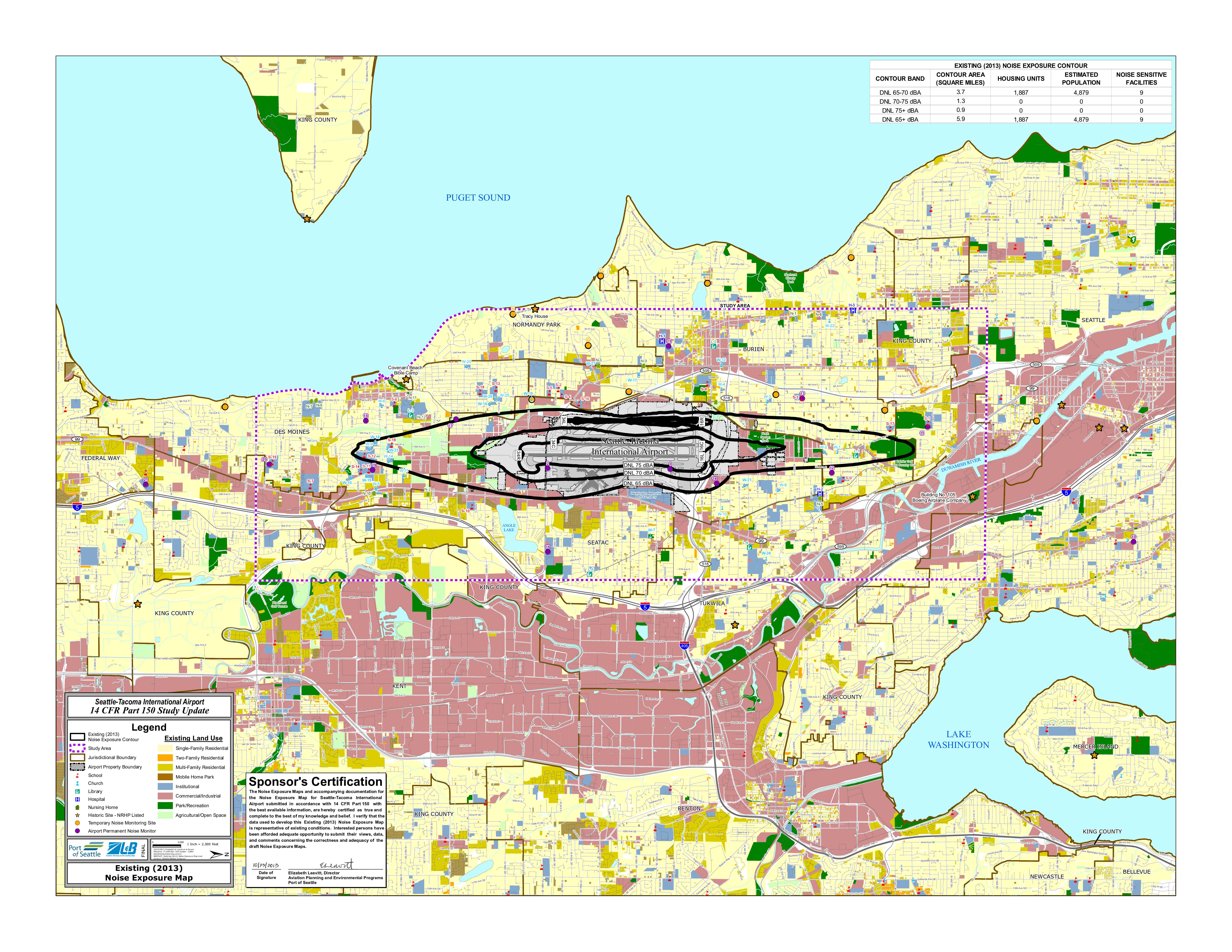
    Existing (2013) Noise Exposure Map: Seattle-Tacoma International Airport 14 CFR Part 150 Study Update

    This is the Existing (2013) Noise Exposure Map for Seattle-Tacoma International Airport, prepared as part of a 14 CFR Part 150 Study Update by Landrum & Brown for the Port of Seattle. The map shows aircraft noise contours around Sea-Tac, indicating that the DNL 65 dBA or greater noise zone covers approximately 5.9 square miles and affects an estimated 1,887 housing units and 4,879 residents, along with 9 noise-sensitive facilities such as schools and churches. The map was certified by Port of Seattle Aviation Planning Director Elizabeth Leavitt as accurately representing existing noise conditions based on the best available data.
    TagsLandrum & Brown, Noise Exposure Update, Part 150, Port Of Seattle, Sea-Tac AirportFolder2013
  • 2013-10-15

    Informal Runway Use Agreement (Appendix I 2013 Part 150 Study)

    ★ 32
    Appendix I from the 2013 Part 150 Study by Landrum & Brown. A Letter Of Agreement (LOA) where the Port Of Seattle agrees to using the Third Runway primarily for overflows and bad weather. Note the very official looking signature of the Port CEO, Tay Yoshitani. Also note that it is described as an ‘informal
    CategoriesKey Documents TagsLandrum & Brown, Part 150, Runway Use Agreement, Tay Yoshitani, Third Runway
  • 2013-10-01

    2013 Part 150 Noise Compatibility Study Update — Volume One Cover Page

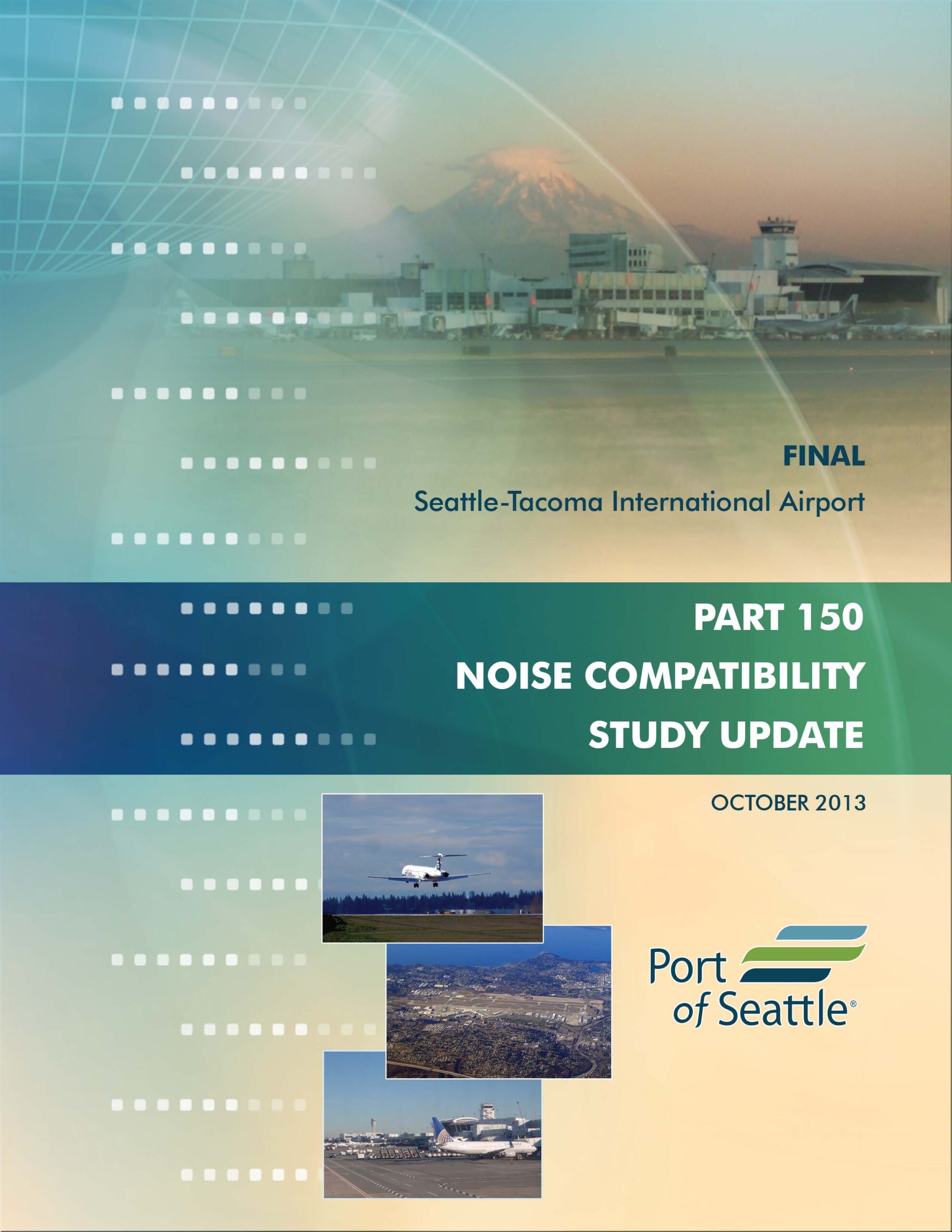
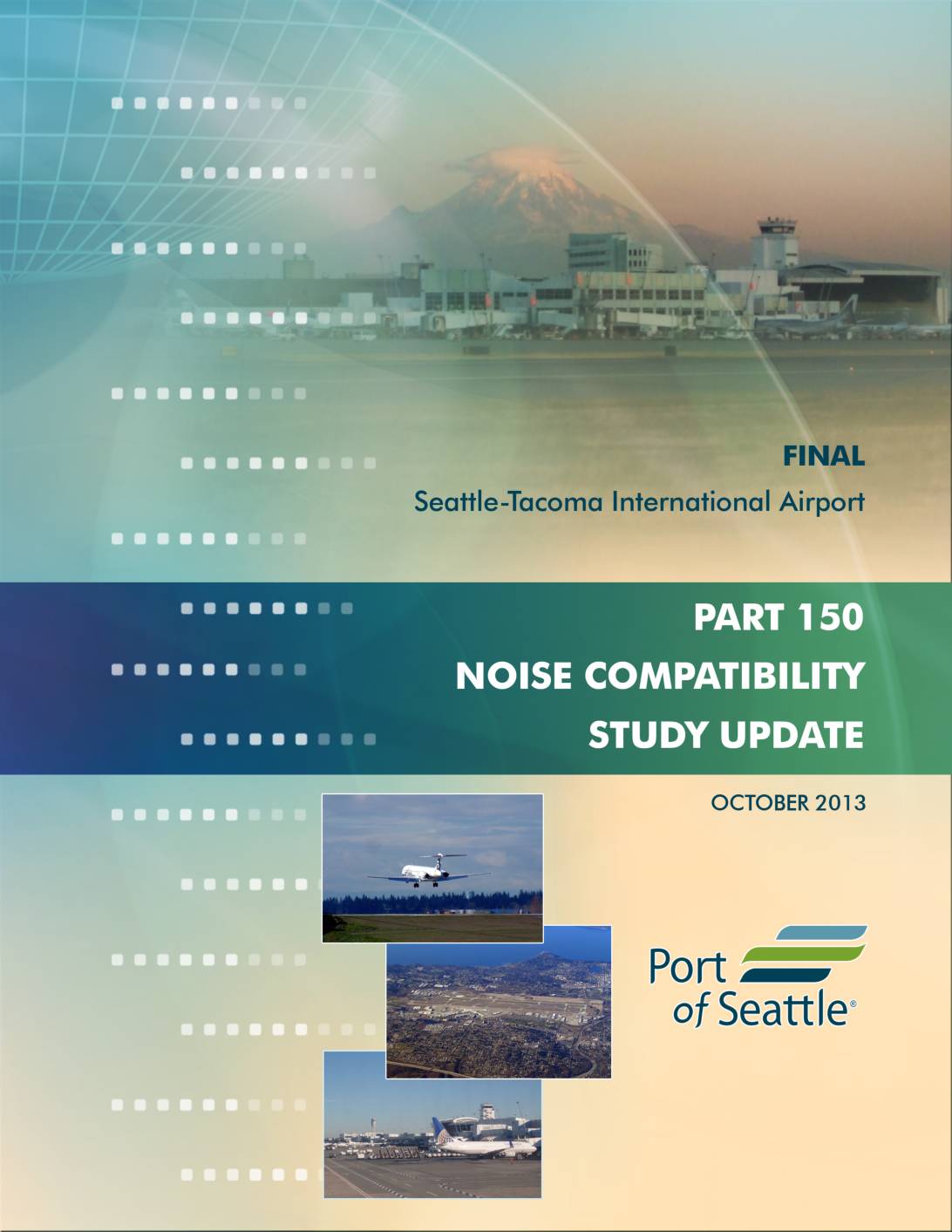
    Cover page of the Final Part 150 Noise Compatibility Study Update for Seattle-Tacoma International Airport, published October 2013 by the Port of Seattle. The document cover includes the Port of Seattle logo, three photographs of airport operations, and a background image of the airport terminal with Mount Rainier visible in the distance.
    TagsNoise Mitigation, Part 150, Port Of Seattle, Sea-Tac AirportFolder2013
  • 2013-10-01

    Seattle-Tacoma International Airport Part 150 noise compatibility study final: Chapter three – noise analysis

    This chapter from Sea-Tac Airport's 2013 Part 150 Noise Compatibility Study explains how aircraft noise is measured and analyzed around Seattle-Tacoma International Airport. It covers the basic properties of sound—including loudness, pitch, and duration—and explains why noise is measured on the logarithmic decibel (dB) scale rather than a standard linear scale. The chapter also outlines how noise contour modeling was conducted to assess the real-world impact of aircraft operations on surrounding communities.
    TagsLandrum & Brown, Noise, Part 150, Sea-Tac AirportFolder2013
  • 2013-10-01

    Seattle-Tacoma International Airport Part 150 noise compatibility study final: Chapter one – inventory

    ★
    This document is Chapter One of the Seattle-Tacoma International Airport (Sea-Tac) Part 150 Noise Compatibility Study, finalized in October 2013. It provides an overview of the airport's size, ownership by the Port of Seattle, and its role as the Pacific Northwest's primary commercial hub, while explaining the federal regulations (14 CFR Part 150) that guide airport noise compatibility planning. The study was undertaken to update a 2002 noise plan, accounting for major changes such as the opening of a third parallel runway in 2008, with the goal of reducing noise impacts on surrounding communities.
    CategoriesKey Documents TagsLandrum & Brown, Part 150Folder2013
  • 2013-10-01

    Seattle-Tacoma International Airport 14 CFR Part 150 Noise Compatibility Study Update

    This October 2013 final report, prepared by Landrum & Brown for the Port of Seattle, updates the noise exposure maps and noise compatibility program for Seattle-Tacoma International Airport under federal regulations (14 CFR Part 150). It assesses the impact of aircraft noise on surrounding communities and outlines strategies to reduce noise-related conflicts between the airport and neighboring land uses. The study serves as a key planning document guiding Port of Seattle noise mitigation policies at Sea-Tac Airport.
    TagsLandrum & Brown, Noise Exposure Update, Part 150, Port Of Seattle, Sea-Tac AirportFolder2013
  • 2013-10-01

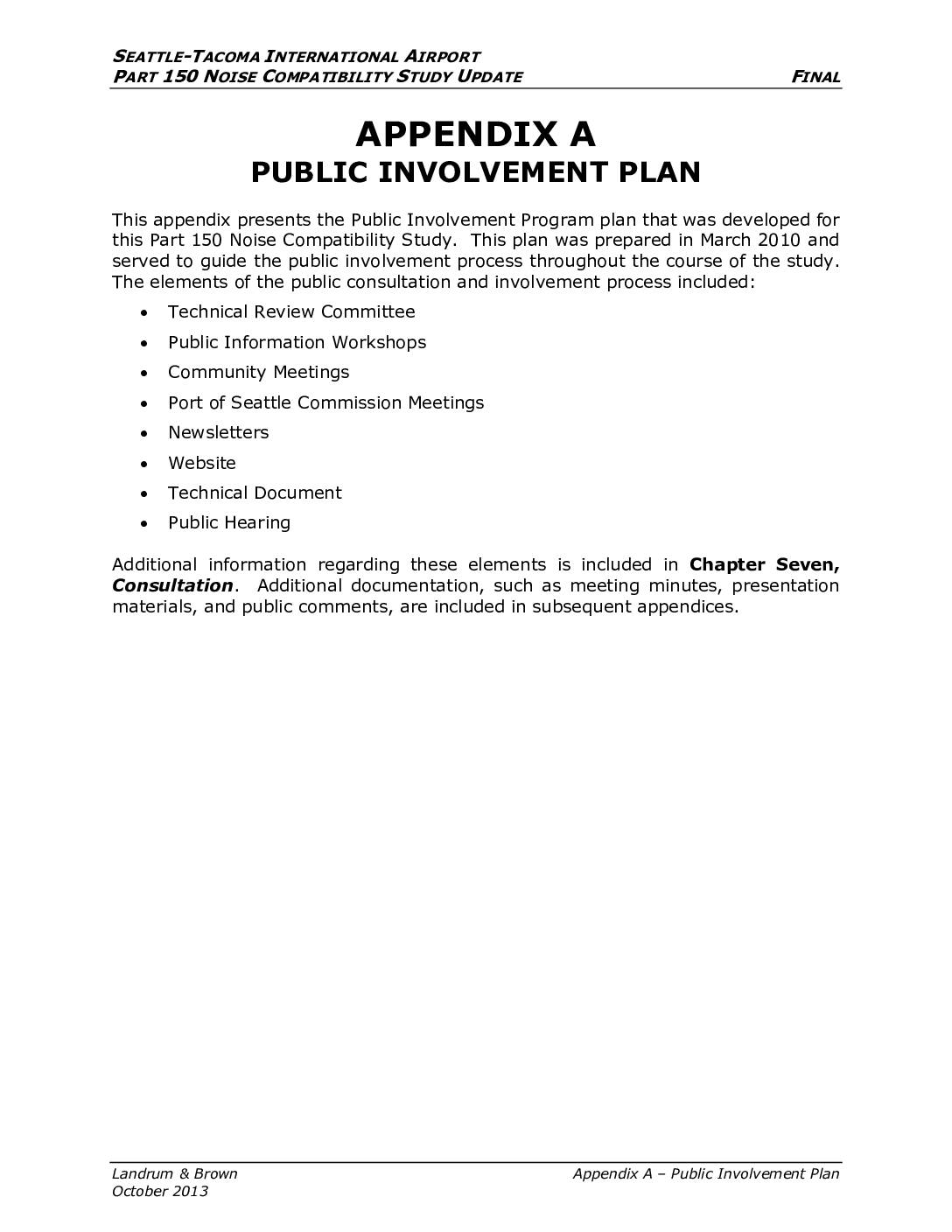
    Seattle-Tacoma International Airport Part 150 Noise Compatibility Study Update: Public Involvement Plan

    This document outlines the Public Involvement Program developed in March 2010 for Seattle-Tacoma International Airport's Part 150 Noise Compatibility Study Update, which was finalized in October 2013. The program details eight key elements of community engagement, including Technical Review Committee meetings, public information workshops, community meetings, newsletters, and a public hearing, all designed to gather input on airport noise compatibility. Additional details on these elements, along with meeting minutes, presentation materials, and public comments, are documented in the study's Chapter Seven and subsequent appendices.
    Tagscommunity engagement, Landrum & Brown, Part 150, Port Of Seattle, Sea-Tac AirportFolder2013
  • 2013-10-01

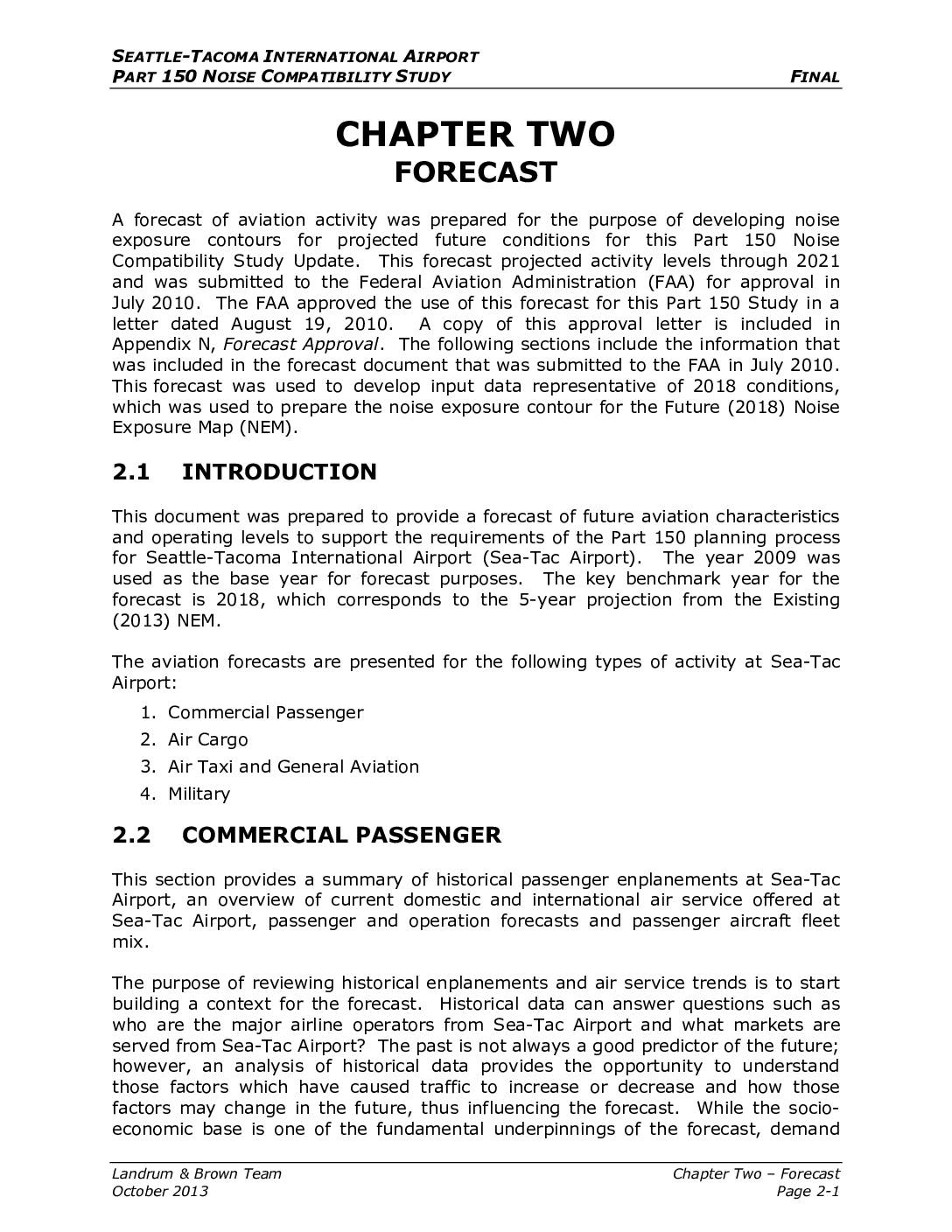
    Seattle-Tacoma International Airport Part 150 noise compatibility study final: Chapter two – forecast

    This chapter from the Seattle-Tacoma International Airport Part 150 Noise Compatibility Study presents aviation activity forecasts developed to support noise exposure planning through 2018 and beyond. It covers historical passenger enplanement trends showing growth from 8.2 million in 1990 to 15.6 million in 2009, as well as domestic and international air service patterns dominated by Alaska Airlines. The forecasts, approved by the FAA in August 2010, were used to project aircraft fleet mix and noise exposure contours for future planning purposes.
    TagsForecast, Landrum & Brown, Noise Countour, Part 150, Sea-Tac AirportFolder2013
  • 2013-10-01

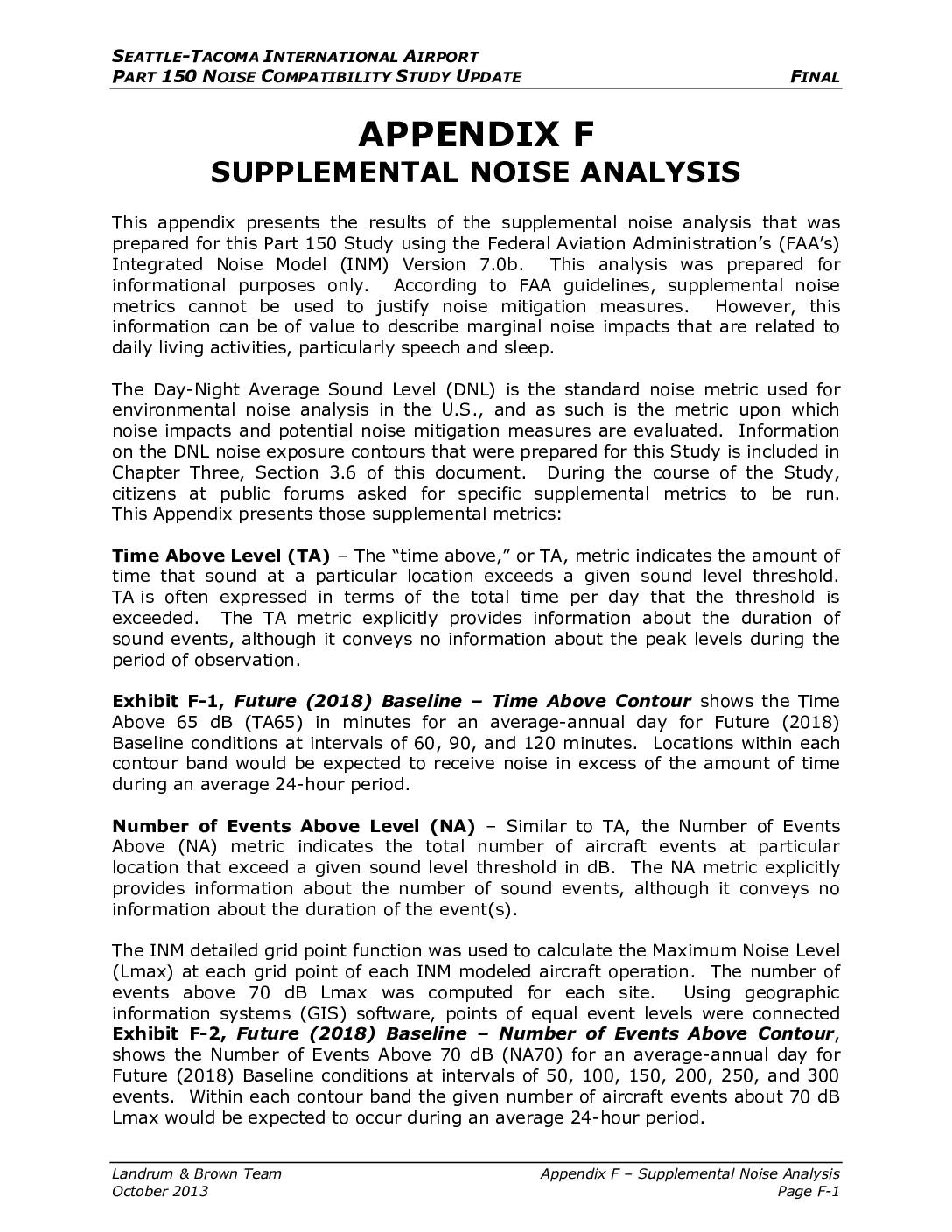
    Seattle-Tacoma International Airport Part 150 noise compatibility study update: Appendix F – Supplemental noise analysis

    This appendix from Seattle-Tacoma International Airport's 2013 Part 150 Noise Compatibility Study presents supplemental noise analysis results using the FAA's Integrated Noise Model, covering metrics such as Time Above Level, Number of Events Above Level, and Sound Exposure Level. The analysis was prepared for informational purposes only and cannot be used to justify noise mitigation measures, but helps illustrate how aircraft noise affects daily activities like speech and sleep for communities surrounding Sea-Tac. Contour maps and grid point data show projected 2018 noise impacts on noise-sensitive facilities including schools, hospitals, libraries, and places of worship in nearby cities such as SeaTac, Burien, Des Moines, and Tukwila.
    TagsLandrum & Brown, Part 150Folder2013
  • 2013-10-01

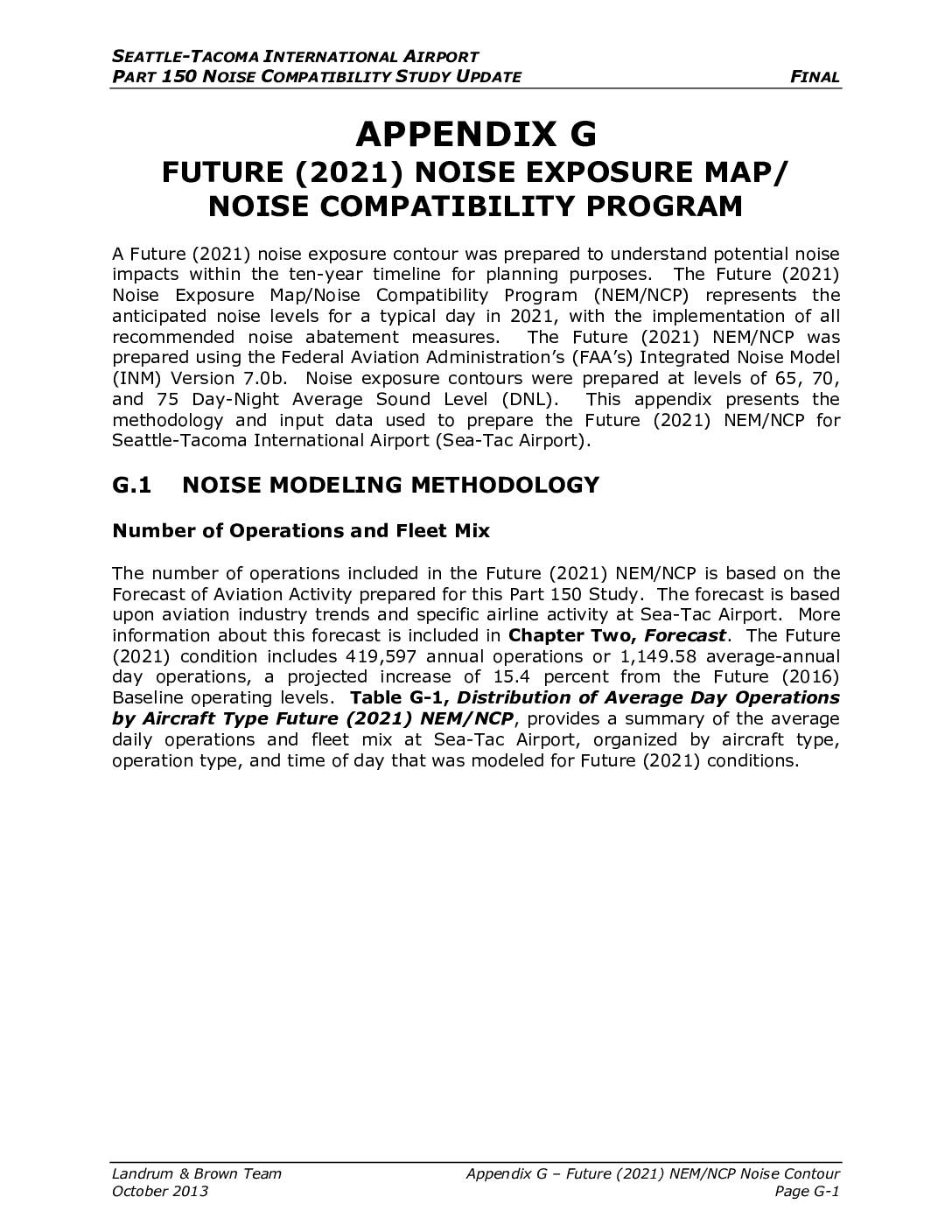
    Future (2021) noise exposure map/noise compatibility program – Seattle-Tacoma International Airport Part 150 noise compatibility study update

    This document outlines the Future (2021) Noise Exposure Map and Noise Compatibility Program for Seattle-Tacoma International Airport, projecting noise levels for a typical day in 2021 assuming all recommended noise abatement measures are in place. Using the FAA's Integrated Noise Model, it forecasts 419,597 annual aircraft operations — a 15.4% increase over 2016 baseline levels — and maps noise contours at 65, 70, and 75 decibel DNL thresholds. The report details the fleet mix and runway usage data used in the modeling, with Boeing 737-800s representing the largest share of daily operations.
    TagsINM, Landrum & Brown, Noise Countour, Part 150, Sea-Tac AirportFolder2013

Posts pagination

Page 1 … Page 16 Page 17 Page 18 Page 19 Page 20 … Page 27
Sidebar On/Off

Upcoming Events

  • Part 150 NCP Workshop — Burien
    Add to CalendarMSaturday Oct 17: 10:00am

    Attend a Port of Seattle open house on the Part 150 Study Noise Compatibility Program (NCP). The Part 150 program determines the noise boundary around the airport and opportunities for noise mitigation such as sound insulation.

    [...]
  • Part 150 NCP Workshop — SeaTac
    Add to CalendarMMonday Oct 19: 6:00pm

    Attend a Port of Seattle open house on the Part 150 Study Noise Compatibility Program (NCP). The Part 150 program determines the noise boundary around the airport and opportunities for noise mitigation such as sound insulation.

    [...]
  • Part 150 NCP Workshop — Des Moines
    Add to CalendarMTuesday Oct 20: 6:00pm

    Attend a Port of Seattle open house on the Part 150 Study Noise Compatibility Program (NCP). The Part 150 program determines the noise boundary around the airport and opportunities for noise mitigation such as sound insulation.

    [...]

[See all...]


Issues

Sea-Tac Airport is currently undergoing the largest and longest expansion in its history, collectively known as the Sustainable Airport Master Plan (SAMP). Some of it you can already hear, but you’re probably not aware of what it all means. Here’s what you need to know.
read more...

Read This!

As the source for federal transportation grants, the Puget Sound Regional Council was charged with developing a system to meet the growing need for commercial aviation. When the search for a second airport failed, they authorized the Port of Seattle to build the Third Runway, with a mandate to develop a noise abatement and mitigation program. In their effort to stop the Third Runway, the ACC argued over every detail of the Port's efforts--including property buyouts and sound insulation. The dispute was meant to be settled by a three member Expert Arbitration Panel. This is their final report. It finds 2-1, that the Port's program was insufficient in several respects. Despite that, funding for the Third Runway was approved by the PSRC, and the 'Port Package' program, proceeded largely unchanged. Expert Arbitration Panel's final decision finding that the Port of Seattle had not shown sufficient reduction in real on-the-ground noise impacts to satisfy noise reduction conditions required for approval of a third runway at Sea-Tac International Airport. The majority decision concluded the Port's noise abatement programs were insufficient despite being impressive in scope.
continue...

  • Sea-Tac Noise.Info
  • Connect with STNI

    • Subscribe
    • Port Package Problem?
    • Donate
    • Podcast
    • Socials
      • Facebook
      • X (Twitter)
      • Bluesky
      • Instagram
  • Learn

    • Frequently Asked Questions
    • Explainers
    • Youtube
    • Research Requests
    • Complain about one flight
  • Goals

    Fulfill the promises of 1976:
    • Compensation
    • Reduced noise
    • Improved air quality
    • Environmental remediation
Login/Register
©2026•Data Privacy

Message

We use cookies to provide basic functionality. We also provide access to search engines in order to provide site analytics. We do not sell or share your data.
V V