TagMiller Creek(252)
-
 2001-09-13
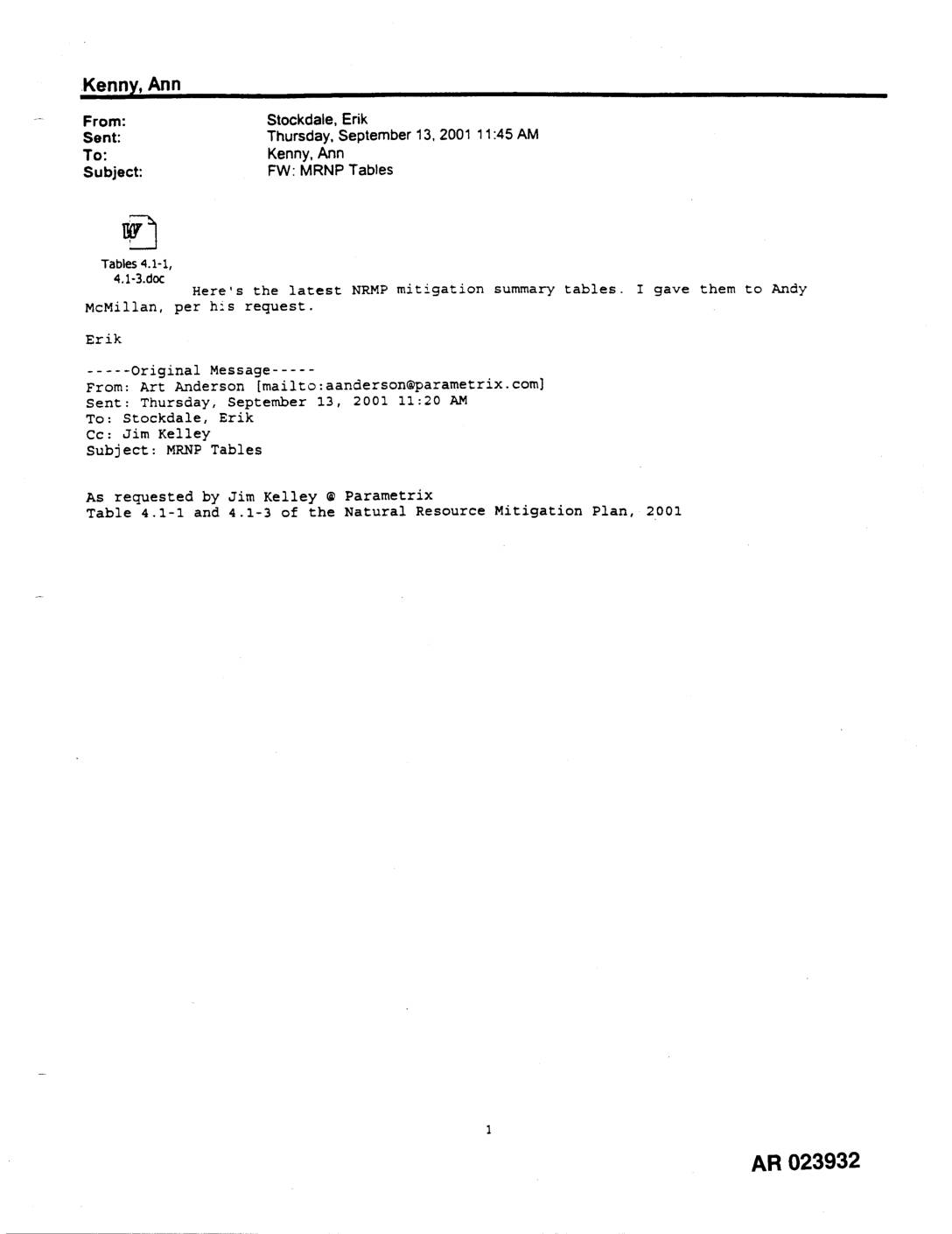
EXH AR023932: Email & Table 4.1-1 Natural Resource Mitigation Plan — MRNP Summary Tables Third Runway STIA Master Plan Update 2001
This 2001 Natural Resource Mitigation Plan document for Seattle-Tacoma International Airport outlines proposed environmental mitigation actions associated with construction of a new third runway and related facilities. It details a sequenced approach to avoiding, minimizing, and compensating for impacts to wetlands, Miller Creek, Des Moines Creek, and other natural resources. Key measures include constructing retaining walls to protect wetlands, restoring the Vacca Farm floodplain, establishing forested stream buffers, and providing a $300,000 trust fund for fisheries habitat enhancement. -
 2001-09-01
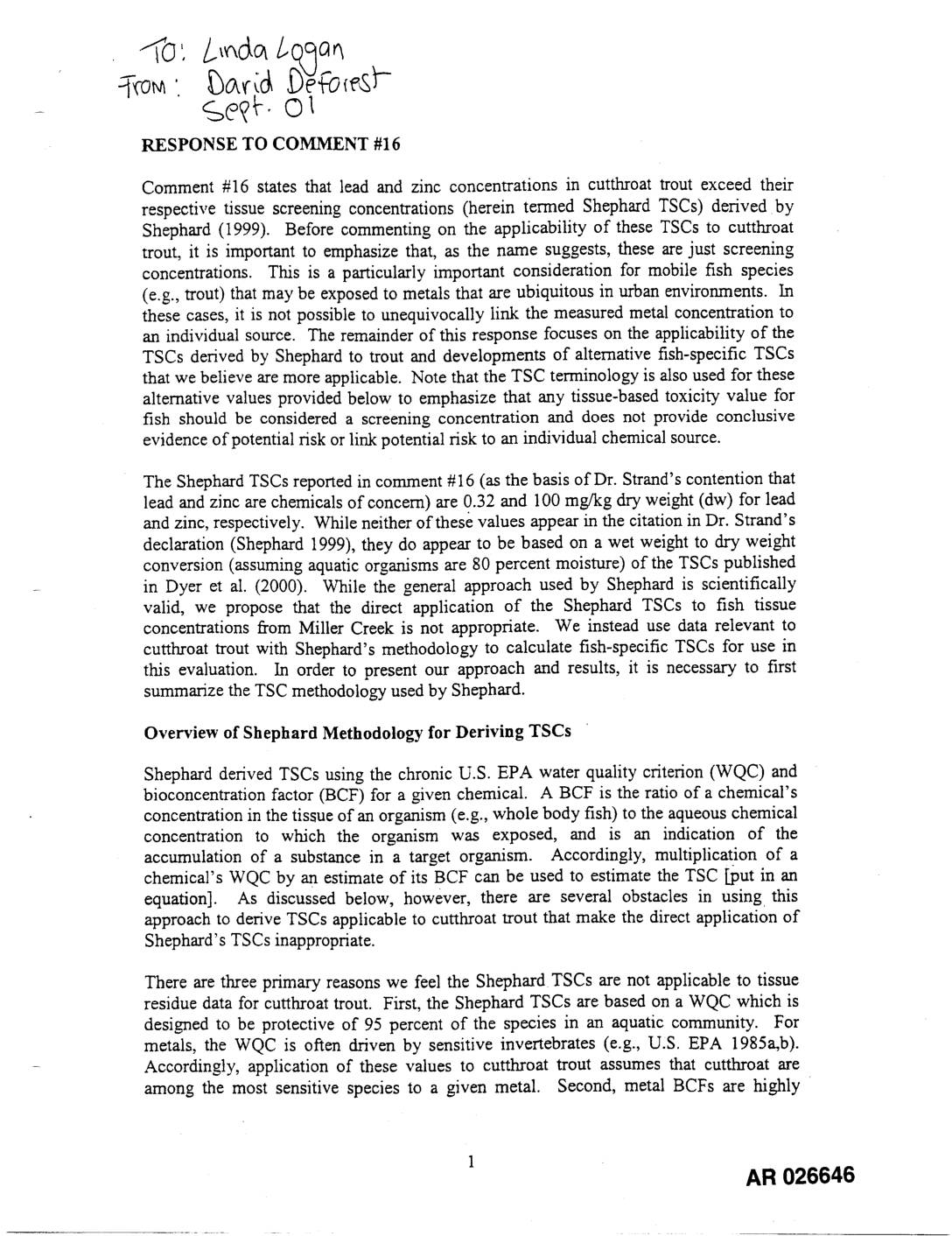
EXH AR026646: Response to Comment #16 — Fish Tissue Screening Concentrations Lead, Zinc, Copper, Miller Creek Cutthroat Trout
This technical memo evaluates whether lead and zinc levels found in cutthroat trout from Miller Creek pose a risk, arguing that standard tissue screening concentrations are not appropriate for trout. Using fish-specific toxicity data and bioconcentration factors, the authors derive alternative thresholds and conclude that measured metal levels in the trout fall well below harmful concentrations. The document recommends using species-specific methods rather than generic screening values when assessing metal risks to fish. -
 2001-09-01
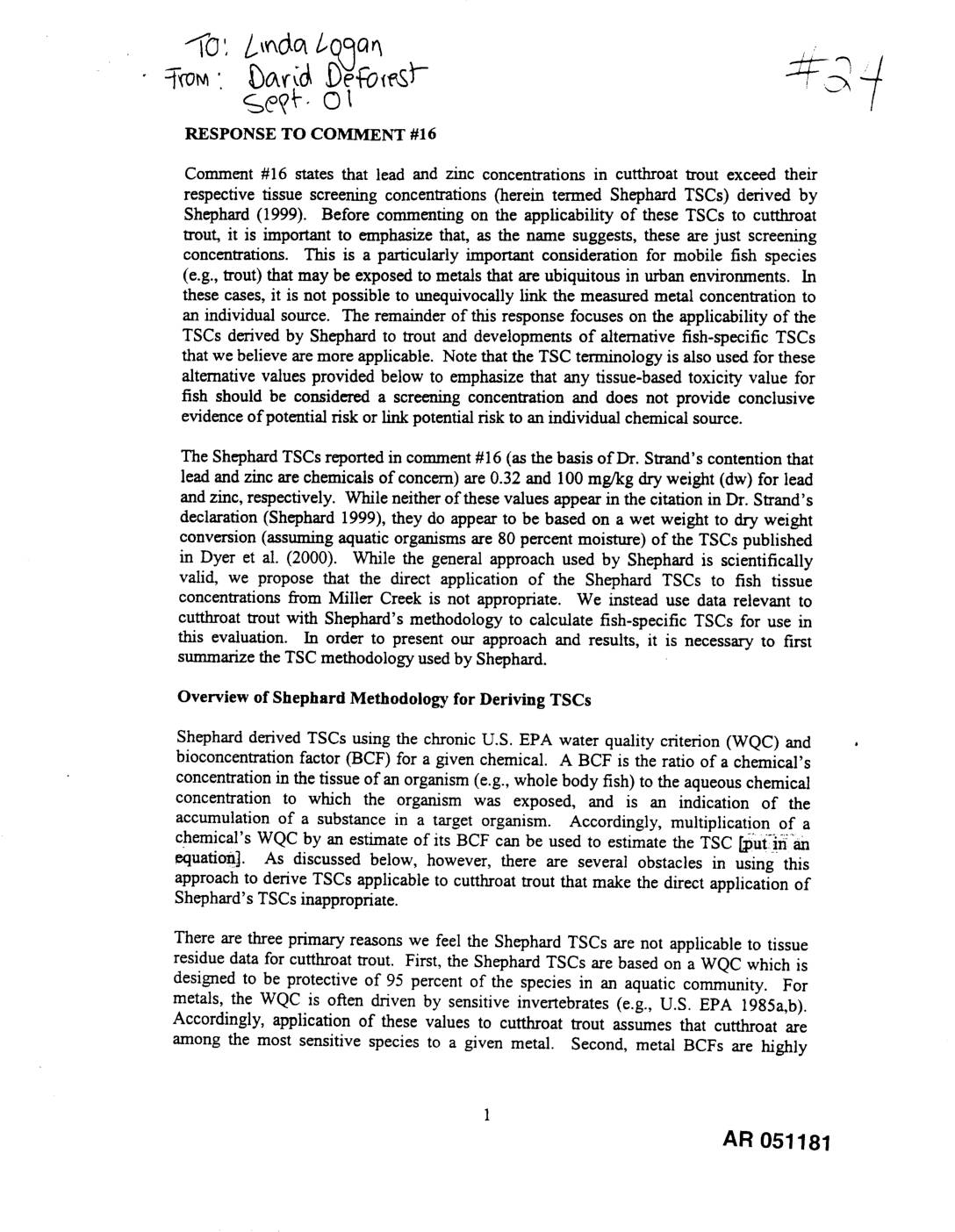
EXH AR051181: Response to Comment #16 — Fish-Specific Tissue Screening Concentrations for Lead, Zinc, and Copper in Cutthroat Trout, Miller Creek
Response to Comment #16 by David DeForest to Linda Logan (September 2001) critiquing Shephard (1999) tissue screening concentrations (TSCs) for lead (0.32 mg/kg dw) and zinc (100 mg/kg dw) as applied to cutthroat trout from Miller Creek. Argues Shephard TSCs derived from EPA water quality criteria and bioconcentration factors (BCFs) are not appropriate for cutthroat -
 2001-08-13
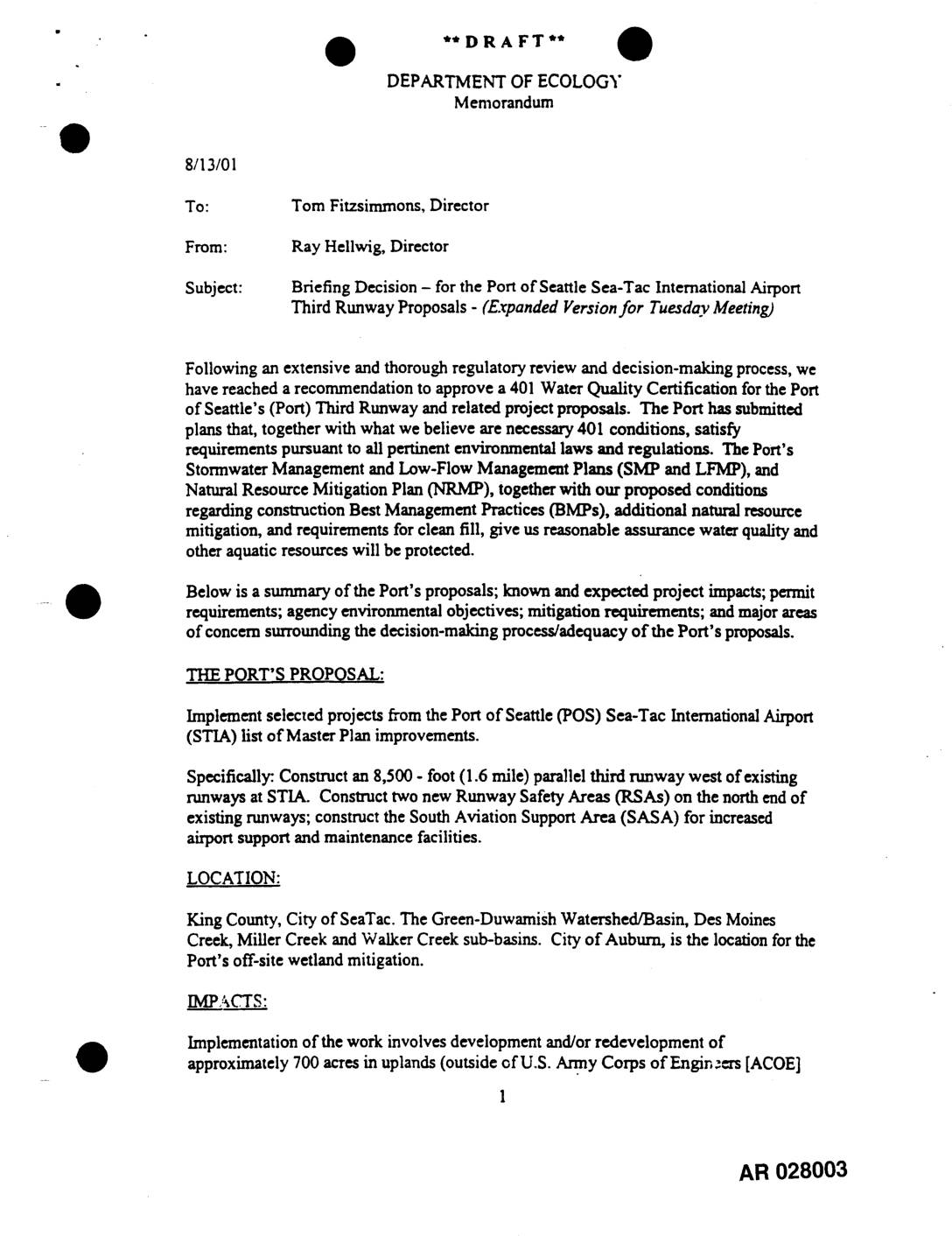
EXH AR028003: Ecology Draft Memo — 401 Water Quality Certification Decision for Port Of Seattle STIA Third Runway
Draft memorandum dated 8/13/01 from Ray Hellwig, Director, to Tom Fitzsimmons, Director, Washington State Department of Ecology, recommending approval of a 401 Water Quality Certification for the Port Of Seattle Sea-Tac International Airport (STIA) Third Runway and related projects. Document AR028003 covers the Port’s proposals to construct an 8,500-foot parallel third runway, two Runway Safety -
 2001-08-10
Exhibit 2045: Letter from Stoel Rives LLP to FWS Transmitting Draft Embankment Seepage Monitoring Plan for Third Runway
Letter dated August 10, 2001, from James M. Lynch of Stoel Rives LLP, attorney for the Port Of Seattle, to Ken Berg, Manager of the U.S. Fish and Wildlife Service (FWS) Western Washington Office, transmitting a draft Embankment Seepage Monitoring Plan (MP) for the proposed Sea-Tac Airport Third Runway embankment fill. Submitted pursuant to the -
 2001-08-07
Exhibit 108: Ecology NWRO Memorandum — Review of Low Flow Analysis, Flow Impact Offset Facility Proposal, Port Of Seattle (Parametrix Inc., July 2001)
Memorandum dated August 7, 2001 from Dave Garland, NWRO Water Quality Watershed Unit Supervisor, to Ann Kenny, Kevin Fitzpatrick, and Ray Hellwig of the Washington State Department of Ecology Northwest Regional Office. Reviews the Parametrix Inc. July 2001 report ‘Low Flow Analysis, Flow Impact Offset Facility Proposal’ prepared for Port Of Seattle regarding predicted impacts -
 2001-08-07
Exhibit 2012: Ecology Memorandum — Review of “Low Flow Analysis, Flow Impact Offset Facility Proposal, Port Of Seattle” by Parametrix Inc., July 2001
Memorandum dated August 7, 2001 from Dave Garland, NWRO Water Quality Watershed Unit Supervisor, Washington State Department of Ecology, to Ann Kenny, Kevin Fitzpatrick, and Ray Hellwig, reviewing Parametrix Inc.’s July 2001 “Low Flow Analysis, Flow Impact Offset Facility Proposal” prepared for the Port Of Seattle regarding the proposed third runway at Sea-Tac Airport. Reviews -
 2001-08-06
EXH AR023086: NHC Letter to Ecology — Technical Review Low Flow Analysis Flow Offset Facility Proposal (Third Runway)
A technical review letter from Northwest Hydraulic Consultants, written on behalf of the Airport Communities Coalition, raises serious concerns about the Port of Seattle's Low Flow Analysis related to the proposed 3rd runway at SeaTac Airport. The letter identifies the July 23, 2001 document as incomplete and inconsistent with other project plans, citing missing sections, absent facility drawings, and unresolved questions about how water storage and release systems would function in practice. Key technical issues flagged include inadequate accounting for water transit losses, potentially impractical small-orifice flow controls, and poor calibration of streamflow models for Walker Creek. -
 2001-08-06
EXH AR023128: Letter from Columbia Biological Assessments to Army Corps of Engineers and Ecology re Port Of Seattle Low Flow Analysis/Flow Impact Offset Facility Proposal
A biological scientist hired by the Airport Communities Coalition reviewed the Port of Seattle's plan to store airport stormwater in detention vaults and release it into Miller, Walker, and Des Moines Creeks during summer low-flow periods. The review found that the plan could worsen water quality in those creeks, because stored sediments may release toxic levels of copper and zinc, and potentially harbor human pathogens from airplane wastewater. The scientist concluded that regulators lacked sufficient information to approve the proposal without further testing, modeling, and independent scientific review. -
 2001-08-06
EXH AR023564: Letter Water Resources Consulting (Peter Willing) to Army Corps & Ecology — STIA Sec 404/401 Permit Low Flow Analysis & Flow Impact Offset Facility
A water resources consultant, writing on behalf of the Airport Communities Coalition, argues that the Port of Seattle's July 2001 Low Flow Analysis for Sea-Tac Airport expansion fails to provide reasonable assurance that the project will meet water quality standards in Miller, Walker, and Des Moines Creeks. The letter criticizes the submission as incomplete and rushed, noting missing figures, unfinished sections, and an unresolved plan to store the required 46 acre-feet of stormwater across the three watersheds. The consultant contends that the Port's proposed water quality protections—including filtration, aeration, and biofiltration swales—are unproven, inadequately designed, and fall short of the regulatory standard required for Section 401/404 permit approval.