Notes
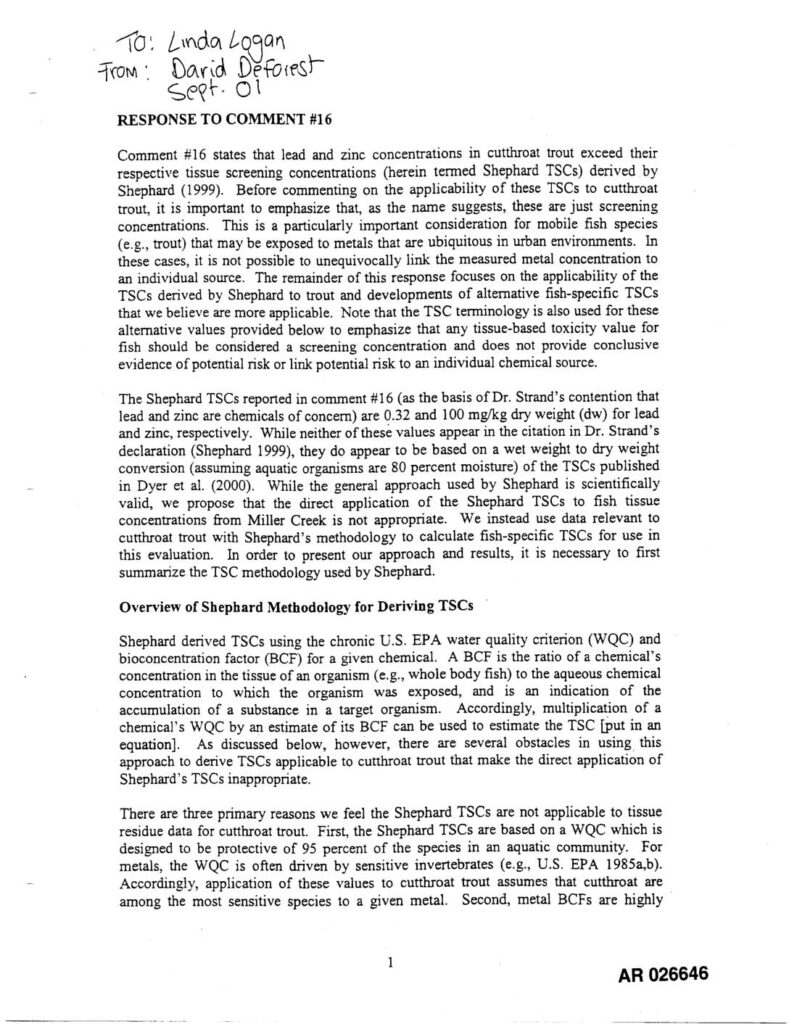
Memo from David DeForest to Linda Logan, dated September 2001, responding to Comment #16 in the PCHB third-runway EIS proceeding. Challenges applicability of Shephard (1999) tissue screening concentrations (TSCs) of 0.32 mg/kg dw lead and 100 mg/kg dw zinc to Miller Creek cutthroat trout. Derives alternative fish-specific TSCs using chronic toxicity NOECs and LOECs for brook trout (Salvelinus fontinalis), rainbow trout (Oncorhynchus mykiss), Atlantic salmon (Salmo salar), and fathead minnow (Pimephales promelas), combined with BCF-exposure concentration relationships. Concludes measured lead concentrations in Miller Creek cutthroat trout (0.31, 0.74, 0.34 mg/kg dw) are over an order of magnitude below fish-specific TSCs (4.9–14.8 mg/kg dw), and zinc concentrations (129–145 mg/kg dw) do not exceed the estimated fish-specific TSC of 182–188 mg/kg dw. References Dyer et al. (2000), Brix and DeForest (2000), Sinley et al. (1974), U.S. EPA water quality criteria, and Lind et al. (unpublished). AR numbers 026646–026648.