TagLegislation(123)
-
 2024-10-08
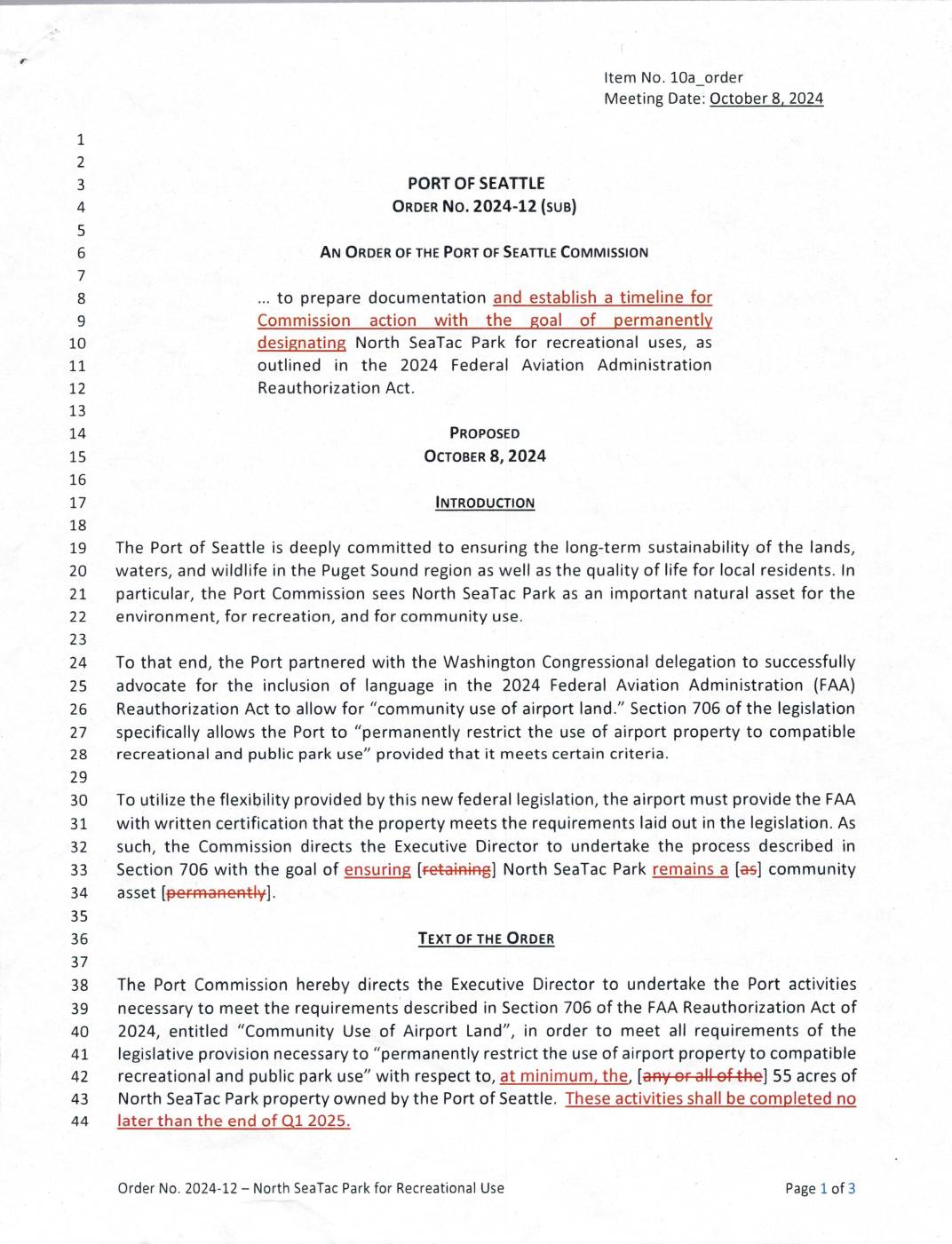
Port of Seattle Order No. 2024-12 – North SeaTac Park for Recreational Use
The Port of Seattle Commission issued Order No. 2024-12 in October 2024, directing its Executive Director to take the steps necessary under Section 706 of the 2024 FAA Reauthorization Act to permanently designate the 55-acre North SeaTac Park for recreational and public park use. The order requires the development of legally binding frameworks, a preferred protection methodology reported to the Commission by Q2 2025, and at least $150,000 in the 2025 budget for park improvements in partnership with the City of SeaTac. This action aims to ensure the park remains a permanent community and ecological asset, shielded from future aeronautical or commercial redevelopment. -
 2024-07-15
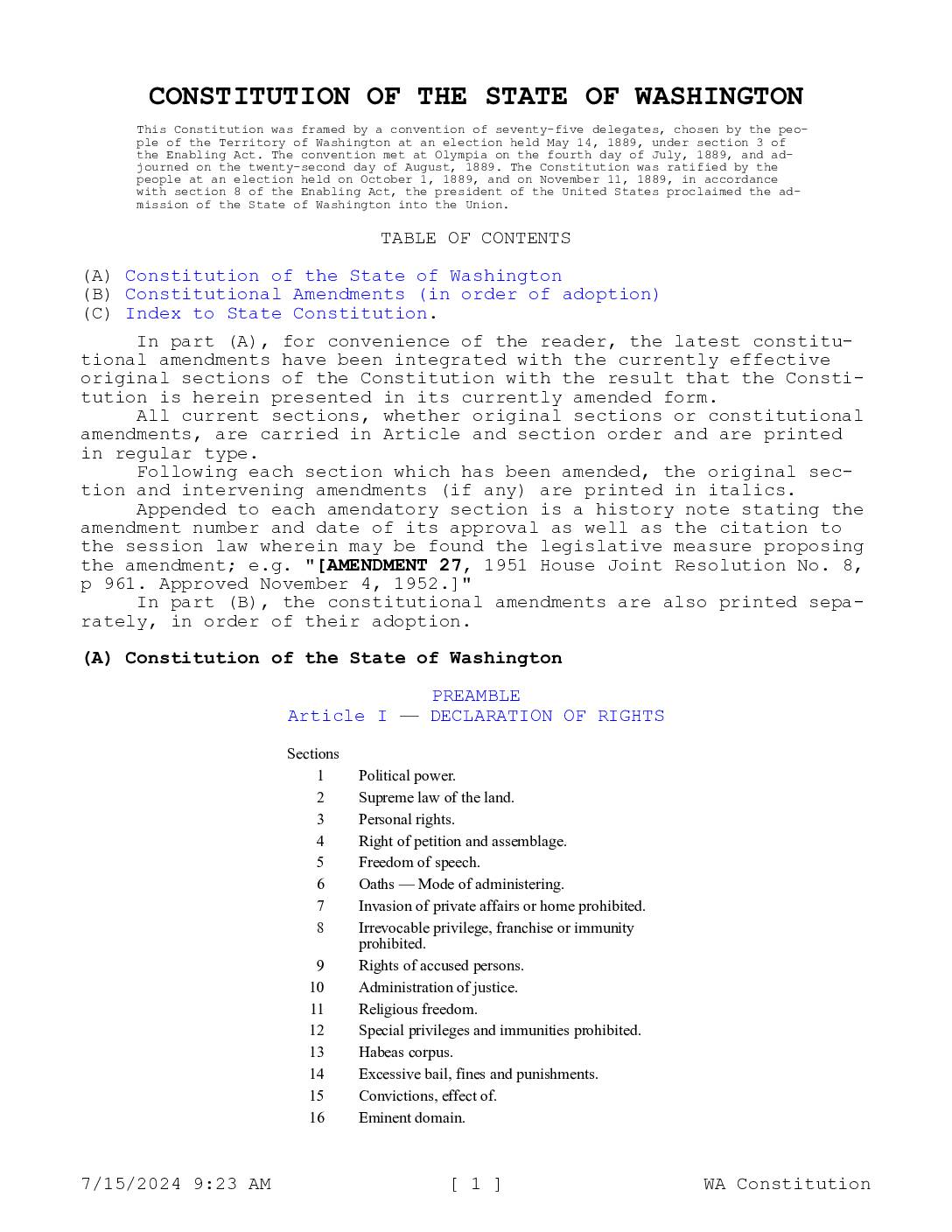
Constitution of the State of Washington
This document is the Constitution of the State of Washington, originally framed in 1889 and presented here in its currently amended form. It outlines the foundational legal framework for the state, covering individual rights, legislative powers, and executive responsibilities across multiple articles. Note that this document does not contain specific content related to Sea-Tac Airport noise policy. -
 2024-05-13
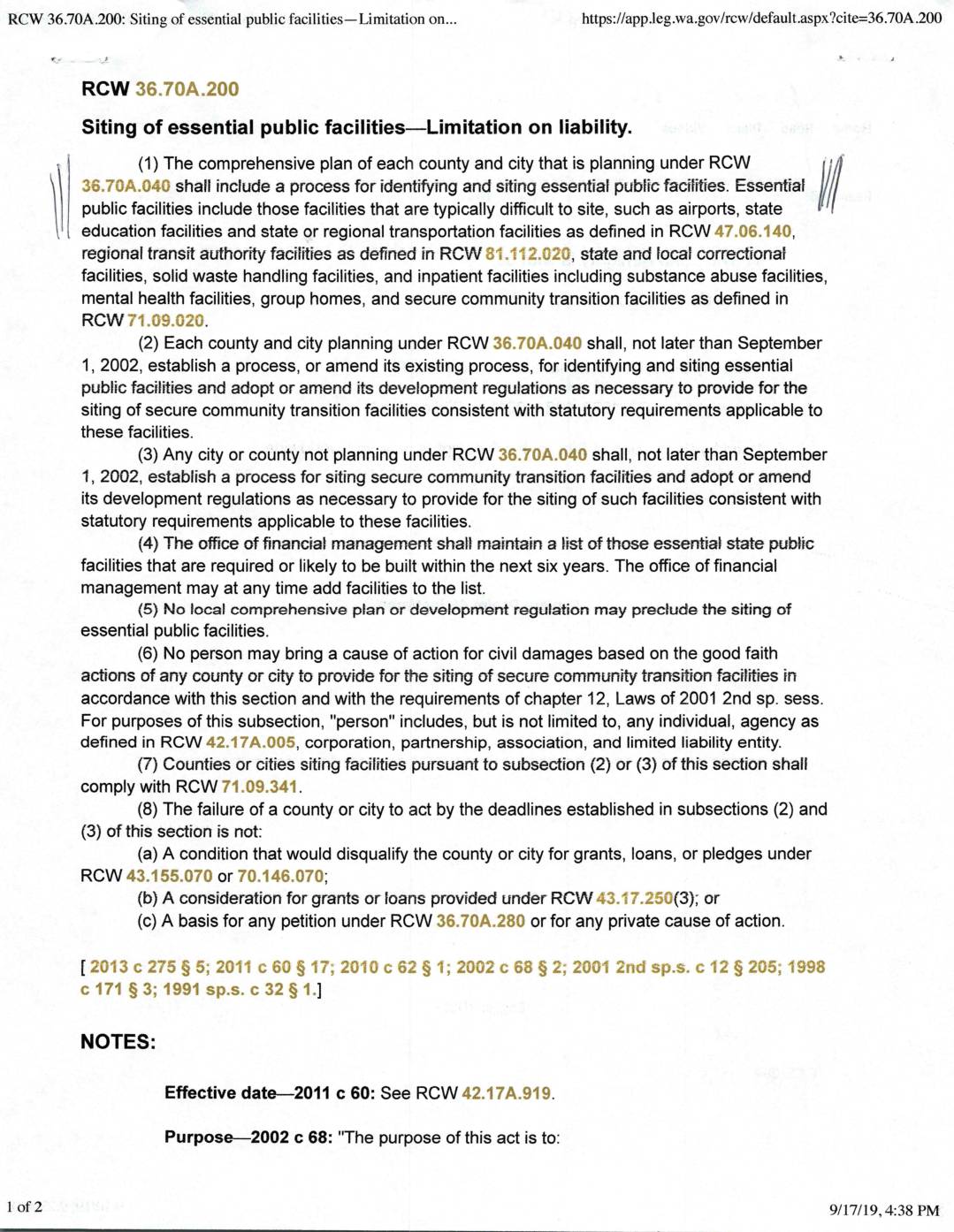
RCW 36.70A.200: Siting of essential public facilities—Limitation on liability
RCW 36.70A.200 requires counties and cities planning under Washington's Growth Management Act to include a process for identifying and siting essential public facilities — defined as those typically difficult to site, such as airports, state education facilities, regional transportation facilities, correctional facilities, solid waste handling facilities, and inpatient mental health or substance abuse facilities. The law explicitly prohibits any local comprehensive plan or development regulation from completely blocking the siting of such facilities. It also establishes liability protections for jurisdictions acting in good faith to site secure community transition facilities. -
 2024-05-06
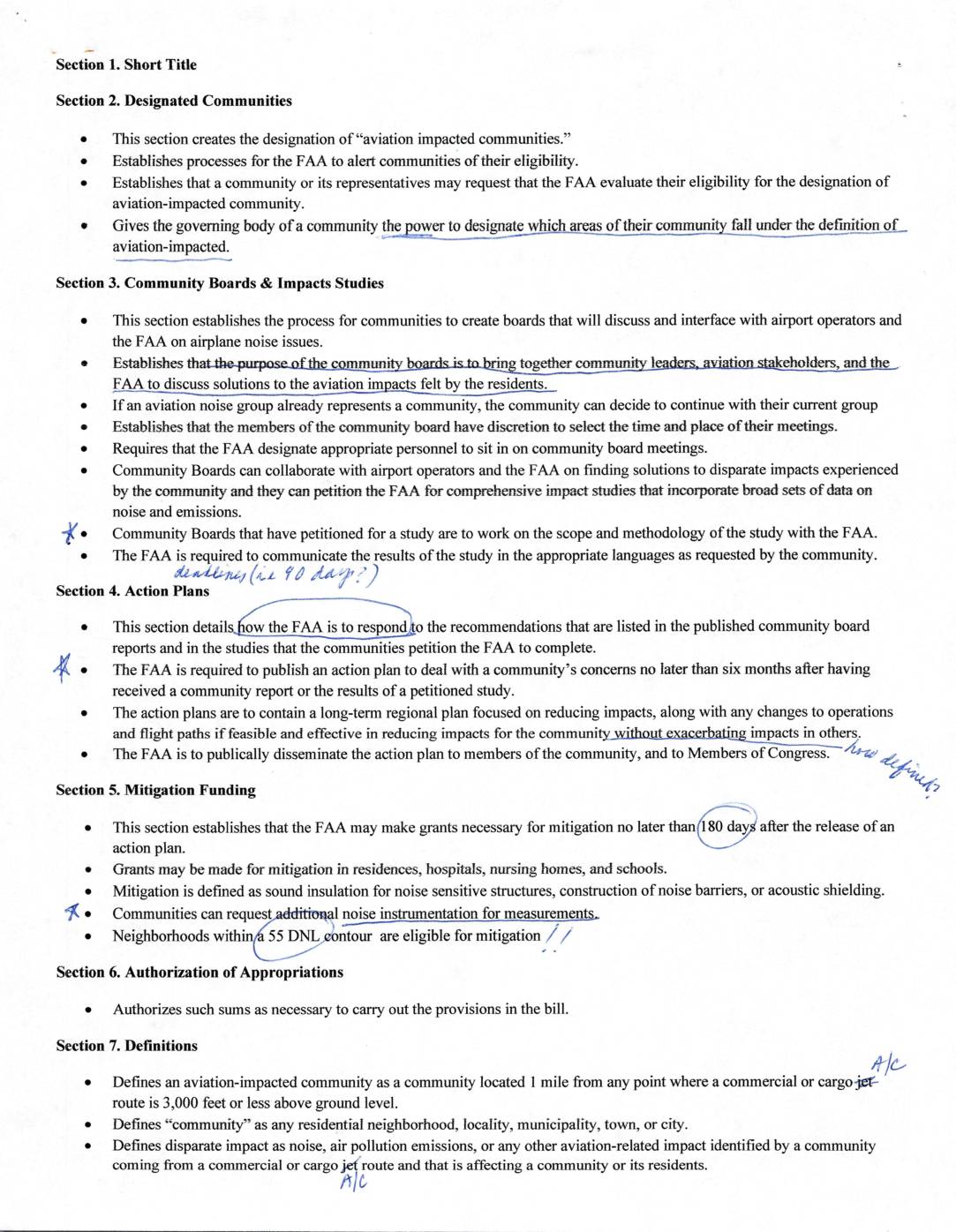
Airport impacted communities act summary
This legislative summary outlines a proposed bill to protect communities near busy flight routes from aviation noise and pollution. It establishes a process for the FAA to designate 'aviation-impacted communities' located within one mile of low-altitude commercial or cargo flight paths, create local community boards to engage with the FAA and airport operators, and develop action plans and mitigation funding for affected residents. Key provisions include grants for sound insulation and noise barriers, eligibility for neighborhoods within a 55 DNL contour, and requirements for the FAA to respond to community concerns within set deadlines. -
 2024-05-06
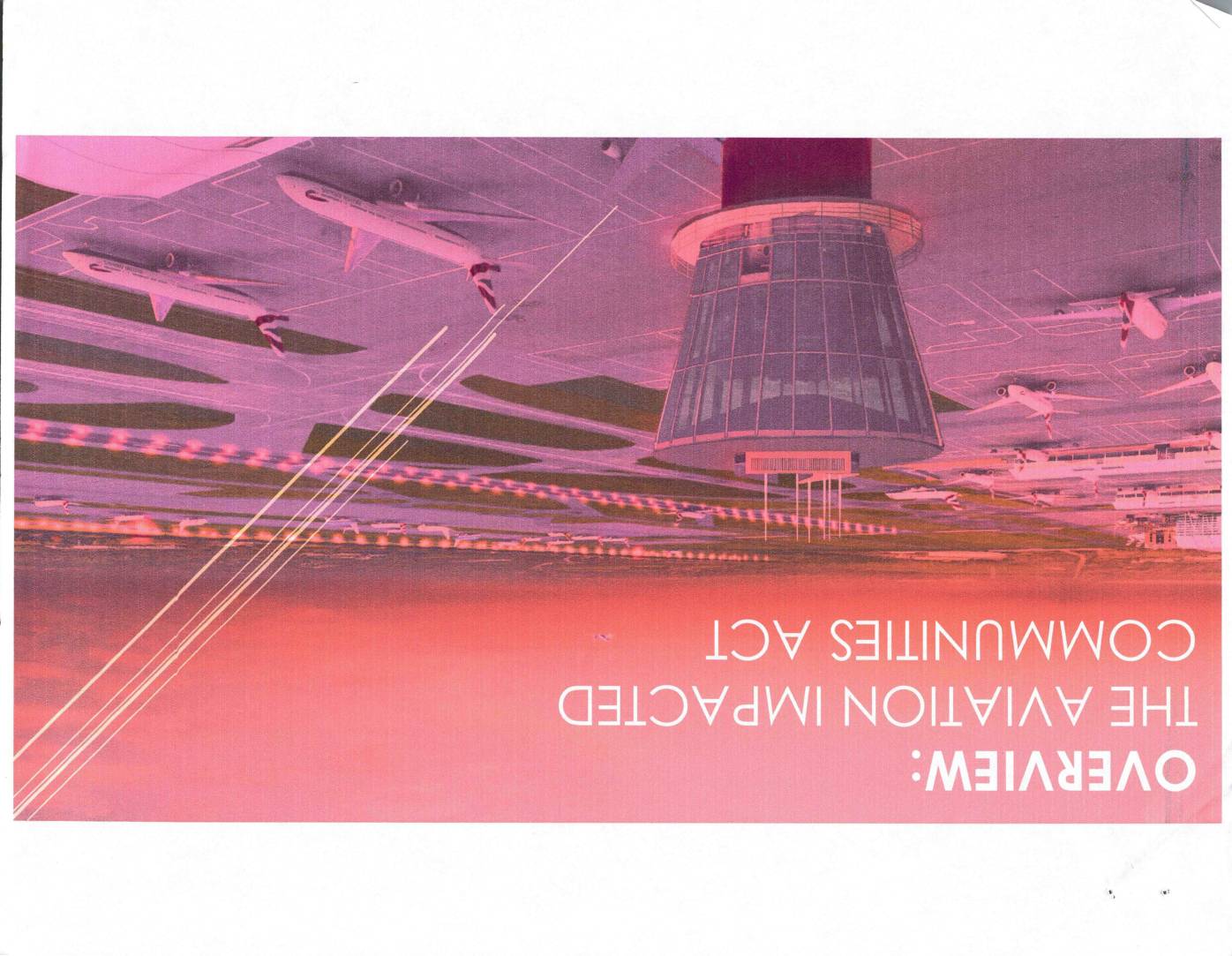
Overview: The Aviation Impacted Communities Act
This document provides an overview of the Aviation Impacted Communities Act, which establishes a formal process for communities affected by airport noise and flight paths. The process begins with the FAA notifying eligible communities of their 'designated community' status, then proceeds through board formation, meetings, studies, action plans, and ultimately grants for mitigation funds. A community qualifies as 'aviation impacted' if it is located no more than one mile from any commercial or cargo jet route at 3,000 feet or less above ground level. -
 2024-03-19
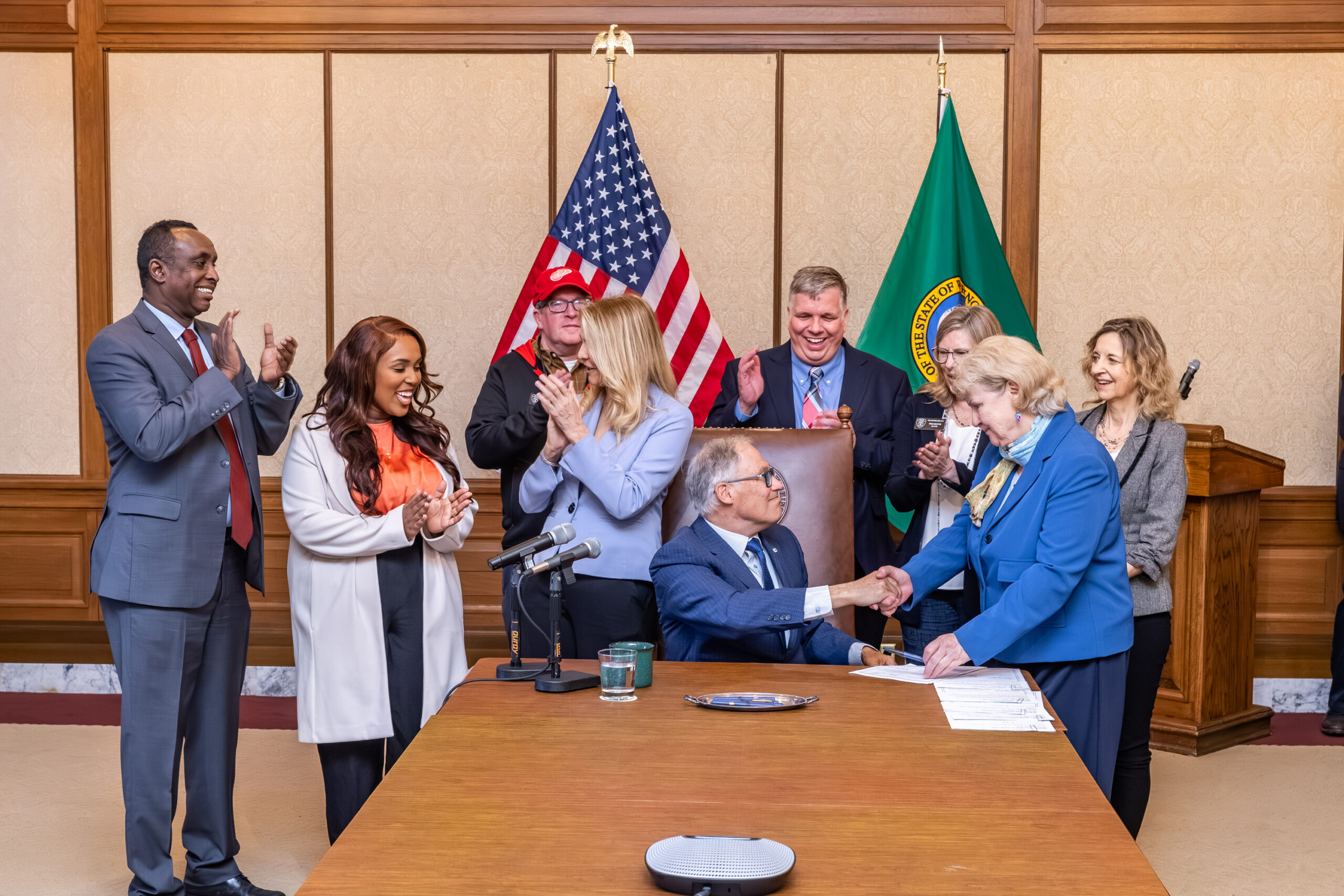
Governor signing legislation with officials present
A seated official in a navy suit signs or exchanges documents at a formal table in what appears to be the Washington State Governor's office, indicated by the visible Washington State seal on the chair and the State of Washington flag in the background alongside a U.S. flag. Several attendees, including a woman in a white blazer and a man wearing a Detroit Red Wings cap, look on during the ceremony. -
 2024-03-19
Bill Signing Ceremony
A seated official signs legislation at a desk while shaking hands with a woman in a blue blazer, surrounded by applauding attendees. The Washington State flag and U.S. flag are visible in the background, indicating this is an official state government ceremony. -
 2024-03-19
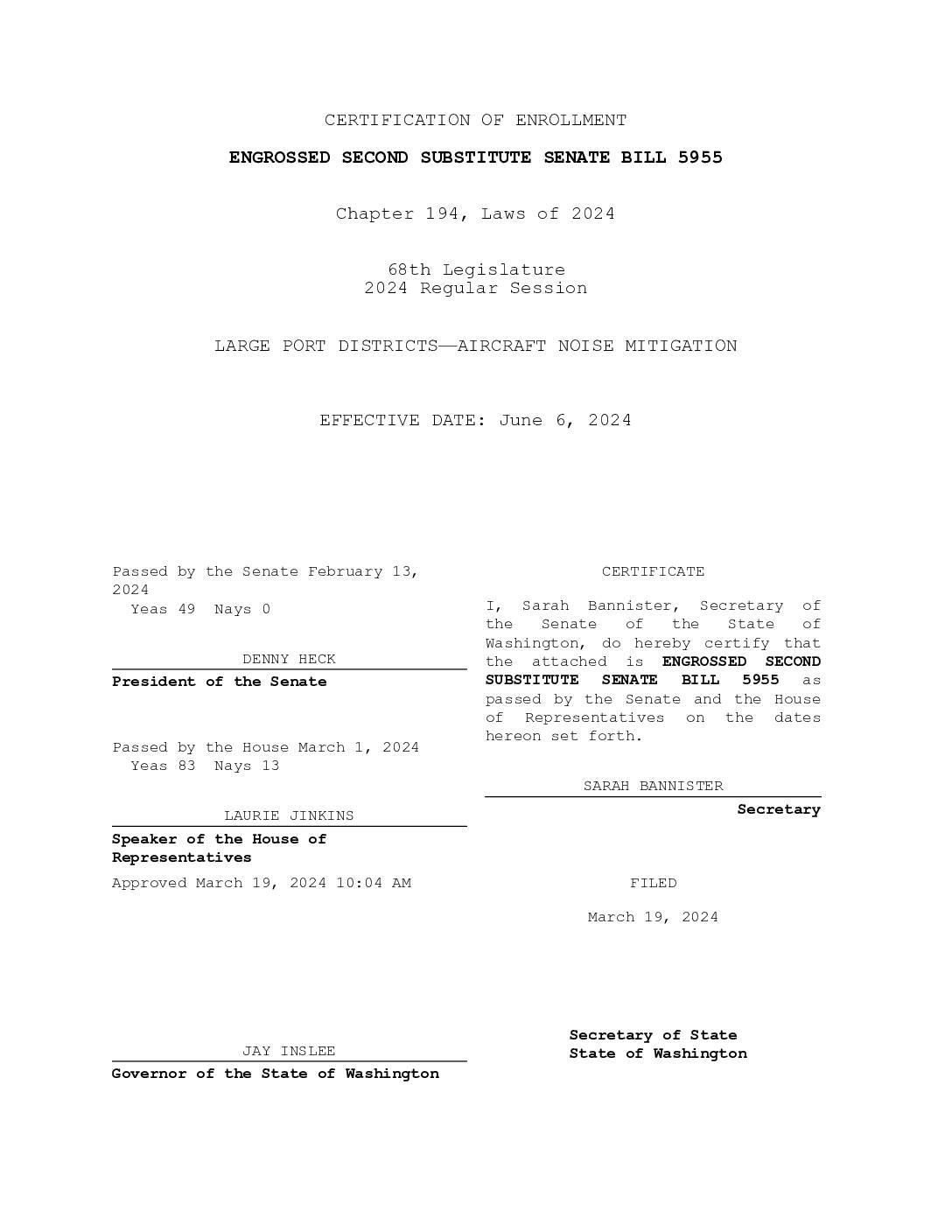
Engrossed Second Substitute Senate Bill 5955: Large Port Districts—Aircraft Noise Mitigation
Washington State's Engrossed Second Substitute Senate Bill 5955, signed into law on March 19, 2024, addresses aircraft noise mitigation for large port districts like the Port of Seattle, which operates Seattle-Tacoma International Airport. The law allows the port to repair or replace noise mitigation equipment that is no longer functioning properly or has caused structural damage to nearby properties, using non-federal local funding. It also acknowledges that communities of color — including Black, Hispanic, Native Hawaiian, and Pacific Islander residents in King County — are disproportionately impacted by airport noise, and establishes a state partnership to improve equity and responsiveness in noise mitigation efforts. -
 2024-03-13
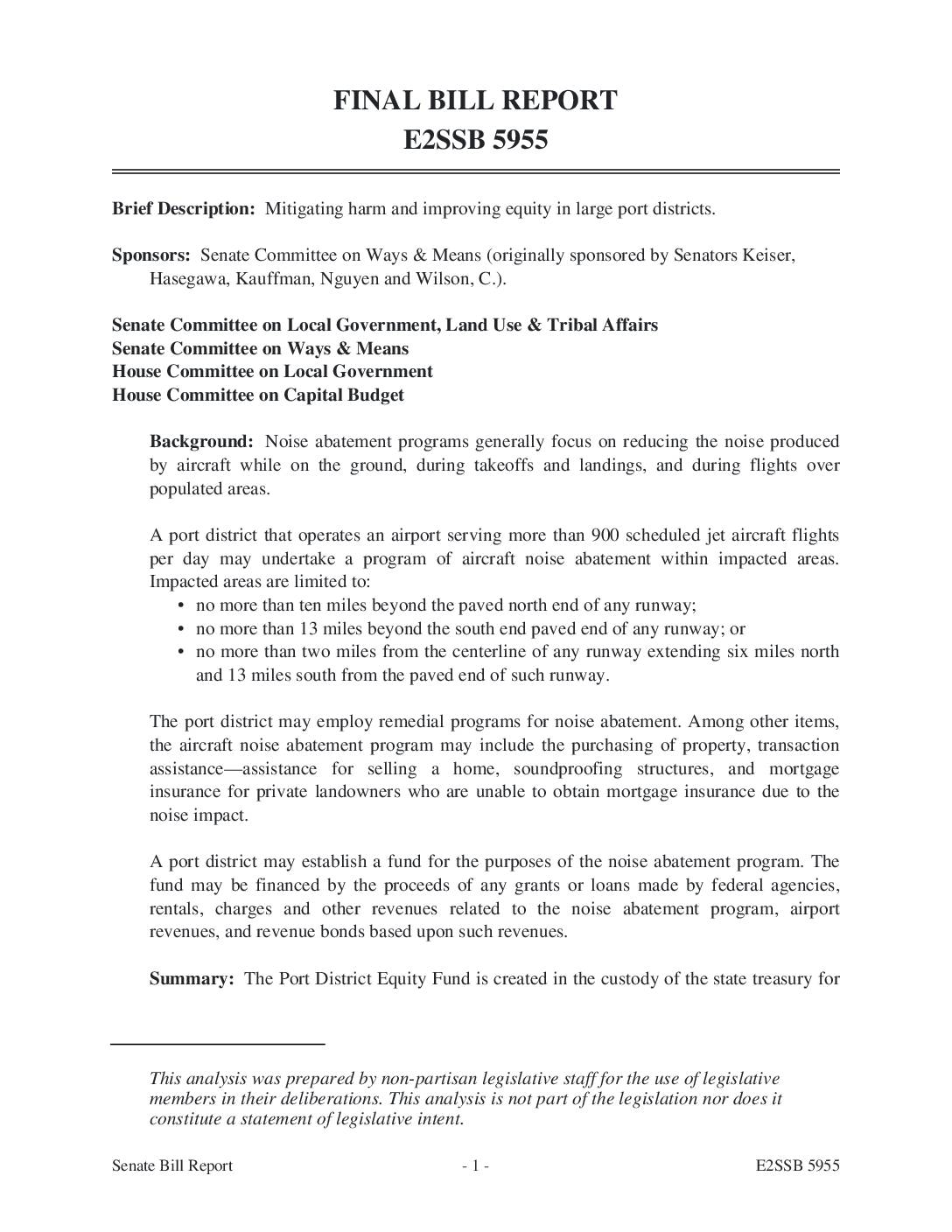
Final Bill Report: E2SSB 5955 — Mitigating Harm and Improving Equity in Large Port Districts
Washington State E2SSB 5955 creates the Port District Equity Fund to help large port districts, such as the Port of Seattle, repair or replace failing aircraft noise mitigation equipment in nearby homes and properties. The Department of Commerce administers the grant program, which requires port districts to match at least half of state funding, and mandates annual public reporting on inspections and repairs. The program is set to expire July 1, 2029, with a legislative audit review, and will be fully repealed by July 1, 2030. -
 2024-03-07
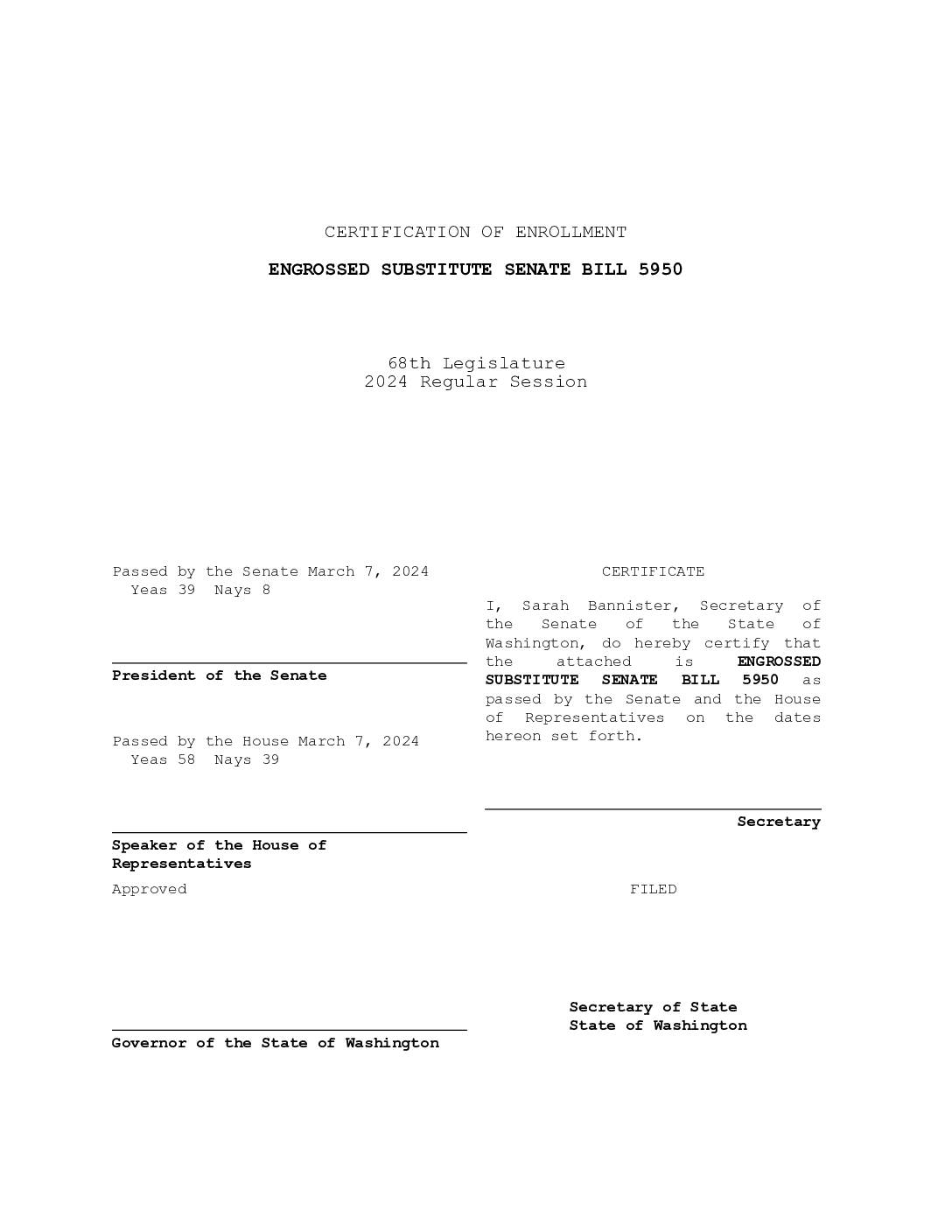
Engrossed Substitute Senate Bill 5950: Washington State Fiscal Matters Appropriations Act, 2024
Engrossed Substitute Senate Bill 5950, passed by the Washington State Legislature on March 7, 2024, is a fiscal appropriations bill that adopts a state budget for the biennium running from July 1, 2023, through June 30, 2025. The bill authorizes spending from various state funds for agency salaries, wages, and other specified purposes, while amending several existing statutes related to financial management. Note: This bill addresses general state fiscal matters and does not contain provisions specifically related to Sea-Tac Airport noise policy.