TagKing County Public Health(19)
-
 2021-04-20
Community health and airport operations-related noise and air pollution
A 2021 presentation by Public Health Seattle and King County examines how noise and air pollution from Seattle-Tacoma International Airport (SeaTac) affect nearby communities. It covers community health profiles, the current strength of scientific evidence, a University of Washington study on ultrafine particles (UFP), and recommendations for addressing health impacts. The affected communities are notably diverse, with people of color — particularly Native Hawaiian/Pacific Islander and Black/African American residents — making up a disproportionately large share of the airport-area population compared to King County as a whole. -
 2021-04-20
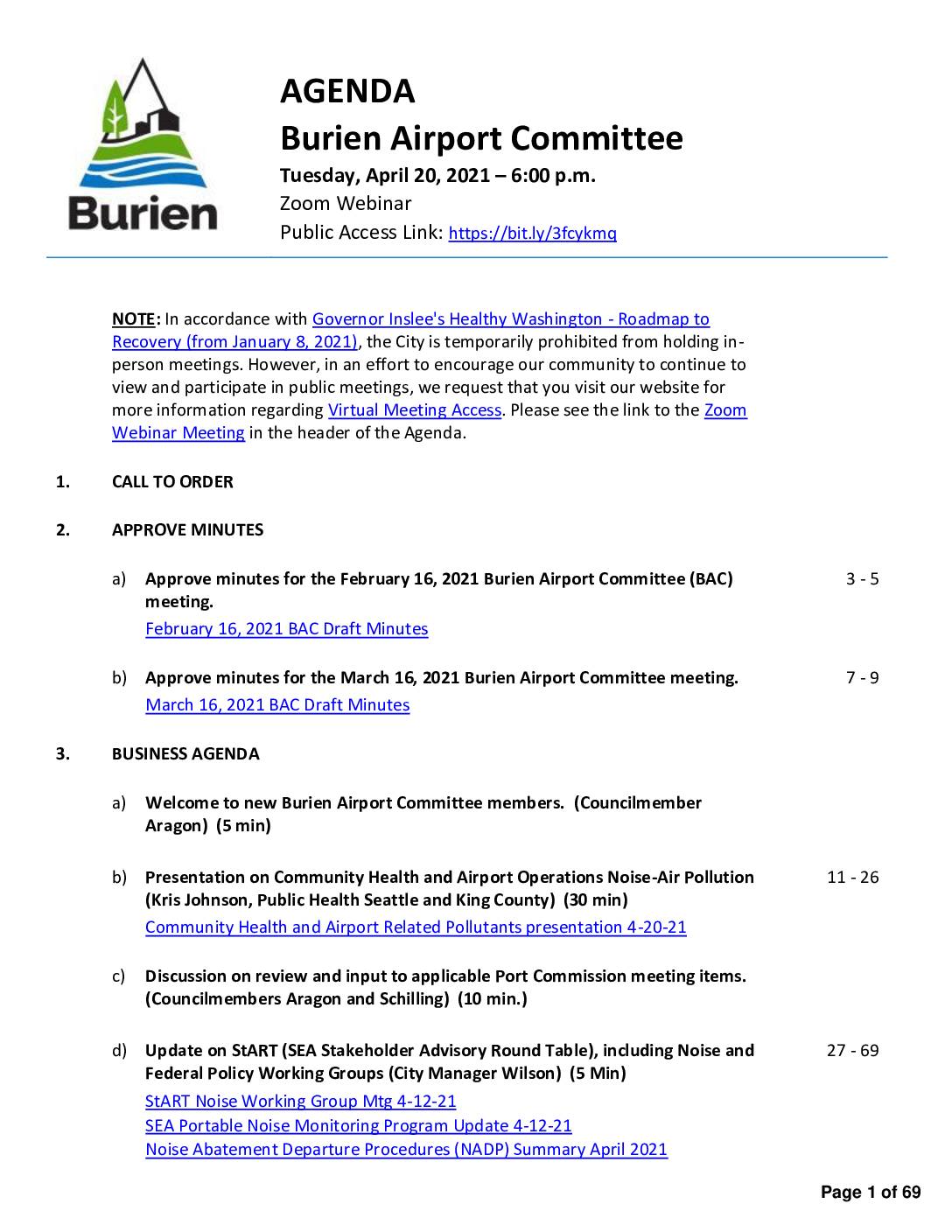
Burien Airport Committee agenda, April 20, 2021
The Burien Airport Committee held virtual meetings in early 2021 to address community concerns about Seattle-Tacoma International Airport, including noise pollution, air quality, and public health impacts on nearby residents. The April 20, 2021 agenda featured a Public Health Seattle and King County presentation on airport-related pollutants, updates on the SEA Stakeholder Advisory Round Table (StART) noise and federal policy working groups, and discussion of noise abatement departure procedures. The committee, chaired by Councilmember Sofia Aragon, was actively engaging with Port of Seattle commission items and coordinating with federal and state officials on airport noise policy reform. -
 2020-12-01
Community health and airport operations related noise and air pollution: Report to the legislature in response to Washington State House Bill 1109
This December 2020 report, prepared by Public Health Seattle & King County in response to Washington State House Bill 1109, examines how noise and air pollution from airport operations affect the health of communities near Sea-Tac Airport compared to the rest of King County. It reviews evidence on pollutants such as ultrafine particulates, their links to conditions like asthma, heart disease, and reduced life expectancy, and includes findings from a University of Washington study on air quality. The report concludes with recommendations for addressing these public health impacts. -
 2019-08-14
Rep. Orwall’s stakeholder meeting re: Port packages
On August 14, 2019, Representative Orwall held a stakeholder meeting at Kent City Hall to discuss Port noise-insulation packages affecting homeowners near Sea-Tac Airport. The agenda included background information from an airport study, Public Health – Seattle & King County, and a review of legislative action, followed by homeowner testimonials describing issues such as failed insulation, mold, structural damage, sleep disruption from flight noise, and air quality concerns. Residents shared personal accounts dating back to the 1980s and 1990s, highlighting ongoing frustrations with inadequate soundproofing and health impacts tied to airport operations. -
 2006-01-01
Health of King County 2006
The Health of King County 2006 report provides a broad overview of the health status of King County, Washington residents, drawing on public health data from vital records, hospital discharges, and surveys. While King County residents generally enjoy better health than the rest of Washington State and the US, the report highlights growing concerns including rising rates of obesity, diabetes, and chronic diseases such as cancer, heart disease, and stroke. Chronic diseases accounted for 21,000 hospitalizations in 2004 at a cost of $531 million, with cancer, heart disease, and stroke alone responsible for more than half of all deaths in the county. -
 2002-06-01
Results from Soil Contamination Study of King County
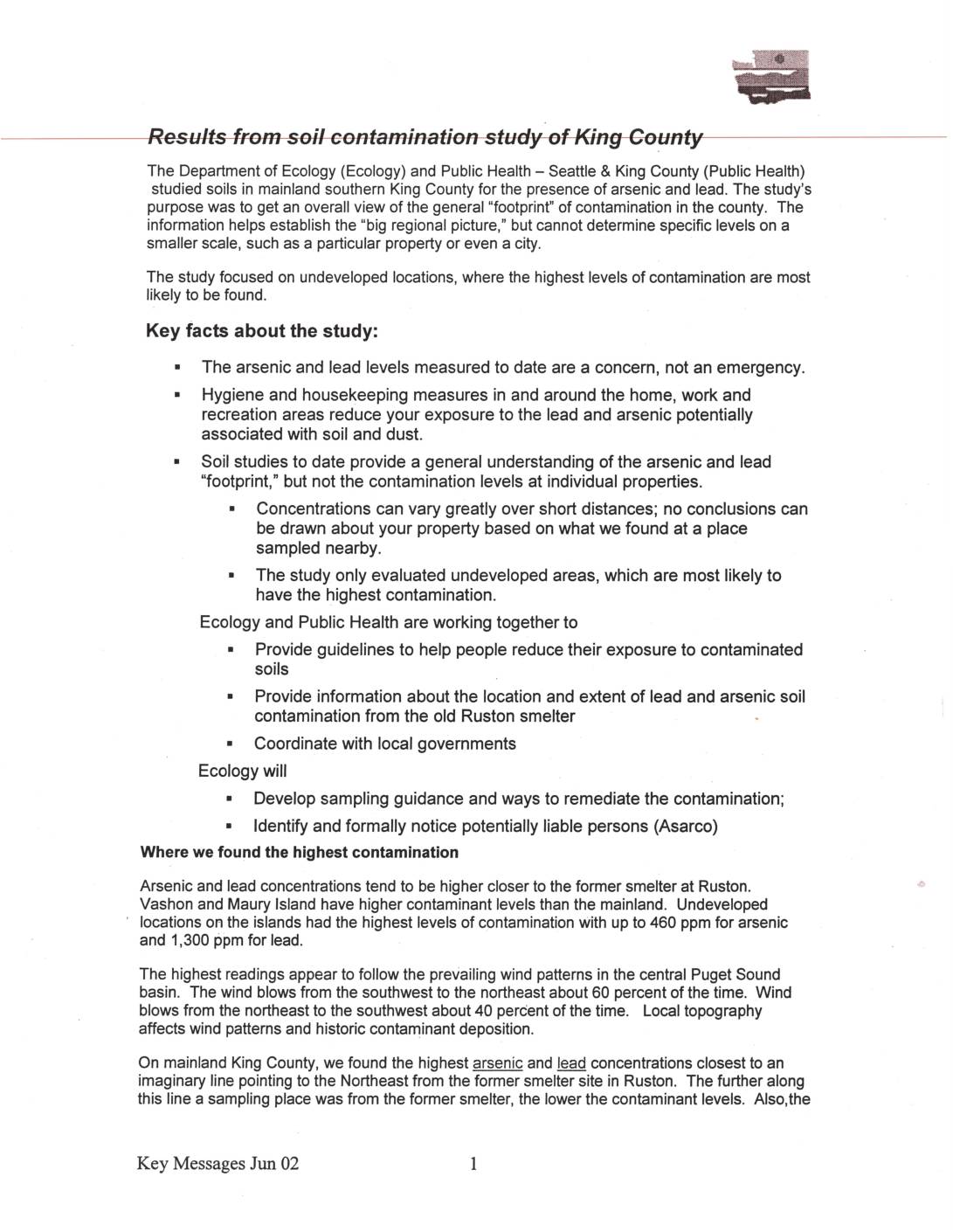
A soil contamination study by Washington State's Department of Ecology and Public Health – Seattle & King County found elevated levels of arsenic and lead in southern King County soils, linked primarily to the former Asarco smelter in Ruston. Contamination levels were highest near the smelter and on Vashon and Maury Islands, with concentrations decreasing further from the source and following prevailing wind patterns. While the findings are a concern rather than an emergency, officials stress that the study reflects regional trends only and cannot predict contamination levels at individual properties. -
 2000-03-01
Addressing community health concerns around SeaTac Airport: Response to the question, ‘Is it possible to monitor jet engine exhaust emissions or to model their path using data on prevailing winds and takeoff patterns?’
This March 2000 report, prepared by Washington State health and environmental agencies, examines whether jet engine exhaust emissions from Seattle-Tacoma International Airport can be monitored or modeled using wind and takeoff data. It reviews previous air quality studies, outlines health and environmental justice concerns for nearby communities, and recommends a structured air quality monitoring study with specific methods, data analysis approaches, and estimated costs. The report was developed in consultation with community representatives, the EPA, and local universities. -
 1999-02-01
Health profile for the SeaTac Airport Community
This 1999 report by the Seattle-King County Department of Public Health profiles the health of the community surrounding Seattle-Tacoma (SeaTac) Airport, comparing local health indicators to King County as a whole. Key findings include higher rates of lung cancer, firearm-related deaths, teen births, and respiratory hospitalizations in the SeaTac community, alongside lower rates of heart disease and stroke deaths among older residents. The report was produced in response to a request from local residents seeking a comprehensive community health assessment. -
 1998-08-01
The Health of King County: Highlights, August 1998
A 1998 public health report from the Seattle-King County Department of Public Health summarizing key health trends among King County residents. The report highlights both improvements, such as declining infant mortality, increased prenatal care access, falling teen birth rates, and reduced AIDS cases and sexually transmitted diseases, as well as ongoing challenges including chronic illnesses, drug-related deaths, smoking, obesity, and persistent health inequities across racial and socioeconomic groups.