Skip to content
  • STNI
  • Statistics
    • Ops and Passengers
      • King County International Airport (Boeing Field) Annual Operations
    • Financials
    • Aviation fuel uplift in the State of Washington 2018 – 2025
      • Aviation Fuel Uplift at Sea-Tac Airport
    • Air Quality Monitoring
    • Flight Tracking
      • Flow and Flight Tracks
      • Five Year Comparison
      • Busiest Hours and Days
    • SEL Noise Reports & Graphs
      • About The Permanent Noise Monitors
      • Minutes of Quiet by Noise Monitor
      • Noise Events mapped
      • Noise Events (SEL)
    • Runways
    • Employees
    • Real Estate
      • Port Properties and Trees mapped
    • Parking
  • Events
  • Protest
    • Regular Events
    • Legislation 2026
    • Complain about a particular flight
    • Advocacy Organizations
    • Media Outlets
    • People
    • The Port of Seattle
      • Commission Meetings
      • Public Records Requests
      • StART
      • Highline Forum
    • Contact Your Electeds
  • Resources
    • FAQs
      • FAA Occurrences/Accidents/Indents
    • The unSustainable Airport Master Plan
      • SAMP Public Comment Template
        • Two versions of Appendix K: NEPA/SEPA 2018 vs 2023
      • SAMP NTP: 31 projects by the numbers
      • SEPA Draft EIS (2026)
      • SAMP Record of Decision/FONSI (2025)
      • SAMP Draft EA (October 2024)
      • 2018 Scoping
    • Port Packages
      • Port Package Property Costs
      • Port Packages mapped
      • The Port Package Explainer
      • So you want a (first-time) Port Package? Start here
      • Port Package Looker Upper
      • How do I determine if I have a Port Package or Avigation Easement?
      • Progress on Port Package Update legislation
      • Having a Port Package Problem?
      • Port Package Site Visit Follow-Up
    • Document Library
    • Explainers
      • The Airport Law Cheat Sheet
      • The Grant Explainer
    • External Articles
    • History
      • Timeline
      • The Sea-Tac Communities Plan
        • Sea-Tac Communities Plan – Planning Maps
      • PSRC Third Runway Decision Process
    • Studies
    • Videos
  • Stories
  • Mission
  • Subscribe
  • Contact
Scroll down to content

Get InformedStay Informedx

I understand that you will never share my information with anyone, you will only use it to keep me updated on relevant events and that I may unsubscribe at any time.

STNI

STNISea-Tac Noise.Info

  • Solve for Sea-Tac. Solve for every airport.
  • Since 2016, working to obtain justice for everyone living under the flight path.
  • Less Noise. Cleaner Air. Better Public Health. Compensation.
  • Everything you think you know about the airport is wrong.

TagFAA(793)

Advanced Search Options

  • Dates
  • Media
    • External Articles
    • Images
    • PDFs
    • Video
    • Audio
  • Order By
  • 1981-10-01

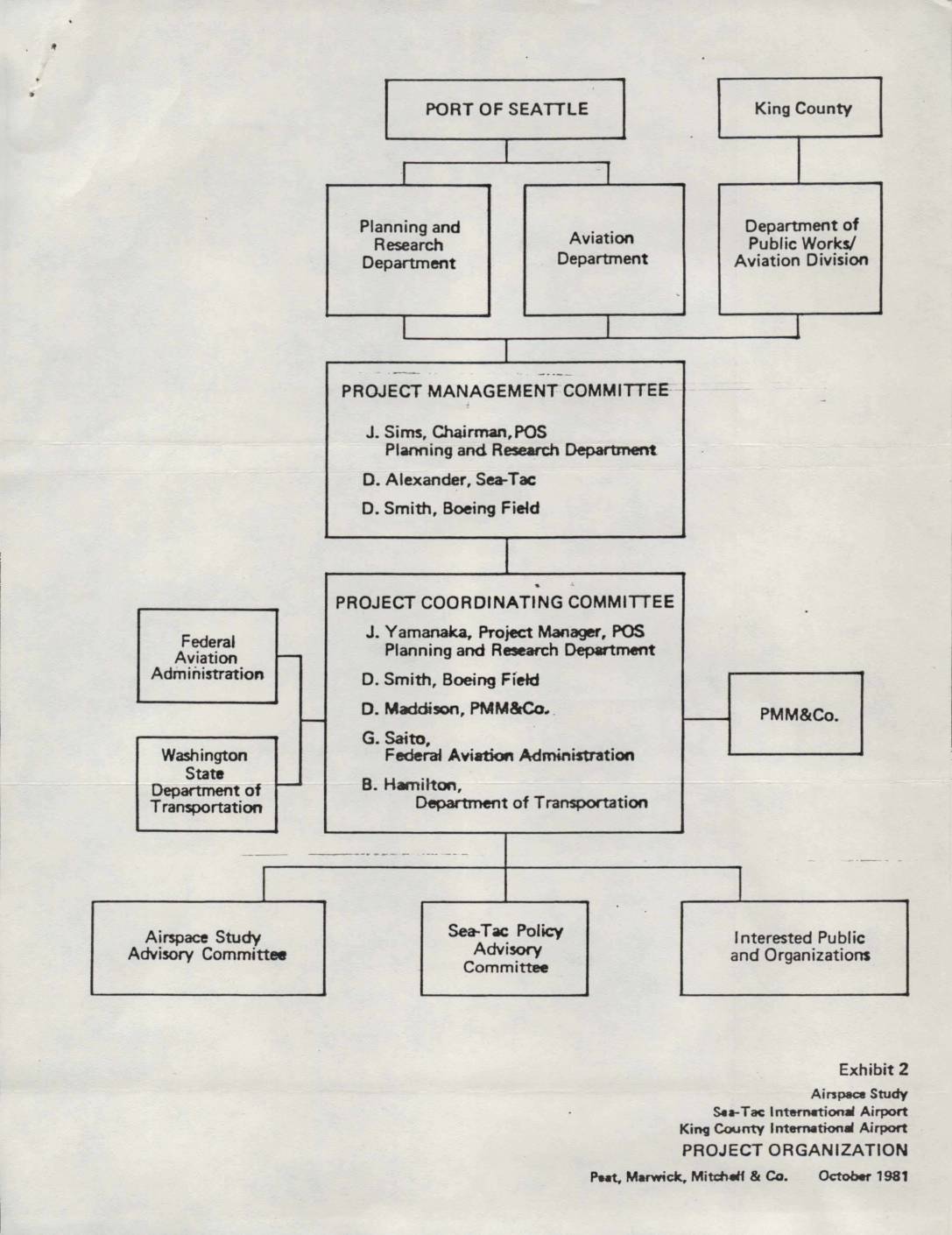
    Exhibit 2: Airspace Study, Sea-Tac International Airport / King County International Airport — Project Organization

    This 1981 organizational chart from Peat, Marwick, Mitchell & Co. outlines the project structure for an Airspace Study covering Sea-Tac International Airport and King County International Airport (Boeing Field). The study was jointly overseen by the Port of Seattle and King County, with a Project Management Committee chaired by J. Sims and a Project Coordinating Committee led by Project Manager J. Yamanaka, drawing participation from the Federal Aviation Administration and the Washington State Department of Transportation. Advisory input was provided by the Airspace Study Advisory Committee, the Sea-Tac Policy Advisory Committee, and interested members of the public and organizations.
    TagsAdvisory Committees, Airspace Study, Boeing Field, FAA, King County International Airport, Port Of Seattle, Sea-Tac Airport
  • 1981-01-31

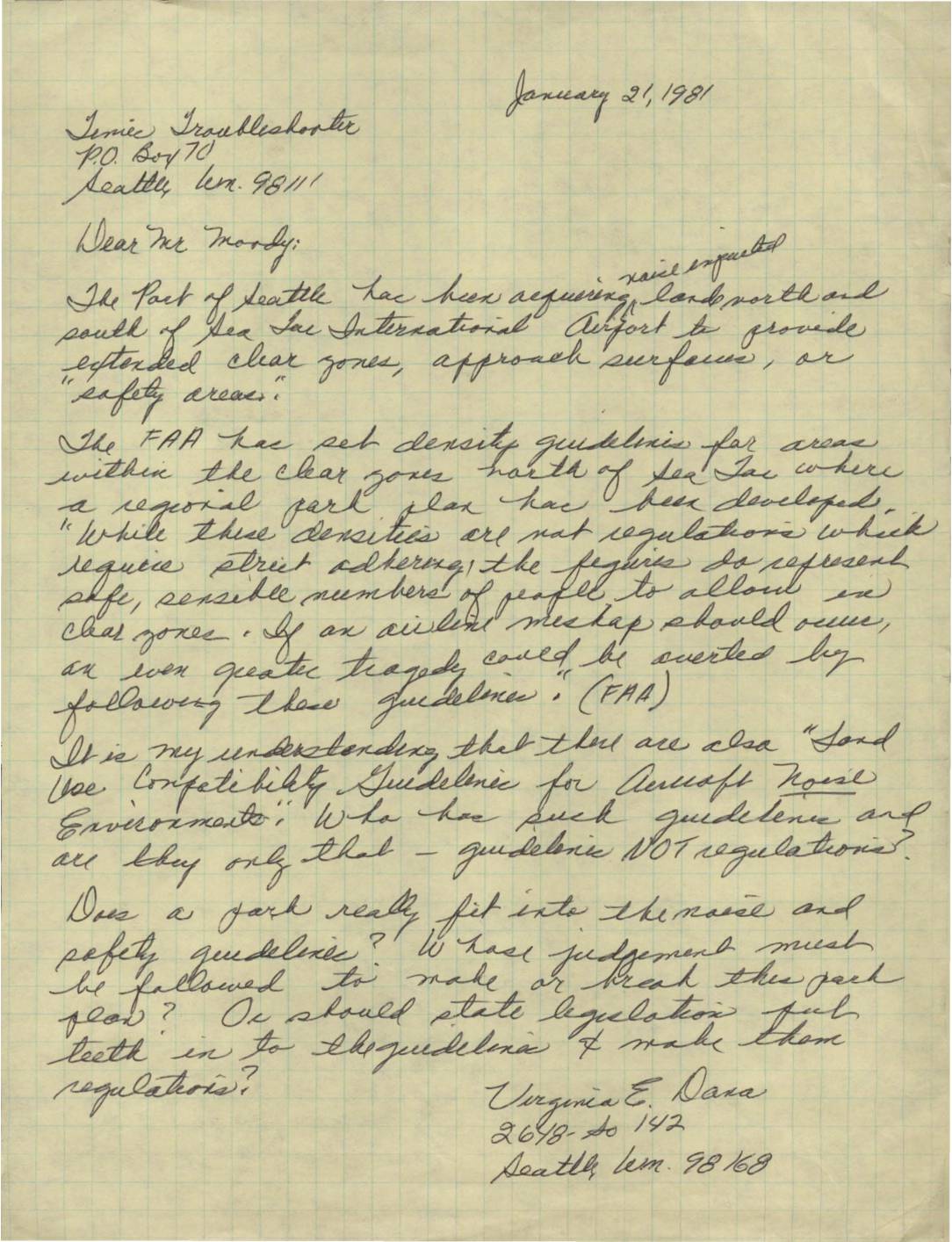
    Letter to Times Troubleshooter regarding FAA guidelines

    In this January 21, 1981 letter to Janice Troubleshooter of Seattle, resident Virginia E. Dana raises concerns about the Port of Seattle's land acquisition near Sea-Tac International Airport for clear zones and safety areas. She questions whether FAA density guidelines and land use compatibility guidelines for aircraft noise environments are enforceable regulations or merely voluntary guidelines, and whether a proposed regional park plan is appropriate for these safety-sensitive zones. Dana calls for state legislation to give these guidelines regulatory teeth.
    CategoriesCorrespondence TagsFAA, FAA Density Guidelines, letter, Port Of Seattle, Virginia Dana
  • FAA sea twr 7110 071c noise abatement procedures 1980 10 07 pdf
    1980-10-07

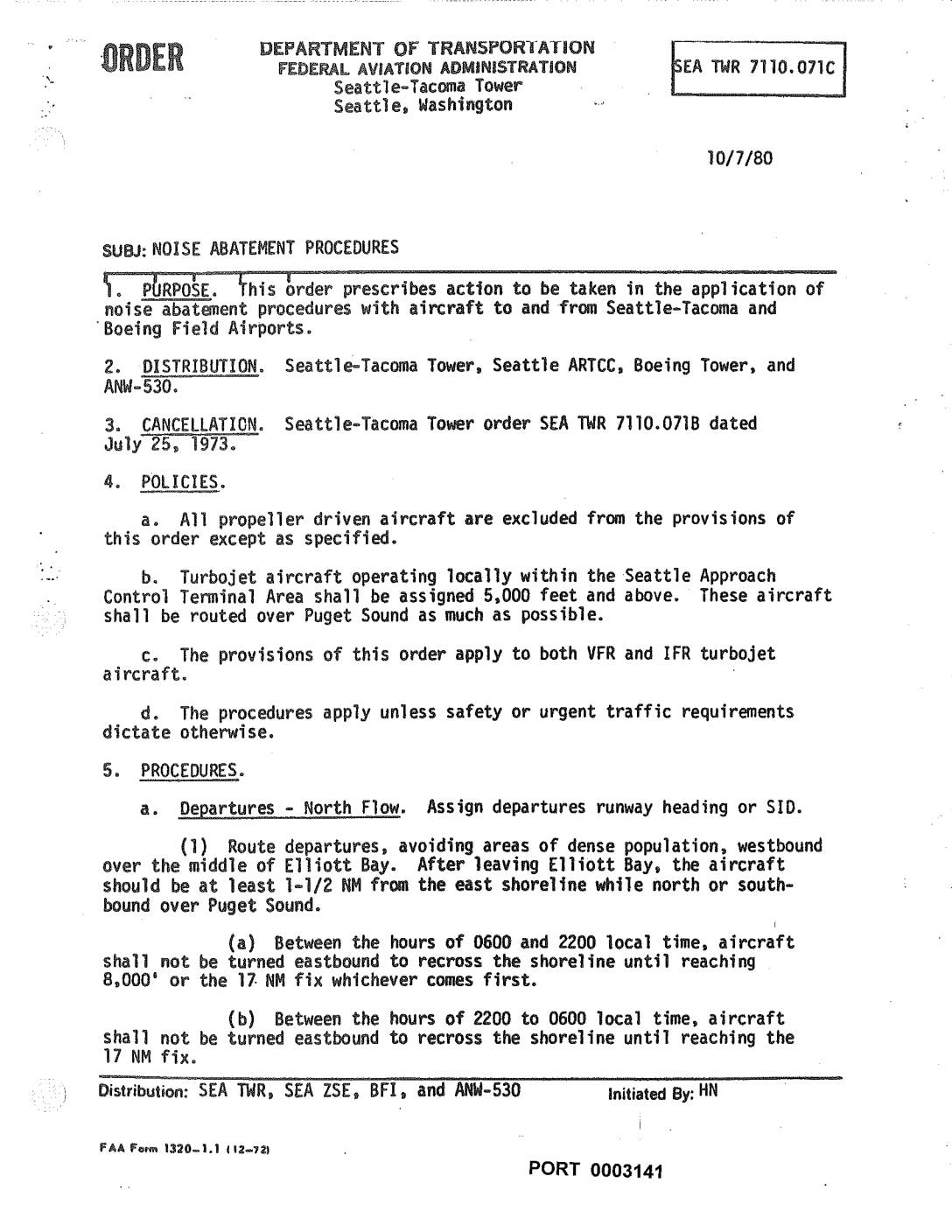
    SEA TWR 7110.071C: Noise Abatement Procedures, Seattle-Tacoma Tower

    FAA order SEA TWR 7110.071C dated October 7, 1980, issued by Seattle-Tacoma Tower (Seattle, Washington), prescribing noise abatement procedures for turbojet aircraft operating to and from Seattle-Tacoma International Airport and Boeing Field (BFI). Cancels prior order SEA TWR 7110.071B dated July 25, 1973. Covers north flow and south flow departure routing over Elliott Bay and
    TagsAir Traffic Control, Boeing Field, FAA, Four Post Plan, Noise Abatement Procedures, Sea-Tac Airport
  • 1980-10-07

    SEA TWR 7110.071C: Noise Abatement Procedures, Seattle-Tacoma Tower

    This 1980 Federal Aviation Administration order establishes noise abatement procedures for aircraft operating to and from Seattle-Tacoma International Airport and Boeing Field. It directs turbojet aircraft to fly over Puget Sound and Elliott Bay whenever possible, sets altitude and distance restrictions before aircraft can turn toward populated shoreline areas, and defines preferred takeoff and landing runways to minimize noise impact. The procedures apply to both VFR and IFR turbojet flights, with stricter nighttime rules between 2200 and 0600 local time.
    TagsAir Traffic Control, Boeing Field, FAA, Four Post Plan, Noise Abatement Procedures, Sea-Tac Airport
  • 1980-04-21

    FAA Says Orange County, California Noise Policy Discriminates Against New Entrants

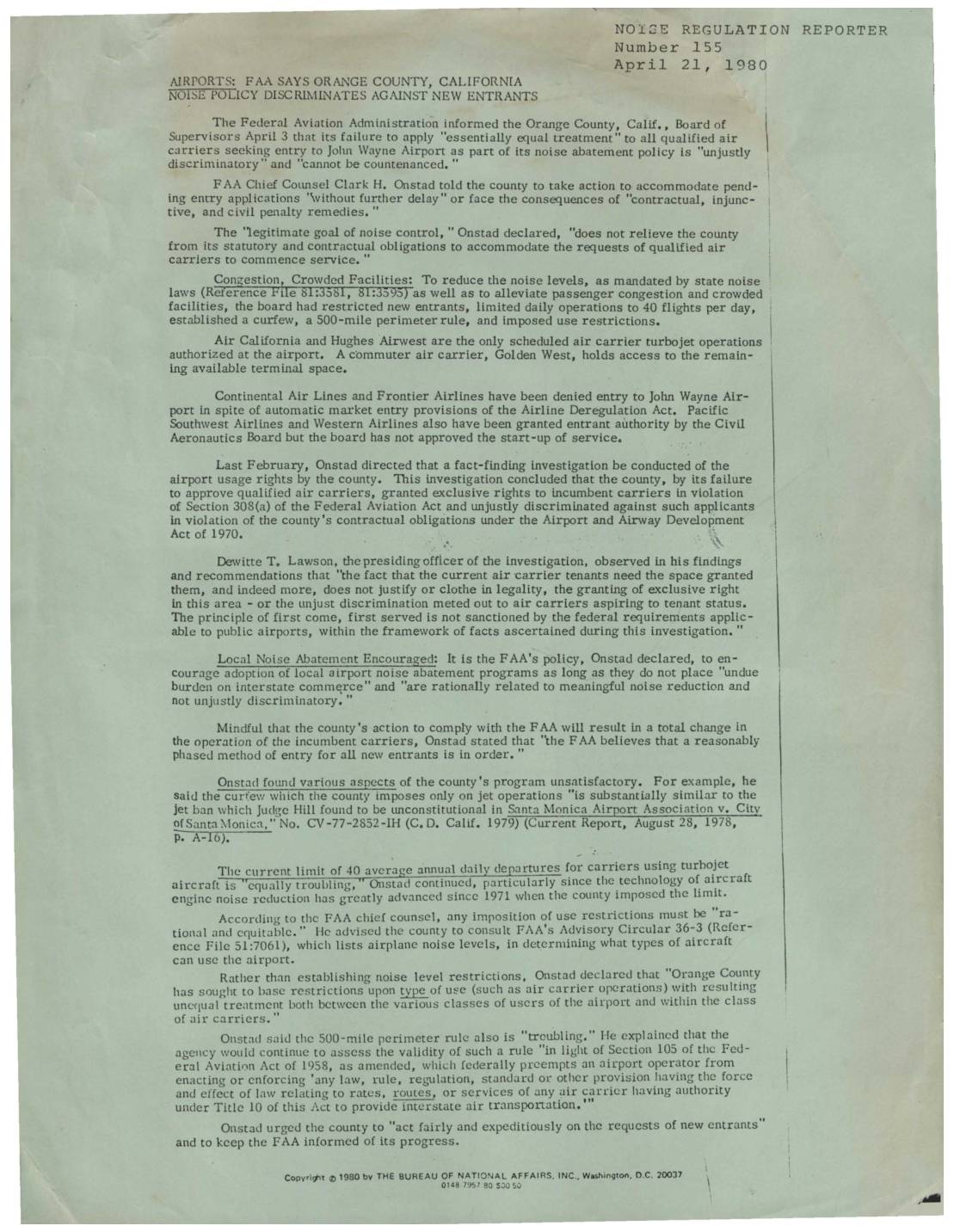
    In April 1980, the Federal Aviation Administration ruled that Orange County, California's noise abatement policy at John Wayne Airport was unlawfully discriminatory because it blocked new airlines from entering while protecting existing carriers. The FAA warned the county to accommodate pending entry applications from airlines like Continental and Frontier without further delay, or face legal and financial penalties. While the FAA supported local noise control efforts, it made clear that such policies must treat all qualified air carriers equally and not place undue burdens on interstate commerce.
    TagsAirline Deregulation Act, Airport Noise Law, FAA, John Wayne Airport
  • FAA noise regulation reporter 155 orange county john wayne airport 1980 04 21 pdf
    1980-04-21

    FAA Says Orange County, California Noise Policy Discriminates Against New Entrants

    Noise Regulation Reporter Number 155 (April 21, 1980) reports that FAA Chief Counsel Clark H. Onstad informed the Orange County, California Board of Supervisors that its noise abatement policy at John Wayne Airport is ‘unjustly discriminatory’ against new airline entrants. The FAA found that denying entry to Continental Air Lines, Frontier Airlines, Pacific Southwest Airlines,
    TagsAirline Deregulation Act, Airport Noise Law, FAA, John Wayne Airport
  • 1979-11-14

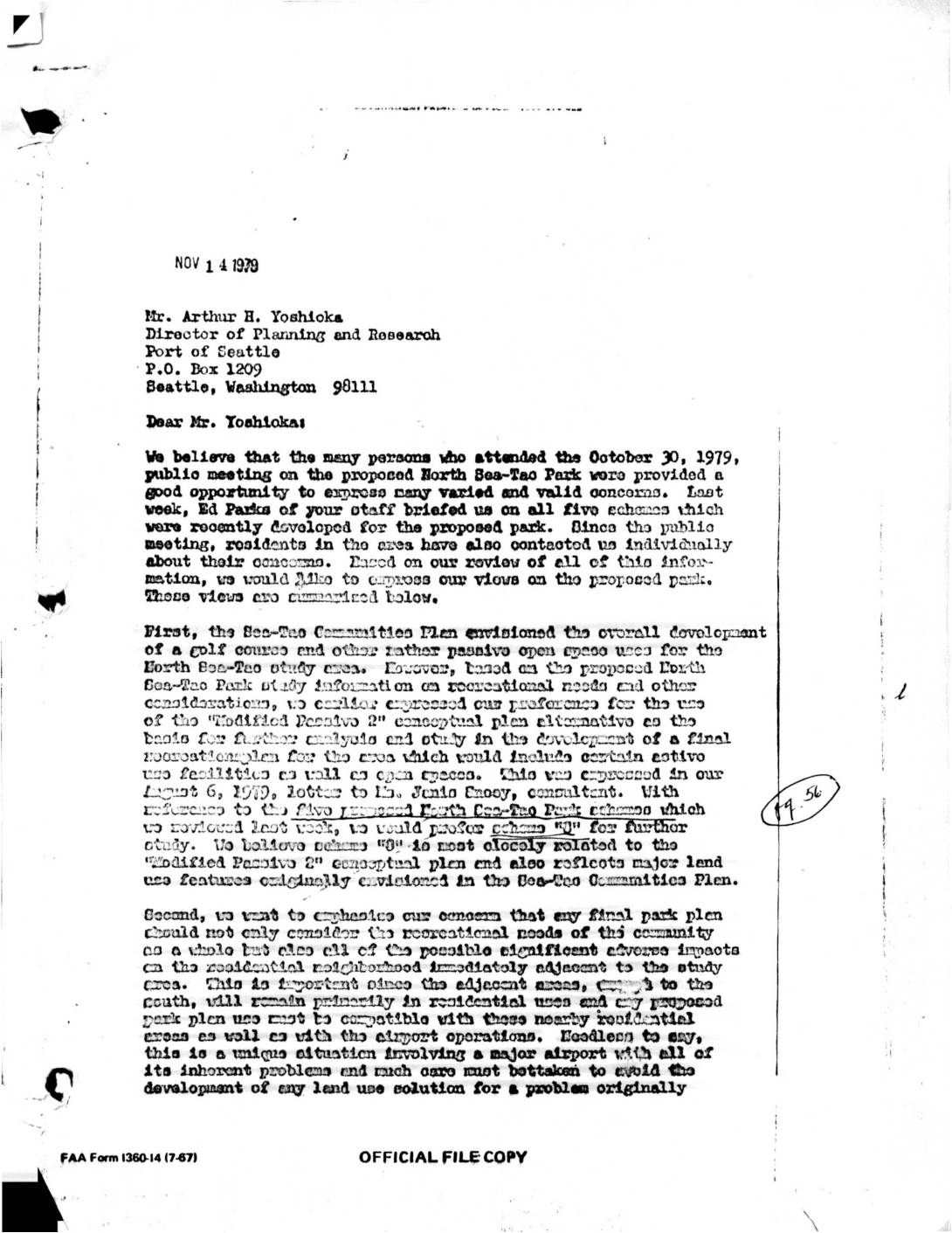
    Letter to Arthur H. Yoshioka re: North Sea-Tac Park planning

    A November 1979 FAA letter to the Port of Seattle expresses support for a 'Modified Passive 2' conceptual plan for the proposed North Sea-Tac Park, while urging that any final park plan carefully weigh adverse impacts on adjacent residential neighborhoods and airport operations. The letter emphasizes that residents in the immediate study area should have meaningful input into the final park plan, and calls for close collaboration among the Port, King County, consultants, and citizens to minimize conflicts between park uses and the unique challenges posed by proximity to a major airport.
    TagsFAA, North Sea-Tac Park, Port Of Seattle, Robert O. Brown, STCP
  • 1979-08-06

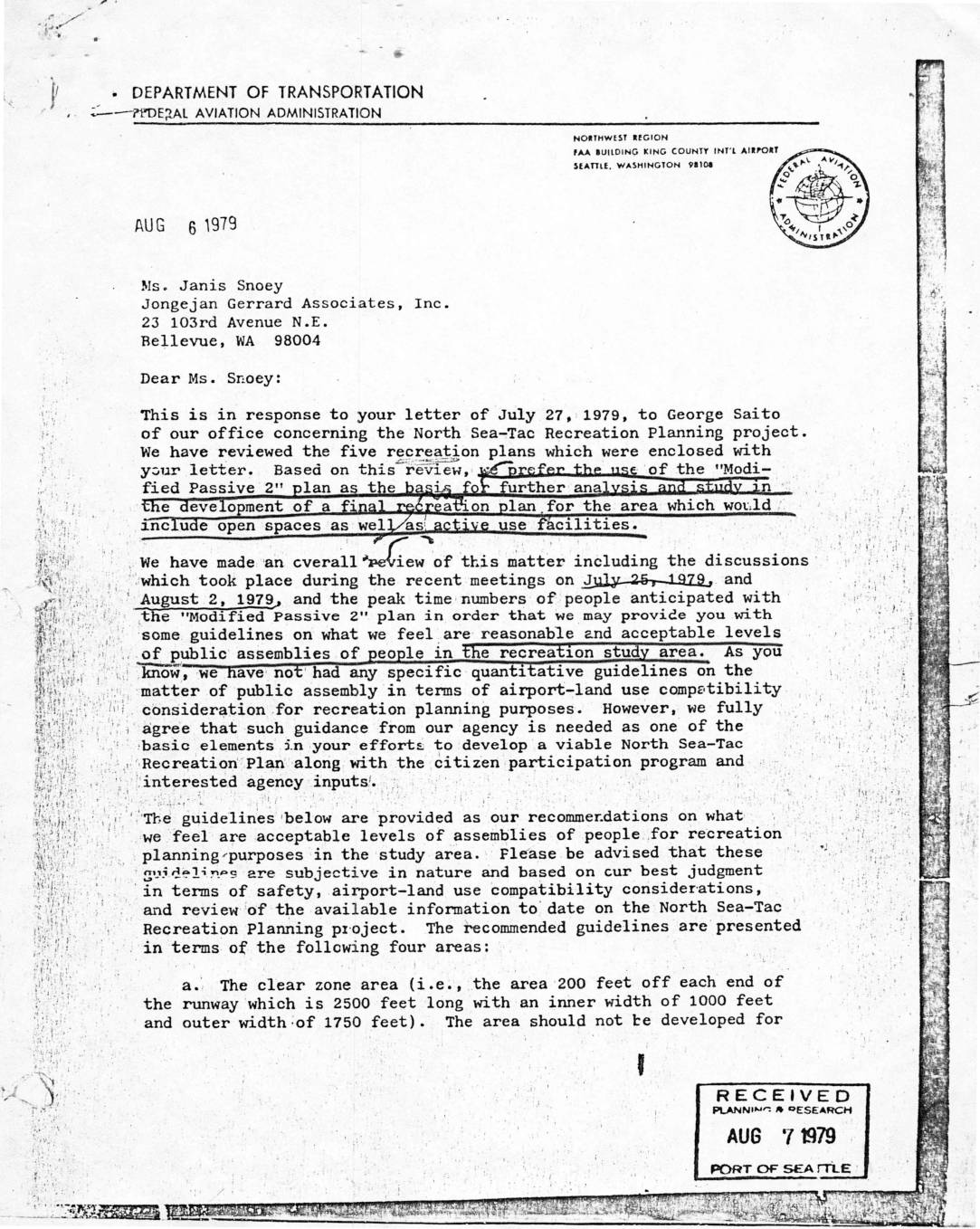
    FAA letter to Jongejan Gerrard Associates regarding North Sea-Tac Recreation Planning guidelines

    In this August 6, 1979 letter from the FAA's Northwest Region to Jongejan Gerrard Associates, the agency provides guidelines on acceptable crowd density levels for recreation planning near Sea-Tac Airport. The FAA outlines four zones around the runway, each with specific limits on peak-time people per acre, ranging from no intensive use in the clear zone closest to the runway to no more than 40 people per acre in outlying areas. The letter also discourages any recreation development that could create bird hazards, incompatible lighting, or electronic interference with airport operations.
    TagsAirport Citizen Participation Program, FAA, Jongejan, letter, North Sea-Tac Park, NSTP
  • 1979-08-02

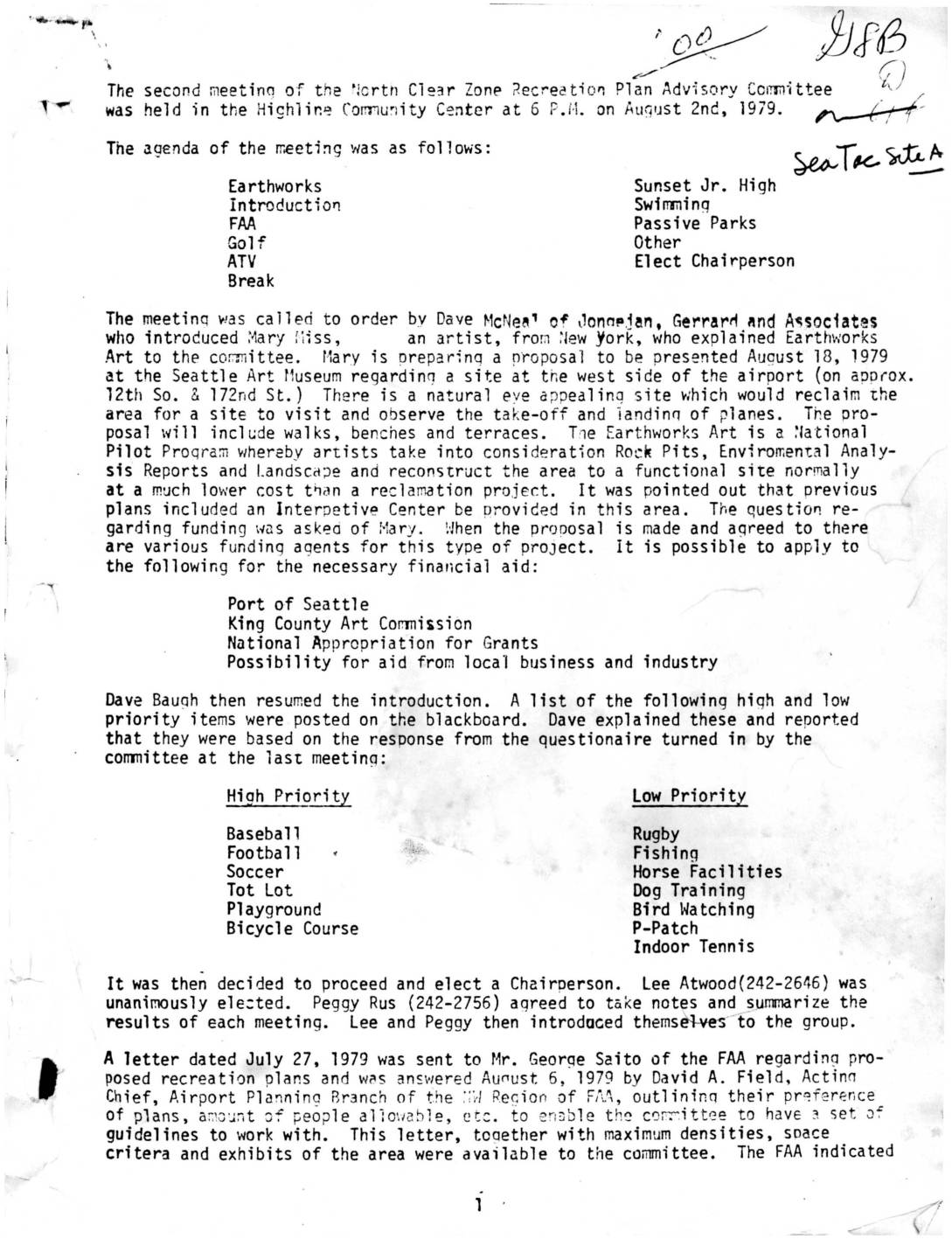
    Minutes: North Clear Zone Recreation Plan Advisory Committee, Second Meeting – August 2, 1979

    Minutes from the August 2, 1979 second meeting of the North Clear Zone Recreation Plan Advisory Committee, held at the Highline Community Center, covering proposed recreational uses for land near Sea-Tac Airport's north clear zone. Topics discussed included an Earthworks Art installation, FAA density guidelines (1.5 people per acre), a possible 9-hole golf course, ATV facilities, use of Sunset Jr. High School, and passive park development around Tub Lake and Lake Reba. Lee Atwood was elected Chairperson, and the committee agreed to reconvene with the consulting firm to develop workable recreation plan recommendations within FAA constraints.
    CategoriesHistory, Meetings TagsAdvisory Committees, FAA, Highline Community Plan, North Sea-Tac Park, NSTP, Parks
  • 1979-07-30

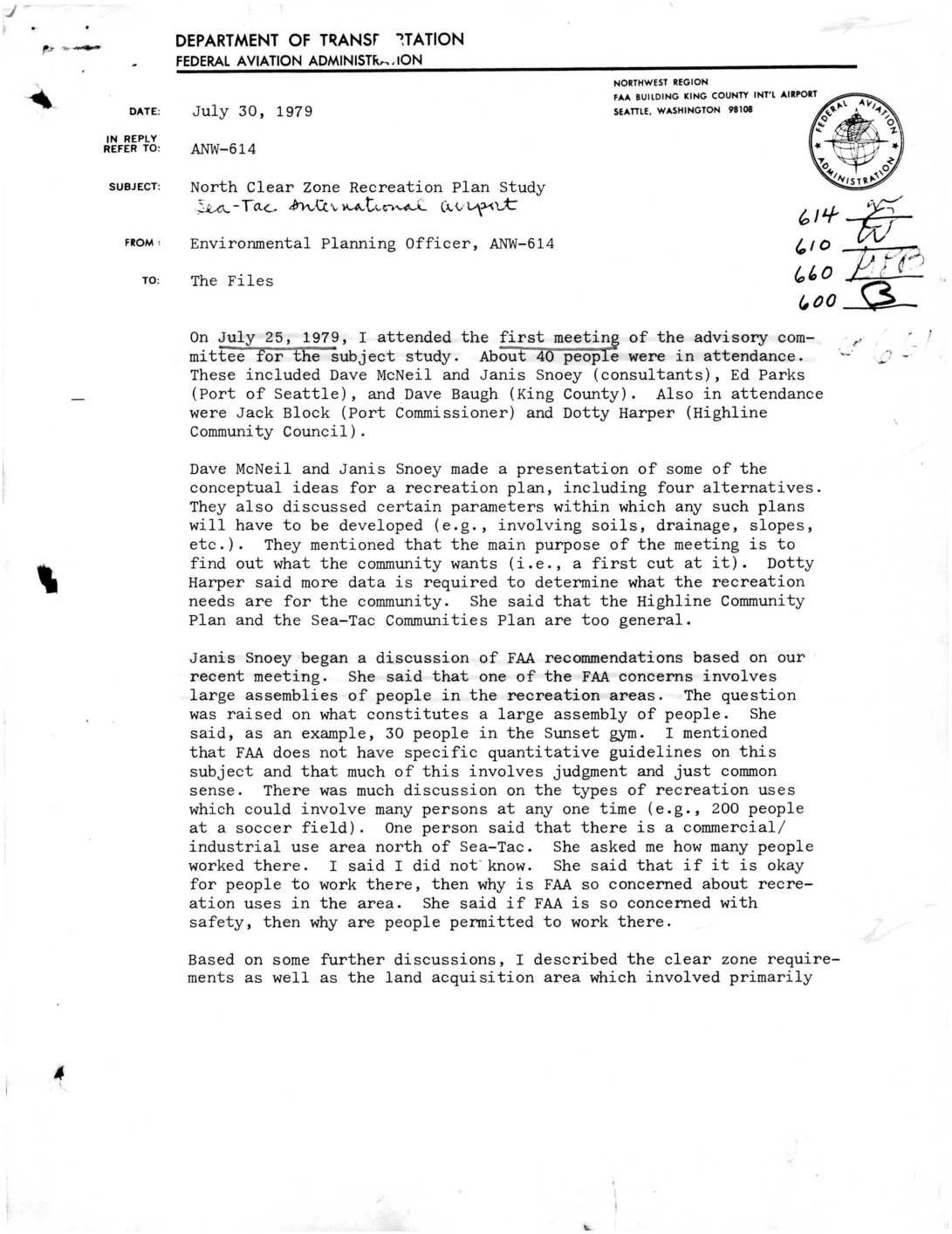
    North Clear Zone Recreation Plan Study – Sea-Tac International Airport

    A July 1979 FAA memo summarizes the first advisory committee meeting on a proposed recreation plan for the North Clear Zone near Sea-Tac International Airport. The meeting, attended by about 40 community members, consultants, and Port of Seattle representatives, centered on what types of recreational uses—such as soccer fields, golf courses, and bike trails—would be compatible with airport safety guidelines, with the FAA cautioning against intensive uses and large fixed spectator facilities in the clear zone. The group requested more specific, quantitative FAA guidelines on acceptable land use, and a follow-up meeting was scheduled for August 8, with the full study expected to take six months and potentially set precedents for recreational land use near major airports.
    Tagscommunity engagement, FAA, Land Use, North Sea-Tac Park, Sea-Tac Airport

Posts pagination

Page 1 … Page 75 Page 76 Page 77 Page 78 Page 79 Page 80
Sidebar On/Off

Upcoming Events

  • StART SEA Stakeholder Advisory Round Table
    Add to CalendarMWednesday Aug 26, 5:00pm - 7:00pm
    Zoom (Virtual Meeting)
    START meetingagenda 2026826 final 0 pdf

    Meeting Objectives Introduce the primary feedback themes identified by StART members regarding StART’s Operating Procedures and determine areas that may warrant future discussion. 5:00 PM – Welcome Meeting Management Welcome Lead: Andrés Mantilla, Facilitator, Uncommon Bridges; Wendy Reiter, Airport Managing Director, POS 5:15 PM – Dinner: All participants eat. 5:30 PM – StART Operating Procedures

    [...]
  • Commercial Aviation Work Group
    Add to CalendarMThursday Sep 3, 10:00am - 1:30pm
    Virtual Meeting (Zoom)
    Cawg agenda sep 3 26 virtual pdf

    Meeting Agenda 10:00 a.m. – 10:15 a.m. | Welcome – Evan Nordby, Chair a. Introductions and Agenda Reviewb. Status of appointments and non-voting member invitationsc. Other updates as necessary 10:15 a.m. – 11:00 a.m. | Is it practical and legal to operate the western Washington [Puget Sound] airports as a single airport system? – Consultant

    [...]

[See all...]


Help study childhood asthma. Get free HEPA filter!

read more...

Issues

Sea-Tac Airport is currently undergoing the largest and longest expansion in its history, collectively known as the Sustainable Airport Master Plan (SAMP). Some of it you can already hear, but you’re probably not aware of what it all means. Here’s what you need to know.
read more...

Read This!

As the source for federal transportation grants, the Puget Sound Regional Council was charged with developing a system to meet the growing need for commercial aviation. When the search for a second airport failed, they authorized the Port of Seattle to build the Third Runway, with a mandate to develop a noise abatement and mitigation program. In their effort to stop the Third Runway, the ACC argued over every detail of the Port's efforts--including property buyouts and sound insulation. The dispute was meant to be settled by a three member Expert Arbitration Panel. This is their final report. It finds 2-1, that the Port's program was insufficient in several respects. Despite that, funding for the Third Runway was approved by the PSRC, and the 'Port Package' program, proceeded largely unchanged. Expert Arbitration Panel's final decision finding that the Port of Seattle had not shown sufficient reduction in real on-the-ground noise impacts to satisfy noise reduction conditions required for approval of a third runway at Sea-Tac International Airport. The majority decision concluded the Port's noise abatement programs were insufficient despite being impressive in scope.
continue...

The Podcast!

Subscribe to the only podcast devoted to policies, politics, history, impacts for people living under the flight path everywhere. It’s definitely not just about noise!
  • Sea-Tac Noise.Info
  • Connect with STNI

    • Subscribe
    • Port Package Problem?
    • Donate
    • Podcast
    • Socials
      • Facebook
      • X (Twitter)
      • Bluesky
      • Instagram

    "SeaTac – From crime-ridden strip to safe city" — , 2010

  • Learn

    • Frequently Asked Questions
    • Explainers
    • Youtube
    • Research Requests
    • Make a complaint
  • Goals

    Fulfill the promises of 1976:
    • Compensation
    • Reduced noise
    • Improved air quality
    • Environmental remediation
Login/Register
©2026•Data Privacy

Message

We use cookies to provide basic functionality. We also provide access to search engines in order to provide site analytics. We do not sell or share your data.
V V