TagFAA(793)
-
 1985-09-24
Resolution No. 2974: Authorization to accept FAA grant offer for AIP Project No. 3-53-0062-10
In September 1985, the Port of Seattle's Port Commission passed Resolution No. 2974, authorizing acceptance of a Federal Aviation Administration grant (AIP Project No. 3-53-0062-10) to fund land acquisition and relocation of residents in the extended clear zone around Seattle-Tacoma International Airport. The grant agreement, issued under Contract No. DOT-FA85NM-0062, covered nine specific land parcels (J-54, J-56, J-114, J-141, J-144, J-146, J-149, J-150, and J-151) adjacent to the airport. The resolution directed the Port's Executive Director to execute the agreement on the Port's behalf, provided it met FAA standard form requirements. -
 1985-09-24
Resolution No. 2974: Authorization to accept FAA grant offer for AIP Project No. 3-53-0062-10
In September 1985, the Port of Seattle's Port Commission passed Resolution No. 2974, authorizing acceptance of a Federal Aviation Administration grant (AIP Project No. 3-53-0062-10) to fund land acquisition and relocation of residents in the extended clear zone around Seattle-Tacoma International Airport. The grant agreement, issued under Contract No. DOT-FA85NM-0062, covered nine specific land parcels (J-54, J-56, J-114, J-141, J-144, J-146, J-149, J-150, and J-151) adjacent to the airport. The resolution directed the Port's Executive Director to execute the agreement on the Port's behalf, provided it met FAA standard form requirements. -
 1985-02-01
Sea-Tac International Airport Part 150: Airport noise compatibility program
This 1985 document, prepared by the Port of Seattle, outlines the Part 150 Airport Noise Compatibility Program for Seattle-Tacoma (Sea-Tac) International Airport. It combines two phases: Phase I, Noise Exposure Maps (officially submitted to the FAA in October 1984), and Phase II, a Noise Compatibility Program adopted by the Port Commission in January 1985. Together, these phases identify noise exposure around the airport and propose measures to address compatibility between aircraft noise and surrounding land uses. -
 1984-08-28
Commission Resolution no. 2940 FAA Grant AIP Clear Zone land acquisition
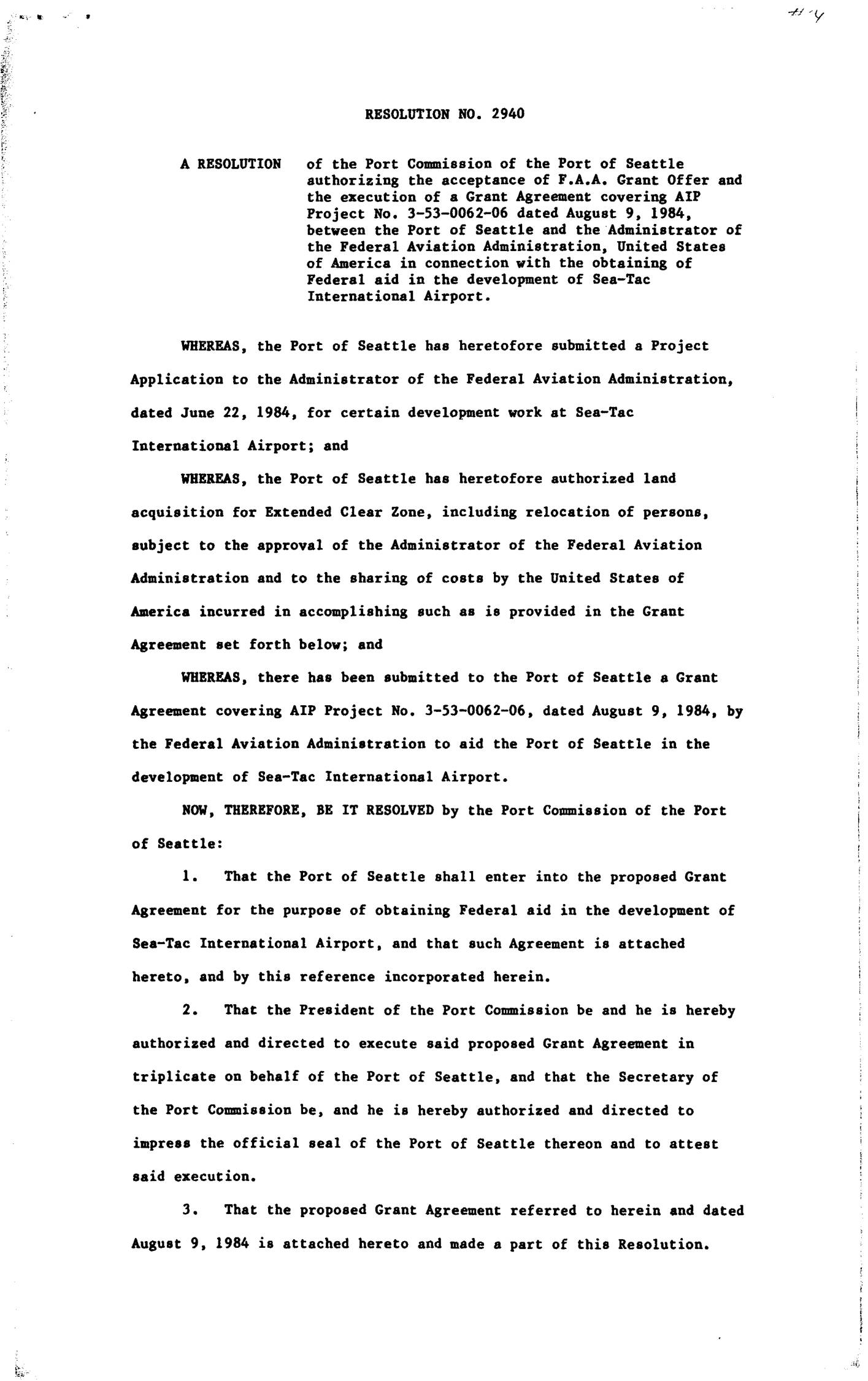
A resolution authorizing the Port of Seattle to accept an FAA grant offer and execute Grant Agreement for AIP Project No. 3-53-0062-06 to obtain federal aid for Sea-Tac International Airport development, specifically for land acquisition in Extended Clear Zone areas and relocation of persons. The resolution was adopted by the Port Commission on August 28, -
 1984-08-28
Resolution no. 2940
A resolution authorizing the Port of Seattle to accept an FAA grant offer and execute Grant Agreement for AIP Project No. 3-53-0062-06 to obtain federal aid for Sea-Tac International Airport development, specifically for land acquisition in Extended Clear Zone areas and relocation of persons. The resolution was adopted by the Port Commission on August 28, -
 1984-07-09
Port Of Seattle Letter to United Airlines on Sea-Tac Airport Noise Abatement Procedures
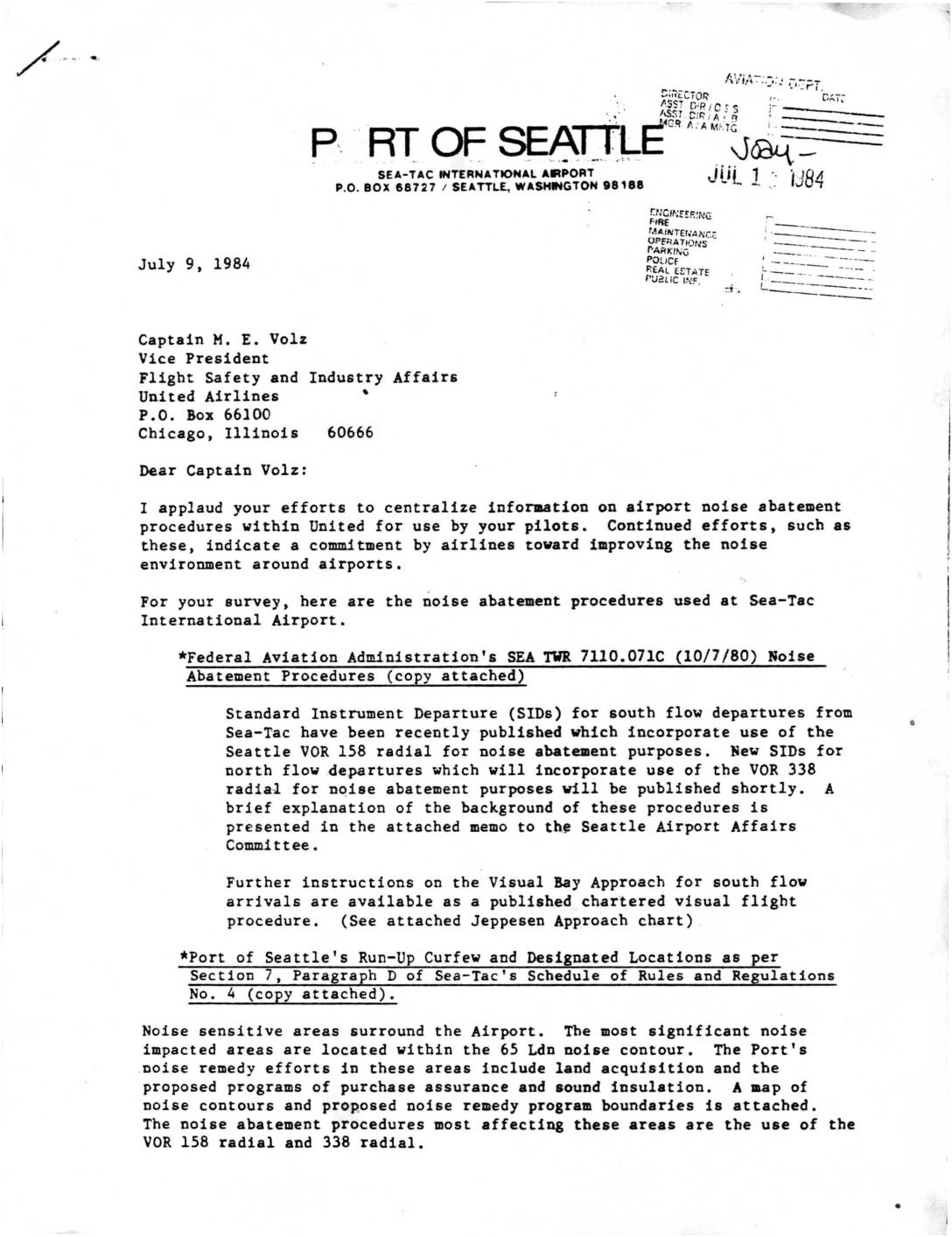
A July 9, 1984 letter from Port of Seattle to United Airlines Vice President Captain M. E. Volz outlines the noise abatement procedures in use at Seattle-Tacoma International Airport. The procedures include FAA-established Standard Instrument Departure (SID) routes using the Seattle VOR 158 and 338 radials to minimize noise over surrounding communities, a Visual Bay Approach for south flow arrivals, and a Run-Up Curfew with designated engine run-up locations. The letter also notes that the most noise-impacted areas fall within the 65 Ldn noise contour, where the Port was pursuing land acquisition, purchase assurance, and sound insulation programs as remedies. -
1984-07-09
Port Of Seattle Letter to United Airlines on Sea-Tac Airport Noise Abatement Procedures
July 9, 1984 letter from Port Of Seattle to Captain M. E. Volz, Vice President of Flight Safety and Industry Affairs at United Airlines, summarizing noise abatement procedures at Sea-Tac International Airport. Covers FAA SEA TWR 7110.071C (10/7/80) noise abatement procedures, Standard Instrument Departure (SIDs) using Seattle VOR 158 radial for south flow and VOR -
 1984-06-13
July 10/12 open house planning document
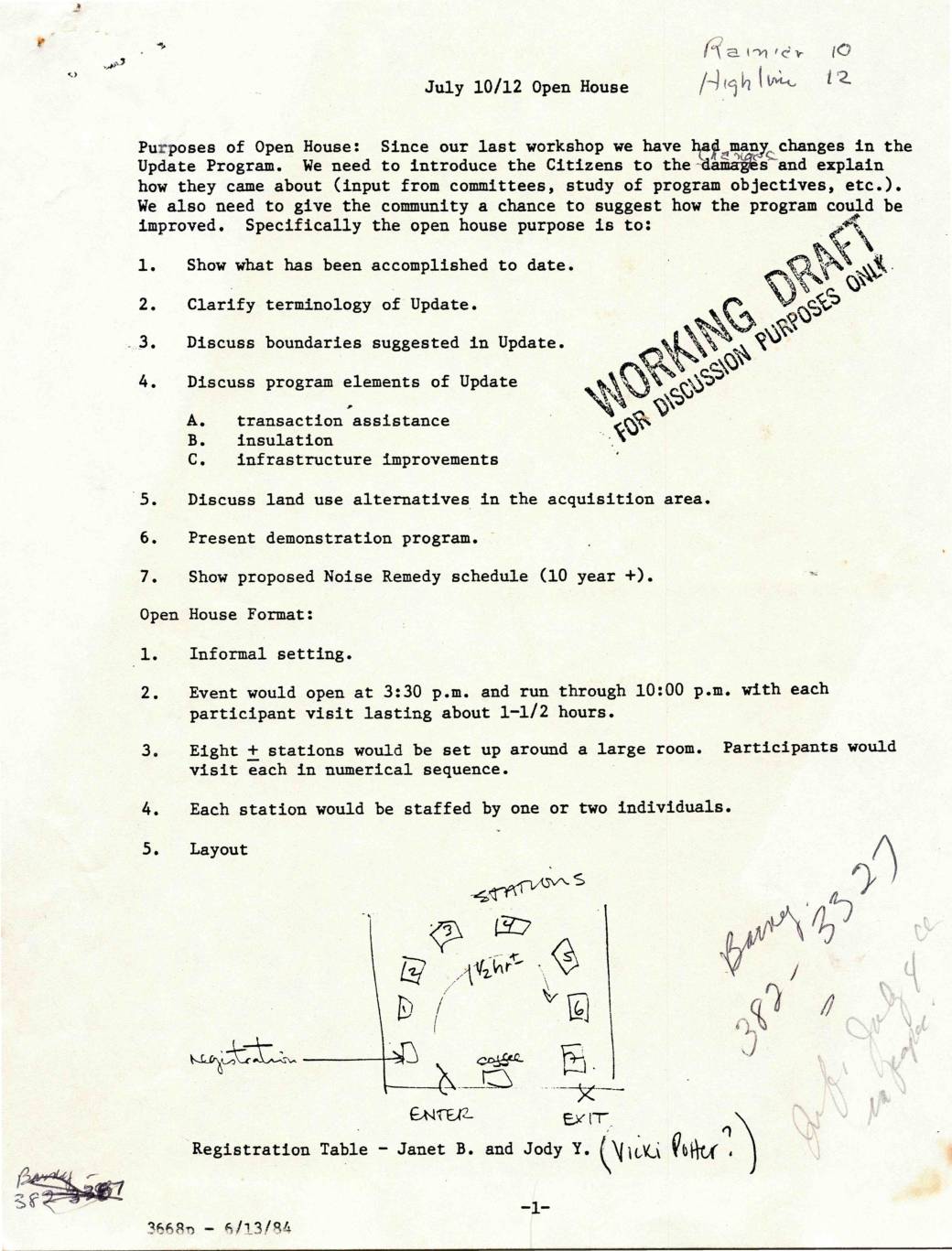
This 1984 working draft outlines the planning and format for two public open house events held on July 10 and 12 at Rainier High School and Highline High School, designed to inform the community about updates to the Sea-Tac Airport Noise Remedy Program. The events featured eight informational stations covering topics such as insulation, transaction assistance, infrastructure improvements, land use alternatives, and a proposed 10-year Noise Remedy schedule, with each visitor spending approximately 1.5 hours rotating through the stations. The document also details staffing assignments, budget estimates, necessary equipment, publicity plans, and an attendance expectation of roughly 300 people per event. -
 1984-02-28
FAA review letter on proposed Noise Remedy Program criteria and boundaries
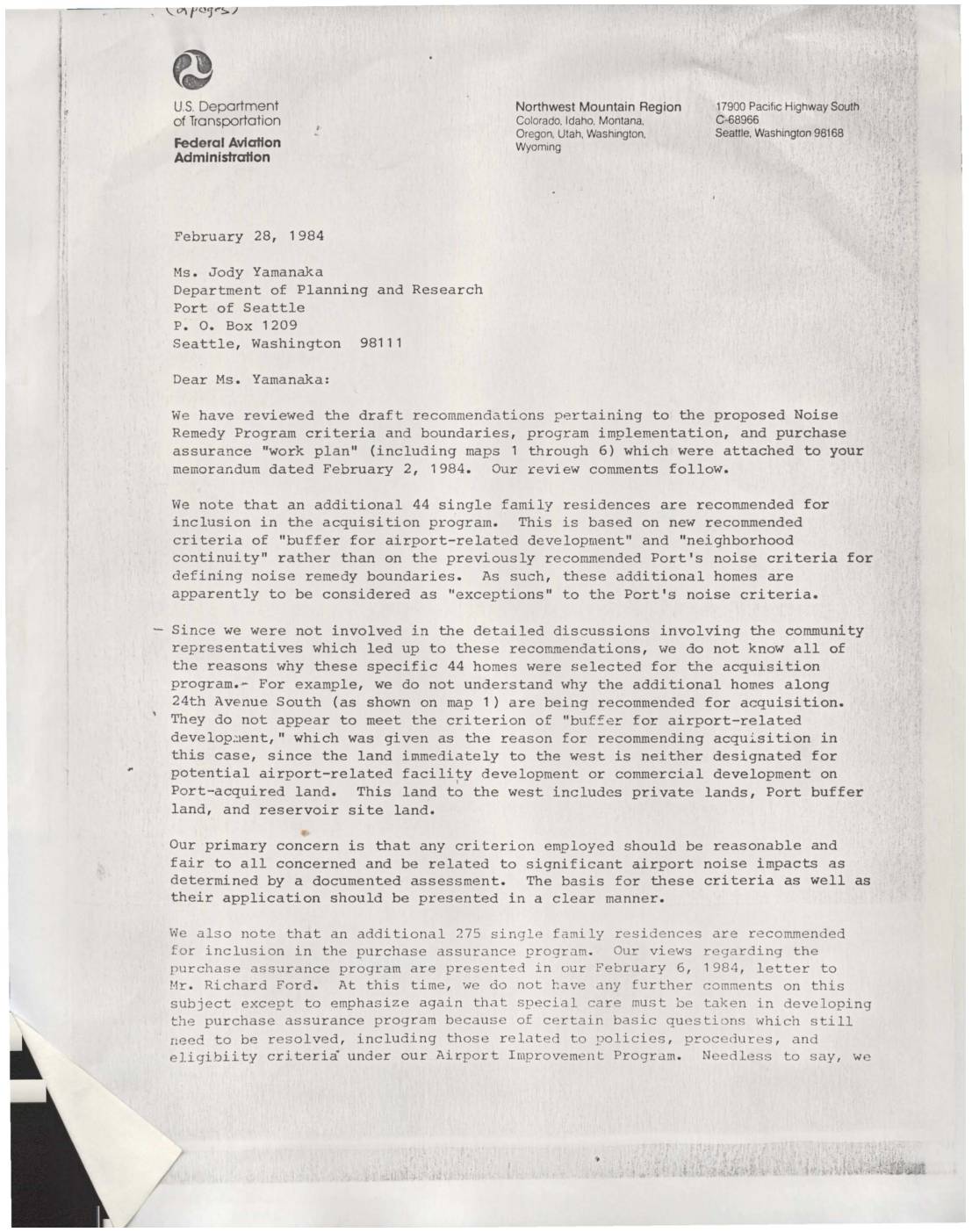
In this February 28, 1984 letter, the FAA's Northwest Mountain Region reviewed the Port of Seattle's proposed Noise Remedy Program for Sea-Tac Airport, raising concerns about the criteria used to add 44 homes to an acquisition program and 275 homes to a purchase assurance program. The FAA questioned whether the new criteria of 'buffer for airport-related development' and 'neighborhood continuity' were sufficiently justified, particularly for homes along 24th Avenue South. The agency urged that all criteria be reasonable, clearly documented, and tied to measured noise impacts, and cautioned against finalizing the purchase assurance plan before key federal policy questions were resolved. -
 1983-12-28
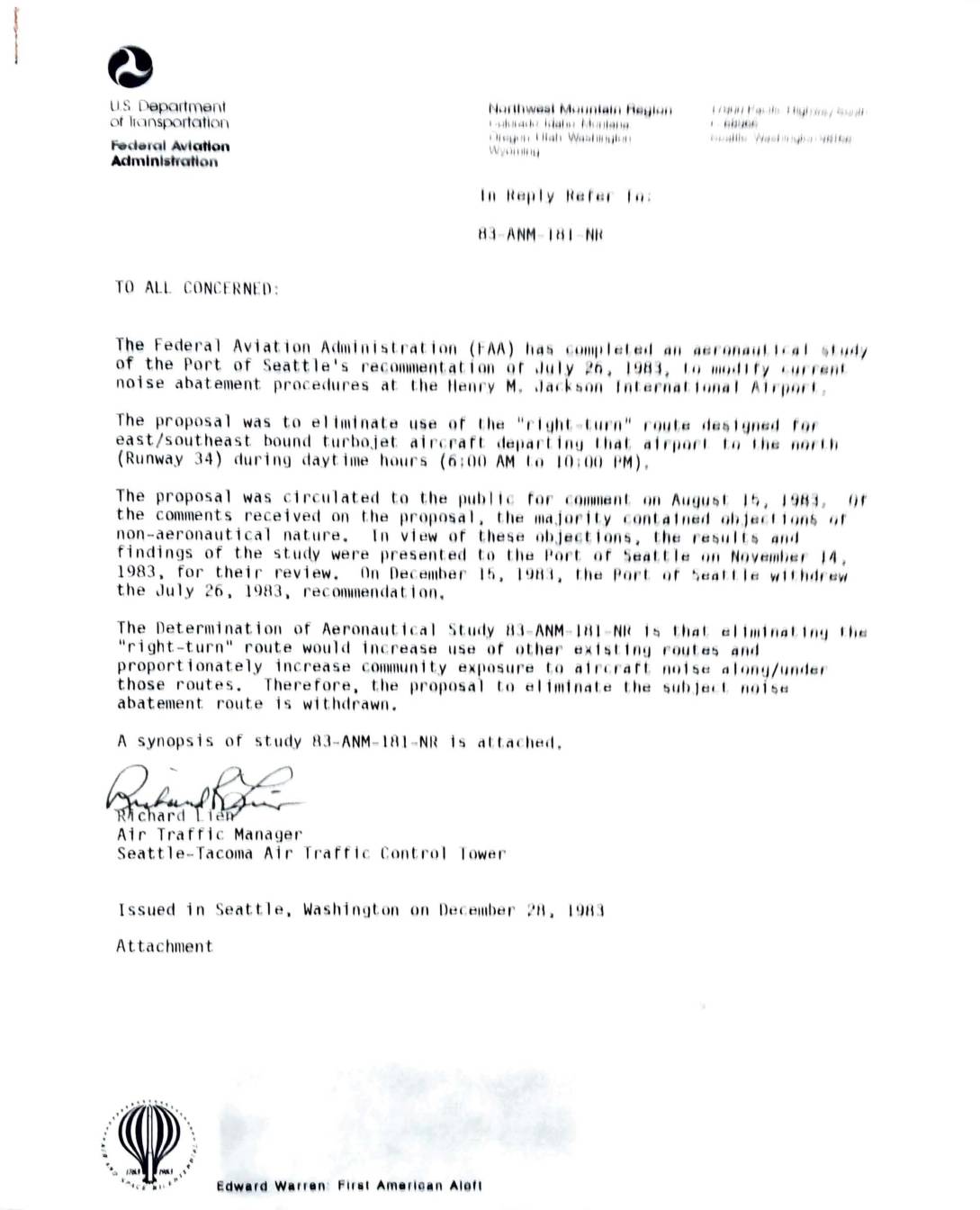
Aeronautical study 83-ANM-181-NR synopsis: Noise abatement procedures at Henry M. Jackson International Airport
In December 1983, the FAA completed an aeronautical study of a proposal by the Port of Seattle to eliminate the 'right-turn' departure route for eastbound turbojet aircraft leaving Sea-Tac Airport (Runway 34) during daytime hours. The study found that removing this route would simply shift aircraft noise to other communities, increase airline operating costs by an estimated $1.5 million annually, and raise fuel consumption, without providing a net noise reduction benefit. As a result, the Port of Seattle withdrew its proposal and the FAA declined to eliminate the existing noise abatement route.