TagEnvironmental Impact Statement(328)
-
 2024-06-06
Council on Environmental Quality Substantially Rewrites NEPA Regulations
In May 2024, the Council on Environmental Quality published major updates to the rules governing how federal agencies must review environmental impacts of projects, affecting everything from public participation to project timelines. The changes place new emphasis on environmental justice, requiring agencies to meaningfully engage communities facing disproportionate environmental burdens, and remove previous rules that limited who could challenge agency decisions in court. While some updates are designed to speed up the review process, others may add new requirements for agencies and project sponsors seeking federal permits or funding. -
 2024-06-01
Purpose and Need Technical Report: Sustainable Airport Master Plan – Near-Term Projects
This technical report, prepared by Landrum & Brown for the Port of Seattle in June 2024, outlines the purpose and need for near-term construction and improvement projects identified in Sea-Tac Airport's Sustainable Airport Master Plan. It is part of a broader set of supporting documents that also covers alternatives analysis, terminal needs assessment, and air cargo facility requirements. The report provides the foundational justification for proposed airport development decisions and infrastructure changes. -
 2024-06-01
Appendix B: SAMP – Near-Term Projects: Purpose and Need Technical Report
This technical report, prepared by Landrum & Brown for the Port of Seattle in June 2024, outlines the purpose and need for near-term construction and improvement projects identified in the Sustainable Airport Master Plan for Seattle-Tacoma International Airport. It is part of a broader set of supporting documents that also covers alternatives analysis, terminal needs, and air cargo facility requirements. The report provides the foundational justification for planned airport development decisions. -
 2024-06-01
Purpose and Need Technical Report: Sustainable Airport Master Plan – Near-Term Projects
This technical report, prepared by Landrum & Brown for the Port of Seattle in June 2024, outlines the purpose and need for near-term capital projects identified in Sea-Tac Airport's Sustainable Airport Master Plan. It is part of a broader set of supporting documents that also covers alternatives analysis, terminal needs assessment, and air cargo facility requirements. The report provides the foundational justification for proposed airport improvements and infrastructure expansions at Seattle-Tacoma International Airport. -
 2024-05-11
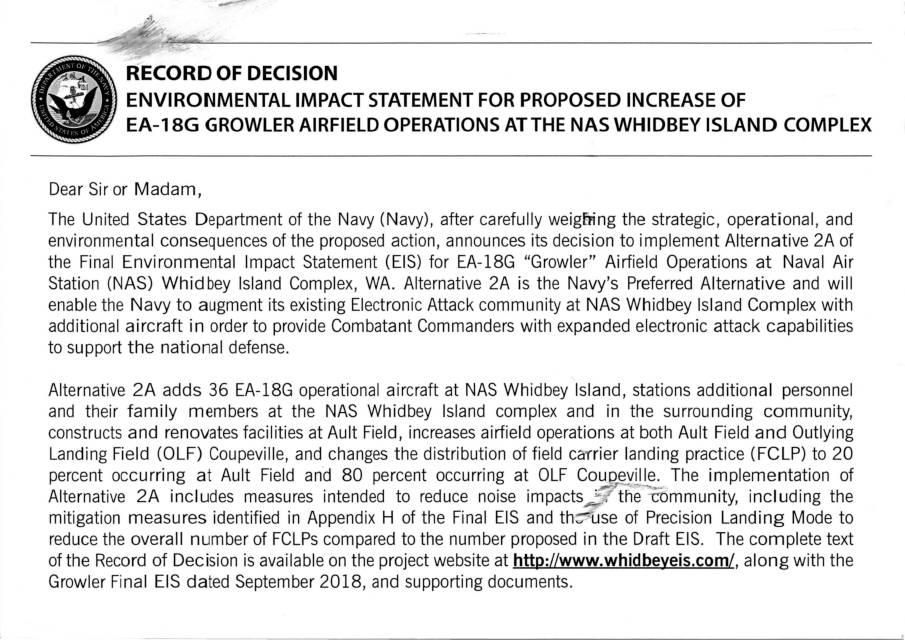
Record of decision: Environmental Impact Statement for proposed increase of EA-18G Growler airfield operations at the NAS Whidbey Island Complex
The U.S. Navy announced its decision to expand EA-18G Growler jet operations at Naval Air Station Whidbey Island, Washington, by adding 36 aircraft and increasing flight training activities at both Ault Field and Outlying Landing Field Coupeville. Under the chosen plan (Alternative 2A), 80% of field carrier landing practice sessions will occur at OLF Coupeville, with noise-reduction measures included to limit community impact. The full Environmental Impact Statement and supporting documents were made available on the project website in September 2018. -
 2024-05-07
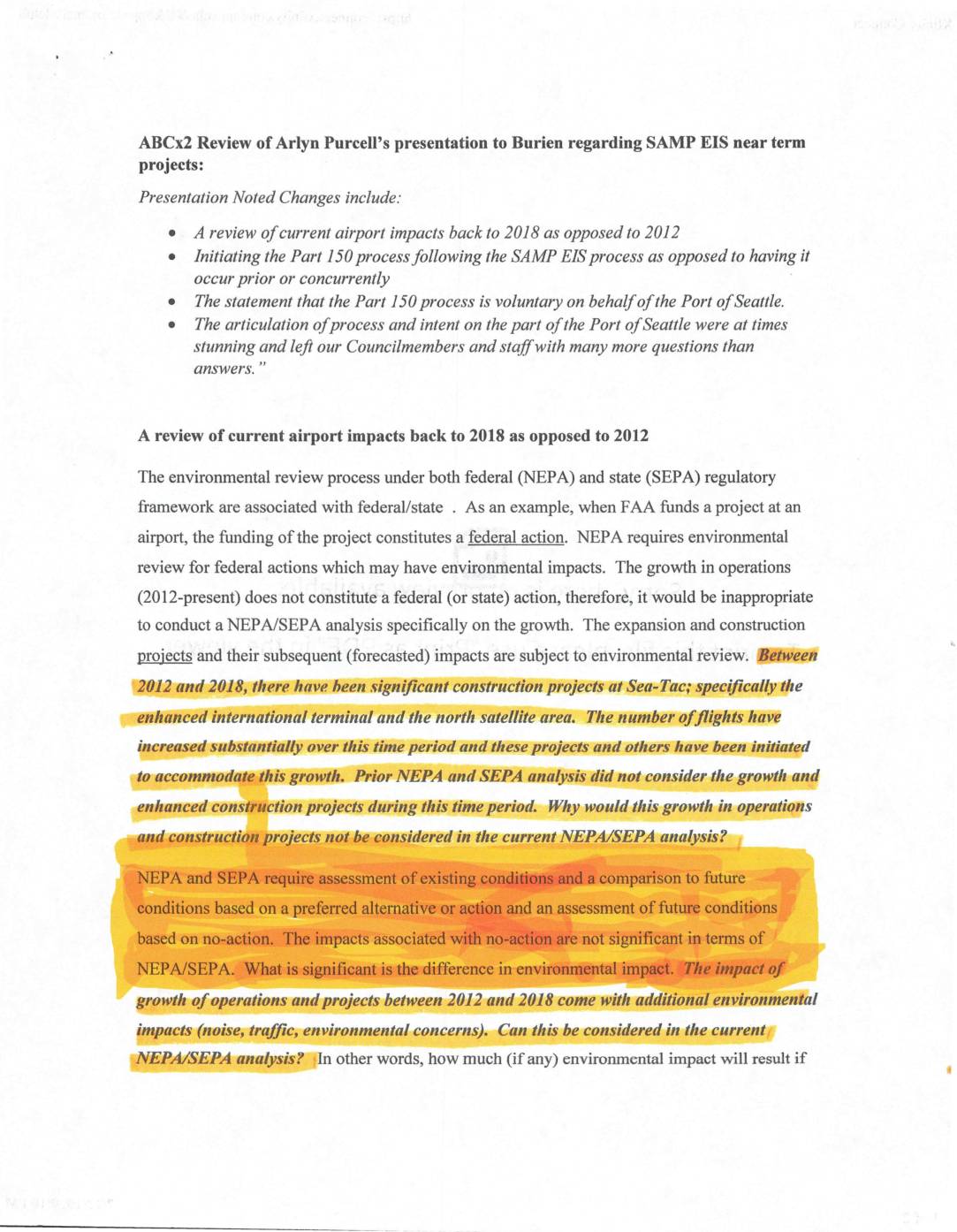
ABCx2 review of Arlyn Purcell’s presentation to Burien regarding SAMP EIS near term projects
This document is a review by ABCx2 of a Port of Seattle presentation to the city of Burien regarding the Sea-Tac Airport Master Plan (SAMP) Environmental Impact Statement. It raises concerns about the Port's decision to limit its environmental review of airport impacts to 2018 rather than 2012, questions whether significant construction growth and flight increases during that period were properly analyzed under federal (NEPA) and state (SEPA) environmental law, and challenges the Port's characterization of the FAR Part 150 noise abatement process as purely voluntary. The document also examines potential consequences if the Port fails to meet noise mitigation commitments tied to federal funding. -
 2024-03-01
Sustainable Airport Master Plan – Near-Term Projects: Noise Technical Report
This Noise Technical Report, prepared by Landrum & Brown for the Port of Seattle in March 2024, analyzes noise impacts associated with near-term construction and development projects outlined in the Sustainable Airport Master Plan for Seattle-Tacoma International Airport. The report is part of a broader Appendix J covering noise and noise-compatible land use, which also includes a Noise Modeling Protocol and a Construction Noise Technical Report. Together, these documents provide technical assessments to guide planning decisions that balance airport operations with the noise concerns of surrounding communities. -
 2024-03-01
Sustainable Airport Master Plan – Near-Term Projects: Air Quality and Climate Technical Report
This March 2024 technical report, prepared by Landrum & Brown for the Port of Seattle, assesses air quality and climate impacts associated with near-term construction and operational projects outlined in the Sustainable Airport Master Plan for Seattle-Tacoma International Airport. It analyzes emissions from sources including aircraft, ground support equipment, stationary and mobile sources, auxiliary power units, and construction activities. The report follows NEPA air quality and climate protocols to evaluate potential environmental effects of planned airport improvements. -
 2024-02-01
Seattle-Tacoma International Airport SAMP Near Term Projects: Wetlands and Streams Report — Appendix A Background Information
This February 2024 technical report from the Port of Seattle documents the wetlands and streams located at and around Seattle-Tacoma International Airport as part of the Sustainable Airport Master Plan (SAMP). It includes mapped locations of wetlands surveyed across multiple years (2006, 2014, and 2017) along with stream corridors such as Miller Creek, Des Moines Creek, and Walker Creek. Field hydrology monitoring data from 2020 is also provided, recording groundwater depth and soil saturation measurements to assess wetland conditions across the airport property. -
 2024-02-01
Appendix M: Water Resources — Wetland and Stream Delineation Technical Report, Seattle-Tacoma International Airport SAMP Near Term Projects
This technical report, prepared by Parametrix for the Port of Seattle in February 2024, documents the wetlands and streams found within and around Seattle-Tacoma International Airport as part of the Sustainable Airport Master Plan (SAMP) Near Term Projects. It covers the delineation of aquatic critical areas, assessments of potential project impacts on wetlands and waterways, proposed mitigation measures, and the permitting approach needed to address those impacts. The report also includes analysis of impervious surface changes and Federal Flood Risk Management Standard (FFRMS) compliance worksheets.