TagEnvironmental Impact Statement(328)
-
 2025-09-01
Appendix O Agency & Public Engagement
Appendix O of the FAA NEPA Draft Environmental Assessment (EA) for the Sustainable Airport Master Plan (SAMP) at Sea-Tac Airport. Summarizes agency and public engagement activities during the EA process, including coordination under NEPA (42 U.S.C. 4321 et seq.), FAA Orders 1050.1F and 5050.4B, and CEQ regulations (40 CFR parts 1500-1508). Notes regulatory changes since -
 2025-09-01
Seattle-Tacoma International Airport Environmental Assessment for the Sustainable Airport Master Plan Near-Term Projects: Chapter 7 References
This document is the References section of the Environmental Assessment for Seattle-Tacoma International Airport's Sustainable Airport Master Plan Near-Term Projects, finalized in September 2025. It lists all sources cited across the assessment's chapters, including federal regulations, FAA advisory circulars, technical memoranda, city comprehensive plans, and environmental studies used to evaluate the airport's proposed development projects. The referenced materials cover topics such as air quality, facility requirements, stormwater management, land use, and aviation activity forecasting. -
 2025-09-01
Seattle-Tacoma International Airport Environmental Assessment for the Sustainable Airport Master Plan Near-Term Projects: Chapter 5, Cumulative Impacts
The Final Environmental Assessment for Seattle-Tacoma International Airport's Sustainable Airport Master Plan near-term projects explains that cumulative impact analysis has been removed from the document. This change reflects recent legal developments, including the revocation of CEQ regulations implementing NEPA and a May 2025 Supreme Court ruling, which together mean federal agencies are no longer required to assess the combined environmental effects of separate but related projects. As a result, the section that previously contained cumulative impacts data and analysis is now absent from this final report. -
 2025-09-01
Seattle-Tacoma International Airport Environmental Assessment for the Sustainable Airport Master Plan Near-Term Projects: Chapter 2 — Alternatives
This section of the Seattle-Tacoma International Airport Environmental Assessment describes how planners evaluated different alternatives to the airport's near-term expansion projects, using a two-step screening process to determine whether each option met the project's stated goals and was practical to implement. Public suggestions submitted during the scoping process—such as building a new airport, using high-speed rail, limiting growth, or relying on other existing airports—were largely rejected because they could not meet current and future passenger demand at SEA. A No Action Alternative is also included, representing a future scenario in which none of the proposed new construction takes place. -
 2025-09-01
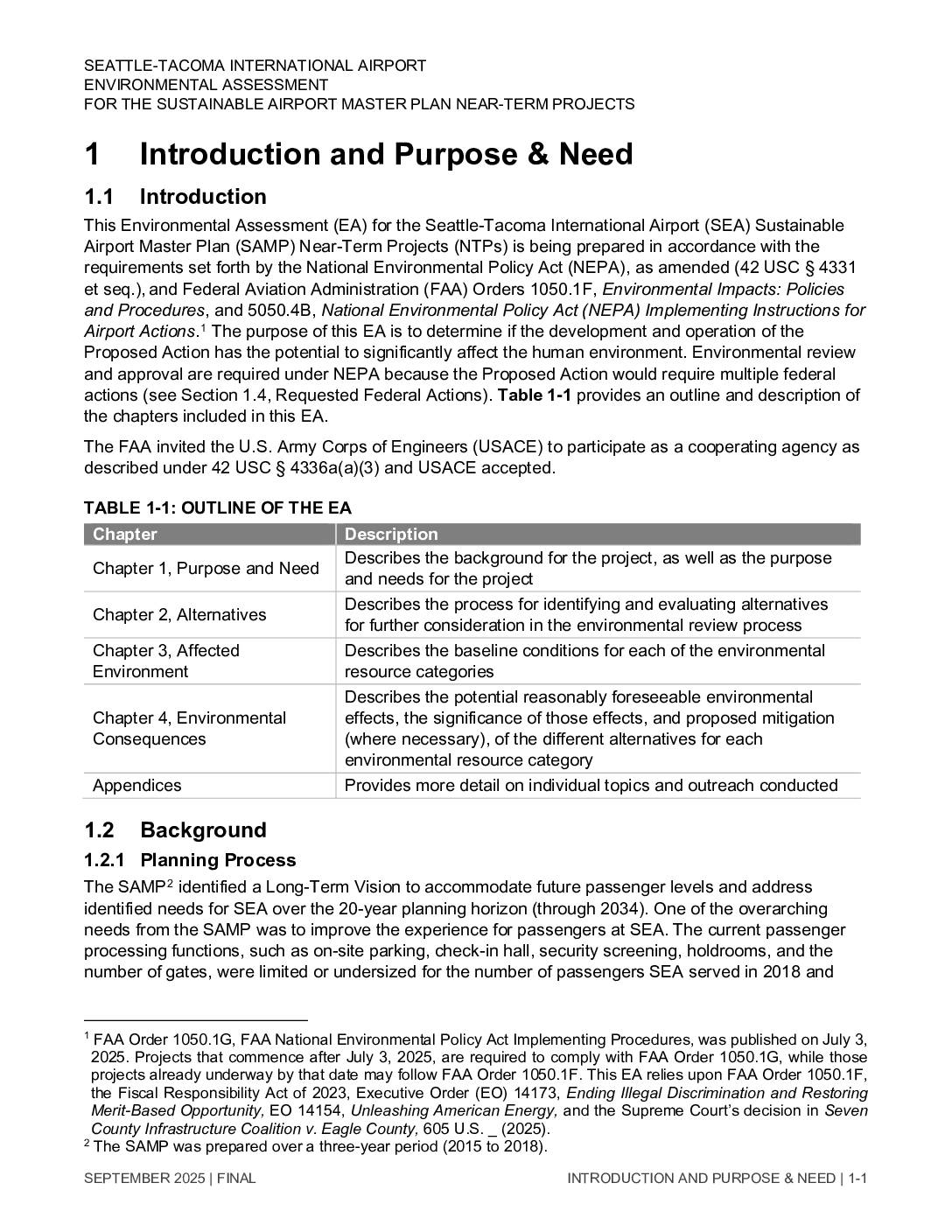
Seattle-Tacoma International Airport Environmental Assessment for the Sustainable Airport Master Plan Near-Term Projects: Chapter 1, Introduction and Purpose & Need
The Port of Seattle is conducting an Environmental Assessment (EA) under federal law for 31 near-term improvement projects at Seattle-Tacoma International Airport (SEA), covering airfield upgrades, taxiway extensions, and passenger facility improvements. The projects, collectively known as the Sustainable Airport Master Plan Near-Term Projects, are intended to reduce congestion, improve safety, and enhance the passenger experience, with construction potentially beginning in late 2025 and completion targeted for 2032. The federal review will determine whether the projects could significantly impact the surrounding human environment, including potential noise and other effects on neighboring communities. -
 2025-09-01
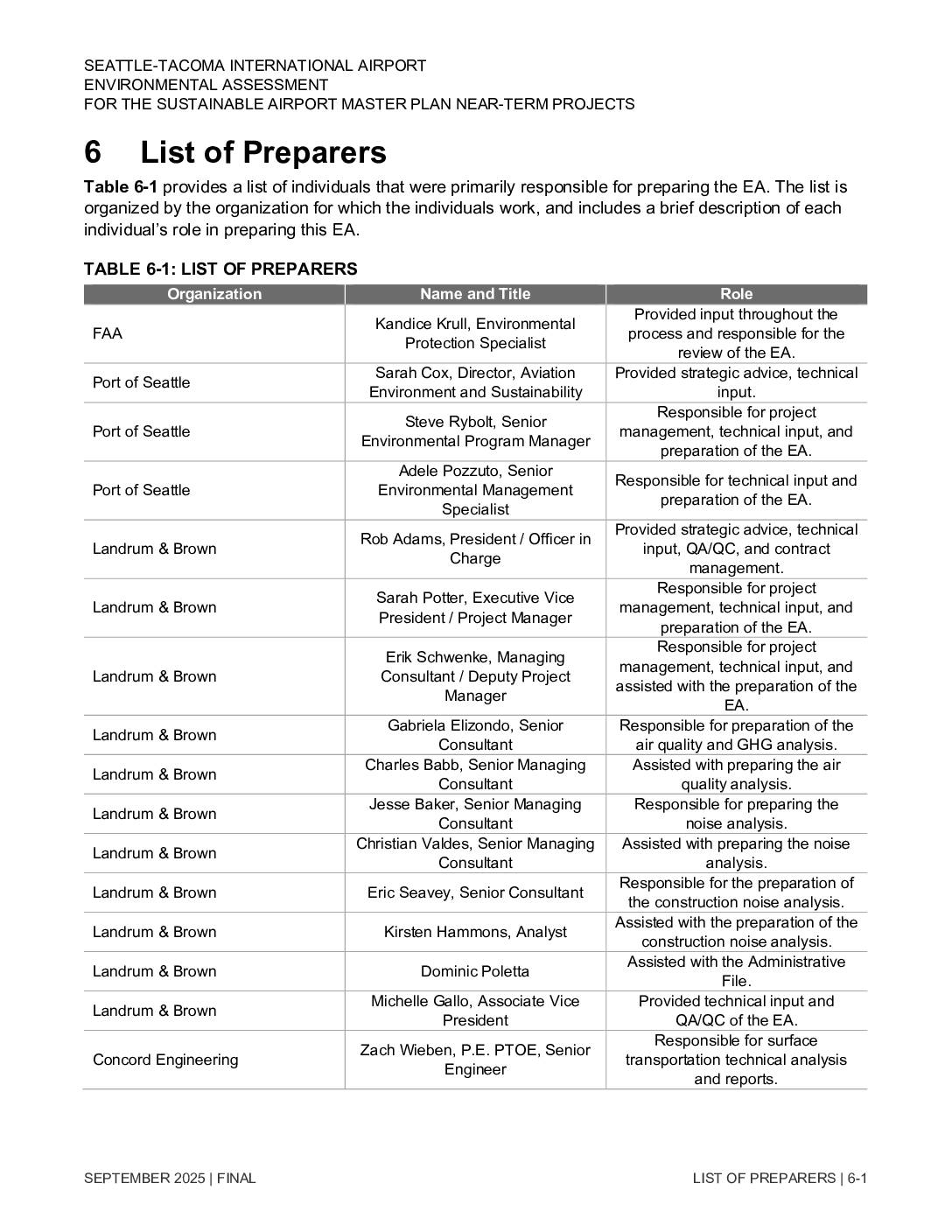
Seattle-Tacoma International Airport Environmental Assessment for the Sustainable Airport Master Plan Near-Term Projects: List of Preparers
This section of the Seattle-Tacoma International Airport Environmental Assessment lists the individuals and organizations responsible for preparing the EA for the Sustainable Airport Master Plan Near-Term Projects, finalized in September 2025. It includes contributors from the FAA, Port of Seattle, and multiple consulting firms covering areas such as noise analysis, air quality, surface transportation, wetlands, cultural resources, and public engagement. Key organizations involved include Landrum & Brown, Concord Engineering, Confluence Environmental Company, Parametrix, Stell Environmental, and others. -
 2025-05-29
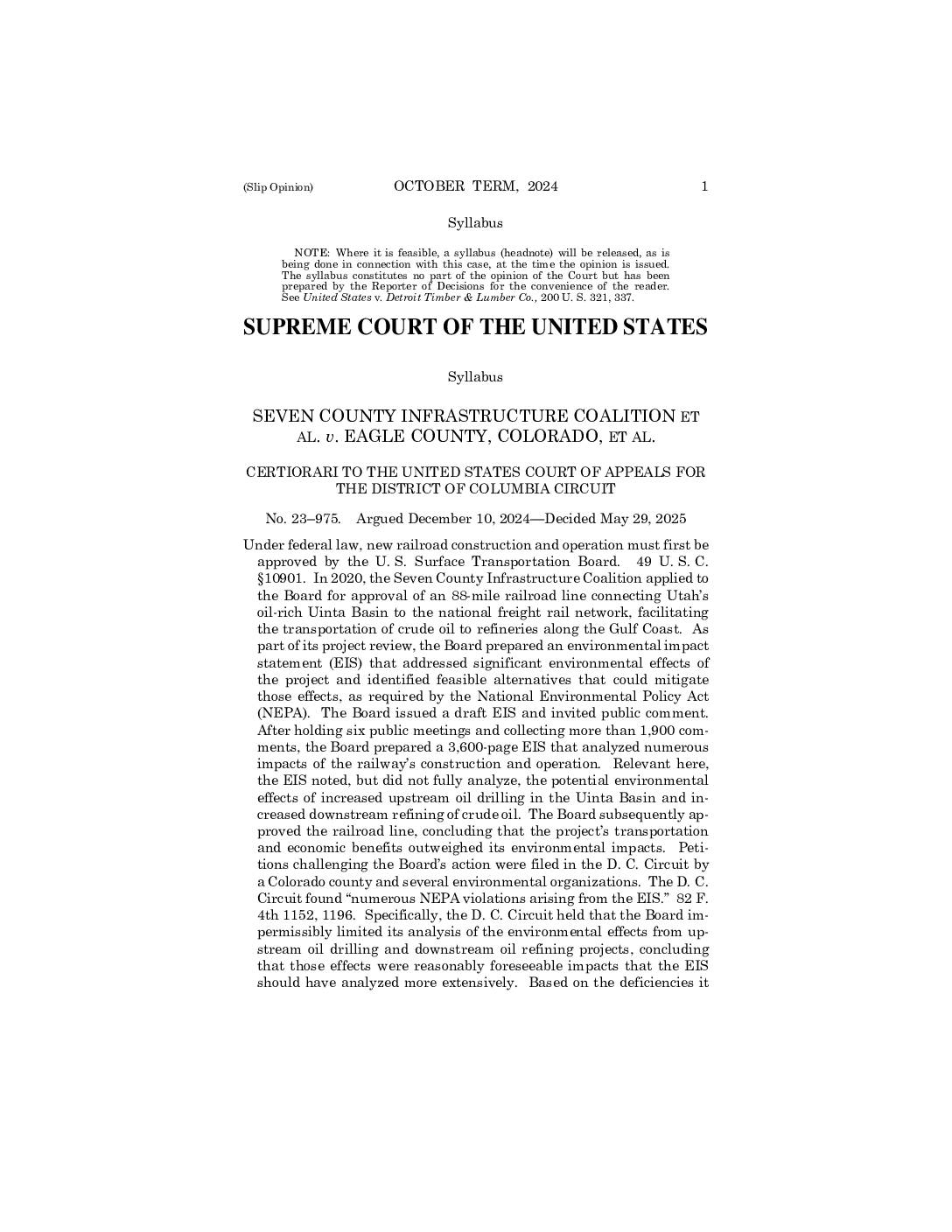
Seven County Infrastructure Coalition et al. v. Eagle County, Colorado, et al.
The U.S. Supreme Court ruled in May 2025 that federal agencies have broad discretion in determining the scope of environmental reviews required under the National Environmental Policy Act (NEPA). The case involved a proposed 88-mile railroad in Utah, where the Court held that agencies do not need to analyze the environmental effects of separate upstream or downstream projects — such as oil drilling or refining — when reviewing a specific infrastructure project. Courts must give substantial deference to agency decisions about what to include in environmental impact statements, rather than imposing their own judgment about what details are required. -
 2025-01-21
Senate Bill 5380: Increasing environmental justice by improving government decisions
Washington Senate Bill 5380 (2025) requires state agencies to evaluate environmental justice impacts when reviewing permits for industrial or potentially harmful projects located in pollution-burdened communities. It mandates the completion of an Environmental Justice Impact Statement and a public hearing within affected communities before project approvals can move forward. The bill aims to reduce cumulative environmental and health disparities across Washington State. -
 2024-12-13
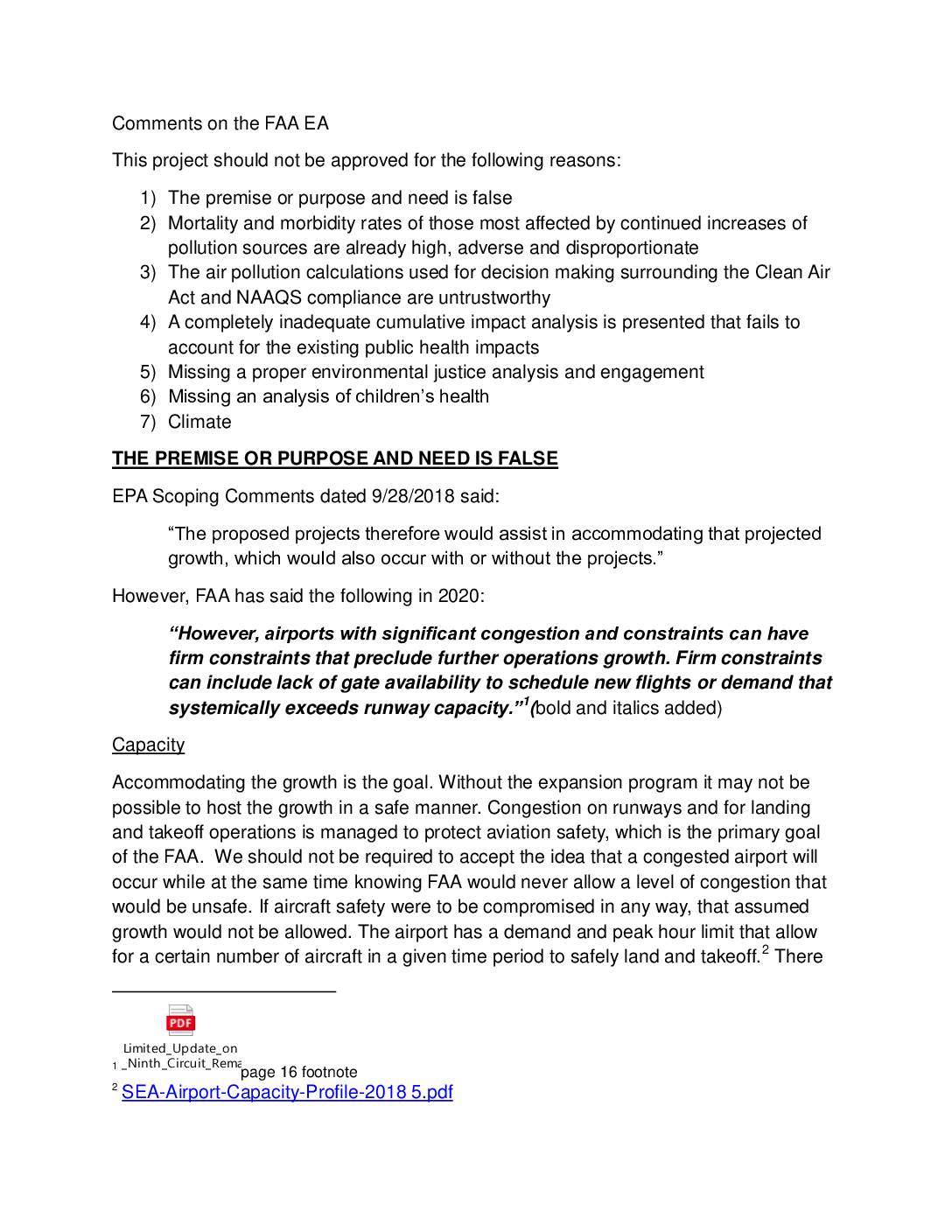
Comments on the FAA EA: SAMP Draft Environmental Assessment (Debi Wagner)
This document presents formal public comments opposing an FAA Environmental Assessment for expansion projects at Seattle-Tacoma International Airport. The author argues that the stated justification for expansion is misleading, contending that airport growth would not automatically occur without new gates and terminals since FAA safety rules already cap the number of aircraft operations. Additional concerns raised include disproportionate health burdens on nearby communities, unreliable air pollution modeling, inadequate environmental justice analysis, and failure to properly assess cumulative public health and climate impacts. -
 2024-12-13
SAMP Comments: Stuart Jenner Public Comment on 2024 Draft Environmental Assessment
Seatac Airport neighbor Stuart Jenner submitted public comments in December 2024 criticizing the Port of Seattle's Sustainable Airport Master Plan (SAMP), arguing that citizens were given inadequate time to review over 4,000 pages of documents and that an Environmental Impact Statement—not merely an Environmental Assessment—is needed to properly evaluate the plan's effects on nearby residents. Jenner raises concerns about opaque computer models used to claim a nearly 50% increase in passenger traffic would have no environmental impact, shifting baseline comparisons that ignore past promises made during the third runway approval, and the absence of project cost information. He calls on Port Commissioners and the FAA to extend the public comment period and subject the plan to greater independent scrutiny.